

You've got plans on the kitchen bench, a trade asking for a deposit and materials ready to order. You're managing the renovation yourself, but it's not clear whether you need owner-builder insurance, a contractor's certificate or both.
Planning owner builder insurance in NSW for 2027 starts with separating permission to build from protection against loss. An owner-builder permit doesn't insure the project. A contractor's Home Building Compensation certificate doesn't cover everything you do yourself. You need to identify who's doing the work, which policy responds and what risk remains yours.
Table of Contents
- Which Insurance Applies to Your NSW Project
- Four Covers Owner Builders Should Weigh
- What Moves Your Premium Up or Down
- Exclusions and Risk Controls That Matter Most
- How to Get Owner Builder Cover Step by Step
- Questions Owners Ask Before a 2027 Start
- Ask ABS to Place Cover Before Site Work
Which Insurance Applies to Your NSW Project
NSW insurance requirements by project scenario
| Project scenario | Owner-builder permit | HBC cover required | Recommended protection |
|---|---|---|---|
| Owner does all work, over $10,000 | Required, subject to the permit rules | Not available for own labour | Contract works and public liability |
| Owner does all work, $10,000 or less | Generally not required | Not available for own labour | Public liability and contract works advisable |
| Licensed trade contract over $20,000 incl. GST | Still applies to the owner where the permit test is met | Contractor must hold HBC before work starts or any money is paid | Contractor public liability plus your own contract works |
| Licensed trade contract $20,000 incl. GST or less | Still applies if the permit test is met and no licensed builder supervises | Not mandatory under the HBC threshold | Verify contractor public liability and insurance |
| Trade subcontracted by a licensed builder | Not applicable where the licensed builder supervises the project | No separate HBC for that subcontracted work | Confirm the head contractor's HBC and public liability |
| Several contracts on one project | Still applies where the permit test is met | Contract values can be added; cover applies when the relevant value exceeds the threshold | Verify the certificate for each contractor required to hold cover |
The permit figures in this lookup reflect NSW Government owner-builder guidance: a permit is generally required when you supervise or perform residential building work worth more than $10,000 on your own home without a licensed builder supervising.
For directly contracted trade work, SIRA's information for owner-builders requires HBC cover for work valued at more than $20,000 including GST, with the certificate supplied before work begins or any payment, including a deposit, is accepted.
Permission to build isn't insurance
The permit test concerns your role in supervising or performing the project. The contractor insurance test concerns the work you commission from a trade business. Meeting one requirement doesn't satisfy the other.
Say you manage an extension, organise deliveries and do the painting, while a licensed contractor handles a substantial roofing package. Your permit position concerns the overall owner-builder arrangement. The roofer's HBC obligation concerns its contracted work.
You can't replace the roofer's statutory cover with your own project policy. Equally, the roofer's certificate won't insure your materials against every site loss or protect you against every injury claim.
The table also assumes you're legally entitled to perform the work involved. An owner-builder permit isn't permission to undertake work that requires a specialist trade licence.
Why HBC stops at your own work
HBC cannot be issued for work personally performed by an owner-builder. It isn't an optional warranty product you can buy to guarantee your own workmanship.
Where HBC applies to a contractor, it operates as a last-resort protection if that contractor cannot complete or rectify insured work because of insolvency, death, disappearance or licence suspension. It doesn't function like ordinary construction damage insurance.
For your own activities, contract works and public liability are the practical starting points. Neither automatically pays to correct a mistake you made. Policy exclusions still determine the result.
Practical rule: Match each certificate to the contractor, property and contracted scope. A policy number in an email isn't enough.
Staged work needs particular care. Don't assume that separate paperwork removes an insurance obligation, or that every trade on site is protected by someone else's certificate. Record who engaged each contractor and what work each agreement covers.
The terminology can also mislead. A guide to owner-builder warranty insurance can help you frame questions, but NSW's distinction between owner-performed work and insured contractor work remains critical.
Liability is a separate question from damage to the building. GM GROUP Services' guide to understanding liability for event organisers offers a useful parallel about responsibility for activities and third parties, although it isn't construction-specific advice.
Before a planned start, re-check the applicable dollar tests, each contractor's licence and the required certificates. Don't rely on an old quote as evidence that the legal position remains unchanged.
Four Covers Owner Builders Should Weigh
Start with the loss you couldn't comfortably fund: damaged building work, an injured visitor, your own injury or stolen equipment. These are different exposures, even when an insurer packages them together.
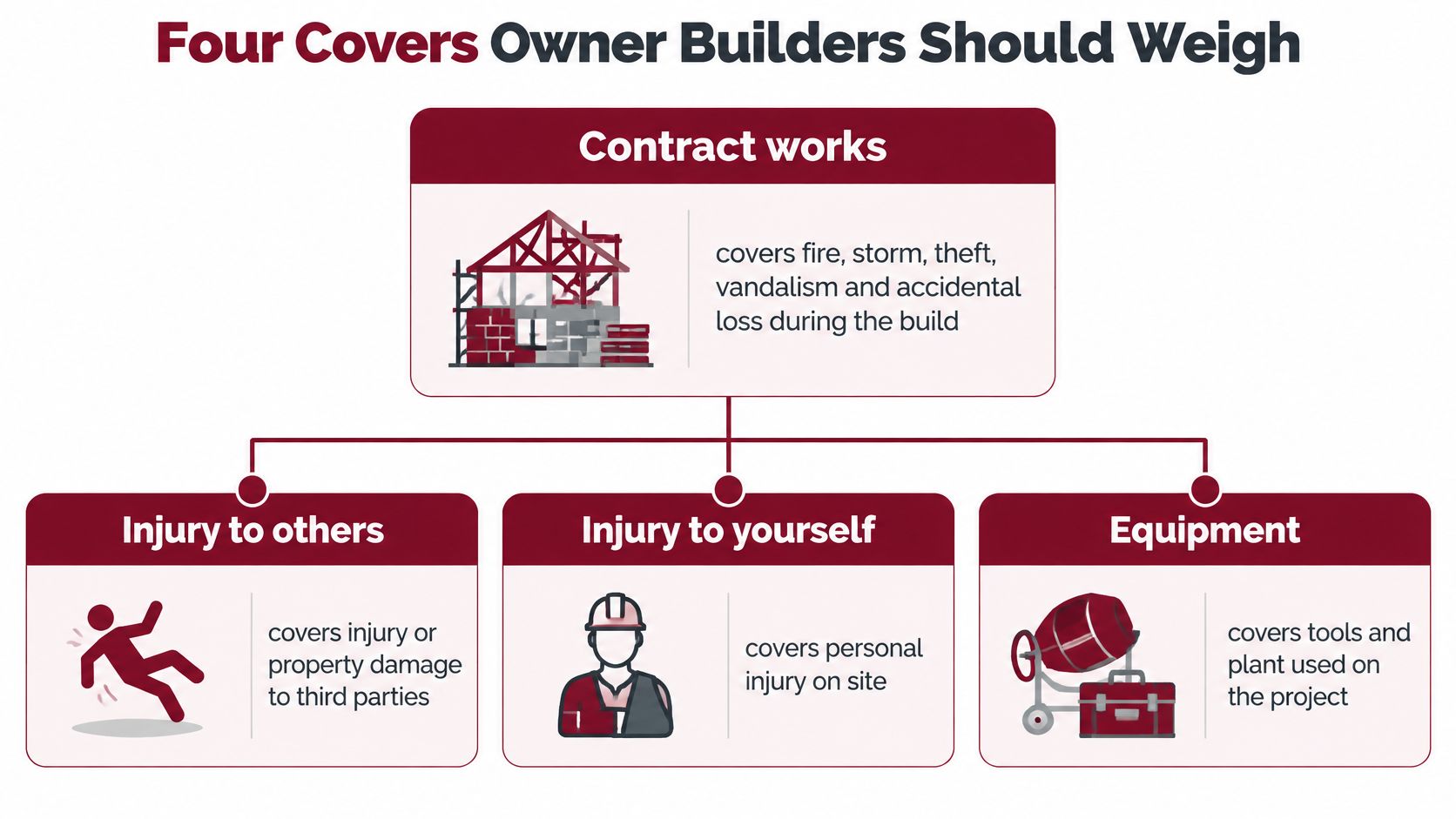
The diagram separates the main protection categories.
Match the policy to the loss
NSW Government insurance guidance distinguishes contract works protection for materials and work from public liability protection for injury caused by building activity, and identifies contractor HBC obligations for contracts above $20,000 including GST.
Contract works addresses insured physical loss or damage during construction. Fire, storm, theft and accidental damage can affect stored materials and partially completed work, particularly at frame and lock-up stages. Check whether existing parts of the home are included, rather than assuming the whole property is covered.
Public liability addresses your legal liability for covered injury or property damage to others. A visitor tripping over unsecured materials and a neighbour's property damaged during building activity involve different losses from damage to your extension. Hire companies and site managers may request evidence of this cover.
Personal accident can provide specified benefits if you're injured while working. Check the benefit schedule, waiting periods and exclusions. It isn't a promise to reimburse every medical expense or replace all lost income.
Tools and equipment cover addresses insured theft or damage to assets such as saws, ladders and plant. Hired excavators need particular attention because the hire agreement may leave you responsible for losses your policy excludes.
Owner builder cover types compared
| Cover | Protects against | Typical use on your project | Gap if missing |
|---|---|---|---|
| Contract works (material damage) | Fire, storm, theft and accidental damage to materials and partly built work | Whole build period, especially frame and lock-up | Funding uninsured rebuilding yourself |
| Public liability | Covered liability for injury or property damage to neighbours, visitors and passers-by | Site activity, including relevant trade activities | Personal exposure to third-party claims |
| Personal accident | Specified benefits for injury to the owner | Hands-on work | Unfunded income loss and injury-related expenses |
| Tools and equipment | Insured theft or damage to owned and hired plant | Saws, ladders, scaffolding and hired excavators | Replacement costs and hire liabilities |
| HBC (contractor's policy) | Eligible contracted work, not owner labour | Direct trade packages exceeding the statutory trigger | Missing statutory protection if the contractor is uninsured |
Check the boundaries before buying
Contract works and public liability are advisable risk protection, not substitutes for mandatory contractor HBC. Employment arrangements can create separate workers compensation questions, so raise those with your adviser if you engage workers.
Ask about temporary works, demolition, stored materials, subcontractor activities, excesses and existing structures. The beginner's guide to contract works insurance provides further background for comparing wording.
Use the accompanying video as an introduction, then assess the actual policy documents.
What Moves Your Premium Up or Down
A quote reflects what the insurer might have to pay and how likely a loss appears. The same property can attract different terms when the scope changes from internal alterations to roof removal, excavation or a pool.
Don't confuse your owner-builder project premium with the contractor's HBC premium. They insure different risks and use different assessment processes.
How insurers assess the project
Premium drivers and how they move the cost
| Premium driver | Effect on cost | Example |
|---|---|---|
| Build value or sum insured | Higher value generally raises contract works premiums | An extension adds more insured work than a bathroom refit |
| Project duration | Longer builds extend exposure time | Delayed windows leave the site incomplete for longer |
| Type of work | Structural work, roofing, pools and demolition increase risk | A pool and retaining wall add loss exposure |
| Excess chosen | A higher excess can lower the premium | You retain more of an insured theft loss |
| Public liability limit | A higher limit can increase the premium | Hypothetically, comparing a $10 million limit with $20 million |
| Contractors engaged | Uninsured trades increase the owner's exposure and may affect acceptance | A subcontractor has no public liability cover |
| Claims history | Previous claims can increase rates | A prior water or theft claim at the property |
| Site location and security | Remote access and theft exposure can affect pricing | An unattended regional NSW site without locked storage |
A lower sum insured isn't a safe way to reduce the price. Give the insurer an accurate project value and ask how materials, labour, debris removal and professional fees should be treated.
Likewise, choose an excess you could pay after a loss. A cheaper premium offers little comfort if the retained amount would stop the project.
Contractor HBC pricing is a separate calculation
Service NSW's HBC application guidance bases contractor HBC assessment on the contract price or reasonable market cost of labour and materials where there's no fixed contract, applies the trigger at more than $20,000 including GST, and allows relevant split contracts to be added together.
Dividing a job into smaller agreements isn't a reliable way around the requirement. It also doesn't remove your financial exposure if a trade's work is uninsured.
Compare the same scope, excess and limits before comparing the bottom-line premium.
Ask for separately itemised cover options and record any differences in exclusions. The guide to owner-builder insurance costs can help organise those questions, but no fixed premium applies to every build.
Exclusions and Risk Controls That Matter Most
The exclusion owners can overlook is the cost of correcting defective workmanship. If you install something incorrectly, don't assume contract works insurance will pay to remove it and start again.
Some policies distinguish the defective component from resulting damage to other insured property. Others use broader exclusions. That distinction needs to be read in the wording, not inferred from the product name.
Exclusions to question
These are policy issues to investigate, not a claim that every insurer uses identical exclusions.
- Defective workmanship: Your own errors and rectification costs may be excluded. Use written scopes and arrange inspections before work is concealed.
- Wear and gradual deterioration: Insurance isn't a maintenance fund. Protect materials from prolonged moisture and inspect stored goods.
- Uninsured or unlicensed contractors: Their involvement can create coverage disputes. Verify licences and insurance before access is granted.
- Unauthorised work: Missing approvals or work outside the declared scope can affect cover. Resolve approval questions before construction.
- Unattended or unlisted equipment: Theft conditions may require secure storage or specifically declared plant. Check the schedule against what's on site.
- Existing structures: Damage to the original house may need an express extension. Identify occupied rooms, retained walls and adjoining structures.
- Design faults: Defective design and its consequences may be restricted. Keep engineering documents and approved revisions.
- Delayed weatherproofing: Rain entering an exposed building may fall outside cover. Arrange temporary protection before removing roofing.
Controls you can put in place
Good site management doesn't erase exclusions, but it reduces avoidable losses and helps establish what happened.
- Keep written agreements: Save scopes, variations and responsibility for temporary protection.
- Check trade documents: Obtain required HBC certificates and current public liability evidence before work starts.
- Photograph progress: Record waterproofing, services and structural connections before they're covered.
- Secure access: Use fencing, locked storage and controlled keys.
- Plan for weather: Have tarpaulins, fixings and a safe installation method ready before opening the roof.
- Maintain a project log: File permits, inspections, deliveries and significant site events.
- Prepare claim contacts: Keep the insurer's and broker's details accessible away from the site.
Read exclusions before focusing on optional extras. Ask the broker what defective work and temporary works mean under the proposed wording, and request a practical example of each.
How to Get Owner Builder Cover Step by Step
Build a single project information pack before seeking quotes. It reduces inconsistent answers and helps the insurer assess the work you intend to undertake.
Prepare the project and arrange placement
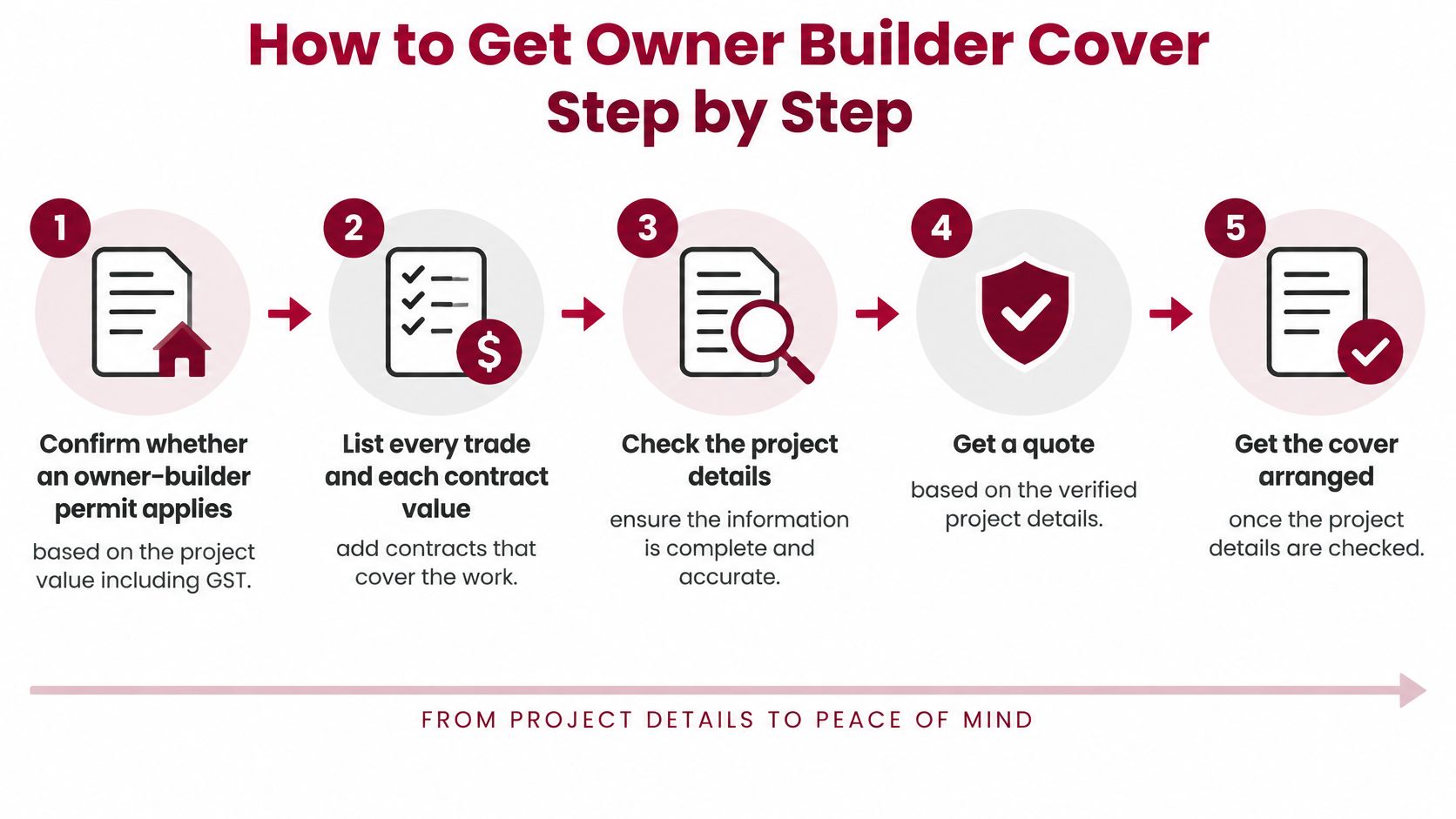
Confirm the permit position. Under the Home Building Act 1989, the owner-builder permit test generally concerns work worth more than $10,000, while directly contracted work above $20,000 has a separate contractor HBC requirement. Confirm the project valuation, including GST, and whether a licensed builder will supervise.
List every trade and agreement. Record the contracting business, scope and contract value, and identify agreements covering related work. Ask for advice where staged packages may need to be assessed together.
Assemble the information pack. Include the site address, plans, budget, timeline, contractor names, licence numbers and available HBC certificates. Describe demolition, excavation, roof removal and any occupation during construction.
Set the insured amounts. Establish the contract works sum insured and suitable public liability limit. Separately consider personal accident benefits, tools, owned plant and hired equipment obligations.
Request comparable quotes. Send the same pack to your chosen broker and ask for cover components to be itemised. Keep limits and excesses consistent wherever possible so price differences are meaningful.
Compare wording and claims arrangements. Review temporary works, defective-work treatment, existing structures and theft conditions. Ask who receives claim notifications and what evidence an assessor would need.
Bind before site work begins. Obtain written confirmation that cover has been placed, including its commencement date and declared scope. Store the schedule and certificates with your permits, and diarise the expiry date.
The workflow below is a visual prompt for collecting details before arranging protection.
Keep the records after completion
Retain approvals, contracts, invoices, inspection records, certificates and contractor insurance evidence after the building work finishes. Store a backed-up digital copy, with files named by trade and work stage.
Owner-builder responsibilities can remain relevant when the property changes hands. A tidy project file helps establish who performed the work, what was approved and which insurance arrangements applied.
Before paying a deposit: Confirm both that the required contractor certificate exists and that your own project cover has actually commenced.
Tell the insurer about material changes during construction. An extended programme, additional demolition or newly hired plant may need reassessment rather than being added to your private spreadsheet.
Questions Owners Ask Before a 2027 Start
Do the dollar tests change for a planned start?
Don't assume either an advertised quote or an earlier insurance guide fixes the law for your start date. Treat the permit and contractor HBC thresholds described above as the current tests to confirm, not a guarantee about future legislation.
Check with NSW Fair Trading and your insurer before committing money. Give them the proposed start date, project scope and contracting arrangement, rather than asking only whether you need owner-builder insurance.
What follows a sale?
An owner-builder effectively guarantees the quality and completion of their work. The next immediate owner receives statutory warranty rights under the Home Building Act and may seek enforcement through the NSW Civil and Administrative Tribunal.
Selling doesn't automatically transfer every responsibility away from you. Keep permits, approvals, contracts, invoices, inspection records and contractor certificates after handover, and obtain legal advice about sale disclosures and your particular obligations.
Does everyone on site need HBC?
No. A contractor subcontracted by another licensed contractor generally doesn't need a separate HBC policy for that subcontracted work. Verify the head contractor's applicable certificate and identify which business has contracted directly with you.
That arrangement doesn't settle all site insurance questions. You still need to establish who covers materials, existing structures, third-party liability and your own activities.
- If the arrangement is unclear: Take the written contracts to a broker rather than relying on job titles.
- If the scope changes: Recheck the insurance responsibilities before the additional work begins.
If you still can't match your project to a straightforward scenario, write down each contract value and who engages whom. Those details give an adviser something concrete to assess.
Ask ABS to Place Cover Before Site Work
Once you know the permit position, contract values and contractor certificate requirements, you can move from checking obligations to arranging protection. A broker helps assess and place cover, but doesn't replace those preliminary checks.
ABS Insurance Brokers Pty Ltd is an Australian-owned brokerage based in Bankstown, NSW, and is one option for arranging owner-builder insurance, contract works, public liability and eligible HBC placements for builders and owners across Australia. It operates as a Steadfast Network broker with market access and holds Australian Financial Services Licence No. 700333.
Send a pack that supports comparable quotes
Provide the site address, plans, build value, programme, contractor names, licence numbers and HBC certificates already obtained. Flag any existing structures, occupied areas, temporary works and hired plant.
- Request separate options: Ask for contract works, public liability, personal accident and tools cover to be itemised.
- Align the comparison: Use the same excess and limits for equivalent cover across competing quotations.
- Identify missing protection: Ask which declared activities or assets the proposed insurer won't cover.
- Check commencement: Arrange placement before the relevant site exposure begins.
No single premium fits every build. A renovation involving an occupied house and roof removal needs a different assessment from a new build on a cleared site.
Read before you bind
Use the contact details on the publisher's website to submit your pack and discuss unresolved questions. Read the proposed exclusions for defective work, temporary works and existing structures before accepting a quote.
Ask for written clarification where an answer affects whether you could afford a loss. The owner carries the residual risk, including uninsured work, excluded losses and amounts above policy limits.
ABS Insurance Brokers Pty Ltd offers owner-builder insurance placement and advice on contract works, public liability and related project exposures. Visit ABS Insurance Brokers Pty Ltd with your plans, contract values and contractor certificates to discuss suitable cover before site work starts.