

A permit is permission to do the work, not insurance for it. For a 2027 renovation, separate three issues: work you perform yourself, HBC cover for direct trade contracts, and a policy that may be required if you later sell.
The Home Building Act 1989 prohibits a Part 6 insurance contract for owner-builder work carried out by the owner-builder. Defects or incomplete work in your own labour therefore remain your responsibility. A permit does not transfer them to the Home Building Compensation Fund or protect you from a later owner's claim.
The other two issues involve different cover. For each direct trade contract over $20,000 including GST, the contractor must arrange its own HBC certificate before work starts or you pay a deposit. If you sell within six years and the project value exceeds $20,000, owner-builder warranty insurance may be required for the sale. A contractor's certificate does not replace that policy, just as the permit does not cover your own workmanship.
Table of Contents
- What Owner Builder Warranty Insurance Means in 2027
- When the NSW Rules Require Cover
- How Owner-Builder Work Differs from Builder HBC Cover
- How to Obtain the Policy and Certificates
- A Renovation and a Sale Inside Six Years
- Claims Windows and What Cover Will Not Pay
- Line Up Certificates Before You Pay or Sell
What Owner Builder Warranty Insurance Means in 2027
Say you take an owner-builder permit for a 2027 renovation and your first call is to buy owner builder warranty insurance for the walls you'll line and the painting you'll do yourself. That purchase isn't available. The Home Building Act 1989 expressly prohibits a Part 6 insurance contract for owner-builder work carried out by the owner-builder. Workmanship defects and non-completion stay with you. They don't shift to the Home Building Compensation Fund.
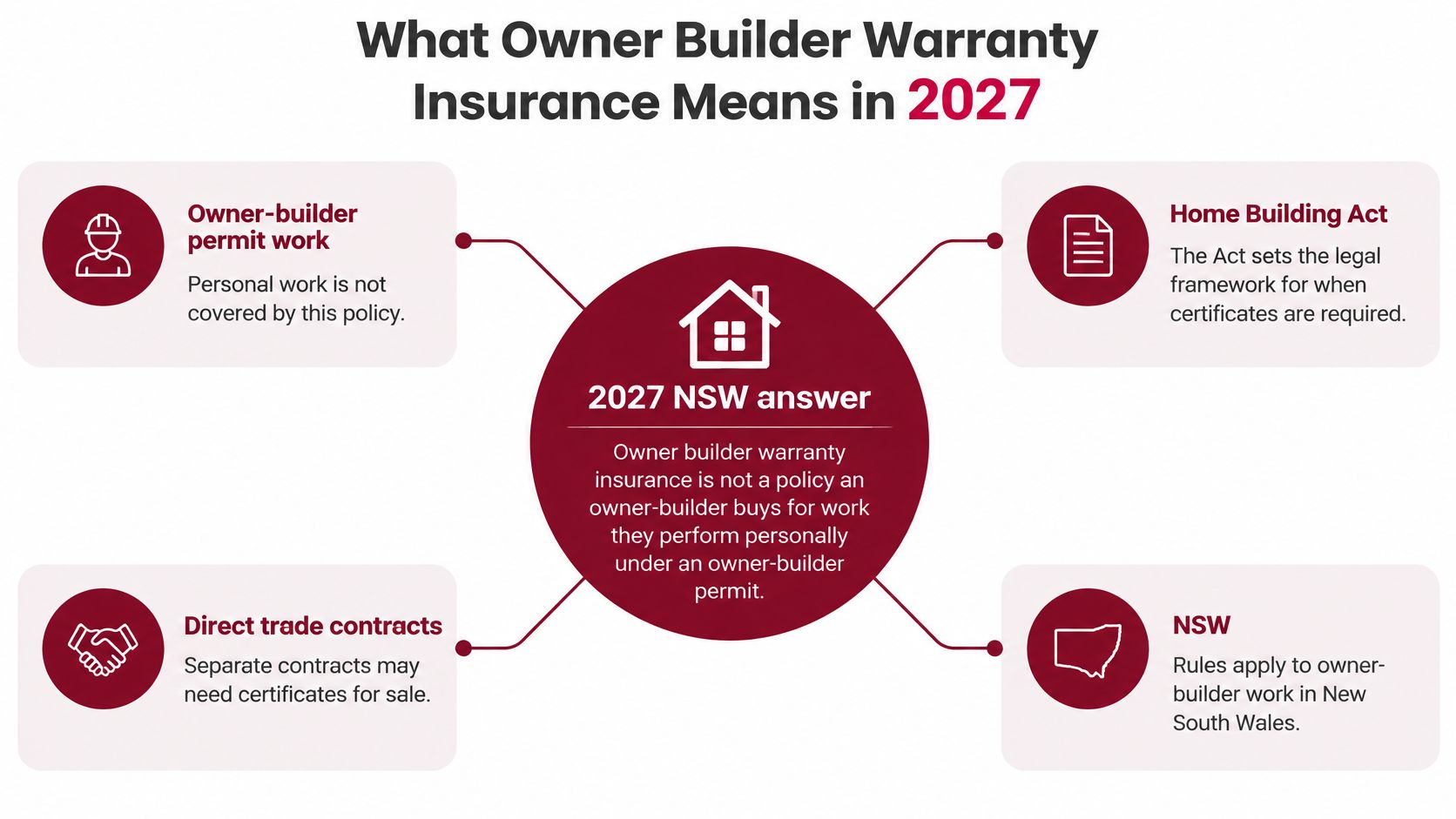
Picture the HBC scheme as a safety net hung under the licensed trades businesses you hire, not a cover stretched over your own tools and labour. The prohibition creates a risk-transfer gap. You're still the person a later owner can pursue for the quality of what you built with your own hands.
Two duties the permit doesn't cancel
Two obligations can still arise, and they aren't the same product.
- A direct contractor: a trades business you engage on a qualifying contract may have to hold HBC cover, and you should check the certificate before that work starts.
- A later sale: selling within six years of completion can require owner builder warranty insurance for the buyer, even though your own permit work was never insured while you lived there.
Which obligation applies turns on the scope split, the completion date and the project value. Those tests are set out in the scenario table that follows.
Practical rule: contract works insurance pays for physical loss or damage on site. It doesn't answer the statutory warranty consequences of your own workmanship, so don't file it in the warranty folder.
When the NSW Rules Require Cover
Test each row against your 2027 quotes and any plan to sell. Don't treat the whole build as one insured job.
| Situation | Who arranges cover | Dollar test | When evidence is needed |
|---|---|---|---|
| Self-performed work under an owner-builder permit | No HBC policy for that work | Permit does not create a duty to insure own work | No HBC certificate for own labour |
| One trades business contracted directly | That contractor | More than $20,000 including GST | Before work starts or any payment, including a deposit |
| Several contractors on one project | Each contractor separately | $20,000 test applies per contract, not the whole project | A certificate for every qualifying contract |
| Sale within six years of completion | Owner-builder, for the sale | Project value over $20,000 including labour and materials | In place for the sale, based on a proven completion date |
| Contract at or under $20,000 including GST | No HBC insurance for that contract | At or under $20,000 including GST | Keep the contract and invoices anyway |
| Material damage or third-party injury during the build | Separate contract works and liability policies | Not set by the HBC $20,000 test | Before site work begins |
How to read each row
Self-performed work needs no HBC policy and produces no certificate. That absence is lawful. SIRA's information for owner-builders states that an owner-builder doesn't need Home Building Compensation insurance for building work they personally perform.
Each direct contract is priced on its own. Two packages at $12,000 don't merge into a $24,000 trigger. One package over $20,000 including GST does. On that contract the contractor, not you, arranges the cover and must hand you the certificate before tools start or before any payment, including a deposit. The policy protects you and any later owner if that business becomes insolvent, dies, disappears, or has its licence suspended for failing to comply with a court or tribunal compensation order.
Several contractors mean several tests. The $20,000 line applies to each relevant contractor's work, not automatically to the whole project. The published guidance doesn't explain how overlapping packages are grouped. Don't split one scope into smaller contracts to stay under the line, and confirm a grouping question with the regulator before you rely on separate paperwork.
A sale is a different row from a trade certificate. If the home is sold within six years of completion and total project value, labour and materials included, exceeds $20,000, you arrange warranty insurance for that sale.
A contract at or under $20,000 still needs a written scope and invoices. A buyer or a tribunal will test value and the completion date from those papers, not from memory.
Contract works and public liability never stand in for an HBC certificate. They answer damage and injury. They don't answer the statutory failure triggers.
Mark which rows match your current permit, your quotes and a possible 2027 listing before you book a start date.
How Owner-Builder Work Differs from Builder HBC Cover
On 15 January 2015, owner-builder work ceased to be insured under the NSW HBC scheme, as set out in the HBC scheme report. Permit work has had no statutory safety net for defects or non-completion since that date. A licensed builder or trade can still insure eligible residential work. From 1 July 2010, the NSW Self Insurance Corporation has been the sole provider of home warranty insurance in the state.
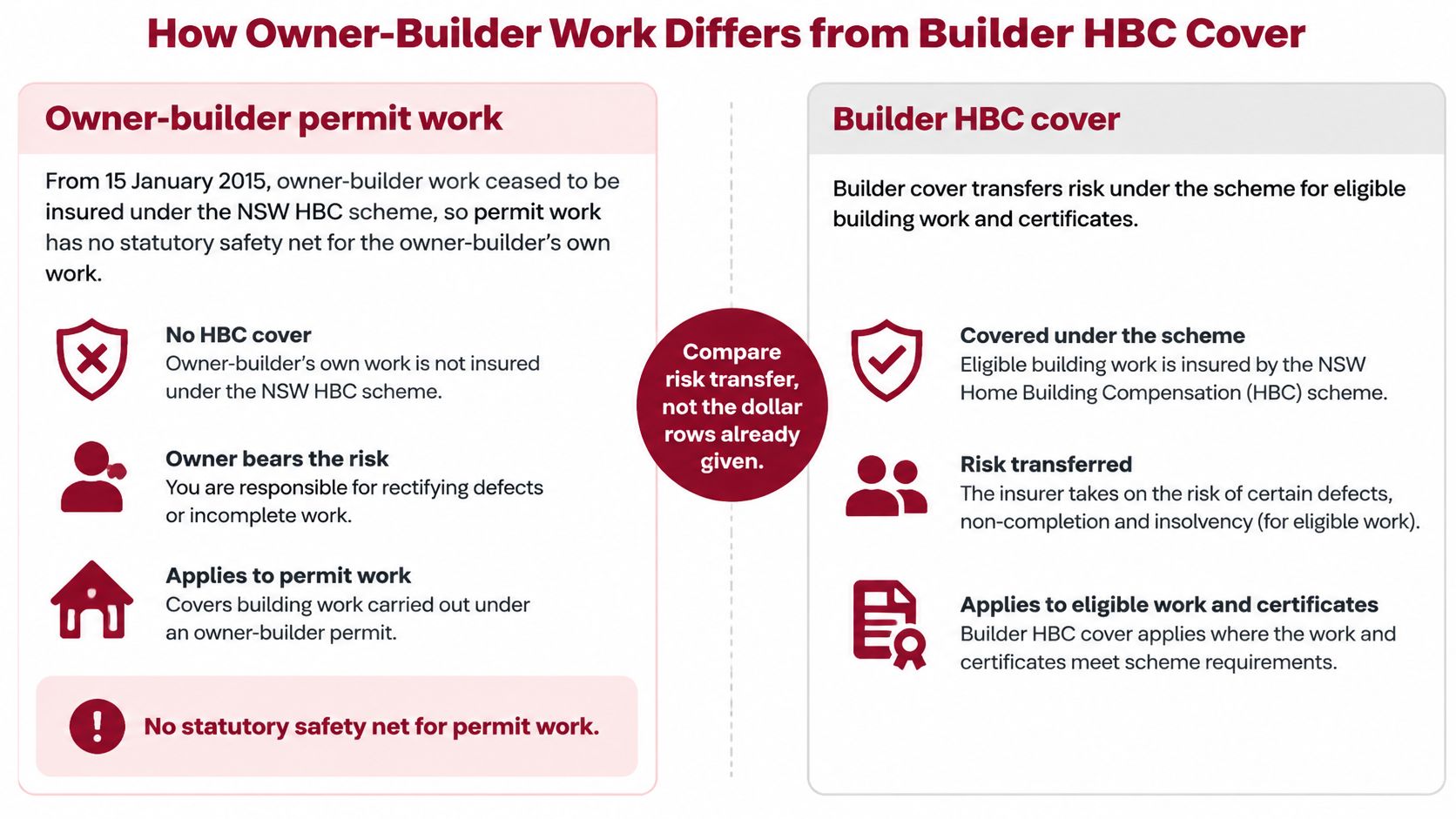
| Point of difference | Owner-builder's own work | Licensed builder or trade on HBC |
|---|---|---|
| Can HBC insure the work | No; Part 6 cover for owner-builder work is prohibited | Yes for eligible residential building work |
| Insured since | Owner-builder work left the scheme on 15 January 2015 | Sole provider from 1 July 2010 via NSW Self Insurance Corporation |
| Who carries workmanship risk | The owner-builder; the next owner may go to NCAT | The contracting business while it remains able to rectify |
| When the statutory policy responds | Does not respond to self-performed defects or non-completion | Insolvency, death, disappearance, or licence suspension for ignoring a compensation order |
| Historical claims pattern | Main cause was disappearance of the builder | Predominantly builder insolvency |
Where the risk actually sits
Historical claims split the two groups. For owner-builder claims, the main cause was the disappearance of the builder. Builder claims were predominantly associated with builder insolvency. As at 30 June 2008, about 2,100 builders, 14% of approximately 15,000 eligible builders, held eligibility with two or more insurers, and owner-builder premium rates were generally higher than rates for comparable builder-performed work.
HBC is last-resort cover. It responds if the contracting business becomes insolvent, dies, disappears, or has its licence suspended for failing to obey a court or tribunal compensation order. It isn't designed to pay defects, delays or poor work while that business is still trading and licensed.
You remain personally responsible for the quality of self-performed work. The next immediate owner can enforce statutory warranties, including through NCAT. A licensed contractor's column is different: while that business can still rectify, the claim sits with the business, not the fund.
A site can hold poor workmanship, incomplete work, contractor failure, damaged materials, injury and a fight over who owns the fault. One statutory policy doesn't replace the rest of the risk controls.
Licensed builders who want a structured approach can build a strategic homebuilder warranty program that separates statutory cover from the construction policies sitting beside it. For damage during the build, look at contract works insurance, annual or single-project, because that product answers physical loss rather than a warranty claim.
How to Obtain the Policy and Certificates
A permit lets you carry out owner-builder work, but it does not insure the work you do yourself or replace certificates for trade contracts. Treat these as separate checks: record your own scope, collect a certificate for each contract that meets the threshold, and keep the completion details needed if you sell later.
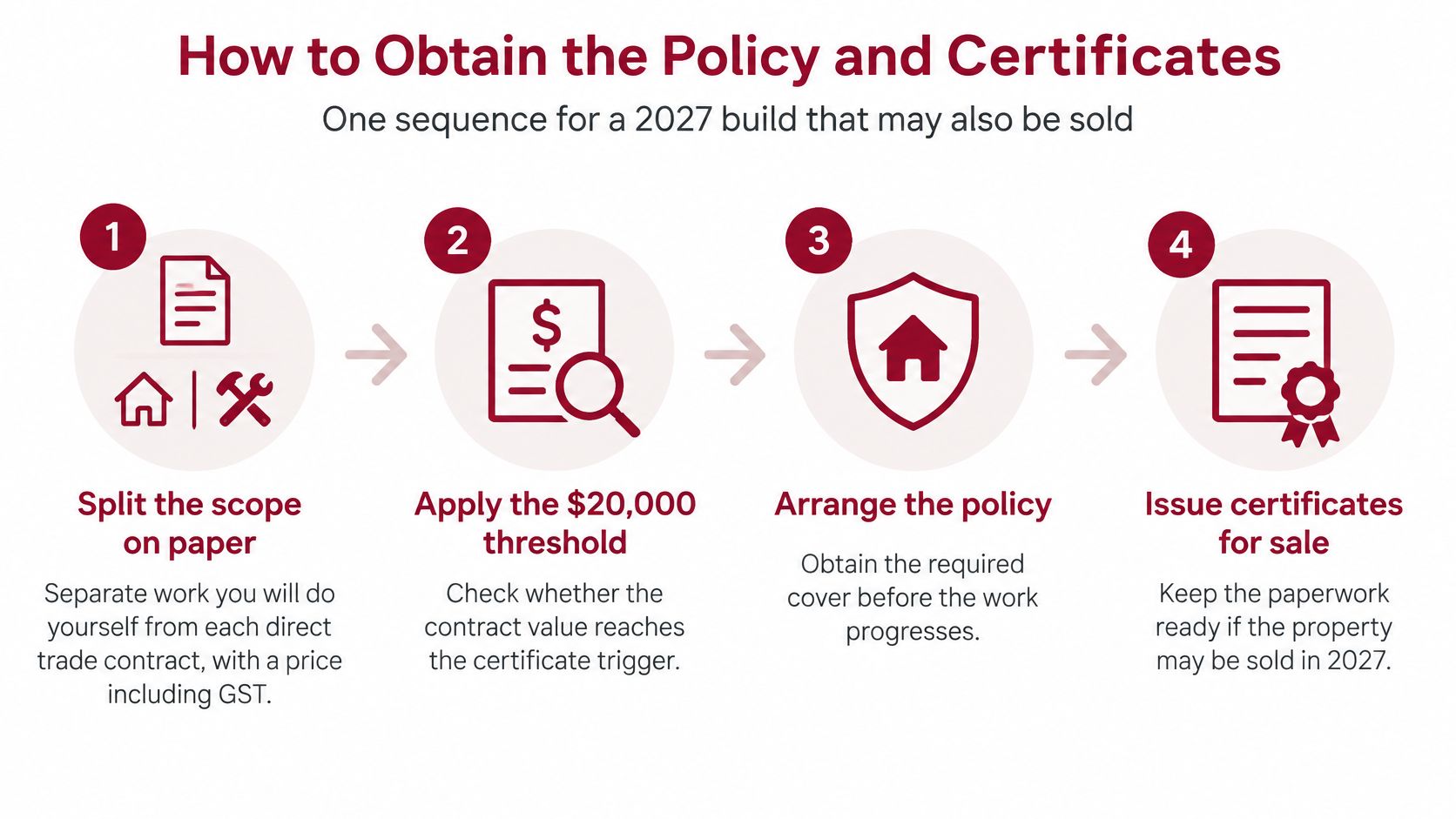
Split the scope on paper. List the work you will do yourself separately from each direct trade contract, including each contract price with GST. A clear split helps a future buyer distinguish your work from a contractor's work.
Check each contract against the $20,000 threshold. HBC cover applies to qualifying residential building work over $20,000 under an individual contract, so assess each direct contract separately rather than combining smaller packages. Keep the contract and price together in your records.
Collect the HBC certificate before the contractor starts or takes a deposit. Check that the legal name, site address, described work and contract amount match your paperwork. A deposit receipt is not a substitute for the certificate. Use this guide to check an HBC certificate of insurance.
Keep the documents distinct. A licence card, public liability schedule or contract-works note does not replace an HBC certificate. Each document answers a different question, so file the certificate against the contract it covers.
Build a completion pack. Keep the permit, contracts, invoices, inspection records and completion date together. Central Coast Council guidance states that owner-builder work is completed on the date of the principal certifier's final inspection or, if there is no final inspection, six months after the permit was issued. That date helps establish the sale window.
Check the sale trigger separately. If you plan to sell within six years and the total value of labour and materials is above the same $20,000 threshold, owner-builder warranty insurance must be obtained for the sale. A trade contractor's certificate covers its qualifying contract, not your own work. Keep evidence of the project value and completion date; the next immediate owner receives statutory warranties, and a dispute may be taken to NCAT.
Arrange other site cover separately. Contract works addresses physical loss or damage during construction, while liability cover addresses injury. Neither replaces warranty cover for defects in your work. Check the scope of each policy before work starts, so damage, injury and workmanship are not treated as one risk.
A Renovation and a Sale Inside Six Years
The bathroom and kitchen
A permit does not insure every part of a renovation. An NSW owner-builder renovating a bathroom and kitchen in 2027 might hang the linings and paint the rooms themselves, while hiring separate trades. A waterproofer contracted for $8,500 and an electrician for $11,000 are each below the threshold for an HBC certificate. Keep a written scope and invoices for both. The kitchen contractor's $46,000 including GST contract is above the threshold, so an HBC certificate is required before the deposit.
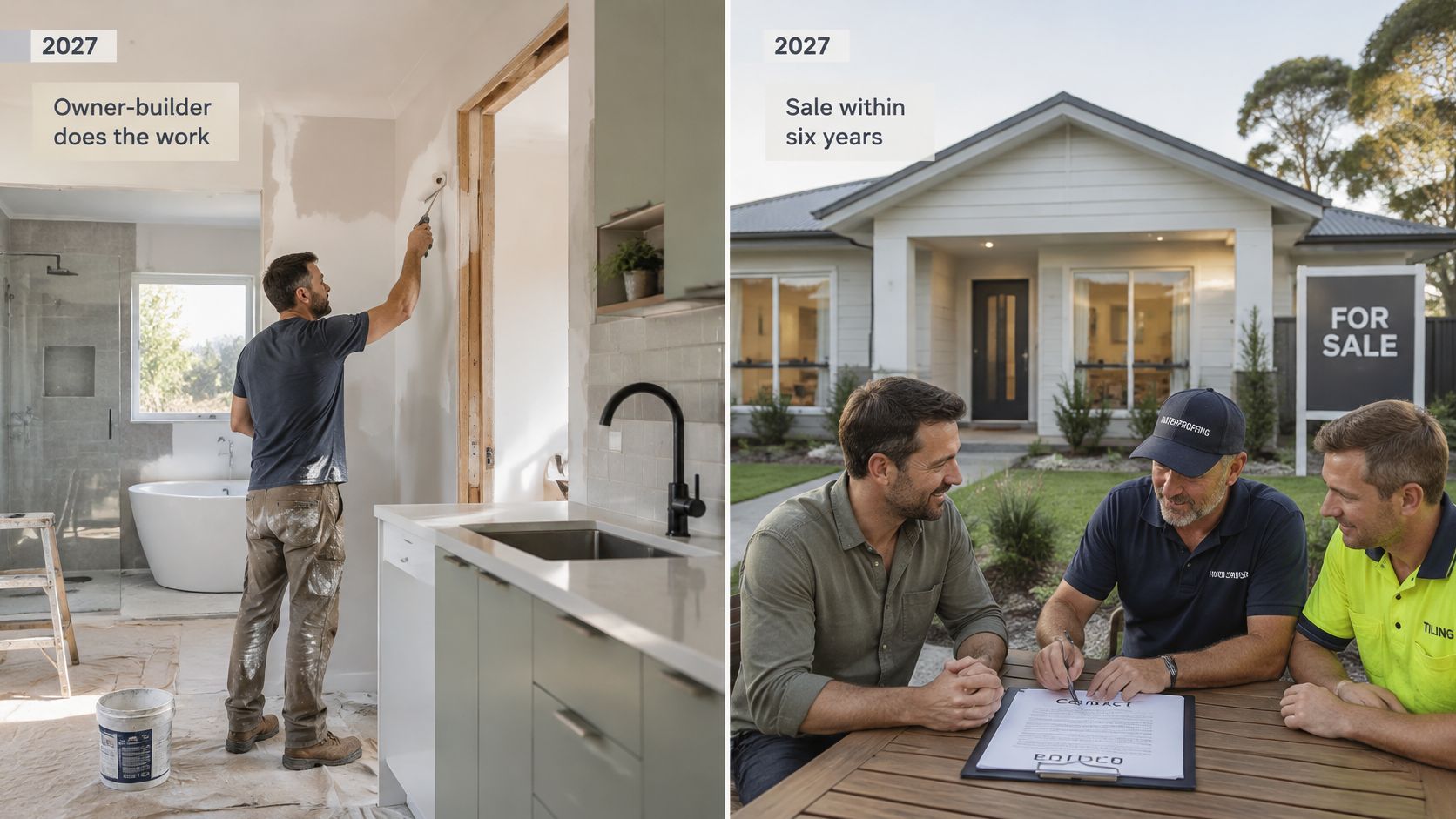
That certificate covers the kitchen contractor's work, not the owner-builder's painting. If joinery is stolen during the fit-out, the relevant question is contract works cover. If a visitor is injured on site, that is a liability matter. Each risk needs its own file.
The sale in 2031
Now consider the later sale. The owner's final inspection is dated 12 March 2027, and the project value, including the owner's labour and materials, is $180,000. If contracts are exchanged in February 2031, the sale falls within six years of completion. Sale-triggered cover is required, even with the kitchen contractor's certificate on file: that certificate does not insure the owner-builder's own work.
The inspection date matters because it sets the completion date used to assess the six-year sale window. If there is no final inspection, the Central Coast Council's guidance on owner-builder completion dates says completion is six months after the permit was issued. Statutory warranties are a separate issue from insurance: the NSW Government's contract guidance explains that they attach to the work and can be enforced by the next owner. A certificate file does not replace those warranties.
Claims Windows and What Cover Will Not Pay
A permit is not a policy, and a contractor's HBC certificate does not insure work the owner-builder performed. Keep the three questions separate: statutory rights for the work, a contractor's certificate for an eligible contract, and any sale-triggered cover. For statutory warranties, NSW contract guidance sets out six years for major defects and two years for other defects, starting when the work is completed. The next owner may enforce those rights against the owner-builder, including through NCAT. That is a separate path from an HBC claim.
| Protection | What it can answer | Time limit |
|---|---|---|
| Statutory warranty, major defects | Major defects in the work, enforceable against the owner-builder by the next owner | 6 years from completion |
| Statutory warranty, other defects | Non-major defects, through the same enforcement path | 2 years from completion |
| HBC claim for defective contractor work | Defects after insolvency, death, disappearance or qualifying licence suspension | A short period from awareness; confirm the exact period in the policy wording |
| HBC incomplete-work cover | Contractor fails to start or stops work | Check the policy wording for the applicable period |
| Contract works | Physical loss or damage to the works during construction | The construction policy period, not the warranty window |
| Contractor still trading and licensed | Ordinary defects, delays and disputes | No HBC payment; claim against the contractor |
Match the complaint to the clock
For defective contractor work, the Home Building Act and policy wording set a short claim period that runs from when the homeowner becomes aware of the defect. The exact period depends on the applicable terms, so check the policy before deciding to wait. For incomplete work, check the policy wording for the relevant period after the contractor fails to start or stops. A defect notice, photos and a dated record of when the problem was first noticed help keep the timeline clear.
A solvent, licensed contractor who does poor tiling is generally pursued under the contract, not through HBC. HBC is a last-resort response to the specified events, such as insolvency, death, disappearance or a qualifying licence suspension. While the contractor is still trading and licensed, ordinary defects, delays and disputes remain matters to raise with that business.
What you still insure elsewhere
- Theft or storm damage to materials on site is a contract-works question during the construction policy period.
- Delay is not itself a warranty payment or an HBC trigger.
- Injury to a neighbour belongs under liability cover, not a defects claim.
How building defects insurance responds depends on who did the work and whether a last-resort trigger has occurred. Record when you first become aware of a defect, and keep the relevant certificate with the defect notice. Waiting can matter when the policy sets a short notification period.
Line Up Certificates Before You Pay or Sell
Leave this project with three files, not a vague sense that you're "covered".
- Scope split: your own labour on one side, each direct trade and its GST-inclusive price on the other.
- HBC certificates: one for every direct contract over $20,000 including GST, in hand before any payment.
- Completion-and-value pack: the inspection or permit date and the labour-and-materials total, ready if a sale falls within six years.
If any file is missing, don't pay a deposit and don't list the property. A missing certificate after money has moved is much harder to fix than a delayed start.
The statutory certificate, the sale warranty and the construction policies are placed through different routes and they fail in different ways. One check against the scenario table shows which gap is still open. A broker's job is to read the quotes against those three files and say which covers are still needed. ABS Insurance Brokers Pty Ltd can do that review. The role is paperwork and placement support, not a guaranteed claim outcome.
Match each quote to the scenario table, collect the certificate before money moves, and send the three files for review.
ABS Insurance Brokers Pty Ltd places Home Building Compensation cover, owner builder insurance, contract works and public liability for residential projects across Australia. If you're lining up a 2027 owner-builder job or a sale inside six years, the team can check your scope and quotes against the certificate and sale tests before you pay a deposit. Visit ABS Insurance Brokers Pty Ltd and send the three files for a review.