

You're about to take a deposit on a house, or you're about to pay a framing crew on a job that's already out of the ground. The head contract says insurance will be held. A certificate of currency is sitting in your inbox. It feels as if the risk has been ticked off. It hasn't, until you know which loss each policy pays, who is allowed to claim, and which documents have to exist on the day the job stops.
Insurance construction is the set of covers that sit around a building job. Some protect the homeowner if the builder fails. Some pay for physical damage to the works. Some answer a third-party injury. Some respond to a design mistake, a stolen excavator, or a van full of tools. They don't fold into one blanket. A storm, an injury and an administration can land on three different wordings, and finance costs or an unpaid subcontractor often land on none of them.
The useful question isn't "Do we have insurance?" It's "Which loss survives if this builder collapses, who can claim it, and what evidence will the insurer ask for?"
Table of Contents
- Construction Insurance Policies at a Glance
- NSW Home Building Compensation Rules You Must Meet
- Which Cover Responds When a Project Goes Wrong
- Specialist Cover for Plant, Fleet, Marine and Aviation
- Setting Limits, Excesses and Exclusions for Your Project
- How to Make a Construction Insurance Claim
- Confirm Your Cover Before the First Payment
Construction Insurance Policies at a Glance
Say you're the principal on a three-townhouse job worth $1.2 million. A storm knocks part of the half-built frame down. A passer-by is struck by falling timber from the scaffold. Three months later the builder goes into administration with the cladding unfinished and a list of defects already on the site diary. Each of those events is a different policy. One of them may not be insured at all.
That last event isn't a classroom story. In the 2023–24 financial year, 2,832 Australian construction companies entered insolvency, according to ASIC data cited by UNSW in 2024. Builder failure is a normal way a residential job can stop, which is why the statutory cover and the project covers have to be read together.
Seven policies and the job each one does
Home Building Compensation (HBC), which many trades still call builders warranty, is last-resort protection for eligible homeowners, not a policy that repairs storm damage. Professional indemnity (PI) answers claims that negligent design, advice, specification or certification caused a loss. The other five covers in the table protect the works, other people, machines, vehicles, or goods and aircraft in transit.
| Policy | What It Covers | Who Typically Needs It |
|---|---|---|
| Home Building Compensation (builders warranty) | Protects homeowners if an eligible builder fails to finish or fix residential work | Licensed builders and owner-builders on NSW residential work over $20,000 |
| Contract works | Physical loss or damage to the works, materials and temporary works during construction | Principals, head contractors and developers |
| Public liability | Third-party injury and property damage claims arising from the work | Every contractor, trade and developer on site |
| Professional indemnity | Claims for negligent design, advice, specification or certification | Engineers, designers, consultants and design-and-construct builders |
| Plant and machinery | Damage, theft or breakdown of owned or hired equipment | Civil, earthworks and hire-heavy contractors |
| Commercial motor and fleet | Damage, theft and liability for work vehicles | Trades running vans and trucks |
| Marine and aviation | Hull, cargo, transit and aircraft liability | Operators moving materials by water or using aircraft |
The table answers "what is this for." It doesn't set a premium, an excess, or a limit, and it doesn't tell you whether your wording matches the head contract. A developer who buys only public liability has cover for the injured passer-by and nothing for the frame lying in the mud. A builder who holds only HBC has a statutory certificate for the homeowner and no cover for the storm.
No single policy covers the whole project. If you can't name which wording pays for each line of loss, you don't have a programme yet. You have a folder of certificates.
NSW Home Building Compensation Rules You Must Meet
In New South Wales, HBC is the statutory scheme set up under the Home Building Act 1989. It used to be called home warranty insurance. It is last-resort protection for eligible residential building work, and it is not project damage cover. It responds when the builder can't complete the work or rectify defects because of insolvency, death, disappearance, or licence-related circumstances.
The threshold and the clock
Price the job with GST in the figure. Residential building or renovation work over $20,000 including GST needs HBC unless a statutory exemption applies. A bathroom "just under the line" that grows by a variation can cross it. Count the full contract, not the labour-only portion you feel like declaring.
A 2020 IPART review put the scale in plain numbers. The scheme issued around 65,000 new policies each year and received approximately 350 claims annually, a claim rate near 0.5%. Since 2010, about 500,000 certificates had been issued and about 2,700 claims made. Insolvency was the dominant trigger, about 85% of claims, and 76% of claims assessed since 2010 had been accepted. Low frequency doesn't mean a small promise. For residential buildings of three storeys or fewer, eligible homeowners could claim up to $340,000.
| Requirement | NSW Rule | What It Means for You |
|---|---|---|
| Mandatory threshold | Residential building or renovation work over $20,000 including GST | Include GST when pricing the job to decide whether HBC applies |
| Major defects, completed work | Six-year protection period | Keep handover and defect records for the full period |
| Other losses, completed work | Two-year protection period | Document handover and any early defects promptly |
| Incomplete work | 12 months from the builder's failure to start or cessation of work | Record the date work stopped, not only the contract date |
| Homeowner claim limit | Up to $340,000 for buildings of three storeys or fewer, per the 2020 IPART review | Compare the limit with the project value before relying on it |
The statutory warranty splits a six-year period for major defects from a two-year period for minor defects. The older "structural defect" label was replaced by major defect for that six-year period, so don't draft your defect notices in the retired wording. Incomplete-work claims generally run 12 months from the builder's failure to start, or from the date work ceased. Write that date in the site diary. A contract date alone won't show an assessor when the job actually stopped.
On a $1.2 million townhouse row, $340,000 is a consumer backstop, not a rebuild budget. Compare the cap with the contract value before you tell a client the scheme "covers the build." Licensed builders and owner-builders can read the current certificate rules in this guide to the Home Building Compensation Fund for NSW licensed builders.
Checks before you take the deposit
Three details on the certificate decide whether the job is actually covered.
- Principal contractor: The name must be the entity signing the building contract, not a related company or a trading name.
- Site address and scope: The lot, the street and the described work have to match the contract, including a variation that changed the scope.
- Contract value: The insured value has to match the priced job, GST included, not an earlier quote.
Then check the NSW public register at certificate level, including whether claims have already been paid. Do this before the deposit lands, not after the client calls about a half-finished frame.
Practical rule: If the certificate names the wrong company, the wrong lot, or an old contract price, treat it as no certificate. Fix it before you accept money.
Which Cover Responds When a Project Goes Wrong
"We've got insurance" is the assumption that gets builders hurt. A policy can be current and still pay nothing on the loss that occurred. Construction led insolvency appointments in the first eight months of 2025–26, with 2,101 appointments, 24% of the total, according to ASIC data cited by the ATO's Property and Construction Stakeholder Relationship Forum. More than 80% of those construction cases paid no dividend to unsecured creditors, and roughly 80% had estimated assets of $100,000 or less against liabilities of $1 million to $5 million. If you're an unsecured creditor when the builder fails, the insolvency itself won't pay you. Only a responsive policy, or a security you already hold, will.
The diagram below is the question to put in the middle of the programme before you argue about premiums.
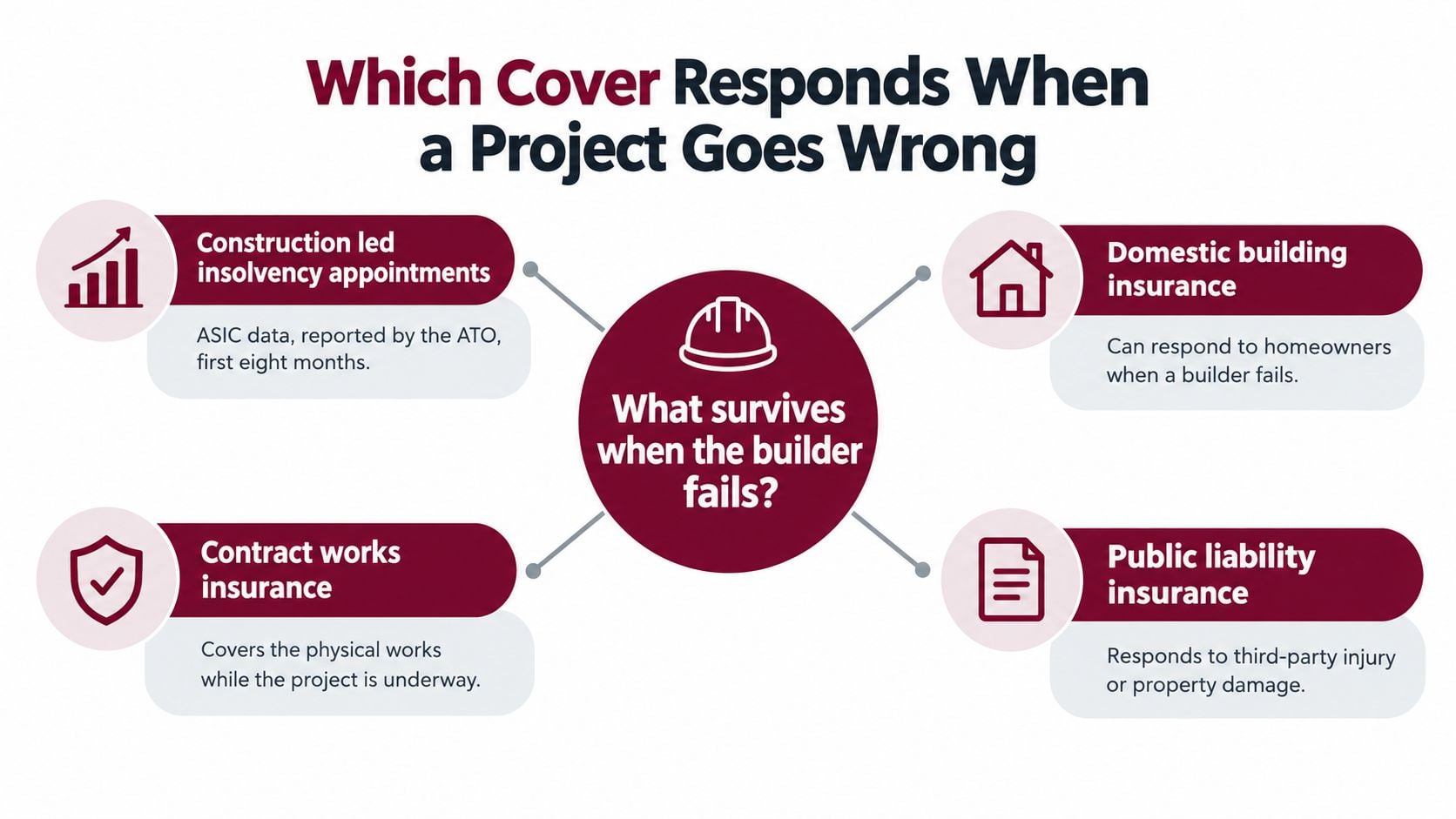
icare's homeowner claims guidance is clear about what HBC is. It is mandatory for residential building or renovation work exceeding AUD 20,000, including GST, unless an exemption applies. It responds when the builder can't complete the work or rectify defects because of insolvency, death, disappearance, or licence suspension after failing to satisfy a court or tribunal money order. It principally protects eligible homeowners against builder default. Contract works insurance addresses physical loss or damage during construction. Those are different promises, and a client who has only one of them is exposed on the other.
Event by event
| Event | Cover That Usually Responds | Gap to Check |
|---|---|---|
| Builder becomes insolvent before finishing a home | HBC, if the work is eligible residential work | Financing costs and delay losses are usually not covered |
| Storm damages the half-built frame | Contract works | Cost of fixing faulty workmanship itself is often excluded |
| Passer-by hit by falling timber | Public liability | Your own works and property are not covered by this policy |
| Design error forces rework | Professional indemnity | Claims-made wording, retroactive date and limits govern the response |
| Defective workmanship found after handover | HBC for major defects on eligible work | Contract defects liability periods may differ from statutory periods |
| Subcontractor unpaid and claims made against the principal | Usually none of the standard policies | Security of payment rights and cash-flow planning |
Losses that sit with you
Delay damages, interest on a construction loan, and a subcontractor's unpaid account usually sit outside both HBC and contract works. HBC is a consumer mechanism for eligible residential default. Contract works pays to reinstate damaged property, not to fund the weeks the crane stands idle while you argue about who insures the site. If water is entering through a finished roof, understanding roof leak policy exclusions shows how a leak can fall outside the wording people assumed was automatic, especially where workmanship or gradual deterioration is the actual cause.
Clauses that move the risk
Read the head contract before you bind anything.
- Who must insure the works: The contract names either a principal-controlled policy or contractor-arranged cover. Buy the one the clause requires, not the one that's cheaper to arrange this week.
- Waiver of subrogation: If the insurer can still chase your subcontractor, a "covered" loss can come back as a recovery claim against that trade.
- Certificates of currency: Collect them, then read the exclusions, the project conditions and the limit. A certificate proves a policy exists. It doesn't prove the limit is enough or that this site is endorsed.
- Cancellation and notification: Diary the dates. A policy cancelled for non-payment, or a loss notified late, can leave a current-looking PDF with nothing behind it.
A certificate of currency is a snapshot, not an underwriting opinion. If you haven't matched the insured names, the limit and the exclusions to the head contract, you haven't checked the cover.
Put the townhouse back together. After the storm and the administration, the owner claims HBC for defective framing the failed builder can't return to fix. Contract works pays to rebuild the storm-damaged frame, subject to its exclusions. Three months of delayed finance costs stay with the borrower. That unpaid interest is the loss that survives the collapse with nobody's policy attached.
Specialist Cover for Plant, Fleet, Marine and Aviation
HBC and contract works follow the building. Plant, fleet, marine and aviation follow the assets that build it, and the routes those assets travel. Mixing them up is how a stolen excavator gets notified under a contract works policy that never insured the machine.
An excavator stolen overnight, a hired crane damaged on a low loader, and a compactor that seizes mid-shift are plant and machinery claims. Hire agreements usually make the hirer insure the item for its full value while it's in your possession, including during transport if the hire terms say so. Owned plant may be insured for replacement cost or for market value. After years of depreciation those two numbers diverge, and a market-value settlement can leave you short of a replacement machine on Monday morning.
Commercial motor and fleet covers the vans and trucks that carry tools and materials, for damage, theft and third-party liability. Tools-in-vehicle sub-limits are often far below the cost of a full ute fit-out. Declare business use correctly. A private comprehensive policy won't carry a site trailer or a crew.
Marine cargo and transit cover matters when materials move by barge or ferry to an island job or a river-access site. The route, the loading point and the storage yard between wharf and slab all need to sit inside the transit wording. A pallet that leaves the barge and sits unattended in an unlisted yard can fall into a gap between marine and contract works.
Aviation hull and liability is for operators, not for a builder who once hired a drone casually. Aerial survey and inspection firms choose an agreed value or market value on the hull, and they set third-party liability limits against the work they fly in practice. A hull limit that matched last year's aircraft doesn't match a replacement airframe.
If you run hired excavators or a yard of owned gear, the placement detail sits in this note on plant and equipment insurance for construction businesses.
A register before you bind
- Asset list: Record each item, its current value, and whether the basis is replacement or market.
- Hire terms: Note who insures, from which hour, and whether transit is included.
- Geographic and use limits: Match the endorsement to the sites, the water route, or the flying work.
- Operators: Keep licences and tickets with the register, not in a glovebox.
- Overlap: Check that contract works isn't double-insuring materials the marine policy already covers, and that neither policy leaves the loading yard out.
Setting Limits, Excesses and Exclusions for Your Project
Claim counts are a poor way to pick a limit. Severity is what blows a hole in a balance sheet. For finalised accepted claims in NSW scheme data, new single-dwelling construction recorded 3,191 claims and approximately AUD 221.3 million in total gross payments, an average of about AUD 69,353. New multi-dwelling construction exceeding three storeys recorded only nine claims but approximately AUD 5.55 million, an average of about AUD 616,545, roughly nine times the single-dwelling average. These are historical scheme figures, not a current-year report. Confirm the latest figures before you lock a limit to them. The pattern is the lesson: a rare project type can still be the one that hurts.
| Project type | Claims | Gross payments | Average claim |
|---|---|---|---|
| New single-dwelling construction | 3,191 | about AUD 221.3 million | about AUD 69,353 |
| New multi-dwelling construction over three storeys | 9 | about AUD 5.55 million | about AUD 616,545 |
A nine-claim history can look quiet on a spreadsheet and still average more than half a million dollars. Project concentration, contract value and how long defects can be claimed matter more than how many claims the last builder happened to lodge.
Settings to decide before the policy is bound
Work through these against the head contract, not against last year's invoice.
- Contract works sum insured: Build it from the total contract value plus the cost to rebuild, including escalation and debris, not from the land purchase price. The land price doesn't reinstate a frame.
- Public liability limit: Match what the head contract demands. A $5 million liability limit doesn't authorise a $5 million construction contract. Those are different numbers.
- Per occurrence or aggregate: One large event can erode an aggregate for every later claim in the period. If the contract assumes a fresh limit per event, an aggregate wording fails that test.
- Excess: A higher excess cuts premium and leaves the first slice of every loss with you. Set it at a figure the job's cash flow can pay on a bad Friday, not at the figure that wins the quote comparison.
- Exclusions: Read defective workmanship, wear and tear, and design defects. Contract works often pays the resultant damage and not the faulty work itself. PI is the design path, and only if the retroactive date reaches the advice.
- Extensions: Confirm debris removal, professional fees, and any maintenance or defects-period extension. Without them, the reinstatement sum can be spent before the engineer is paid.
- PI retroactive date: Design-and-construct builders need the date to reach the drawings, not just the site start. A claims-made policy notified this year can still decline advice given before that date.
A broker can test these settings against the head contract before the policy is bound. Bundling several covers on one schedule can make the wording easier to administer, and it can also hide a duplicated limit or a missing one. Read each section as if it were a separate policy. On the multi-dwelling side of that table, a limit borrowed from a single-house habit is the mistake.
How to Make a Construction Insurance Claim
Notify the insurer or your broker as soon as a loss is known. Late notice is a common reason cover is disputed, even when the damage itself sits inside the wording. The flow below is the minimum path. The notes under it are what actually decides the dollars.
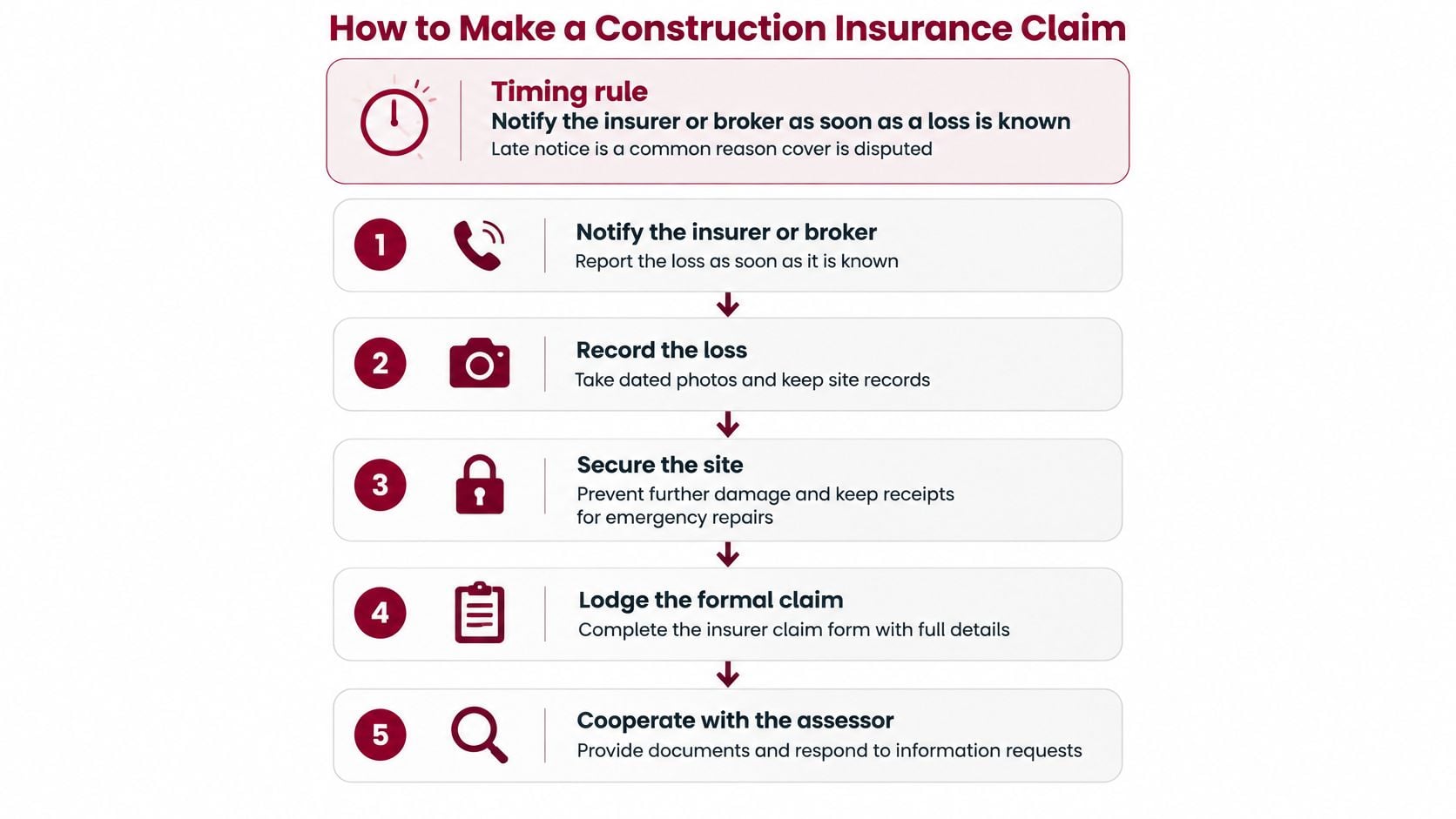
Eight steps, and why each one matters
- Notify in writing. Send the date, the time and a short description to the insurer or broker. A phone call that nobody logged is not a notice. Written notice starts the claim and protects you if the wording treats prompt notice as a condition.
- Secure the site. Take reasonable steps to stop further loss. Shore the frame, tarp the opening, isolate the public. Keep every receipt for emergency work, because those costs are often claimable only if you can show them.
- Photograph and video. Capture timestamps, the weather, and the sequence of work around the damage. A wide shot plus a close-up beats a single dramatic photo that doesn't show where the loss sits in the build.
- Preserve the evidence. Leave damaged materials and defective work in place until the assessor has inspected them. Clearing the site to "get on with it" can destroy the only proof of cause.
- Collect the contract file. Pull the signed contract, variations, progress claims, invoices, certificates, subcontractor records and daily diaries. The loss is proved from these papers, not from memory at the end of the month.
- Quantify it. Complete the claim form and attach costings that separate reinstatement, emergency work, and anything you already know is excluded. Padding a doubtful item weakens the items that should be paid.
- Answer the adjuster. Respond quickly and keep a dated log of every email, call and site visit. Silence reads as a gap in the facts, and gaps become deductions.
- Review the settlement. Check the figure against your costings, reserve your rights in writing, and if you disagree, use the insurer's internal dispute process and then the Australian Financial Complaints Authority.
If you've never sat through that first notification call, this short briefing shows the order of the conversation before the paperwork starts.
Evidence is the difference between a notified loss and a paid one. The March 2017 HBCF scheme report recorded 4,924 accepted claims attributed to builder insolvency, generating approximately $420.2 million in total gross payments, with an average claim of approximately $85,335. Across insolvency, disappearance and death, the report recorded 5,244 accepted liability claims and roughly $445.2 million in total payments. Files of that size are won on diaries, invoices and dates, not on a verbal account of what the site looked like.
On an HBC claim the homeowner, not the builder, is usually the person who lodges. Your role as the failed builder's successor, or as the principal, is to hand over the contract, the certificate and the record of when work stopped. Practical help with the repair side of a lodged claim is covered in this note on insurance repairs for builders.
Disappearance and death claims are smaller in number than insolvency, but they still need the same file. The report showed 268 accepted disappearance claims at about $19.0 million (average about $70,790) and 52 death-related claims at about $4.0 million (average $76,800). For owner-builders, disappearance has historically been the main cause, so an owner-builder file needs the same date-stamped record as a licensed builder's.
Confirm Your Cover Before the First Payment
The gap costs more than the check. Confirm the programme before you accept a deposit or pay a subcontractor, while you can still change a name, a limit or a clause.
- Contract against certificates. Put the head contract's insurance clauses beside every certificate of currency. Tick the named parties, the limits and the periods. A mismatch is a gap, not a paperwork quibble.
- Residential jobs. Run the HBC certificate checks on any residential job over the GST-inclusive threshold before the deposit moves.
- Subcontractors. Confirm each trade's certificate is current, and diary the renewal, cancellation and notification dates so a lapsed policy doesn't hide inside a "current" folder.
- Limits against the job. Test the sums insured against the contract value and against how severe a single project loss can be, not against how rarely claims are lodged.
ABS Insurance Brokers Pty Ltd, a Bankstown NSW brokerage and Steadfast Network Broker holding AFSL 700333, arranges HBC, contract works, public liability, professional indemnity, plant, fleet, marine and aviation cover, with building consultancy and developer finance facilitation for eligible projects. You can start that review on the 1300 number or at abshow.com.au. Send the head contract and the project value for a cover review before the first payment leaves the account.
ABS Insurance Brokers Pty Ltd places construction cover for builders, trades and developers, including builders warranty, contract works, liability and the specialist plant, fleet, marine and aviation policies a project uses. If you're about to accept a deposit or release a subcontractor payment, a cover review against the head contract is the cheapest hour you'll spend on the job. Visit ABS Insurance Brokers Pty Ltd and send the contract and project value before that first payment.