

Most insurance repairs builders manage fall apart at the notification stage, not on site, and the difference is usually documentation, not workmanship. In New South Wales, residential work over $20,000 including GST sits inside the home building compensation framework, with 6 years for major defects and 2 years for other losses from completion, so the first job is to protect the claim trail, not grab the tools NSW SIRA guidance.
A builder can know exactly how to fix a leak, a cracked slab, or storm damage, then lose days because the insurer wants a different form, a clearer photo set, or a tighter scope. That's the friction point: trade skill gets the work done, procedural discipline gets the work paid.

The gap shows up most clearly when the builder assumes the insurer will “sort it out” after the defect is reported. It won't. Claim handling runs on evidence, timing, and policy wording, which is why a clean notification process matters as much as the repair plan itself. For a useful reference on how claims expectations are framed for small business, see the General Insurance Code of Practice claims guidance for small business.
Table of Contents
- Understanding Insurance Repair Workflows
- From Notification to Scope Assessment
- Navigating Provisional Works and Final Settlement
- Securing Insurer Approvals
- Claims Settlement Best Practices
- Essential Builder Pre-Flight Checklist
Understanding Insurance Repair Workflows
A cracked bathroom wall looks like a straightforward trade job until the notification lands in your inbox with missing photos, no completion date, and a vague policy reference. At that point, the builder is part record keeper, part claims coordinator, and part translator between site reality and insurer procedure.
Why procedure beats urgency at the start
The statutory framework matters because it sets the minimum rules of engagement. In NSW, home building compensation is mandatory for eligible residential work over $20,000 including GST, and the framework discussed earlier sets the same thresholds and time limits for major defects and other losses from completion. That means the first response is to preserve the claim position, not improvise on site.
Practical rule: treat the first notification like a claim file, not a site callout.
The builder who wins insurance repair work usually does the unglamorous things well. They log dates, keep original build records close, and avoid mixing emergency attendance with permanent repairs before the insurer has seen the loss. That discipline matters because repair rights, statutory warranties, and insurance cover can overlap, and each one brings its own paper trail.
What goes wrong when the admin trail is weak
The technical fix might be obvious, but the claim can still stall if the notice lacks inspection notes, issue history, or completion records. That is where cash flow gets exposed. A crew can be ready, but without a clear claim pathway the work either waits or gets done before scope is agreed, which creates payment risk.
The best builders keep the notification stage simple and formal. They record what happened, when it was first observed, what was made safe, and what original contract documents exist. That helps the insurer assess liability, and it protects the builder if the conversation later turns to exclusions, maintenance, or workmanship versus insured damage. For a useful reference on how claims expectations are framed for small business, see the General Insurance Code of Practice claims guidance for small business.
From Notification to Scope Assessment
The first few days decide whether the file moves or drifts. A builder who responds with a structured paper trail usually shortens the back-and-forth, while one who relies on phone updates and scattered texts often ends up re-explaining the same loss three times.
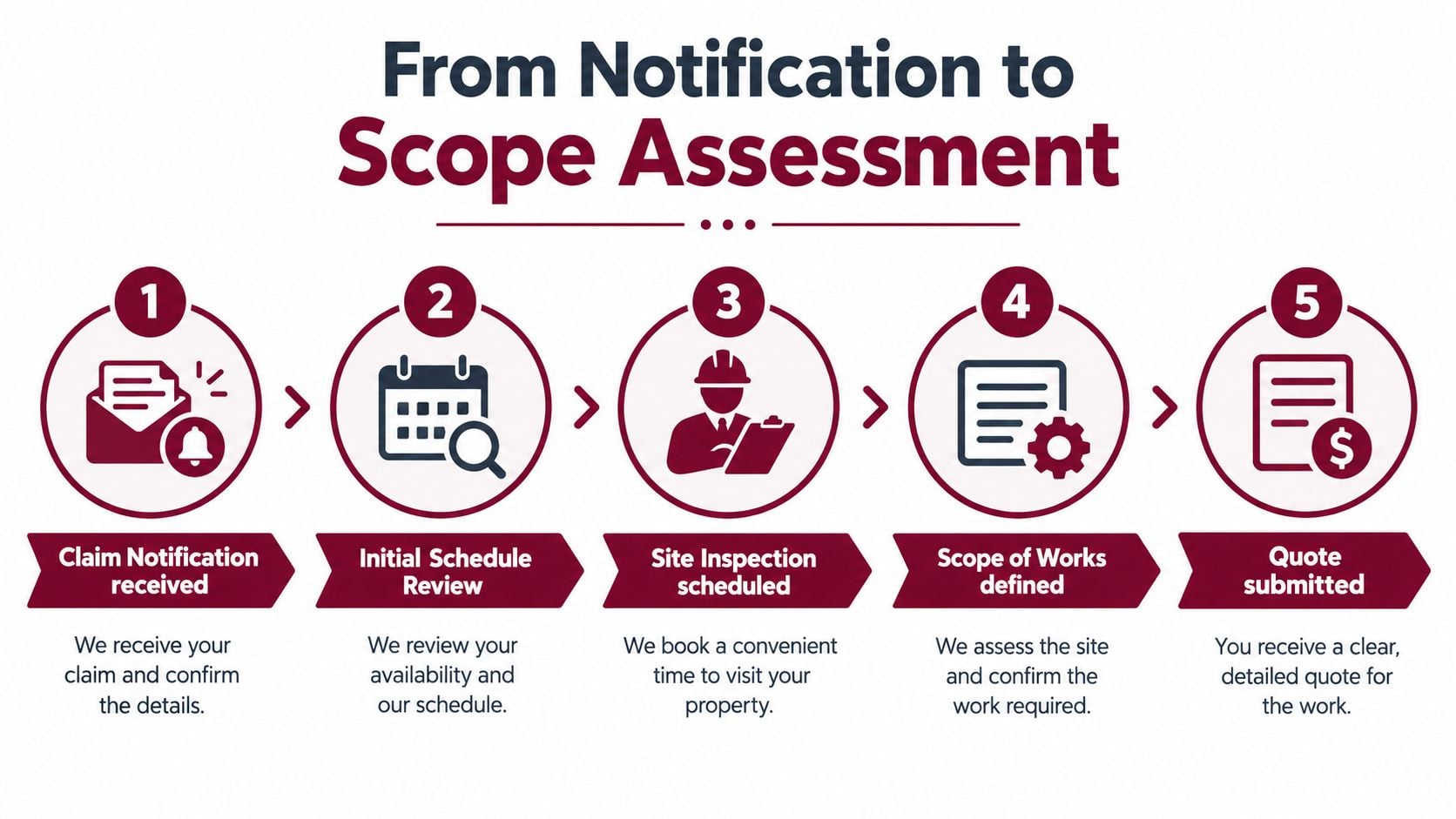
A clean sequence protects the claim
Start with the notification itself. Capture the damage, the date it was noticed, who reported it, and whether any temporary make-safe work was done. Then pull the original build pack, because photos, variations, completion records, and defect notes help distinguish new damage from pre-existing issues.
Next comes the insurer or assessor inspection. The builder should arrive with site photos, annotated notes, and a plain-English summary of what is repairable, what is likely excluded, and what needs confirmation. That inspection isn't the moment to argue for every line item. It's the moment to make sure the evidence is complete enough for the insurer to decide fairly.
Keep the assessment collaborative. The cleaner the evidence, the less everyone has to debate interpretation later.
What belongs in the file
A good scope file is built from the loss itself, not from memory. Include photographs that show the full area, close-ups of impact points, and context shots that connect the damage to surrounding rooms or building elements. Keep original plans, contract variations, and product details together if they affect the repair method.
A practical team will also separate make-safe work from permanent rectification. Temporary drying, tarping, or isolation work should be identified as provisional, because those costs and the final repair scope rarely belong in the same bucket. If the file is messy at this point, quote approval becomes slower, and payment timing stretches with it.
For builders who want a tighter admin workflow, insurance supplement software can help structure variations and missing line items so the repair record stays aligned with the insurer's requests. The point isn't automation for its own sake, it's reducing the time spent rebuilding the same claim evidence from scratch.
For contract context on project-based cover, the distinction between policy types is worth keeping in mind, and the broader builder setup is outlined in this contract works insurance explanation for Australian builders.
Navigating Provisional Works and Final Settlement
Not every insurance repair moves in a straight line from damage to final invoice. Some jobs need make-safe work first, then a separate decision on the permanent scope. Others go straight to a final settlement if the insurer has enough evidence and no further site stabilisation is required.
Provisional works and final scope are not the same job
| Aspect | Provisional Works | Final Settlement |
|---|---|---|
| Purpose | Stop further damage, secure access, stabilise the site | Complete the insured repair to the agreed scope |
| Timing | Immediate or short notice | After assessment and approval |
| Documentation | Make-safe photos, labour notes, temporary materials used | Approved scope, variation trail, final photos, completion notes |
| Cash flow impact | Useful for early billing, but only if recorded cleanly | Drives the main payment cycle and final close-out |
| Risk if handled badly | Temporary work gets mixed into permanent pricing | Settlement gets delayed by unclear scope or missing evidence |
Provisional work suits emergency situations. Permanent settlement suits the agreed repair path. The mistake is blending them into one vague invoice, because then the insurer can't easily see what was urgent, what was temporary, and what was part of the final fix.
Cash settlement needs tighter controls
Cash settlement can work well when the builder has a clear scope and the owner is ready to manage the repair pathway. It can also fail fast when the price is too loose, the owner expects the insurer to coordinate everything, or supplier availability changes after the cheque is issued. That's where site access, subcontractor timing, and final invoicing get harder to control.
Builder-side admin tools matter more in this phase than in any other. If the repair grows after hidden damage appears, the file needs a clean variation record, not a phone call that nobody writes down. The insurer can't assess what it can't see, and the builder can't protect margin on work that was never properly documented.
Securing Insurer Approvals
Approvals stall when the file doesn't answer the insurer's first questions quickly enough. Is the damage covered. Is it sudden and accidental. Does the policy exclude it. Is the repair method proportionate. Each of those questions sends the file in a different direction if the evidence isn't organised.
The approval gates that matter
The first gate is liability. The insurer wants to know whether the event sits within cover, and whether statutory warranties, maintenance issues, or wear and tear are pushing it outside the policy response. The second gate is scope. Even if cover exists, the repair method still has to match the loss, not the builder's preferred way of doing the job.
A third gate is information quality. Missing photos, no date sequence, and incomplete measurements often trigger more questions than the original defect itself. If the insurer asks for extra detail, reply with the next piece of evidence, not with a longer opinion. A disciplined file beats a persuasive email.
A good approval file answers the insurer's next question before it's asked.
Independent experts can help when the damage is technically complex or the cause is disputed. The builder's job is to support the process with site records, not to treat the expert as an opponent. If the expert needs moisture readings, structural notes, or a build history, send them promptly and in one tidy pack rather than in fragments across multiple messages.
Builders who handle these requests well keep the claim moving without burning labour time on repeated clarification. That's especially important on jobs where the actual repair is simple, but the approval pathway is slow. The trade doesn't fail. The file does.
Claims Settlement Best Practices
Repair work can be technically sound and still finish badly on payment if the record is weak. That's why disciplined variation tracking, date-stamped photos, and clear completion notes are essential in insurance repairs builders workflows.

Why repair-based outcomes still dominate
Insurance claims in Australia still lean heavily towards repair rather than rebuild. During 2022–2026, insurers received 409,094 catastrophe and major-weather claims at an insured cost of $11.3 billion, with most damaged properties repaired rather than rebuilt and an average claim cost just over $27,500 Insurance Council data. That matters to builders because repair scope, moisture evidence, and variation discipline directly affect whether the job stays within the agreed settlement.
The practical lesson is simple. Track every change as it happens. If hidden damage appears after demolition, record it with photos, measurements, and a clear note on why the scope changed. If a substitution is needed because materials are delayed, record that too. Settlement disputes usually start where the documentation stops.
Don't let cash settlement shift the risk onto the builder
Cash settlement can be efficient, but it also leaves more room for cost drift if the owner, insurer, and builder each assume someone else is tracking the details. Recent Australian reporting showed cash settlements were used in more than 63% of final home insurance claims, which means a lot of households are effectively self-managing the repair phase Australian reporting on cash settlements. For builders, that makes scope clarity and written variation approval even more important, especially where labour availability or material replacement costs shift after the claim is underway.
If you're dealing with roof damage after hail or storms, keep a separate record of impact points, underlay conditions, and moisture entry paths. A practical reference for that kind of site triage is this hail damage roof inspection guide, which reinforces how inspection quality affects the repair brief.
Keep the final report tight. State what was repaired, what was changed from the original scope, what remains excluded, and what evidence supports completion. That's the fastest way to close the claim cleanly and protect your payment timeline.
Essential Builder Pre-Flight Checklist
Before the job starts, confirm the policy basis, the repair scope, and the evidence trail. If those three things don't align, the project can turn into a cash flow delay even when the building work itself is straightforward.
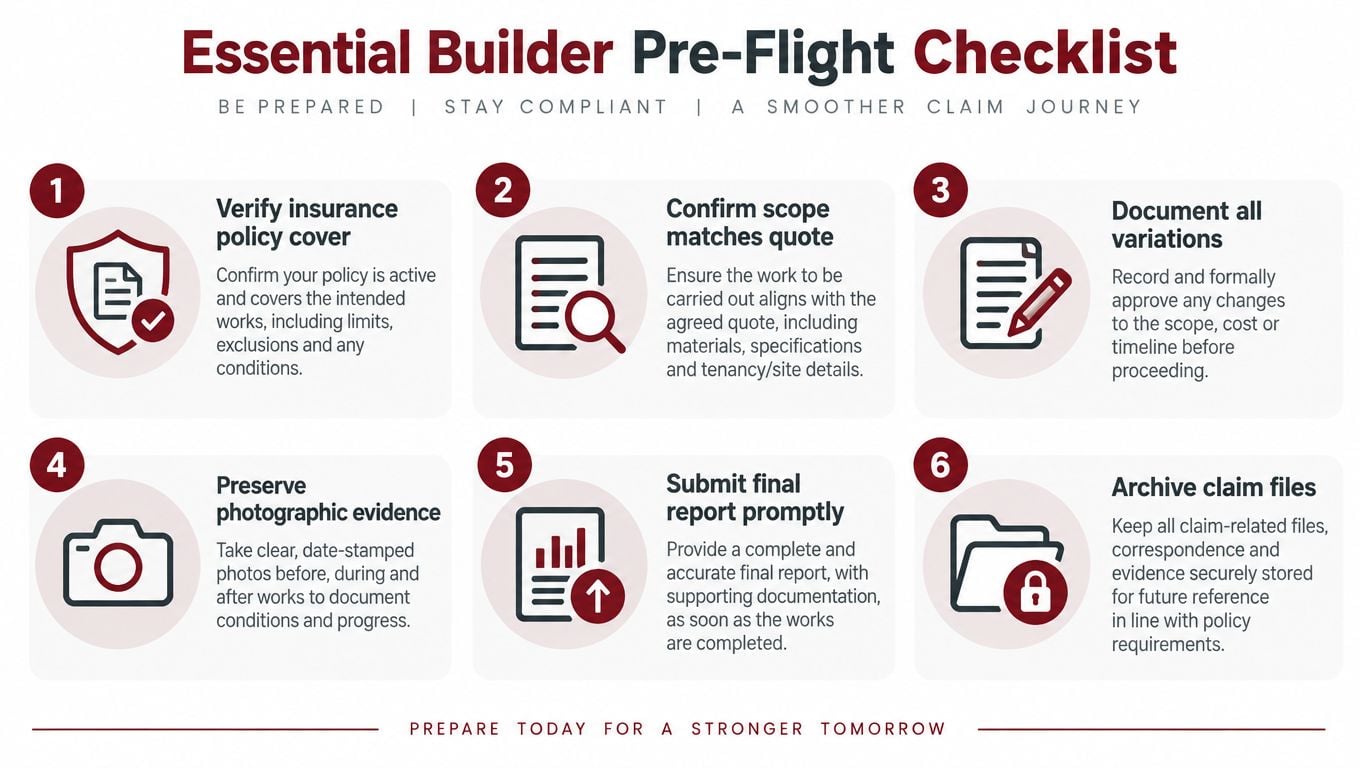
Use this sequence on every claim file, and keep it close to hand during active repairs:
- Verify policy cover: Confirm the claim sits within the relevant insurance or statutory pathway before work starts.
- Match scope to quote: Make sure the agreed repair scope and the pricing line up before labour is committed.
- Record every variation: Document extras, substitutions, and hidden damage the moment they appear.
- Preserve photo evidence: Keep dated images of condition, progress, and completion in one file.
- Submit close-out promptly: Send the final report, completion notes, and supporting evidence without delay.
- Archive the file: Store claim records, correspondence, and approvals for future reference.
For a broader builder-focused insurance overview, the builders for insurance repairs guide is a useful companion reference when you're setting up project cover and claim processes.
ABS Insurance Brokers Pty Ltd helps builders and trades arrange cover and manage project insurance needs, including builders warranty insurance, contract works, and public liability. If you want to tighten the way your business handles insurance repairs and keep claims files aligned with policy requirements, visit ABS Insurance Brokers Pty Ltd and review the support they provide for construction businesses.