

In 2023, falls from height killed 29 workers in Australia, representing 15% of all worker fatalities, with construction responsible for 45% of those deaths. For roofing contractors, public liability insurance is essential because one falling tool, unsecured sheet or damaged property can create a claim involving someone who isn't your employee.
Roofing businesses face a risk that combines physical danger, contractual pressure and difficult coverage boundaries. A policy certificate may satisfy a site gate, but it won't automatically protect you from every workmanship dispute, safety failure or uninsured contract obligation.
The right approach is practical: match the policy to the work you perform, document the controls you use, and understand the difference between accidental third-party damage and the cost of repairing your own defective work.
Table of Contents
- The Reality of Roofing Risks in Australia
- Understanding Public Liability Coverage Scope
- Navigating Contract Requirements and Limits
- Safety Compliance Versus Insurance Defence
- Essential Documentation for Risk Mitigation
- Comparing Policy Options for Roofing Businesses
- Building a Resilient Risk Management System
- Conclusion and Next Steps
The Reality of Roofing Risks in Australia
Australia's national safety data gives roofing contractors little room for complacency. In 2023, 200 workers died from traumatic injuries at work, including 29 deaths from falls from height. Construction accounted for 13 of those 29 fatalities, or 45%, making it the dominant affected industry. Safe Work Australia's 2024 national WHS statistics show why roof access is an insurance issue, not merely a site-management issue.
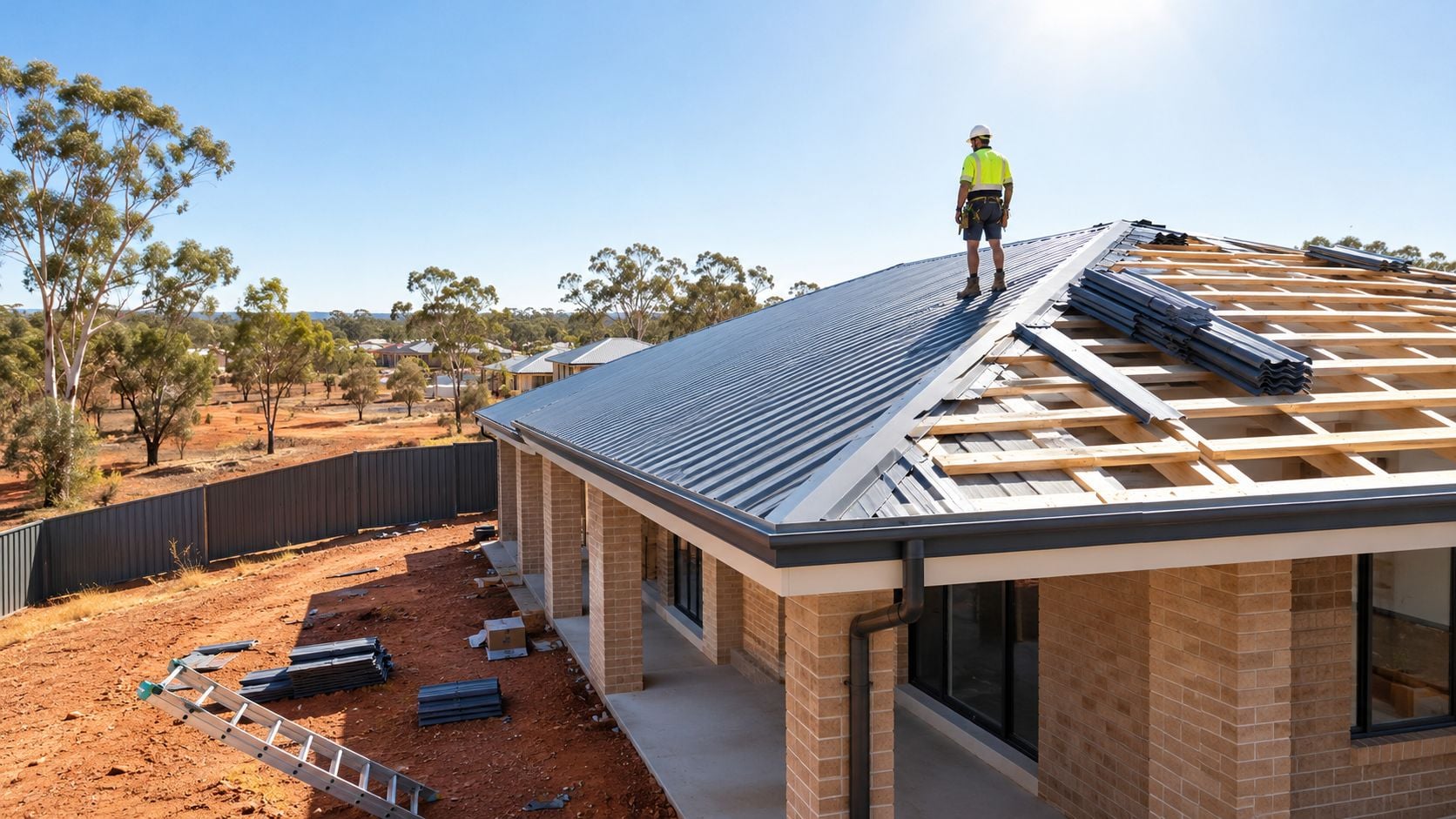
Consider a normal residential repair. Your worker removes old sheets, a resident walks beneath the work area, and wind lifts unsecured material onto a neighbouring vehicle. No one on your payroll may be injured, but the homeowner, pedestrian or neighbour can still allege that your business caused bodily injury or property damage. That is where public liability responds in principle.
The risk extends beyond your crew
Workers compensation deals with eligible employee injuries. Public liability is principally concerned with non-employees, including homeowners, visitors, pedestrians and neighbouring property owners affected by your operations. Safe Work Australia's roofing risk material describes examples such as a homeowner injured by unsecured roof sheets or a pedestrian struck by falling tools. The national height-fall data makes the distinction clear.
Broker's rule: A safe work method reduces the chance of a claim. Public liability insurance protects the business when a third party alleges that your work caused harm.
Safe systems still matter because insurance doesn't remove regulatory duties, contractual obligations or the need to investigate an incident properly. It transfers part of the financial exposure. Without suitable cover, a single third-party claim can reach business assets, cash flow and future contracts.
Understanding Public Liability Coverage Scope
Public liability insurance for roofing generally addresses claims that your business caused third-party bodily injury or third-party property damage during its work or presence at a site. It can also respond to legal defence costs, investigation expenses and covered settlements, subject to the policy wording, exclusions, excess and limit.
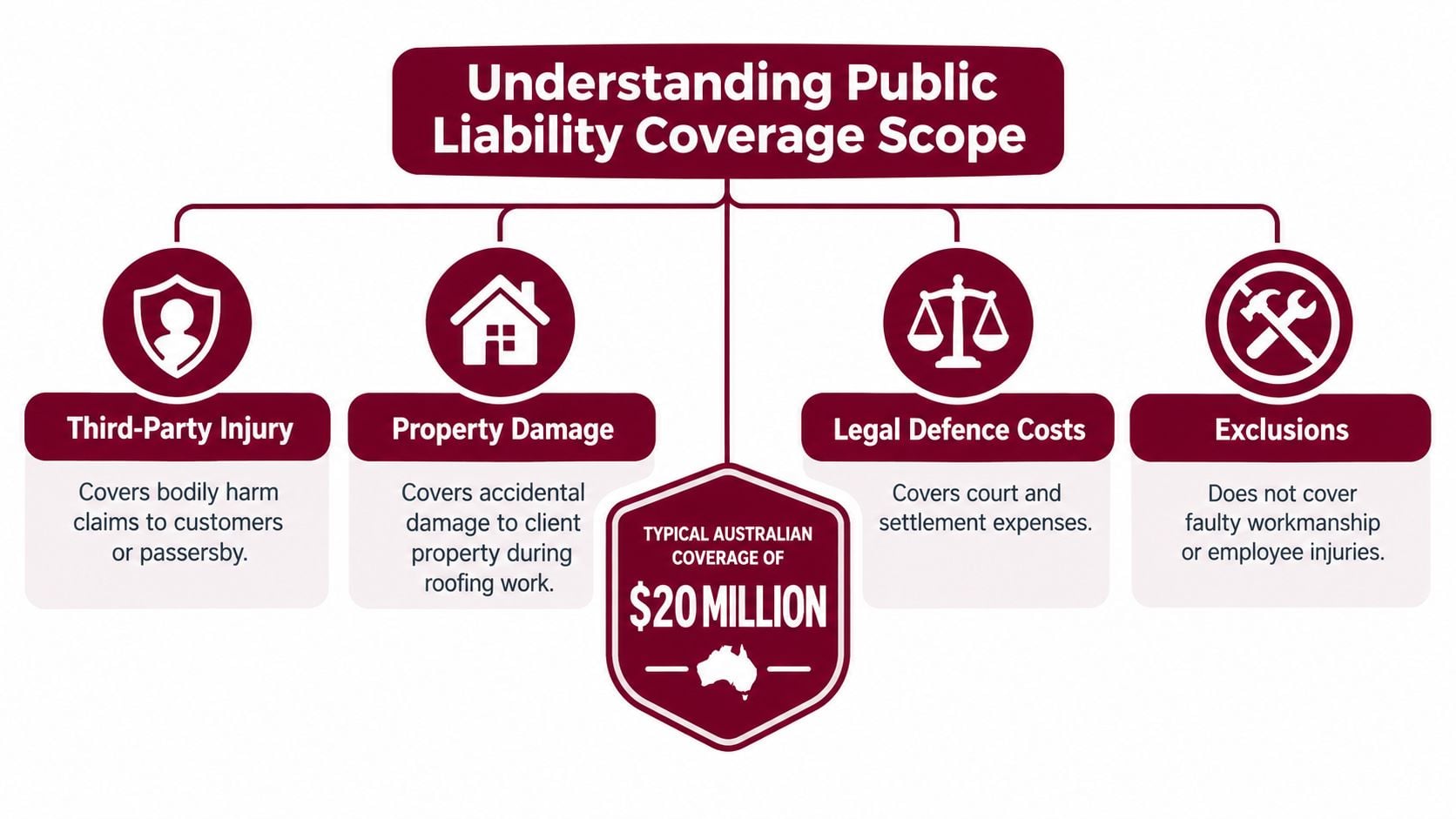
The important question isn't just whether something went wrong. Ask what was damaged, who owned it, how the damage occurred, and whether the loss is accidental or part of correcting your work.
Bodily injury and accidental property damage
A falling tool that cracks a neighbour's windscreen is a straightforward example of accidental property damage. A roof sheet that falls onto a passerby may create a bodily injury claim. Damage to a client's existing solar panels, gutters, windows or other property during an unexpected incident may also fall within the liability analysis.
The position becomes less favourable when the allegation concerns the work itself. If your team installs flashing incorrectly and the roof leaks, the cost of removing and reinstalling defective flashing may be a workmanship or contract-performance issue rather than insured accidental damage. Resulting damage to a client's contents or interior may require separate analysis, because the policy can treat the defective work and the resulting damage differently.
| Scenario | Main insurance question |
|---|---|
| A tool hits a visitor or vehicle | Was the third-party injury or damage accidental and connected with your work? |
| A roof sheet damages a neighbour's property | Were materials secured and does the policy respond to third-party property damage? |
| Incorrect installation causes the roof to leak | Is the claim for correcting your work, resulting damage, or both? |
| An employee falls while working | Workers compensation and workplace obligations are central, not public liability alone. |
Public liability isn't a blanket warranty for your workmanship. Contract works insurance may be relevant to physical damage to the project, while professional indemnity can matter where you provide design, specification or technical advice. The correct arrangement depends on your role and the policy wording.
For a useful comparison of liability issues in another trade, see this UK plumbing liability insurance guide. The terminology differs across jurisdictions, but the practical lesson is familiar: identify the injured party, the damaged property and the nature of the alleged failure before assuming a policy will pay.
Navigating Contract Requirements and Limits
A certificate of currency is evidence that a policy exists. It isn't proof that the policy satisfies every term in a building contract.
Principal builders, strata managers and government clients may specify liability limits, cross-liability wording, contractual-liability requirements and equivalent insurance for subcontractors. SafeWork NSW's roof-work guidance reinforces the need to check those requirements against the actual policy schedule and endorsements.
Review the contract before accepting the job
Use this sequence before you quote or sign:
- Mark the insurance clauses. Identify the required limit, period, territorial scope, insured parties, cross-liability wording and any indemnity obligation.
- Compare the wording, not just the certificate. Ask for the schedule and endorsements. Check whether your declared activities include roof replacement, repairs, guttering, hot works, fragile roofs and work on occupied premises.
- Check subcontractor treatment. Confirm whether subcontractors are covered under your policy, whether they must carry their own insurance, and whether you must collect current certificates from them.
- Escalate unusual obligations. Broad indemnities, uncapped liability and obligations to guarantee the finished work may go beyond ordinary liability cover. Obtain legal advice before agreeing to unfamiliar wording.
The limit demanded by a client is a contract requirement, not a universal answer to your exposure. A smaller residential repair and a complex commercial project can involve very different access, public-area and property-damage risks. Your broker needs the actual scope, turnover, work locations and subcontracting arrangements to assess the structure.
If a third party has already suffered loss, guidance on getting help after roof damage may help clarify the legal issues. For insurance planning, also understand the difference between contract works insurance and public liability, because they address different parts of a construction risk.
Safety Compliance Versus Insurance Defence
Insurance responds to covered liability. It does not make unsafe roof work defensible. Your business still needs a suitable SWMS, competent supervision, edge protection and a rescue plan before work begins.
SafeWork NSW identifies falls from height as the leading cause of traumatic fatalities in the NSW building and construction industry. Its 2025 inspection programme found that only 60% of roof-work sites had higher-order controls, including scaffolding, guardrails or elevating work platforms. SafeWork NSW's inspection information confirms that inadequate controls remain a serious operational problem.
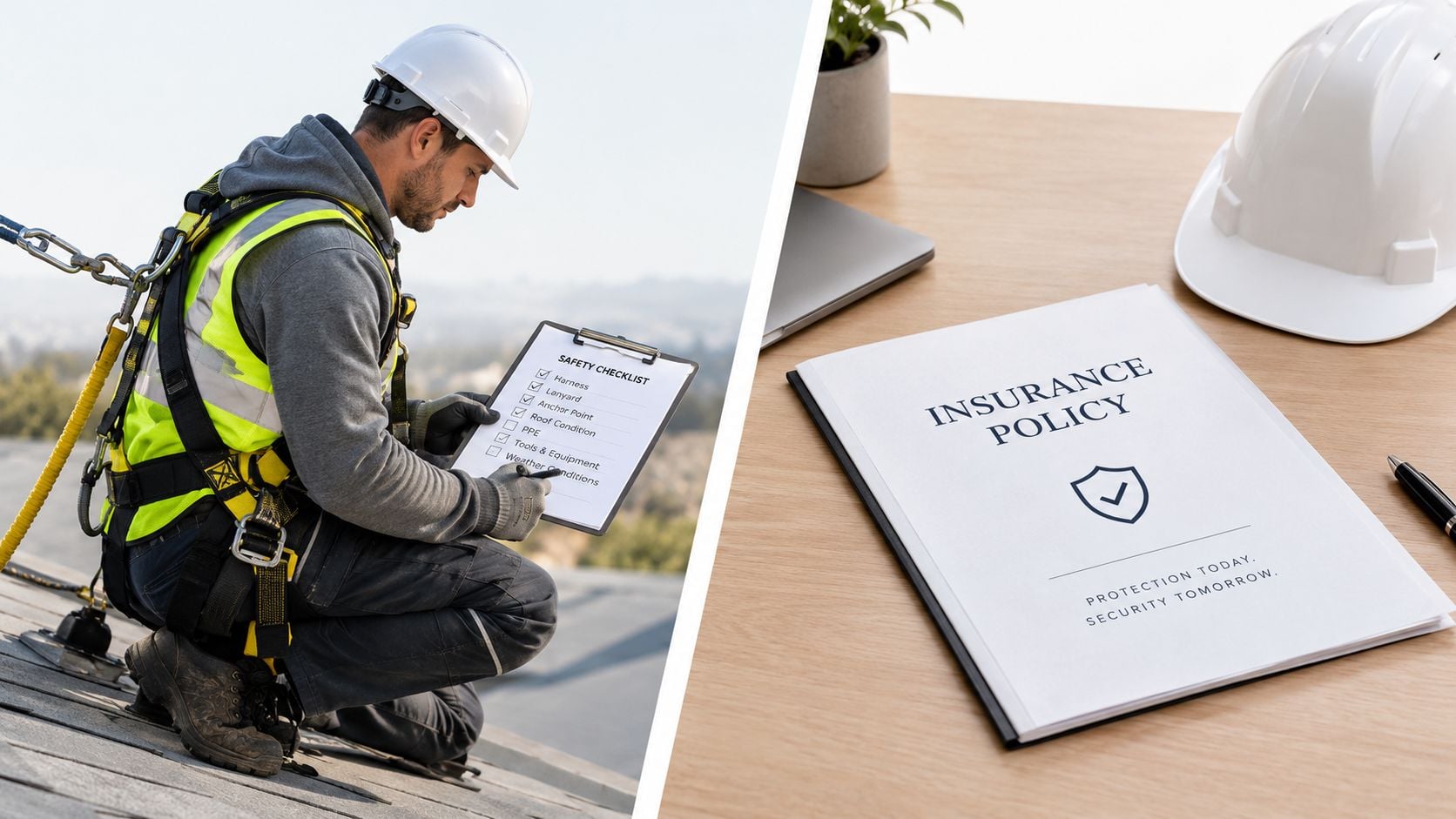
Why the claim file matters
After an incident, the insurer will examine what happened and how your business prepared for it. Investigators may review site conditions, worker instructions, subcontractor competence, equipment inspections, exclusion zones and the records supporting your account.
Weak controls do not automatically defeat every claim. They can make liability harder to defend, trigger regulatory consequences and expose differences between your declared operations and actual work practices. A certificate of currency proves that a policy exists. It does not prove that a particular roof task was planned safely.
The practical standard is this: a safe work method reduces the chance of a claim, while public liability insurance protects the business when a third party alleges your work caused harm.
For NSW roofing work involving a risk of falling more than two metres, a SWMS is required before high-risk construction work starts. SafeWork NSW also says fall risks must be managed at any height, since serious incidents occur below the level many contractors consider dangerous. Single-storey roofs, ladders, skylights, brittle surfaces and building edges therefore require disciplined controls.
Separate accidental damage from defective workmanship. Public liability may respond when your work accidentally damages a third party's property. It generally does not turn the cost of correcting your own faulty roofing work into an insured property-damage claim. That distinction often determines whether a dispute becomes a manageable claim or a direct business expense.
Your strongest position combines higher-order controls first, trained workers, documented supervision and a policy that accurately describes the business. Fall-arrest equipment has a place, but relying on harnesses alone where guardrails, scaffolding or an elevating work platform is reasonably available leaves the business exposed.
Essential Documentation for Risk Mitigation
Good documentation serves two audiences at once. It demonstrates that you planned the work for the regulator, and it gives your insurer evidence to assess causation, responsibility and policy response after an incident.
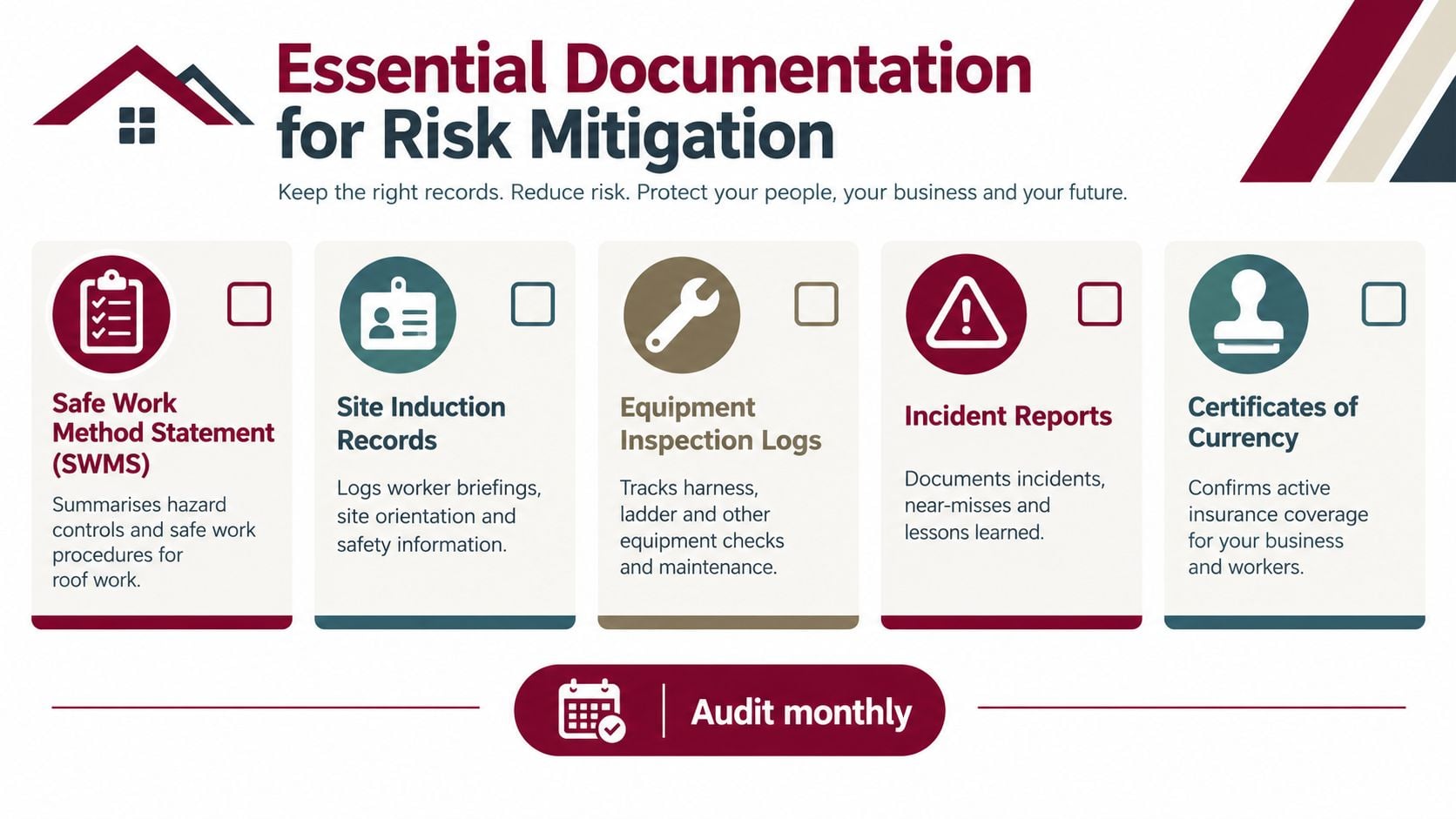
Build a usable record, not a paperwork archive
Keep records task-specific and easy to retrieve:
- Safe Work Method Statements: Identify the roof activity, hazards, risk controls, access method, fragile surfaces, falling-object controls and rescue arrangements.
- Site induction records: Record who received the briefing, what site rules applied and whether visitors or subcontractors were informed about exclusion zones.
- Inspection and maintenance logs: Track ladders, scaffolds, anchors, harnesses, elevating work platforms and other relevant equipment before use.
- Incident and near-miss reports: Record what happened, immediate controls, photographs, witnesses and corrective action. A near miss is an early warning, not an administrative nuisance.
- Certificates of currency: Keep current evidence for your business and subcontractors, then compare it with the contract requirements and actual policy terms.
A roofing contractor should also retain site photographs showing temporary edge protection, barriers, signage, material tie-down and public separation. Keep subcontractor licences, competency evidence and written instructions with the job file rather than in an unrelated office folder.
The documentation needs to reflect reality. A generic SWMS copied from a previous project won't help if the site includes a fragile skylight, occupied premises, unusual pitch or temporary weather protection that the document ignores.
For a broader explanation of arranging cover, see this guide on how to get public liability insurance. Review the records regularly, close gaps while the job is active, and make sure the person supervising the work knows where the documents are.
Comparing Policy Options for Roofing Businesses
A solo roofer doing residential repairs needs a policy that accurately reflects roof access, repair activities, tools, subcontractors and public contact. A larger contractor managing commercial sites needs a more structured programme that addresses contract wording, project interfaces and multiple parties.
The policy label matters less than the details. Compare declared activities, liability limits, excesses, territorial scope, subcontractor treatment, contractual liability wording and exclusions.
Match the policy to the work
| Business profile | Priority checks |
|---|---|
| Solo residential roofer | Correct trade description, public access, tools and accidental damage to client property |
| Small team using subcontractors | Subcontractor certificates, supervision, cross-liability and contract requirements |
| Commercial roofing contractor | Principal contracts, occupied premises, exclusion zones, hot works and project interfaces |
| Contractor handling advice or design | Whether professional indemnity is needed alongside public liability |
Don't assume low-rise work is low risk. Historical Australian evidence found that roofs, ladders and scaffolds were the most common objects involved in reported falls, together accounting for 49% of reported falls. Falls of 2.1 and 4 metres, or from heights up to two metres, were commonly reported. Safe Work Australia's historical falls-from-height review supports a simple conclusion: a single-storey roof still needs serious controls and properly matched insurance.
Cross-liability wording can matter when multiple insured parties are involved, while subcontractor provisions determine whether your arrangement works as expected when another business performs the task. Don't rely on a standard package without testing it against your actual operations. A public liability insurance broker can help compare policy structure, but you still need to disclose the work accurately.
Building a Resilient Risk Management System
Treat safety, insurance and claims response as one operating system.
Start with a pre-job assessment covering roof condition, access, fragile areas, public movement, weather, neighbouring property and material storage. Select higher-order controls, brief the crew, tether tools where appropriate, secure sheets and install clear exclusion zones.
Then control the handoffs:
- Subcontractors: Verify competence, insurance and site induction before work starts.
- Supervisors: Require them to inspect controls and record changes when conditions shift.
- Office staff: Keep policy schedules, endorsements, SWMSs and certificates easy to retrieve.
- Incident response: Protect people first, preserve evidence, notify the insurer promptly and avoid admissions before the facts are established.
Review near misses and completed jobs for recurring weaknesses. If a roofer changes from repairs to larger replacement projects, adds hot works or starts using subcontractors, update the insurer before the new exposure becomes a claim.
Conclusion and Next Steps
Public liability insurance roofing arrangements fail most often at the edges. The business has a certificate, but the policy doesn't match the declared work. The contract demands wording that was never checked. A roof leak is treated as a liability claim even though the dispute concerns defective workmanship. A falling object injures a passerby, but the business can't produce a SWMS, inspection record or evidence that the exclusion zone existed.
The remedy is direct. Review the actual policy schedule and endorsements, not only the certificate. Compare them with your contracts, roof access methods, subcontractor arrangements and property-damage exposures. Keep documentation that proves the controls were selected, implemented and checked.
Use public liability for its proper purpose, third-party injury and accidental third-party property damage. Consider contract works, professional indemnity, workers compensation and other covers where the business activity creates those exposures. Don't assume one policy will repair every defect, replace damaged work or satisfy every contractual promise.
Before accepting the next project, ask your broker to test the job against the policy. Give them the full scope, site conditions, heights, access systems, hot works, subcontractors and client requirements. That review is far cheaper and more useful than discovering a coverage gap after a claim.
ABS Insurance Brokers Pty Ltd arranges public liability, contract works and related insurance for builders, roofers, tradespeople and construction businesses across Australia. Visit ABS Insurance Brokers Pty Ltd to discuss your roofing activities, contract requirements and documentation with a broker before you start the next job.