

If you're wondering how to get public liability insurance in Australia, start with the work you do and the requirements in your contract. A builder may need a current Certificate of Currency before site access is granted; providing accurate business details, required limits and the intended start date helps the insurer or broker assess the request. Allow time for questions before the work is due to begin.
Table of Contents
- How to Get Public Liability Insurance in Australia
- Preparing Your Business Details Before You Quote
- Choosing the Right Cover Limit for Your Work
- Comparing Quotes Beyond the Price
- Binding Your Cover and Getting Written Confirmation
- Common Pitfalls That Delay or Derail Cover
How to Get Public Liability Insurance in Australia
The first document a principal contractor usually asks for is a current Certificate of Currency. A quote reference does not get you through the gate, and it does not satisfy a landlord or venue operator who needs written proof before work starts.
Public liability insurance matters because a third-party claim can cost far more than the job itself. A spill in a café, a dropped tool, or hot works that start a fire can lead to property damage, injury, and legal defence costs that small businesses rarely want to carry alone. Insurers price that risk by occupation and claims history, not by guesswork. APRA's National Claims and Policies Database gives them years of Australian claims data to price against, which is why two businesses doing the same job can still receive very different quotes. Published material from APRA and Marsh shows how pricing varies across industries, so a flat “best price” approach usually misses the core issue, which is whether the policy fits the work (APRA statistics, Marsh public liability overview).
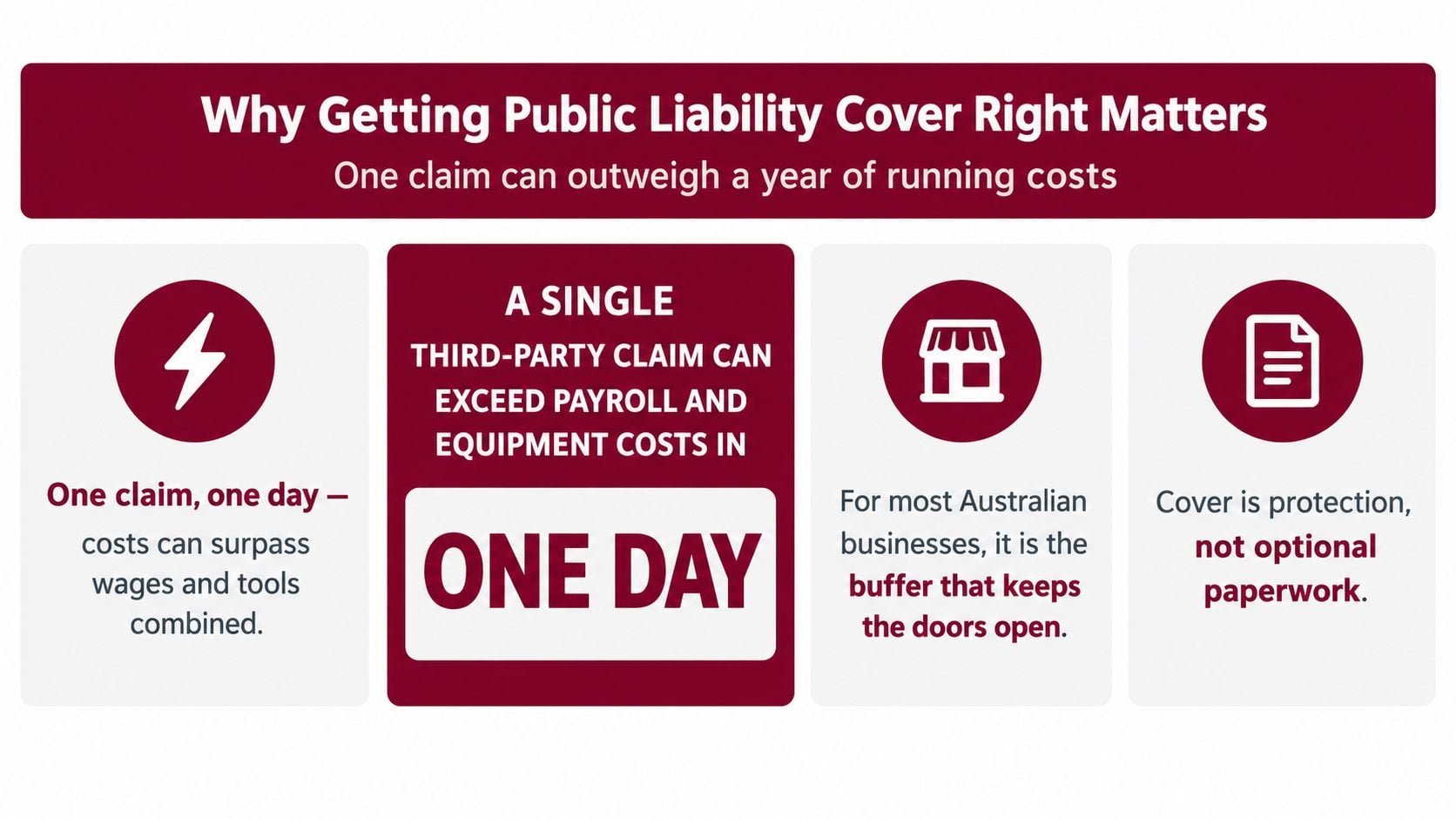
A quote can look fine and still leave a business exposed if the limit, the activity description, or the evidence behind it is wrong. That is the trap many first-time buyers fall into.
Practical rule: if a contract, lease, or site access depends on cover, ask for the insurer's written confirmation and the Certificate of Currency before anyone relies on the policy.
The test is whether the policy matches the requirement in front of you. If a builder, council, or venue operator asks for a specific limit, the answer has to line up with that demand, not with the cheapest premium on the page. For a plain-English overview of the cover itself, the public liability insurance page is a useful starting point.
Risk controls matter too. If your business has lone workers, after-hours visits, or staff entering customer premises, practical lone worker policy steps can help reduce the incidents that turn into claims in the first place.
Preparing Your Business Details Before You Quote
Underwriters don't price on a handshake. They price on what you can evidence, and incomplete details are the main reason quotes drag on. The faster you can put a proper information pack together, the faster you move from enquiry to terms.
Start with the basics: your business name, ABN, legal entity, trading name if you use one, and current contact details. Then write a clear description of what the business does, not the polished marketing version. If you're a builder, say whether you do new builds, renovations, owner-builder support, carpentry, or site supervision. If you're a café operator, say whether you offer dine-in, takeaway, delivery, alcohol, or functions.
What underwriters want to see
Insurers also look for the work profile behind the business name. Proposal forms in Australian liability markets ask for things like estimated annual turnover, contractor or subcontractor use, labour hire, and whether you contract to a principal contractor. That's not filler, it's how they measure exposure and decide whether the work sits inside appetite (liability proposal form example).
A complete pack usually includes:
- Turnover and staffing: expected annual turnover, staff numbers, and subcontractor or labour hire details.
- Work locations: your premises, client sites, construction sites, events, or online sales.
- Contract triggers: any lease, licence, tender, or head contract that names a minimum liability limit.
- Claims and incidents: prior claims, incidents, complaints, or circumstances that could become a claim.
- Risk controls: licences, qualifications, safety procedures, quality checks, and incident records.
- Products, if relevant: anything you manufacture, import, supply, install, or sell.
A builder's file looks different from a café's. A builder should be ready with licence details, subcontractor numbers, project types, and the kinds of sites they enter. A café should be ready with seating capacity, delivery exposure, equipment, and whether liquor service is part of the business.
A quick reality check before you submit
Broker's habit: if the description of work can fit on one vague line, it's probably too vague for underwriting.
The cleaner the pack, the less back-and-forth. More importantly, the more likely the quote reflects the actual business instead of a stripped-down version that falls apart when the insurer asks follow-up questions.
Choosing the Right Cover Limit for Your Work
The right limit is not a random number, and it's not decided by premium alone. It starts with the contract in front of you. If the head contract, lease, or permit says $10 million or $20 million, that's your floor, not your target.
Read the obligation before you read the price
Most small, lower-risk jobs can sit around the common market limits used in practice, but the contract drives the actual decision. NSW government guidance on small business insurance identifies common public liability limits of $5 million, $10 million, and $20 million, and says the right amount depends on the risk assessment, complexity, and value of the work. That's the point, the limit should reflect the work you do, not just the cheapest available option (NSW government guidance).
A lower premium can hide a bad structure. If one quote gives you a sensible limit and a manageable excess, while another quote trims the premium by cutting the limit or loading exclusions, the cheaper one may be poor value once a claim lands. The same applies to endorsements. Some policies carve out work above certain heights, hot works, or broad contractual liability assumptions without much notice.
Typical limits by work type
| Trade or activity | Common contract minimum | Recommended limit | Notes |
|---|---|---|---|
| Domestic subcontracting | Often $10 million | Match contract, then add headroom | Common baseline for smaller trade work |
| Commercial construction | Often $20 million | Match the site requirement | Principal contractors commonly insist on it |
| Retail and hospitality | Often $10 million or higher | Set to foot traffic and lease terms | Public access increases exposure |
| Councils and venues | Often $20 million | Match the permit or venue rule | Access usually depends on written proof |
| Professional or advisory work on site | Varies by contract | Pair with the right companion cover | Public liability alone may be incomplete |
Excess matters too. A low premium with a large excess can be false economy if the likely claim size is modest. That's why a good quote comparison looks at the entire structure, not just the headline number.
Practical rule: choose the limit that survives the worst plausible claim, not the one that looks neat on the invoice.
Comparing Quotes Beyond the Price
A cheap quote can look efficient right up until the first claim. When that happens, the critical questions are the limit, the excess, the activities covered, and the exclusions you didn't notice on page two. Price matters, but it's only one line in the schedule.
How to compare properly
Take each quote and line it up against the same business facts. Same turnover. Same activities. Same sites. Same contract requirement. If one insurer is pricing a “cleaned-up” version of the business and another is pricing the actual work, you're not comparing like for like.
The quote schedule should be read line by line:
- Limit of indemnity: confirm it matches the contract or site requirement.
- Excess: check what you pay on each claim, not just the annual premium.
- Covered activities: look for wording that matches actual work, not a generic description.
- Endorsements and exclusions: watch for height limits, hot works restrictions, or contractual liability carve-outs.
A plumber with a $10 million limit and a modest excess can be better protected than a cheaper policy with a lower limit and a high excess. The quote that saves money today can cost more tomorrow if the claim sits outside the wording.
For a broader comparison of insurance cost drivers, the business insurance costs guide is worth reading alongside your quote pack. It helps put the premium into context before you focus on the final figure.
How to push back without overexposing the business
If a competing quote is stronger, use that as negotiating power carefully. Ask the insurer or broker whether they can match the structure, not just the premium. Keep the discussion on limit, excess, exclusions, and endorsements. Don't volunteer extra detail that changes the risk unless it's already part of the factual submission.
“Can you match the same limit and excess, with the same activities and wording, if I stay with the same turnover figure and contract profile?”
That's the kind of question that gets a useful response. It keeps the comparison disciplined and avoids turning a price negotiation into a new underwriting file.
| Field to Check | Quote A | Quote B | Quote C |
|---|---|---|---|
| Limit of indemnity | |||
| Excess | |||
| Activities covered | |||
| Key exclusions | |||
| Endorsements | |||
| Contract match |
For specialist quote requests, even something as routine as a training cost enquiry shows why precise pricing questions matter, because the input has to match the outcome. Insurance works the same way.
Binding Your Cover and Getting Written Confirmation
A quote does not mean cover has started. That's the mistake that causes the most avoidable trouble, especially when a client is trying to start work the same day the paperwork lands in the inbox. Until the policy is bound and confirmed in writing, there's nothing reliable to present to a principal contractor or venue.
What the binding sequence looks like
The usual sequence is straightforward. The proposal form is completed and signed, the declarations are accurate, the insurer accepts the risk, premium is paid or direct debit is authorised, and the effective date is set correctly. If any of those pieces are missing, cover can't be assumed.
A proper Certificate of Currency should show the insured's name, the policy number, the limit of liability, the expiry date, and the activities covered. If the certificate doesn't match the business entity, the contract, or the site requirement, it can be rejected even if the policy itself exists.
When to request the certificate
Ask for written confirmation before:
- Site access: when a builder, landlord, or venue wants proof before anyone enters.
- Contract signing: when the agreement names a minimum limit or requires current insurance.
- Commencement date: when work starts on a fixed day and timing matters.
If you wait until the next-day email, you're already in the danger zone. That's especially true where another policy, such as building-related cover or repairs work, might be involved. A useful comparison point is building insurance repairs Australia, because once property damage is in play, the paperwork has to line up quickly.
Practical rule: never book the job, sign the contract, or open the site gate on a verbal “it's fine”. Get the written certificate first.
That sounds basic, but it's where a lot of delays start. The claim doesn't need to exist for the documentation problem to hurt you. The site controller just needs to say no.
Common Pitfalls That Delay or Derail Cover
Most delays are self-inflicted. The file is rushed, the business description is too thin, or the applicant waits until the day before the contract starts and hopes someone else can fix the gap. That's rarely how it ends.
The repeat offenders
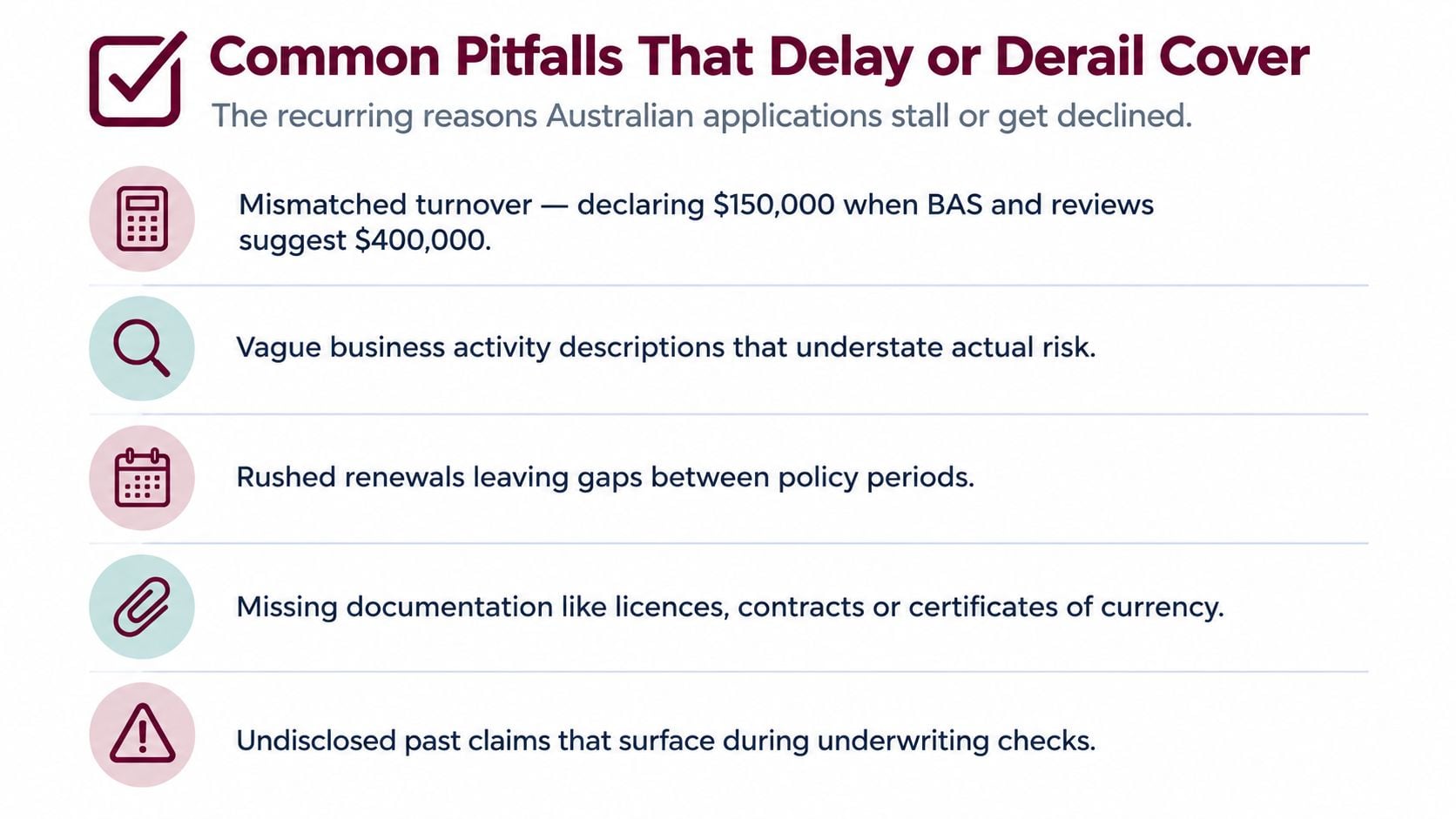
The first problem is mismatched turnover. If the turnover figure doesn't line up with what the business is doing, the insurer will usually ask questions or reassess the file. The second problem is vague activity descriptions. “Handyman services” is not enough if the business also does roofing, demolition support, or working at heights. The third problem is missing claims or incidents. Silence can be treated as non-disclosure, not as a harmless omission.
A fourth issue is subcontractor reliance. If the business uses contractors, labour hire, or principal-contractor arrangements, that has to be disclosed cleanly. A fifth issue is underestimating how long underwriting can take when the work is specialist or the contract requirements are strict. Construction, site access, and unusual activities all tend to trigger follow-up questions.
A five-minute pre-submission check
Run this before you send anything to a broker or insurer:
- Check turnover: make sure the figure matches your actual business activity.
- List all work: include higher-risk jobs, not just the easy description.
- Confirm subcontractors: note whether you use labour hire, subcontractors, or both.
- Gather documents: have licences, contracts, and any current certificates ready.
- Disclose incidents: mention claims, complaints, or circumstances that might lead to a claim.
If you're renewing, add the expiry date and confirm there won't be a gap between policies. If the business has changed over the year, update the description before the renewal hits the queue. Waiting until the last minute is what creates a no-cover Friday.
For a broader look at the difference between liability policies and other covers that often get confused, the professional indemnity vs public liability guide is useful for keeping the file clean.
Broker's habit: the quickest way to slow a quote is to send half the story and hope nobody notices.
ABS Insurance Brokers Pty Ltd helps builders, trades, and businesses arrange public liability insurance with the right limit, wording, and written confirmation for the job. If you need a clear, practical path from enquiry to bound cover, visit ABS Insurance Brokers Pty Ltd and send through the details before the next site deadline lands.