
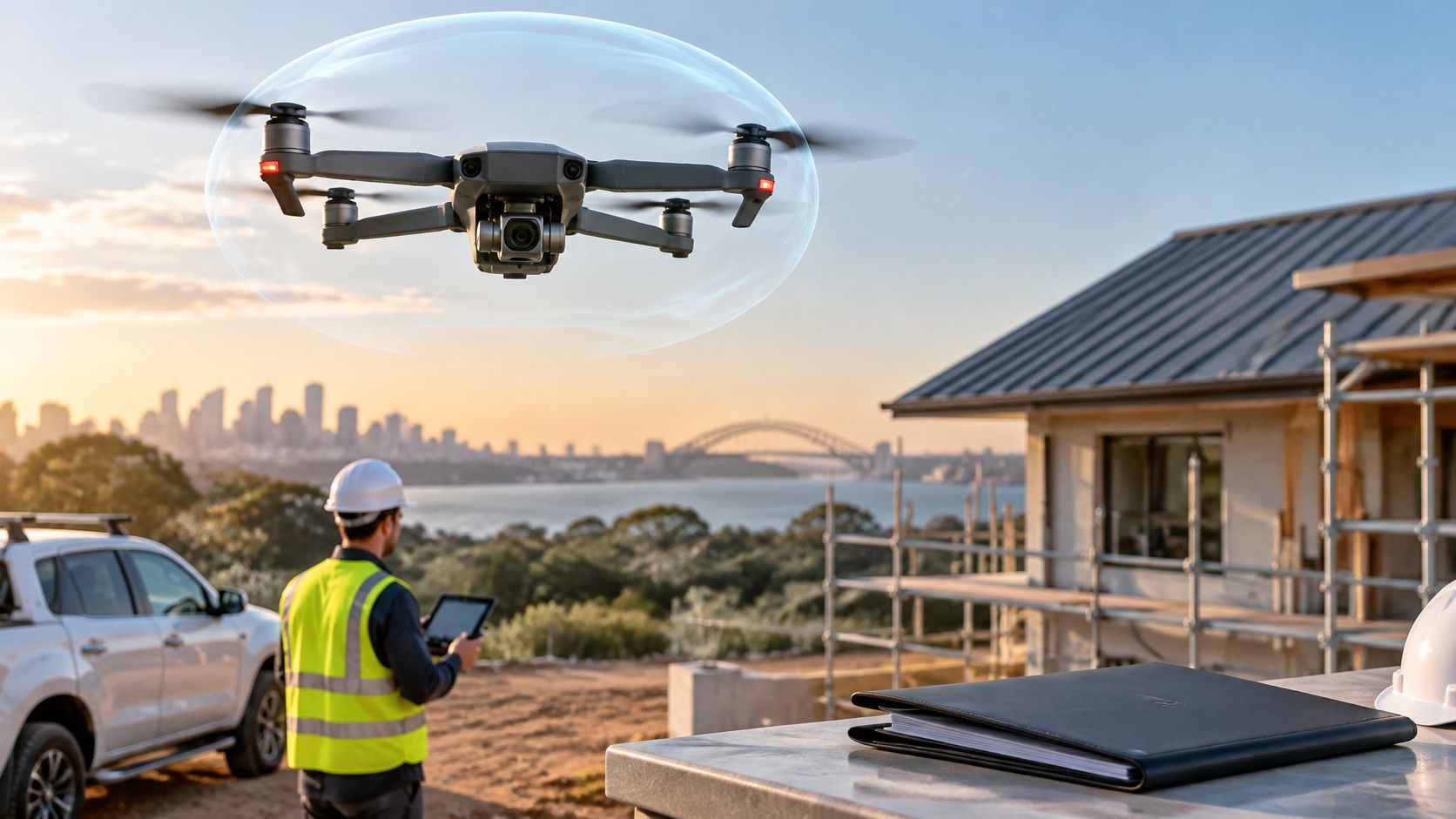
You have a roof inspection booked for Thursday, the drone is charged, and the builder wants photos before the scaffold comes down. The question that usually arrives too late is whether the policy you already hold will pay if the aircraft drops onto a car, a neighbour, or the roof you were meant to document.
That gap is a claims question, not a paperwork one. A CASA approval, a current pilot record, and the wording on the schedule decide whether a loss is paid. Permission to fly and an insurer's willingness to accept the risk are not the same thing.
Table of Contents
- Drone Insurance Cover Types at a Glance
- Third-Party Liability and Gaps in Standard Policies
- How to Assess Your Cover Needs Step by Step
- What Drone Insurance Costs and What Drives the Premium
- Cover for BVLOS and Automated Drone Operations
- Exclusions That Can Void or Reduce a Claim
- Confirm Your Cover Before Your Next Flight
Drone Insurance Cover Types at a Glance
Drone insurance is specialist aviation cover, not a line that sits inside a standard business package.
The need is already mainstream. CASA's sector demographics reported 2,802 holders of a Remote Operators Certificate (ReOC), 29,876 registered drones, and 36,271 remotely piloted aircraft licences (RePLs). Thousands of Australian organisations fly under regulation, and a conventional business policy may not respond to aircraft damage or aviation liability.
Drone insurance cover types, limitations and who needs them
| Cover type | What it pays for | Common limitation | Best suited to |
|---|---|---|---|
| Hull | Repair or replacement of the drone after accidental damage | Usually excludes wear, mechanical breakdown and sensor failure without impact | Owners and financiers of aircraft |
| Third-party liability | Injury to people and damage to property on the ground or in the air | Limited to the policy limit; may not respond to unlicensed flying | Any business flying for hire or reward |
| Equipment or payload | Cameras, gimbals, sensors and attachments | Often sub-limited below full equipment value | Photography, mapping and inspection operators |
| Professional indemnity | Financial loss from errors in a survey, report or inspection | Does not respond to physical damage to the aircraft | Consultants who sell drone-derived data |
| Non-owned aircraft liability | Liability when you fly a drone you do not own | Responds only where the wording covers hired or borrowed aircraft | Operators who hire or borrow drones |
Read the rows against the job, not against a brochure title.
Hull pays to repair or replace the aircraft after an impact. It usually won't pay for wear, a motor that fails in the hangar, or a sensor that dies without a strike. Owners and anyone financing the kit need this row.
Third-party liability is the row clients ask for. It responds to injury and property damage, on the ground or in the air, up to the limit on the schedule. Unlicensed flying can take it outside the policy. Any business flying for hire or reward should treat this as the starting point, and our guide to public liability versus hull cover sets the two side by side.
Equipment or payload covers cameras, gimbals and sensors. Insurers often cap it below the invoice you paid. Mapping and inspection operators should list each item.
Professional indemnity pays financial loss when a survey or inspection report is wrong. It does not repair a crashed airframe. Consultants who sell the data need both.
Non-owned aircraft liability matters when you fly someone else's drone. Hire wording has to say so.
Start with the aircraft's value, then the people and property under the flight path, then the commercial activity. Any row you can't match to your own work is a question for the insurer before you launch. If you fit replacement arms or brackets, keep the part numbers with the aircraft file. Suppliers of 3D printed drone parts are a useful reference when you need to describe a non-standard component on a schedule.
Third-Party Liability and Gaps in Standard Policies
A construction firm uses a drone to inspect a roof. Its public liability policy may cover a visitor who trips on site, yet that does not mean it covers a falling aircraft, damage to the drone, or a dispute over the inspection report. These are different exposures, and a standard business policy may not respond to aviation-related losses.
What the rules actually require
Australian aviation rules do not generally require RPA operators to buy public liability insurance. CASA's advisory circular on RPAS licensing and operations warns that injury and property damage can create significant liability. Landowners and public-land administrators may also ask for proof of insurance before allowing a flight. Insurance does not replace operational risk controls when CASA assesses a certified operator.
The claim question begins with the flight itself. If the pilot is unlicensed, the drone is unregistered, or a required approval is missing, the policy may not respond. Keep the records that show the flight was authorised and operated within the relevant conditions. A claims handler may ask for them.
For a commercial flight, liability can apply even if the operator was not careless. For example, if an aircraft used for paid real-estate photography falls onto a parked car, the operator may face strict liability for ground injury or property damage. The exact legal position depends on the circumstances, but the important point is that a claimant may not need to prove negligence.
Strict liability means a claim can succeed even when you did everything right.
What the safety record shows
The exposure is practical, not just theoretical. CASA's sector safety performance review recorded 939 encounters between remotely piloted aircraft and other aircraft from 2015 onward, and 76 accidents involving uncrewed aviation in 2024–25. These events do not all become insurance claims. They can, however, lead to injury, property damage, and a claim that turns on the policy wording and flight records.
Other disputes may sit outside aviation liability. A falling aircraft or payload can prompt trespass or privacy allegations. An inspection error may lead to a contractual dispute. Check whether the policy covers these exposures rather than assuming aircraft liability includes them.
Before a commercial flight, ask the insurer to confirm the following in writing:
- Named aircraft: serial number, maximum take-off mass, and payload.
- Declared activity: roof inspection, progress survey, or defect documentation, rather than a vague “aerial work” description.
- Flight and ground operations: including transit and set-up on site.
- Territory: the states and sites where you operate.
- Remaining exposures: trespass, privacy, and contract claims that may sit outside aviation liability.
Request a written list of covered and excluded activities. Compare it with the actual job, including any CASA approval conditions and pilot records. If the work does not match the declared activity, confirm cover before flying.
How to Assess Your Cover Needs Step by Step
Build one file before you ask for a quote. Insurers price what you can show them, and a missing serial number or an unnamed subcontractor is where disputes start.
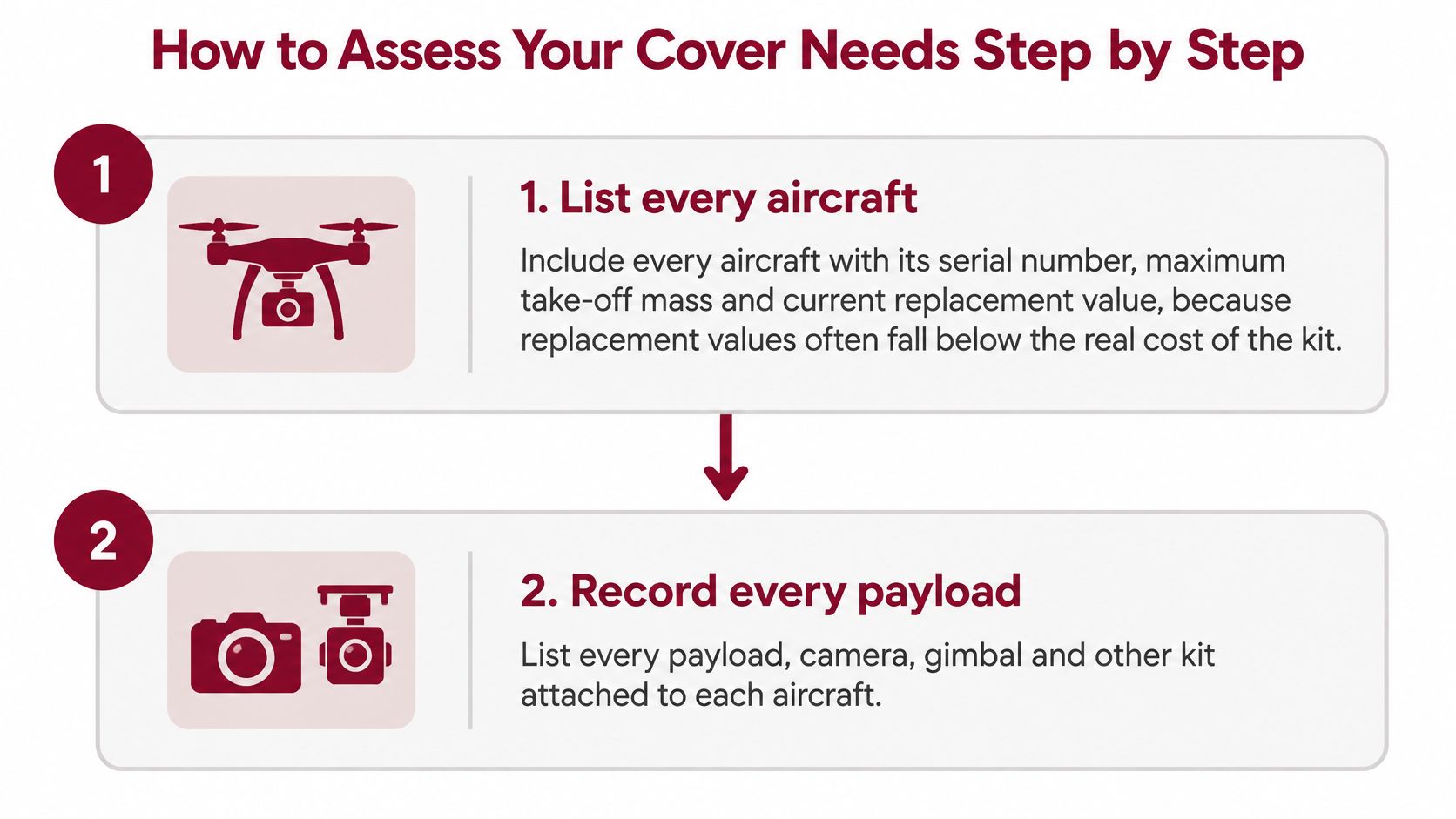
List every aircraft. Write the serial number, maximum take-off mass, and current replacement value, because the figure you remember from the invoice is often below the cost of the kit today. A common mistake is insuring the airframe and forgetting the spare you fly when the primary is in for service.
Record every payload. Cameras, sensors, and any lifting or spraying attachment change both the sum insured and the liability picture. Operators assume accessories are covered because they were in the box. They aren't, unless they're listed.
Map each operating location. Note how close people, roads, neighbours, and sensitive sites sit to the flight path. A rural paddock and a street of parked cars are different risks, even with the same aircraft. Skipping the neighbour's side of the boundary is the usual miss.
Confirm the commercial purpose of each job type. Construction inspection, survey, media, and agriculture drive different wording. Describing the work as general photography, when the client needs construction inspection cover, leaves the job outside the schedule. If you want a sense of how inspectors brief a roof from the air, Front Range roof assessments from above show the kind of job description a schedule should match, and our note on drone insurance for construction inspections and surveys walks through the wording builders usually need.
Check licence, training, and competency for every pilot. Include subcontractors. An unverified pilot is a common reason a claim is argued. A certificate in a drawer, with no record of who flew on the day, won't help.
Document maintenance, firmware, and service schedules. Insurers use these to judge how the aircraft is kept. A lapsed firmware note looks like neglect even when the crash had another cause. Log the update on the day you do it.
Note client, principal, or financier requirements. Minimum liability limits and named-insured wording have to appear on the policy, not in an email. Relying on a verbal figure is how a $10 million contract requirement turns into a $5 million schedule.
Compare the draft wording with this list. Flag every gap for the broker before you bind. Accepting a quote because the premium looks tidy, without reading the activity description, is the last and most expensive mistake.
A complete file is a one-page schedule of aircraft, activities, locations, and pilots that you can hand to any insurer.
The short video below shows how a simple pre-flight record supports that file.
What Drone Insurance Costs and What Drives the Premium
Premiums reflect the risk an insurer is asked to carry. Two quotes only compare if they're built on the same aircraft, the same limit, and the same activity. Our breakdown of what drone insurance costs in Australia is the place to line those inputs up.
The drivers, in the order they move the price
Aircraft value sets the hull premium and the sum insured. Undervaluing the kit trims the premium and leaves a gap on the day you replace it.
Liability limit is next. A higher limit costs more, and client contracts often set the minimum, so price to that figure rather than to the cheapest option on the screen.
Operation type changes the questions. Visual line of sight, beyond visual line of sight, and automated or multi-drone work are underwritten differently. Expect a different quote for each, not a single rate with a footnote.
Pilot records support better terms when licences and competency are verified and current. A new pilot with no log is priced as a higher risk than a pilot with a clean, documented history.
Excess and sub-limits trade premium for your own money. A higher excess lowers the premium and raises what you pay on each claim. Equipment sub-limits need to be checked against the actual camera and sensor invoices.
Compliance record is the last lever. Documented approvals and clean pilot records usually support a stronger quote than a file full of gaps.
Request every quote in writing with identical limits, excesses, and exclusions. If one insurer has excluded night work and another hasn't, you aren't comparing premiums. You're comparing different policies.
Cover for BVLOS and Automated Drone Operations
The licensed drone sector has outgrown the old picture of a hobby aircraft over a backyard. CASA told the RPAS Australian Skies Conference it had recorded 38,874 licensed drone operators by 1 May 2025, exceeding the 30,845 conventional crewed pilots, and a 46% five-year increase in authorisation holders from 3,674 to 5,355. Its broad-area beyond-visual-line-of-sight trial began in October 2025, and applications increased 57% in 2025 compared with 2024.
Permission isn't acceptance
A CASA approval lets you conduct the operation. It doesn't mean your insurer has agreed to insure it. If the schedule still describes visual line of sight over a single site, a new beyond-visual-line-of-sight approval doesn't rewrite that schedule.
There's a second assumption worth dropping. For automated or multi-drone work, the main exposure often isn't the replacement cost of the aircraft. It's accumulated third-party exposure from repeated flights over worksites, roads, neighbouring properties, or sensitive infrastructure. One low-value airframe, flown every day above a live road, can carry more liability than an expensive aircraft flown twice a month over a closed paddock.
Drone operation types and the evidence insurers may request
| Operation type | What it involves | Evidence an insurer may ask for |
|---|---|---|
| Visual line of sight | Pilot keeps the aircraft in sight | Pilot licence, flight logs and site plan |
| BVLOS | Flights beyond visual line of sight under CASA approval | Approval conditions, detect-and-avoid details and command-link information |
| EVLOS | Extended visual line of sight using observers | Observer roster, positioning procedure and incident logs |
| Automated or multi-drone | Software-run flights, sometimes several aircraft at once | Firmware versions, geofence settings, maintenance records and supervision roster |
After a loss, expect the insurer to ask whether the geofence was on, who supervised the flight, and what the command link was doing. Subcontractor use and incident logs belong in that same pack.
Any change in a CASA approval should trigger a policy review, not sit in a compliance folder until renewal.
Send the new conditions to your broker the week they're issued. Waiting until the next anniversary leaves every flight in between on yesterday's wording.
Exclusions That Can Void or Reduce a Claim
A drone crashes on a neighbouring property. The photos are clear, the damage is modest, and the pilot did what the manual says. Then the insurer asks for the remote pilot licence and finds it lapsed two months ago. The claim is disputed, and the operator pays for the fence, the car, and their own aircraft.
That's the pattern. Many exclusions aren't hidden traps. They're documentation gaps you can close before the job starts.
Common drone insurance exclusions and how to reduce them
| Exclusion or gap | Typical effect | How to reduce the risk |
|---|---|---|
| Unlicensed or unregistered operation | Cover may be voided, according to CASA guidance | Confirm licence, registration and approvals before each job |
| Flying outside approved areas or conditions | Claim may be declined or reduced | Keep operations within approved areas, altitudes and weather limits |
| Unapproved or untrained pilots | Claim may be contested | Record licence, training and competency for every pilot |
| Hire arrangements without written terms | Liability may fall outside the policy | Confirm non-owned or hire-and-reward wording in writing |
How each gap plays out
An unlicensed or unregistered flight is the hardest to rescue. If the aircraft wasn't registered, or the pilot wasn't licensed for that operation, the insurer can treat the flight as outside the policy. Check both before you leave the yard, not after the phone call.
Flying outside approved areas or conditions is more common than people admit. A wind limit, a no-fly radius, or an altitude cap in the approval is a condition of cover as much as a condition of the flight. If the site plan says 400 feet and the job needs 450, stop and vary the approval.
Unapproved pilots turn up when a subcontractor "just does this one flight." If that name isn't on your competency record, the claim can be contested even when the aircraft and the site were fine.
Hire without written terms leaves you arguing about whose policy should respond. If you borrow a drone for a week, get the non-owned or hire-and-reward wording confirmed in writing before the first take-off. Hull wear and mechanical breakdown sit with the aircraft cover, so don't expect a liability claim to repair a tired motor.
Keep an evidence folder for each job: the approval, the pilot record, the flight log, and the maintenance entry. If something goes wrong, that folder is what lets the claim be assessed quickly instead of argued for months.
Confirm Your Cover Before Your Next Flight
Take your assessment file and job evidence folder to a broker who arranges aviation cover. ABS Insurance Brokers serves clients across Australia, and its office locations include Bankstown, NSW. The brokerage offers aviation insurance, including aircraft hull and liability and cover for remotely piloted aircraft, subject to insurer acceptance and the individual risk. It holds Australian Financial Services Licence No. 700333.
Before accepting a quote, compare the written wording with the exclusions, check that the liability limit meets your client's requirements, and note the renewal date. If CASA approval or the work changes, ask the broker to review the policy. Developers using aerial imagery in commercial real estate entry strategies should still check that the flight itself is insured for its actual purpose and conditions.
For a quote, provide your aircraft details, pilot records and client limits. These help the broker assess whether the proposed cover fits the operation. ABS Insurance Brokers arranges specialist aviation cover for remotely piloted aircraft, including hull and liability options. Visit ABS Insurance Brokers Pty Ltd with your complete file before the next flight, and confirm the cover in writing rather than relying on an assumption.