

Professional Indemnity Insurance in Australia: Claims-Made Cover
Professional indemnity insurance in Australia should be assessed against the advice and services you provide, your contracts and the policy’s timing conditions. This guide focuses on claims-made cover, retroactive dates and continuity of insurance. Start with ABS’s professional indemnity service and prepare your current wording for a review.
For builders, consultants, engineers, designers, project managers and other technical advisers, that delay is the trap. A policy can look generous on paper and still fail if the timing, wording or history behind it is wrong. Professional indemnity insurance Australia is really about managing that long tail of exposure, not just buying a number on a certificate.
Table of Contents
- Professional indemnity insurance in Australia: why claim timing matters
- What Professional Indemnity Covers
- How Claims-Made Cover, Retroactive Dates and Run-Off Work
- Regulatory and Professional-Body Requirements Across Australia
- Setting a Limit That Matches Your Exposure
- Gaps That Keep Practitioners Licensed but Exposed
- How a Broker Places PI Cover That Fits
- Practical Steps and Questions to Ask Before You Renew
Professional indemnity insurance in Australia: why claim timing matters
A small consultancy finishes a set of drawings. The project moves ahead, the office archives the file, and everyone assumes the risk has passed. Then years later, a lawyer writes alleging the original advice caused financial loss, and the business owner realises the actual problem isn't the mistake alone, it's whether the policy in force now will respond to work done back then.
That's why PI catches so many professionals off guard. The loss often appears detached from the day-to-day business, but the claim grows out of a decision, a document, or a recommendation made long ago. Ordinary business insurance usually responds to physical damage or injury, not the financial loss that follows from professional judgement.
Practical rule: if the complaint is about what you advised, specified, certified, or signed off, PI is the policy you reach for first.
APRA's analysis shows the Australian PI market has become much broader than many people realise, with gross written premiums up 75% from 2015 onward and insured risks rising as well, which is a strong sign that more professions are relying on this cover across the economy (APRA analysis). That matters because PI is no longer a niche policy for a few white-collar occupations. It sits inside the risk profile of many construction and advisory businesses.
A useful way to think about it is this. Public liability protects you when something goes physically wrong. PI protects you when your advice, plans, reports or professional decisions create a financial loss that turns into a claim.
What Professional Indemnity Covers
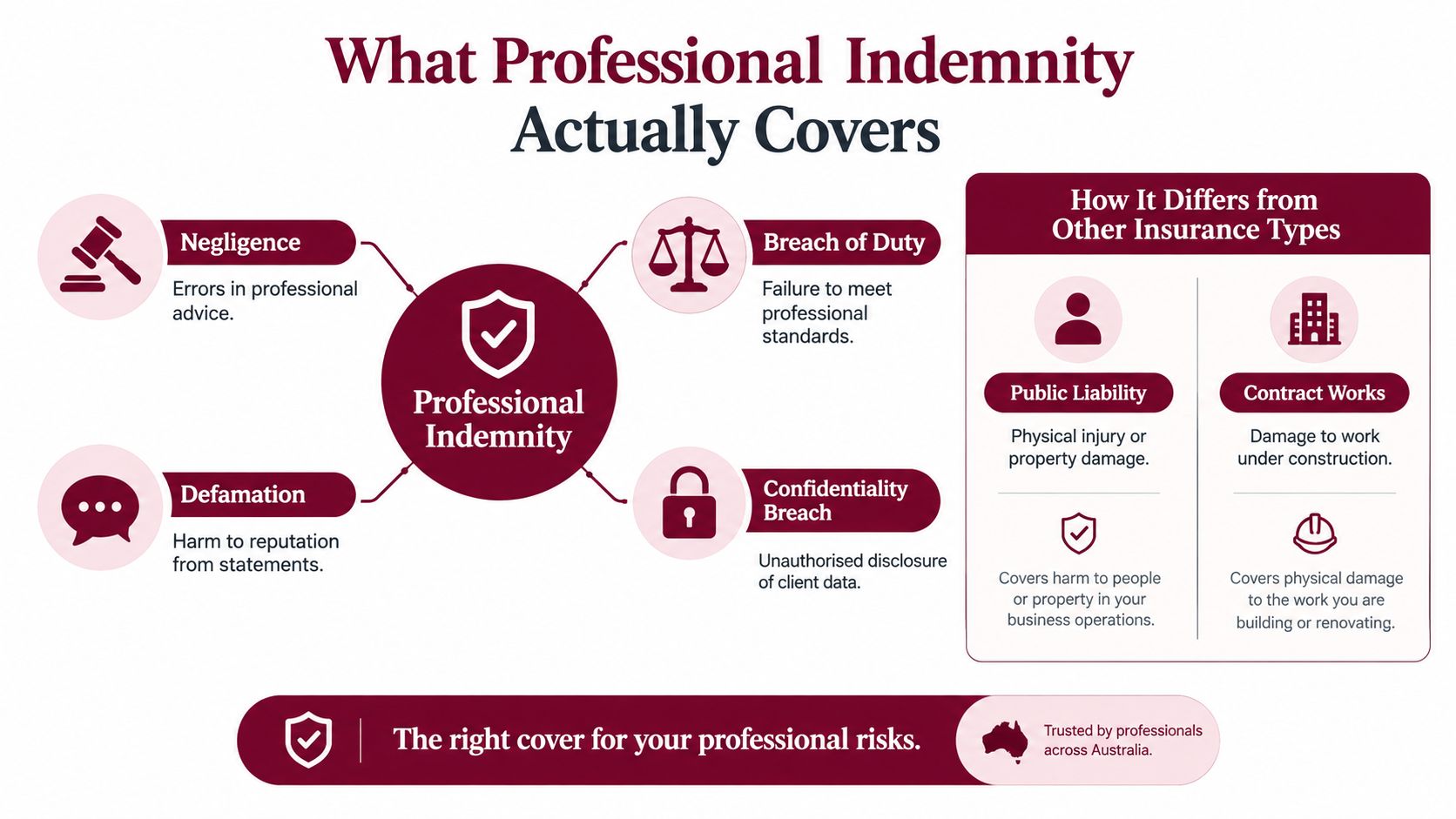
A professional can do the job carefully and still face a PI claim. The issue is usually not a broken pipe or a sprained ankle. It is the financial loss that follows when advice, design, certification, or another professional service is said to have fallen short.
The Australian Government Solicitor describes professional indemnity as protection for liabilities arising from professional practice, which is a practical way to read the cover (AGS professional-indemnity guidance). That matters because PI is not a general business safety net. It is the policy you look to when the complaint is about the professional work itself.
An architect and a builder can stand on the same site and face different exposures. The architect's problem often sits in plans, specifications, certification, or judgement calls. The builder's risk is more often public liability or contract works, unless the builder is also stepping into design, supervision, or project management.
PI usually responds to negligent advice or design, and it can help with settlement amounts and legal defence costs. Depending on the wording, some policies also deal with defamation or confidentiality allegations, which are often the sort of claim people do not expect until a letter arrives. That is why indemnity claims and cash flow can become part of the conversation as soon as a matter starts moving.
PI usually does not respond to bodily injury or property damage. Those losses generally sit with public liability. It also does not automatically follow every contractual promise, especially where a contract asks you to take on more than your ordinary legal duty.
A builder, consultant, or tradesperson who starts giving design input, approving details, or managing consultants can step into PI territory without changing job titles. A worksite accident and a professional mistake are different problems, and they sit on different policies.
How Claims-Made Cover, Retroactive Dates and Run-Off Work
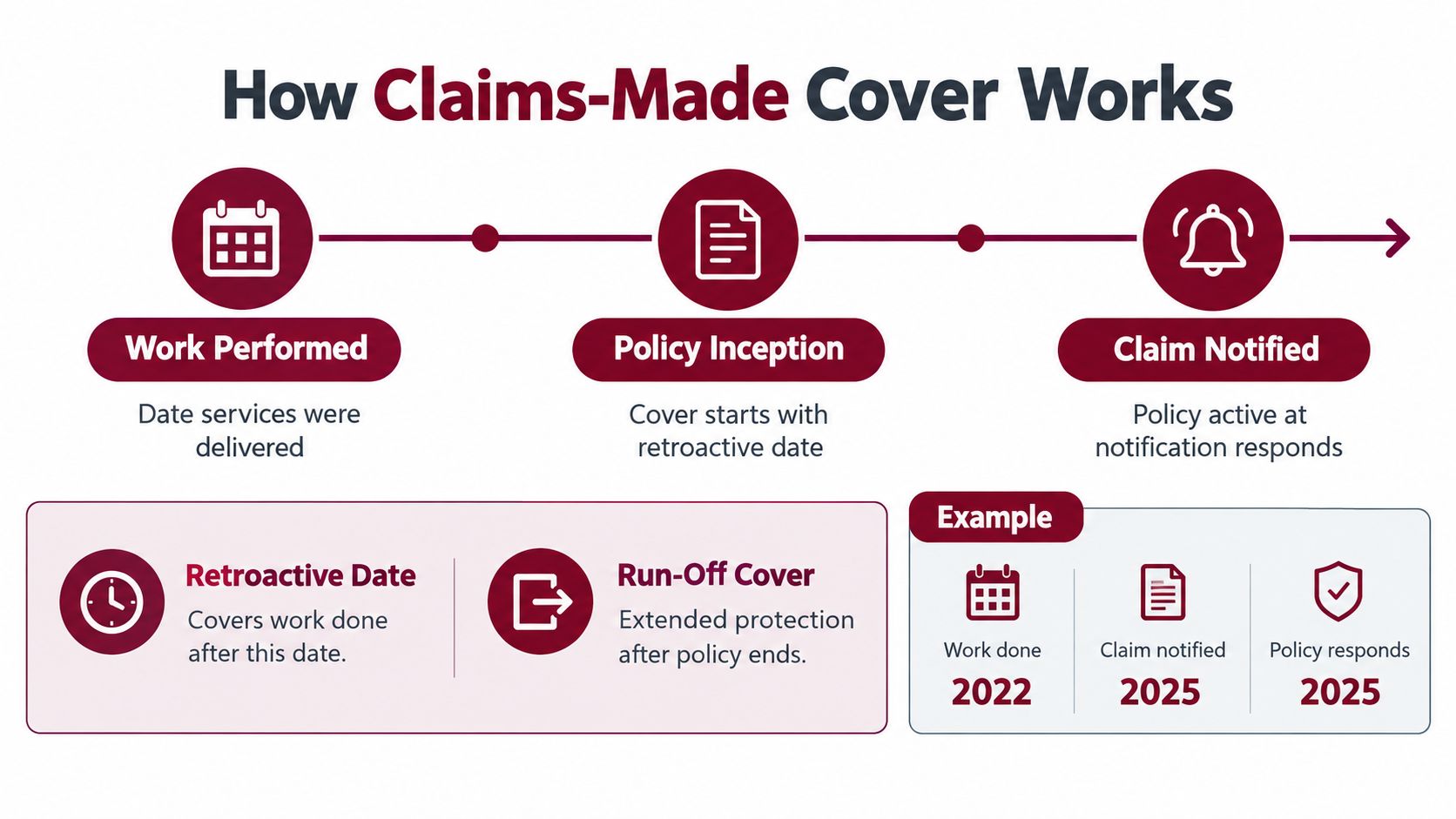
PI in Australia is usually written on a claims-made-and-notified basis. That means the policy that is active when the claim is made, or when you first become aware of a problem and tell the insurer, is usually the one that responds. It works differently from property or public liability cover, where the trigger is often the time of the incident.
A train line is a useful way to visualise it. The work happens first, the policy starts later with its own history attached, and the claim must arrive at the station that is running when it is notified.
The three levers that matter most
Retroactive date is the backstop. It tells you how far back the policy will reach for past work. If that date is wrong, or if cover has been interrupted, a later claim can fall into the gap.
Notification timing matters just as much. Insurer claims-made guides explain that circumstances need to be reported while the policy is still active, because waiting until the complaint grows teeth can leave you exposed when the formal claim lands. A small issue can feel harmless at the time, then become expensive later.
Run-off cover protects you after you stop practising, retire, or sell the business. The PSC guidance notes that professional bodies can require long-tail protection after cessation, which is why this part of the wording deserves the same attention as the limit itself.
A simple example makes the timing risk easier to see. Work is done in one year, the concern is first raised much later, and the policy that responds is the one in force when the matter is notified, not necessarily the one in force when the job was done. That is why a policy with the wrong history can leave a perfectly ordinary business exposed.
For practitioners facing long-tail liabilities, the policy is only half the job. The other half is keeping the history clean, the notifications prompt, and the post-practice cover alive for as long as the exposure can surface.
Regulatory and Professional-Body Requirements Across Australia
A PI policy can satisfy a file and still miss the underlying requirement. Across Australia, registration bodies, licensing schemes and professional associations may set the rules on cover features, insurer type and wording, and those rules shift with the occupation.
For public accountants, the PSC guidance requires eligible practices to use an APRA-regulated insurer and to hold cover with retroactive cover and at least seven years of run-off protection after cessation (PSC guidance). That shows the point clearly, PI is not only a limit on a policy schedule, it is also a compliance test.
NSW has its own wrinkle. Under the Design and Building Practitioners framework, cover must be adequate for liabilities arising from the work, but the legislation does not give every practitioner the same fixed minimum. The mandatory PI commencement has also been deferred to 1 July 2026, so firms have time to check whether their wording matches the role they perform, rather than waiting until an application is due (NSW Government Building Commission information).
Cladding risk is a separate pressure point. A policy can look fine on paper and still leave a gap if the wording excludes the kind of defect or advice that later turns into a claim. That is why the question is not just “do we have PI”, but “does the wording respond to the work we do?”
What tends to trip people up
- Adequacy is not a round number: A larger limit can still be wrong for the exposure.
- The role matters: Design, supervision and project-management duties can each create different risks.
- The insurer matters: Some bodies care who is carrying the risk, not only that cover exists.
For licensed credit businesses, ASIC expects PI arrangements to consider both per-claim and aggregate limits against potential AFCA compensation exposure. The lesson is simple. Regulators look at the full liability picture, not a single number on the certificate. For a broader comparison of cover types in construction, this internal guide on professional indemnity insurance vs public liability key differences is worth keeping nearby.
Setting a Limit That Matches Your Exposure
Choosing a PI limit is not a guess, and it is not just a matter of annual turnover. You need to look at how claims can build on each other, how defence costs are treated, how many jobs overlap at once, and whether your contracts create liabilities that stretch beyond the immediate client loss.
PI works like a long tail. The work is done, the invoice is paid, then a letter can arrive later and pull that old advice or design back into the frame. That is why the market's claims and premium data matters, and why older work can still generate new loss (APRA NCPD resources). Treasury has also described professional-liability claims as long-tail, and in its material it reported that financial-planner PI claims paid rose approximately fourfold over the cited five-year period. The lesson is not to copy another profession's number. It is to respect the way liability can surface well after the job is finished.
How to think about a limit
A low limit can vanish quickly once defence costs start drawing from the same pool. A mid-range limit may suit a smaller advisory business with limited aggregation. Higher limits make more sense where one mistake can affect a project, a development, or several clients at once.
| Common PI limit choices | Roles commonly choosing it | Exposure pattern it addresses |
|---|---|---|
| Lower tier limits | Sole practitioners, small consultants | Lower client values, simpler advice, limited aggregation |
| Mid-range limits | Builders with design input, project managers, certifiers | Several linked matters, moderate contract exposure |
| Higher limits | Engineers, large consultants, multi-dwelling projects | Bigger client losses, repeated reliance on one opinion, defence costs and aggregation |
A feasibility report relied on by a developer is a different risk from a one-off office visit. A building certifier signing off on multiple dwellings faces a different aggregation pattern again. In both cases, the important question is not which certificate is cheapest. It is what the largest believable loss looks like if your work sits at the centre of the claim.
Useful test: if your worst-case claim would need legal help, expert evidence and a client payout, do not size the policy as if only the payout matters.
Turnover can be a rough screen, but it should not be the anchor. A small practice can still create a large claim if the advice is tied to a high-value project, and that is where underinsurance starts to hurt.
Gaps That Keep Practitioners Licensed but Exposed

A valid certificate can still leave a practitioner exposed. You may be licensed, registered, or exempt, yet still carry a gap in the policy wording that leaves a claim unpaid. That risk shows up most clearly in NSW building work and in cladding-related exposures.
The NSW Design and Building Practitioners framework is broader than many people expect. The statutory duty of care is non-delegable, applies across building, design, supervision and project-management activities, and can reach back to work dating from 11 June 2010. The issue is whether the policy responds to your exact role, subcontracted design input, rectification exposure and contractual liabilities, not whether the certificate looks tidy in a tender pack. For a plain-English comparison with another common cover, see professional indemnity insurance vs public liability key differences.
Cladding creates a different problem. Independent policy analysis points to PI exclusions and rising premiums linked to combustible aluminium composite panels and expanded polystyrene, while Queensland has extended certain private-certifier exemptions, scheduled to run until 30 June 2027 (Productivity Commission attachment). A practitioner can keep working and still be left with an uninsured defect or remediation claim if the wording is too narrow.
Questions to ask before you renew
- Does the exclusion touch only the cladding material, or also adjacent design and certification decisions?
- Are defence costs inside the limit, or paid separately?
- How does the policy treat prior-known circumstances and legacy projects?
- Does run-off still work if the business changes structure or stops trading?
A useful broker reads the wording with you, not just the premium. The certificate can look compliant from the outside while still missing the issue that ends up in dispute.
The same caution applies to understanding AI abuse in justice. Different subject, same lesson, a system can appear sound while the problem sits in the detail underneath.
How a Broker Places PI Cover That Fits
PI placement starts with the work you do, not the label on your business card. A broker should ask what you advise on, what you sign, who relies on it, where subcontractors fit, and whether your contracts push liability beyond the ordinary duty of care. Once those facts are clear, the policy wording becomes a matching exercise rather than a shopping exercise.
A broker should also read the policy like a claims file waiting to happen. Defence costs, aggregation wording, and prior-known-circumstance exclusions can all change how a policy responds when a letter arrives years after the job is done. For practitioners in NSW, that reading also needs to include adequacy requirements under the Design and Building Practitioners regime, because the limit on the certificate is only part of the exposure picture.
Cladding needs the same care. Policy wording can leave gaps around combustible materials, adjacent design work, or certification decisions, so a practitioner can remain licensed and still carry an uninsured defect or remediation problem. A broker who knows the market will ask where those exclusions sit, then test whether the wording lines up with the work on the ground.
See how a broker structures PI placement step by step in this guide to PI broking.
Good PI placement is never finished after the certificate lands in your inbox. It gets revisited when your services change, your contracts change, or your project footprint changes.
A specialist Australian broker such as ABS Insurance Brokers Pty Ltd can sit in that conversation as one placement option among others, especially for builders, contractors and technical service providers who need a policy that matches the way they trade. That is not about chasing the cheapest quote. It is about making sure the wording lines up with the risk.
Practical Steps and Questions to Ask Before You Renew
Start with the basics. Pull out your current certificate, the policy wording, and any contracts that mention insurance. Then check that the retroactive date reaches back far enough for the oldest work that could still generate a claim.
Ask your broker these questions:
- Does defence cost sit inside the limit, or outside it?
- Does the policy respond if an old client raises a claim years later?
- Is there any cladding-related exclusion or prior-known-circumstance wording that could bite?
- What happens if the practice stops, merges or changes structure?
If you're not sure who should help coordinate the renewal, find a business advisor who understands how contracts, claims and insurance wording fit together. A good adviser won't replace a broker, but they can help you line up the commercial side of the decision.
The short version is simple. Don't renew on autopilot. Renew with the oldest project, the messiest contract, and the most awkward claim scenario in mind.
ABS Insurance Brokers Pty Ltd helps Australian builders, trades, developers and commercial clients arrange professional indemnity insurance that matches the work they do. If you want help reviewing retroactive dates, exclusions, run-off, or whether PI sits correctly beside your public liability and contract works cover, visit ABS Insurance Brokers Pty Ltd and start the conversation.