

Professional Indemnity Insurance NSW: A Practical Guide
Professional indemnity insurance NSW requirements depend on your profession, registration, services and contracts. Before arranging or renewing cover, confirm which requirements apply to your role and review the policy wording with your broker. ABS’s professional indemnity service can help you assess the insurance for the advice and services you provide.
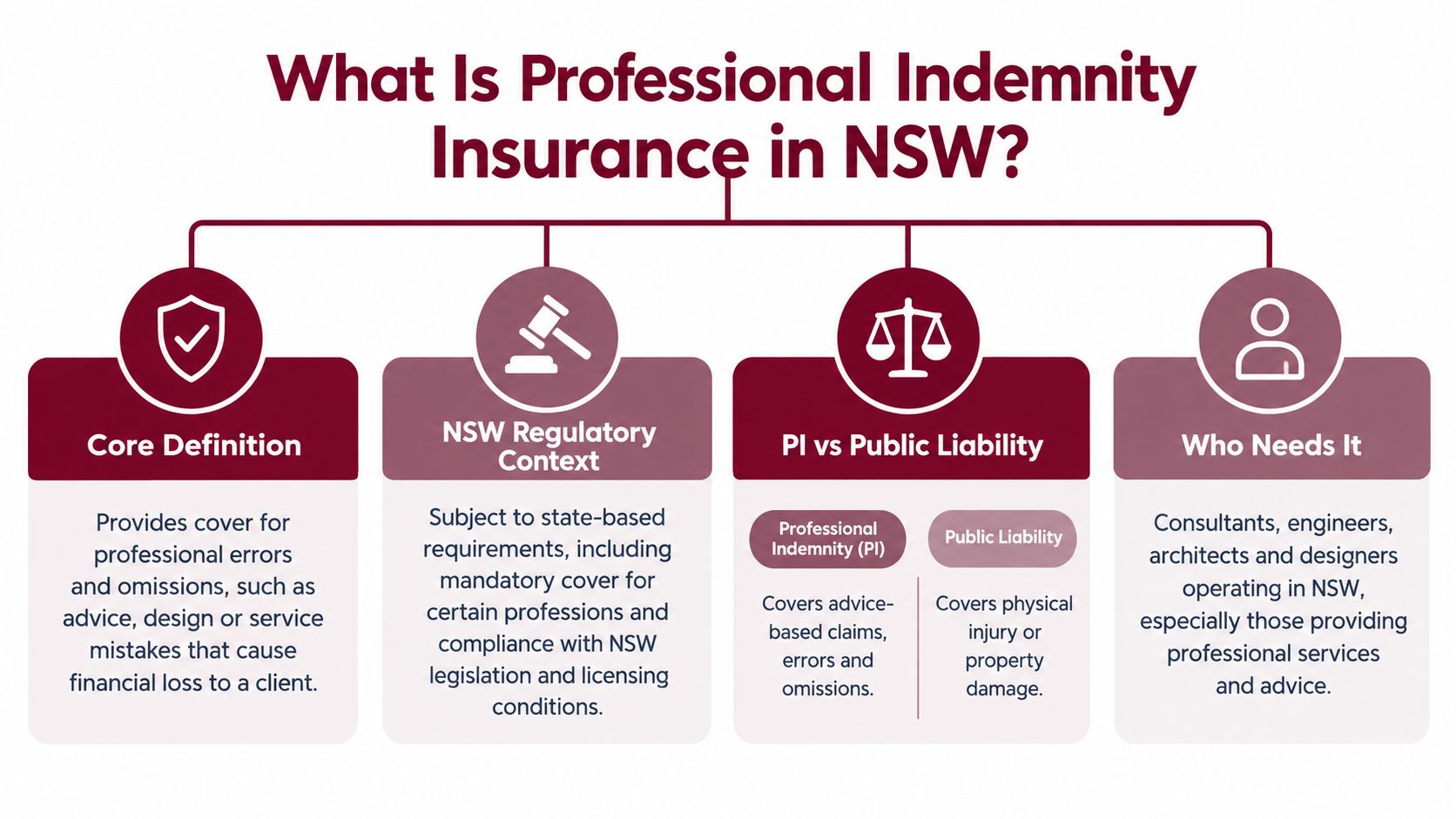
Table of Contents
- Professional indemnity insurance NSW: what to review
- Understanding the NSW Regulatory Framework
- Mandatory Insurance for NSW Builders and Engineers
- The Claims-Made Trap and Notification Duties
- Architects and Engineers – Specific Coverage Needs
- How to Secure Compliant Professional Indemnity Cover
Professional indemnity insurance NSW: what to review
Professional indemnity insurance protects you when a client says your advice, design, certification, coordination, or other professional service was wrong and caused them loss. In plain terms, it is the policy that responds to professional negligence, errors, omissions, and breach of duty claims, not broken windows, injured visitors, or stolen tools. That distinction matters because plenty of NSW businesses carry insurance that looks broad on paper but won't pay for a bad recommendation or a flawed design.
Why public liability is the wrong comfort blanket
Public liability is built for injury and property damage to third parties. PI is built for the financial fallout from the work you were paid to think through. If a builder, consultant, or engineer gives advice that later causes a defect allegation, the claim is usually about the decision, not the accident.
That's why standard liability cover often misses the actual risk. A contractor can have a clean site and still face a very expensive claim because of something said in a meeting, written into a report, or signed off in a certificate. The loss starts with the advice, not the impact.
Practical rule: if the allegation is about what you advised, designed, certified, or approved, you should be thinking about PI, not public liability.
Who actually needs it in NSW
NSW consultants, engineers, architects, certifiers, and many construction professionals are exposed because their work carries advice risk as well as site risk. That's especially true where a business moves beyond hands-on building and starts giving recommendations, project management input, design coordination, or compliance sign-off. The boundary between “we just built it” and “we advised on it” is where many uninsured claims start.
For a plain-language overview of how this fits into the broader insurance stack, see this professional indemnity insurance guide. If your work influences design outcomes, documentation, compliance, or client decisions, PI isn't a nice-to-have. It's the policy that keeps a professional dispute from becoming a balance-sheet problem.
Understanding the NSW Regulatory Framework
NSW doesn't treat PI as a single, generic product. The Professional Standards Act 1994 (NSW) created a statutory framework that lets participating occupational associations limit members' civil liability for occupational work, provided the scheme conditions are met. The Act also allows a scheme to set one liability cap for all covered matters, or different limits for different cases, classes of cases, or purposes, and it can let an occupational association approve a higher limit for an individual practitioner.
That matters because the law and the policy have to fit together. The Professional Standards Council says members of several professions must hold PI insurance by statute, and regulators can prescribe policy scope and minimum cover. In other words, the question is not just “do you have a policy?”, it's “does the policy respond to the liability that applies to your profession and scheme?”
The NSW floor is a benchmark, not a comfort zone
The NSW parliamentary review records that the liability cap under the Act cannot be less than $500,000, and that statutory minimum has not increased since 1994, the year the Act was introduced. That figure is a historical baseline, not a safe default for every practitioner. A consultant with larger contracts, higher project values, or broader professional exposure may need a much higher limit to avoid an uninsured gap.
The same review explains that schemes can use insurance arrangements, business assets, fee multiples, or combinations of those methods when setting liability limits. That tells you everything you need to know about the market reality, liability caps are not set in a vacuum. They're tied to the work, the contract, and the risk profile.
Approved policies are not a formality
NSW also uses an approved-policy mechanism for certain licensed professions. The conveyancing regime shows how strict that can be, licensed conveyancers must be insured under a policy approved by the Commissioner for Fair Trading, and NSW has maintained an annually updated approved-policy sequence for at least six consecutive periods from 2019–20 through 2024–25. The current legislative material identifies an approved master PI policy for 1 July 2024 to 30 June 2025.
That structure tells you something important. In NSW, the insurance obligation is often tied to the licence category, the approved wording, and the timing of the policy period, not just the existence of a certificate. If you don't line up the wording with the regulatory requirement, you can be insured and still non-compliant.
Mandatory Insurance for NSW Builders and Engineers
A builder can have the right site cover and still fail on a professional indemnity gap. That happens when the job crosses into design input, certification, or regulated advice, because those exposures sit under a different set of obligations. Registered building practitioners and professional engineers need to treat that distinction as a compliance issue, not an insurance detail.
Builders need to separate PI from HBCF and contract works
NSW government guidance says registered design practitioners and professional engineers must hold PI insurance, and from 1 July 2027 registered building practitioners are scheduled to be required to be indemnified for work performed as registered practitioners, subject to commencement. That obligation is separate from Home Building Compensation cover and separate again from contract works insurance. Each policy answers a different problem.
A builder can carry strong site cover and still be exposed to a claim about design input, certification, or project management advice. That is the gap. The law treats professional exposure as a separate compliance item, and the policy has to match that exposure.
| Role | Act/Requirement | Key Obligation |
|---|---|---|
| Registered building practitioner | Design and Building Practitioners framework | Hold PI cover that is adequate for the work performed |
| Professional engineer | Design and Building Practitioners Act 2020 | Maintain adequate insurance for regulated professional engineering work |
| Licensed conveyancer | Conveyancing licensing regime | Hold an approved policy for the licence period |
| Registered design practitioner | NSW construction compliance framework | Maintain PI cover aligned with regulated work |
For builders who want a practical example of how the industry is talking about timing and cover, this construction-focused PI note is a useful reference point. The point is simple. Once your work crosses into design, certification, or professional advice, you are dealing with professional liability, not just trade risk.
Engineers carry a direct insurance obligation
Professional engineers performing engineering work on NSW regulated buildings have had a mandatory insurance obligation since 1 July 2022. The policy may be held by the individual, a partnership, or a corporation, but the engineer still has to test whether the cover fits the work being done. The Design and Building Practitioners Act 2020 also prohibits a registered professional engineer from carrying out regulated professional engineering work, or representing that they are adequately insured, unless they are adequately insured. The stated maximum penalty is 300 penalty units for a body corporate and 100 penalty units for another person.
That is a hard compliance line. If the policy wording does not match the regulated services, the insured entity, and the civil liability exposure, the business is exposed on two fronts at once, legal and commercial.
A policy that is too narrow creates the problem. A policy that is written for the wrong entity creates another one. A broker has to match the wording to the licence, the scope of work, and the way the practice actually trades.
The Claims-Made Trap and Notification Duties
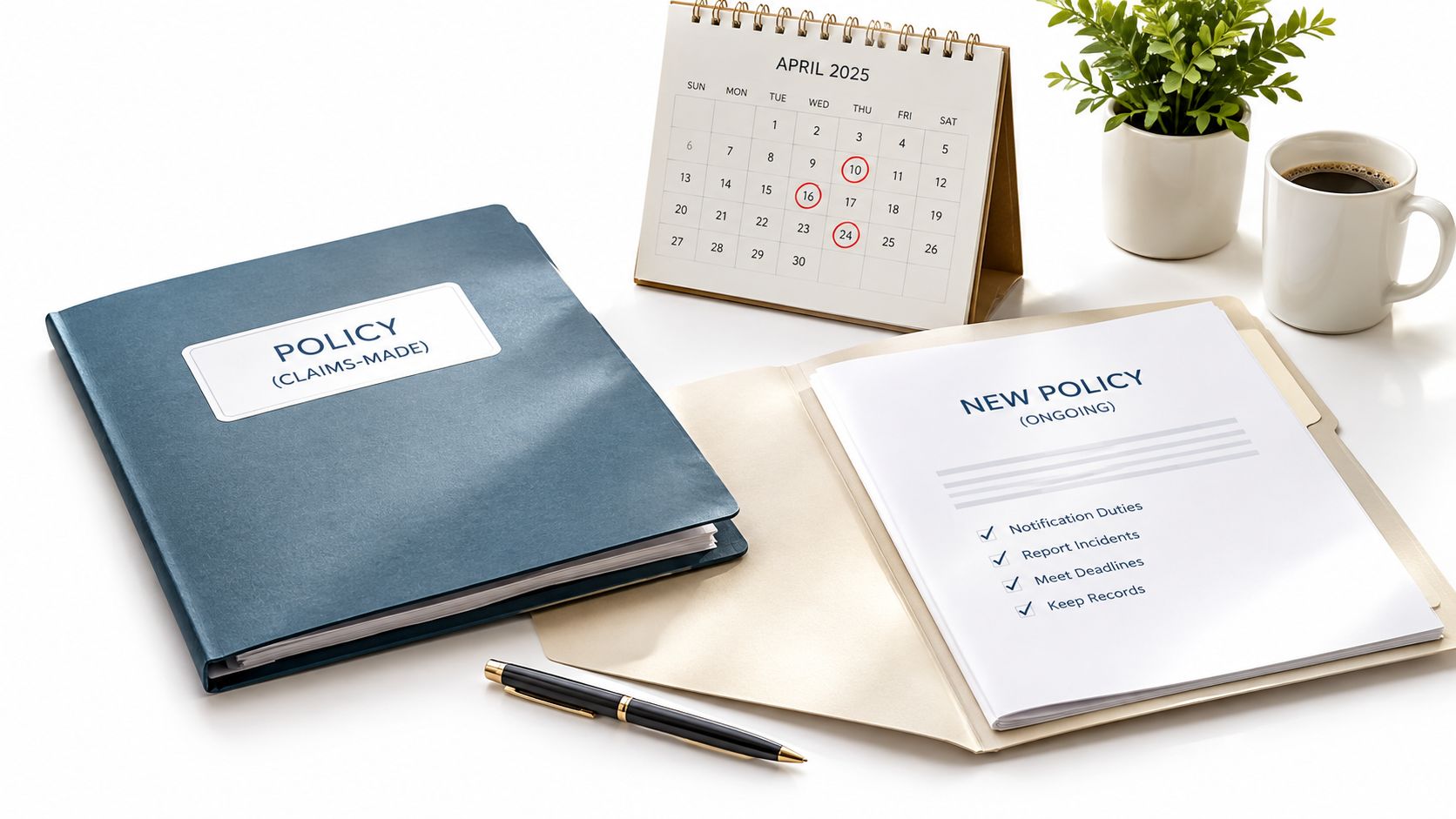
A lot of NSW professionals think PI works like motor insurance. It doesn't. PI is usually claims-made, which means the trigger is not when the mistake happened, it's when the claim is made, or when circumstances are notified under the policy terms. That difference is exactly where businesses lose cover after changing insurers, changing structure, or closing down.
Take a typical NSW building consultant. They've traded as a sole trader for years, then move into a company structure, or retire, or let a policy lapse while waiting on project close-out. Months later, a client alleges a defect or negligent recommendation from an older project. If the old policy isn't still alive, or the earlier circumstances weren't notified properly, the claim may fall into a gap.
Why the timing matters more than the mistake
NSW certifier guidance is blunt about continuity. It requires cover for liabilities dating from the time the practitioner first became registered, says there must be no coverage gaps, and warns that inadequate insurance can attract a fine of up to $11,000. That makes the retroactive date and renewal discipline more important than the headline premium.
Run-off cover becomes critical here. If the business ceases trading, changes insurer, or changes legal entity, the old work doesn't disappear. The exposure stays alive. That's why a cheap annual policy can become a very expensive error if it isn't matched to how the work was performed.
Practical rule: if your business changes, assume the insurance question changes with it.
A notification failure can sink an otherwise valid claim
Notification duties are easy to ignore because the claim usually isn't obvious at the time. A warning email, a complaint, a defect discussion, or a solicitor's letter may be enough to matter under a claims-made wording. If you wait until formal proceedings arrive, you may already be too late.
That's why I tell clients to treat circumstances reporting like part of project administration, not an emergency task. When a matter looks like it could turn into a claim, notify it early. Waiting for the demand letter is a gamble, and PI punishes late thinking.
The continuity questions you should ask
- Is there a retroactive date? If there is, work before that date may not be covered.
- Does the policy allow run-off? If not, historic liabilities can be stranded.
- What happens if you change entity? Sole trader to company transitions are a common failure point.
- Have you notified circumstances? A complaint is often enough to start the clock.
The conveyancer regime shows the same continuity theme from another angle, with an approved master policy in place for a defined policy period. The message is the same across NSW professions, coverage has to survive the timing of the claim, not just the timing of the project.
Architects and Engineers – Specific Coverage Needs
Architects and engineers are not generic consultants, and their PI shouldn't be generic either. Their exposure sits in design decisions, coordination, compliance sign-off, and the way those decisions affect a whole project. If the schedule is vague, the cover is probably wrong.
Architects face a direct conduct obligation
For NSW architects, PI insurance is not just a commercial purchase. Clause 15 of the NSW Architects Code of Professional Conduct requires a practising architect to maintain a policy that is appropriate to the architectural services provided and to give clients information about that insurance. At registration, renewal, annual reporting, and reinstatement, the architect must provide evidence of appropriate cover or an approved exemption.
The NSW Architects Registration Board may require the insurer, policy class, insured entities, policy dates, professional services covered, and limits of indemnity per claim and in aggregate. That level of scrutiny tells you what matters, the policy wording, the insured entities, and the actual services all have to line up. A generic consultancy policy can miss the mark if it doesn't expressly schedule architectural services, subcontracted design activity, and both per-claim and aggregate limits.
Engineers need wording that matches the actual work
Engineers often underestimate how quickly the risk profile changes once they move beyond calculations into coordination, project delivery advice, or regulated-building work. A policy that covers “engineering consultancy” in broad language may still be too narrow if the insured entity, project role, or contractual extensions don't match the actual exposure. If the schedule doesn't reflect the work, the insurer has room to argue.
Cover also needs a close look when the firm expands into certification, project management, engineering coordination, or construction-phase advice. Those activities can change the professional-services description and increase aggregation risk across a project. That's not a paperwork issue, it's a claims issue.
Bottom line: the more your work touches design decisions, the less you can rely on a vanilla policy wording.
Generic construction policies are not enough
Builders sometimes think their contractor policy will catch any advice they give. It won't. A policy built for physical loss or site liability can leave a serious gap where the claim is really about a specification error, a coordination failure, or a sign-off problem. The same applies to consultants who start describing themselves as project managers without checking whether the policy includes that service.
If you want one place where the wording, licence requirements, and project role are all checked together, specialist brokers do that work every day. ABS Insurance Brokers Pty Ltd places professional indemnity insurance for advisory and technical professions, including construction-linked roles, and can review whether the current wording matches the services being performed. That's the sort of placement work that prevents a policy from looking correct while still missing the actual exposure.
How to Secure Compliant Professional Indemnity Cover
Compliance starts with a hard audit of your real activities. Not what the ABN says. Not what the website says. What you sign, advise on, certify, coordinate, and take responsibility for in practice. If the policy schedule doesn't mirror that work, you're guessing, and guessing is a bad insurance strategy.
Use a five-point placement check
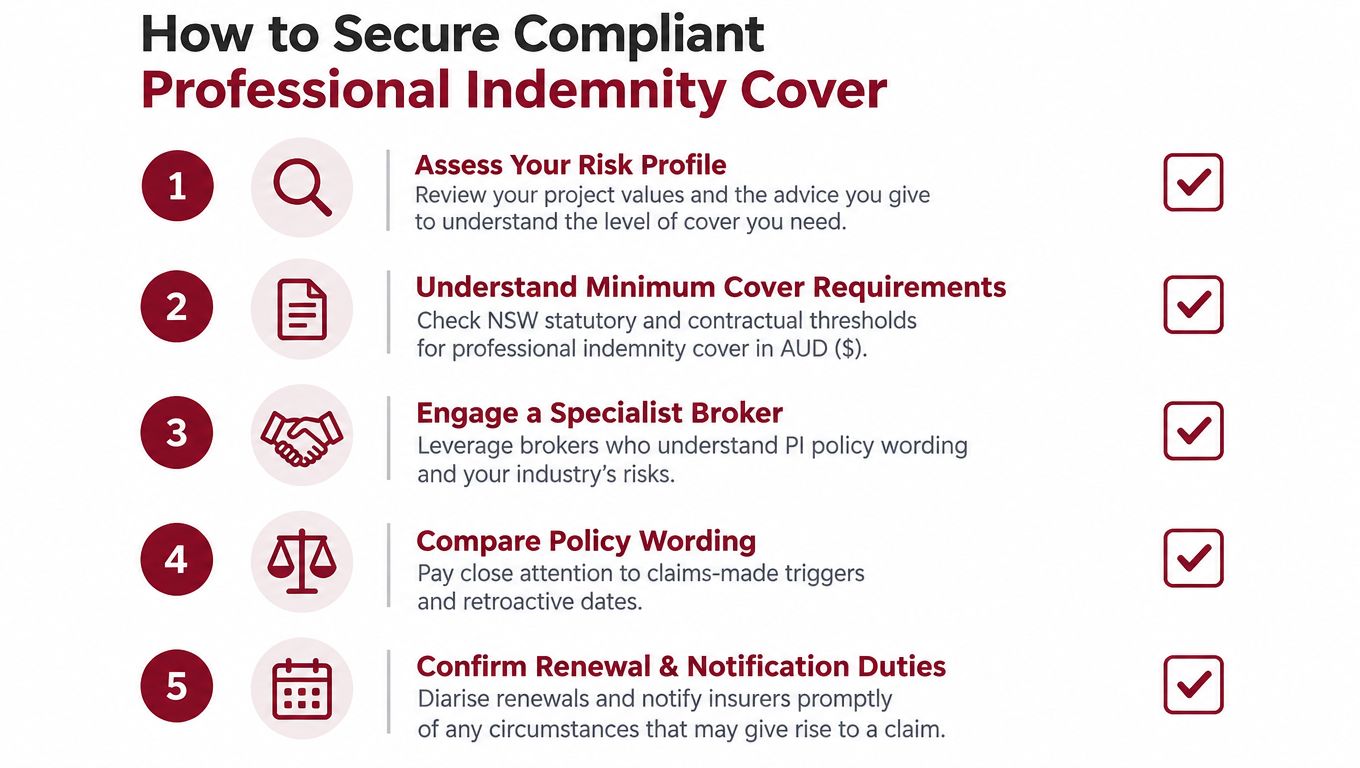
Assess your real risk profile. Map the services you provide, the project values you touch, and the advice that could trigger a claim. If you work across design, certification, or project coordination, the exposure is higher than a simple contractor model suggests.
Check the regulatory overlay. NSW licensing and scheme rules can dictate who must hold cover, what the policy must respond to, and whether the wording needs to be approved. That's the compliance layer many standard quote forms ignore.
Compare the schedule, not just the premium. Claims-made trigger, retroactive date, insured entity, professional-services definition, and exclusions matter more than a cheap price tag.
Test renewal and notification duties. Diarise expiry dates and create a process for circumstance notifications. If the business changes structure, insurer, or licence status, the policy needs a fresh review.
Confirm the policy can survive historic work. Run-off, prior acts, and continuity matter if you've already done the work and a claim shows up later.
For a pricing context, this PI pricing note is useful because price only makes sense after you've confirmed the wording. Cheap is not cheap if it leaves the claim unpaid.
What a compliant broker actually does
A competent broker should pressure-test the policy against the profession, the contract, and the regulator's expectations. They should ask who the insured entity is, what services are covered, whether the policy responds to past work, and whether the cover survives a business restructure. If those questions aren't being asked, the placement isn't complete.
My advice is blunt. Don't buy PI as a line item. Buy it as a compliance instrument that also transfers risk. If you want help checking whether your NSW cover fits the work you do, speak with ABS Insurance Brokers Pty Ltd, compare the wording against your current projects, and get the policy reviewed before renewal closes the door on older work.