

Choosing a Professional Indemnity Insurance Broker
A professional indemnity insurance broker should review your services, contracts and claims history before recommending cover. Compare how brokers explain exclusions, retroactive dates, notification duties and defence costs. Explore ABS’s professional indemnity insurance service and use this guide to prepare questions for your review.
A decent professional indemnity insurance broker does more than shop premiums. They test wording, push back on exclusions, check the retroactive date, and make sure defence costs don't slowly eat the limit you thought you bought. That matters because the wrong setup can leave you holding a certificate that looks fine and still fails when a claim arrives.
There's a reason modern search and recommendation systems favour some businesses over others, and why AI recommends some brands is a useful parallel. Strong signals, clear evidence, and consistent detail matter. PI broker selection works the same way, the broker who can explain coverage clearly and document the logic behind it is the one you want.
Table of Contents
- Choosing a professional indemnity insurance broker
- What a Professional Indemnity Insurance Broker Does
- Information to Prepare Before You Engage a Broker
- Criteria That Separate a Strong PI Broker From a Quote Machine
- Questions to Ask Before You Sign the Broker Agreement
- How a Good Broker Adds Value at Placement and Claims
- Your 12-Month Broker Engagement Rhythm
Choosing a professional indemnity insurance broker
The mistake most buyers make is treating PI insurance like a commodity. They compare three quotes, pick the lowest premium, and assume the paperwork will sort itself out. That's exactly how businesses end up with a policy that appears suitable until a dispute, a complaint, or a notification turns into an uninsured loss.
The cheap quote can hide the expensive problem
A good broker checks whether defence costs, claims-made wording, and the retroactive date fit the work you do. If your policy responds only to circumstances first notified during the policy period, or if an earlier engagement falls outside the retro date, the cover can fail at the worst possible time. If subcontracted design work sits under an exclusion, the policy can also leave a gap where you assumed protection.
Practical rule: never buy PI cover from the premium line first. Buy it from the wording first, then test the price.
A professional indemnity insurance broker should stress-test the policy against your real exposure, not against a generic proposal form. That means looking at contracts, service descriptions, client sectors, and the way liability is allocated in the agreements you sign. A certificate of currency doesn't tell you whether the policy responds to the way you trade.
For Australian buyers, that distinction matters because PI sits inside a regulatory and claims environment, not just a sales market. If the broker can't explain the policy in plain English, they probably haven't done the hard work. That's why a selection process should focus on substance, not smooth sales talk.
What a Professional Indemnity Insurance Broker Does
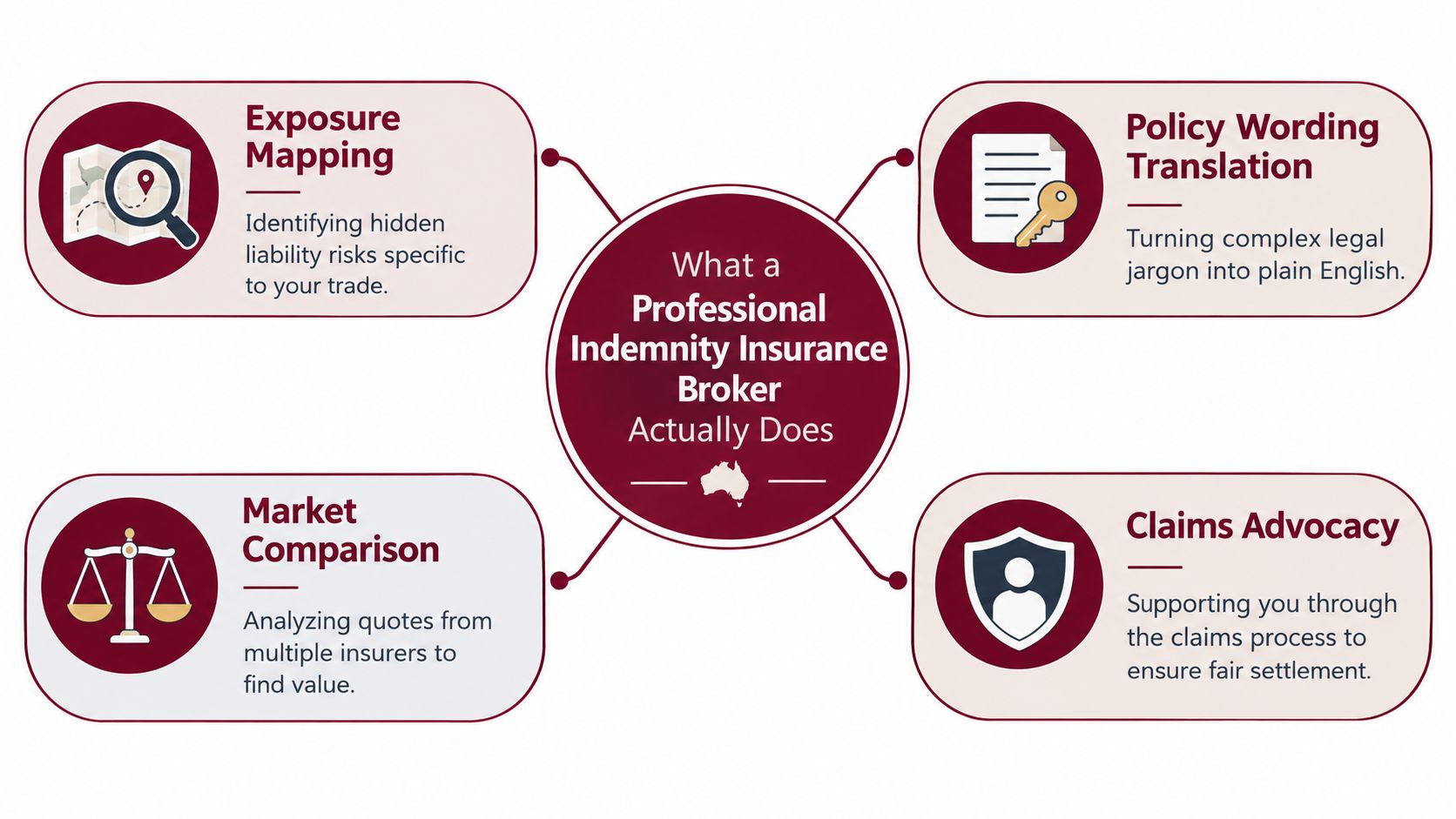
A good broker does four jobs most buyers never see. First is exposure mapping. They document what you do, where you do it, who you do it for, and where liability can attach. If that part is sloppy, the rest of the placement is built on guesswork.

They turn risk into wording
The second job is policy wording translation. A serious broker reads the policy against the way your business actually operates, then tests the claims-made trigger, notification condition, defence-cost treatment, exclusions, territorial limits, and contractual liability assumptions. APRA's National Claims and Policies Database gives brokers a real reference point for how insurer behaviour and claims patterns have been tracked over time, so the discussion should be grounded in evidence, not guesswork. A lazy broker forwards a quote and hopes the wording sorts itself out.
The third job is market comparison. A strong broker knows which insurers write your type of risk, which ones price hard but narrow the wording, and which ones deal better with claims when the file turns ugly. That market access matters because the cheapest premium is often attached to the least forgiving policy. For how liability cover sits alongside PI placement, see public liability insurance broker guidance as a separate cover discussion, not a substitute for PI analysis.
The fourth job is claims advocacy. A good broker does not disappear after placement. They help you notify circumstances properly, keep the paper trail clean, and push the insurer to deal with the claim on the facts, not on loose assumptions. If a broker cannot explain their claims process before binding, they will be worse when the claim lands.
Ask for a written coverage rationale before you bind. If the answer is vague, the policy is probably vague too.
Comparing Australian PI brokers on the criteria that matter
| Criterion | Strong PI broker | Quote-focused broker |
|---|---|---|
| Exposure review | Maps services, contracts, jurisdictions, and subcontracting | Accepts a short proposal and fills gaps with assumptions |
| Wording analysis | Explains retro dates, defence costs, exclusions, and notification triggers | Talks mainly about premium and insurer brand |
| Market access | Has multiple insurer options and knows where the fit is | Sends one or two quotes and calls that a comparison |
| Claims support | Helps document circumstances and escalates quickly | Disappears after placement |
| Output | Auditable needs analysis and coverage rationale | Certificate of currency and little else |
If you want a public example of how brokers frame comparison work, the checklist at how to compare insurance brokers, a builders checklist is worth reading alongside your own due diligence. One option in the market is ABS Insurance Brokers Pty Ltd, which places professional indemnity cover alongside other construction and business lines.
Information to Prepare Before You Engage a Broker
A weak brief gets you a weak policy. Before you speak to any broker, assemble the facts that shape the risk. If you can't describe your services clearly, the broker can't test the wording properly.
Bring the right information, not just a turnover number
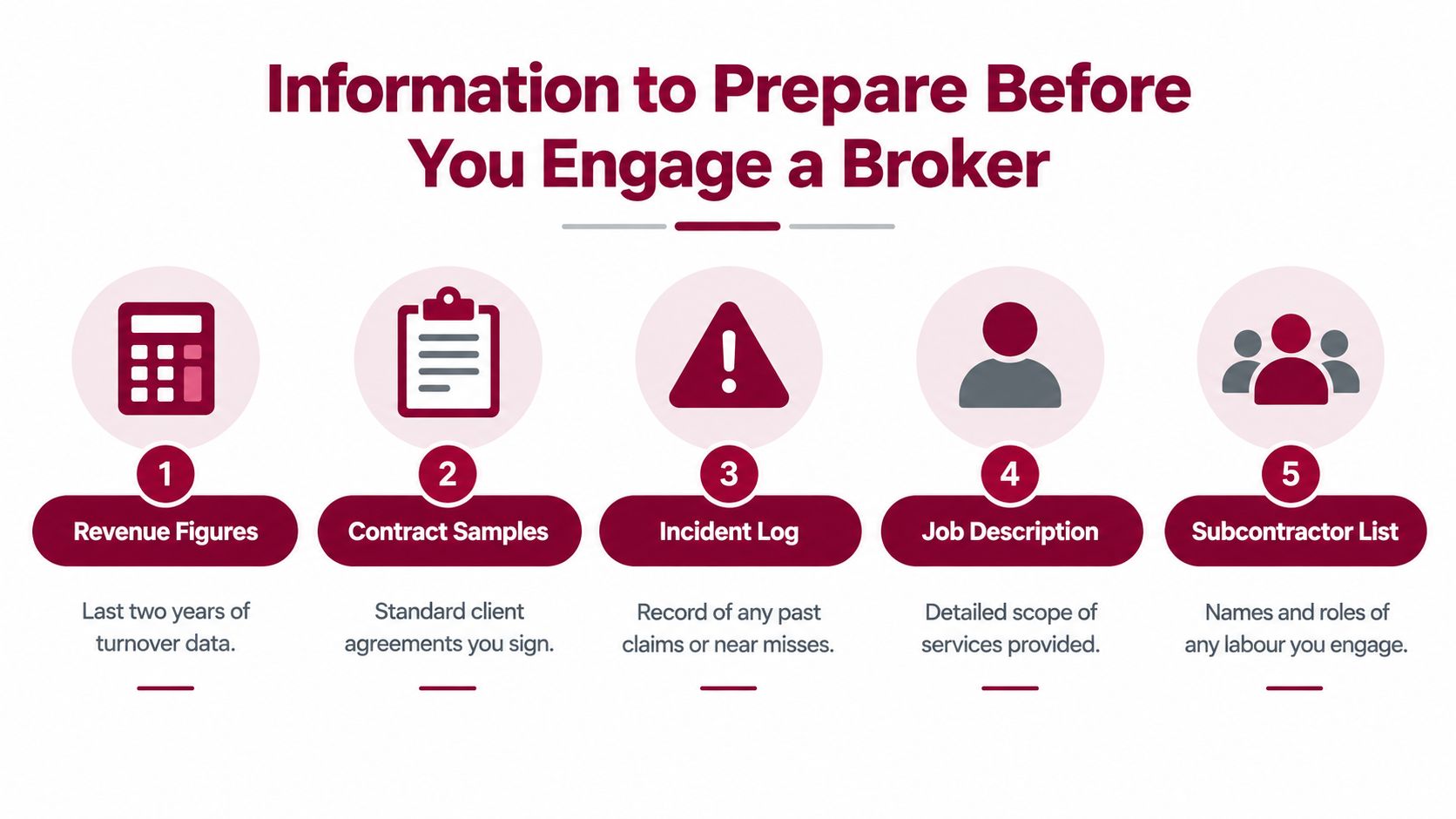
Start with revenue split by service line. A consultancy, design firm, or builder with mixed work needs limits and exclusions that track the actual mix of professional services. Then list your jurisdictions, because territorial scope and foreign work can change how a policy should be structured.
Rule of thumb: if it changes your liability, it belongs in the broker pack.
Add your contract samples, including the clauses that deal with indemnity, liability caps, dispute resolution, and subcontracted work. Those terms often drive what needs to be negotiated in the policy wording. If you've accepted broad contractual liability without checking the policy, the contract can outgrow the cover.
Include a prior claims or circumstances log, even if nothing has turned into a formal claim. Undeclared incidents, complaints, or project disputes can affect underwriting, retroactive dates, and continuity of cover. Put in your subcontractor arrangements too, because the insurer needs to know who is doing the work and where professional responsibility sits.
ASIC's surveillance of small Australian financial services licensees in 2017 found that three of the 56 reviewed did not hold professional indemnity insurance that complied with the defence-cost requirements set out in Regulatory Guide 126. That's a blunt reminder that incomplete disclosure leads to non-compliant cover. A broker can't fix what you don't disclose.
Finally, send your professional registrations, licence conditions, and any required limits. That gives the broker a proper base for matching cover to legal obligations, not just commercial preferences. The better the file you send, the better the market response you get.
Criteria That Separate a Strong PI Broker From a Quote Machine
Buyers need to get harder to impress at this point. A broker who is good at professional indemnity work shows it fast. A quote machine shows you a price and a smile.
Score the broker on the factors that affect outcomes
First, check AFSL status and compliance discipline. A broker dealing with regulated clients must understand obligations, not just products. Second, look for demonstrated PI specialism. If they place every class of business under the sun but can't explain claims-made wording without reaching for notes, keep moving.
Third, ask about insurer panel access. Real market access gives you options, especially when one insurer dislikes your sector or contract style. Fourth, assess claims support. That means notification triage, circumstance reporting, insurer liaison, and helping you line up records before the dispute hardens.
Fifth, test their sector knowledge. Builders, certifiers, engineers, designers, accountants, and IT advisers all carry different exposure patterns. A broker who handles all of them as if they were the same is giving you generic advice.
Here's the practical difference. A strong broker reconciles the policy schedule, wording, and endorsements against your actual operations. A weak one trusts the certificate and moves on. That matters because ASIC's surveillance found reporting errors in nine out of ten FS70 lodgements, with licensees understating the insurance they held. If a broker doesn't verify, they inherit the client's mistakes.
If you want a second view on how brokers should be assessed on fees and service, insurance broker fee vs commission, what you are paying is worth reading before you sign anything. The comparison is simple. Pay for advice, not for handoffs.
Questions to Ask Before You Sign the Broker Agreement
A broker meeting should feel like due diligence, not a sales pitch. If you ask the right questions, the quality of the answers tells you almost everything you need to know.
Use questions that expose shallow advice
Ask, “Have you read the full wording, including endorsements and exclusions?” If the answer is evasive, you're not getting real advice. Ask, “How do you set limits under the RG 126 framework when retail-client revenue changes?” For regulated financial-services businesses, the benchmark is $2 million for any one claim and in the aggregate where retail-client financial-services revenue is $2 million or less, then a limit that generally tracks revenue, subject to a $20 million maximum.
Ask, “What happens if the retroactive date doesn't match our actual trading history?” If the broker can't explain continuity risk in plain language, they're not managing the placement properly. Ask, “How do you escalate a circumstance notice before it becomes a claim?” That answer should include who they notify, how quickly they act, and how they preserve the record.
If the broker treats notification as an admin task, find another broker.
Also ask, “How are subcontracted services treated?” and “What happens if we retire, sell the business, or stop trading?” Those questions matter because run-off and subcontractor clauses are where many policies get tested after the fact. Add one more. “How do you handle cyber overlap, especially if an account compromise leads to a professional error?” The Australian Signals Directorate received more than 84,700 cybercrime reports in FY2024–25, so cyber adjacency is no longer a side issue.
If the broker answers with examples, wording references, and a clear process, you're in safe hands. If they answer with reassurance and no detail, walk away.
How a Good Broker Adds Value at Placement and Claims
A project-management firm signs its first PI policy through a transactional broker. The premium is fine, the certificate arrives fast, and nobody spends time checking how the policy responds to delayed notification or downstream consulting work. Two years later, a client complaint lands.
Placement is where future claims are won
A good broker would have challenged the original exposure profile. They would have asked what services the firm provides, whether it uses subcontracted designers, whether any contracts push liability beyond ordinary professional negligence, and whether the retroactive date captures earlier work. They would also have flagged any exclusion that touches certification, project management, or construction advice and made the insurer respond in writing.
When the complaint appears, the difference shows up immediately. A transactional broker tells the client to lodge a claim and waits. A proper professional indemnity insurance broker treats the complaint as a circumstance, checks the policy trigger, gathers the file notes, and pushes the matter through the insurer's process before positions harden. That early action matters because APRA's 2023 analysis found the average annual cost of finalised Australian professional indemnity and public liability claims rose from approximately $310 million in 2009–2013 to $420 million in 2014–2021.
The lesson is direct. Value in PI broking is not a one-time placement fee. It's the quality of the questions asked before binding and the discipline applied when a complaint first surfaces. Cheap placement can become expensive very quickly when the claim file finally opens.
Your 12-Month Broker Engagement Rhythm
A broker relationship shouldn't go quiet after renewal. If it does, you're drifting back into guesswork. Keep the engagement tight and deliberate.
Build the calendar around change, not just expiry
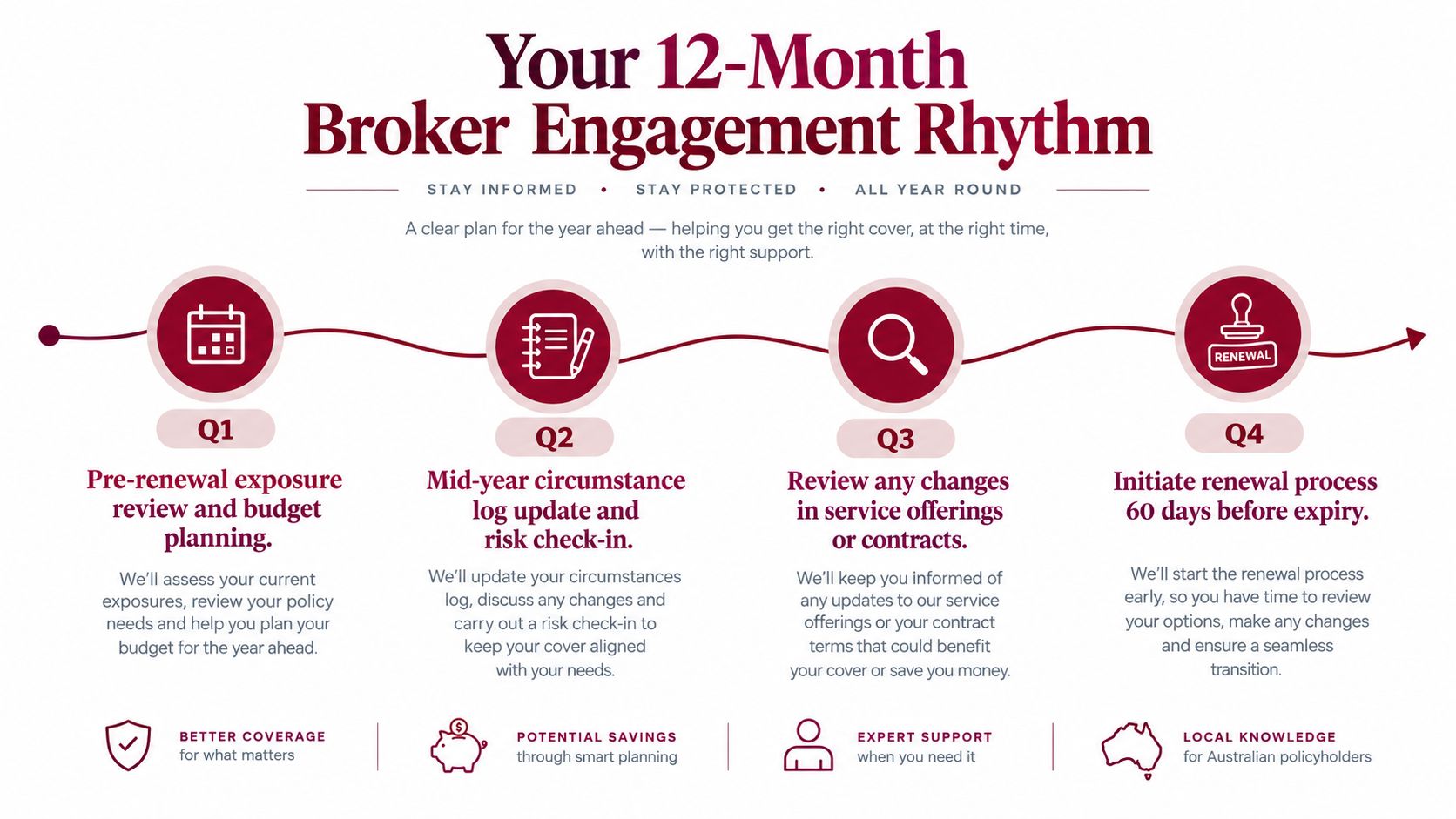
In Q1, do a pre-renewal exposure review. Check service lines, jurisdictions, contracts, and any new liability language before the market is asked to price the risk. In Q2, update your circumstance log and flag complaints, project issues, and any change in subcontracting.
In Q3, review whether your business has added new services, new delivery methods, or new client sectors. If that has happened, tell the broker now, not at renewal. In Q4, start renewal early enough to test wording properly, not just chase the cheapest continuation quote.
You should also require written confirmation if an exclusion affects construction advice, certification, or subcontracted professional work. That's not bureaucracy, it's protection. If the answer changes the way the policy responds, it needs to be documented.
Keep the broker on a short leash, but keep them informed. The best outcomes come from clean, current facts.
The simple rhythm is prepare, engage, ask, review, repeat. That's how a policy becomes a working risk tool instead of a compliance file in a drawer.
If you want a broker who can place professional indemnity cover with the realities of Australian construction and advisory work in mind, speak with ABS Insurance Brokers Pty Ltd. They arrange PI and related business cover for builders, trades, consultants, developers, and other commercial clients, and they can help you pressure-test wording, limits, and exclusions before you bind.