

Premiums for consulting engineers increased by 75% over the seven years to 2024, according to APRA figures reported by Infrastructure Magazine. That isn't a management-consulting price benchmark, but it's a warning against treating professional cover as a fixed administrative cost. For management consultants, the more important question is whether the policy you're paying for covers the liabilities you're accepting in your client contracts.
Professional liability insurance for management consultants should be selected against actual engagements, not just an occupation label. A certificate can satisfy a client's procurement team while the underlying policy excludes a promise buried in the services agreement. Start with what you deliver, what you've promised and what the insurer has agreed to cover.
Table of Contents
- What Professional Liability Insurance Covers for Consultants
- Professional Liability Versus Public Liability
- Claims Professional Liability Can Respond To
- Policy Terms That Decide Whether You Are Paid
- Contract Wording That Can Push Risk Outside Cover
- Cyber and AI Exposures Standard Cover May Miss
- Confirm Your Cover Before Your Next Engagement
What Professional Liability Insurance Covers for Consultants
Professional liability insurance, usually called professional indemnity insurance or PI in Australia, can pay covered defence costs and legal liability when a client alleges your advice, analysis or recommendations caused financial loss through negligence, an error, an omission or a breach of professional duty.
The distinction is straightforward. If a client trips over your cable during a workshop, that's a physical accident. If your restructuring plan contains flawed assumptions and the client alleges it lost money implementing it, that's the type of professional-services claim PI is designed to address.

Insure the work you actually perform
A proposal describing only management consulting may not adequately explain procurement advice, governance reviews, transformation delivery or operational implementation. The insured professional services description should reflect those activities, including work performed through subcontractors where relevant.
Pricing and terms also reflect the nature of your advice, project size, client concentration, contractual requirements and claims history. Market conditions matter: APRA's analysis of Australian liability insurance records total professional indemnity premium volumes increasing from approximately $0.9 billion to $1.4 billion between 2017 and 2020. That measures premium volume across the class, not the increase in an individual consultant's renewal premium.
Buying principle: Describe your highest-risk service accurately before comparing premiums. A cheap policy with the wrong service description isn't a useful saving.
PI is usually written on a claims-made basis, with requirements governing when claims must be made and reported. Maintaining continuity matters, including when switching insurers or leaving practice.
It isn't complete business protection. PI doesn't ordinarily replace public liability cover, reimburse your own lost fees or automatically insure promises that extend beyond your normal professional responsibility.
Professional Liability Versus Public Liability
Professional liability versus public liability at a glance
| Feature | Professional liability | Public liability |
|---|---|---|
| What triggers a claim | Alleged error, omission or negligent advice | Injury or property damage to a third party |
| Typical claimant | Client that suffered financial loss | Member of the public, client staff or landlord |
| Typical example | Flawed market-entry plan costs the client a contract | Client employee trips over equipment during a workshop |
| Policy basis | Usually claims-made | Usually occurrence-based |
| Usually excluded | Bodily injury and property damage, subject to extensions | Professional services and pure financial loss |
| Who needs it | Anyone whose advice clients rely on | Anyone who attends client sites or works on premises |
The difference isn't whether you were working when something went wrong. Both policies concern business activities. The distinction is the cause of the alleged liability and the type of harm, subject to each policy's wording.
A consultant facilitating an on-site workshop can create both exposures during the same engagement. Professional advice doesn't stop being professional advice because you delivered it at the client's premises.
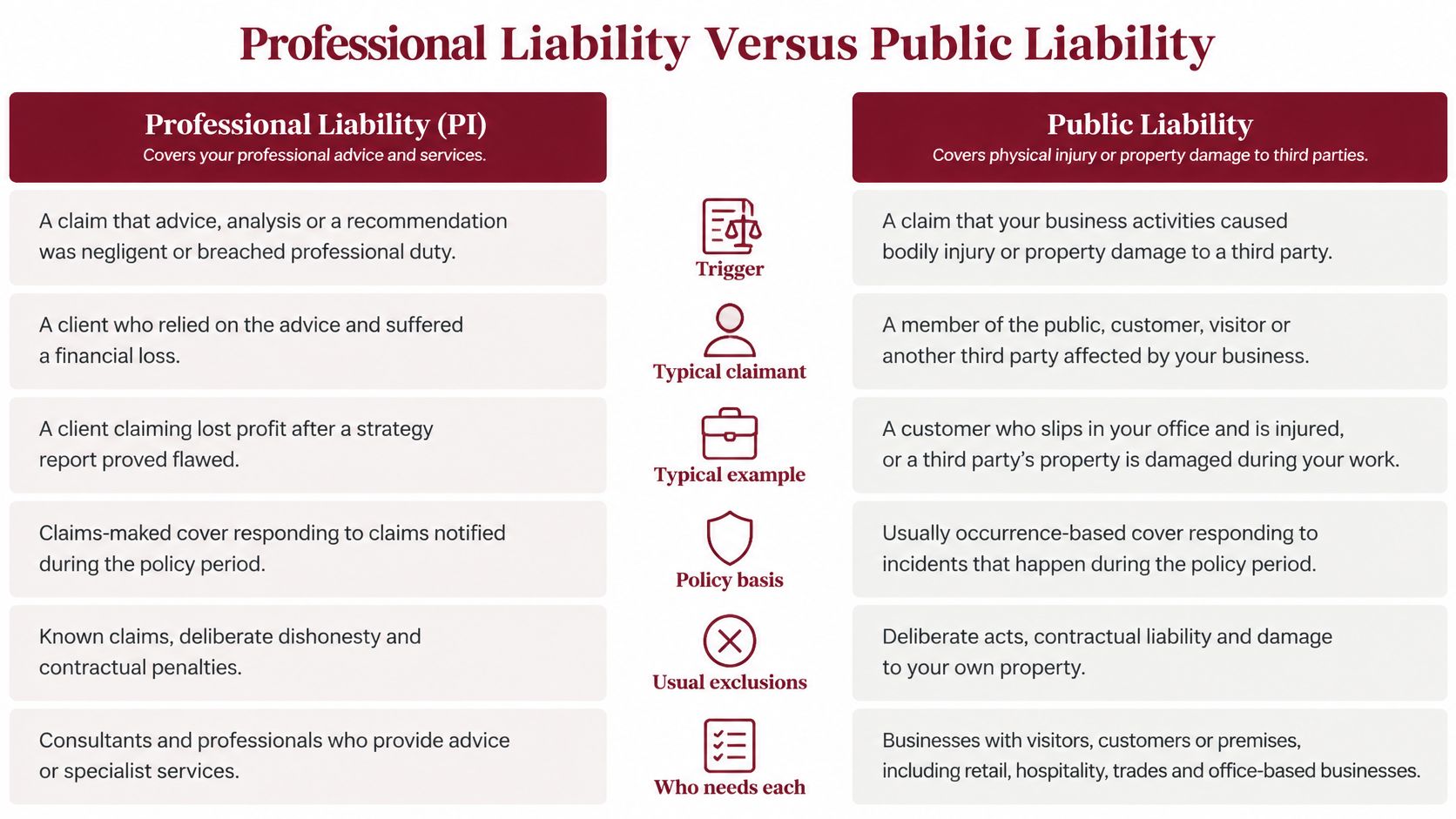
When an incident involves both policies
Say you damage a client's equipment during a site visit, then the client claims the interruption delayed a transformation project. Public liability may address the equipment damage and covered consequential loss flowing from it. If the client separately alleges your implementation advice caused avoidable delay, that allegation requires a professional-services assessment.
Don't assume every financial loss belongs under PI. Financial consequences arising from covered physical damage can sit under public liability, while a pure economic loss arising from professional advice points towards PI.
The distinction also affects timing. Occurrence-based public liability generally looks to when the injury or damage happened; the timing requirements under PI work differently. Our guide to professional indemnity versus public liability insurance provides a further comparison.
Practical rule: If the complaint concerns what you advised or delivered, examine PI. If it concerns an accident involving people or property, examine public liability. Where the allegations overlap, notify potentially relevant insurers rather than deciding the allocation yourself.
Claims Professional Liability Can Respond To
Say a management consultant recommends a cost-reduction programme for a retailer. The savings fall short, margins deteriorate and the client alleges the consultant excluded material implementation costs from the analysis. The client seeks compensation for lost margin and its legal costs.
A disappointing commercial outcome doesn't itself prove negligence. The coverage question is whether the allegations fall within the insured services and insuring clause, and whether an exclusion removes the claim. A covered defence can matter even where the consultant ultimately defeats the allegations.
Common allegations and whether PI usually responds
| Allegation | Illustrative example | Usually responds under PI? |
|---|---|---|
| Negligent advice | Strategy recommendation built on flawed market data | Usually responds |
| Breach of professional duty | Agreed deliverable missed, causing client financial loss | Usually responds, subject to scope wording and the basis of liability |
| Misleading information | Overstated savings in a board paper | Often responds, subject to exclusions for deliberate acts |
| Economic loss from delay | Project overrun after a faulty implementation plan | Usually responds if caused by covered professional advice |
| Confidentiality or data breach | Client files leaked from a subcontractor's laptop | Generally not comprehensively addressed by PI; check cyber cover |
| Liability beyond common-law duty | Guaranteed results or an uncapped indemnity accepted | Additional assumed liability is often limited or excluded |
| Bodily injury or property damage | Client staff injured at your workshop | Ordinarily a public liability matter, subject to its terms |
Assess the allegations, not the client's label
A demand headed breach of contract may still allege negligent professional work. Conversely, a demand alleging negligence may include a refund request, contractual penalties and other amounts the policy doesn't insure.
The insurer needs the engagement letter, scope changes, recommendations and correspondence to assess those components. Don't rewrite the history in a response to the client or promise reimbursement before obtaining guidance on the policy's consent requirements.
For a cross-jurisdictional introduction to professional-negligence issues, professional negligence advice from RNC Group offers additional context. It isn't a substitute for Australian legal advice on your engagement or an insurer's coverage assessment.
Preserve the evidence behind your recommendation
Keep the source material, assumptions, qualifications and approval trail supporting the advice. In the retailer scenario, the distinction between an estimate and an unconditional savings promise could be central to both the dispute and the insurance response.
- Retain the calculation: Save the working model, not just the presentation exported from it.
- Record client dependencies: Identify information and implementation decisions controlled by the client.
- Document scope changes: Confirm additional tasks and revised deadlines before proceeding.
APRA's National Claims and Policies Database provides a national framework for understanding professional indemnity claims and policy trends. For an individual dispute, however, the decisive evidence remains your documents and the applicable policy wording.
Policy Terms That Decide Whether You Are Paid
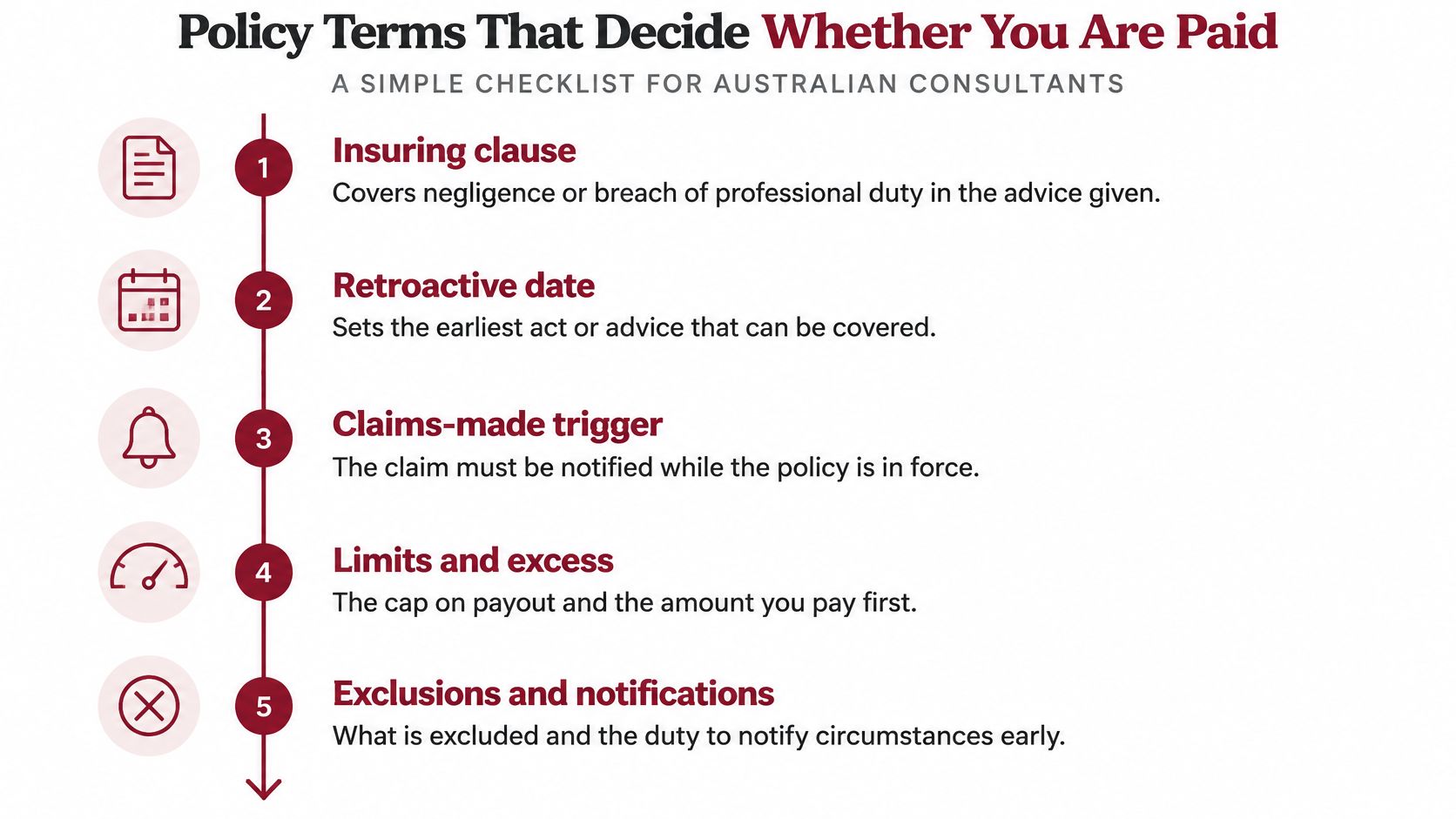
Read the policy in the order the insurer will assess the claim. Establish whether the allegation falls within cover before spending time debating the size of the limit.
Policy terms and how they change a payout
| Policy term | What it means | How it changes the payout |
|---|---|---|
| Insuring clause | Cover for specified liability, such as negligence or breach of professional duty | Claim must fall within the insured service |
| Retroactive date | Earliest act the policy covers | Earlier acts may be refused even if the claim is new |
| Claims-made trigger | Requirements for claims made and notified during the policy period | Gaps in continuity or late notification can jeopardise cover |
| Limit of indemnity | Most the insurer pays under the applicable limit | Defence costs may erode it |
| Excess | Amount you contribute to a covered claim | Leaves you responsible for the applicable contribution |
| Exclusions | Restrictions including known circumstances, deliberate acts and assumed liability | Remove losses that would otherwise be covered |
Follow the claim through the wording
The insuring clause must match both your service and the alleged wrongdoing. Then check the retroactive date against when the relevant advice or act occurred, not when the client discovered the problem.
Read notification requirements alongside the definition of claim. A written demand for compensation may require action before court proceedings begin. If you become aware of circumstances that could lead to a claim, obtain advice promptly about notification rather than waiting for a quantified demand.
Check what is available for settlement
Defence costs inside the limit consume money otherwise available for damages or settlement. Costs payable in addition to the limit can provide a different level of protection, but conditions and separate restrictions still need checking.
Examine whether the limit applies to each claim, whether an annual aggregate restricts total payments, and how related claims are combined. Also check whether the excess applies to defence costs and whether specific extensions carry lower sublimits.
A headline limit doesn't tell you how much remains after lawyers are paid, related claims are grouped and sublimits are applied.
APRA separately tracks management consultants in its professional indemnity loss-ratio development workbook. Claims can develop as notifications, litigation and settlements progress, so an apparently favourable early result isn't a reliable measure of ultimate exposure.
Procurement thresholds are equally easy to misread. Tasmania's consultant-insurance guidelines specify minimum prequalification levels of AUD 1 million PI and AUD 5 million public liability for the consultants within their scope. Those are procurement requirements, not a recommendation that those limits suit every management consultant.
Contract Wording That Can Push Risk Outside Cover
Holding PI doesn't mean every contractual promise is insured. The distinction is between liability arising from a professional failure and additional liability you voluntarily accept through the agreement.
A reasonable-care obligation requires you to perform to the applicable professional standard. A guarantee that a transformation programme will achieve a specified result can impose responsibility even where you exercised reasonable care. That additional exposure may encounter a contractual-liability exclusion.
Compare the obligation with the duty you would otherwise owe
Consider a procurement consultant whose client controls supplier selection and implementation. If the consultant guarantees the resulting savings regardless of those decisions, the contract may make the consultant responsible for outcomes outside its control.
The same problem can arise through an indemnity covering every loss connected with the engagement, rather than loss caused by the consultant's breach. Background reading on types of contractual indemnification from Kons Law can help explain the mechanisms, but Australian legal review is needed to assess a particular clause.
- Uncapped indemnities: An unlimited obligation can exceed available insurance without automatically making every part of that obligation excluded.
- Outcome warranties: Promised results can create liability without a negligent act.
- Consequential-loss provisions: Exposure may extend to lost profit, business interruption or losses elsewhere in the client's group.
- Subcontractor obligations: Your contract may make you responsible for work that your policy doesn't fully encompass.
- Governing law and jurisdiction: The agreed dispute forum must be checked against territorial and jurisdictional restrictions.
Negotiate the liability you can reasonably control. Don't use the insurance limit as permission to accept every proposed indemnity.
A certificate cannot amend an exclusion
Public-sector and enterprise contracts can require insurance while separately imposing broad contractual obligations. Satisfying the insurance clause doesn't establish that the insurer accepts those other obligations.
A broker can identify insurance mismatches, while a solicitor can advise on enforceability and negotiate liability wording. Where necessary, obtain the insurer's written position or an endorsement before accepting the obligation.
I would prioritise removing an unsupported outcome guarantee over buying a larger limit that still excludes it. More capacity helps only after the claim falls within cover.
Cyber and AI Exposures Standard Cover May Miss
The Australian Signals Directorate recorded more than 84,700 cybercrime reports in FY2024–25, according to its cyber threat factsheet for businesses and organisations. For consultants handling strategy documents, employee information and financial models, a compromised account can create costs quite different from a faulty recommendation.
PI may address some advice-related liability without paying the full cost of investigating a breach, restoring operations or notifying affected people. Those incident-response and first-party costs need a separate assessment.
Separate the advice allegation from the incident
Say a subcontractor uploads a client workbook to an insecure platform. The client alleges both that the consultant's recommendations were negligent and that disclosure of the workbook harmed its negotiating position.
The insurer must distinguish the alleged professional failure from the confidentiality breach and the consultant's own response costs. Definitions, cyber exclusions, confidentiality extensions and applicable reporting requirements can produce different answers for different parts of the demand.
Use our guide to a cyber insurance policy to frame questions about forensic investigation, notification, regulatory response and business interruption. Don't assume a confidentiality extension provides the same response as dedicated cyber cover.
AI use changes the evidence you need
Australian Government guidance on AI and Australian law explains that privacy, intellectual-property, confidentiality and contract laws can apply to training data, prompts and outputs, and notes that the statutory tort for serious invasions of privacy commenced on 10 June 2025. Using an AI tool doesn't transfer your professional responsibility to its provider.
Test the proposed use against specific failure modes:
- Fabricated analysis: Would negligent reliance on invented market data fall within your insured service?
- Copyright concerns: Does an intellectual-property exclusion restrict a claim involving generated material?
- Confidential prompts: Could uploading client information trigger cyber or privacy restrictions?
- Prohibited tool use: Have you accepted a client restriction that your workflow would breach?
Keep evidence of source checking, human validation and approval of material recommendations. A reviewer's signature alone doesn't demonstrate that someone tested the assumptions or verified the citations.
Engagement terms should address approved tools, client consent, data retention and ownership of outputs. The useful question isn't whether AI is covered in the abstract, but whether the policy answers the particular allegation your use could generate.
Confirm Your Cover Before Your Next Engagement
Run the review while the contract is still negotiable. Once you've signed, correcting the mismatch may require the client's agreement, an insurer endorsement or a change to the work itself.
Gather the proposed services agreement, statement of work, policy schedule, full wording and endorsements. Include subcontractor arrangements and any client requirements concerning information security or AI use.
Pre-engagement checks
- Confirm the service description: Match strategy, governance, procurement and implementation activities to the insured services.
- Protect the retroactive position: Check that earlier relevant work remains within scope when renewing or changing insurers.
- Test the available limit: Identify defence-cost treatment, aggregate restrictions and sublimits.
- Read the indemnity beside the exclusion: Flag obligations that extend beyond responsibility for your own professional breach.
- Check the liability cap: Identify carve-outs that could make the apparent cap ineffective.
- Allocate digital risks: Establish which policy addresses data incidents and AI-related allegations.
- Document the engagement: Record scope, assumptions, client dependencies, approved tools and change-control arrangements.
- Locate notification instructions: Make sure the person receiving complaints knows how to escalate them promptly.
Ask for a wording-based comparison
A useful review produces specific answers, not just a cheaper quotation. Ask which clause supports the proposed cover, which endorsement changes it and which contractual obligations remain uninsured.
Our professional indemnity insurance broker guide explains the broking role. When providing general insurance broking services, we may advise on your insurance needs, arrange insurance on your behalf or provide quotes through our quotation platform.
ABS Insurance Brokers Pty Ltd is based in Bankstown, NSW, and serves commercial clients across Australia. Bring the actual contract rather than a summary of the client's insurance requirements so the discussion can focus on the exposure you're being asked to accept.
If the next agreement contains an uncapped indemnity or an outcome warranty, resolve the coverage position before signing. This is general information; the appropriate decision depends on your services, contract and policy wording.
ABS Insurance Brokers Pty Ltd offers professional indemnity, public liability and cyber insurance, allowing you to discuss how advice-related liabilities fit alongside other business exposures. Visit ABS Insurance Brokers Pty Ltd to request a review of your insurance needs, and bring your proposed engagement letter and current policy wording so the discussion addresses the obligations you'll accept.