

Household building insurance pays to replace the home after insured events such as fire or storm. In NSW, the statutory meaning is Home Building Compensation cover for eligible residential work over $20,000 including GST, which responds after defined builder failure rather than acting as general construction insurance.
But if your builder is still trading and won't fix a leaking roof, who pays? That question exposes the gap between having an insurance certificate and having protection for the problem you face.
For builders, developers and homeowners, understanding which risk a policy covers matters more than recognising its name.
Table of Contents
- What Domestic Building Insurance Means in Australia
- How NSW Home Building Compensation Cover Works
- Who Must Arrange Cover Before Work Starts
- How It Differs from Other Construction Insurance
- Who Pays When the Builder Will Not Fix the Work
- Why a Policy Can Still Leave You Short
- Confirm the Right Cover Before You Start
What Domestic Building Insurance Means in Australia
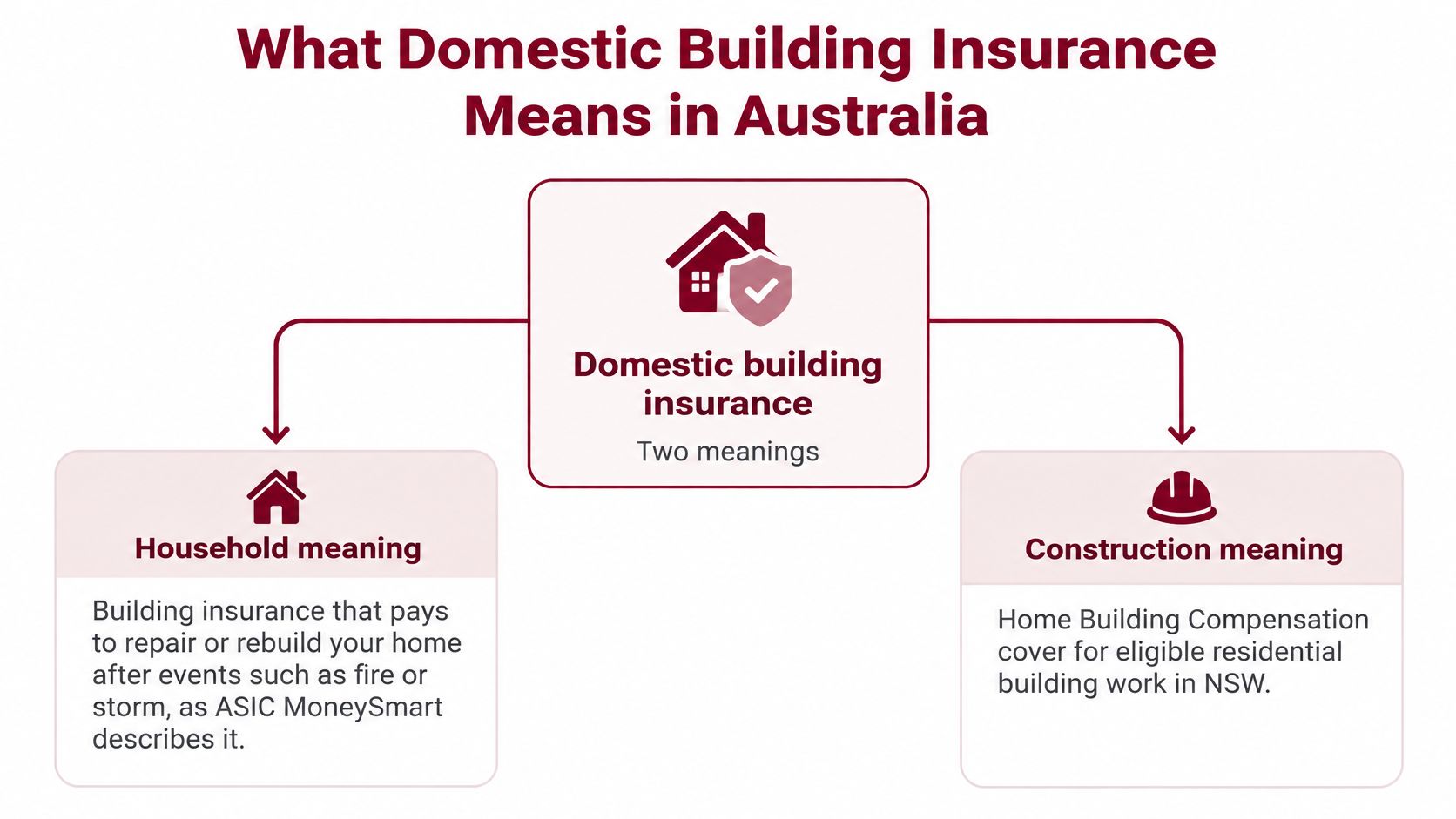
The answer to what is domestic building insurance starts with a distinction: Australians use the phrase for household property cover and for statutory protection connected with residential building work. Those meanings aren't interchangeable.
ASIC's MoneySmart insurance guide describes building insurance as cover for replacing a home damaged by events such as fire or storm, commonly extending to fixed structures such as garages and inground pools. Statutory home-building compensation instead concerns specified losses when a builder cannot complete work or meet covered obligations after a qualifying event.
Two products called domestic building insurance
| Cover | What it protects | Who it is for | Typical trigger |
|---|---|---|---|
| Home or building insurance | The home's permanent fabric, plus fixed items such as garages and inground pools | Owner of a completed dwelling | Fire, storm and other events listed in the policy |
| NSW HBC or home warranty cover | Incomplete work, lost deposits and covered defects after builder failure | Homeowner of eligible residential work; the builder arranges it | Insolvency, death, disappearance, or licence suspension after failure to comply with a compensation order |
For the household policy, the sum insured should reflect reconstruction costs, not land value or necessarily the property's sale price. Buying a house and land is a different transaction from paying contractors to reconstruct a damaged dwelling.
Separate the building from its contents
Building insurance concerns the permanent fabric of the home and the structures specified in the policy. Contents insurance concerns movable possessions, such as furniture, clothing and household electronics.
Say a fire damages a kitchen. Repairing the walls and fixed cabinetry raises a building-insurance question; replacing freestanding furniture raises a contents-insurance question. The insurer still assesses each loss against the relevant policy wording.
A reconstruction estimate also needs to consider more than replacement bricks and roofing. Removing damaged material, arranging professional services and meeting applicable building requirements can all affect the cost of restoring a usable home.
Practical rule: Start with what needs replacing or what obligation has failed, not with the words on the certificate.
For statutory cover, location matters too. NSW uses Home Building Compensation terminology, while other jurisdictions have their own arrangements. Don't assume a familiar label means the same eligibility rules apply across Australia.
Before comparing premiums, write down whether you need protection for a completed property or for residential construction obligations. That simple distinction helps prevent buying the wrong kind of protection.
How NSW Home Building Compensation Cover Works
HBC cover works like a spare tyre: it sits in the boot for the breakdown, not for everyday driving. The builder arranges it for eligible work, yet what the homeowner can claim is limited to specified losses after a qualifying event.
The NSW Government's building insurance guidance sets out the requirement for eligible work exceeding $20,000 including GST, the qualifying builder events, protection periods of six years for major defects and two years for other losses, and a $340,000 maximum, subject to limits and conditions.
NSW HBC cover at a glance
| Item | What applies |
|---|---|
| When it is required | Most residential building work over $20,000 including GST, unless an exemption applies |
| Qualifying builder events | Insolvency, death, disappearance, or licence suspension for failing to comply with a court or tribunal compensation order |
| Major defects | Six years from completion |
| Other losses | Two years from completion |
| Maximum cover | $340,000, subject to limits and conditions |
| Examples of covered loss | Non-completion, warranty breaches, lost deposits or progress payments, accommodation, storage, legal costs, rectification and subcontractor defects |
The qualifying event is the gate every claim must pass through. A builder who is still trading and refusing to fix defective work has not triggered the policy: licence suspension only counts when it follows a court or tribunal compensation order the builder failed to satisfy. An unanswered email is not disappearance, and a workmanship dispute is not, by itself, an insured loss.

What the covered loss might involve
Non-completion concerns insured work left unfinished. The practical issue is identifying what the original contract required, what has been completed and what remains outstanding. Where a builder becomes insolvent mid-renovation, the claim starts by costing the work needed to finish what the contract promised.
Lost deposits or progress payments concern money paid towards insured work. A covered deposit loss can arise even where the work never starts, although eligibility and policy conditions still need to be satisfied.
Rectification and warranty breaches concern covered failures in the building work. Subcontractor involvement doesn't, by itself, remove the need to assess the work against the head contract and applicable protection.
Other covered loss categories may include alternative accommodation, moving, storage and legal costs. They operate as defined categories with conditions and limits, so each item claimed is tested against the policy rather than reimbursed automatically.
Why timing and project details matter
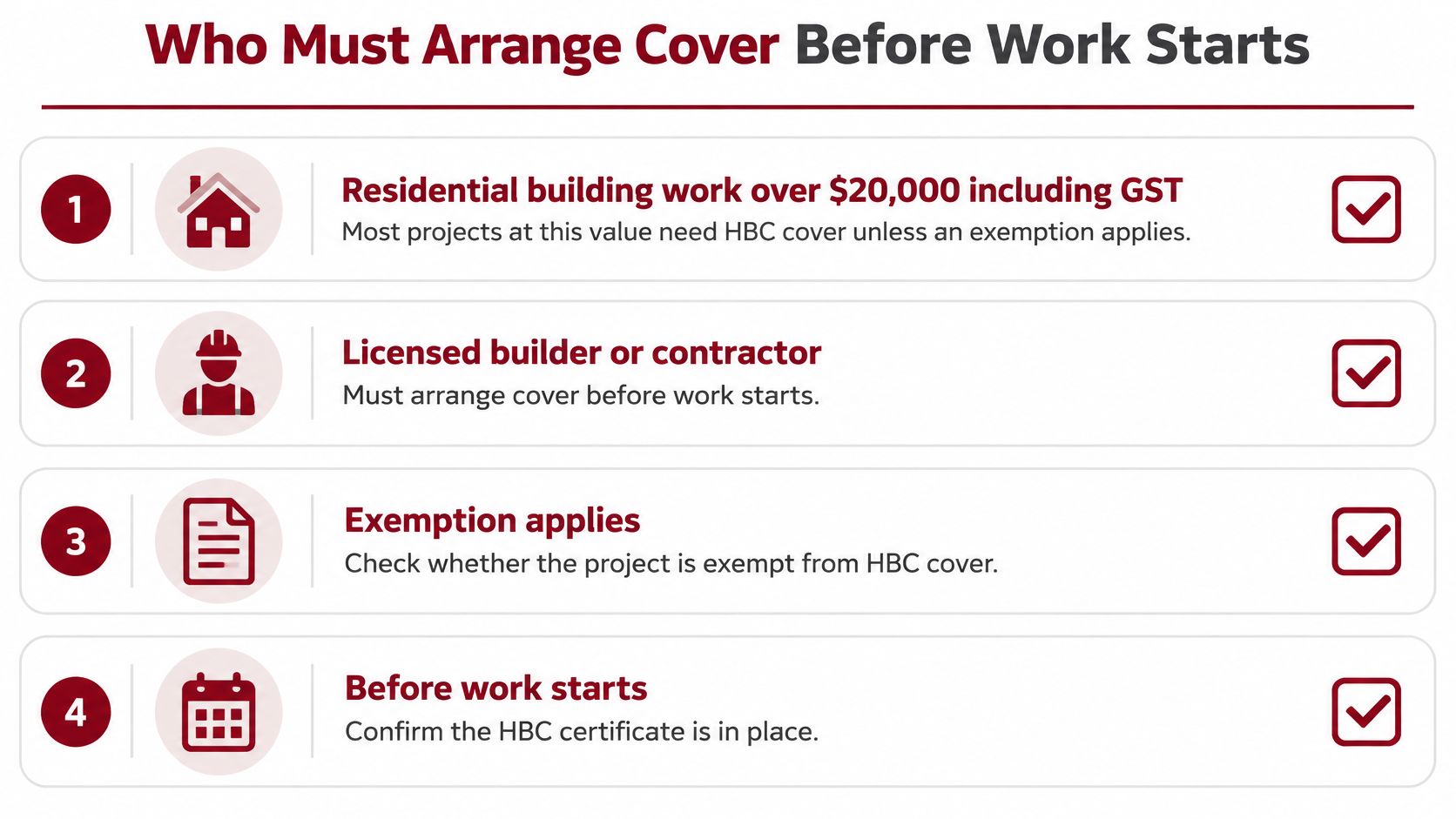
The licensed builder or tradesperson must arrange required cover before starting work or accepting payment. A project-specific certificate should therefore be part of the pre-start paperwork, kept alongside the signed contract and any approved variations, rather than something chased after a deposit has changed hands.
Owner-builders carry a separate preparation task: permit responsibilities sit apart from insurance arrangements. TP Training's explanation of owner-builder permit education requirements is a useful starting point for that side of the paperwork.
An education course, a permit and an insurance certificate each prove a different thing. A certificate shows a policy exists for that project; it says nothing about whether the sum insured would match the cost of finishing the job if the worst happened.
Who Must Arrange Cover Before Work Starts
The licensed builder or tradesperson arranges required HBC cover, rather than leaving the homeowner to purchase it after signing. The practical task is to confirm the project's requirements early enough that insurance doesn't become an unresolved issue on the intended start date.
In NSW, the requirement applies to most eligible residential work above the statutory threshold, unless an exemption applies. New homes, relevant apartment projects, renovations and swimming pools can fall within the requirement; project type alone isn't enough to settle the question.
Check the job before scheduling commencement
Use the contract and project documents to work through these checks:
- Confirm the contract value: Use the amount including GST, and make sure the scope being insured matches the agreed work.
- Establish eligibility or exemption: Record why the work requires cover or why an exemption applies. Don't rely on an assumption based on a previous job.
- Check other insurance obligations: A building contract, financier, principal or state requirement may specify additional insurance.
- Match the project certificate: Check the builder, site and project details before work starts or payment is accepted.
An exemption from one statutory insurance requirement doesn't mean the project has no insurance needs. The contract may still require protection for damage to the works or liability to other people.
Eligibility isn't the project certificate
A Certificate of Eligibility allows an assessed builder to apply for insurance within approved limits. It doesn't establish that a particular customer's project has been insured.
Each project requiring cover needs its own Certificate of Insurance. A homeowner shown a builder's eligibility document should still ask for the certificate that identifies their job.
A builder's capacity to apply for cover and the existence of cover for your project are separate questions.
This distinction matters when paperwork moves between an estimator, office administrator, supervisor and customer. Make someone responsible for checking the actual project certificate rather than assuming another person has done it.
Owner-builders follow a different path
An owner-builder shouldn't assume a licensed builder's warranty arrangements apply to their role. Their responsibilities, contracts and insurance needs require a separate assessment.
Before engaging trades, identify who is carrying each contractual obligation and which activities need protection. Keep the permit paperwork, trade contracts and insurance documents together so responsibilities can be checked against the same scope.
Builders and owner-builders should confirm their contractual obligations and arrange appropriate cover before work begins. Resolving those questions before commencement is more useful than discovering a mismatch after an incident.
How It Differs from Other Construction Insurance
A construction project can produce several unrelated losses: storm damage to unfinished work, damage to a neighbour's property, or an unfinished contract after builder failure. Different policies address different losses, even when all the documents sit in the same project folder.
The distinction becomes clearer when you compare the risk period and purpose, rather than looking for one policy with the broadest-sounding name.
Which construction policy answers which loss
| Policy | When it applies | What it is for | What it does not replace |
|---|---|---|---|
| HBC or builders warranty | Eligible residential work and the statutory defect periods | Non-completion and covered defects after a qualifying builder event | Storm damage, site accidents or ordinary defect disputes while the builder remains trading without a qualifying event |
| Contract works | During construction | Accidental physical loss or damage to works in progress | Builder insolvency or the homeowner's later building policy |
| Public liability | During the insured activity | Injury or third-party property damage | Cover for the works themselves or a general workmanship guarantee |
| Home building insurance | Once the dwelling is insured as a home | Rebuild cost after insured events such as fire or storm | Incomplete building work or a builder who disappears |
Match construction cover to the scope
Contract works insurance can protect works in progress against accidental physical loss or damage. It can be arranged for an individual project or on an annual basis, according to the insured's arrangements.
Renovations need particular attention because new works and an existing home occupy the same site. Optional cover may address sudden and accidental damage to existing structures, but don't assume that extension is automatically included.
For a broader explanation of how these protections fit together, use our guide to insurance for construction when reviewing the contract's insurance clauses. Compare the required insured parties, activities and period with the proposed policy documents.
Read beyond the headline sum insured
ASIC's underinsurance report discusses standard home-building events under the Insurance Contracts Regulations and found that many reviewed policies didn't cover supplementary costs such as making a property safe, reinstating gardens or meeting enhanced council requirements.
Those omissions matter even where the main building estimate looks reasonable. An owner may have enough allocated to the structure but insufficient cover for the additional work needed to make the site usable and the rebuild compliant.
For each policy, check:
- Insured property: Identify whether the cover includes existing structures, new works or specified equipment.
- Insured activities: Make sure the declared work reflects what contractors will do.
- Exclusions and extensions: Check supplementary costs rather than assuming they sit outside the building limit.
- Evidence of currency: Confirm the insurer, insured entity and effective period.
DLG Electrical's guidance on how to verify a Certificate of Currency provides useful context for checking contractor paperwork. Evidence that a policy exists is a starting point, not confirmation that its wording answers every project exposure.
Who Pays When the Builder Will Not Fix the Work
Your renovated roof leaks. The builder is still licensed and trading, acknowledges your messages, but refuses to return.
The builder's responsibility doesn't disappear because there's an insurance certificate. Builders warranty insurance isn't a replacement for the obligation to complete and rectify work, and a refusal to repair isn't automatically a qualifying insurance event.
A trading builder refuses rectification
Start by documenting the defect and notifying the builder in writing. Identify the affected work, refer to the contract and keep a clear record of the response.
Consumer Affairs Victoria's guidance on implied warranties and domestic building insurance distinguishes warranty responsibilities from insurance protection associated with defined builder-failure events. State-specific dispute processes matter because proving defective work and establishing an insurance trigger are separate tasks.
If the builder won't rectify the work, you may need to pursue contractual or statutory-warranty remedies. The owner can face investigation or repair costs while that dispute is resolved, without any guarantee that an insurer will pay them.

An unfinished renovation after insolvency
Change the scenario: the renovation stops halfway and the builder's company becomes insolvent. That raises a non-completion question and may engage HBC protection where the project and loss satisfy the requirements.
Preserve evidence before another contractor changes the site. Photographs, the payment schedule and a clear record of completed work help distinguish an unfinished obligation from proposed improvements.
A disputed insurer decision
A homeowner who disagrees with an icare HBCF claim, eligibility or premium determination faces a different issue again. Reviewing an insurer's decision requires attention to its reasons and the relevant review procedure, not merely more evidence that the workmanship is poor.
First identify whether you're disputing the building work, the builder's conduct or the insurer's decision. The next step won't be the same.
Keep a usable evidence file:
- Contract documents: Signed contract, plans, specifications and approved variations.
- Financial records: Deposits, invoices, progress payments and receipts.
- Insurance evidence: Project certificates, policy documents and claim correspondence.
- Defect records: Dated photographs, reports and written notices.
Melbourne Tiling Services P/L's explanation of building contract rules for renovations offers context for Victorian renovation paperwork. For the broader liability distinction, our guide to building defects insurance in Australia helps separate responsibility from potential cover.
Owner-builders and developers should apply the same discipline. A construction shortfall isn't insured just because it arose on an insured project.
Why a Policy Can Still Leave You Short
Buying a household building policy isn't the same as being able to fund a rebuild. A premium saving achieved by reducing the sum insured can leave an owner with a recovery problem they can't afford to solve.
The NSW Reconstruction Authority's insurance guidance reports that 2025 research found 7 per cent of surveyed homeowners, concentrated primarily in the Northern Rivers and Hawkesbury-Nepean Valley, had no home building insurance, with 66 per cent of that group citing cost; it also discusses the Reserve Bank findings and averaging risk summarised below.
Uninsured and underinsured households
| Measure | Figure | What it shows |
|---|---|---|
| NSW surveyed homeowners reporting no home building insurance | 7 per cent, mainly Northern Rivers and Hawkesbury-Nepean | Cost was the reason for 66 per cent of that group |
| Households in uninsured properties | 4 per cent | A Reserve Bank finding, with rising premiums and building costs a concern |
| Households in underinsured properties | 7 per cent | Cover can exist and still fall short of a rebuild |
| Averaging example | $600,000 rebuild insured for $400,000 | The claim can be reduced to less than the policy limit |
How a reduced sum can affect a claim
In the worked example, the owner hasn't chosen a smaller maximum payment. If the policy contains an applicable averaging or coinsurance clause, the insurer may reduce a claim because the declared sum falls below the required relationship to the rebuilding value.
The exact result follows the policy wording. Don't assume a partial loss will be paid in full merely because its repair cost is below the stated building limit.
This isn't a feature to assume every household policy contains. It's a clause to check before deciding that lowering the insured value is a harmless way to reduce the premium.
Check the whole recovery budget
A current rebuilding calculator is a useful starting tool. For unusual construction, difficult access or a complex site, a suitably qualified rebuilding-cost assessment may help identify costs a basic estimate misses.
Check the estimate against:
- Site preparation: Demolition, debris removal and access for rebuilding.
- Professional and compliance costs: Design, approvals and required code upgrades.
- Construction conditions: Current labour and materials, including pressure after a regional disaster.
- Living arrangements: Temporary accommodation and its applicable limits.
Builders and developers should recognise the handover implication too. Proper construction certification doesn't establish that an owner's later property insurance is adequate.
Keep this household rebuilding problem separate from statutory compensation limits. They concern different losses, different policy conditions and different reasons an owner might face a shortfall.
Confirm the Right Cover Before You Start
Before paying a deposit or authorising commencement, name the risk you're trying to insure. A useful project review separates the questions instead of collecting certificates without checking their purpose.
- Builder failure: Does eligible residential work need statutory home-building compensation protection?
- Damage during construction: What protects the works, and is the existing structure included where needed?
- Third-party injury or damage: Which activities and parties fall within the liability arrangements?
- The completed dwelling: What protection starts or continues when the property becomes an occupied home?
Turn the answer into a document check
For a licensed builder, confirm eligibility, obtain the required project certificate and compare the construction policies with the contract. Check any additional requirements imposed by the principal or financier before accepting the proposed insurance arrangements.
For an owner, request the certificate for the actual job rather than relying on general builder paperwork. At completion, organise the property-insurance transition so there isn't uncertainty about who insures the dwelling and when.
Owner-builders should assess their responsibilities separately from those of the trades they engage. Our explanation of owner-builder insurance provides context for that review.
Prepare the application information early
At ABS Insurance Brokers Pty Ltd, we help builders understand the home warranty process and the information needed for their application. Our work includes NSW builder eligibility guidance, project-certificate support and personal service for residential project requirements.
Bring the signed or proposed contract, scope, site details and any insurance clauses to the discussion. Flag changes in project value or scope rather than assuming the original arrangements remain suitable.
The decision isn't whether one certificate looks reassuring. It's whether the required documents and policy terms match the obligations you're about to accept.
ABS Insurance Brokers Pty Ltd offers NSW home warranty guidance and project-certificate support, alongside a review of contract works and other construction insurance requirements. Before work or payment begins, visit ABS Insurance Brokers Pty Ltd to discuss your project, the application information needed and the cover required by your contract.