

The frame is up on a suburban renovation, the progress claim is late, and the neighbour has just called about a dented car. You have certificates in the site folder. You still don't know which policy answers, what it won't pay, or whether the statutory cover will fund the job if a subcontractor walks off next week.
That's the gap most insurance for construction guides skip. They list policy names. They don't show the money left unpaid when a builder fails early, or the delay costs that keep running after every certificate is in order. Policy wording governs. A valid certificate is not the same thing as a funded loss.
Table of Contents
- Which Construction Insurance Covers Which Risk
- Exclusions and Limits That Leave Gaps
- NSW Home Building Compensation Rules Before You Start
- What Drives Your Construction Insurance Premium
- Insolvency and Delay Risks Standard Policies Miss
- How to Make a Construction Insurance Claim
- Confirm Your Cover Before the First Pour
Which Construction Insurance Covers Which Risk
A subcontractor's scaffold slips onto a neighbour's car during a Parramatta renovation. Public liability may cover the damage to the car, while contract works may respond to damage to project materials or temporary works. If a worker is injured, workers compensation may apply. Each policy has its own insured parties, triggers and exclusions, so one claim can leave costs outside the cover that responds.
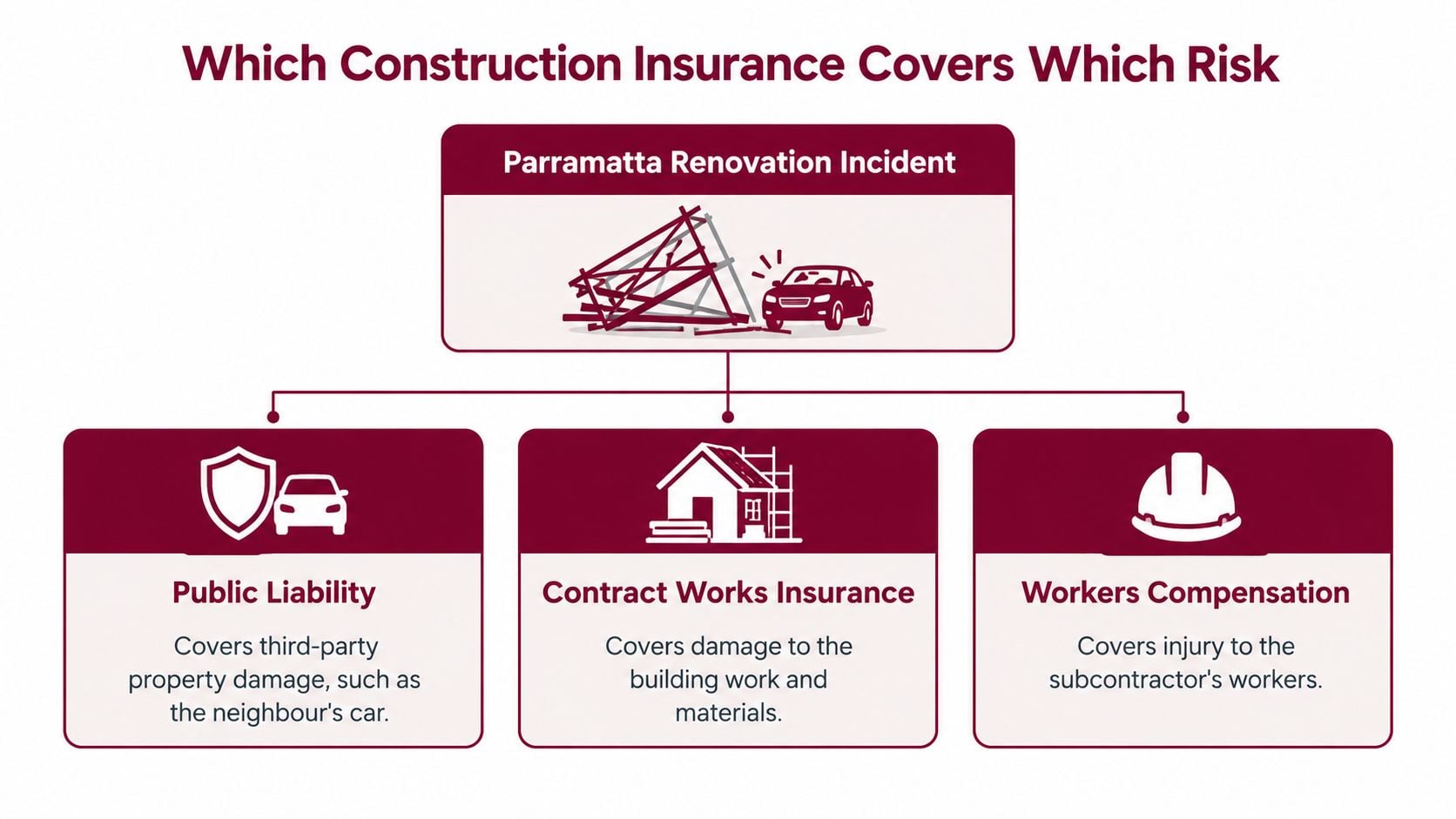
Every policy answers a different question: who was hurt, what was damaged, or who is owed money?
Core construction insurance covers at a glance
| Cover | Protects | Typical trigger | Who usually needs it |
|---|---|---|---|
| Contract works | Project works, materials and temporary works | Fire, storm, theft or accidental damage to the works | Builders and developers on construction contracts |
| Public liability | Third parties for injury or property damage | A passer-by is hurt or a neighbour's property is damaged | Almost every contractor and tradesperson |
| HBCF builders warranty (NSW) | Homeowner when a residential builder fails | Insolvency, death, disappearance or licence suspension after a court or tribunal order | NSW residential builders above the threshold |
| Professional indemnity | Clients against errors in advice, design or technical work | Client claims that advice or design caused financial loss | Designers, engineers, project managers and consultants |
| Plant and machinery | Owned or hired equipment | Breakdown, damage or theft of excavators, cranes or generators | Businesses with significant equipment |
| Workers compensation | Employees injured or made ill at work | Workplace injury or illness | Every employer with staff, as a statutory requirement |
| Motor and fleet | Trucks, utes and work vehicles | Collision, theft or damage to third-party vehicles | Businesses running work vehicles |
The distinction matters when you review a contract or set insurance limits. Contract works is generally aimed at physical loss or damage to the project, while public liability addresses legal liability for injury to others or damage to their property. The difference between contract works and public liability cover is worth checking against the actual policy wording and contract requirements. Naming one cover does not automatically provide the other.
A project also needs to match cover to who carries each risk. A builder with employees needs workers compensation as required by law. A contractor using hired plant should check whether the equipment is insured and who pays the excess if it is damaged. Designers and consultants may need professional indemnity where their advice or design could lead to a client's financial loss.
Statutory cover and project insurance serve different purposes. For a NSW residential project, HBCF builders warranty protects the homeowner when specified failure events occur, subject to the scheme's rules. It does not replace contract works, liability or workers compensation. A policy certificate can confirm that cover exists, but the wording, limits and exclusions determine whether a particular loss is funded.
Exclusions and Limits That Leave Gaps
A frame fails early in a project. The contract works insurer pays for materials damaged in the collapse, but not necessarily the cost of dismantling faulty work and rebuilding it. That repair bill can remain with the builder, even when the policy responds to resulting damage.
Contract works generally covers damage to the project. It usually excludes the cost of correcting faulty workmanship itself. Check the policy wording and schedule: cover for resulting damage does not mean the defective work is covered too.
A separate funding gap can arise under domestic building insurance. Victoria's 20% cap on incomplete-work cover is a feature of that state's scheme, not a standard contract works or plant policy term. The cited Recent Australian industry evidence does not establish that more than 55% of incomplete-work claims exceed the cap, so that figure should not be relied on here. For work covered by a domestic building scheme, check the applicable state rules and compare any cap with the likely cost to finish. Commercial builders should check their own policy limits instead.
Common exclusions and limits that catch builders out
| Exclusion or limit | How it bites | Fix to check at quote stage |
|---|---|---|
| Faulty workmanship itself | The cost of redoing poor work is usually excluded; resulting damage may be covered | Check defect cover and keep site inspections documented |
| Employee injury under public liability | Injuries to your own staff generally fall outside public liability | Arrange workers compensation separately |
| Mechanical breakdown under plant policies | Breakdown may be excluded unless an extension is added | Get written confirmation of any breakdown extension |
| Claims-made professional indemnity | The policy generally responds only to claims made and notified during the policy period | Maintain continuous cover and check run-off terms if you stop trading |
| Tools and materials off site | Cover may be limited by a sublimit or excluded | List high-value items and match sublimits to replacement costs |
Compare exclusions and limits alongside the premium. A lower quote may leave a larger share of a failure, breakdown or off-site theft bill with your business. Check the wording before accepting the trade-off.
Practical rule: If the quote doesn't say an extension is included, treat it as excluded until the insurer confirms it in writing.
NSW Home Building Compensation Rules Before You Start
A residential renovation can be ready to start while its HBCF certificate is still missing or lists the wrong contract details. In New South Wales, residential building or renovation work generally requires Home Building Compensation Fund (HBCF) cover when the contract exceeds AUD 20,000 including GST, unless an exemption applies. Check the applicable rules with icare before work begins.
HBCF is a last-resort statutory scheme, not a replacement for contract works or public liability insurance. It may respond when a builder cannot complete work or rectify defects because of insolvency, death, disappearance, or licence suspension after failing to comply with a court or tribunal order. Contract works cover addresses insured physical damage, while public liability responds to certain third-party injury or property damage claims. Neither automatically fills the funding gap when a builder fails and statutory cover does not apply.
The protection period depends on the defect. Six years from completion applies to major defects, and two years applies to other covered losses. If a defect first appears in the final six months of the relevant period, the homeowner generally has an extra six months to lodge a claim.
HBCF requirement by project type
A certificate is not a formality. NSW government figures record 72,422 home building and renovation projects in 2023. At that scale, a missing or inaccurate certificate can leave a homeowner without the intended statutory protection if the builder fails, even when other policies are in place.
| Project type | HBCF position | What to verify before work starts |
|---|---|---|
| Residential building or renovation above AUD 20,000 incl. GST | Generally mandatory unless an exemption applies | Project value, homeowner, site, contract and insured amount on the certificate |
| Residential work at or below AUD 20,000 incl. GST | Generally not required under the threshold | That the value includes GST and all approved variations |
| Commercial or non-residential construction | HBCF does not apply | Contract works and public liability cover instead |
Pre-start check
- Confirm the project value including GST. Include variations approved before work starts when checking the threshold.
- Match the homeowner, site and contract. A certificate issued for different details may not cover the contract you signed.
- Check the insured amount. It should match the contract, not a rounded amount carried over from an earlier quote.
- Keep the certificate and evidence of issue. Financiers and purchasers may request it at settlement. A missing certificate can also delay commencement, even if the building contract is valid.
Builders can check eligibility requirements in this guide to NSW home building compensation. A broker can arrange cover for eligible projects, but the builder remains responsible for checking that the certificate matches the job before the first trade arrives.
What Drives Your Construction Insurance Premium
A quote for the same builder can change when payroll, project duration or site conditions change. Insurers price the exposure they take on, using your trade mix, work scope and claims history. Industry reporting on the 2025 construction insurance market, drawing on Aon's 2025 Global Construction Insurance and Surety Market Report, describes large worker injury claims. Those claims can affect workers compensation pricing and, where a worker's injury leads to a liability claim, the insurer's view of liability exposure. Your own premium still depends on your business and policy terms.
Premium drivers and the information to prepare
| Cost factor | How it moves the premium | Information to prepare |
|---|---|---|
| Wages and payroll | Workers compensation premiums scale with wages by trade classification | Payroll by class for the last 12 months |
| Contract value and project length | Contract works premiums rise with the value and time exposed | Contract sum, program and site address |
| Trade and activity risk | Roofing, scaffolding, demolition and excavation rate higher | Scope of works and maximum working height |
| Claims history | Recent claims can raise rates or reduce insurer appetite | Five years of loss history with dates and amounts |
| Subcontractor management | Current certificates of currency reduce uninsured-subcontractor exposure | Subcontractor insurance register with expiry dates |
| Excess and sums insured | Higher excess lowers the premium; higher sums insured raise it | Your appetite for retained risk and replacement values |
| Location and asset values | Urban sites, high-value plant and flood-prone areas shift cost | Site addresses and asset schedule with values |
Start with the payroll and project details. Wages by trade class set the workers compensation exposure, so roofing and painting payrolls may be priced differently. Contract value and program length affect contract works cover: a higher insured value or longer construction period keeps the insurer exposed for more. Activity risk also matters, with scaffolding, demolition and excavation often attracting tighter terms than fit-out.
Claims history and subcontractor records shape the insurer's assessment too. Prepare the requested loss history and keep certificates of currency current. A certificate helps document a subcontractor's insurance, but check what the policy covers and whether its limits fit the work.
A higher excess can reduce the quoted premium, while lower limits may leave more of a loss unfunded. Before choosing the cheaper option, compare the excess and sums insured with the cash your business could put toward a claim that month. Policy wording and exclusions govern what the insurer pays, so compare cover as well as price.
Insolvency and Delay Risks Standard Policies Miss
A critical subcontractor fails halfway through a fixed-price job. Replacement takes time, completion slips, and liquidated damages or financier penalties begin to accrue. Contract works insurance generally responds to physical loss or damage, not the financial chain caused by non-performance. Check the policy wording for the exact triggers and exclusions.
The NSW figures show the scale of builder insolvency risk in one state. Infrastructure NSW recorded 3,596 construction companies entering external administration or having a controller appointed for the first time in the 12 months to June 2025. That was a 21% annual increase and the highest level in more than a decade. The report does not establish how often a subcontractor failure causes delay losses, and it does not support a national estimate. Nor should builders assume standard policies cover those costs: check the wording and consider the options below.
The NSW Government's 2016 HBCF scheme report recorded 4,824 accepted insolvency-related claims, with AUD 372.5 million paid to claimants and AUD 33.3 million to third parties, about AUD 405.9 million in gross payments. These are historical payments under a residential scheme that protects eligible homeowners when a builder cannot perform. They are not estimates of commercial subcontractor-default or delay losses. They do show why insolvency can create costs for parties beyond the failed builder, while leaving the builder's own delay, plant and cash-flow losses outside that protection.
Insolvency and delay exposures and the response to each
| Exposure | Cover or control to consider | Use it when |
|---|---|---|
| Subcontractor default | Subcontractor default cover, or staged payments and bonds (control) | Several subcontractors sit on one critical path |
| Delay in start-up or completion | Delay in start-up or advance loss of profits cover | Delays trigger liquidated damages or financier penalties |
| Price escalation | Escalation allowance in the contract, backed by a contingency (control) | Fixed-price contracts run beyond 12 months |
| Hired plant failure | Plant hire cover or hirer's liability cover | Hiring cranes, excavators or specialist equipment |
| Client or developer insolvency | Progress claim security, payment terms and retention (control) | Large commercial contracts have a single client |
Three options in the table are contractual controls, not insurance policies. Staged payments, escalation clauses and retention terms need to be agreed before pricing. Insurance bought after signing cannot change a fixed price or remove an uncapped damages obligation. If a site shutdown could interrupt revenue, review business interruption cover when a construction site shuts down alongside the contract, cash forecast and available contingency. Policy wording determines whether the loss is covered.
How to Make a Construction Insurance Claim
Most delayed or declined construction claims fail on process, not on the existence of cover. The policy may respond. The file doesn't.
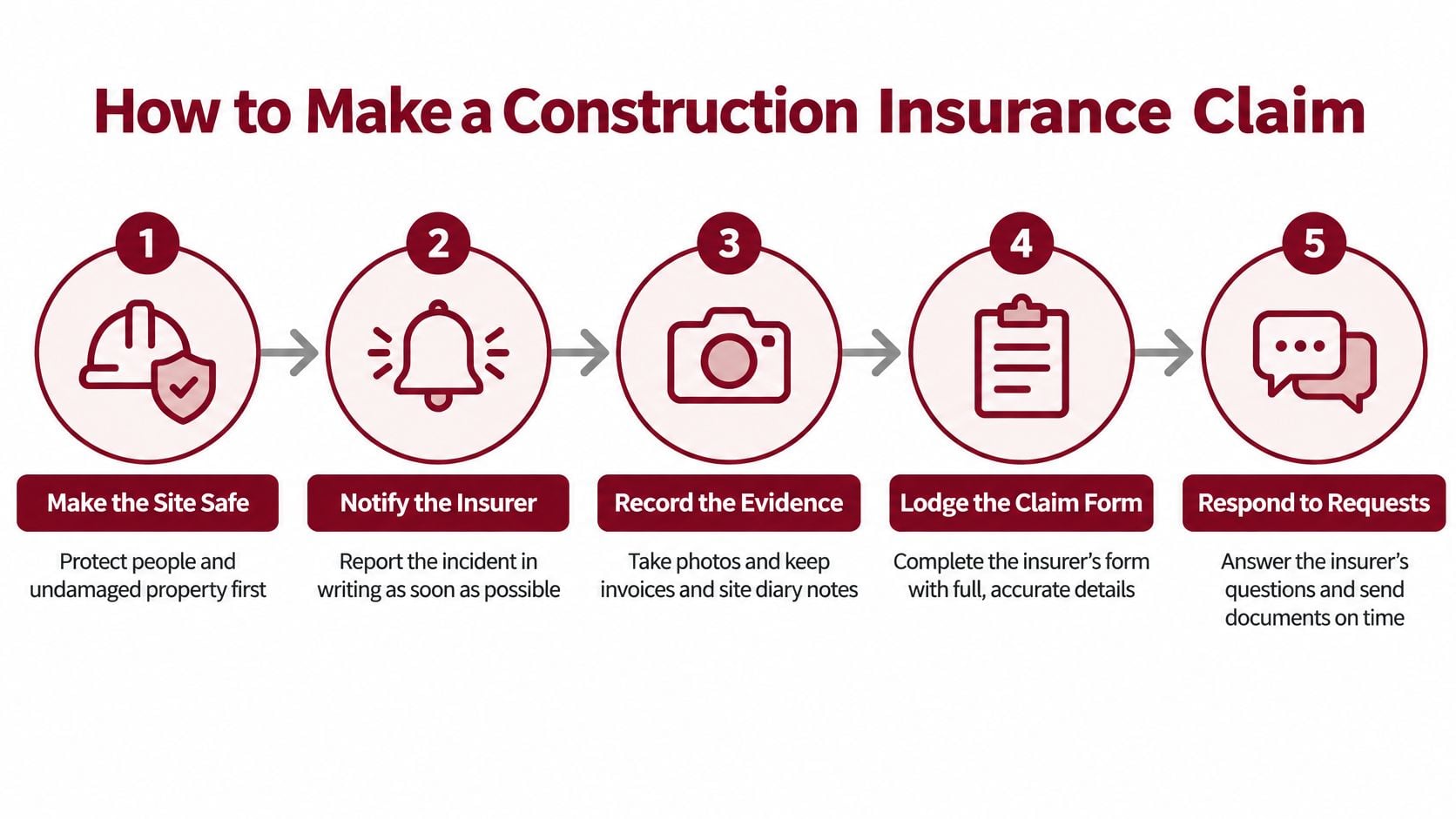
The claim sequence
- Make the site safe. Protect people first, then undamaged property and materials. A second incident on the same site becomes a separate argument about what you did after the first one.
- Notify the insurer or broker in writing. Do it as soon as you can. Late notice can put cover at risk even when the event itself is insured, because the insurer loses the chance to inspect.
- Record the facts the same day. Dated photos, witness names, weather and a site-diary entry. Memory written a fortnight later is weaker evidence than a note made before the clean-up.
- Preserve damaged items. Don't repair or dump them until the insurer or assessor has inspected. A pump that's already been replaced, with the failed unit gone, can turn a covered breakdown into a disputed one.
- Lodge the formal claim. Attach invoices, the contract, the program and a proof of loss. Incomplete packs sit in a queue while the adjuster asks for what you already had on site.
- Answer the loss adjuster inside the stated time. Silence reads as a gap in the facts, and gaps get priced against you.
- Track assessment, agree the settlement and confirm how payment is made. Check whether the insurer pays you, the owner or a repairer, and whether the excess comes off the cheque.
HBCF claims run through the insurer named on the certificate, and homeowners face the defect time limits already set for that scheme. Keep the certificate with the contract so nobody is hunting for the policy number after a builder has stopped answering the phone.
A broker can coordinate the paperwork and the liaison while the assessment runs. You still own the site diary, the photos and the decision not to throw the damaged plant in the skip.
Confirm Your Cover Before the First Pour
A project can have every certificate in order and still leave the builder funding losses that statutory cover and standard policies do not address. Check the program against the contract before ordering concrete, then revisit it as the work and values change.
Map each project risk to a cover from the table of seven. Design risk should not sit on a liability policy, and hired plant should not be assumed to follow the contract works cover.
Check limits and exclusions against the contract value and head contract. A public liability limit in a standard package may still fall short of the principal's minimum. Policy wording governs what is covered.
Review the program when the project stage changes and at renewal. Values at risk shift from foundation to frame and from frame to practical completion. Last year's sum insured does not automatically match the current contract.
Five actions before you start
- Confirm the HBCF certificate where the residential threshold applies, with the correct homeowner, site and contract.
- Match the contract works sum insured to the contract value, including expected variations.
- Check public liability limits against the head contract, not last year's schedule.
- Collect current certificates of currency from subcontractors and track expiry dates in a register.
- Decide how to address non-damage gaps. Identify whether delay, subcontractor default and price escalation need insurance or a contract control.
Build the program in layers: contract works and public liability form the base, with statutory residential cover where it applies. Add professional indemnity, plant and motor cover according to who carries the design, equipment and vehicles. Set sums insured for the current contract, then review them when the project stage changes.
Policy wording governs, and this guide is general information, not advice on your contract. ABS Insurance Brokers Pty Ltd arranges contract works, public liability, HBCF and related covers for builders, trades and developers. For a review of a live project, submit the contract value, project type and subcontractor list through ABS Insurance Brokers Pty Ltd.