
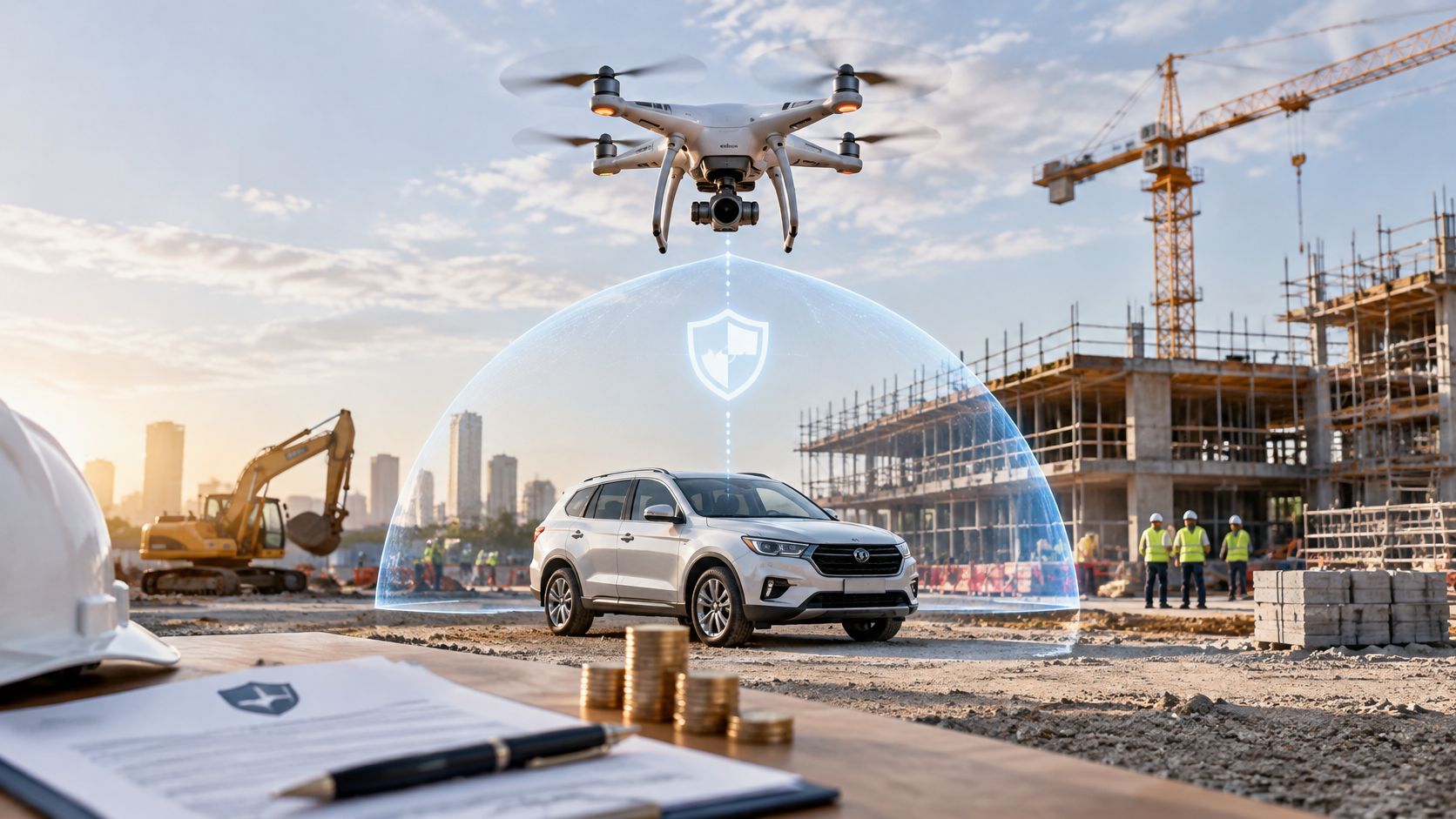
You're getting ready to photograph a building site, inspect a roof or deliver a survey, and the client asks for evidence of drone insurance. You might already have business public liability cover, a registered aircraft and the right operating permissions. None of those, on its own, confirms that your insurer will pay if the flight causes a loss.
Drone operator insurance needs to match the flight, the equipment and the information you collect. A compliant flight can still leave you exposed through a site-access condition, an excluded activity or footage that captures someone's private life.
Table of Contents
- What Drone Operator Insurance Covers at a Glance
- Aviation Liability and Aircraft Damage Explained
- Common Exclusions That Leave Operators Exposed
- What Drives Drone Insurance Premiums and Limits
- Privacy and Data Claims Standard Policies Miss
- Do You Legally Need Drone Insurance and What Else to Check
- Confirm Your Cover Before Your Next Commercial Flight
What Drone Operator Insurance Covers at a Glance
Say you're surveying a construction site. Your drone clips a parked car, damages its camera on landing and prompts a neighbour to complain about footage of their backyard. These aren't interchangeable losses, even though they arose during the same job.
Drone operator insurance is a collection of covers, sometimes packaged together, that address different financial consequences. Don't assume an ordinary business policy includes all of them.
Core cover types for drone operators
| Cover type | What it responds to | Limit to check |
|---|---|---|
| Aviation public liability | Injury to people or damage to third-party property caused by the drone, including impact with aircraft | Often $10 million or $20 million, the standard limits used in Finder's Australian benchmark |
| Aircraft hull | Physical loss or damage to the drone itself | Agreed or replacement value stated in the schedule |
| Professional indemnity | Errors or omissions in survey, mapping or inspection reports | Limit required by the client contract and potential financial loss |
| Equipment and payload | Camera, gimbal, batteries and attached payload | Replacement value of each item |
| Hired or leased drones | Damage to a drone you don't own | Limit set in the hire agreement |
| Privacy and data | Claims arising from captured footage | Express privacy or data cover and its sublimit, confirmed in the wording |
Match each loss to its cover
Aviation public liability is the relevant starting point for the parked car. Hull and payload cover address your damaged aircraft and camera, subject to the items insured and applicable excesses.
The neighbour's allegation needs a separate privacy assessment. If your survey also contains an error that causes the client financial loss, that's a professional indemnity question, not a crash claim.
Australia's sector warrants this separate treatment: CASA's sector profile reported 29,876 registered drones and 2,802 ReOC holders. Drone work is a distinct business activity, not an equipment purchase to tuck into an existing policy without checking.
Read the schedule line by line. A policy can insure the aircraft while excluding its removable sensor, or provide aviation liability without covering professional advice.
Aviation Liability and Aircraft Damage Explained
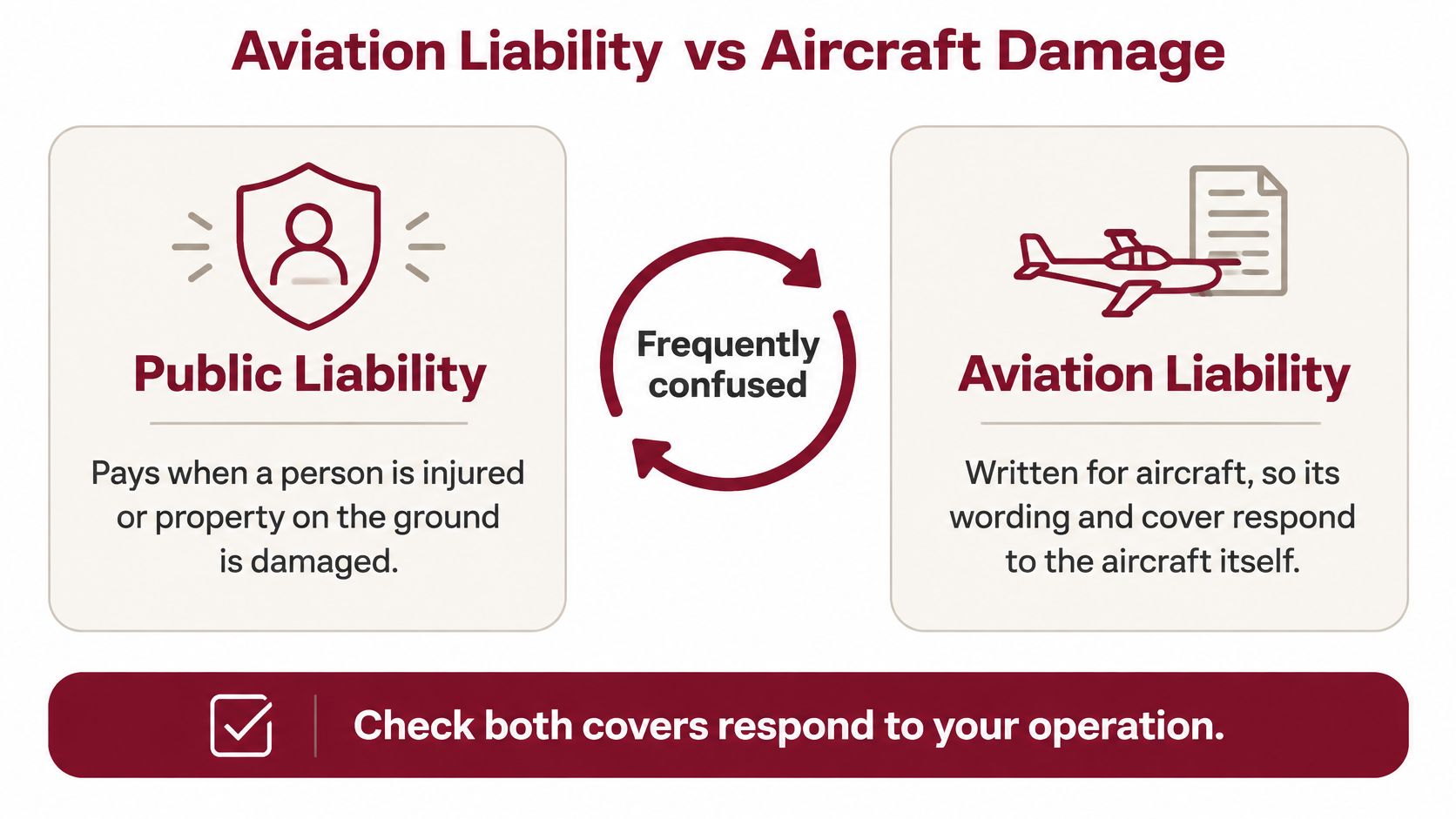
Think of ordinary business liability as cover designed around your usual workplace activities, and aviation liability as wording designed around an aircraft moving through shared airspace. It's a little like the difference between a home policy and a motor policy: owning both assets doesn't make their risks interchangeable.
However, aviation liability isn't aircraft damage cover. Aviation liability concerns your legal responsibility to others; hull cover concerns your own drone. The comparison below should be read with that distinction in mind.
Why flight risk needs specific wording
The ATSB's remotely piloted aircraft assessment records 939 encounters with remotely piloted aircraft from 2015 to 2024, representing approximately 1% of all ATSB-reported occurrences during that period. More than half of RPAS occurrences involved near encounters with manned aircraft, and almost half of those involved high-capacity air transport aircraft.
No collision between RPAS and manned aircraft had been reported in Australia at the assessment's publication. The ATSB nevertheless estimated that a collision with a high-capacity aircraft could cause engine ingestion in about 8% of strikes.
These are safety occurrences, not insurance claims statistics. They explain why assessing liability solely by the drone's purchase price misses the potential severity of an incident.
A drone could strike a worker, vehicle, building or aircraft. An airspace incident without a collision could also involve investigation, defence and regulatory expenses, but those expenses aren't automatically insured. Check the policy's defence provisions and treatment of regulatory proceedings rather than assuming every legal cost is included.
Declare the actual operating profile
Your disclosure should describe:
- Aircraft characteristics, including mass and payload type.
- Flight envelope, including altitude and visual line of sight or beyond visual line of sight operations.
- Location exposure, including controlled aerodromes, roads, workers and neighbouring properties.
For hull insurance, establish whether settlement uses an agreed value or replacement value, and whether in-flight loss, transport and storage are included. Our explanation of drone public liability versus hull insurance provides a useful distinction when reviewing those terms.
Choose the liability limit against the plausible severity of injury, aircraft damage and airport disruption, not the cost of replacing your drone.
Common Exclusions That Leave Operators Exposed
An insurance certificate doesn't make an unauthorised operation insurable. CASA's guidance on hiring a drone operator warns that an incorrect licence, an unregistered drone or missing approval to fly could void insurance.
The important word is could. Don't assume every breach automatically defeats every claim, but don't assume a minor-looking departure is harmless either. The policy wording, circumstances and applicable law matter.
Questions that expose a coverage gap
Use the exclusions to test your actual work, not a broad description such as commercial drone services.
- Unauthorised operations: Does the policy exclude flights outside declared areas, permissions or operating conditions? Ask how a change of location or mission must be notified.
- Payload damage: Are the camera, gimbal and removable sensors insured during flight, or only while stored? Check whether each item must appear separately on the schedule.
- Hired or leased equipment: Is damage to an aircraft you don't own included? Compare the insurance limit and exclusions with the obligations you accept under the hire agreement.
- Pollution or chemical application: Does spray work require a specific extension or separate placement? Don't describe agricultural application merely as aerial photography.
- Breach of aviation regulation: How does the exclusion operate, and what connection must exist between the breach and the loss? Seek a written explanation rather than relying on a verbal assurance.
Test a realistic job
Say a roof-inspection operator flies outside the scope of the required approval and strikes a neighbour's car. If the policy excludes that unauthorised activity, the insurer may decline the claim despite the operator having purchased liability insurance.
Preventing that gap starts before take-off. Keep applicable RePL and ReOC details, aircraft registration, pilot competency evidence, standard operating procedures and mission approvals together with maintenance and battery records.
A construction progress flight and an infrastructure inspection can involve different payloads, locations and operating conditions. Update the declared activities when the business changes instead of waiting for renewal.
Request the relevant exclusions in writing, then compare them against your job list. Treat any unanswered activity as unresolved, not implicitly covered; privacy and data wording also needs its own assessment.
What Drives Drone Insurance Premiums and Limits
Published drone insurance cost benchmarks in Australia
| Source and year | Reported premium | Cover level or assumption |
|---|---|---|
| Coverdrone Australia, 2025 | $188.74 a year ($15.88 a month) | $1.5 million public liability; assumes no prior claims and commercial operations |
| Insurance Business Australia, 2025 | $500-$750 a year | Coverage up to $1 million |
These figures aren't equivalent quotes. Coverdrone publishes an advertised price for a defined liability limit under stated assumptions, while the Insurance Business figure is a broader market estimate tied to a different cover level. Read them as reference points, not rate cards.
A premium works like an airfare: the headline figure means little until you know what's included. A lower advertised premium is not proof of better value, and a higher premium doesn't establish that hull, payload, professional indemnity or privacy cover is included.
What changes the price
An underwriter prices the operation, not the machine. The aircraft's value drives the physical damage assessment, while the operating environment drives the liability side. Three questions shape the quote: what you fly, where you fly and what could be affected if a flight goes wrong.
Details an insurer will weigh:
- Use and frequency: Dedicated commercial services expose the aircraft to more flight hours and more third parties than occasional in-house photography, so describe each activity accurately.
- Equipment ownership: Owned aircraft, hired drones and expensive removable payloads create different replacement and contractual exposures.
- Operating conditions: Height, range, aerodrome proximity, nearby people and beyond visual line of sight work all feed the assessment.
- Pilot and business history: Qualifications, competency evidence and claims history show how the operation is managed.
- Policy choices: Liability limits, equipment values, excesses and requested extensions change the protection being purchased.
Compare the operation, not just the aircraft
Two operators can insure the same drone and receive different quotes. One flies within sight over an empty paddock; the other runs an approved beyond visual line of sight mission along a road corridor.
The corridor flight adds people, property and approval conditions to every sortie, so it presents additional exposure and should be budgeted for accordingly. That doesn't guarantee a specific premium difference, because the insurer assesses the whole proposal, but it explains why identical aircraft don't produce identical quotes.
Before accepting a price, ask what the excess applies to and whether defence costs sit inside or outside the liability limit. Check also that the quoted total includes the equipment you carry; a liability-only figure can look cheap until the payload is added. Price comparisons tend to test only the flight itself, so whether the policy responds to site-permission conditions or to claims arising from footage remains a separate question.
Comparison rule: Require every quote to state the limit, declared activities, insured equipment and key exclusions. Compare matching protection before comparing the premium.
A low price won't help if the policy excludes the job that produces the claim.
Privacy and Data Claims Standard Policies Miss
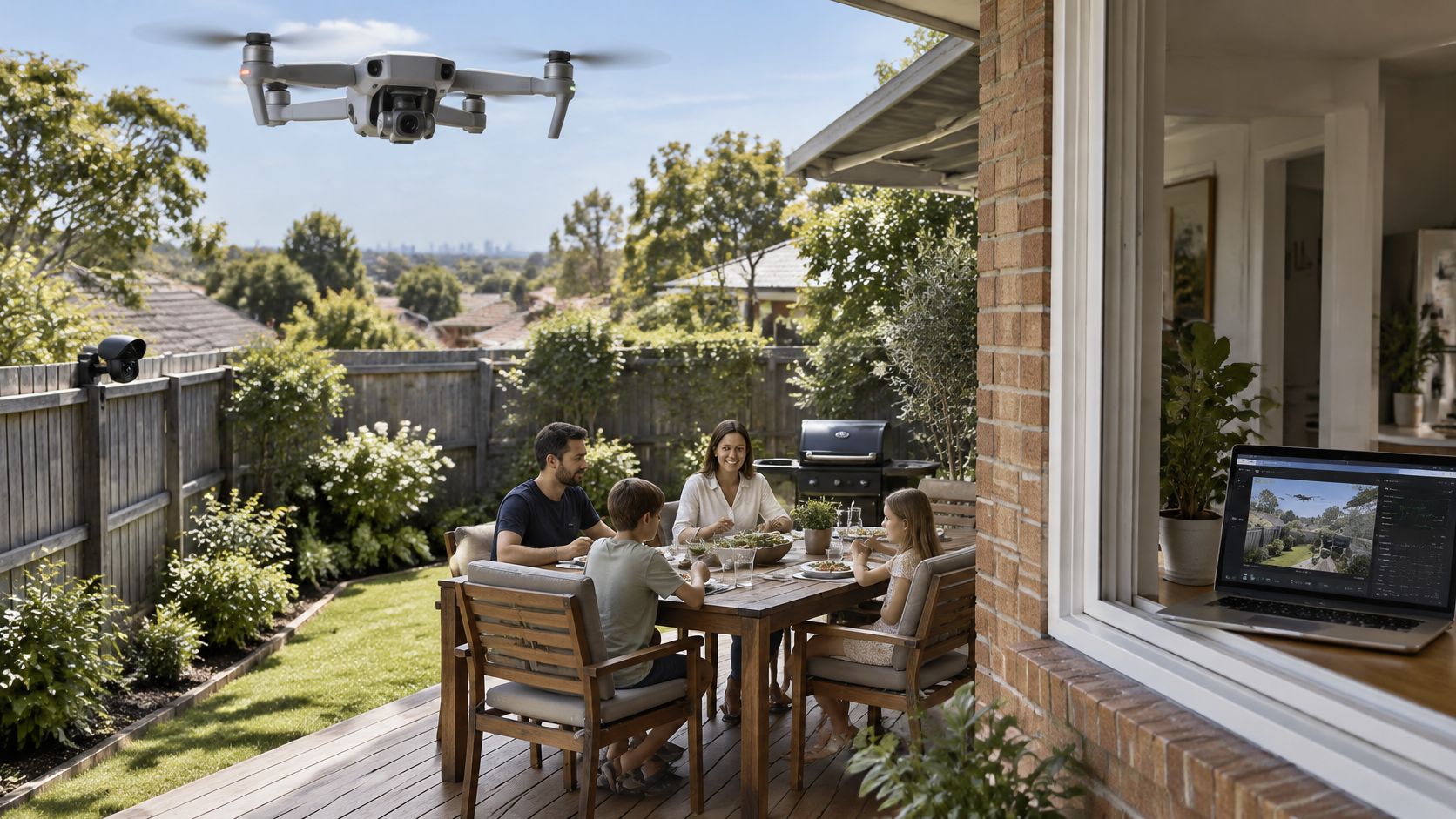
A legally compliant, physically safe flight can still produce a claim through its footage. A progress photograph may capture a neighbour's backyard, an identifiable worker or the interior of a tenant's home without any collision or equipment failure.
Flight approval works like a driver's licence: it confirms you may operate the vehicle, and it says nothing about what you record through the window. Site permission is a separate test again, and most cover comparisons stop at the aircraft and the liability limit, leaving these last two unexamined.
The Australian Drone Privacy Guidelines advise operators to avoid viewing, recording or collecting personal or private information without consent. The Privacy Act 1988 now includes a statutory tort for serious invasions of privacy, and a serious invasion can be actionable without proof of damage.
Check the insurance beyond the aircraft
Public liability under an aviation policy is built around third-party injury and property damage. A privacy allegation arising from footage sits in different territory, and careless handling can expose sensitive material just as easily as deliberate misuse. Accidental collection therefore deserves the same attention as intentional recording.
Put these questions into the coverage review:
- Privacy and confidentiality: Does the wording expressly respond to allegations arising from captured footage?
- Storage and sharing: Are cloud-hosted recordings, download links and client distribution within scope?
- Subcontractor handling: Whose policy responds when another operator captures, edits or stores the files?
- Hired aircraft: Does using a hired drone change any relevant protection or equipment-security requirement?
A cyber policy and an aviation policy protect against different losses. Reviewing the scope of a cyber insurance policy can help you frame questions about data breaches, and it still leaves open whether a privacy allegation from filming is covered.
Give footage a handling procedure
Before filming, work out what the client actually needs and what the camera should avoid. Obtain consent before recording identifiable people, narrow the camera angle where practical and remove unnecessary private material before delivery.
Set a documented retention period and name the people permitted to access the files. Use controlled sharing rather than an unrestricted public link, and agree when working copies will be deleted after handover, subject to legitimate recordkeeping obligations.
Apply the same rules to subcontractors as to employees. Data handling belongs beside aircraft values and liability limits in the risk assessment, agreed in writing before the files exist rather than raised for the first time after delivery.
Do You Legally Need Drone Insurance and What Else to Check
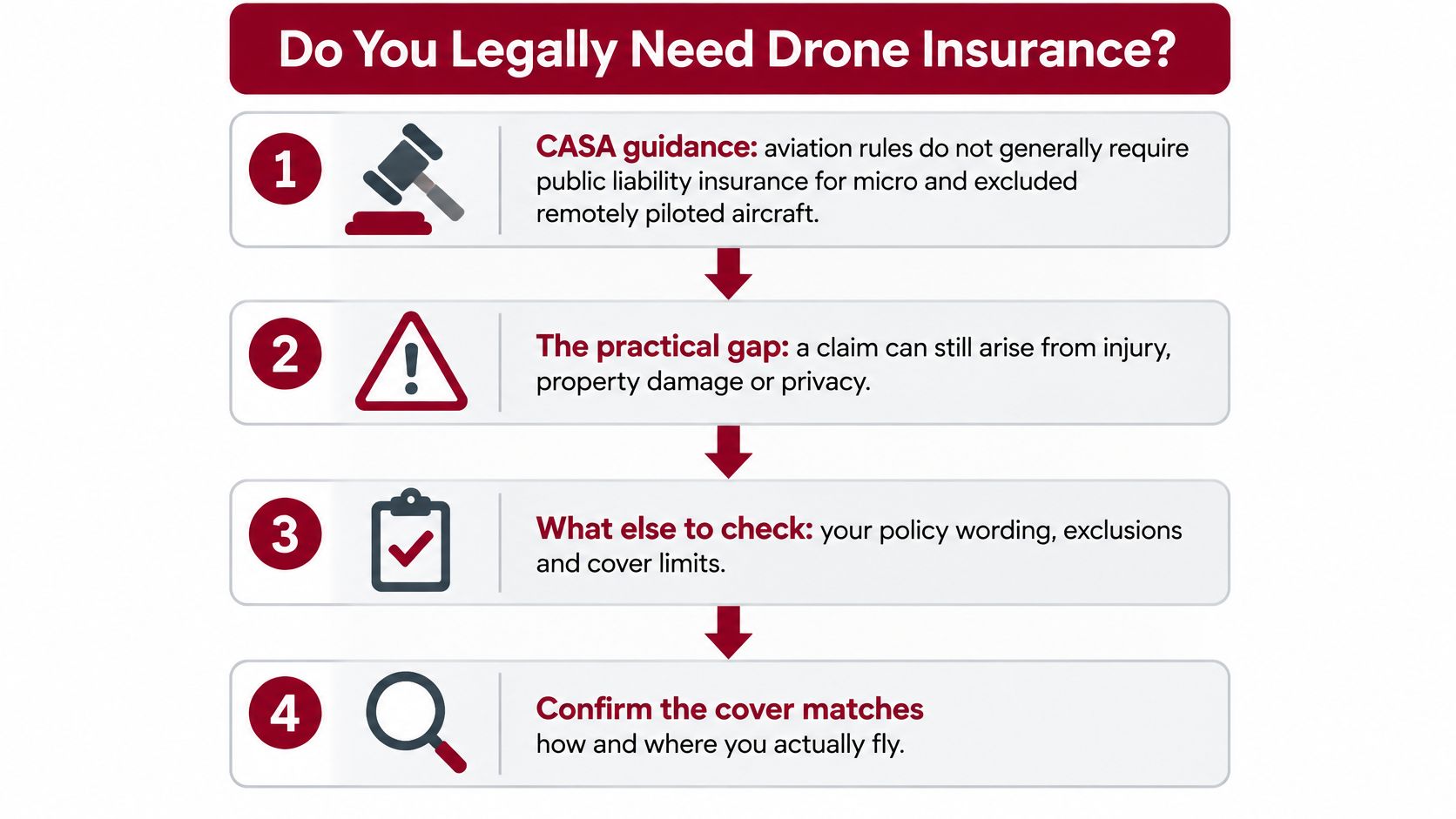
Not generally for micro and excluded remotely piloted aircraft: CASA's plain-English guide says aviation rules don't generally require public liability insurance for those categories.
That's a scoped answer, not a universal exemption for every drone operation. Landowners and park administrators may require evidence of insurance before permitting access, and a construction principal may impose contractual requirements.
Separate aviation permission from project permission
This matters even if drones aren't your main business. Builders taking progress images, tradespeople documenting roof defects and businesses producing marketing footage still need to assess their specific operation.
Calling the flight incidental doesn't settle its regulatory category or insurance status. Site permission also doesn't replace airspace approval, and airspace approval doesn't establish that the client contract has been satisfied.
Use this sequence before committing to the job:
- Describe the purpose. Record whether you're delivering a paid aerial service or using the drone within another business activity. Don't treat incidental business use as automatically recreational.
- Confirm the pilot's required credentials and the aircraft's registration status for the applicable category.
- Check mission permissions. Establish whether CASA approval or an operator certificate is required, including any conditions on the intended flight.
- Obtain written site permission and ask whether the landowner or administrator requires evidence of insurance.
- Review the client contract for cover types, limits, territorial scope, named insured requirements and any completed-operations provisions.
- Reconcile the documents. Match the policy to the mission and retain flight logs, maintenance and battery records, subcontractor details and the site risk assessment.
Keep overseas examples in context
For photographic planning rather than Australian legal requirements, Jimmy Clemmons Photographer's Atlanta aerial photography guide offers a separate resource to explore. Overseas photography guidance shouldn't be used to decide whether an Australian flight is authorised or insured.
Our Australian UAV insurance guide provides further context for reviewing local cover.
A small aircraft can create a substantial uninsured business exposure on a commercial project. Legal compliance, permission to use the site and financial protection are separate tests, and each needs an answer before the flight.
Confirm Your Cover Before Your Next Commercial Flight
A compliant flight can still leave a business paying for the loss. CASA approval, site permission and privacy risk from footage are separate questions, and a policy does not answer them just because the mission was legal. Before requesting a quote, write down the services performed, site types, intended heights and ranges, aircraft and payloads, hired equipment and how footage is stored or shared.
Attach client insurance clauses rather than paraphrasing them. Wording that asks for a principal's interest to be noted can differ from wording that makes that principal an insured party, and the difference matters after an incident.
Ask for written answers
ABS Insurance Brokers Pty Ltd works through four steps: Tell Us What You Need, Risk Assessment, Compare Cover Options and Arrange Your Cover. Give enough detail to separate current work from activities only planned for later.
A coverage review should produce clear answers:
- Limit selection: Why does the proposed limit suit the worst plausible claim arising from the declared operation?
- Operational exclusions: Which exclusions affect the services, aircraft, payloads, locations or permissions?
- Information exposure: Does the wording respond to privacy and data allegations, and what sits outside cover?
Keep those answers with the quotation, schedule and policy wording. If a verbal explanation conflicts with an exclusion, resolve it before accepting the policy; a summary email is weaker than the wording itself.
Make the final check operational
ABS Insurance Brokers Pty Ltd is Australian-owned and operated, holds Australian Financial Services Licence No. 700333, and offers aviation insurance, including aircraft hull and liability. Its Sydney office is at 2 Hartzell Place, Bankstown NSW 2200, at Bankstown Aerodrome, with office hours Monday to Friday, 8:00 am to 5:00 pm. Use the 1300 number or email with the equipment list, operating description and contract requirements ready.
Before flight, confirm the schedule shows the insured entity, activities, limits and territorial scope that were agreed, and keep evidence of cover with whoever controls site entry. Recheck when a payload, subcontractor, operating range or footage-handling process changes.
ABS Insurance Brokers Pty Ltd offers a free insurance quote on request and can help assess aviation cover against commercial drone operations. Visit ABS Insurance Brokers Pty Ltd with the aircraft, payload and job details, then confirm the exclusions and final wording before the next commercial flight.