

You've got a drone on site most weeks. Someone flies it for progress shots, a roof inspection, a stockpile survey, and the footage lands in the monthly report without anyone thinking much about it. Then a tender pack comes back asking for a certificate of currency that shows public liability cover, names the head contractor as an insured, and confirms the aerial work is included.
The certificate arrives by email. It names the operating company, states a limit and looks official. What it doesn't tell you is whether the policy responds when a drone drops onto a pedestrian, clips a crane jib, or lands on a neighbour's roof.
That distance between what a certificate looks like and what a policy does is where Australian construction businesses get caught. Drone public liability insurance is a specific form of cover with its own wording, its own exclusions and strict rules about what you declared when you bought it. The order below follows the way a claim would arrive.
Table of Contents
- What Drone Public Liability Insurance Covers at a Glance
- Why Strict Liability and Operating Factors Set Claim Size
- Matching Declared Operations to Your Policy Schedule
- How Contracts and Site Rules Shape Cover Needs
- What Happens When a Third-Party Claim Is Made
- Questions to Ask Your Insurer and How to Get Advice
What Drone Public Liability Insurance Covers at a Glance
A drone can strike a worker, damage a client's vehicle or fall onto a neighbouring building. CASA's drone registration requirements report 27,584 commercial drone registrations and 14,791 operator accreditations in 2020–21, rising to 37,539 registered drones by 2022–23, an increase of about 36%. Those figures show the scale of commercial drone activity, but registration is not proof that a particular flight is insured.
Public liability cover is about legal liability to third parties. If a drone operation causes someone's injury or damages their property, the policy may cover the business's liability, subject to its wording, limits and exclusions. It does not automatically cover the drone itself or every financial loss connected to an incident.
| Loss from a drone incident | Usually covered by public liability | Usually needs separate cover |
|---|---|---|
| Bodily injury to a bystander or worker | Legal liability for injury caused by the drone, subject to the policy | Not applicable |
| Damage to a third party's building, vehicle or property | Legal liability for physical damage caused by the drone, subject to the policy | Not applicable |
| Legal defence and settlement costs | May be covered, subject to the policy wording | Check whether costs reduce the limit or are excluded |
| Damage to the drone itself | No | Drone hull or equipment cover |
| Delay or lost income on a worksite | Generally no | Delay or business interruption cover, where available |
| Errors in inspection findings or advice | Generally no | Professional indemnity cover |
Use the table to separate the risks rather than treating “drone insurance” as one all-purpose policy. A falling drone that injures a worker raises a third-party liability question. A drone written off in a crash is an aircraft or equipment loss. A client alleging that an inspection missed a cracked façade may raise a professional liability question instead.
The distinction matters because a general business policy may not automatically cover aviation activities. Check the policy wording and schedule for the declared drone operations, relevant exclusions and applicable limits. Defence costs may also be treated differently from the compensation paid to a claimant, so confirm whether they are included within the limit or handled separately.
Why Strict Liability and Operating Factors Set Claim Size
A roof tile falls from a construction site and injures a passer-by. Even if the site team followed its safety procedures, the injured person may still have grounds for a claim. Drone incidents can raise a similar question: liability may arise under legislation that applies to aircraft damage, without the claimant needing to establish negligence.
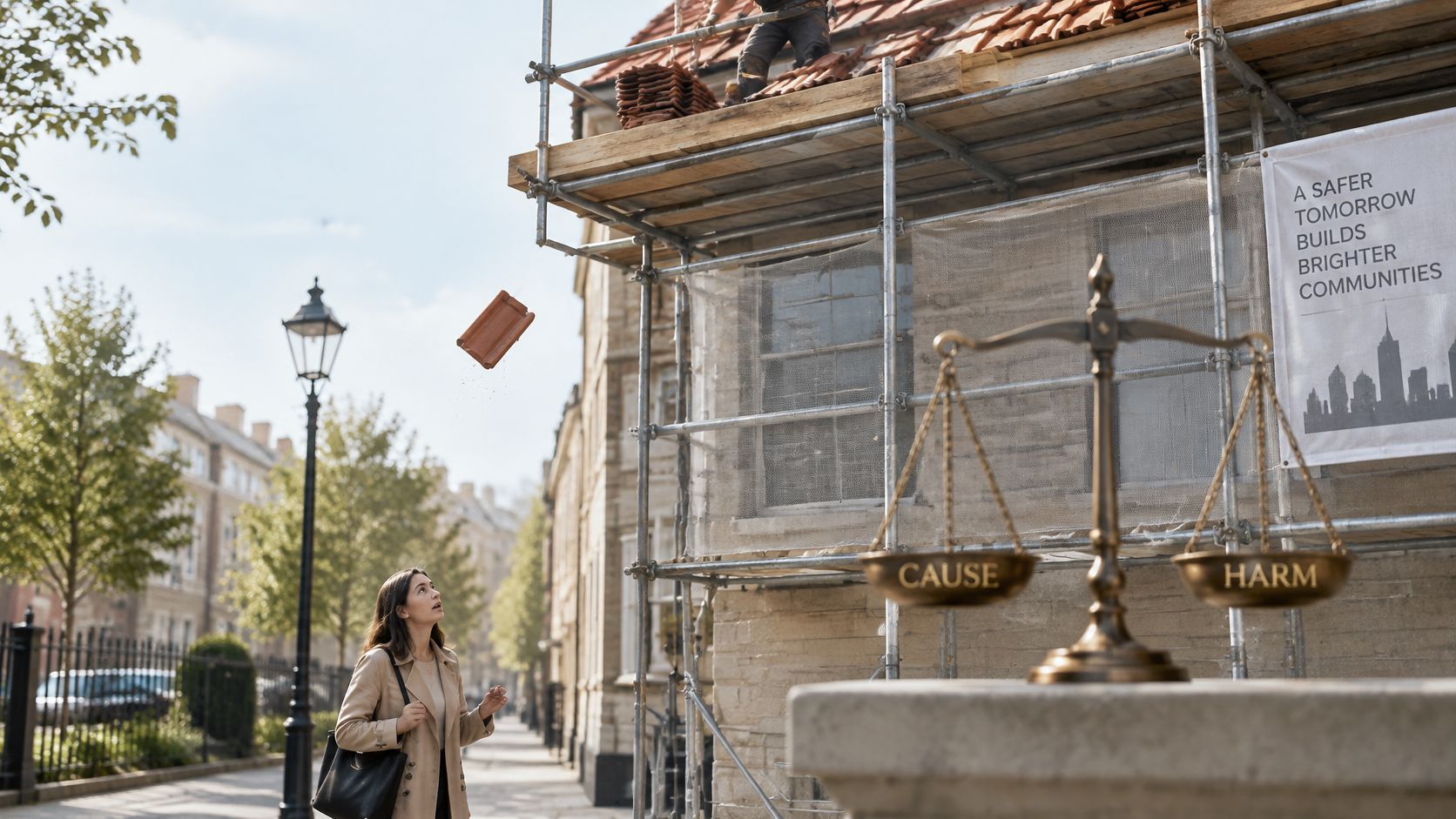
That does not mean every drone incident automatically creates liability. The relevant law and the policy wording matter. A general business policy may not respond to aviation-related claims, and a drone policy only applies within the operations, aircraft and conditions it covers.
A drone can look steady through a screen while posing risks to people and property below. The video below offers a reminder of how an aircraft's operation can affect the ground.
Where claim size actually comes from
The severity of an incident can matter more than how often incidents occur. CASA's RPAS sector safety performance profile records reported encounters with remotely piloted aircraft and identifies loss of control and collision with obstacles as possible accident mechanisms. CASA also states that drone operations do not override landowners' property rights or remove liability for injury or property damage caused directly or indirectly by an RPAS operation.
The potential cost depends partly on where the aircraft flies and what it carries. Consider these factors when assessing the exposure and checking the policy wording:
| Factor | Why it matters | Effect on cover and limit |
|---|---|---|
| Location near worksites, roads, cranes, pedestrians, airports or events | A fall or collision in a busy area could cause serious injury or property damage | Check applicable limits, territorial terms and any location exclusions |
| Aircraft class and weight | The aircraft's size and weight affect the potential impact | Confirm the declared aircraft matches the policy schedule |
| Payload and attachments | Equipment may change what could fall or be released | Check whether the payload or attachments must be declared |
| Territory of operation | Policies define where cover applies | Confirm the planned flights fall within the stated territory |
| Subcontracted pilots | A different pilot may affect who is insured | Check whether the policy extends to subcontractors |
| Documented risk controls | Spotters, pre-flight checks, return-to-home settings and battery management help manage operational risk | Keep controls in place, but do not treat them as a substitute for insurance |
Third-party liability and drone hull cover address different losses. Hull cover concerns damage to the aircraft itself; it does not pay an injured person's claim or repair a damaged roof or vehicle. Liability cover may respond to covered third-party claims, with defence costs and limits governed by the policy. CASA also makes clear that insurance does not replace aviation risk controls, so exclusion zones, spotters and pre-flight checks remain part of safe operations.
Matching Declared Operations to Your Policy Schedule
The most expensive mistake in drone public liability insurance isn't choosing the wrong insurer. It's describing the wrong operation on the schedule you signed.
Australian aviation rules don't generally require an RPA owner or operator to hold public liability insurance, yet an operator can still face very large financial liability for third-party injury or property damage, and landowners and public land administrators commonly demand evidence of cover before granting permission, as CASA's guidance for hiring a drone operator explains. That combination is the trap: the cover isn't compulsory, but it's often a condition of getting on site, so it has to be usable when someone asks.
| Activity | Main third-party exposure | What the schedule should state |
|---|---|---|
| Construction progress imaging | Falling objects onto workers, plant or footpaths | Site address, flight frequency and the contracted service |
| Roof and façade inspection | Damage to roofs, neighbouring property or people below | Building type, height and whether flights pass over occupied areas |
| Surveying and mapping | Collisions near other aircraft, roads or powerlines | Operating area, airspace approvals and any flights beyond the pilot's direct line of sight |
| Event or real estate photography | Injury to crowds or collisions with vehicles | Venue, exclusion zones and payload |
| Agricultural monitoring | Damage to crops, livestock, buildings or neighbouring land | Property boundaries and any payload or spraying use |
Look at the first row with a real job in mind. Say a builder engages an operator for monthly progress imaging on a six level site. The operator's schedule lists general photography and aerial survey, because that's how the business started. Nothing on the schedule says construction, nothing names the site, and nothing records that the aircraft routinely hovers above an active crew. The policy is genuine, the certificate is genuine, and a dispute about whether the flight was declared is now live.
That's why the exclusions page deserves the same attention you'd give it decoding fine print after storm damage, where an unnoticed exclusion turns a valid claim into a self-funded one. Operators working in property marketing hit a similar version of this problem, which is why the notes on drone insurance for photographers and real estate work are worth reading alongside your own schedule.
CASA also warns that illegal operations, including using an unregistered drone or flying without the required licence or approval, could void your insurance. So the controls sit before the flight, not after: confirm the pilot's credentials, the drone's registration, site permissions, airspace approvals and your documented operating procedures every time the aircraft is deployed.
Practical rule: if a line on your schedule doesn't match this month's work, fix the schedule before the next take-off. A premium adjustment is cheaper than a declined claim.
How Contracts and Site Rules Shape Cover Needs
Two policies can look adequate on paper and still leave a flight uninsured, because neither one was written for that flight.
Take a familiar arrangement. A head contractor holds a broad public liability policy and assumes it covers everything happening on site. A drone operator holds a specialist policy with a respectable limit. The operator flies over the site for progress imaging, clips a crane cable, and the aircraft falls into a loading zone, damaging a delivery vehicle and injuring a driver. The builder's general policy contains an aviation or aircraft exclusion, which is common in ordinary business liability wordings, so it doesn't respond to a drone at all. Guidance on drone public liability for Australian operators makes the point directly: ordinary business public liability may exclude aviation, so the drone policy has to stand on its own.
Now add the second half. The operator's policy does cover liability for drone flights, but its stated territory doesn't include the site, or its schedule describes survey work rather than construction. The claim falls between the two policies and the builder discovers the gap only after the invoice arrives.
Why a bigger limit doesn't fix a mismatched policy
Head contractors often fix this by demanding a higher limit, and that instinct is understandable but incomplete. A policy with an unsuitable aviation exclusion, a narrow territory, or no cover for the declared activity is less useful than a lower-limit policy that matches the contract and the operation. The right order is to match the wording first, then set the limit to the contract.
Four questions decide whether the arrangement works, and they're contract questions rather than insurance ones. What limit does the head contract require? Who must be named as an insured? Are subcontracted pilots covered and identified by name? Does the policy respond to damage to the client's own building under the contract? Get written answers before the first flight, not after the first incident.
There's a second group of losses the contract may assume and no public liability policy provides: damage to the aircraft, delay to a programme, and defective inspection advice or a misread image set. If your contract expects those, they need their own cover or their own risk allocation.
Site access rules tie all of this together. Landowners and site administrators can require evidence of insurance before allowing drone operations, which is why the public liability insurance certificate of currency you hand over has to match the policy and the declared work. A certificate that names the wrong entity or shows an old limit creates a delay at the gate, and sometimes a cancellation.
What Happens When a Third-Party Claim Is Made
The sequence after an incident is mostly administrative, and it goes better when you know it before you need it.
- Notify the insurer as soon as possible. The policy wording sets the notice period, and it's the only document that tells you what yours is. Phone the broker the same day, then confirm in writing.
- Preserve the evidence. Download flight logs and telemetry before anything is overwritten. Collect site permits, pilot credentials, airspace approvals, photographs of the scene, and the names and numbers of everyone who saw it happen.
- Don't admit liability or offer to settle. Insurers usually require consent before you commit to anything, so keep the conversation to sympathy and fact-finding and let the insurer handle the rest.
- Expect the insurer to run the defence. They generally appoint or approve the lawyers and control settlement negotiations. Ask whether defence costs sit inside or outside the limit, because costs inside the limit eat into the money available for the injury claim itself.
- Know your excess and the gaps. The excess comes off your side of the claim first, and losses like damage to your own drone, delay or professional errors stay outside the policy regardless of how the claim is framed.
- Understand why a valid claim can still be declined. If the flight breached regulatory conditions or sat outside the declared operations, the insurer may not respond at all. That's the practical reason the schedule work matters more than the headline limit.
When a head contractor or council holds a certificate for you, reissue it whenever the policy changes. An out-of-date certificate is the first thing a claims team asks for and the fastest way to turn a straightforward claim into an argument.
The mechanics of a claim are routine for a broker, which is worth knowing before you're standing in a car park at 4pm. The work a general insurance broker does when you need to make a claim covers notification, documentation and the back-and-forth with the assessor.
Questions to Ask Your Insurer and How to Get Advice
Take a written list into the conversation, whether that's a phone call or an email, and ask for the answers in writing so the schedule and the file agree.
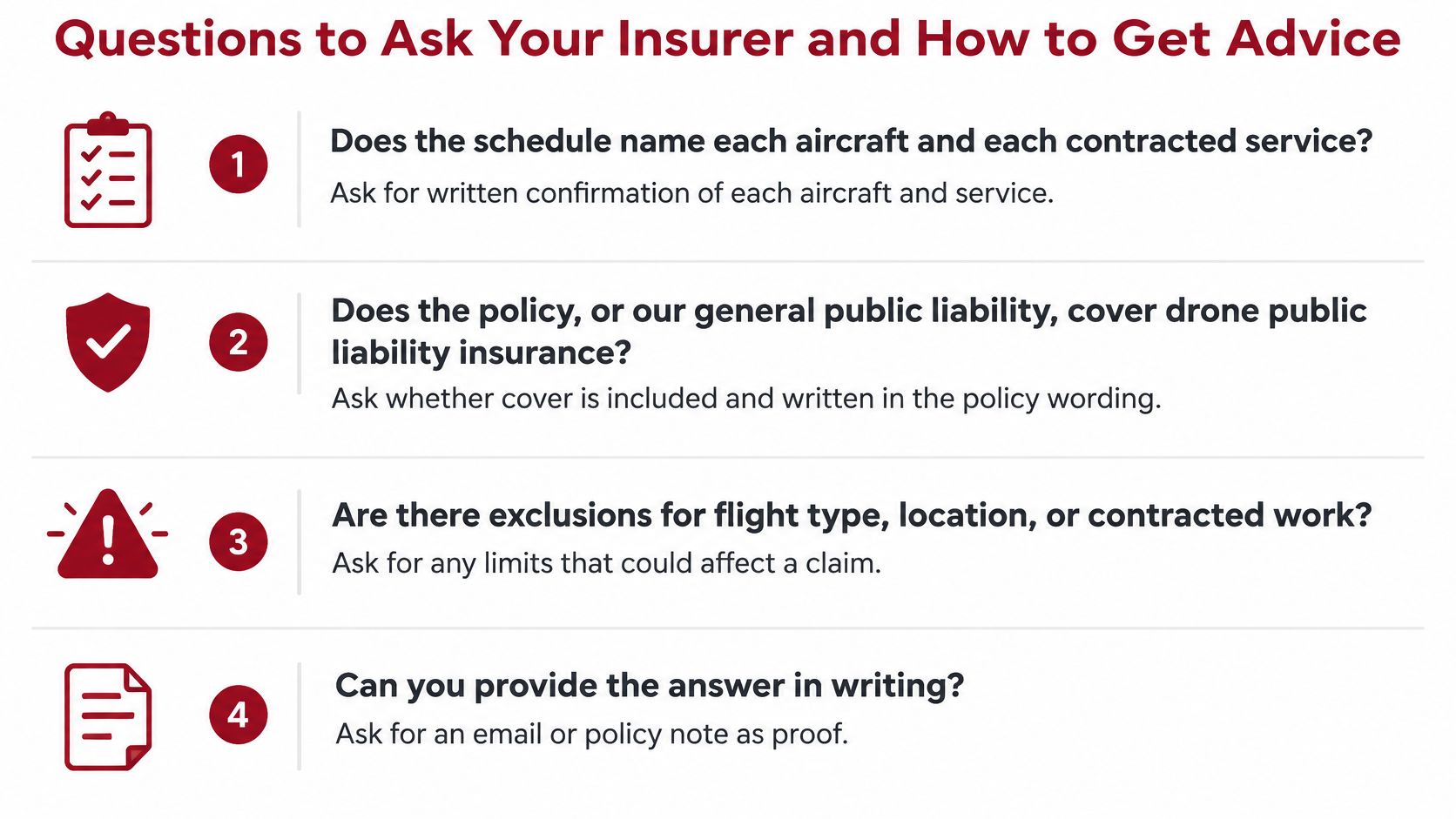
Eight questions to put in writing
- Does the schedule name each aircraft and each contracted service, or does it describe a category broad enough to argue about later?
- Does this policy, or our general public liability, exclude aviation or aircraft?
- Do the bodily injury and property damage limits match what the head contract requires?
- Does the territory include every site we fly at, including interstate work?
- Are subcontracted pilots covered, and are they identified on the policy?
- Are defence costs inside or outside the limit?
- What is the excess, and what exclusions could affect a claim?
- What evidence of cover can be issued for councils, landowners and head contractors, and how quickly?
A vague answer over the phone is worth nothing six months later. "Please confirm in writing" is the most useful sentence in this whole process.
Four checks to run before the next flight
Compare the schedule with this month's work. List each aircraft and each service you're selling, then tick them against the policy document. Anything that doesn't appear goes on a question list for the broker.
Read the contract and the site rules. Look specifically for required limits, named insureds, subcontractor provisions and the evidence the site wants before granting access.
Verify each pilot with CASA. Registration, accreditation and any approvals for the airspace or operation belong on file, not in someone's memory.
Ask a licensed broker to review the wording against your operations. A broker works with insurers daily and can compare what the policy says against what you do. Our team works with builders, contractors, tradespeople, developers, property owners and businesses across Australia, and we'd rather review a schedule before a claim than after one.
This guide is general information only. Personal advice depends on your aircraft, your contracts and your declared operations, so speak to a licensed broker such as ABS Insurance Brokers before you change or renew cover.
ABS Insurance Brokers Pty Ltd arranges aviation hull and liability cover alongside public liability for Australian builders, contractors and developers, so the drone policy and the construction policy are reviewed together rather than in isolation. If a head contractor, landowner or council has asked for proof of drone cover, or you're unsure whether your general policy responds to a flight, we can review your schedule against the work you do and request a free insurance quote on your behalf. Visit ABS Insurance Brokers Pty Ltd to start the conversation.