
Marine cargo insurance covers physical loss or damage to goods during the insured journey, subject to the clause chosen and its exclusions, and it does not automatically pay for delay. You've paid for fixtures, steel, components, or stock, the ship has docked, and now you're told the goods are damaged, short, or stuck at the port while your site or shop waits. That's usually when people discover their marine cargo insurance coverage was narrower, shorter, or valued differently than they assumed. The useful question is not only whether you have a policy. It's which loss happened, where in the journey it happened, and whether your clause was built to pay for that kind of loss.
Table of Contents
- What Marine Cargo Insurance Covers at a Glance
- Who Needs Marine Cargo Insurance
- When Cover Starts and Ends Across Your Journey
- Which Law Applies to Your Shipment
- Perils, Exclusions and the Gaps Policies Leave
- Valuation and Sum Insured for Australian Shippers
- How to Buy Cargo Cover Step by Step
- How to Make a Cargo Insurance Claim
What Marine Cargo Insurance Covers at a Glance
At its simplest, marine cargo insurance pays for physical loss or damage to goods while they're on the insured journey. It doesn't pay for every cost a shipment creates. If a crate is crushed, a container is flooded, or goods are lost in a covered incident, you're in cargo insurance territory. If the goods arrive intact but late, you're usually looking at a different problem.
Think of the clause in your policy as a sieve. You pour every possible loss through it, and the size of the mesh decides what gets caught and paid. A wide mesh catches most accidental losses. A mesh with named holes only catches the losses listed on it. A tight mesh catches major casualties and lets a lot of everyday damage slip through.
The three clause levels
Clause A is the wide mesh. It's generally accidental physical loss or damage cover, so most accidental losses are in unless an exclusion takes them out. Clause B only responds to listed perils, so you have to match your loss to a name on the list. Clause C is narrower again and is aimed at major casualties rather than routine handling or water damage.
| Clause | Basis of cover | Named perils or scope | Main gap |
|---|---|---|---|
| Clause A | Accidental loss or damage, subject to exclusions | Broadest scope; covers most losses unless excluded | Exclusions still apply, such as delay and inherent vice |
| Clause B | Listed perils only | Fire, explosion, overturning, collision, seawater damage, cargo washed overboard | Theft and general handling damage are not named |
| Clause C | Narrower listed perils | Major casualties such as fire, explosion and collision | Omits cargo washed overboard and seawater damage |
Even Clause A doesn't catch everything. Delay, inherent vice and inadequate packing sit outside it. Inherent vice means the goods damaged themselves because of their own nature, for example perishables deteriorating without an external cause. Inadequate packing means the goods weren't packed well enough to withstand the ordinary knocks of the journey you'd expect them to face.
An "all risks" label still has exclusions. Always read what the clause leaves out, not just what its name suggests.
Run three questions over any shipment before it leaves. First, what are the goods worth once freight and other costs are included? Second, which clause does your policy schedule name, A, B or C? Third, which losses fall outside that clause, and can your business absorb them if they happen? Those answers tell you more than the premium does.
Who Needs Marine Cargo Insurance
Anyone who owns goods while they're moving needs to think about cover. That includes an importer whose goods are at its own risk from an agreed point, an exporter selling on terms that pass risk early, and a builder importing plant, fixtures or materials for a project. It also includes a manufacturer waiting on components and a retailer holding time-sensitive stock.
The sales terms decide who carries the risk. The Incoterms 2020 term in your contract sets the point where risk passes from seller to buyer, and that point tells you who should arrange cover and from when. Under FOB or ex-works, the buyer usually carries risk from loading at origin, so the buyer should arrange cover starting there. Under CIF, the seller must buy only minimum Clause C cover, while under CIP the minimum is Clause A, so check the clause before you accept the arrangement.
Say a contractor buys a container of steel on CIF terms. The seller's policy meets the minimum standard, but it's narrow Clause C cover, and the inland truck leg plus weeks of site storage aren't insured at all. The builder assumed "insured shipment" meant the whole trip. It didn't. Businesses that rely on others to move goods face the same trap, which is why it's worth understanding how insurance arrangements for courier operations differ from covering your own goods.
Practical rule: If you own the goods at the moment a loss could happen, you need cover running over that moment, whoever pays the premium.
When Cover Starts and Ends Across Your Journey
Cover follows the journey, not the port, and it can stop earlier than most shippers expect. Follow a typical shipment in order. Goods are loaded at origin, travel by sea, get discharged at the final port, clear customs, and then move by truck to a warehouse or site. Your cover needs to be alive at each handover, because damage and theft often happen during loading, unloading and transfer rather than mid-ocean.
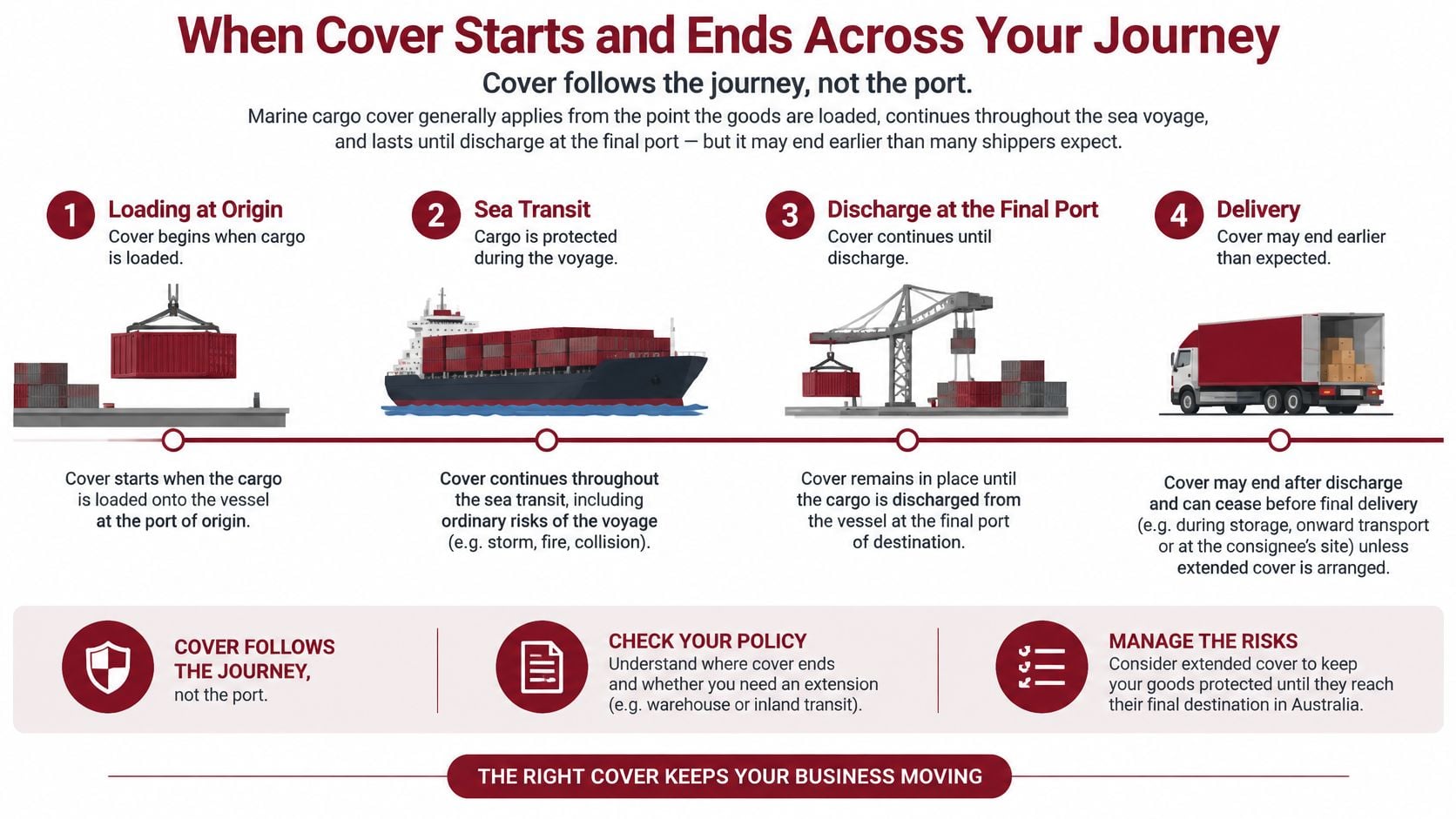
Most policies limit cover to the "ordinary course of transit". As the Insurance Council submission on marine insurance protections explains, cover may terminate when goods reach the final warehouse, are placed into non-transit storage, or after 60 days from discharge at the final port, depending on the wording. That outer limit matters if clearance or onward transport drags on. If you're estimating your timeline, it's worth checking typical customs processing times for household goods so you can see whether delivery realistically fits inside your cover window.
| Termination point | Typical effect | What to check |
|---|---|---|
| Final warehouse | Cover may end on arrival | Whether an extension covers onward handling |
| Non-transit storage | Cover may end once goods are placed in storage | Whether storage cover or an extension is arranged |
| 60 days after discharge at the final port | Common outer limit, depending on wording | Whether delivery will happen within the limit |
Where builders get caught
Say imported fixtures arrive on site and sit in a shed for three weeks waiting for installation. If that shed counts as non-transit storage, transit cover may have already ended, even though the goods haven't been used yet. The fix is arranging storage or extended-duration protection before shipping, not after the goods land. The same issue arises with distribution warehouses and temporary storage yards.
Subcontracted carriers complicate the picture further. Your freight forwarder may hand the goods to a local carrier you've never dealt with, and temporary storage between legs can fall outside ordinary transit. Map every leg before the goods leave origin, note who holds the goods at each stage, and check the end date for each stage against the policy. If your journey mixes sea, road and rail, confirm the transport insurance arrangements for mixed freight movements line up across all of them.
Which Law Applies to Your Shipment
Two boxes leave the same warehouse on the same day. One travels by sea to Fremantle, the other by truck to a depot in western Sydney. Same goods, same insurer, yet different legal rules can sit underneath each part of the journey.
For marine cargo, the Marine Insurance Act 1909 (Cth) is the statute that generally governs the contract. For air and land legs there is no single equivalent Act you can assume applies. The governing rules come from the policy wording and the law the contract nominates, so confirm with the insurer or an adviser which framework covers each leg before you rely on it.
This matters in practice. The applicable law shapes disclosure duties (what you must tell the insurer before cover starts), how warranties in the policy are interpreted, and what remedies exist if a claim is disputed. A clause that reads one way under marine law can behave differently once the goods move onto a truck.
Australian import and export policies commonly incorporate the Institute Cargo Clauses, but the clause name alone doesn't tell you which law governs the journey. Check the policy schedule and match it to each transport leg. A policy built around the sea voyage may not respond the way you expect once the goods are moving inland.
A multimodal example
Say a construction business imports plant by sea into Port Botany, then trucks it to a Sydney site. The sea leg sits under marine law. The road leg is inland carriage, and its rules come from whatever the policy specifies. If the policy was written only for the sea voyage, damage on the road to site may fall outside cover, even though it's the same goods on the same trip. Structure cover across the full multimodal journey rather than assuming a sea policy follows the goods automatically.
Before you bind cover, confirm five things:
- Insured interest: who owns the goods, or who loses money if they're damaged.
- Start and end points: where cover begins and where it finishes.
- Value basis: how the goods will be valued if there's a claim.
- Applicable law: which legal framework governs each leg of the journey.
- Inland legs: whether the road or air portions carry the same governing rules as the sea voyage.
Perils, Exclusions and the Gaps Policies Leave
A builder's imported windows sit in port congestion for a week. They arrive undamaged, but the site stood idle, trades had to be rescheduled, and the delay cost real money. Many assume the cargo policy pays for that week. It usually doesn't, and that gap between damaged goods and delayed goods is where the biggest uninsured losses hide.
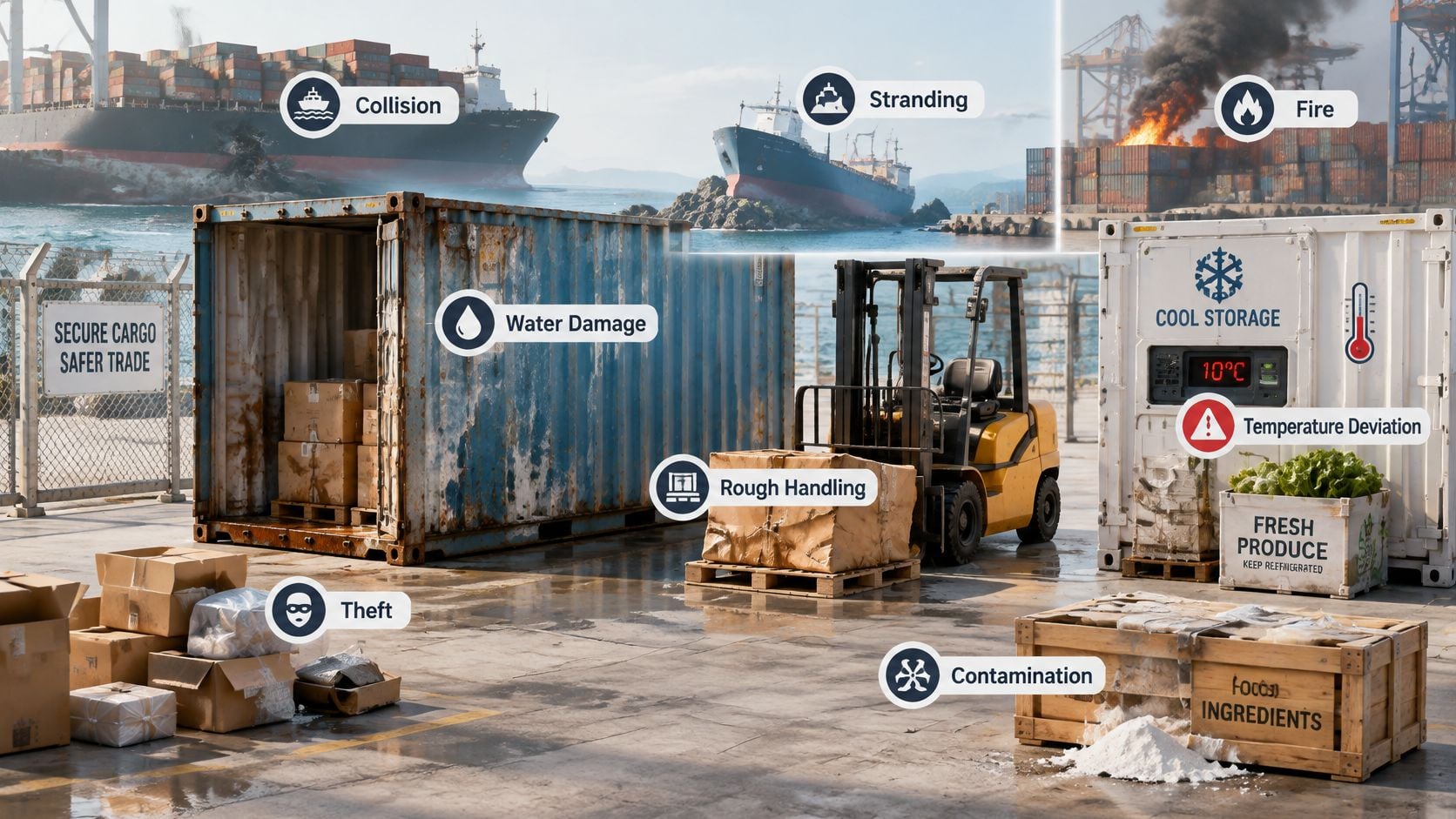
Cargo policies handle physical events well. That includes damage from collision, fire, stranding, water entry and rough handling. It includes theft from containers under the right clause, plus contamination and temperature deviation where specialist cover is in place, and genuine non-delivery of a shipment.
The delay gap
Standard cargo cover focuses on physical loss or damage. The Australian Government's 2024–25 National Freight and Supply Chain Strategy annual report identifies declining maritime schedule reliability and increased global disruption as continuing freight problems. Yet demurrage, extra freight, missed delivery windows, contract penalties and lost sales usually need a separate extension or a different policy altogether. A policy can pay a damage claim in full while leaving the larger delay costs entirely uninsured.
Theft needs a direct answer too. Theft from containers is covered under Clause A when the loss is accidental and can be proven. Theft isn't a named peril under Clauses B or C, and a parcel that disappears on a delivery run may fall outside cargo cover entirely. Note that cargo cover protects your goods, which is different from marine liability cover for third party claims, so make sure you're buying the protection that matches your actual exposure.
Common exclusions to check on every policy include delay, inherent vice, inadequate packing, misdescription of the goods and unattended delivery. Misdescription matters more than people expect. If the goods shipped don't match what the policy describes, you may have a problem before anyone even looks at the damage.
| Loss or cost | Responds under | Extension or separate policy needed |
|---|---|---|
| Physical damage from fire, collision or stranding | Clause A, B or C as named | Not needed where the named peril is listed |
| Seawater or washed-overboard damage | Clause A and B | Extension needed under Clause C |
| Theft or non-delivery | Clause A, subject to proof of loss | Theft cover needed under Clause B or C |
| Temperature deviation or deterioration | Usually not covered by general clauses | Refrigerated or deterioration extension |
| Demurrage and extra freight | Not covered by cargo clauses | Delay or trade disruption extension |
| Missed delivery windows and lost sales | Not covered by cargo clauses | Consequential-loss or business-interruption cover |
Your task is straightforward. List every cost a late, damaged, or missing shipment could create for your business, then ask which ones the policy pays. Separate physical cargo cover, deterioration or temperature extensions, trade disruption cover, and consequential-loss protection on paper. Whatever sits in the last three columns needs its own arrangement.
Valuation and Sum Insured for Australian Shippers
The sum insured sets the maximum your policy can pay, and undervaluation is one of the most common reasons claims fall short. People often insure the invoice price and forget the freight, insurance and duty they've also spent. If the goods are lost, they want all of that money back, but the policy only knows the value you declared.
| Valuation basis | How it is set | Typical use | Watch for |
|---|---|---|---|
| CIF plus 10% | Cost, insurance and freight plus 10% | Standard sea import and export shipments | Confirm the uplift matches the policy wording |
| Invoice value | Price on the supplier invoice | Simple sales where freight and duty are small | Freight and duty may fall outside the insured value |
| Declared value | Value set by the insured and agreed with the insurer | Repeat shipments through the same ports | Undervaluation may reduce the payout |
| Replacement value at destination | Cost to replace the goods at the destination | Project materials and specialist plant | Confirm how the insurer assesses replacement cost before shipping |
For standard sea import and export shipments, CIF plus 10% is the usual starting point. If you're buying ex-works or FOB, the invoice alone misses freight and duty, so add those costs into the insured value. If you ship repeatedly through the same ports, a declared value that reflects your usual volumes can work well, provided you keep it current.
Scale matters here because Australian cargo exposure is concentrated. The BITRE Australian Infrastructure and Transport Statistics Yearbook shipping data reported that Western Australian ports loaded approximately 1 billion tonnes of maritime cargo in 2020–21, Queensland loaded 289 million tonnes and New South Wales loaded 176 million tonnes, and together these three states accounted for 94% of Australia's maritime cargo loaded by volume. If your goods repeatedly move through the same major ports, one disruption or accumulation event can involve several of your shipments at once, so declared values should reflect that pattern rather than treating each journey as isolated.
A worked example
Say your invoice is $100,000 and freight and insurance add $8,000. Your CIF value is $108,000, so CIF plus 10% gives a sum insured of $118,800. Insuring only the invoice would leave an $18,800 gap before a claim even starts. If your insured value sits below the actual value at the time of loss, the payout may be reduced under the policy wording.
Write the valuation basis into the policy in words both sides understand. Then recalculate it whenever shipment values, freight rates or routes change, because a value that was right last year can become an underinsurance problem this year.
How to Buy Cargo Cover Step by Step
Decide the cover before you compare premiums. The cheapest policy is often cheap because it carries the narrowest clause, the shortest transit window, or the longest exclusion list. Work through these steps in order and you'll know what you're buying before price enters the conversation.
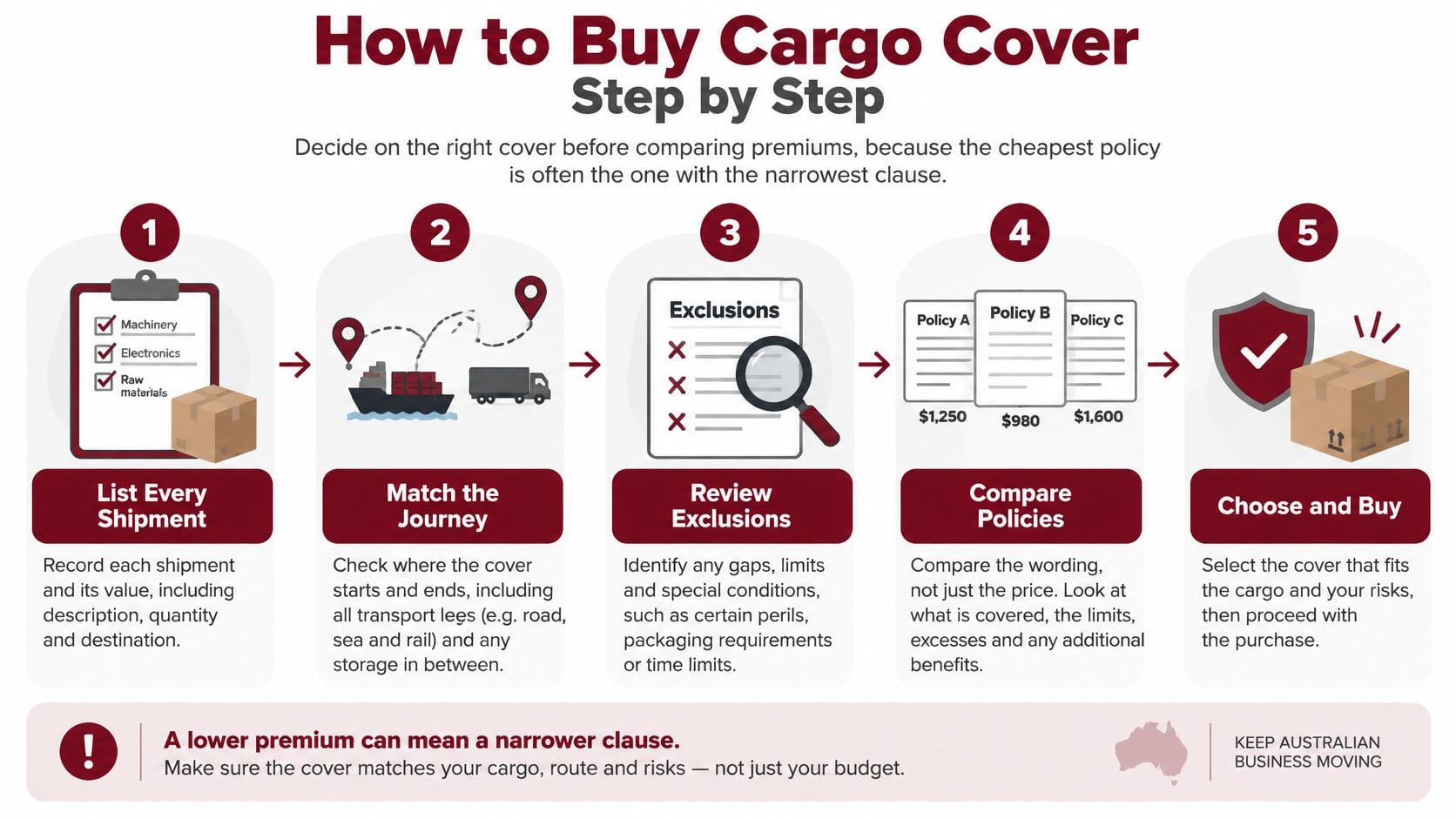
List every shipment. Record the value, route, transport modes and any storage stops for each movement. This list becomes the map your policy has to match. The common slip is describing only the sea leg and forgetting the warehouse stay at either end.
Confirm the insured interest. Work out whether the owner, the buyer or a financier needs protection, and make sure that party is covered. If a bank has funded the goods, it may need its interest noted. Skipping this step can leave the person who loses money outside the policy.
Check your contract obligations. A building contract, financier, principal or state requirement may require specific insurance for a project. Read those documents before you buy, not after. Buyers often skip this check and discover at claim time that their cover never met the contract.
Choose the clause against the goods. Fragile plant, glass, electronics and high value fixtures usually point toward Clause A. Hardy bulk commodities moving on short, simple routes may suit a narrower clause. The common slip is accepting whatever clause a supplier arranges without asking which one it is.
Set the valuation basis and sum insured. Use the valuation approach that matches how you buy, whether that's CIF plus 10%, declared value or replacement value at destination. Recheck the number against your latest invoices and freight bills. Stale values are the quietest way to underinsure.
Decide on extensions. Ask specifically about temperature deviation, deterioration, storage beyond ordinary transit, and delay related costs. If a late shipment would idle a site or empty your shelves, raise it now. These protections are rarely added automatically.
Compare quotes on wording, not price alone. Line up the exclusions, excesses and the point where cover ends for each quote. Ask what happens on the truck leg, in temporary storage, and after discharge. The classic slip is assuming a sea policy covers the road journey to site.
Compare the point where cover ends before you compare the premium. A cheaper policy that stops at the port gate isn't cheaper if your loss happens on the road.
Finish by reading the draft policy schedule line by line. Check the clause named, the insured value, the transit dates and every listed exclusion against your shipment list from step one. If a leg, a storage stop or a value doesn't match, fix it before the goods leave origin.
How to Make a Cargo Insurance Claim
Claims are won or lost on paperwork created in the first hour after delivery. Insurers pay for proven loss, so your job is to turn what happened into evidence they can verify. Follow these steps in order.
Record the loss at delivery. Write any damage, shortage or missing packages on the delivery docket before you sign it. A clean signature tells the insurer the goods arrived in good order, and that can seriously weaken your claim. Photograph the goods, the packaging and the container seals while everything is still in place.
Notify promptly. Tell the insurer or broker as soon as you can, in the way the policy wording requires. Late notice is a common reason claims are reduced or declined, because the insurer loses the chance to inspect the goods and pursue whoever caused the loss. Don't wait until you've worked out the full dollar figure.
Gather the evidence pack. You'll typically need the commercial invoice, packing list, bill of lading, dated photos, any survey report, and your correspondence with the carrier. Keep the damaged goods and packaging until the insurer says you can dispose of them. Throwing evidence away makes the loss harder to prove.
Document custody for disappearance claims. If goods have vanished without visible damage, record which custody stage they disappeared at, which carrier held them, what security arrangements were in place and how they were packed. This level of detail matters more than ever. Recent Australian marine claims reporting from NTI on five years of marine trends recorded a 10% increase in theft claims from 2024 to 2025, while carrier theft claims rose about 40% and stolen vehicles represented nearly one-third of those carrier claims. The same reporting noted one-fifth of local deliveries were reported stolen in 2024–25 and that parcel loss may not be covered by the same insurance used for conventional cargo.
The question is never just whether theft is covered. It's which theft, at which custody stage, with what proof and what security conditions.
- Submit the claim against the insured value. Calculate the loss using the valuation basis written into your policy, not the figure you wish you'd insured for. Expect a reduction if your sum insured fell below the actual value of the goods. Acceptance for cover in the first place depends on the project scope, contract value, construction period and insurer criteria, so gaps identified during a claim are best fixed before the next shipment, not argued about after it.
Once the claim is settled, review what it exposed. ABS Insurance Brokers Pty Ltd can review your policy schedule against your actual journey, legs and storage stops, and offers a free insurance quote on request. That review shows you where the gaps were while there's still time to close them before the next container leaves.
If you're importing materials, plant or stock and you're not sure whether your current marine cargo insurance coverage runs the full journey, covers the right clause, or values the goods correctly, we can check your schedule against your actual route and storage stops. Visit ABS Insurance Brokers Pty Ltd to request a free quote and get cover structured around how your goods really move, from origin loading to final delivery.