Marine Liability Insurance in Australia
Marine liability insurance helps vessel operators and marine businesses manage liability risks arising from their work. The cover you need depends on vessel use, passengers, cargo, operating limits and contracts. This Australian guide explains the policy checks to make before a voyage or project.
That situation is why marine liability insurance needs to be treated as a specialist placement, not a small extension to a standard business package. Australian operators face a combination of waterborne operations, contractual obligations, pollution concerns and maritime liability rules that don't fit neatly inside ordinary public liability wording.
Table of Contents
- Why Marine Liability Insurance Is Its Own Conversation
- The Three Streams of Marine Liability Cover
- How Marine Liability Policy Wording Actually Works
- Underwriting Inputs, Valuation and Transit Considerations
- Risk Factors That Drive Marine Liability Exposure
- Practical Placement Tips for Australian Operators
- Your Marine Liability Checklist and What Comes Next
Why Marine Liability Insurance Is Its Own Conversation
Marine liability has developed within a legal and commercial environment that differs from ordinary premises or contracting risks. The Australian Government explains that rules limiting shipowners' liability date back to at least 1733 in England, while Australia incorporated the modern international framework through the Limitation of Liability for Maritime Claims Act 1989. The 1976 Limitation Convention came into force in Australia on 1 June 1991. You can review the framework in the Australian Government's explanation of maritime liability and limitation principles.
That history affects the way a claim is assessed. For certain maritime liabilities, the maximum compensation exposure may be calculated by reference to the vessel's size rather than the size of the loss. The legal limit isn't a reason to buy less insurance. It's a reason to understand how the limit interacts with your policy, charter contracts, port requirements and the possibility of claims that sit outside a limitation regime.
Why a general liability policy may not respond
A standard business policy usually starts with the insured's business premises, products, services or contracting activities. A vessel introduces different questions. Who controlled the vessel at the time? Where was it operating? Was it carrying passengers, cargo or crew? Did the incident involve navigation, towage, mooring, salvage, pollution or a contractual assumption of liability?
Those details can trigger a watercraft exclusion or restrict cover to a narrow incidental use. The operator may have paid for public liability in good faith, but the insurer may still say the incident falls outside the insured activity.
Cargo operations also depend on clear documents. Record who accepts responsibility for the goods, when custody begins and when it ends. Check transport contracts and bills of lading against the liability cover arranged for loading, transit and discharge.
A vessel creates a specialised underwriting question
Insurers don't assess a commercial vessel in the same way they assess a shop, office or construction contractor. Turnover and payroll still matter to the wider business, but marine underwriters need vessel-specific information, including the vessel's design, use, trading area, crew arrangements, passenger activity and claims history.
Marine liability is a specialist market. Vessel type, operating area, contracts and claims history affect the insurers and terms available. Ask for a comparison of the cover your operation requires rather than relying on broad marine-market premium statistics.
The result is a specialised class with specialised evidence. A domestic commercial vessel, marina business, slipway, boatyard or harbour-cruise operator can't assume that a generic package will understand its exposure. A broker needs to map the operation first, then decide which marine liability sections and extensions are appropriate. Operators can also review marine insurance information for Australian businesses when comparing the questions a specialist placement should address.
The Three Streams of Marine Liability Cover
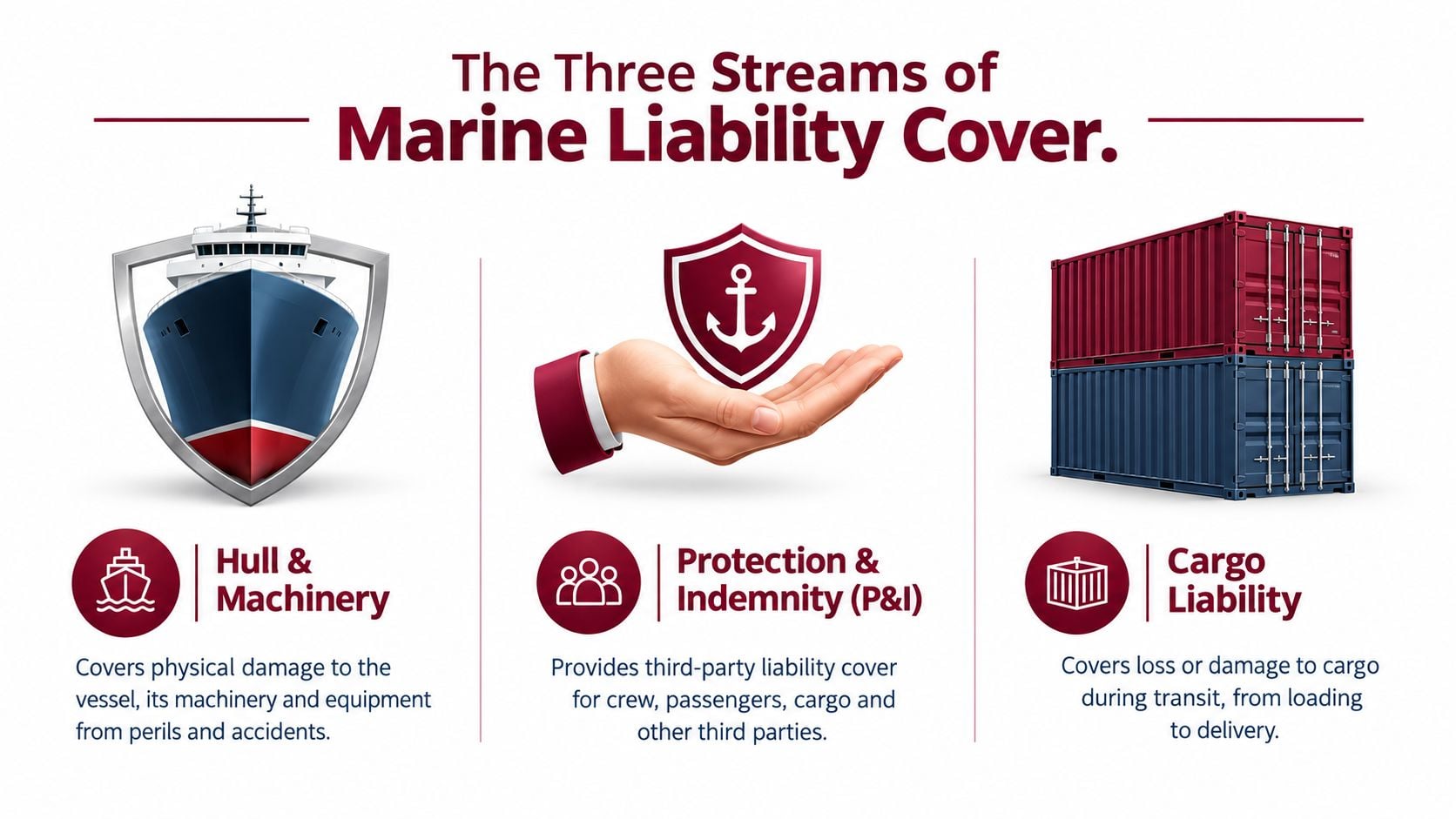
Marine liability programmes often combine three related but distinct streams. Think of them as three buckets. The first responds to liabilities arising from operating the vessel, the second deals with collision liability connected to the vessel's physical damage cover, and the third addresses responsibility for cargo in the operator's custody.
Protection and Indemnity
Protection and Indemnity, or P&I, is the broad third-party liability stream for many commercial marine operations. It can address liabilities such as injury to passengers or other third parties, collision with another vessel, pollution, wreck-related obligations and certain crew exposures, subject to the actual wording, exclusions, limits and applicable law.
A useful analogy is the public liability section for the vessel itself. If your ferry passenger is injured, your tug damages another vessel while manoeuvring, or your operation causes a covered pollution event, P&I is the part of the programme you'd expect to examine first. It isn't interchangeable with every form of marine liability policy. The scope depends on how the cover is structured and whether the operator needs a fixed-limit policy, a broader facility or another form of protection.
Towage operators, passenger services, commercial fishing businesses and charter operations commonly need to examine P&I because their exposures extend beyond damage to their own vessel. A small domestic commercial vessel may need a carefully designed policy rather than the same structure used for an ocean-going ship.
Hull liability
Hull and machinery insurance primarily concerns physical loss or damage to the insured vessel and its machinery. Its collision-liability component may respond to the operator's legal responsibility for damage caused to another vessel, depending on the policy's collision wording and the applicable conditions.
That makes hull liability different from P&I. Hull cover starts with the vessel and its physical condition. P&I starts with the operator's legal responsibility to other people, vessels or property. A collision can involve both sections, so the claims team needs to determine which part of the loss belongs in which policy.
Cargo liability
Cargo liability addresses the operator's legal responsibility for goods in its care, custody or control. It becomes relevant when a business transports, stores, loads, unloads or otherwise handles goods under a contract that creates responsibility for loss or damage.
Cargo liability isn't automatically included because a business owns a vessel. A harbour operator carrying passengers may have limited cargo exposure, while a marine transport business may have substantial contractual responsibility for goods moving from wharf to wharf. Operators should compare the marine liability programme with their cargo and transit arrangements, including the marine transit insurance options available to Australian businesses.
Practical rule: Don't ask only whether you have “marine liability”. Ask which stream responds to each activity, what limit applies, and whether a deductible or sub-limit changes the result.
How Marine Liability Policy Wording Actually Works
A policy responds according to its wording, not according to the label on the schedule. Before renewal, read the trigger, insured activity, navigation area, exclusions, limits and contractual-liability provisions together.
For third-party liability, the trigger is commonly linked to an occurrence, meaning an event that causes injury, damage or another covered liability during the policy period. Hull cover is more commonly framed around accidental physical loss or damage to the insured vessel. The distinction matters because a dispute may arise over when the event occurred, when damage became apparent and whether the operation fell within the declared use.
The operating perimeter
Marine wordings often define where and how the vessel may operate. Navigation, transit and mooring provisions can work differently from one another. A vessel permitted to operate in a particular coastal area may not automatically be covered for a voyage outside that area, an unusual tow, a commercial passenger service or an amphibious activity.
The exclusions deserve the same attention. Common categories include wilful misconduct, known unseaworthiness, war and nuclear risks, but the exact wording and carve-backs control the outcome. “Unseaworthiness” can be especially sensitive if the owner or operator knew about a defect and continued operating. A survey, maintenance record and incident log may therefore become important evidence, not just administrative paperwork.
Limits and contractual assumptions
Cargo wording can narrow the meaning of “care, custody or control”, particularly where amendments based on Institute Time Clauses or similar marine forms modify the basic liability grant. A business may be responsible for cargo under a contract, but that doesn't mean every contractual obligation is insured.
Charter parties, port agreements and supplier contracts can also require the operator to indemnify another party beyond the liability the operator would have had at common law. A broker should examine unusual indemnities early, especially if the document is drafted in Chinese or translated from another language. A broad indemnity can absorb the available limit or create an obligation the policy excludes.
| Wording Element | What It Does | Practical Effect |
|---|---|---|
| Occurrence trigger | Connects third-party liability to a covered event | Establishes when the policy may respond |
| Accidental loss or damage | Applies to physical damage under hull cover | Separates vessel damage from wider liability |
| Navigation and trading limits | Defines where and how the vessel may operate | An unauthorised voyage can create a coverage dispute |
| Care, custody or control | Describes responsibility for cargo or property handled by the operator | Contractual custody doesn't guarantee insurance |
| Exclusions | Removes specified risks or conduct | A watercraft, war or pollution exclusion can change the result |
| Sub-limits and deductibles | Restricts or reduces payment for a particular exposure | The headline limit may not be the amount available |
| Release deductibles | Applies a deductible where a release or waiver affects recovery | A contractual release may leave the operator retaining part of the loss |
Read the schedule with the endorsements. That's where the practical answer usually sits.
Underwriting Inputs, Valuation and Transit Considerations
Marine underwriters price the operation they can identify. A short, accurate submission is more useful than a generic business description that says only “marine services”.
What the underwriter needs to know
Start with the vessel particulars. Age, flag, class, tonnage, construction, propulsion, machinery and maintenance history help underwriters understand the physical asset and its operating demands. They'll also examine the trading limits, crew qualifications, passenger numbers or cargo activity, voyage pattern and previous claims.
The declared value needs equal care. Agreed value establishes a value accepted for the insured asset, subject to the policy terms. Market value reflects what the vessel could reasonably sell for at the relevant time. Replacement value concerns the cost of obtaining an equivalent asset or replacing specified equipment. These concepts aren't interchangeable, and the wrong valuation can create friction during a total-loss or major-damage claim.
Hull liability and P&I deductibles need to be considered alongside those values. A low deductible may affect premium, while a high deductible can leave the operator carrying a significant first loss. The right structure depends on cash flow, contract requirements, vessel value and the operator's tolerance for retaining smaller claims.
Transit changes the risk
Cargo type and packaging matter. So do the route, loading method, storage arrangements and transfer points. Tropical cyclone exposure, Torres Strait pilotage and sensitivity around the Great Barrier Reef can all change the questions an underwriter asks, even when the vessel itself hasn't changed.
Lay-up periods also need to be declared. A vessel stored or inactive for part of the year may have different maintenance, security and reactivation risks from a vessel operating continuously. Dual-use and amphibious operations deserve early disclosure because an incident may raise both marine and aviation questions.
| Underwriting Input | What Underwriters Examine | Typical Impact on Cover |
|---|---|---|
| Vessel particulars | Age, construction, machinery, flag, class and tonnage | Influences conditions, deductibles and market appetite |
| Trading area | Coastal limits, route, ports and unusual waters | Defines where navigation is permitted |
| Crew and management | Certifications, experience, manning and procedures | Affects confidence in operational control |
| Claims history | Prior incidents, causes and corrective action | Helps distinguish recurring problems from isolated events |
| Cargo profile | Type, packaging, loading and storage | Shapes cargo liability and transit terms |
| Passenger activity | Numbers, services, embarkation and safety controls | Can alter liability limits and conditions |
| Dual-use operations | Marine, aviation or amphibious activities | May require coordinated policy wording |
A clean submission doesn't hide difficult facts. It explains them, shows the controls in place and gives the underwriter enough detail to price the actual operation.
Risk Factors That Drive Marine Liability Exposure
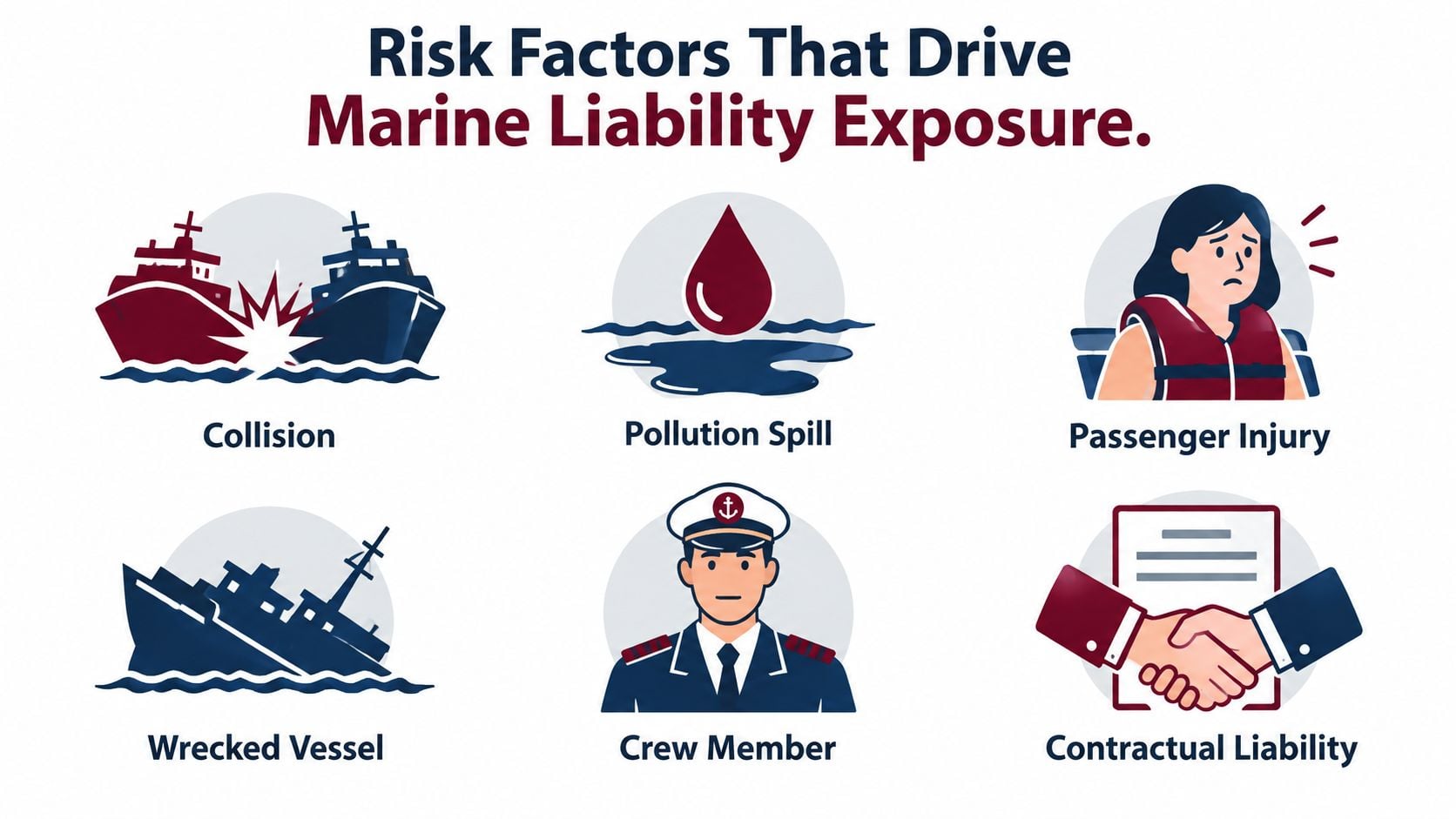
A vessel can generate several liabilities from one event. A collision may damage another vessel, injure a passenger, release fuel, require salvage and trigger a contractual claim from a charterer. The operator needs a programme that can separate those outcomes rather than relying on one broad label.
Collision and salvage
Collision liability can involve another vessel, a berth, a marina structure or navigational equipment. Salvage and emergency response costs may follow even when the damage appears limited at first. A standard public liability policy may exclude the vessel or navigation activity altogether, while hull and P&I sections may divide the response according to the loss.
The 1976 Convention framework adds another layer. Australian rules provide a mechanism for limiting certain shipowners' liabilities, with the potential limit often linked to vessel size rather than the claimed loss. The operator still needs enough insurance to manage the claim, legal costs, investigation and liabilities that aren't successfully limited.
Pollution and wreck removal
A bunker spill can create cleanup costs, third-party property damage and regulatory attention. Wreck removal can become an obligation when a vessel sinks, strands or obstructs a waterway. These exposures are often subject to specific wording, conditions or sub-limits, so the schedule needs more scrutiny than the headline P&I amount.
Passengers and crew
Passenger injury creates a direct bodily-injury exposure, but it can also involve medical assistance, investigation, communications and contractual demands from a tour organiser or charterer. Crew claims raise different questions about employment arrangements, injury, illness, repatriation and statutory obligations.
A shopfront policy may respond to a customer slipping in an office. It may not respond when a passenger is injured while boarding a vessel or when a crew member is hurt during marine operations. The activity, location and wording determine the answer.
Contractual indemnities
Ports, charterers, marina operators and customers may require an operator to indemnify them. That promise can be wider than the liability the operator would otherwise have had. If the indemnity isn't disclosed, the policy may not cover the assumed obligation, or a sub-limit may apply.
Claim perspective: Ask what happened, who was legally responsible, which contract changes that responsibility and which policy section was designed for the resulting loss.
Australian operators also face an evidence gap. APRA's National Claims and Policies Database explicitly excludes all forms of marine cover, including marine liability. That means public pricing, frequency and severity benchmarks for marine liability aren't visible in the main regulatory claims database used for other public liability classes.
Underwriters therefore rely more heavily on the vessel, operation, trading area, limits, contracts, claims files and risk-engineering information. It's one reason a complete submission and careful claims history matter so much in a niche class.
Practical Placement Tips for Australian Operators
A sound placement begins before the quotation request. The broker needs to understand what the vessel does on an ordinary day, what it does occasionally and what it may be asked to do under a new charter.
Start with the right market conversation
Use a broker with genuine marine authority or access to a specialist marine market. A generalist may arrange a useful business package, but marine liability requires someone who can challenge exclusions, test navigation limits and identify whether P&I, hull liability, cargo liability or a combination is needed.
Prepare the underwriting file in advance:
- Vessel details: Provide specifications, valuation, ownership, registration, machinery information and recent survey material.
- Operating profile: Describe routes, ports, towing, passenger work, cargo handling, mooring and seasonal activities.
- People and procedures: Include crew qualifications, safety systems, maintenance routines and incident records.
- Contract documents: Supply charter parties, port agreements, customer terms and indemnity clauses before the insurer finalises terms.
Disclose aviation-adjacent or amphibious work at the beginning, not after an incident. A seaplane, amphibious craft, aircraft support vessel or operation involving transfer between airside and waterside environments can create overlapping triggers. The marine and aviation policies should be checked together so that one doesn't assume the other will respond.
Match the policy to the contract
Check whether the policy trigger fits the obligations you've accepted. A loss-occurs structure and a claims-made structure can create different notification and continuity concerns. Don't sign a charter party with a broad indemnity until the broker has reviewed the obligation against the available limit, exclusions and deductible.
ABS Insurance Brokers Pty Ltd operates from Bankstown and arranges marine insurance, marine transit cover and aviation insurance for Australian clients, including liability options for vessels and aircraft-related risks. Operators comparing an insurance broker with an insurer and understanding who works for the business should ask who will negotiate the wording, explain the exclusions and assist if a claim develops.
Make the file claim-ready
Keep crew training records, maintenance documents, voyage records, incident logs, photographs and third-party correspondence in an organised file. Record near misses as well as insured events, because a pattern may matter during renewal even if no claim was submitted.
Also check the practical details:
- Confirm notification contacts: Make sure the skipper, operations manager and office know who must be notified and how quickly.
- Review waivers and releases: Use documents that match the actual activity and don't assume a waiver removes every liability.
- Test the limits: Compare the policy limits with port, charterer and passenger-contract requirements.
- Update the trading pattern: Tell the broker about new routes, new cargo, extra passengers or changes in vessel use.
A renewal should reflect the business you operate now, not the business described in last year's proposal.
Your Marine Liability Checklist and What Comes Next
Use this short checklist before binding or renewing:
- Confirm P&I cover: Check passenger, crew, pollution, wreck and third-party liabilities against the actual operation.
- Verify hull liability limits: Make sure collision wording and deductibles align with vessel use and contracts.
- Check cargo liability boundaries: Identify when custody begins, when it ends and which goods are excluded.
- Review 1976 Convention limits: Understand which liabilities may be limited and which obligations may remain outside that framework.
Operators should expect underwriters to scrutinise older tonnage, weather-related exposure, crew arrangements and passenger operations. Public marine-liability data also remains less transparent because APRA's main claims database excludes marine cover, so each submission needs to carry more of its own evidence.
Aviation-adjacent operators need particular care. Their risks sit where marine and aviation coverage logic can overlap, and a policy written for one environment may not answer a claim arising in the other. Treat the insurance file as a living document, reviewed whenever a charter, route, vessel use or contractual indemnity changes.
ABS Insurance Brokers Pty Ltd can help Australian marine and aviation-adjacent operators review vessel liability, marine transit, hull and related insurance requirements against their actual contracts and operations. Speak with the team through ABS Insurance Brokers Pty Ltd before your next charter renewal so gaps, exclusions and notification requirements are addressed while there's still time to negotiate.