

Construction Company Insurance Checklist Before Work Starts
A construction company insurance checklist helps you gather the evidence needed before work starts. Confirm the business named on each policy, the project details, contract requirements and expiry dates. Use ABS’s construction insurance service to review gaps, and the home warranty insurance page for the separate residential building cover questions.
Table of Contents
- Construction company insurance checklist: organise each policy
- Required Covers Including HBCF for NSW Builders
- Optional and Project-Specific Policies to Consider
- Policy Scope and Exclusions You Must Check
- What Drives Construction Insurance Premiums
- How to Choose Cover and an Insurance Broker
- Making a Claim and Taking Your Next Step
Construction company insurance checklist: organise each policy
A small builder in western Sydney signs a contract for a second storey addition on a Friday. On Monday he's got scaffolding booked, a chippy starting, and demolition planned. He hasn't checked whether his public liability covers height work, whether the project itself is insured if a storm tears off temporary roofing, or whether he needs a statutory certificate before he can legally start. By Wednesday, the certifier asks for paperwork he doesn't have. The job stalls before a wall comes down.
That story plays out because construction risk isn't one risk. Think of a finished house. It doesn't have one lock for the whole building. The front door, the garage, the windows, and the meter box each need their own protection, and locking one doesn't secure the others. Insurance works the same way on site.
Different Doors, Different Locks
An injured employee is one door. A passerby hurt by falling material is another. Fire damage to half built framing is a third, and a homeowner left with an unfinished home if your business fails is a fourth. No single policy is designed to open all of them.
That's why builders usually carry a coordinated mix rather than one broad policy. Workers compensation addresses employee injury obligations. Public liability responds to third party injury or property damage. Contract works covers physical loss or damage to the project itself. In NSW, statutory warranty cover sits separately again, because it protects the homeowner, not your business assets.
The numbers explain why insurers and regulators treat construction differently from an office or a shop. Construction recorded 45 worker fatalities in 2023, representing 23% of all Australian worker fatalities that year, according to Safe Work Australia key WHS statistics for 2024. Falls from height are a particular concern on residential and commercial sites alike. Construction accounted for 13 of the 29 Australian worker deaths caused by falls from height in 2023, or 45%, based on the same Safe Work Australia reporting.
Those figures aren't there to frighten you off a job. They explain why a principal, a lender, or a homeowner will ask hard questions about limits, subcontractor cover, and height exclusions before you start. A low limit that might suit a low risk business can be quickly exhausted after one serious incident involving medical costs, legal defence, rectification, and delay.
Practical rule: If you can't name which policy would pay for an injured worker, an injured visitor, and storm damage to the build itself, you don't yet have a complete picture of your cover.
Start by mapping your actual work. List who is on site, what you're building, what plant you own or hire, and who could claim against you if something goes wrong. That map tells you which doors exist. Only then can you check whether you've got the right lock on each one.
Required Covers Including HBCF for NSW Builders
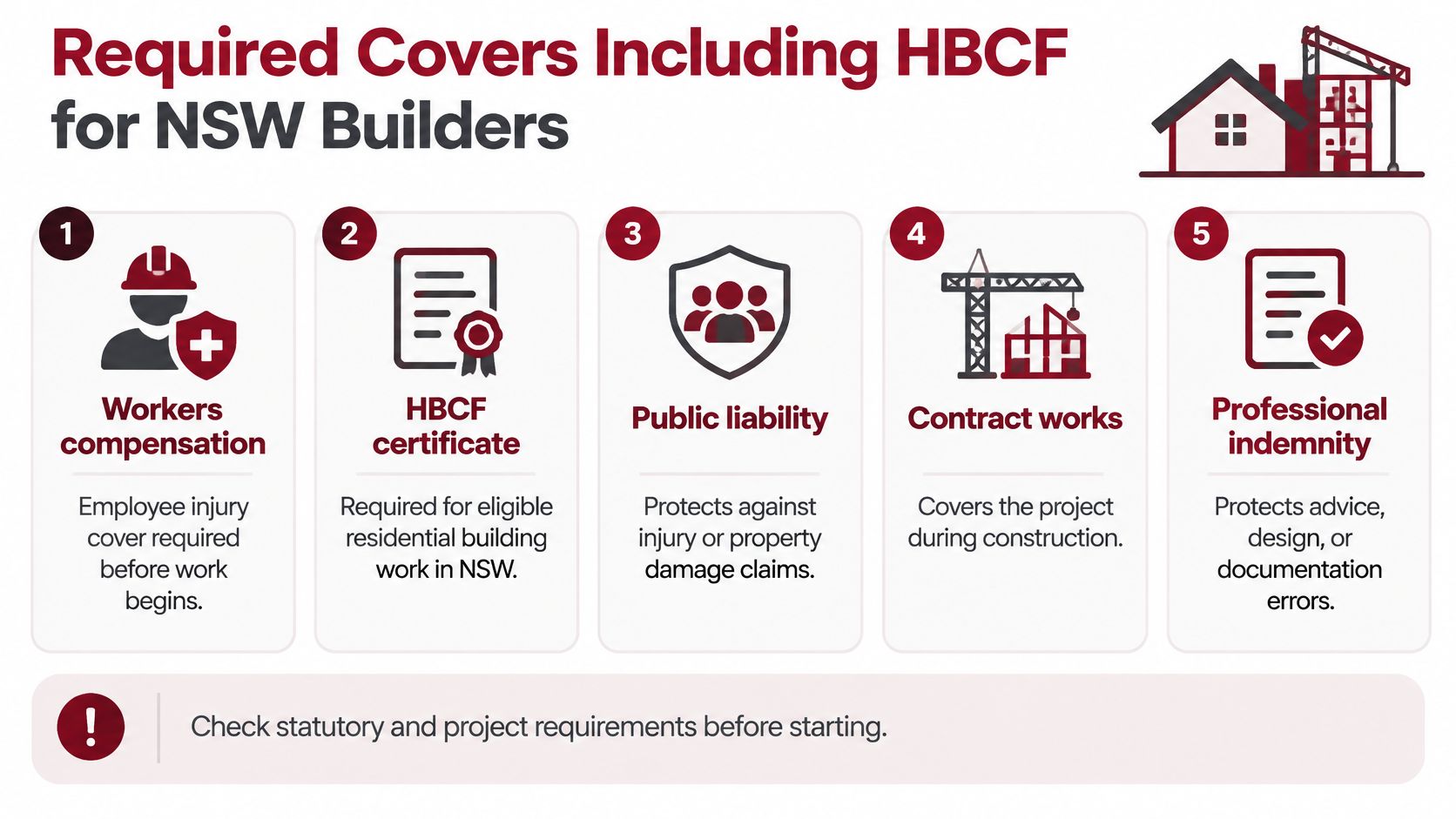
Some covers aren't a shopping choice. You need them in place before work can lawfully begin, and getting the order wrong can stop a project at mobilisation.
Workers Compensation Comes First for Employees
If you employ workers, workers compensation is the cover that addresses your obligations when an employee is injured at work. It's separate from public liability. One looks after your own people, the other looks at claims from third parties. Confusing the two is where many first time employers get caught, especially when labour hire and subcontractors are mixed on the same site. Confirm who counts as a worker for your business and make sure your declared wages and activities match what your crew does.
HBCF and Builders Warranty in NSW
For eligible residential building work in NSW, builders warranty insurance operates through the Home Building Compensation Fund, known as HBCF. It sits inside the state's licensing and consumer protection system. It's designed to protect eligible homeowners when a licensed builder can't complete or rectify covered work because of insolvency, death, disappearance, or licence suspension.
That makes HBCF different from optional commercial covers. It isn't there to pay your suppliers or fix your cash flow. It's a last resort protection for the homeowner, and eligible work generally requires evidence of appropriate cover before the project can lawfully commence. If you want the detail on eligibility and timing, read this guide on what licensed builders must know about the Home Building Compensation Fund in NSW.
Claims under the scheme are uncommon but can be costly when they occur. IPART reported approximately 500,000 certificates of insurance issued since 2010 and about 2,700 claims, an aggregate claim rate of roughly 0.5%, in its IPART issues paper on the NSW Home Building Compensation Fund. The principal trigger was builder insolvency, accounting for about 85% of assessed claims, according to the same IPART paper.
Because insolvency drives most claims, obtaining a certificate isn't just admin. Insurer acceptance, your licensing status, and your financial position can all affect whether cover is issued for a project.
Checks Before You Mobilise
Complete these checks before anyone sets foot on site:
- Project eligibility: Confirm the work type and construction type require an HBCF certificate.
- Contract value: Reconcile the declared contract value against the certificate and policy records.
- Licence details: Make sure the contracting entity and licence details match the certificate exactly.
- Certificate timing: Hold the certificate before starting work or requesting payment where the rules require it.
- Other required covers: Confirm workers compensation is current and matches your workforce.
Don't treat the certificate as a substitute for contract works, public liability, or professional indemnity. It answers a specific statutory problem. The rest of your programme still has to protect the project, third parties, and your business while you're building.
Optional and Project-Specific Policies to Consider
Required cover gets you legally onto site. It doesn't necessarily protect the build, your equipment, or your balance sheet while you're there. That's where project specific and optional policies do their work.

Think of it as a layered sandwich. Each layer has a job, and removing one doesn't make the others bigger. It just leaves a gap you can taste when something goes wrong.
Contract works insurance is the layer for the project itself. If fire, storm, theft, or accidental damage hits work in progress and materials on site, this is the policy you look to for physical loss or damage to the build. Without it, you may be rebuilding at your own cost while still owing the client a finished job.
Public liability insurance is the layer for other people and their property. If a delivery driver trips over unsecured material, or your work damages a neighbour's fence and paving, that's a third party exposure. The injury data shows why this layer carries so much weight for contractors. Construction had 59 cases per 1,000 employed persons for work related injury or illness in 2017-18, recorded by the Australian Bureau of Statistics work related injuries survey. 60% of injured workers took time off, based on the same ABS survey, which shows how an incident quickly becomes downtime as well as a claim.
Equipment, Vehicles and Advice
Plant and machinery insurance covers owned and hired equipment such as excavators, scaffolding, and tools. Hired plant deserves special attention because hire agreements often make you responsible for damage even when you don't own the machine. This overview of plant and equipment insurance for construction businesses explains how owned and hired gear are treated differently.
Commercial motor and fleet cover utes, trucks, and trailers that keep a job moving. Professional indemnity matters if you give design input, certify aspects of work, or provide advice a client relies on. An error in documentation can cause financial loss even when nothing physically breaks.
Other layers depend on how your business is structured:
- Management liability: Responds to certain claims against directors and managers arising from running the company.
- Cyber insurance: Helps smaller firms respond if invoicing systems, email, or project files are compromised.
- Business interruption: Can help with ongoing costs after an insured event stops trading.
- Owner builder insurance: Relevant where an owner is doing their own work rather than engaging a licensed builder for the whole project.
You don't need every layer for every job. You do need to match each layer to a real exposure in your work type, contract, and site conditions, and then check that the limit is realistic for a bad day, not just an average one.
Policy Scope and Exclusions You Must Check
Holding a policy doesn't mean every problem on a job is insured. That assumption causes more disappointment at claim time than almost any other.
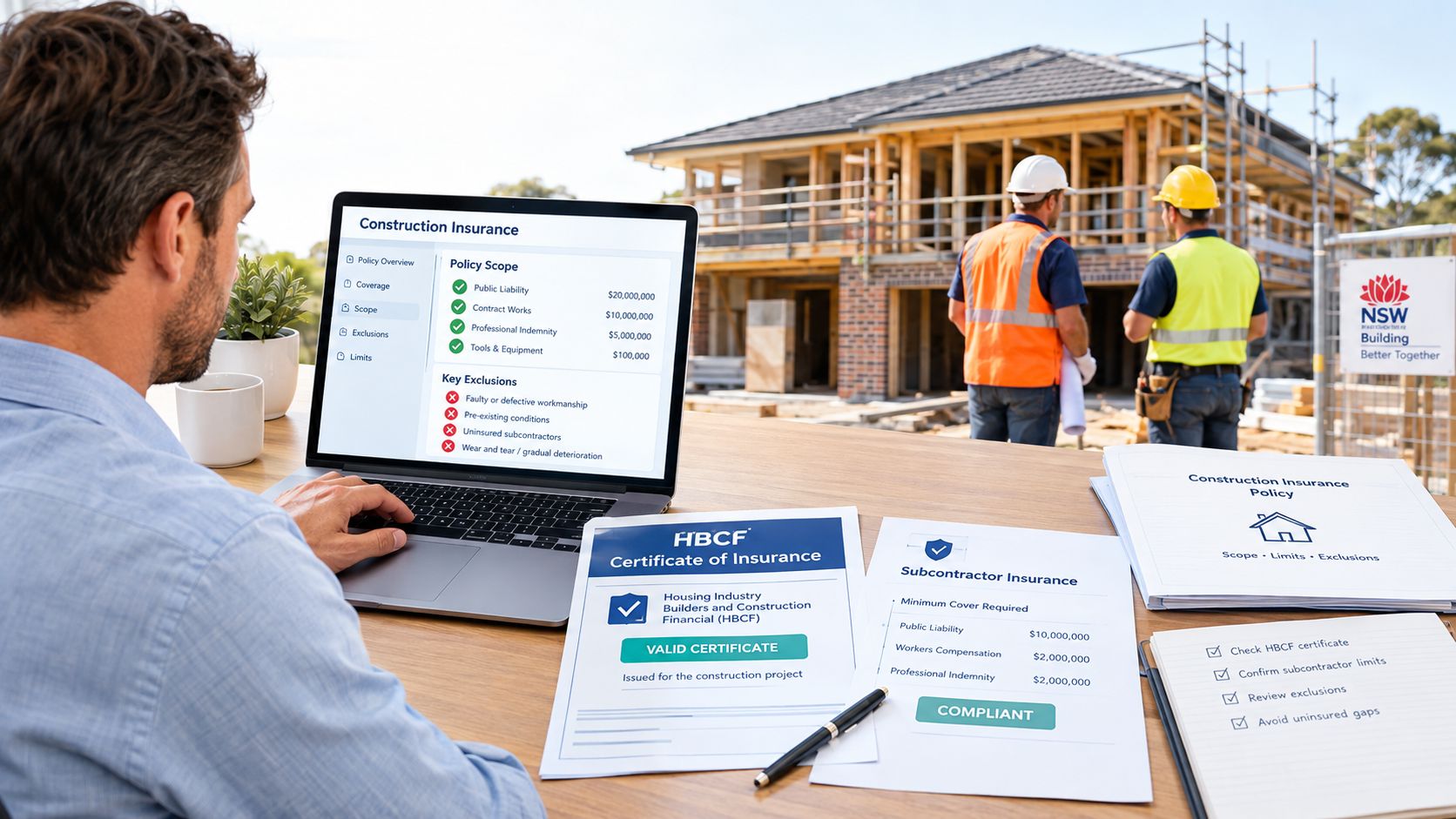
Consider a builder with a valid HBCF certificate for a home extension. Mid project, four things happen. His waterproofing subcontractor's insurance has lapsed. The homeowner disputes a delayed completion date and withholds payment. A hired excavator is damaged while trenching near services. Then a storm damages exposed framing overnight.
Which policy pays for what?
Walking Through the Example
The HBCF certificate doesn't fix the delay dispute. HBCF is not a general project delay or defect policy. It's triggered by builder insolvency, death, disappearance, or certain licence suspensions, as described in NSW guidance on insurance requirements for contractors. Ordinary cost overruns, poor project management, and contractual disputes sit outside that trigger. For NSW residential work above $20,000, the builder must obtain cover before starting work or requesting payment, according to the same NSW guidance.
The damaged framing is a contract works question, subject to that policy's terms and excess. The hired excavator is a plant and hire agreement question, not an HBCF question. The lapsed subcontractor policy is the sleeper issue. If that subcontractor causes loss and has no current cover, your business and your insurer will want to know what checks you did and what your contract said about risk transfer.
A certificate of currency proves a policy existed on a date. It doesn't prove the limit is adequate, the activity is covered, or the policy is still current when the loss happens.
Exclusions That Commonly Create Gaps
Read these areas in every wording before you sign a contract:
- Height work: Check any height limits or conditions for roofing, scaffolding, and second storey work.
- Excavation and underground services: Confirm depth limits, dial before you dig conditions, and service location requirements.
- Hot works: Welding and cutting often carry specific fire prevention conditions.
- Completed operations: Make sure liability cover continues to respond after handover for work you've finished.
- Principal controlled insurance: If the principal arranges insurance, confirm what it covers and what remains your responsibility.
- Limits and sublimits: A strong headline limit can hide low sublimits for tools, hired plant, or materials in transit.
Ask each insurer a plain question for your next job. If this exact activity causes this exact loss, will you pay, and what condition could stop you? Get the answer before work starts, while you can still change the cover, the contract, or the method of work. After a loss, you're only interpreting wording. Before a loss, you can still fix it.
What Drives Construction Insurance Premiums
Two builders can quote the same extension and receive very different premiums. That doesn't automatically mean one insurer made a mistake. It usually means the insurers see two different risks.
It's similar to car insurance. A driver with a clean record, a garaged car, and low kilometres usually pays less than a driver with recent claims and a high risk pattern of use. Insurers aren't just pricing the vehicle. They're pricing the habits and history around it. Construction underwriting works on the same principle, with site habits in place of driving habits.
What Insurers Price
Your declared turnover or contract value sets the scale of exposure. Under declare it and you may create problems at claim time. Your trade mix matters too. A carpenter doing internal fitout presents a different risk from a builder doing excavation, roofing, and structural work at height.
Height and excavation work, project duration, and the locations you work in all shape the price. So does your claims history. Repeated small claims can signal weak site controls to an underwriter, even if each claim on its own looks minor.
The structure you choose also changes the premium. Higher limits generally cost more than lower limits. A higher excess can reduce premium, but it increases the amount you pay yourself on each claim. That's the trade off to test against your cash flow, not just against this year's budget.
Habits That Support Better Pricing
You can't talk an underwriter into ignoring real risk. You can show that you control it.
- Verify subcontractor certificates: Check they're current, match the entity doing the work, and cover the activity.
- Document site inductions: Keep signed records that show who was inducted and when.
- Maintain height safety controls: Use appropriate fall protection, edge protection, and supervision for work at height.
- Use written contracts: Set out insurance obligations and risk transfer clearly before work starts.
- Keep declarations accurate: Update turnover, contract values, and trade activities when your work changes.
A lower premium isn't automatically a better deal. Compare what you gave up to get it. If the cheaper quote has a lower limit, a higher excess, or an exclusion for the main activity on your next job, it may be the most expensive option you were offered. Price matters, but price per unit of usable cover matters more.
How to Choose Cover and an Insurance Broker
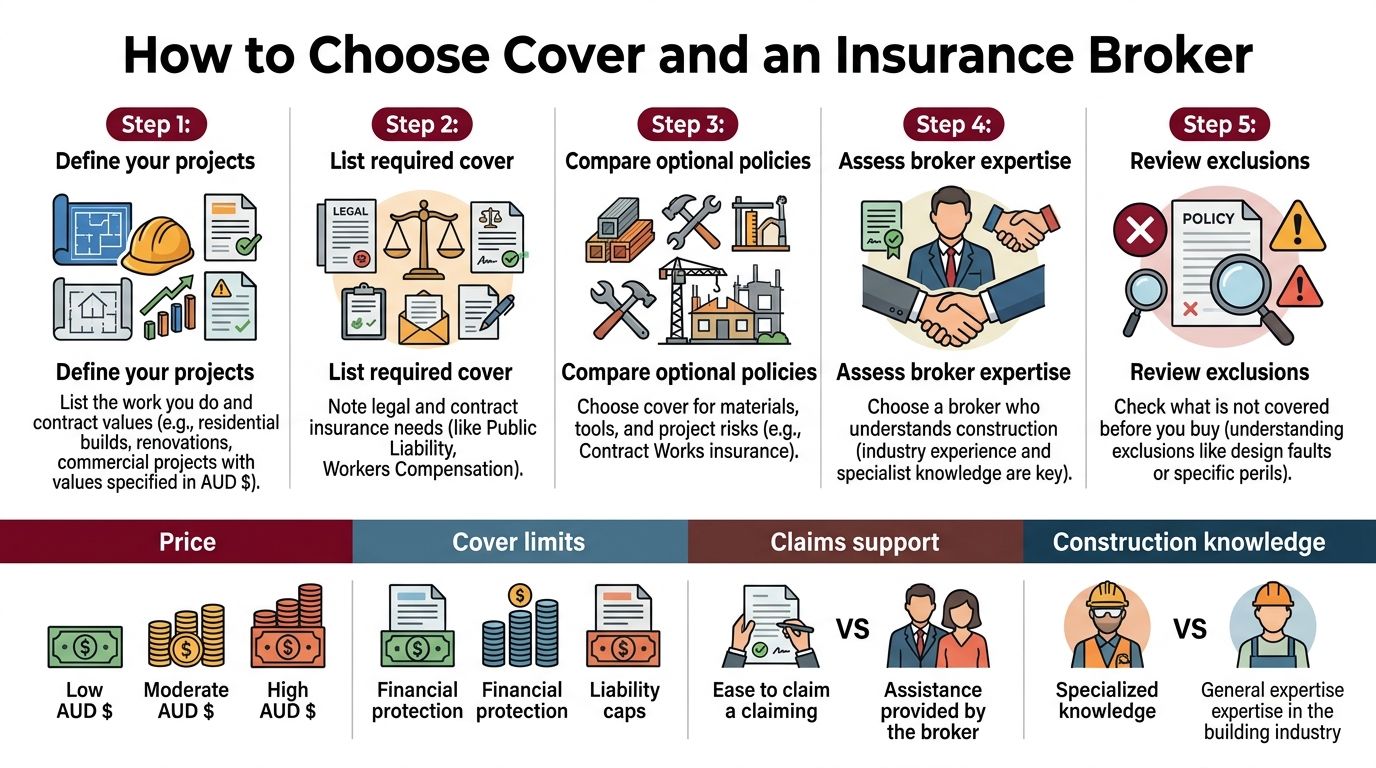
Choosing cover well is a sequence, not a single phone call for the cheapest quote. Work through it in order and you'll spot gaps while they're still cheap to fix.
A Practical Procurement Sequence
- Define your projects: List the work you do, typical contract values, and any high risk activities such as excavation or height work.
- List required cover: Separate statutory and contractual requirements from optional protection.
- Gather contract wording: Pull out principal insurance requirements, indemnities, and required limits.
- Request quotes on consistent limits: Ask each market to quote the same limits and excess so you can compare fairly.
- Compare exclusions and excess: Read what's not covered, not just the premium.
- Confirm certificates and timing: Make sure documentation is issued before mobilisation.
- Schedule an annual review: Revisit cover when your trade mix, turnover, or project size changes.
Going direct can suit a very simple risk, but it puts the comparison work on you. You need to know which markets to approach, how to present the risk, and how to line up wordings side by side. A broker led process shifts that market access and documentation work to someone who does it daily. The difference shows up in time spent, the range of insurers approached, and support when a principal queries a certificate. This guide to choosing construction insurance brokers for your next build sets out questions you can ask before you appoint anyone.
One option in this market is ABS Insurance Brokers Pty Ltd, an Australian owned brokerage based in Bankstown, NSW, serving builders, trades, and developers across Australia. It holds Australian Financial Services Licence No. 700333, has Steadfast Network Broker status for market access, and provides building consultancy linked to insurance needs alongside placement for builders warranty, contract works, public liability, and related construction covers.
Whoever you use, test for construction knowledge with specific questions. Ask how they'd handle an HBCF certificate for a staged residential job, what they'd check in a subcontractor's certificate, and how they'd respond if a principal required higher limits mid tender. Clear, specific answers tell you more than a general promise of good service.
Making a Claim and Taking Your Next Step
When something goes wrong, timing and paperwork decide how painful the next few months will be. Act early, even if you're not sure a claim will proceed.
The First Steps After an Incident
Notify your insurer or broker promptly. Delay can affect a claim, and early notice lets the insurer assess while evidence is fresh. Preserve records and site documentation, including contracts, variations, inductions, photos, delivery dockets, and messages with the client and subcontractors.
Don't admit liability to a homeowner, a principal, or another contractor before you've taken advice. You can be helpful and factual without accepting legal responsibility for a loss that still needs investigation. Cooperate with assessment, provide requested documents in an organised form, and keep your own timeline of what happened and when.
Defect Periods and HBCF Claim Timing in NSW
For NSW residential work, the statutory warranty framework distinguishes six years for major defects and two years for other defects, as explained in NSW guidance on building delays. Homeowners should notify the HBCF insurer immediately because delay may affect a claim, according to the same NSW guidance. The scheme's maximum benefit is $340,000 per dwelling for non completion or defects within that framework, based on that NSW guidance.
Test that limit against real rectification, consultant, escalation, and temporary accommodation costs on an incomplete project. It may not cover every financial loss a homeowner faces, which is why the distinction between statutory rights, policy conditions, and contractual liability matters.
There's also a timing nuance builders miss. A defect identified during the final six months of the statutory period can create an additional six months to commence proceedings, as set out in the NSW guidance on building delays mentioned earlier. Diarise practical completion dates and keep records well beyond handover. A claim can arrive years after your crew left site.
This week, pull out your current certificates and policies and line them up against your upcoming pipeline. Check expiry dates, limits, named entities, and whether your next contract requires cover you don't yet hold. Then get any gaps reviewed before you sign, mobilise, or ask for the first payment. That one review is far cheaper than arguing about wording after a storm, an injury, or a defect notice.
If your certificates don't line up with the jobs you've got coming, get them reviewed before you mobilise or sign the next contract. ABS Insurance Brokers Pty Ltd helps builders, trades, and developers arrange HBCF, contract works, public liability, and related construction covers, and can work through your current policies against your project pipeline. Visit the team online to start that review this week.