

Construction Insurance Program: Coordinating Your Cover
A construction insurance program should be coordinated across the projects, people, plant and contractual responsibilities of the business. This guide explains how to match different covers to those exposures and review gaps between policies. Explore ABS’s construction insurance service for assistance, and use the project checklist when preparing a specific job.
That's why insurance for construction companies works best as a set of linked safeguards, not a generic checklist. The details that matter include the project's value and duration, who controls the site, how work is subcontracted, and whether statutory obligations apply. A mismatch between the contract, the insured entity and the policy schedule can complicate a claim when the business needs clarity most.
Table of Contents
- Construction insurance program: take a project-by-project view
- Understanding the Core Insurance Concepts
- Choosing the Right Construction Insurance Policies
- Matching Cover to Builders Trades and Developers
- Setting Risk-Based Limits and Cover Values
- Spotting Exclusions Clauses and Coverage Gaps
- Comparing Quotes and Placing Cover With a Broker
- Handling Claims and Planning the Next Review
Construction insurance program: take a project-by-project view
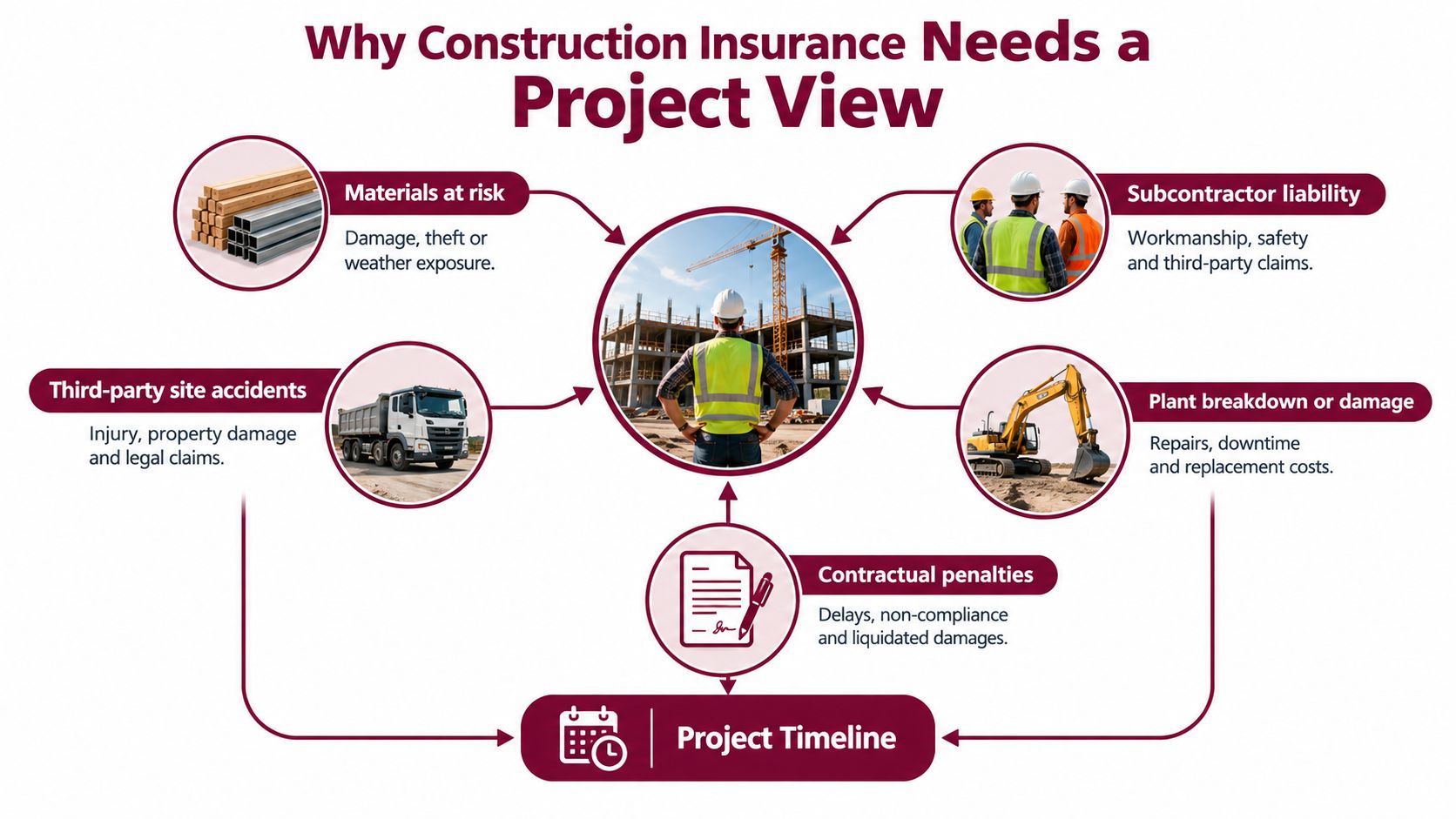
A residential project in progress brings materials, specialist subcontractors, hired excavators and vehicle movements onto one site at the same time. The builder is also managing contract milestones and, for eligible residential work in NSW, checking the applicable Home Building Compensation requirements. Those exposures sit under different policies, and they begin and end on different dates.
The volume of active construction makes project-by-project attention a practical necessity. Australian Bureau of Statistics building activity figures recorded $38.4 billion in building work done in the December quarter of 2024, with 213,834 dwellings under construction nationally. Numbers at that scale reflect the simultaneous value of work in progress, materials and contract obligations across the sector. They say nothing about the right insurance limit for any individual business or project.
Each policy answers a different question. A business package may insure specified property and address some interruption costs. A project-specific contract works policy may cover physical loss or damage to works under construction, subject to its terms. Public liability answers a different question again: the insured's legal liability for injury to other people or damage to their property. In NSW, HBC cover serves a statutory consumer-protection purpose for eligible residential work, so it does not replace those other policies. Even a well-matched program has boundaries. A subcontractor's insolvency, or delay costs from severe weather, can sit outside all of them unless specific cover has been arranged.
An annual policy limit alone can hide important differences between projects. One contract may involve design responsibilities, height work or an active site beside public access; another may involve materials in transit or specialist hired equipment. The review starts with the actual work, the parties and the period of exposure, then checks whether each relevant policy follows those details.
Practical rule: Treat every significant change to project scope, value, timing or responsibility as a reason to check the insurance schedule and policy conditions.
Understanding the Core Insurance Concepts
Think of a project as a house that needs more than one foundation layer. The physical works are one part; the people, vehicles, equipment and advice connected with them are others. If a storm damages an incomplete structure, that's a different problem from a neighbour alleging property damage, a client claiming a design error, or a worker suffering an injury. The policy intended for one exposure may not answer for another.
Start with the works themselves. Contract works cover is intended to address physical loss or damage to insured construction works, subject to the policy's definitions, exclusions, values and construction period. Public liability concerns covered legal liability to third parties. It doesn't insure the builder's own incomplete work because damage occurred on a site. Conversely, a property policy doesn't automatically meet a third party's liability claim.
Professional advice and physical construction also need separate consideration. Professional indemnity is designed for certain claims arising from professional services, such as design or technical advice, according to its wording. Plant and machinery cover addresses insured damage to specified owned or hired equipment. Commercial motor is generally considered for vehicle exposures. Workers' compensation is a statutory scheme, while business insurance may address specified premises, contents, theft or interruption exposures.
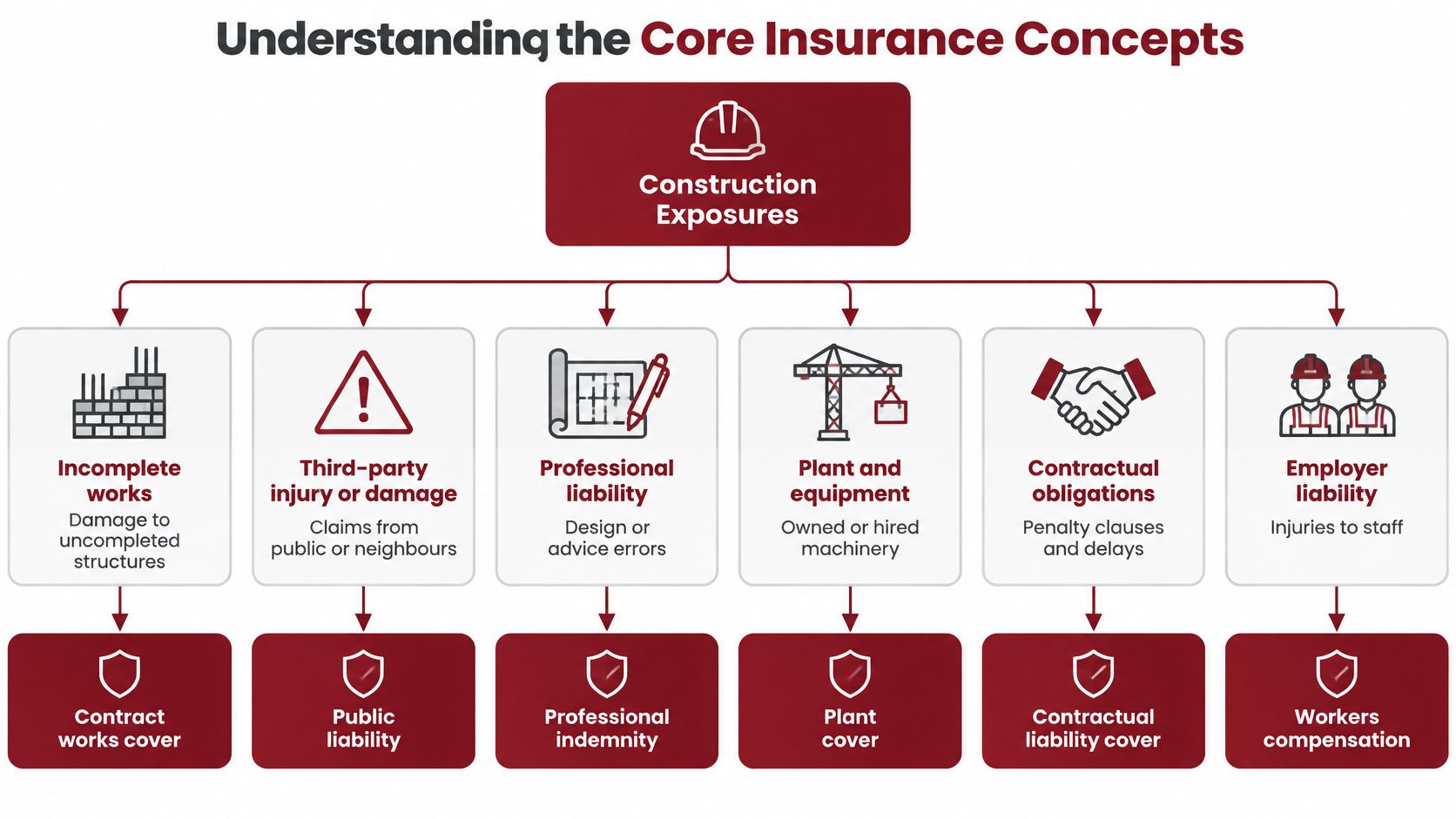
These policies don't automatically combine into a single guarantee against every project loss. Consequential losses such as delay, extra costs or lost revenue may require specific cover, and some policies may offer only restricted protection or none for a particular consequence. The policy wording, not the product label, determines what is insured.
Why matching the details matters
Two businesses can hold policies with identical headline limits and still have different protection. One policy may include the correct contracting entity and site, while another may not. The insured value, period of works, definition of insured activity, excess, sublimit and conditions can all affect how the cover responds. Contractual liability also deserves scrutiny: accepting a broad obligation in a contract doesn't mean an insurer has agreed to cover it.
Keep the risk map simple when reviewing a programme:
- Works and materials: Check the contract works description, declared values and construction dates.
- People and third parties: Identify employee, subcontractor and public exposures, then check the relevant liability arrangements.
- Advice and machinery: Confirm whether design services, hired plant and specialist equipment are included or need separate cover.
- Business records and interruption: Consider whether a cyber or business policy is needed for the company's operations, and verify the limits and conditions.
Choosing the Right Construction Insurance Policies
Choose policies by exposure, rather than assuming every construction business needs the same bundle. Start with the work you perform and the contracts you sign. Then check which policies address those responsibilities, what information the insurer needs, and where the wording draws its boundaries.
Start with the project and liability exposures
Contract works is relevant when the business needs cover for physical loss or damage to insured works during construction. Provide the project description, contract value, construction period, site details, materials exposure and any relevant existing structures. Check how the policy treats temporary works, materials away from site, variations and extensions of time.
Public liability addresses specified legal liability to other parties for bodily injury or property damage. Give the insurer an accurate account of activities, site conditions, subcontracting arrangements and contract requirements. Don't assume the head contractor's policy automatically protects each subcontractor, or that every contractual obligation is insured.
For NSW residential builders, Home Building Compensation cover is a separate statutory consideration for eligible work. The NSW State Insurance Regulatory Authority's public register includes fields such as the insurance certificate number, builder licence number, principal contractor and property address. Check that project records align with the relevant HBC details, and retain the certificate and scope documents. HBC doesn't replace contract works or public liability cover (NSW HBC scheme information).
Add policies where the operation calls for them
- Professional indemnity: Consider this where the business provides design, engineering, project management or other professional services. Describe those services accurately and check the retroactive date, exclusions and claims-made requirements.
- Plant and machinery: List owned and hired equipment, how it's used and where it's kept. Check whether the cover addresses accidental damage, theft, breakdown or items in transit as required by the operation. A business with significant equipment exposure can review plant and equipment insurance for construction businesses as one part of that assessment.
- Workers' compensation: Arrange the relevant statutory cover for employees and confirm how labour hire and subcontracting are treated. It doesn't replace public liability or plant cover.
- Commercial motor: Assess vehicles used for work, including fleet arrangements and how vehicles are used. Don't assume a plant policy covers road use.
- Management liability and cyber: Consider these for company management exposures and technology-related risks. Review insured entities, services, exclusions and incident-response conditions.
- Marine or aviation: Consider specialist cover when the business moves goods by sea or air, or operates aircraft. These policies aren't routine requirements for every builder.
A package can simplify administration, but convenience isn't proof that each exposure is covered. Ask for the policy schedule and wording that apply to the actual operation.
Matching Cover to Builders Trades and Developers
A licensed residential builder, a specialist subcontractor and a property developer may all work on the same site, yet their responsibilities differ. A sensible insurance submission makes those differences visible instead of relying on a broad label such as “construction business”.
The licensed residential builder
A residential builder should explain its licence and contracting arrangements, the type of work undertaken, the projects it accepts and whether it provides design or advisory services. For eligible NSW residential work, check HBC requirements against the project details. Contract works and public liability should then be considered separately, with attention to who is responsible for the site, materials, temporary works and subcontractor activities.
A general contractor shouldn't assume that its own policy transfers automatically to every subcontractor. Check how each contract allocates responsibility and whether subcontractors must maintain their own cover. Obtain current certificates and verify that the stated activities and insured entity make sense for the work being done.
The specialist trade
A trade contractor's exposure may centre on its own tools, hired plant, vehicles, work in progress and potential damage to property while carrying out a specialist task. The broker needs to know whether the business undertakes design or certification, works at height, enters active construction sites, or accepts responsibility for other contractors' work. These details can affect which policies are relevant and how the activity is described.
A head contractor's insurance arrangements shouldn't be treated as a replacement for checking the trade's own obligations. Read the subcontract, identify insurance clauses and confirm what the trade is required to arrange.
The developer or owner-builder
A developer may not perform construction directly, but still needs to clarify who contracts with builders, who controls the site and how responsibilities are divided. Provide the project structure, land and contract information, construction timetable and details of any finance-related insurance requirements. An owner-builder should explain who is doing the work and what statutory or contractual obligations apply.
Design involvement can also change the risk picture. Where a business combines design and construction responsibilities, examine how its professional and construction activities are insured together. A guide to design and construct insurance and the dual role can help identify questions to raise with an adviser.
For a placement discussion, gather contracts, scope of works, project schedules, plant and vehicle details, subcontractor arrangements and claims information. That gives the broker a more reliable basis for separating core cover from policies that are conditional or peripheral to the operation.
Setting Risk-Based Limits and Cover Values
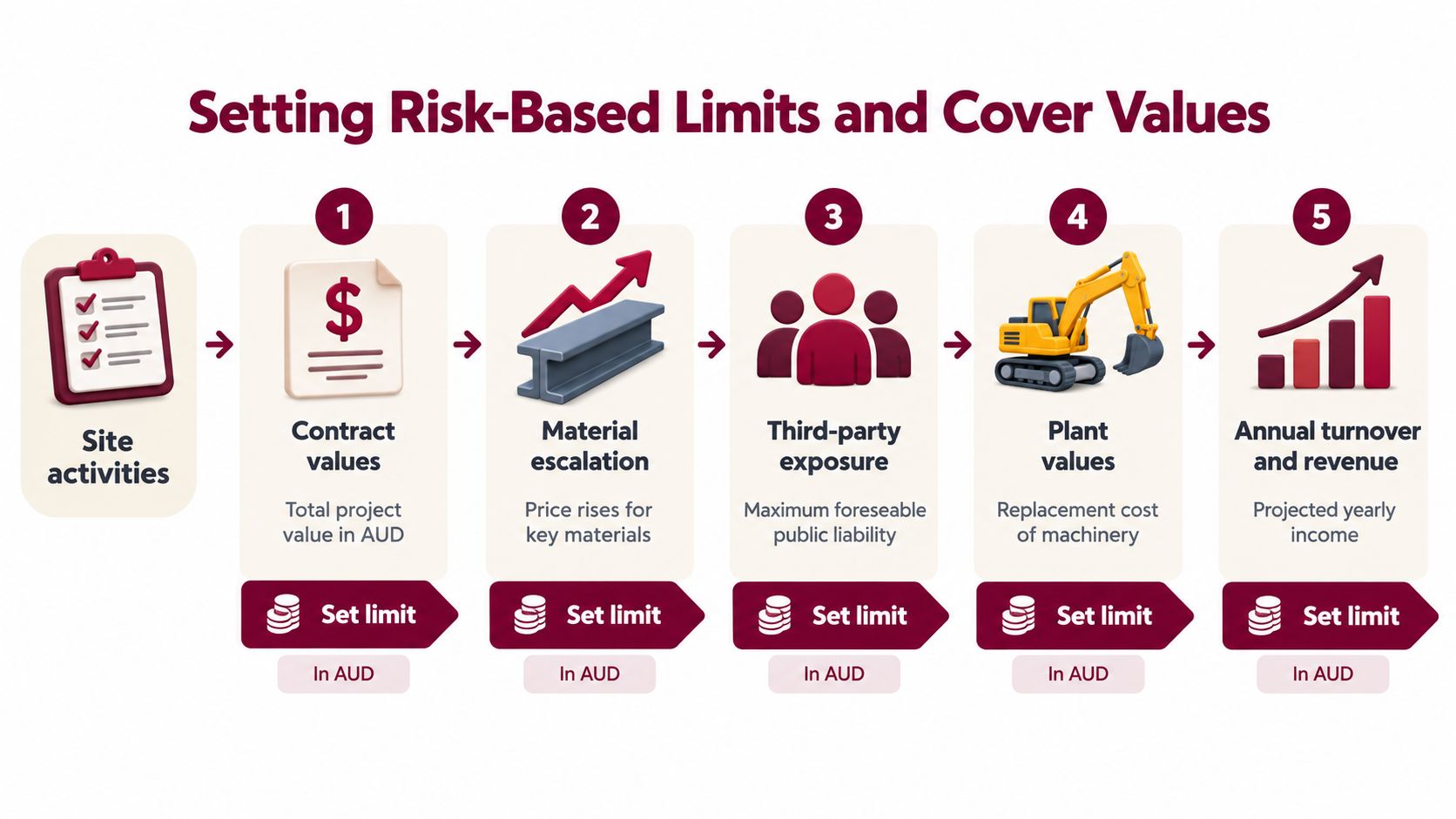
A limit should reflect the exposure the business could reasonably face, not a convenient round figure copied from last year's paperwork. For a project, the starting point is the contract and the maximum value of works and materials that could be exposed at one time. Then weigh changes in scope, construction duration, material costs and any existing structures involved.
Because work done, commencements and dwellings under construction peak at different points in a project, declared values should be checked at each stage rather than set once at inception. A contract works policy sized off the tender figure can drift below actual exposure within months once variations, escalation or an extended programme push the value at risk higher. Builders who set values at renewal and never revisit them are usually the ones disputing underinsurance clauses after a loss.
Build the assessment from the actual job
For each project, review:
- Works value: Compare the declared amount with the contract scope and expected value of work in progress.
- Escalation and changes: Consider material price movement, variations and design changes that can alter the value at risk.
- Duration: Check the insured construction period against the programme, including delays and any required extension.
- Third-party exposure: Consider site access, neighbouring property, traffic, excavation and activities that could injure people or damage property.
- Plant and vehicles: Reconcile schedules with equipment owned or hired and the company's actual use.
- Business dependence: Review turnover, key projects and how an interruption could affect revenue and ongoing costs.
These limits interact rather than sit side by side. The contract works value, the liability limit a principal requires and any delay-related amount each respond to different triggers, so a figure that looks adequate in one policy can leave the adjoining cover thin. Where subcontractors carry their own liability insurance, check their limits against what the head contract assumes.
Contract terms matter too. Compare insurance requirements against the policies, but don't mistake a contractual limit for proof that the insurer has accepted every obligation. A single-project value, an annual aggregate, a delay sublimit and the policy period are different items. Check each one in the relevant wording.
Safety information belongs in this review. Safe Work Australia recorded 16,600 serious workers' compensation claims in construction in 2022–23, with a median of 8.5 weeks lost per claim. Claims involving longer absences represented a larger share of compensation payments than of accepted claims, which is a reason to assess severe scenarios as well as frequent minor incidents (Safe Work Australia workers' compensation insights).
Limits and values need another look when the scope, design, contract price, plant schedule or completion date changes. A policy schedule can fall out of step with the job before renewal arrives.
Spotting Exclusions Clauses and Coverage Gaps
A high limit doesn't fix a policy that doesn't cover the relevant activity, location, person or type of loss. Read the wording around six practical questions: what loss is defined as insured, what period applies, where and how the work must occur, whose liability is covered, what conditions must be met, and which costs sit under a sublimit.
Weather is a good test of the difference between damage and its financial consequences. A policy may address physical damage to insured works while treating delay, acceleration, redesign, temporary works, increased costs or lost revenue differently. Ask specifically about debris removal, professional fees, existing structures, unoccupied sites, site inactivity and the period allowed for interruption. Flood, storm, bushfire and coastal exposures should be checked against the site and policy wording, not assumed to be covered because a policy is described as broad.
The Reserve Bank has discussed construction insolvencies as remaining high, particularly among smaller businesses operating with thin margins. That context makes it important to distinguish insured physical loss from counterparty failure (RBA Financial Stability Review). Unpaid progress claims, a subcontractor defaulting, or a developer becoming insolvent are not automatically insured events. They may be credit or contractual risks, even when they disrupt a project.
ASIC's corporate insolvency reporting identified construction as a significant source of appointments, including 898 appointments in its first-quarter reporting, up 14.4% year on year (ASIC corporate insolvency update). For eligible NSW residential work valued at $20,000 or more, HBC protection may respond in specified circumstances such as a builder's insolvency, death, disappearance or suspended licence, subject to the scheme's conditions. It isn't general cover for unpaid claims, project delay or defective work.
Check how policies respond to subcontractor injury, labour hire, defective work and design responsibility. Confirm the insured names and activities, and ask the broker to explain unclear exclusions or conditions in writing. Keep contracts, certificates, scope variations, safety records and site communications organised so the business can show what work was agreed and who was responsible.
Comparing Quotes and Placing Cover With a Broker
A useful comparison starts with complete exposure information, not the premium column. Send the broker current contracts, a project schedule, declared values, construction periods, turnover details, plant and vehicle lists, subcontractor arrangements and claims history. Identify any unusual work, including design responsibilities, excavation, work near the public, marine transit or aviation.
Once the information is consistent, ask the broker to compare the policies on the points that can change the result of a claim:
- Scope: Which activities, sites, entities and project phases are insured?
- Limits and excesses: What applies to each policy, and are there separate sublimits or aggregates?
- Conditions: What records, security, notifications or risk controls must the insured maintain?
- Exclusions: Which activities or losses are restricted, and can the wording be clarified or amended?
- Period: When does cover start and end, and how are extensions handled?
- Claims support: Who should be contacted, what documents will be needed, and how will the broker assist with insurer liaison?
A cheaper quote may have a narrower definition, a higher excess or a condition the business can't meet consistently. Conversely, paying for a policy the operation doesn't need adds cost without solving the main exposure. Ask for differences to be explained against actual projects and contracts.
Some placements need a separate conversation. Cyber cover should reflect the business's reliance on digital systems, project records and payment processes. Marine and aviation exposures may require specialist markets. Construction and contract works arrangements also need careful description, especially where several parties have different site and contractual responsibilities.
A broker can help compare available terms, structure cover and support the claims process. The broker can't replace subcontractor due diligence, sound payment controls, safe-work systems or clear contract drafting. Use the builders' checklist for comparing insurance brokers to prepare questions about advice, service and claims support before choosing who will handle the placement.
Handling Claims and Planning the Next Review
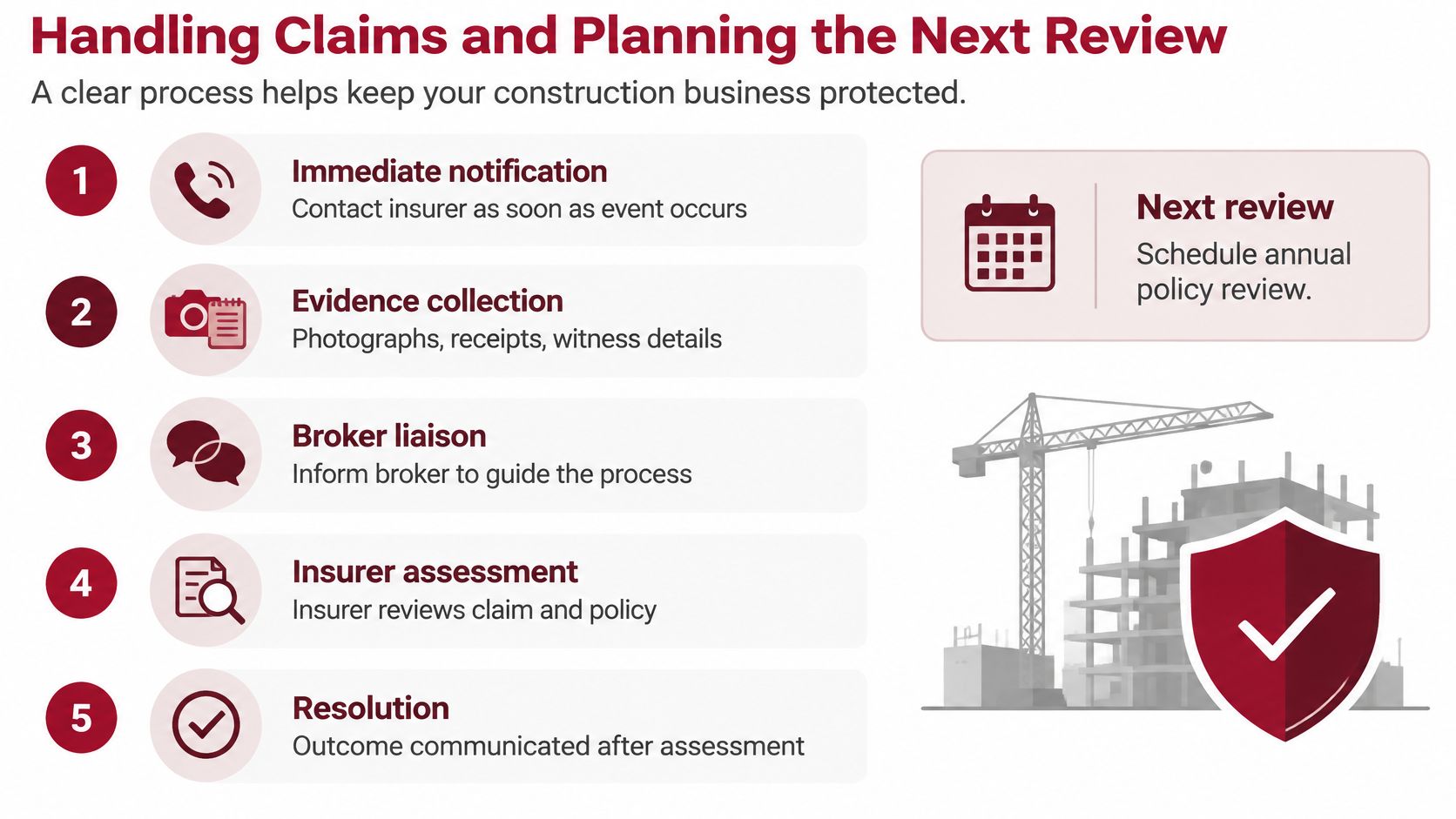
After an incident, the site team's first priorities are safety, preventing further damage and notifying the appropriate people. A worker is injured, a vehicle strikes a boundary or severe weather damages part of the works. The project manager should record what happened, contact the insurer or broker as required by the policy, and follow instructions before arranging non-urgent repairs or making statements about responsibility.
Gather evidence while it's available. Photograph the scene and damaged property, record dates and witness details, preserve relevant correspondence, and keep the contract, variations, invoices and subcontractor records together. Document mitigation work and costs. If a technical cause is disputed, ask before commissioning reports that could affect the insurer's assessment.
The description of the incident should be accurate and consistent. Avoid informal admissions of liability or promises about who will pay. Coordinate with subcontractors so that each party makes any required notification under its own policy, and keep a record of who was contacted and when. The insurer will assess the circumstances against the policy wording; neither early notification nor a complete file guarantees a particular outcome.
Keep the programme current
Review insurance when a new project begins, the scope or completion date changes, plant is purchased, turnover shifts, contractual obligations change or the business takes on specialist work. At renewal, compare the current schedule with the contracts and project list rather than assuming last year's declarations still fit.
Safe Work Australia recorded 200 worker deaths from traumatic injuries sustained at work in 2023, including 45 in construction. The same report recorded 29 deaths nationally from falls from height, with 13 in construction (Safe Work Australia key WHS statistics). These figures aren't a guide to any individual company's premium or required limit. They do reinforce why safety controls, incident records and insurance arrangements need to be considered together.
After a loss: Preserve the evidence, notify promptly, follow the policy's instructions and keep the broker informed as the facts develop.
Bring the incident file and current project documents to a review with a licensed Australian broker. Ask whether the insured values, named parties, activities, time periods and conditions still match the way the business operates.
ABS Insurance Brokers Pty Ltd arranges construction and contract works, public liability, HBC and related insurance for builders, trades and developers, alongside advice on specialist covers where needed. Discuss your projects, contracts and current programme with ABS Insurance Brokers Pty Ltd to identify where the cover aligns with your work and where a closer review is warranted.