
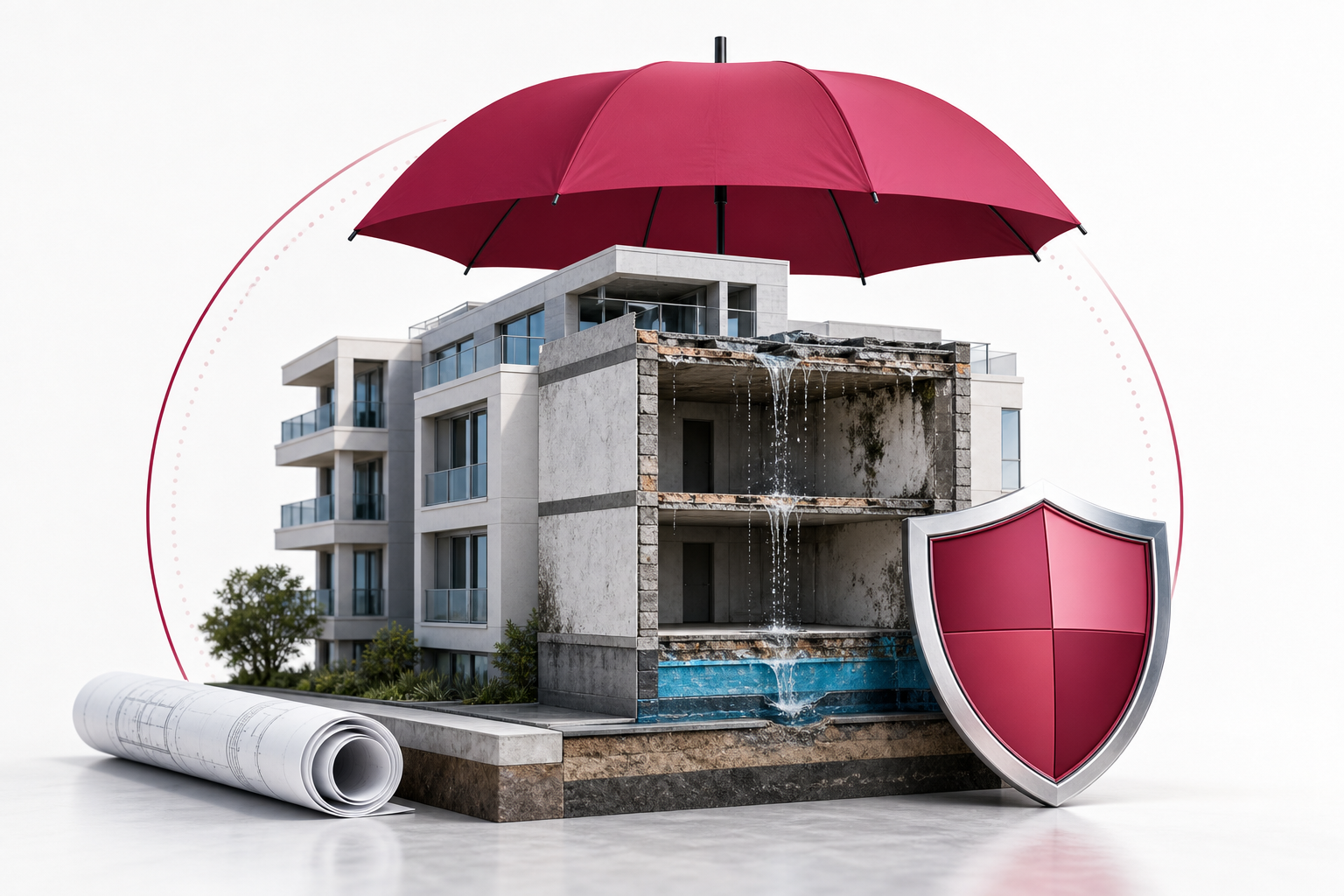
Waterproofing Contractor Insurance: Liability After Handover
Waterproofing contractor insurance should be reviewed for work during construction and liability that may arise after handover. Check the treatment of water damage, defective work, completed work and claims notification in the actual policy wording. Discuss your methods and quality records with ABS through its tradies insurance and public liability services.
Waterproofing contractor insurance: risks during and after the work
Waterproofing work carries a liability tail that most other trades simply do not face. A painter's defect shows up within months. A waterproofing failure can stay hidden for years, appearing only after moisture has already damaged structural elements, finishes, and building contents. By the time the claim lands, you may have finished dozens of other projects and moved on entirely.
That long-tail exposure is the defining risk in this trade. Below-grade applications, wet-area membranes, and roof deck systems are all buried under subsequent finishes. Defects are concealed by design. When water eventually finds a path through, the damage is often extensive before anyone notices.
The risk profile goes further than latent defects alone. Waterproofing contractors regularly handle chemical compounds, including solvents, primers, and reactive membranes, that create occupational health and environmental liability if mishandled or improperly stored. Work on occupied buildings adds a third dimension: any disruption to existing drainage or membrane systems can cause immediate water ingress, affecting tenants or residents on site during the job.
Mould liability sits at the end of this chain. Persistent moisture leads to mould growth, and mould claims can involve property damage, personal injury, and remediation costs that dwarf the original contract value.
According to the American Society of Home Inspectors, 60% of houses experience basement water problems, which illustrates how common moisture intrusion is as a defect category. That figure comes from the US market and is offered here as general context. It points to a consistent pattern: water finds every gap, and waterproofing contractors are the ones held responsible when it does.
A standard general liability policy responds to third-party bodily injury and property damage during the period of cover. It does not automatically extend to damage discovered after the policy period ends. That gap is where waterproofing contractors are most exposed, and it is why the policy structure for this trade needs to be built differently from the start.
What Types of Cover Does a Waterproofing Contractor Need?
Several policy types work together to cover the full range of exposures in this trade. No single policy handles all of them.
Public liability insurance is the foundation. It responds to third-party bodily injury and property damage claims arising from your operations. For waterproofing contractors, this must include both ongoing operations (work in progress) and completed operations (defects discovered after handover). These are not the same thing, and a policy that only covers ongoing operations leaves you exposed the moment you hand over the site. For a detailed look at how liability limits interact with contract size, see Public Liability Insurance for Builders: Getting the Right Limit for Your Contract Size.
Professional indemnity insurance (also called errors and omissions cover) applies when you provide design advice or specify a waterproofing system as part of a design-build arrangement. If your recommendation proves inadequate and a client suffers loss as a result, a general liability policy will not respond to that design error. Professional indemnity fills that gap. Residential projects are a particularly active area for these claims: in the US market, residential projects accounted for 32.9% of all professional liability claims filed in one major program between 2013 and 2022, with an average indemnity payment of $131,966 per claim, according to a Victor and CNA professional liability study. These are US figures and do not represent Australian averages, but they signal the financial scale that design-related claims can reach.
Workers' compensation is mandatory in every Australian state and territory if you employ workers. It covers wages, medical costs, and rehabilitation for employees injured on the job. Sole traders working alone are generally not covered by a workers' compensation policy and should consider personal accident and illness cover instead.
Tools and equipment insurance covers the physical assets your business depends on: spray rigs, testing equipment, compressors, and hand tools. Loss or damage to equipment on a job site can halt a project and create consequential costs that far exceed the replacement value of the item.
Contract works insurance covers the physical work itself while it is under construction, including damage caused by weather, fire, or third parties before handover. For waterproofing contractors working on large commercial or multi-residential projects, this cover is often a contractual requirement. The relationship between contract works and public liability is worth understanding clearly before you sign any subcontract. See Contract Works Insurance vs Public Liability for a direct comparison.
Together, these policies form a practical insurance program for a waterproofing business. The exact combination depends on your trade mix, project types, and whether you employ staff.
Which Policy Conditions Should a Waterproofing Contractor Check?
Read the schedule, wording and endorsements together. Do not assume that a named endorsement from an overseas policy is required by, or available under, an Australian policy.
- Insured activities: confirm the waterproofing systems, locations and work types described to the insurer.
- Defective work and resulting damage: ask how each is treated and which exclusions or extensions apply.
- Completed work: check the relevant policy period, claim trigger and notification requirements for an allegation made after handover.
- Contract terms: discuss additional insured parties, indemnities and any waiver of recovery rights before agreeing to them.
- Water-related restrictions: check conditions affecting leaks, gradual damage, testing and maintenance.
Australian policy wordings set their own conditions. For example, the QBE construction works and liability wording has separate cover sections, exclusions and endorsements. It illustrates why the actual policy must be reviewed; it does not establish what another insurer covers.
How to Prepare Your Business Information Before Getting a Quote
Insurers price waterproofing contractor insurance based on the specific risks your business presents. The more clearly you can describe those risks before approaching a broker or insurer, the more accurate your quote will be, and the less likely you are to find gaps in your cover later.
Work through these steps before you request a quote:
Identify and document the specific waterproofing trades and unusual tasks your business performs. Membrane application, below-grade tanking, wet-area waterproofing, and roof deck systems each carry different risk profiles. If you also apply chemical injection systems or work in confined spaces, note those separately. Insurers classify risk by task, not just trade category.
Classify your projects by sector and occupancy status. Residential, commercial, and civil work are rated differently. Note whether buildings are occupied during your work, as live-site waterproofing on occupied residential or commercial buildings increases your liability exposure and affects how underwriters assess your risk.
Gather historical business data, including past claims, total annual payroll, and payments made to subcontractors. Payroll figures are used to calculate workers' compensation premiums. Subcontractor payments matter because some policies extend cover to subcontractors working under your direction, while others exclude them entirely. A claims history of three to five years gives underwriters a clear picture of your loss record.
Prepare evidence of your current licence status before you apply. Each state sets its own rules around contractor licensing, and some licence categories carry mandatory minimum insurance thresholds. Victoria, NSW, and Queensland obligations are covered in the next section.
How Does Quality Assurance Testing Protect You After Handover?
Pre-handover quality assurance testing is one of the most practical steps a waterproofing contractor can take to reduce long-tail liability exposure. It does two things: it verifies that the membrane or system performs as specified, and it creates a documented record that can be used to defend against a future latent defect claim.
Two testing methods are commonly used in the trade. Electronic leak detection uses low-voltage or high-voltage electrical systems to identify breaches in a membrane before finishes are applied. It is particularly effective on flat roof decks and podium slabs where visual inspection alone cannot confirm integrity. Hydrostatic testing involves ponding water on a membrane for a set period, typically 24 to 72 hours, and monitoring for any drop in water level that would indicate a leak. Both methods produce results that can be recorded and retained.
The documentation step is as important as the test itself. A test report that records the method used, the date, the area tested, the result, and the name of the person who conducted the test gives an insurer a concrete reference point if a claim arises years later. Without that record, a claim becomes a dispute about what condition the membrane was in at handover. With it, you have evidence that the system was performing correctly when you left the site.
Latent defect claims often hinge on when the defect was introduced, not when it was discovered. A well-documented QA process shifts the evidentiary burden.
QA documentation should be stored securely and retained for at least the length of your state's relevant limitation period for building defect claims, which varies but commonly extends to six or ten years for structural or waterproofing defects.
Waterproofing Contractor Insurance in Victoria, NSW, and Queensland: What Changes by State?
Waterproofing contractor insurance requirements vary across Australia's eastern states, primarily because licensing rules, mandatory cover thresholds, and domestic building legislation differ between jurisdictions. What satisfies your obligations in Queensland may not be sufficient in Victoria or NSW.
In Victoria, waterproofing is a prescribed class of work under the Building Act 1993. Contractors performing waterproofing work above a specified contract value must hold a relevant licence issued by the Victorian Building Authority (VBA). Domestic building work above the statutory threshold also triggers obligations under the Domestic Building Contracts Act 1995. Insurers writing cover for Victorian waterproofing contractors will generally require evidence of VBA registration and may ask about compliance with the National Construction Code membrane specifications.
In NSW, waterproofing is a specialist trade that requires a contractor licence under the Home Building Act 1989, administered by NSW Fair Trading. Residential building work above the statutory threshold requires the head contractor to hold Home Building Compensation Fund (HBCF) cover, which is separate from your own public liability policy. As a waterproofing subcontractor, you are not required to hold HBCF cover yourself, but your public liability policy must be current and must be provided to the head contractor before work starts.
In Queensland, the Queensland Building and Construction Commission (QBCC) licenses waterproofing contractors under its specialist trade categories. QBCC licence holders must maintain a minimum level of public liability insurance as a condition of their licence, and the QBCC sets that minimum threshold. Your policy must name the correct licence category and meet the QBCC's financial requirements to remain compliant.
Across all three states, the underlying principle is the same: your licence and your insurance must be current, correctly classified, and matched to the type of work you perform. A broker familiar with code compliance and commercial general insurance obligations across these jurisdictions can help you confirm that your policy meets the relevant state requirements before you start work.
How to Find the Best Waterproofing Contractor Insurance for Your Business
Finding the right waterproofing contractor insurance is not simply a matter of comparing premiums. The cover that suits your business depends on your trade mix, the states you work in, whether you employ staff, and the endorsements your subcontracts require.
A broker can help compare available Australian policies against your work, contracts and claims history. Ask for a clear explanation of material restrictions and the documents needed to arrange or renew cover.
ABS Insurance Brokers is an Australian-owned insurance brokerage that sources and arranges specialist insurance policies for builders, construction businesses, and general commercial clients. The firm operates as part of the Steadfast Network, which gives it access to a wide range of insurers and products. Working through a Steadfast Network broker means your options are not limited to a single insurer's appetite.
Waterproofing contractor insurance cost varies with payroll, project type, claims history, and the endorsements included. The only reliable way to understand what your program will cost is to get a quote based on accurate business information.
FAQs
What is the difference between ongoing operations and completed operations cover?
Ongoing operations cover responds to third-party bodily injury and property damage that occurs while you are actively working on a site. Completed operations cover responds to claims that arise after you have finished the work and handed over the site. For waterproofing contractors, completed operations cover is the more critical of the two, because latent defect claims typically surface months or years after practical completion, well outside the period when ongoing operations cover would respond.
How much does waterproofing contractor insurance cost in Australia?
There is no fixed rate. Premiums are calculated based on your annual payroll, the types of waterproofing work you perform, your project sectors (residential, commercial, or civil), your claims history, and the endorsements included in the policy. A contractor performing below-grade tanking on occupied commercial buildings will be rated differently from one doing wet-area membrane work on new residential builds. The only accurate figure comes from a quote based on your specific business information.
What is a waterproofing contractor required to hold under Australian licensing rules?
Requirements vary by state. In Victoria, contractors must hold a relevant Victorian Building Authority licence for prescribed waterproofing work. In NSW, a contractor licence under the Home Building Act 1989 is required, and your public liability policy must be current and provided to the head contractor before work starts. In Queensland, QBCC licence holders must maintain a minimum level of public liability insurance as a condition of their licence. In all cases, your insurance must be matched to your licence category and the type of work you perform.
Can a waterproofing subcontractor rely on the head contractor’s insurance?
Do not assume a head contractor's policy protects your business. Review the subcontract, insured parties and relevant policy wording, and ask your broker to confirm whether separate cover or evidence is needed.
How long after project completion can a liability claim be made against a waterproofing contractor?
The limitation period depends on the state, the type of claim, and the nature of the defect. For building defect claims, limitation periods commonly extend to six or ten years for structural or waterproofing-related defects, measured from the date of practical completion or the date the defect was discovered. This is why completed-operations cover and long-tail policy extensions matter: a claim made seven years after handover is still a valid legal claim, and your insurance program needs to be structured to respond to it.
Conclusion
Waterproofing claims can arise after handover. Review the claim trigger, relevant insurance period, exclusions and notification conditions before relying on a policy to respond.
Before signing the next subcontract, check your insured activities, contract conditions and quality records with your broker. Contact ABS to discuss your current waterproofing work and insurance arrangements.