Motor Trades Insurance: A Guide for Australian Workshops
Motor trades insurance should reflect customer vehicles, road testing, workshop equipment and the services your business provides. Check the wording for each activity and for property in your care. ABS can help you review business insurance and commercial motor cover for your workshop.
Table of Contents
- Motor trades insurance: start with the workshop’s activities
- What Motor Trades Insurance Actually Is
- The Core Components Explained
- Trader Plates and What Insurers Want to Know
- Fixed Premises and Mobile Operations
- Endorsements and the Gaps Standard Wordings Miss
- Practical Scenarios Workshops Face and Handling
Motor trades insurance: start with the workshop’s activities
It's 4.30 on a Friday. A customer arrives to collect a ute you serviced that morning and finds a fresh scrape down the tray that wasn't there at drop off. Nobody saw it happen. The car was moved twice, parked nose in, then reversed out for a wash.
At the same moment your apprentice calls from two streets away. He's clipped a parked car while road testing your courtesy vehicle and wants to know what to say. You've now got a damaged customer vehicle, a third party demanding details and an upset owner in reception.
Why One Incident Tests Several Covers at Once
Most owners ask which policy pays. That's the wrong first question. You need to know who had care, custody and control, who was driving, whether the driver was authorised and whether the damage happened on your premises or on the road.
Those answers split one afternoon across liability, commercial motor and customer vehicle wording. If any answer was never declared, the insurer starts asking questions you should've settled at renewal.
If you can't explain, in one sentence, which section pays for a customer's car damaged in your yard, your programme has a gap whether the premium was cheap or not.
You're not unusual. Australia has almost 28,000 aftermarket automotive service and repair workshops employing more than 50,000 technicians and support staff, generating around AUD 10 billion annually from servicing and repair, according to the AAAA State of the Industry 2024 report citing ABS and Census data. Most are small operations holding customer vehicles, parts and tools while staff drive on and off site all day.
That operating pattern is the risk. Motor trades insurance has to follow the vehicle on the hoist, the apprentice on the road test and the tools locked in the ute. If your schedule describes a tidier business than the one you run, claims will expose the difference.
What Motor Trades Insurance Actually Is
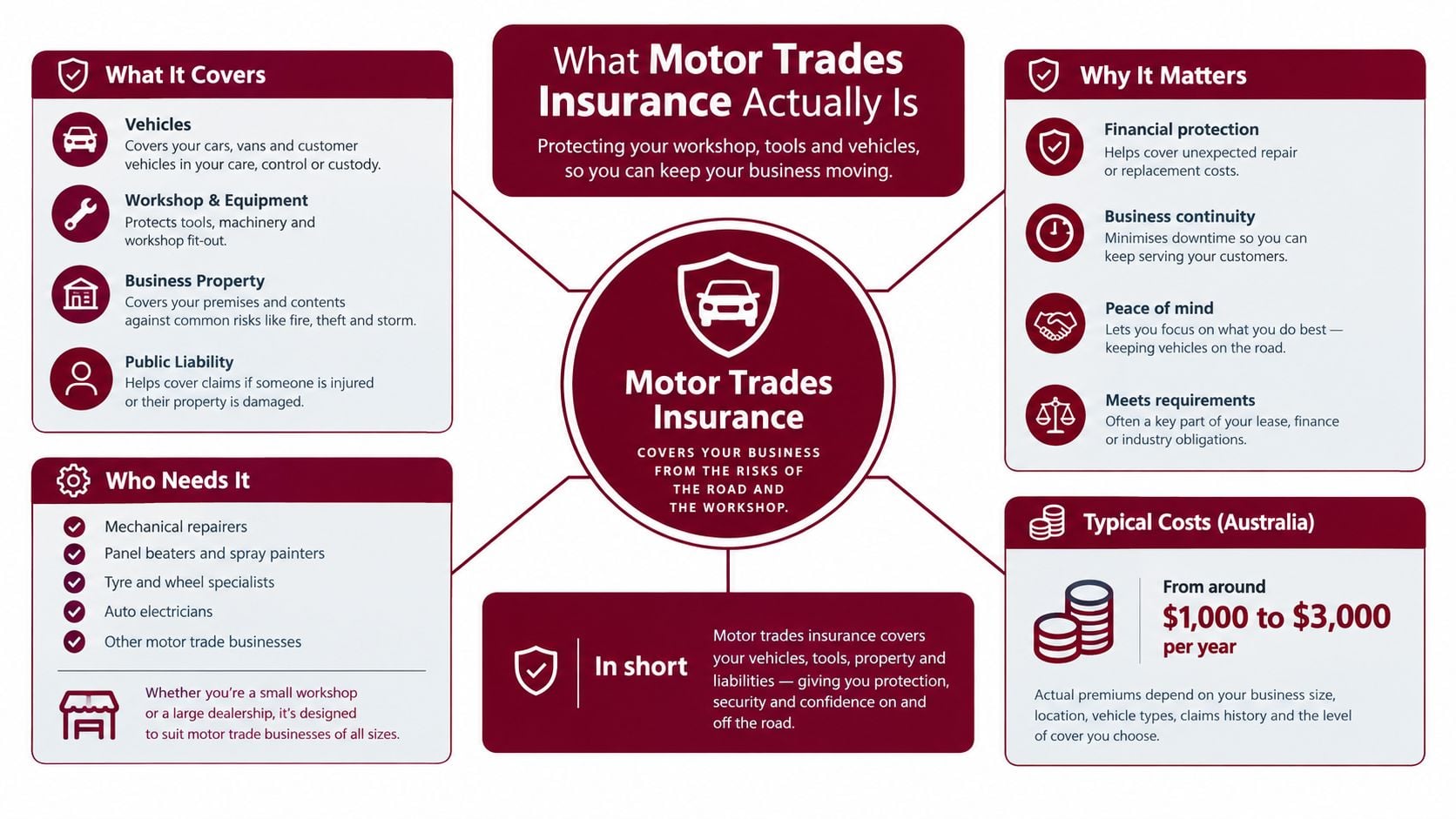
Motor trades insurance isn't a single policy. It's a packaged bundle built for businesses that repair, service, sell, move or store vehicles they own and vehicles they don't. Brokers package it because no single product line covers premises, liability, road use and customer property at once.
Think of it as a toolbox. A socket set doesn't replace a scan tool, and a hoist doesn't do wheel alignments. Each cover does one job, and you're exposed when you assume one tool handles everything.
The visual below maps how those pieces sit together for a typical workshop.
How It Differs From Policies You Already Know
A personal car policy covers a named vehicle for private use. It doesn't contemplate you driving a customer's car for diagnosis, lending a courtesy car or holding six customer vehicles overnight. Using it for trade work is a disclosure problem, not a saving.
A standard business pack covers a premises and general liability well enough for a shop or office. It usually doesn't handle road risks, customer vehicles in custody or test driving properly. That's why workshops need the trade specific structure layered over the business basics.
- Personal motor: One vehicle, private use, named drivers, no customer vehicles.
- Standard business pack: Premises, stock and general liability, limited or no road risk.
- Motor trades bundle: Premises plus liability plus commercial motor plus customer vehicle custody, structured around how you trade.
Don't buy the label. Read the schedule line by line and match each line to something in your yard, on your hoist or on your road test route. If a line has no operational match, query it. If an operation has no line, you're self insuring it by accident.
The Core Components Explained
Four components carry most workshops. Get these right and endorsements become fine tuning. Get them wrong and no add on will save you.
Garage and Workshop Liability
This responds when your work injures someone or damages their property. A customer trips over an air line, a wheel comes off after a tyre change, or a vehicle rolls in the workshop. It also interacts with cover for customer vehicles in your care, which is where wording varies sharply between insurers.
Don't assume general liability automatically covers a customer's car you've damaged. Many wordings exclude property in your care, custody or control unless that cover is specifically written back in. Check your treatment under public liability insurance arrangements for contractors and businesses and confirm the custody extension in writing, including its limit per vehicle and in aggregate.
Property, Equipment and Tools
This covers your building or fit out, hoists, compressors, diagnostic gear, hand tools and parts stock against fire, storm, theft and accidental damage. Replacement cost matters more than purchase price. A scan tool bought years ago costs far more to replace today, and underinsurance clauses can reduce a payout if you've declared too little.
List high value diagnostic equipment separately. Photograph toolboxes, keep serial numbers and store invoices off site. At claim time, proof of ownership speeds settlement more than any argument about value.
Commercial Motor and Road Risks
This covers owned utes, vans, tow vehicles and courtesy cars, plus driving customer vehicles where the wording allows it. Insurers price it on use, drivers, territory, load and claims history, not just vehicle value.
That pricing reflects class performance. APRA reported an estimated ultimate claims loss ratio of 58.6% for the 2021 accident year in commercial motor, compared with a 10 year average of 66.8%, in its general insurance claims development statistics highlights for December 2021. In simple terms, a large share of every premium dollar is consumed by claims before expenses. Underwriters therefore care about who drives, how often and for what.
Business Interruption
Fire or storm damage doesn't just cost repairs. It stops bookings while rent, wages and finance continue. Business interruption pays covered loss of gross profit during the indemnity period after an insured event, subject to waiting periods and limits.
Set the indemnity period for how long you'd need to refit, replace hoists and rebuild bookings. A short period chosen to save premium is false economy if specialist equipment has long lead times.
| Component | What it responds to | Typical workshop trigger |
|---|---|---|
| Garage liability | Third party injury or property damage from your activities | Customer injured in workshop, faulty repair causes damage |
| Property and equipment | Damage or theft of premises, tools, plant and stock | Fire, storm, break in targeting diagnostic gear |
| Commercial motor | Damage to owned vehicles and third party damage while driving | Apprentice collides on road test, ute damaged between jobs |
| Business interruption | Lost gross profit after insured premises damage | Workshop closed while fire damage is repaired |
Size limits to your largest plausible loss, not last year's schedule. Your highest value customer vehicle, your busiest week's turnover and your full tool replacement cost are better starting points than a template.
Trader Plates and What Insurers Want to Know
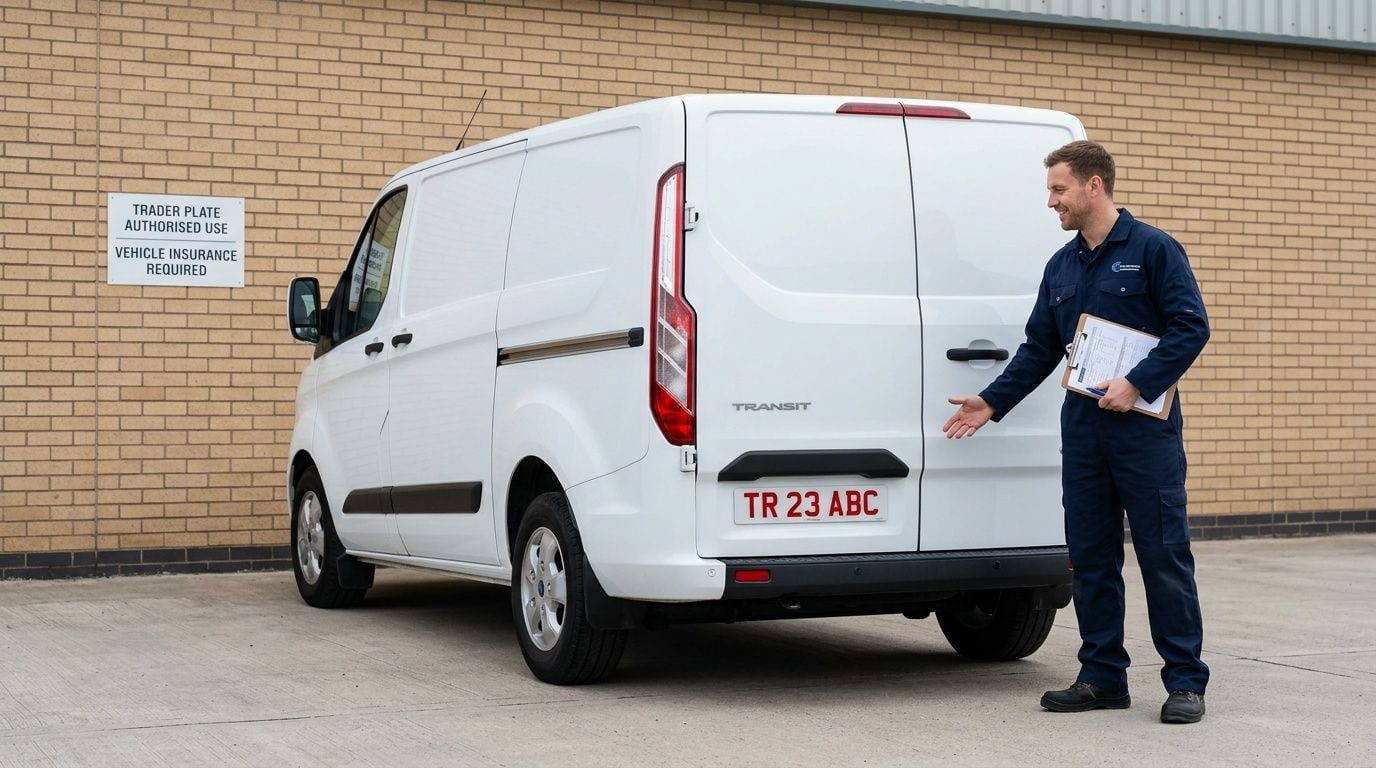
A trader plate lets you move unregistered or trade vehicles legally for defined purposes. It doesn't replace insurance, and it doesn't authorise every driver for every trip. Treat it as a regulated convenience that your policy must be structured around.
The inspection discipline in the photo below is what underwriters want to see formalised, a documented check before a vehicle moves, not a casual grab of the keys.
What Insurers Check at Proposal and Renewal
Expect direct questions. Underwriters want nominated drivers, ages, licence history, annual kilometres, garaging address and whether subcontractors ever drive under the plate. They'll also ask what the plate is used for, collection and delivery, road testing after repair, or moving stock between sites.
Answer precisely. Align your declarations with your commercial vehicle insurance schedule for business use vehicles so vehicles, drivers and uses match across documents. Inconsistent answers between proposal forms are a common reason claims get investigated longer than they should.
- Logbook discipline: Record driver, vehicle, purpose and time for every plate movement.
- Authorised drivers only: Don't lend the plate to a subcontractor or customer unless the policy expressly allows it.
- Purpose limits: Road testing a repair isn't the same as general business travel. Declare both if you do both.
- Garaging: State where vehicles sit overnight, including customer vehicles held over weekends.
Why Driving Controls Affect Your Premium
Work vehicles are a workplace exposure, not just assets. WorkSafe Queensland reported vehicle collisions caused 32% of Australian worker fatalities and 61% of bystander fatalities in 2016 to 2017, with approximately one quarter of fatal road crashes involving a vehicle being used for business, in its vehicles as a workplace guidance for tradespeople.
Show controls and you improve your underwriting story. Licence checks, reversing procedures, load restraint, fatigue rules, dash cameras and maintenance records give an underwriter evidence, not promises. Without evidence, you'll be priced as an average risk even if your workshop runs tightly.
Broker rule: If a driver isn't named or clearly within an authorised driver definition, assume they're not covered until you've confirmed it in writing.
Fixed Premises and Mobile Operations
The same bundle behaves differently depending on where the work happens. Operating model changes structure, not just sums insured.
The Fixed Workshop
A fixed site concentrates risk at one address. Customer vehicles queue in the yard, parts sit in the store, hoists and compressors stay put and staff work under your supervision. Property limits, security, overnight vehicle values and fire protection at that address drive the premium.
Your biggest fixed site questions are simple. What's the maximum total value of customer vehicles on site at any time, how are keys secured, and what happens if fire takes the building and every vehicle inside it? Answer with peak values, not averages.
The Mobile Mechanic
Mobile work spreads risk across customer driveways, building sites and roadside jobs. You drive more, work on ground you don't control and carry your livelihood in the back of a ute or van. Another property owner's surface, slope, lighting and traffic become part of your workplace.
That shift lifts motor exposure and complicates tools cover. Tools secured in a workshop overnight aren't the same risk as tools in a vehicle parked at a job, at lunch or at home. Liability also changes when you're working beside a customer's other property, children or pets.
The comparison below sets out how cost, flexibility and reach differ, which is useful when you're weighing whether mobile work is a side service or your main model.
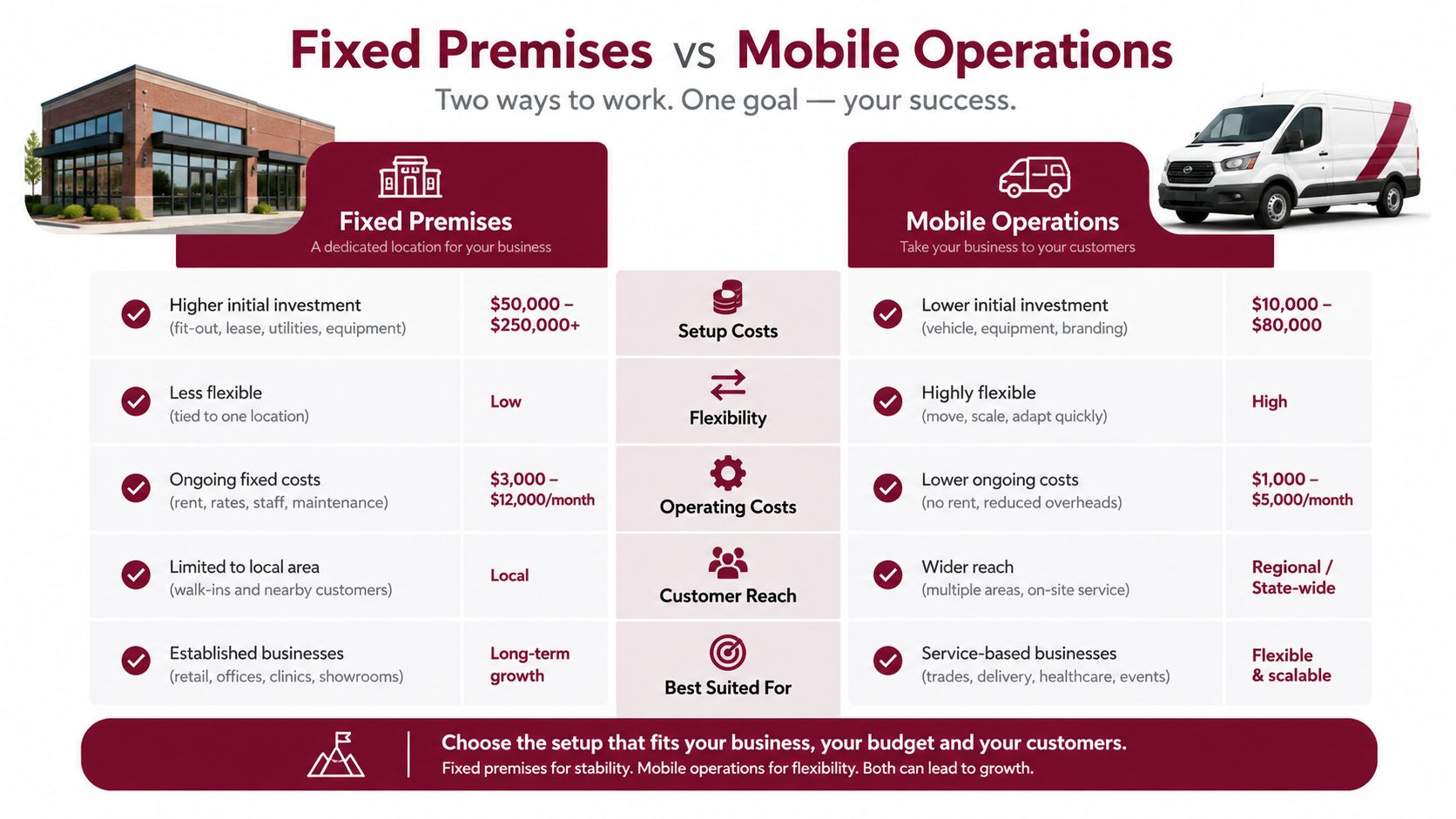
Recent data underlines why insurers load mobile driving risk. Safe Work Australia reported at least one vehicle was directly involved in 66% of Australian worker fatalities in 2024, with single vehicle incidents accounting for 72% of vehicle related worker deaths, in its Key Work Health and Safety Statistics Australia 2025 publication. Single vehicle events point to fatigue, load, speed, reversing and mechanical condition, all within your control.
- Fixed site priority: Peak customer vehicle values, building security, key control and interruption planning.
- Mobile priority: Tools in transit limits, driving frequency, work at third party premises and load restraint.
- Hybrid reality: Most workshops do both. Declare the split accurately instead of describing yourself as purely workshop based.
If you've added a mobile van since last renewal and haven't told your insurer, fix that today. Undisclosed mobile work is one of the easiest gaps to close and one of the hardest to argue after a loss.
Endorsements and the Gaps Standard Wordings Miss
Standard wording gets you started. Endorsements decide whether a real claim gets paid in full. Workshops lose money here, usually over items they assumed were included.
Use the checklist below as a renewal prompt, then work through each item against your actual schedule.
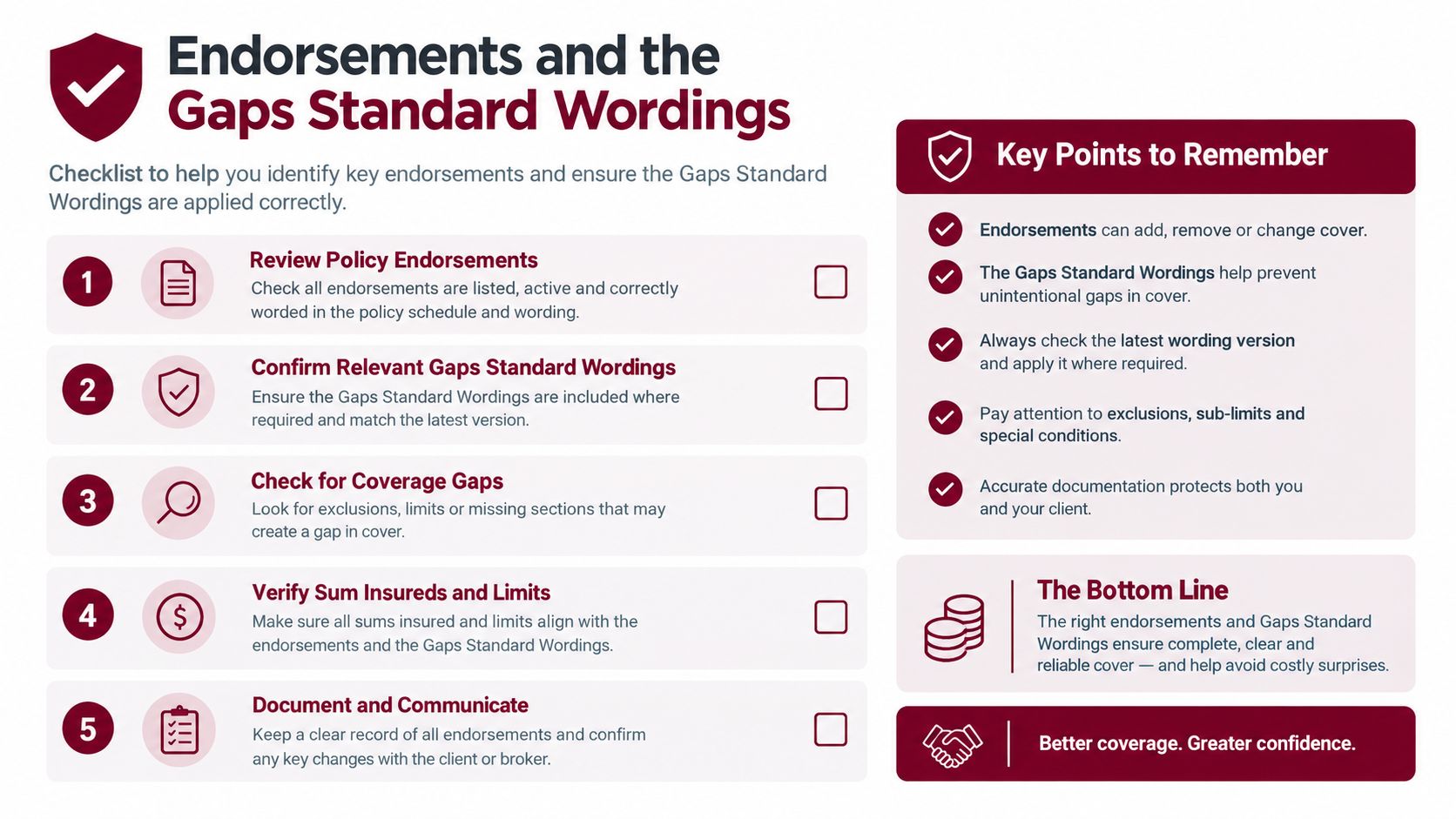
Gaps That Appear Repeatedly at Claim Time
Tools in transit often carries a low default limit and strict locked vehicle conditions. Customer vehicle custody may cap value per vehicle well below the prestige cars you now accept. Hired in plant and borrowed trailers may sit outside cover entirely. Subcontractor driving can fall outside authorised driver definitions.
Defective workmanship needs careful reading too. Policies commonly cover resulting damage from faulty work but not the cost of redoing the faulty work itself. If you promise customers you'll fix everything free, understand that promise may be yours commercially, not the insurer's contractually.
Electric Vehicles Change the Risk, Not Just the Badge
Don't accept a blanket assurance that EVs are covered. High voltage battery damage, thermal events, isolation, quarantine storage and specialist diagnostics create different premises, fire and interruption exposures. Your capability matters as much as your cover.
Australian research cited in the NRMA Changing Gears report 2025 found only about one in ten repairers were certified to handle EV repairs in 2023, while 62% of current EV owners were concerned about a lack of qualified local mechanics. Document exactly which EV services you perform, who is trained, where damaged EVs are stored and what charging infrastructure you have.
If non certified staff move EVs or external specialists do battery work on your premises, disclose it. An insurer learning that after a thermal event will not view it as a minor omission.
Capability, Information Access and Declared Activities
Access to repair information has expanded what independents can attempt. The Treasury review noted the Motor Vehicle Information Sharing Scheme was associated with a 6.7% expansion in industry turnover, equivalent to $2.4 billion in 2024, with independent workshops performing about 60% of vehicle service and repair activity, according to the Treasury ministerial release on the right to repair review.
Capability hasn't kept pace everywhere. The same release context includes Jobs and Skills Australia fill rates showing only 41% of automotive vacancies were filled on average in 2024. Taking on more complex work with scarce staff, temporary labour or outsourced diagnostics changes your risk profile.
Align declared activities with staff competency, subcontractor agreements and quality control records. If you outsource diagnostics, who carries liability for a wrong call? Put it in writing with the subcontractor and tell your insurer. Cheap premium built on understated activities isn't cheap at claim time.
Practical Scenarios Workshops Face and Handling
A customer's car is damaged reversing off your hoist. Liability and custody wording respond if you've bought that extension and the vehicle value sits within its limit. Without it, you're negotiating from your own pocket while pointing at a general liability section that excludes property in your care.
Tools are stolen overnight from a locked ute at home. Property cover may respond, but only if tools in transit extends to that location, the locked vehicle condition is met and your declared value is adequate. Photos, serial numbers and a police report turn a slow claim into a manageable one.
Fire closes your workshop for weeks. Property cover rebuilds, while the interruption section protects gross profit if you've set the period and waiting time properly. Review your position against business interruption insurance for loss following insured damage before renewal, not after the fire brigade leaves. For the repair sequencing questions customers ask after a collision, this collision damage repair guide is a useful plain language resource to share while you handle the insurance side.
Take five questions to your broker. Are my declared activities accurate, are all drivers captured, what's my per vehicle custody limit, are tool values current, and does my EV work match my training and disclosures? Get answers in writing on the schedule.
Bring your current schedule, driver list and peak customer vehicle values to ABS Insurance Brokers Pty Ltd and ask for a motor trades review that tests custody limits, road risks and interruption settings against how your workshop operates. You'll leave knowing which sections respond to the Friday afternoon scenario, which endorsements you need and what to fix before renewal instead of after a claim.