

You've got a workshop full of tools, a pipeline of signed work and a team expecting to be paid next week. Then a fire, storm or major equipment loss shuts the premises. The property policy may rebuild the building and replace the machinery, but it won't automatically replace the gross profit you can't earn while the business is closed. That's the gap business interruption insurance is designed to address.
For Australian builders, trades and SMEs, the serious question isn't just whether the property is insured. It's whether the cover can fund the full journey back to normal trading, including delays, retained staff, supplier problems, customer recovery and fixed costs that continue while revenue stops.
Table of Contents
- Business Interruption Insurance in Australia: What It Covers
- The Two Mechanics That Decide Every BI Claim
- Calculating the Right Sum Insured for Your Business
- Extensions Worth Considering Beyond the Standard Cover
- Why Most Australian SMEs Are Underinsured
- How a BI Payout Works in Practice on a Construction Job
- Reviewing Your BI Cover Before You Need It
Business Interruption Insurance in Australia: What It Covers
A cabinet maker's spray booth catches fire and the workshop closes for six weeks. Property insurance may pay to rebuild the shed and replace damaged machinery, but the business still loses the ability to fulfil orders. If a major contract worth $180,000 falls away because the contractor can't manufacture or deliver, the property section doesn't solve that income problem.
That shortfall, together with the unavoidable costs of keeping the business alive, is where business interruption insurance earns its place. Business.gov.au defines business interruption insurance as cover for ongoing business costs when an insured event interrupts operations, such as fire damage to business property.
What the cover is intended to fund
A properly structured policy can respond to the financial effect of an insured interruption, subject to the wording, including:
- Lost gross profit: The profit the business would have generated if the insured event hadn't stopped normal trading.
- Standing charges: Continuing rent, loan repayments, selected wages, lease commitments and other expenses that don't disappear when the doors close.
- Additional increased costs of working: Reasonable costs incurred to keep trading or reduce the interruption, such as temporary premises, expedited equipment or alternative production arrangements.
- Recovery support: The cash flow needed to retain key staff, communicate with customers, reorganise projects and rebuild the order book.
Business interruption insurance usually sits within a broader material damage, business package or Industrial Special Risks arrangement. It generally isn't a substitute for property, contract works, plant, cyber or liability insurance. Those covers address different exposures, while BI protects the income stream connected to an insured interruption.
The first practical step after a fire is to make the site safe, document damage, arrange temporary operations and establish what can be recovered. A resource covering commercial fire recovery steps can help owners understand the early operational priorities, although the insurance response still depends on the Australian policy wording and claim circumstances.
Broker's view: A property sum insured protects what you own. BI protects the trading capacity that pays your people, lenders and suppliers.
Before renewal, compare the schedule with your current operations using this business insurance coverage checklist. The common failures are predictable: a stale gross-profit figure, a short indemnity period and extensions that were never added because the owner assumed standard BI covered every delay.
The Two Mechanics That Decide Every BI Claim
Every BI claim has two separate gates. The first is the trigger, which opens the door to cover. The second is the indemnity period, which determines how long the policy can continue paying after that door opens.
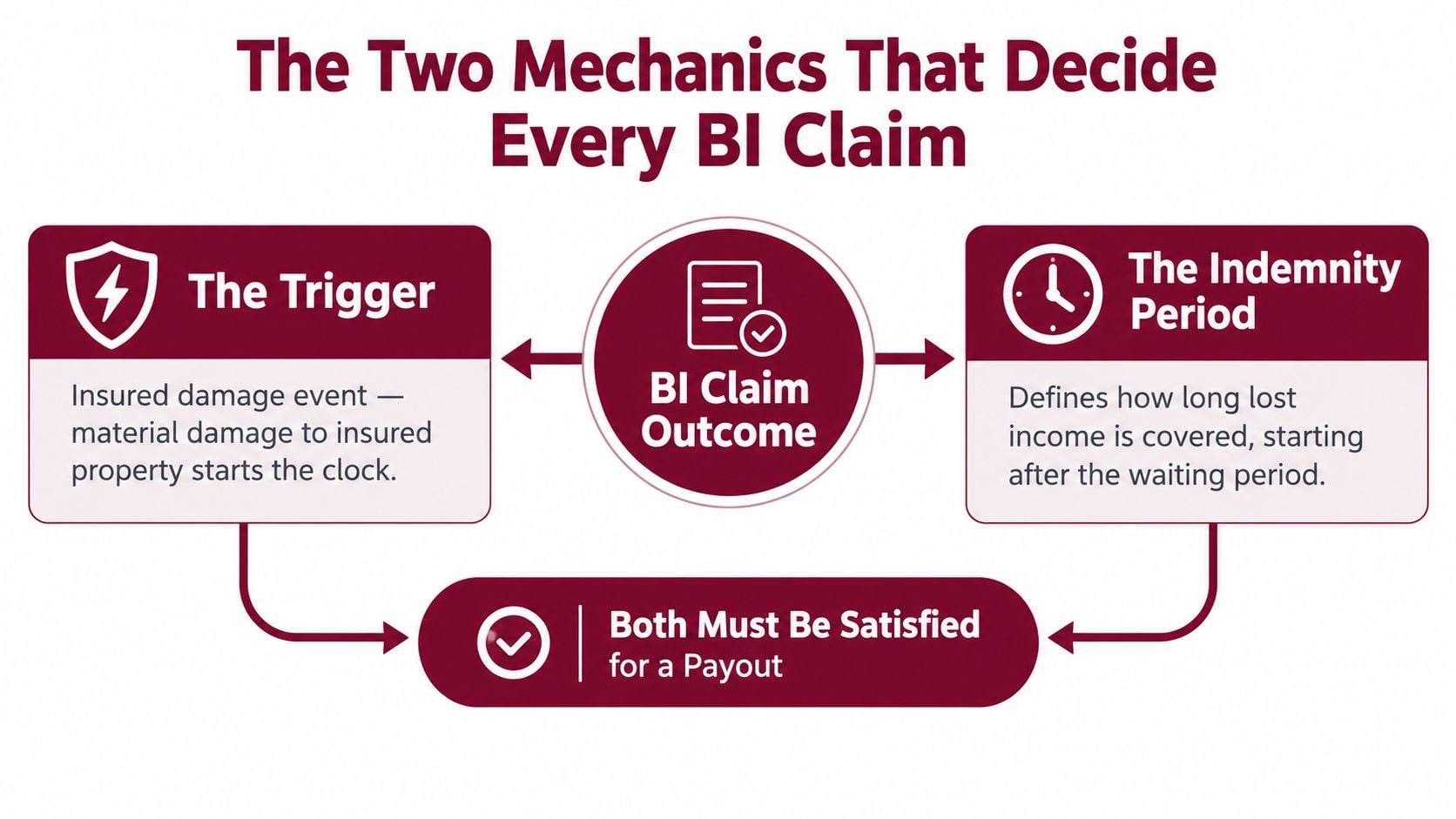
The trigger comes first
Standard Australian BI cover is typically tied to physical loss or damage to insured property. Common insured events include fire, storm, hail, burst pipes and water damage, vandalism, theft and other perils listed in the policy. Xero's Australian guide to business interruption insurance explains that optional extensions may broaden the response to utility outages, supplier or customer damage and denial of access.
A market downturn, an unprofitable contract or an ordinary loss of customers does not become a BI claim just because revenue falls. Cyber interruption, supplier failure, public-authority closure and utility disruption may need separate extensions, endorsements or a different policy altogether.
Think of the trigger as a doorway. You can't enter the BI section unless the insured event satisfies the policy's material-damage requirement or a specific extension replaces that requirement.
The indemnity period measures the recovery
The indemnity period is the measuring tape on the other side of the doorway. It sets the maximum period during which the policy can cover the financial impact, subject to the business recovering sooner and the other policy conditions being met.
Australian cover commonly uses 12, 18 or 24 months, with some markets offering up to 36 months. Marsh's Australian business interruption guidance notes that cover responds until the business returns to pre-loss trading levels or the selected indemnity period ends, whichever comes first.
A waiting period or time excess is different. Australian broker guidance commonly refers to an initial period of roughly 48 to 72 hours before payment begins, depending on the wording. The waiting period is the gap at the beginning. The indemnity period is the much longer recovery window.
The right question isn't, “How long will the builder take to repair the building?” It's, “How long until revenue, customers and project capacity return to the position they would have reached without the loss?”
Construction businesses often need longer than an average repair estimate allows. Approvals, specialist plant replacement, subcontractor re-mobilisation and customer re-acquisition can continue after the physical work appears complete. Review the claims process and communication expectations alongside the wording in this General Insurance Code of Practice claims guide for small business.
Calculating the Right Sum Insured for Your Business
The BI sum insured should reflect the financial result you need to protect, not the replacement value of the building. Start with the basis stated in the policy, then build the figure around the business's expected performance during the selected indemnity period.
A useful working process is:
- Establish the correct financial measure. Many policies use gross profit, while others refer to turnover, revenue or weekly income. Don't substitute a revenue figure for gross profit unless the wording specifically requires it.
- Identify unavoidable costs. Include the costs that continue during closure, such as core wages, rent, finance commitments and essential subscriptions.
- Allow for growth. Use current contracts, planned projects and expected changes in trading, rather than relying only on the last completed financial year.
- Test peak exposure. Seasonality and the timing of major jobs can make one period materially more exposed than another.
- Add recovery expenses. Consider temporary premises, outsourcing, expedited freight and other additional costs that could reduce the interruption.
A practical builder's calculation
Take a residential builder with annual revenue of $2.4 million and a gross-profit margin of 18%. The business forecasts $320,000 in standing costs for the next 12 months at peak and has a pipeline of new duplex starts that supports a projected 15% growth assumption. After applying the policy's calculation basis and allowing for the growth and cost profile, the broker and accountant may arrive at a BI sum insured of $1.1 million.
That figure is an illustration of the process, not a universal answer. The correct amount depends on what the policy defines as gross profit, which expenses are insured, what costs can be saved and how the business would operate during recovery.
Where the shortfall starts
Underinsurance often begins with a reasonable-looking figure that has become outdated. Owners forget to include retained wages, index only the building value, overlook higher material and subcontractor costs, or assume that revenue and gross profit mean the same thing.
The underinsurance condition can reduce a claim proportionally when the declared amount is below the exposure the policy says should have been insured. A shortfall doesn't necessarily mean the insurer pays the declared amount and stops there. Keep financial projections, contract pipelines and the calculation worksheet with the policy records, and update them when the business changes.
Extensions Worth Considering Beyond the Standard Cover
Standard BI is often too narrow for the way contractors lose revenue. A fire at your own premises is only one route to interruption. A blocked road, failed supplier, public closure or utility outage can stop the same job without damaging your building.
| Extension | What triggers it | Typical sub-limit or trap |
|---|---|---|
| Civil authority | An order from police, fire services or a council prevents trading after nearby damage | The order, affected area and covered peril may be narrowly defined |
| Denial of access | A road collapse, protest, gas leak or nearby incident blocks access to the site or premises | Distance limits vary, and physical damage at your property may not be required |
| Contingent BI | Damage at a named supplier, customer or dependent property disrupts your work | The extension may apply only to listed parties and can carry a percentage sub-limit |
| Utility failure | An outage affecting power, water or telecommunications interrupts operations | Waiting periods, provider requirements and exclusions can apply |
Civil authority and prevention of access
A council or emergency service may close a street after a nearby fire or flood. Your workshop can remain physically intact while customers, staff and deliveries can't reach it. The Australian Insurance Council's ISR submission gives a prevention-of-access example involving surrounding fire, storm or flood damage that blocks roads or bridges.
These extensions don't automatically cover every closure. Check the required authority, geographical distance, waiting period and maximum response period.
Dependent property and supply-chain failure
A specialist manufacturer, sole supplier or key customer can be a single point of failure for a construction business. If that party suffers insured damage, your project pipeline may stall even though your own premises are undamaged.
OECD analysis of Australian market policies notes that contingent BI is commonly added by endorsement and may include defined suppliers or customers, conditions and sub-limits. Utility-provider disruption is often excluded unless the wording specifically brings it back.
Utility failure
Power, water and telecommunications are operational dependencies, not background conveniences. A joinery workshop without power or a site office without communications can lose production and coordination capacity quickly. Ask whether the extension covers the relevant provider, whether physical damage is required and whether the waiting period makes the cover useful.
Map each extension to a named exposure. Don't buy a sub-limit only because it appears on a schedule. Confirm that it addresses the supplier, route, utility or authority your business depends on.
Why Most Australian SMEs Are Underinsured
The comfortable formula is to insure the property, apply an inflation index and carry forward last year's revenue. That approach fails when trading capacity changes faster than the property schedule. A larger contract pipeline, new plant, moved premises or a longer rebuild can all extend the cash shortfall.
The numbers show a protection gap
The Vero SME Index report reports that only 17% to 27% of SMEs hold business interruption cover, while 81% say an unforeseen interruption would have a severe impact on their business. That gap leaves many owners relying on cash reserves that were never sized for a prolonged shutdown.
The ARPC and University of Queensland gaps report finds that 70% of uninsured or under-insured businesses suffering a major insurable loss fail within the following year. The report also states that more than 5% of businesses experience recurring interruption claims over five years, with an average cost of $10,000 per claim. For a builder, the exposure includes lost margin, continuing wages, finance costs and the expense of rebuilding a delivery operation.
The 2026 SME Insurance Index reports that just 45% of businesses have a plan for continuing to trade during a disruption, despite about two-thirds being familiar with business continuity planning, as reported in the Vero SME Index report.
Stale values create reductions
QBE told a parliamentary inquiry that, as at 30 June 2025, 80% of businesses hadn't changed their BI sums insured, even though 11% increased building value and 7% increased stock or contents cover by more than 10%. The Australian insurance wake-up call highlights the management failure behind this gap. Businesses grow, move premises, add plant and change contract mix, while the BI calculation remains tied to old revenue and recovery assumptions.
Australian research linked to ARPC reports that about 40% of businesses don't have adequate BI insurance. QBE research also found 43% of SMEs had never heard of BI insurance and 19% had no insurance at all, while only 6% identified fire, power failure or adverse weather as their biggest cash-flow risk. These findings are summarised in the same ARPC and University of Queensland gaps report.
The practical fix: Recalculate gross profit every renewal and test the indemnity period against the longest credible recovery. Include supplier disruption, prevention of access and the time needed to remobilise crews and equipment. Optimistic figures save premium only until the claim is reduced.
Use BI as part of continuity planning to mitigate risks for Australian businesses, not as a form completed once and forgotten.
How a BI Payout Works in Practice on a Construction Job
A small commercial fit-out contractor loses its workshop to a severe fire. The workshop holds tools, plant, materials, project files and the office facilities used to coordinate several active jobs. The crews can still work in some locations, but the contractor can't maintain normal output or access the equipment needed to meet the forward schedule.

The insurer first determines whether the fire caused covered physical damage to insured property. Once the trigger is accepted, the property section can address demolition, debris removal, rebuilding and replacement of insured equipment. The BI section then examines the financial consequences of the interruption.
What the claim team measures
The contractor's records need to show what the business would likely have earned and which costs continued during the loss. The claim may consider:
- Lost gross profit: Work that would have proceeded but for the fire, supported by contracts, tenders, historical accounts and the forward order book.
- Continuing expenses: Project manager salaries, office rent, software subscriptions, ute repayments and other insured standing charges.
- Saved costs: Fuel, materials or subcontractor costs that the business didn't incur because affected work stopped.
- Mitigation expenses: Temporary premises, outsourced production, expedited equipment and alternative arrangements that reduce the overall loss.
The contractor may redeploy a fit-out crew to available work while the claim team traces the affected projects. Accounts and forecasts are reviewed through the recovery, often with forensic accounting input to separate fire-caused lost jobs from ordinary market movement or contract issues.
A well-sized policy gives the contractor time to retain staff, communicate with clients, reorganise projects and rebuild capacity. A thin policy may pay for six months, then stop while subcontractor retention claims, delayed approvals and customer re-acquisition continue. The indemnity period is a hard boundary, even when the business hasn't fully recovered.
For a construction-focused explanation of what happens when a site shuts down, consider the relationship between BI, contract works, plant and project obligations before a loss occurs.
Reviewing Your BI Cover Before You Need It
A renewal review should be a working session, not a quick check that the policy still exists. Put the schedule, current accounts, project pipeline and recovery assumptions on the table and test each against the business you're operating today.
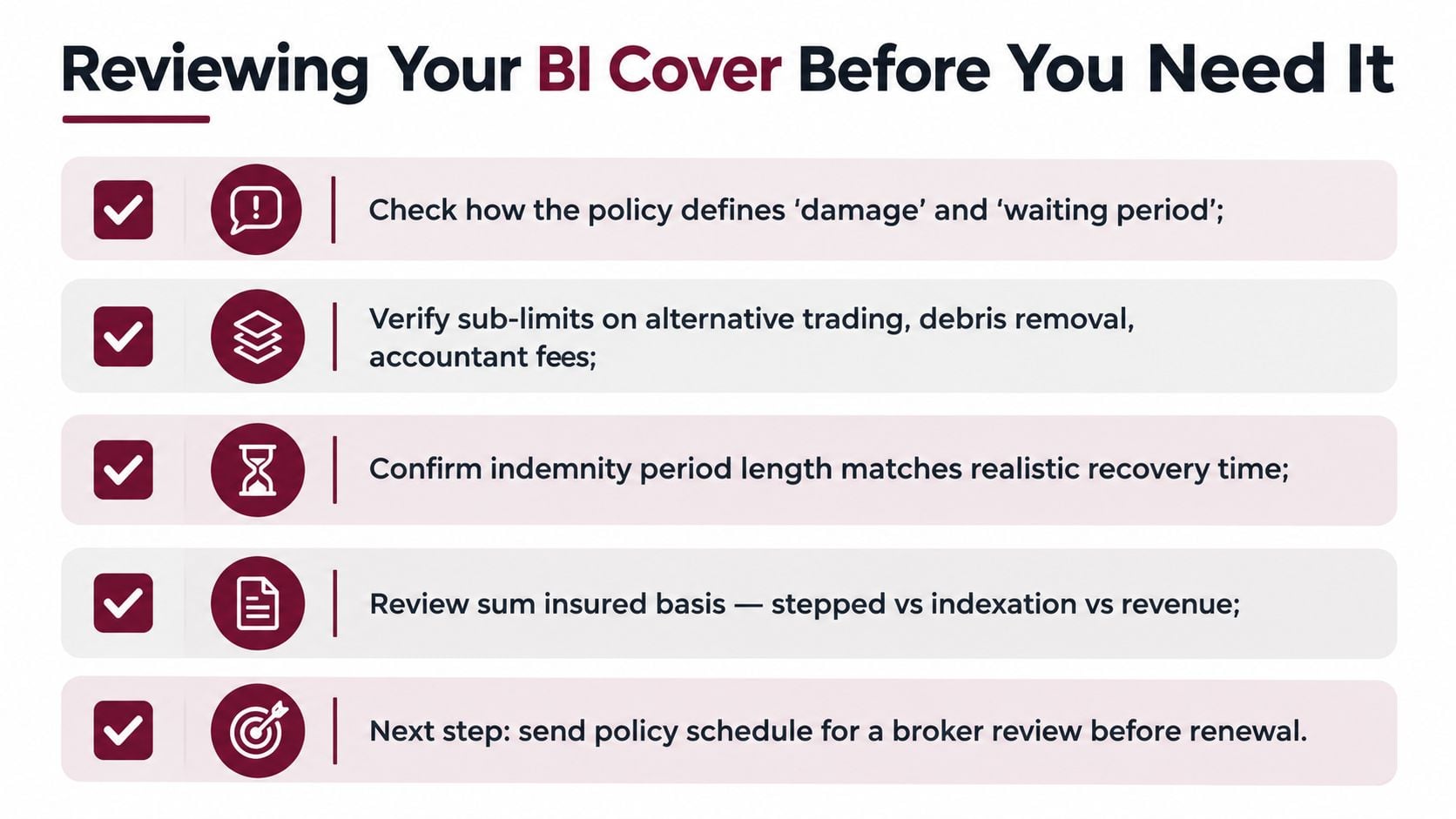
Renewal checks that matter
- Confirm the trigger: Check whether BI requires physical damage to insured property and identify extensions for supplier failure, utility interruption, cyber events and prevention of access.
- Separate the time limits: Record the waiting period separately from the indemnity period. A short time excess doesn't compensate for an indemnity period that ends before revenue stabilises.
- Recalculate the sum insured: Use the policy's stated basis and update gross profit, turnover, wages, rent, finance commitments, growth assumptions and additional increased costs of working.
- Inspect sub-limits: Check alternative trading, debris removal, claims-preparation costs, utility failure, supplier disruption and prevention-of-access limits. A headline BI limit doesn't guarantee that every extension shares the same capacity.
- Stress-test recovery: Ask what happens if approvals, specialist plant, subcontractor availability or customer demand take longer than expected. Construction businesses should benchmark the period against the longest credible restoration scenario, not the average repair.
Your business continuity plan should match the insurance. The Vero research reports that only 40% of organisations had full or partial business interruption insurance, compared with about 65% insured for asset loss from extreme weather, reinforcing the need to test income protection separately from property protection. LendingXpress's insurance requirements resources for investors can also provide useful context where lender or investment obligations influence the wider insurance programme.
For NSW residential building work, SIRA states that insurance obligations apply where the work price exceeds $20,000 including GST. SIRA's guidance on insurance obligations is relevant to builders aligning statutory cover with broader project and continuity risks.
ABS Insurance Brokers Pty Ltd helps Australian builders, trades, developers and SMEs structure business interruption alongside property, plant, contract works, cyber and other relevant covers. Send your current policy schedule, financial basis and recovery assumptions to ABS Insurance Brokers Pty Ltd for a practical review before renewal, rather than discovering a wording gap after the workshop or site has already shut.