

Professional Indemnity Insurance Price in Australia
Your professional indemnity insurance price depends on your services, policy limit, excess and claims history. Australian market averages provide context, but they do not predict a builder’s or consultant’s quote. This guide explains how to compare premiums with the protection each policy provides.
That apparent contradiction is the central fact about the professional indemnity insurance price in Australia. Insurers don't price your business from turnover alone. They assess the work you perform, the financial damage a mistake could cause, your policy limit, claims history, contract obligations and the quality of the information submitted at renewal.
For builders, tradespeople, engineers, project managers and advisers, the cheapest policy is rarely the one with the lowest number on the quote. The question is whether the wording responds to the professional allegation most likely to threaten your business, including claims arising from design responsibility, certification, contract administration, advice or reliance on subcontractors.
Table of Contents
- How Australian PI Pricing Has Evolved
- What Professional Indemnity Insurance Covers
- Key Factors That Move Your Premium
- Benchmark Price Ranges by Limit and Industry
- Getting an Accurate Quote Through a Broker
- Why a Falling Market Does Not Guarantee a Cheaper Renewal
- The Cheap Quote Trap and What to Compare Instead
How Australian PI Pricing Has Evolved
Australian professional indemnity pricing has moved sharply rather than steadily. The Insurance Council of Australia reported an aggregate average PI premium per risk of approximately AUD 2,116 in March 2013, rising to AUD 8,503 in June 2022, before falling to about AUD 2,286 by September 2025. That trajectory is documented in the professional indemnity insurance submission.
| Period | Average PI premium (AUD) | Market phase |
|---|---|---|
| March 2013 | Approximately 2,116 | Earlier market benchmark |
| June 2022 | 8,503 | Market peak |
| September 2025 | About 2,286 | Substantial correction |
These figures show how quickly Australian PI pricing can change. Claims costs, insurer capacity, underwriting appetite and profitability all influence the market. APRA recorded average written premium rising from AUD 1,964 in 2016 to AUD 2,191 in 2017, an 11.5% increase, while gross claim payments rose from AUD 786 million to AUD 1.030 billion, an increase of 31.1%. Those figures appear in APRA's National Claims and Policies Database reporting.
A national average is a market indicator, not a renewal forecast.
Consider two businesses with similar revenue. One provides general maintenance services and rarely gives design advice. The other performs design-and-construct work, signs off technical documentation and manages several subcontractors. Their turnover may look similar on an application form, but their professional exposures are not comparable. The second business offers more routes to a large financial-loss claim, so an underwriter may apply a different rate, limit structure or exclusion.
The market therefore runs at two speeds. Capacity and competition can push the broad average lower, while an individual business faces a flat or higher renewal because its work mix, contracts, claims record or perceived severity has changed.
APRA's data shows the wider cycle. Between 2015 and 2021, gross written premiums increased by 75%, made up of a 38% increase in insured risks and a 27% increase in average premium. The average premium reached approximately AUD 3,000 in 2021, with average annual growth of about 4% from 2015, according to APRA's analysis of Australian public liability and PI affordability.
That database covers APRA-regulated general insurers and policy and claim information dating from 2003. It helps explain market direction, but it is lagged, aggregated and quarterly. Your premium is set by the variables the average conceals, including scope of services, indemnity limit, claims record, contract terms, retroactive protection and potential claim severity.
What Professional Indemnity Insurance Covers
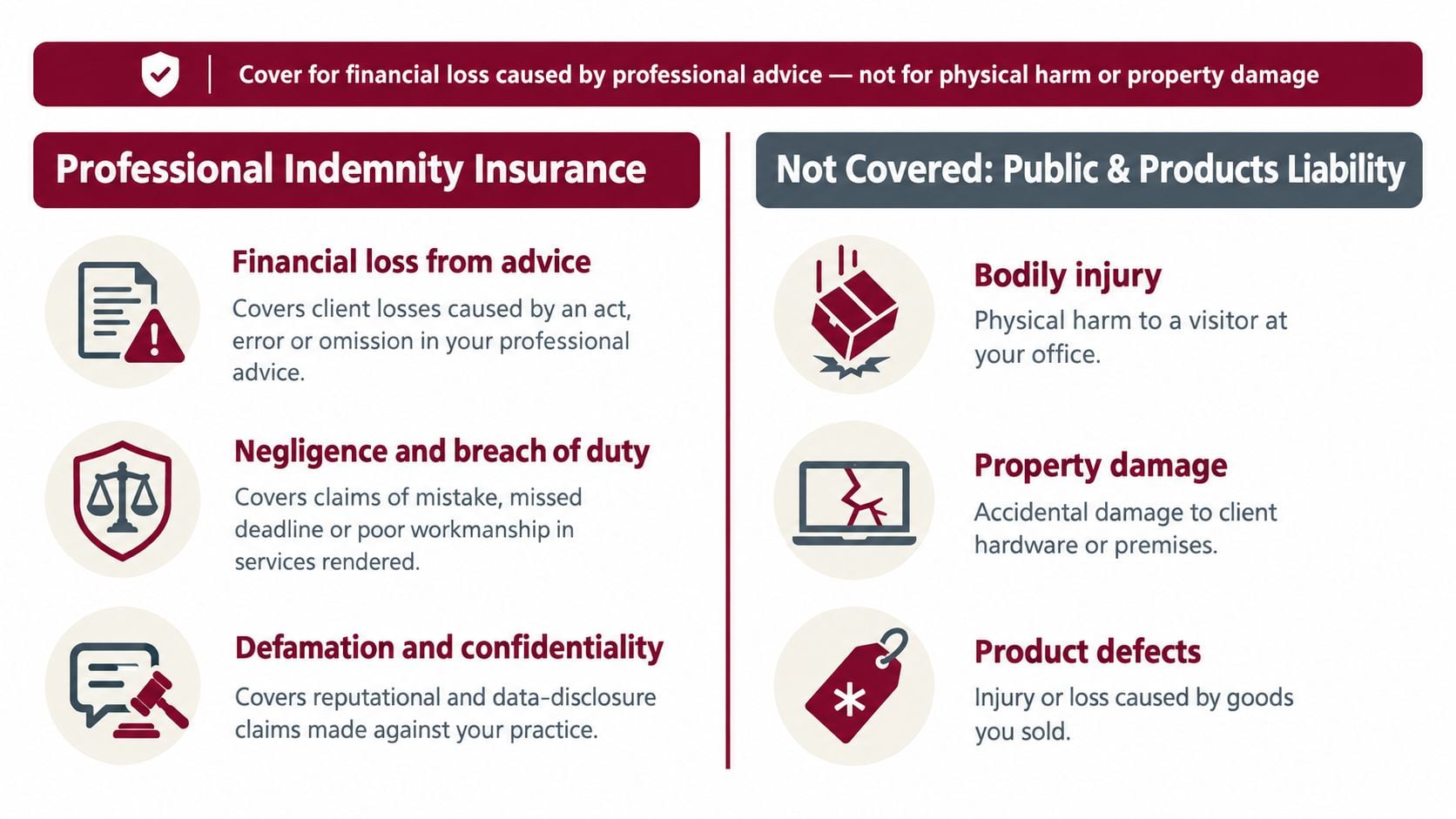
Professional indemnity insurance responds when a client alleges that your professional advice or service caused financial loss through an act, error, omission, negligence or breach of professional duty. The allegation might involve a design, calculation, report, certification, recommendation, project-management decision or other professional service.
It generally addresses the financial consequences of the allegation and the cost of defending it, subject to the policy wording, limits, excess and exclusions. Defence costs matter because a dispute can become expensive before anyone establishes whether you were negligent.
Three policies, three different problems
A builder's insurance programme often needs more than one liability policy because each policy responds to a different trigger.
- Professional indemnity: A client alleges that negligent advice, design, certification or professional work caused financial loss.
- Public liability: A member of the public suffers bodily injury, or their property is accidentally damaged during your business activities.
- Contract works: The building works, materials or project site suffer physical damage during construction, subject to the policy terms.
A simple analogy helps. PI is the policy that may respond when your structural certification is alleged to be negligent and the client suffers financial loss. Public liability is the policy that may respond when a loose brick injures a passer-by. Contract works is the policy that may respond when an insured event damages a wall while the project is under construction.
Those triggers aren't interchangeable. A public liability policy isn't a substitute for PI because it generally deals with physical injury and property damage, not the client's allegation that your professional judgment caused a financial loss. Contract works isn't a substitute for either, because it protects the project from defined physical damage rather than professional negligence.
Where employers liability fits
Employee injury is a separate insurance issue. In NSW, check whether people engaged by your business are workers or deemed workers for workers compensation purposes. An ABN alone does not settle their status. Use SIRA’s construction and workers compensation guidance when reviewing these arrangements.
Builders and advisers should also review the services described in the schedule. "Consulting" may be too broad or too vague if you undertake design, certification, contract administration or project management. A policy should reflect what you do, not just the occupation label selected from a drop-down menu. For an Australian discussion of professional indemnity insurance for advisers and businesses, the same principle applies: the insurer needs a clear connection between the declared professional activity and the possible claim.
Key Factors That Move Your Premium
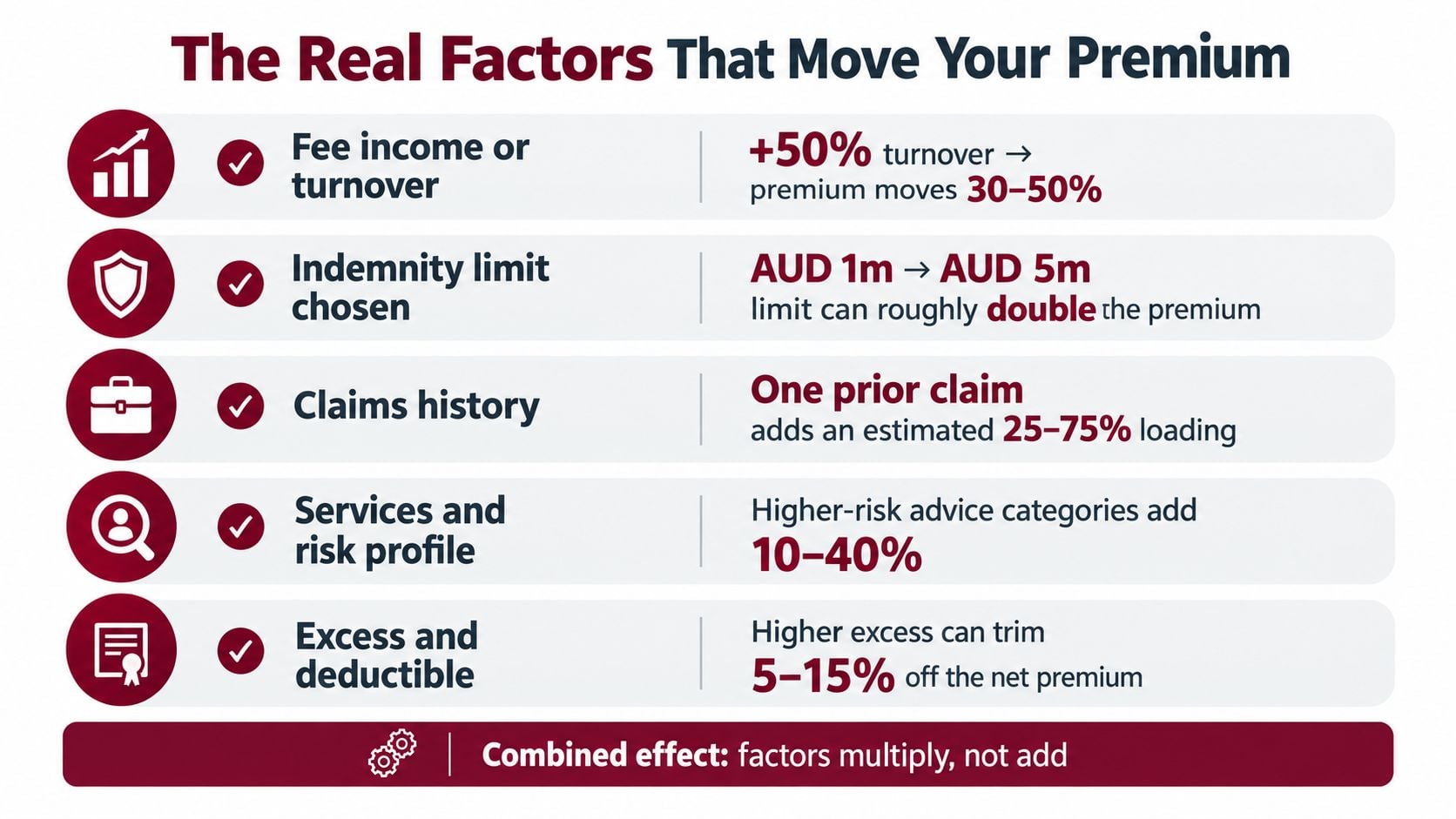
Turnover is the first filter, not the final answer. An underwriter needs to know what generated the revenue, who relied on the work, and how severe the resulting loss could be. That is why a falling market average can coexist with a flat or rising renewal for an individual business.
The following figures appear in market submissions and insurer illustrations, but they are not universal pricing rules. Occupation, policy wording, insurer appetite, claims history, and the quality of the risk presentation can move a quote in different directions.
Revenue measures exposure, not the whole answer
A rise in turnover may affect your premium, but there is no fixed percentage relationship. Explain whether growth comes from the same services or from new work with different professional risks.
A maintenance contractor adding routine jobs presents a different change from a builder adding design-and-construct services. The second business has increased revenue, professional responsibility, client reliance, and potential claim severity.
Split revenue by discipline before approaching insurers. Show the proportion attributable to design, advice, certification, project management, contract administration, supervision, and physical trade work. A clear breakdown gives the underwriter a better basis for pricing.
Limits create a major price step
A higher indemnity limit usually changes the premium, but the increase is not a fixed multiple. Ask for quotations at the limits you need, using the same declared services, excess and policy terms so the comparison is meaningful.
Do not select a limit solely because the previous policy used it. Check client contracts, tender requirements, professional obligations, and the value of projects affected by your advice. A higher limit may be necessary, but reviewing sub-limits and defence-cost treatment matters just as much. Otherwise, the headline limit can create false comfort.
Claims change the conversation quickly
A material claim can produce a substantial renewal loading, while a pattern of claims may make some insurers unwilling to renew. The underwriter will examine what happened, whether the matter is resolved, whether a circumstance was notified, and whether the same process could create another allegation.
Prepare a factual chronology. Include the allegation, reserve or likely exposure if known, insurer response, and corrective action. “No claim paid” does not automatically mean “no underwriting issue” if a circumstance has been notified.
Scope usually matters more than the occupation name
Design-and-construct, structural work, geotechnical advice, financial advice, and medical services generally attract closer underwriting than broad, lower-severity consulting. The central issue is the potential size and complexity of the client's loss.
A plumbing business that installs only to supplied plans does not present the same professional risk as a contractor that changes the design, certifies compliance, or advises on engineering outcomes. Declare those activities accurately. A safer-sounding occupation label will not protect a business if the schedule does not describe the work being performed.
Retroactive cover and business reach
Retroactive cover can protect against claims arising from earlier work, subject to the policy's requirements and exclusions. An insurer may ask when the business began, whether continuous cover has been maintained, and whether any known circumstance should already have been notified. Extended reporting arrangements can matter when a business stops trading or changes insurers.
The insurer may also assess project size, number of clients, overseas work, US exposure, subcontractor reliance, and contract assumptions. These details explain why two businesses with identical revenue can receive very different quotes.
For a contractor-focused overview of broader business exposures and insurance, see insurance for contractors.
Give the broker the work you perform, not the occupation description that sounds safest.
Benchmark Price Ranges by Limit and Industry
A national portfolio can show an average premium falling while an individual business faces a flat or higher renewal. That is the two-speed professional indemnity market. Broad market pricing reflects the mix of risks insurers write, while your renewal reflects your work, claims history, limit and policy terms.
APRA's analysis illustrates the effect of policy limits. Risks with limits below AUD 5 million had an average premium of AUD 1,389, while risks with limits above AUD 10 million averaged AUD 6,118. The figures cover a national portfolio, not construction quotations, and the comparison appears in APRA's claims and policy analysis.
A change to the limit, excess, retroactive date or declared service scope can materially change the quote. Two firms with similar turnover may still receive different prices because the insurer sees different potential losses.
Published averages do not establish a standard price for builders, engineers or trade contractors. Obtain current quotations for your own professional activities and required limits. The comparisons below describe underwriting considerations rather than verified retail price bands.
| Profession | AUD 2M Limit | AUD 5M Limit | AUD 10M Limit |
|---|---|---|---|
| General builder or trade contractor | Commonly lower construction benchmark band | Higher than the AUD 2M option, subject to scope and claims | Requires individual underwriting |
| Design-and-construct contractor | Often materially above general trade pricing | Can rise sharply with design responsibility | Usually negotiated for project and contract needs |
| Structural or specialist engineer | Frequently high relative to general trades | Higher severity exposure requires detailed underwriting | Quote depends heavily on discipline and project profile |
| Electrical or plumbing trade with limited advice | Often toward the lower end of trade pricing | Increased limit may still be available | Requires insurer assessment |
Use the table as a pricing direction, not a retail quotation. Underwriters examine whether the business designs, certifies, supervises, manages subcontractors or accepts responsibility for another professional's work.
A AUD 2 million limit for a general trade business can cost very differently from the same limit for a structural engineering practice. The limit matters, but so do the excess, retroactive protection, project values, contract wording and claims record. A falling market average does not erase those business-specific factors.
Getting an Accurate Quote Through a Broker
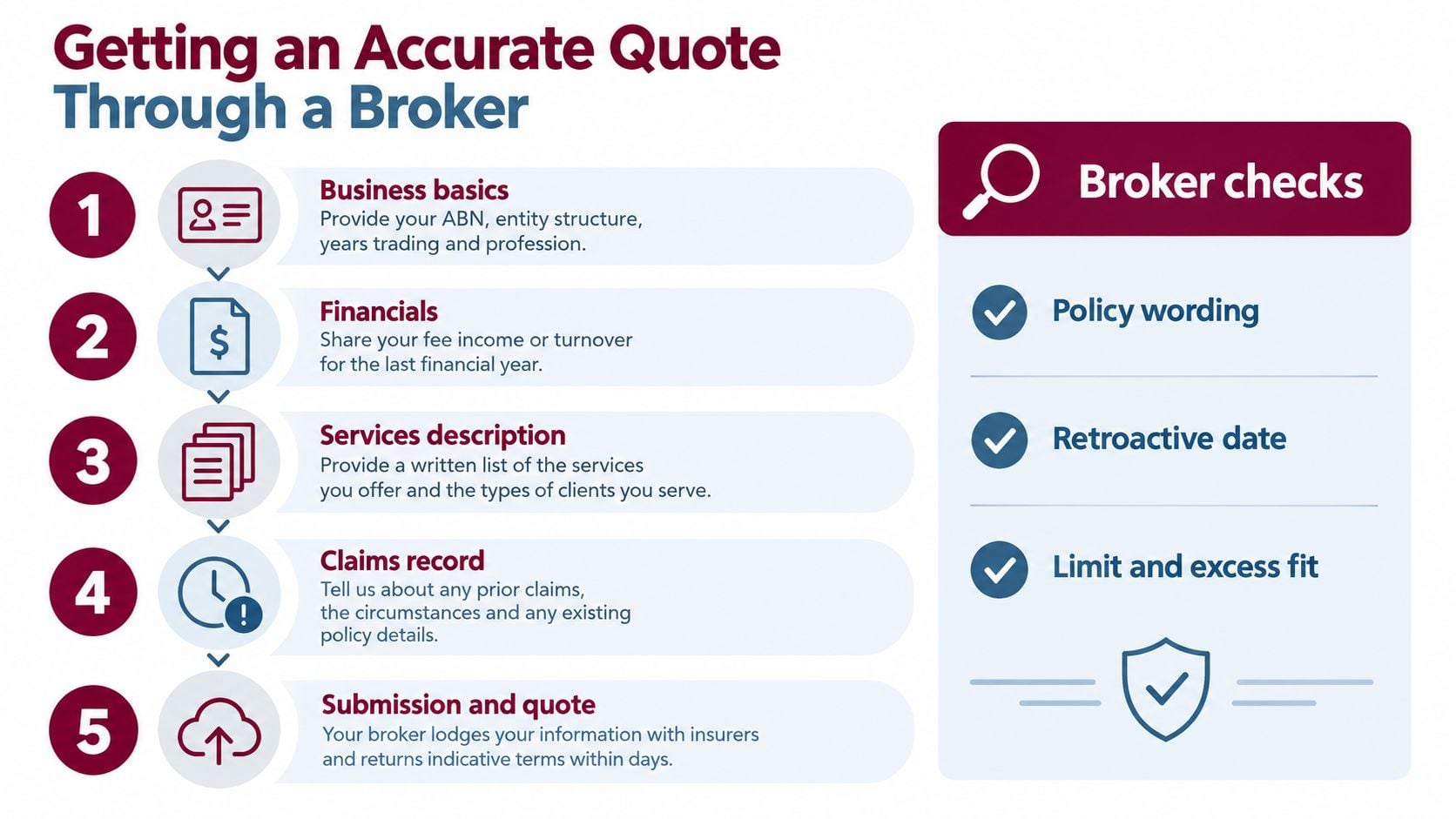
An accurate PI quote starts with a complete submission. A broker can't properly test the market if the application reduces a complex construction business to turnover and a requested limit.
Prepare the business profile
Provide the ABN, legal entity, ownership structure, years trading, number of qualified staff and professional qualifications. Include related entities if they provide services or sign contracts. Insurers need to understand which entity performs the work and which entity should be named on the policy.
Then document the revenue. Give gross fee income or turnover for the last financial year, the forecast for the next twelve months and a split by discipline. Identify subcontractor income, referral work and any revenue connected to design, certification, project management or advice.
Describe the work in ordinary language
Don't rely on a single occupation label. Write a short description of each service, the client types, the usual contract size and the decisions for which clients rely on your business.
A useful submission might distinguish physical installation from design responsibility, supplied plans from modified plans, and supervision from certification. It should also identify overseas work, US exposure, major commercial clients and any work performed through subcontractors.
Get the claims record right
Prepare five years of claims details, including dates, allegations, insurers, current status, circumstances and outstanding reserves where available. Include notified circumstances even where no payment has been made. Omitting a relevant matter can damage confidence in the submission and create problems at policy inception.
The broker should also review current certificates, policy schedules, endorsements and any contract-specific insurance clauses. These documents often reveal limits, retroactive dates or exclusions that the business owner doesn't remember.
Set the cover preferences before approaching insurers
Decide the required indemnity limit, acceptable excess, retroactive date and whether a contract requires a specific limit or wording. Ask whether defence costs sit inside or outside the limit, whether the limit is aggregate and whether any professional activity has a sub-limit or exclusion.
The comparison between insurance broker fees and commission can also help you understand how advice and placement are arranged. The important issue is the quality of the submission and the suitability of the terms, not merely the method of remuneration.
A broker who only needs your revenue and limit is underwriting on assumption, not fact.
Why a Falling Market Does Not Guarantee a Cheaper Renewal
The PI market is operating at two speeds. Claims-free businesses with clear services and strong controls may attract competing terms. Businesses with notified circumstances, prior claims, complex reliance exposures or demanding contract obligations can face a flat renewal or an increase.
The broader benchmark fell to about AUD 2,286 by September 2025, close to the earlier benchmark. That aggregate average does not set the price for every profession, limit or construction risk. It shows market direction, not the renewal outcome for an individual business. As noted earlier, the Insurance Council's benchmark is useful context, not a quotation.
Insurers price loss experience, not headlines
Historical market data can help explain pricing cycles, but an individual renewal requires current quotations. APRA’s National Claims and Policies Database provides aggregate information; it does not quote premiums for individual businesses.
The Insurance Council has stated that insurers need approximately AUD 1 of premium for every AUD 0.70 of claims incurred to break even after operating, administration and claims-handling costs. It also reported that some PI segments have recorded loss ratios above 95%. A class with severe claims development can therefore remain expensive while broader capacity returns.
A clean consulting risk may attract several insurers and better terms. A design-and-construct business with a prior defect notification may attract fewer markets, more underwriting questions, a higher excess or narrower wording. Insurers price the portfolio segment and the individual file in front of them. That is why a falling market average can coexist with a flat or rising renewal.
What buyers should do at renewal
Start early and give the broker a complete claims-free declaration or claims history. Provide updated revenue splits, current contracts, risk controls, quality assurance procedures and any change in service scope. If the business has stopped performing a high-risk activity, explain when and why, then support the change with records.
Compare the renewal against alternative terms, not only last year's premium. A lower price may reflect a different limit, higher excess, restricted retroactive date or revised exclusion. A flat price may be justified if the business has become more complex, its claims profile has changed or insurer appetite for the relevant work has narrowed.
Review the underwriting file with the broker. Correct descriptions of professional services, clear claims information and evidence of risk controls can influence how insurers classify the business.
The market average provides background. Your renewal reflects your work, history, contracts and available insurer appetite.
The Cheap Quote Trap and What to Compare Instead
A low PI premium often reflects a change in protection, not an insurer suddenly discovering a cheaper way to carry your risk. The restriction may sit in the excess, retroactive date, exclusions, notification wording, aggregate limit or definition of professional services.
A quote that is 15% to 25% below comparable alternatives should trigger a wording comparison, not an automatic acceptance. That difference may be justified, but it needs an explanation.
Use this renewal checklist
- Limit: Does the indemnity limit satisfy every client contract and professional obligation? Is it any one claim or aggregate, and are defence costs inside the limit?
- Excess: What will the business pay for each claim? Does the excess apply separately to defence costs, multiple allegations or related claims?
- Exclusions: Does the wording remove design-and-construct work, certification, contract administration, asbestos, cyber-related loss or fraud-related allegations?
- Retroactive date: Does it align with the earliest continuous cover for the work that could still produce a claim?
- Notification: How quickly must circumstances be reported, and does the policy provide appropriate extended reporting or run-off protection?
- Subcontractors: Does the policy respond when a client alleges that your business is responsible for advice, work or reliance involving a subcontractor?
- Claims handling: Who will manage the matter, and can the insurer respond promptly when a client makes an allegation?
For construction businesses, the wording around rectification and design liability deserves particular attention. The cheapest policy may respond to a narrow legal claim but not to the practical costs the business expected it to cover.
The right comparison is not “Which insurer is cheapest?” It is “Which policy gives the required protection for the work we perform, at a price the business can sustain?”
ABS Insurance Brokers Pty Ltd places professional indemnity insurance for builders, trades, advisers and technical businesses, with pricing assessed against the actual business and project profile. Visit ABS Insurance Brokers Pty Ltd to request terms and discuss a PI structure that compares limits, exclusions, excesses and retroactive cover rather than focusing on premium alone.