You're quoting jobs, chasing renewals, and trying to keep a cleaning business moving without getting buried in paperwork. Then a client sends over a contract that wants proof of cover, a supervisor asks about a ladder job next week, and you realise “insurance for cleaners” is not a one-line answer.
A proper policy setup has to match the work you do. For cleaners, that usually means thinking in five directions at once, public liability, workers compensation where staff are employed, tools and equipment, motor, and the often-missed exposure around care, custody and control when client property gets damaged.
Table of Contents
- What Cleaners Actually Need Insured
- Why Cleaning Is a Higher-Risk Trade Than It Looks
- The Core Cover Lines Explained
- Work Methods That Change How You Are Insured
- Employees, Contractors, and Subcontractors
- What Commercial Clients Actually Require in Their Contracts
- Red Flags When Comparing Cleaner Insurance Quotes
- Putting the Right Cover in Place
What Cleaners Actually Need Insured
A mop on a polished lobby floor can turn into a claim in seconds. So can a chemical spill on stone benchtops, or a worker straining their back while shifting a mattress on a Saturday shift. If you only buy public liability, you're betting that none of the other common cleaning risks will ever show up.
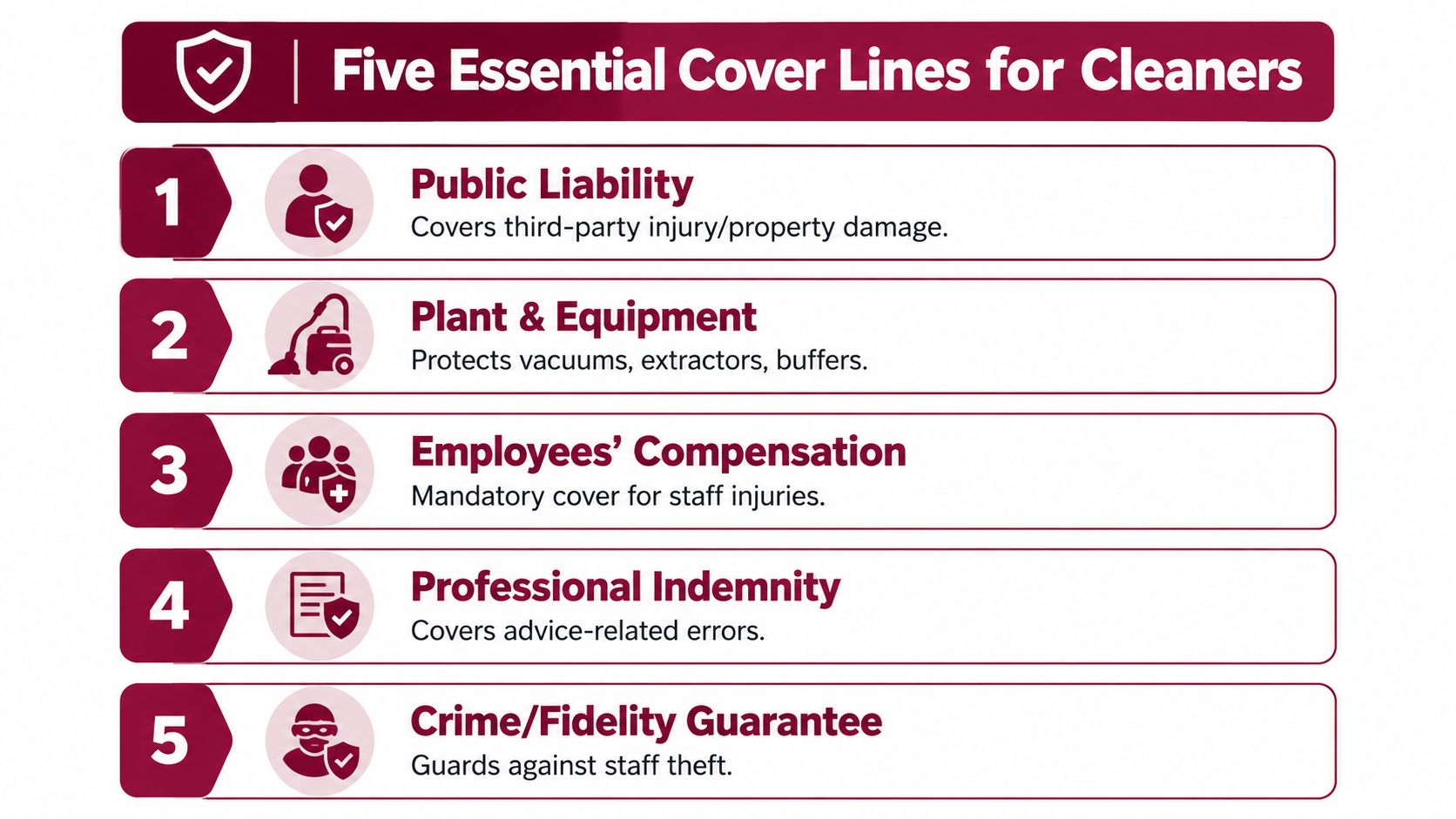
The five cover lines that matter
Public liability handles third-party injury and property damage at client premises. That matters because most cleaning losses don't happen in your office, they happen in somebody else's space.
Workers compensation is the next essential cover if you employ staff. It responds when an employee is injured doing the job, which is a different problem from damaging a customer's property.
Tools and equipment cover is for portable gear, vacuums, extractors, buffers, pressure washers and similar items that keep the business earning. Motor cover matters if vehicles are moving between sites all day. Care, custody and control is the hard edge of the job, because it's where damage to client property sits, and many cheap policies handle that badly.
Practical rule: if your team enters client sites, moves client items, uses chemicals, or works on ladders, you need a broker conversation, not a quick online tick-box.
For a simple starting point on the liability side, finding the right liability insurance is only useful if you match the wording to your actual work. The same logic sits behind how to get public liability insurance, because the certificate alone doesn't tell you what's excluded.
A quick way to think about the risk
If the job can injure someone, damage something, stop a vehicle, or break your own gear, it needs a specific cover conversation. That's why a single-policy shortcut usually leaves a hole somewhere.
Why Cleaning Is a Higher-Risk Trade Than It Looks
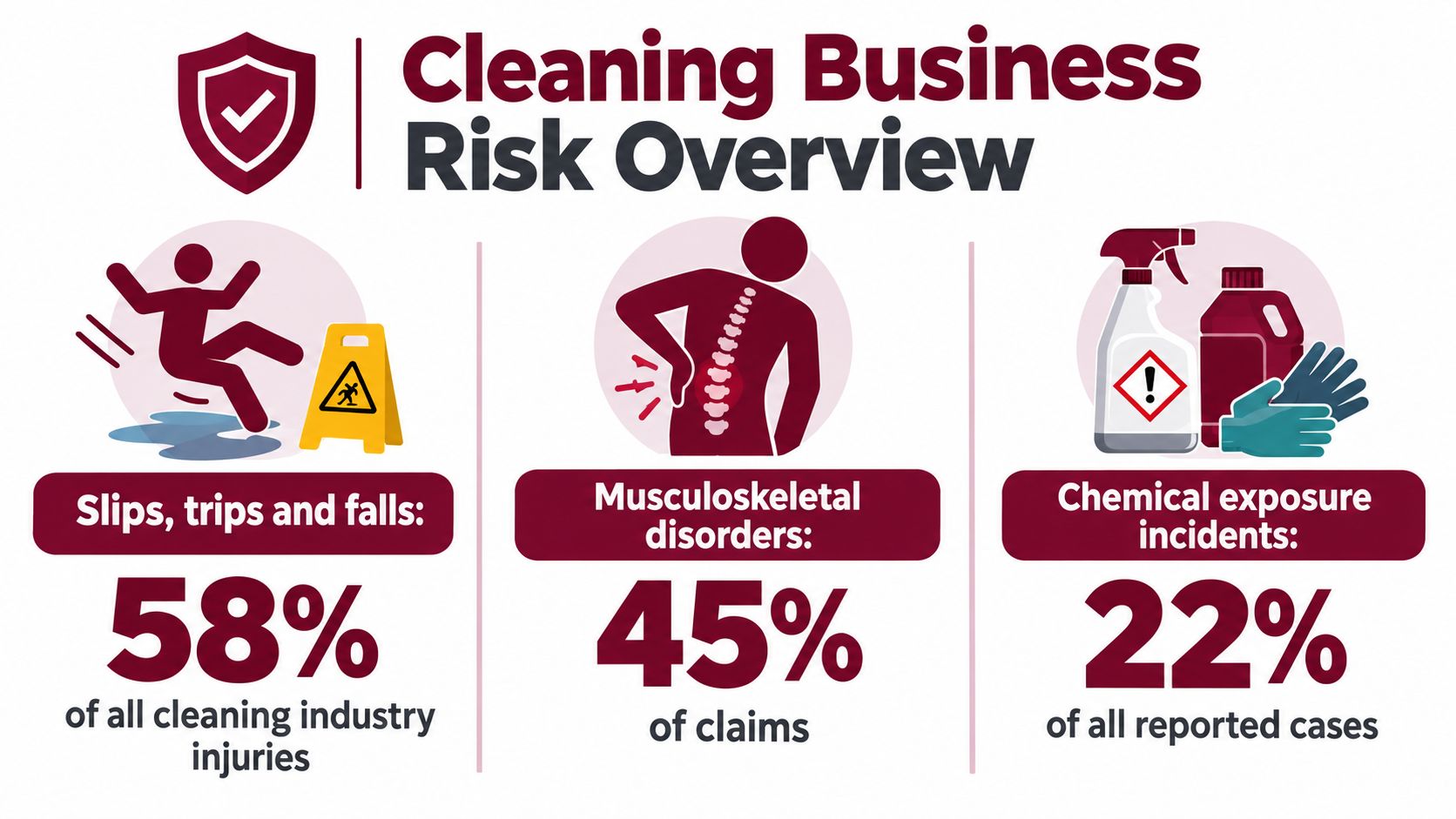
The injury profile in cleaning is not mild, and it's not something to wave away as “low-risk work”. Data submitted to a federal parliamentary inquiry, drawing on Safe Work Australia statistics, recorded an average of approximately 1,805 serious workers' compensation claims per year among commercial cleaners, and in 2015–16 the rate was 7.9 serious claims per million hours worked compared with 5.6 across all industries. The rate had fallen from 18.7 claims per million hours in 2006–07, but it was still about 41% higher than the all-industry average. Covra's summary of cleaners' insurance risk sets out those figures in one place.
What the numbers mean for a quote
Those numbers tell you two things. First, insurers don't price cleaning like a generic office or low-hazard trade. Second, a cheap quote that ignores manual handling, chemicals, work at heights, or client-premises exposure is often cheap because the insurer assumes less than you really do.
The underwriting questions should be blunt. How many workers do you have, are they employees or subcontractors, what manual-handling work do they do, what equipment do they use, and where do they clean? That's the core conversation, because the risk is driven by the work mix, not by business cards or turnover.
A broader Safe Work Australia view shows how common injury and illness still are across the labour force. In 2021–22, 497,300 people experienced a work-related injury or illness, which was 3.5% of the 14.1 million people who had worked in the previous 12 months. Labourers recorded 56.9 cases per 1,000 workers, and community and personal service workers recorded 69.8 per 1,000. Safe Work Australia's latest national WHS statistics are useful because many cleaning roles sit close to those occupations.
A cleaner who hides the actual work mix to chase a lower premium usually ends up paying twice, once in the premium and again when the claim lands in an exclusion.
Why frequency beats turnover
A cleaning business can have modest revenue and still produce a high claim frequency if the work is hands-on and repetitive. That's why a broker should look at the actual jobs, not just the size of the bank account.
The Core Cover Lines Explained
A cleaner can lose a job to one wet floor claim, a stolen machine, or a back injury on a site that looked routine. That is why the cover mix has to match the way the work is really done.
Public liability and workers compensation
Public liability covers injury to other people and damage to their property. Commercial clients often ask for $10 million or $20 million limits, because they want the supplier to carry the clean-up cost when something goes wrong on site.
Workers compensation sits in a different lane. It applies when you employ staff, and the injury data earlier in this article is the reason you cannot treat it as optional paperwork.
Tools, motor, and property cover
Tools and equipment cover should include owned and hired gear if you rely on portable machines. If a vacuum, extractor, or pressure washer is stolen, damaged in transit, or breaks down at the wrong time, the job still has to be finished.
Motor cover matters for the vehicles moving your crew and equipment between sites. Property and business interruption cover protects the office, storage space, and the income hit if fire or flood stops operations.
The cheapest policy usually trims the wording around hired equipment, vehicles, and property in your care. That is where cleaners get caught out.
Which cover line responds to which incident
| Incident | Public Liability | Workers Comp | Tools & Equipment | Motor | Property / BI |
|---|---|---|---|---|---|
| Client slips on a wet floor | Yes | No | No | No | No |
| Worker strains back lifting a mattress | No | Yes | No | No | No |
| Vacuum is stolen from a locked van | No | No | Yes | Possibly | No |
| Ute is damaged between jobs | No | No | No | Yes | No |
| Fire stops work from your storage unit | No | No | No | No | Yes |
Finding the right liability insurance is about matching the wording to the trade, not chasing the lowest premium. How to get public liability insurance is useful reading if you want to see how that conversation is usually framed on the buying side.
A note on policy fit
The right answer is never public liability only. It is a package built around what you clean, what you carry, what you drive, and who you employ.
Work Methods That Change How You Are Insured
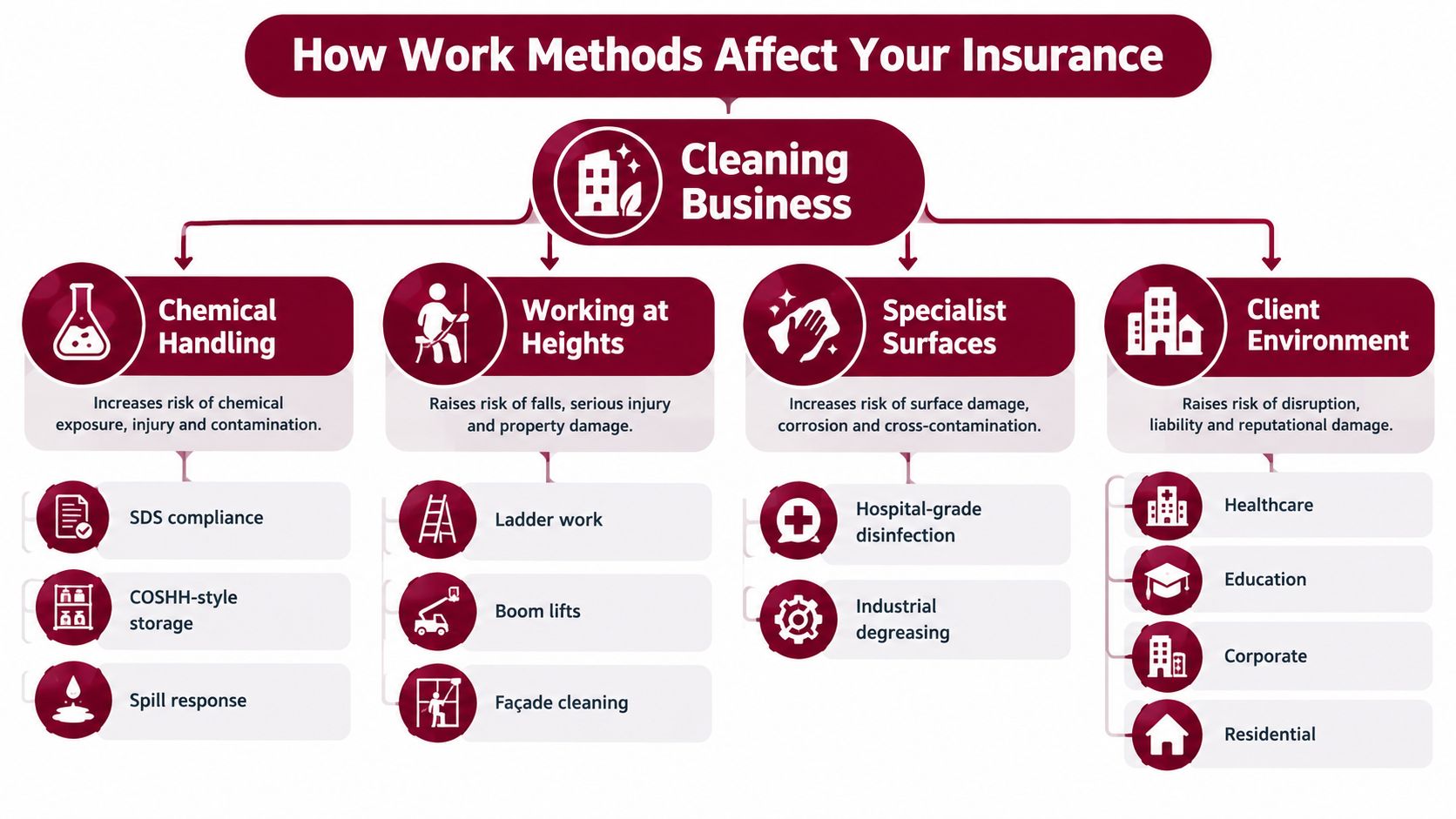
Chemical work changes the policy conversation fast. SafeWork NSW says cleaners may encounter both the products they use and hazardous chemicals already present at client sites, and exposure can happen through skin absorption, inhalation, or ingestion. It also warns that volatile solvents in enclosed or poorly ventilated areas can cause loss of consciousness, cardiac arrhythmia, and death. SafeWork NSW's hazardous chemicals guidance makes clear why a current Safety Data Sheet register, dilution process, storage rules, ventilation controls, PPE records, and site-specific controls are underwriting basics, not admin fluff.
Work at heights, manual handling, and lone work
Ladder work and cleaning at height need to be disclosed plainly. So does repetitive lifting, carrying, and putting down objects, because that's where musculoskeletal claims come from and why insurers ask about training and safe-work procedures.
Lone and after-hours work deserve the same treatment. If a cleaner works alone, the insurer wants to know how you manage supervision, access, communication, and incident response. If you use high-value equipment, list it properly, because a vague schedule causes trouble when a claim is filed.
What the insurer wants to see
- Induction records, because they prove workers were shown the specific hazards.
- Safe-work procedures, because they show how you manage ladders, chemicals, and manual handling.
- Chemical registers and SDS files, because they prove you know what's being used on site.
- Equipment schedules, because the insurer needs to know what assets are covered.
- Client-site controls, because bad disclosure around special premises can create an exclusion fight.
SafeWork NSW also reported 6,976 workers injured, eight deaths and 284 permanent disabilities in its hazardous-chemical exposure strategy data, which is why chemical governance is not a back-office task. The insurer will care if the work includes solvent cleaning, mould remediation, pressure washing, or biohazard exposure, because standard wording often treats those jobs differently.
Employees, Contractors, and Subcontractors
A cleaning business can look simple on paper and still be a liability maze in practice. Direct employees pull one set of obligations, contractors another, and subcontractors another again. The mistake is assuming an ABN solves the classification problem. It doesn't.
Who is actually covered
Direct employees sit inside your workers compensation and your day-to-day duty-of-care obligations. Genuine independent contractors should carry their own public liability, tools cover, motor cover, and personal incapacity protection, because your policy may not respond to their losses the way they expect. Subcontractors need the same scrutiny, plus the contract has to say who carries what risk.
A principal can and should ask for certificates of currency and indemnities, but that doesn't mean your own wording automatically extends to the subcontractor's employee if something goes wrong. A subcontractor's worker can damage a client's plant, lose access to a site and fail to finish a contract, or get hurt while moving between jobs. Those are different risk chains.
If the work arrangement and the policy wording don't match, the cheapest contractor package becomes the most expensive mistake in the business.
The issue is even sharper where platform or gig-style work is involved, because classification can override the label in the contract. Read LeaveWizard's compliance guide if you need a plain-English reminder that worker status mistakes ripple into insurance and legal obligations fast.
Why this matters in a claims file
If you control the roster, the method, the site rules, and the equipment, a contract label won't save you from employment-style obligations. If you don't control the worker, you still need to check their own cover before you let them onto a client site.
Workers compensation insurance is only one part of the picture. The main risk is the gap between how the business operates and how the paperwork describes it.
What Commercial Clients Actually Require in Their Contracts
Commercial clients do not write cleaning contracts for convenience. They write them to shift risk down the chain, and the paperwork often matters as much as the work.
Clauses that change your cover
The first clause to check is the liability limit. A site may require a minimum public liability amount, and if your policy sits below it, you are not compliant even if the work is done well. Additional insured and co-insured wording comes next, because it extends the client's protection under your policy and can change how a claim is handled.
Waiver of subrogation clauses matter too. They can stop your insurer from recovering money from the client after a loss, which is a serious concession. Care, custody, and control wording is another common trap. It often removes damage cover for property you are actively working on.
The clauses that get cleaners into trouble
Some contracts demand asbestos wording, work-at-heights endorsements, or other trade-specific extensions. That is where growth pressure becomes an insurance problem. A cleaner that wins three medical-centre contracts can look busy and well sold, but if the policy schedule never picked up asbestos exposure or the new contract terms, the first claim is where the mistake shows. benjiads for cleaning firms fits here because new business should trigger a policy review before the first shift, not after the first loss.
That is why the certificate of currency is only a document, not proof of fit. It shows that cover exists, not that the cover matches the contract.
Simple contract review rule
If a clause changes who pays for damage, who gets defended, or which work is allowed, it changes the policy conversation too. Sign on that basis, or do not sign at all.
Red Flags When Comparing Cleaner Insurance Quotes
Cheap quotes fail in predictable ways. The warning signs are usually clearer than the premium difference.
The four checks that matter
First, the activity description has to be exact. If the quote says “general cleaning” but you do windows, pressure washing, commercial kitchens, or solvent work, the wording may be too narrow.
Second, check for hidden exclusions around care, custody, and control or pollution. Those are the exclusions that catch cleaners after a claim, because the loss often happens on a client's property, not in your own warehouse.
Third, the excess and sub-limits need to match the business. A policy can look broad until you read the small print and see that the actual response is heavily capped.
Fourth, ask whether the insurer handles cleaning-sector claims. A policy is only as useful as the claims team behind it.
Buyer question: if the worst job you do goes wrong, does the policy still respond, or does it collapse back to a narrow definition of “cleaning”?
Owner-operators should also think about personal incapacity cover, not just business liability. If you're a sole trader, you don't have an employee safety net to fall back on, so personal accident or income protection deserves proper attention.
The simplest test is this, would you happily hand the insurer your actual job sheet, or would you feel tempted to simplify it? If it's the second one, the quote is wrong.
Public liability broker guidance is only useful if the broker is willing to ask the awkward questions, not just chase the cheapest number.
Putting the Right Cover in Place
Start with the work. List the exact jobs, the sites, the chemicals, the equipment, the vehicle use, and whether staff, contractors, or subcontractors are involved. Then match those facts against the five incident types that most often hurt cleaners, injury, third-party damage, stolen gear, vehicle losses, and business interruption.
Next, hand over the documents, not just the price target. Give the broker your induction records, safe-work procedures, chemical register, equipment list, and client contract clauses so the policy can be shaped around reality. If you later add window cleaning or another higher-risk service, treat that as a policy update, not a side note.
FAQ
Do I need public liability if I only clean homes? Yes, if you work in other people's property, because damage and third-party injury are exactly where the claim risk sits.
Do subcontractors sit on my workers compensation? Not automatically. Their status, your level of control, and the state rules matter.
Is tools cover worth it for a small cleaning business? If you rely on portable equipment to earn income, yes. The loss of one machine can stop jobs.
Can I buy the cheapest policy and add more later? You can, but that's a bad habit. Add the right cover before you sign the contract, not after the loss.
ABS Insurance Brokers Pty Ltd helps Australian businesses place public liability, workers compensation, commercial motor, plant and equipment, and business insurance across trade and service sectors. If you want cover that matches the way your cleaning business works, visit ABS Insurance Brokers Pty Ltd and have the policy checked against your jobs, your contracts, and your team structure.