
Insurance for Contractors in Australia: A Practical Guide
Insurance for contractors usually involves several types of cover. Public liability, contract works, tools, plant and professional indemnity address different risks. This Australian guide explains how to match those policies to your trade, contracts and projects before work starts.
That's because insurance for contractors isn't one product. It's a stack of separate decisions based on your trade, your equipment, your people, the state where you work and the contracts you sign. Get the stack right before mobilisation, and insurance supports the business. Get it wrong, and a certificate that looked acceptable at tender can leave a serious gap when a claim arrives.
Table of Contents
- Why Contractor Insurance Is a Stack, Not a Single Policy
- The Core Covers Every Contractor Should Understand
- NSW Home Building Compensation Cover Explained
- How Contract Terms Set Your Minimum Limits
- What Really Moves Your Insurance Premium
- Matching Covers to Trades, Crews and Licensed Builders
- Common Misconceptions Worth Clear Up in Trade Cover
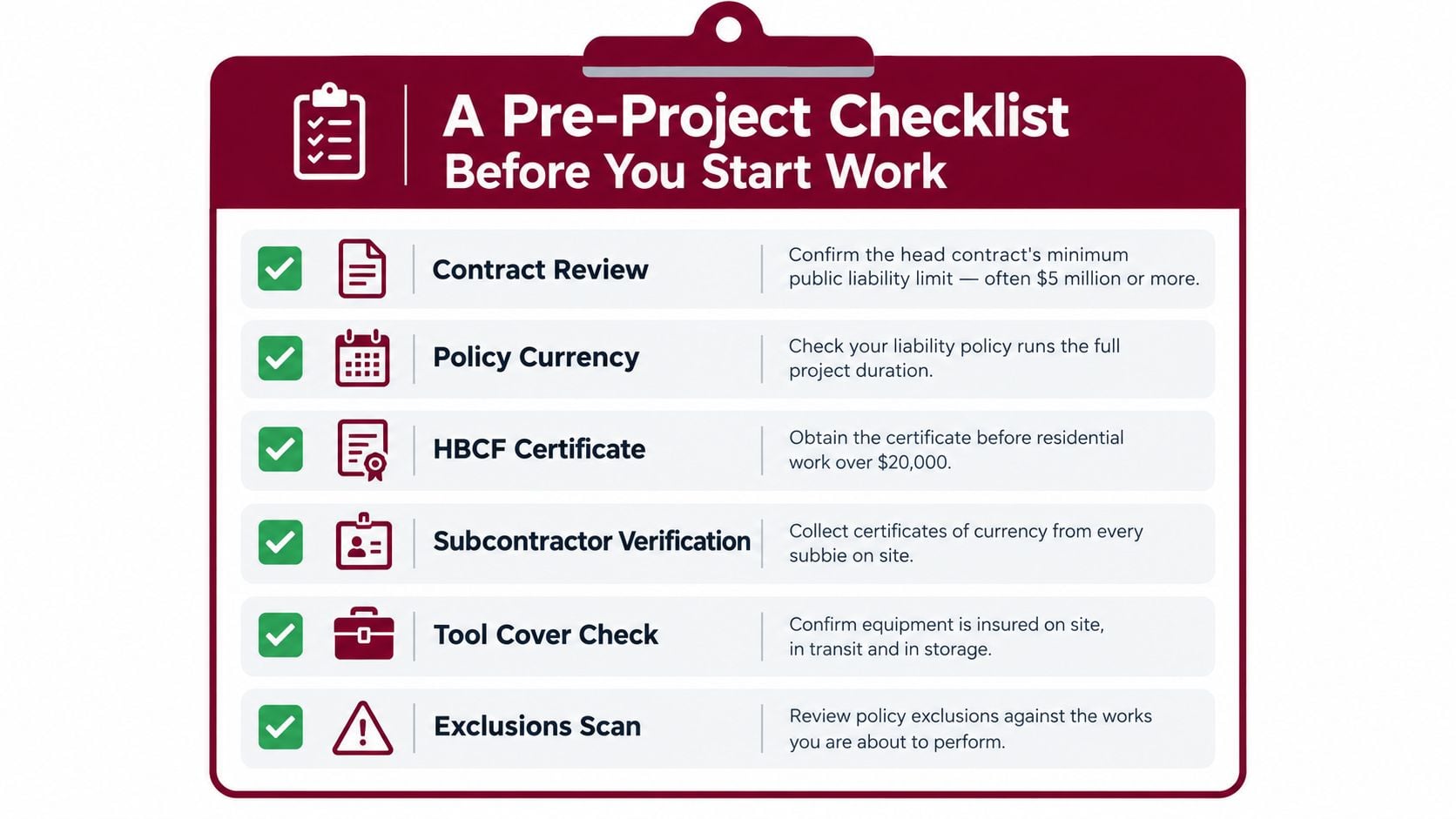
- A Pre-Project Checklist Before You Start Work
Why Contractor Insurance Is a Stack, Not a Single Policy
A concreter is part-way through a residential driveway and retaining wall project. A loose formwork panel clips a neighbour's car, the mini-excavator suffers a hydraulic failure and the principal contractor demands updated proof of cover before the next site meeting. Those are three different exposures.
Public liability may respond to injury or property damage suffered by someone else. Plant and machinery insurance may deal with the excavator, depending on ownership, hire terms and the cause of damage. Contract works insurance may address damage to the project itself while construction is underway. None of those automatically pays for every type of rework, defective workmanship or business interruption.
Each layer answers a different question
Ask these questions before you buy anything:
- Who has been injured or whose property has been damaged? That points towards public liability.
- What part of the project has been damaged? That points towards contract works, subject to the wording and exclusions.
- Which tools, vehicles or machines are affected? That points towards plant, machinery, motor or equipment cover.
- Who is carrying out the work? Employees, subcontractors and sole traders can create different statutory and contractual obligations.
- Did the contractor provide design, advice or certification? If so, professional indemnity may be relevant.
- Does a state scheme apply? In NSW, Home Building Compensation cover is a separate statutory layer for eligible residential building work, not a substitute for the general stack.
This is why a cheap policy with a broad trade description can be a poor result. A plumber doing maintenance work, a demolition contractor, a licensed builder and a carpenter working under a volume builder's head contract don't present the same risk. Their policies shouldn't be assembled from the same template.
Practical rule: Buy cover around the work you actually perform, then test it against the contract you're about to sign.
Your contract may specify limits, insured parties or endorsements. Check those terms alongside any state requirements. List the policies held by your own business and obtain written confirmation before relying on a principal’s insurance.
The Core Covers Every Contractor Should Understand
The five covers below form the starting point for many Australian contracting businesses. They aren't automatically suitable in every case, and they don't all respond to the same event.
Public liability
Public liability is the classic “someone else has been hurt or something else has been damaged” cover. A visitor trips over a temporary cable, a tradesperson damages a client's wall, or an item falls from a work area and damages nearby property. The policy responds to covered legal liability, subject to its wording, exclusions, excess and limit.
It generally doesn't insure your own tools, the contract works themselves or poor workmanship because the client is unhappy. In NSW construction, public liability is commonly treated as an operational necessity even where a specific statute doesn't universally mandate it. Some trade contract templates require at least AU$5 million in public liability cover, as noted in the government's contractor responsibilities guidance.
Contract works
Contract works cover is for the job while it's being built, installed or renovated. Think of it as protecting the physical work in progress, including relevant materials, against insured events such as fire, storm, theft or vandalism. Whether temporary works, existing structures, stored materials, defective work and delay costs are covered depends on the policy.
It can be arranged for one project or across a suitable annual programme. The contract value, construction method, site security and work period all matter. Don't assume that public liability will repair a partially completed building after a storm. Liability and material damage are different questions.
Plant and machinery
This cover is aimed at equipment used to earn revenue. It may include owned or hired excavators, loaders, scissor lifts, compressors, forklifts and other mobile plant, with motor insurance often applying separately to registered vehicles.
Check whether the policy covers theft from a locked site, accidental damage, breakdown, hired equipment and equipment in transit. A hire agreement may make you responsible for damage even when the machine belongs to someone else. That contractual responsibility needs to match the policy wording.
Professional indemnity
Professional indemnity belongs in the stack when you provide design, advice, specifications, certification, inspection or project management. A contractor who only performs work strictly to someone else's design has a different exposure from a design-and-construct business that selects systems and signs off technical decisions.
Professional indemnity commonly responds to claims alleging financial loss caused by professional error, subject to the policy terms. It isn't a replacement for public liability, and it usually won't turn defective workmanship into an insured event.
Workers compensation
Workers compensation is a state-based statutory protection for eligible workers injured or made ill through work. It addresses matters such as compensation, rehabilitation and return to work under the applicable scheme. A business with employees needs to establish its obligations rather than assuming that a subcontractor label removes every responsibility.
Sole traders should also consider the income consequence of their own injury. Workers compensation generally isn't a personal income policy for an owner who isn't an eligible worker under the relevant arrangement.
| Cover | What It Responds To | Who Typically Needs It |
|---|---|---|
| Public liability | Covered legal liability for third-party injury or property damage | Trades, subcontractors, builders and businesses working around clients or the public |
| Contract works | Insured physical damage to work in progress and related project property | Builders and contractors responsible for construction, installation or renovation works |
| Plant and machinery | Loss or damage to owned, hired or mobile work equipment, subject to wording | Earthmoving, civil, construction, access and equipment-intensive trades |
| Professional indemnity | Alleged professional error, advice, design or technical service causing financial loss | Design-and-construct contractors, consultants and project managers |
| Workers compensation | Statutory benefits for eligible work-related injury or illness | Employers and contractors with obligations under the applicable state scheme |
Before accepting a certificate request, compare your policy schedule and endorsements with the actual work. A practical public liability insurance guide for tradies can help sole traders identify the questions they need to put to a broker.
NSW Home Building Compensation Cover Explained
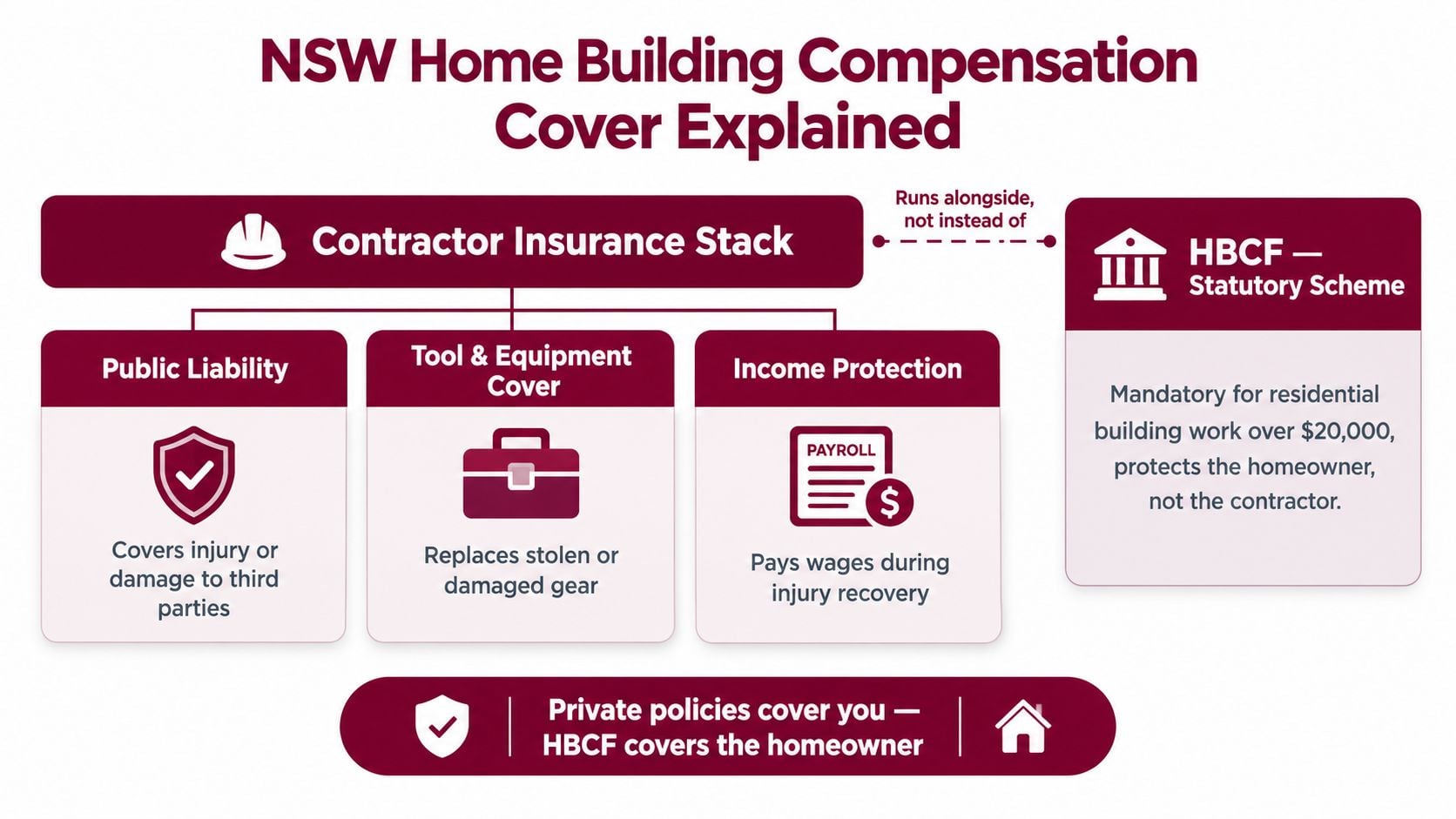
NSW Home Building Compensation Fund cover, commonly called HBCF, is a statutory scheme. It sits beside private contractor insurance and protects the homeowner in defined circumstances. It doesn't replace public liability, contract works, plant cover, professional indemnity or workers compensation.
For eligible residential building work in NSW, cover is mandatory when the work is over AU$20,000, where a licensed principal contractor performs the work. The requirement applies before work starts or money is taken under the contract, according to NSW Fair Trading insurance requirements.
What HBCF actually responds to
HBCF is a last-resort safety net. It can respond when a builder can't complete the job or meet statutory warranty obligations because of events such as insolvency, death, disappearance or licence suspension. It isn't ordinary construction insurance, and it isn't designed to pay for every delay, defect dispute or accidental loss during construction.
HBC cover has claim limits and eligibility conditions. Confirm the rules for the policy issued for your project and keep contracts, variations and payment records. HBC is separate from insurance for damage to the works and from public liability.
HBCF won't repair your stolen tools. It won't answer a neighbour's property damage claim. It won't replace contract works cover, and it doesn't apply as a general solution to commercial construction. Treat the certificate as evidence of a statutory requirement being met, not as proof that the whole project is insured.
NSW's scheme also has project-level records. The public register includes information such as the certificate number, contractor licence number, principal contractor and property address under the relevant legislative framework. That makes document retention and a clean contract trail practical necessities, not office administration that can be ignored.
How Contract Terms Set Your Minimum Limits
Your policy may be adequate for your own view of the risk and still fail the tender. The head contract sets the commercial floor. It can require a particular liability limit, a project-specific contract works policy, named insured wording, a waiver or evidence that subcontractors carry their own cover.
Read the Schedule of Insurances before signing, not after the first certificate request. Look for four things:
- The limit. Check the amount required for public liability, professional indemnity, motor, contract works or any other listed cover.
- The insured parties. Determine whether the principal, head contractor or financier must be noted as an interested party or additional insured.
- The period. Confirm the policy runs for the work period and identify any completed operations or maintenance obligations.
- The evidence. Check whether the contract requires a certificate, policy endorsement, annual declaration or project-specific wording.
A principal may require AU$5 million in public liability for engagement under a trade contract, according to the government contractor guidance. That figure is a contract requirement in the relevant arrangement, not a universal answer for every business or every exposure.
| Cover Type | Common Commercial Limit | Government or Tier 1 Project | Notes |
|---|---|---|---|
| Public liability | Contract-specific, often a substantial minimum | May require a higher limit or stricter wording | Match the certificate and endorsements to the head contract |
| Contract works | Usually tied to the declared contract value | May require project-specific evidence and defined insured parties | Include the scope and relevant materials, not just labour |
| Professional indemnity | Set by the design or advisory exposure | Often governed by the technical scope and procurement documents | Check the required period and retroactive provisions |
| Workers compensation | Governed by the applicable statutory scheme | Proof and subcontractor verification may be required | Confirm who is treated as an employee or contractor |
| Plant and machinery | Based on asset values and hire obligations | Site and hire conditions may impose additional requirements | Schedule owned and hired equipment correctly |
A builder comparing annual and single-project options should also read this explanation of contract works insurance for Australian builders. The right arrangement depends on how often you work, how values move during the year and what each contract demands.
Don't increase limits blindly. Ask what loss the limit is intended to answer, whether the contract requires shared or separate limits and whether the policy wording supports the indemnity you've promised.
What Really Moves Your Insurance Premium
Underwriters price the business they can see, not the label on the ute. “Builder” or “contractor” is only the starting point. The work mix, site conditions, equipment, people and claims record usually matter more than the branding.
Trade classification comes first
A roofer, scaffolder or demolition contractor presents a different liability profile from a tiler or plasterer. Height, structural alteration, excavation, hot work, traffic exposure and interaction with occupied premises can all change the assessment. Describe the actual work accurately, including the work you occasionally accept, because a narrow description that omits a material activity can create a coverage dispute.
Turnover and payroll help the insurer understand the scale of the operation. They also need to be separated properly where the business performs different types of work or uses different classes of labour. A business that grows quickly without updating its policy can end up with inaccurate declarations and an unsuitable premium.
Claims, plant and subcontractors
Claims history affects how an underwriter views controls, workmanship and future frequency. Give the insurer a clear account of what happened, what changed and whether the matter involved an isolated event or a recurring process problem. Hiding an incident until renewal rarely improves the outcome.
Plant values affect equipment pricing directly. An excavator, elevated work platform or mobile crane needs accurate ownership, replacement value, location and use information. Hired equipment requires a separate check of the hire agreement, because the contract may impose responsibilities that a standard owned-plant section doesn't meet.
Subcontracted work creates another review point. Ask whether subcontractors carry their own liability and statutory cover, whether you collect current certificates and whether your agreement transfers obligations consistently. Uninsured or poorly documented subcontractors can leave the principal contractor dealing with both the site issue and the evidence problem.
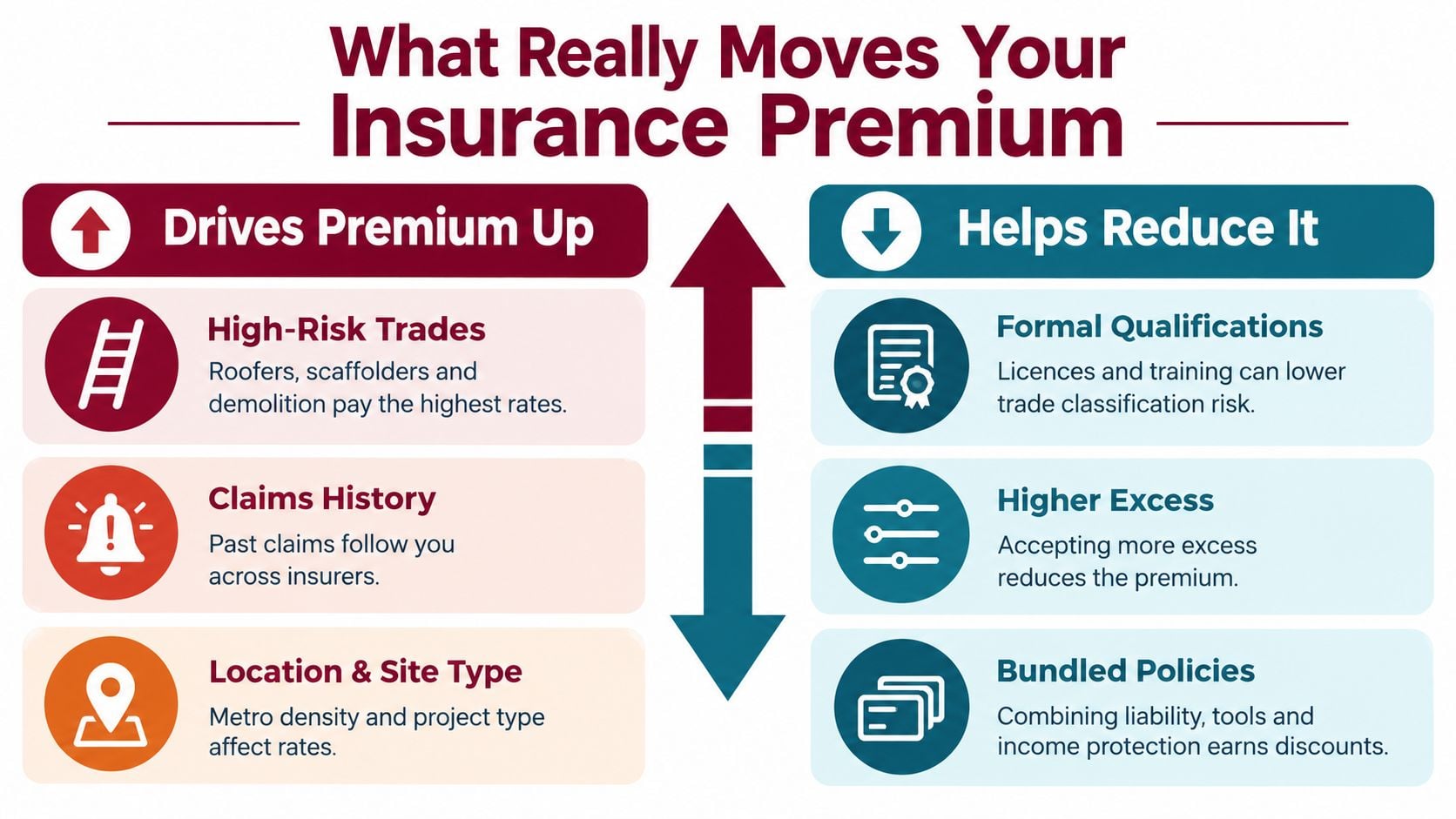
Packaging several covers with one insurer may simplify renewals and sometimes produce a package discount. Separate insurers can be useful when a specialist market offers stronger wording or a better fit for a particular risk. Don't choose packaging on price alone. Check that the limits, exclusions, insured contracts and policy periods still line up across the stack.
For a practical discussion of business insurance costs, focus on the information insurers use to price the risk rather than relying on a generic trade estimate. A better submission usually produces a better comparison.
Matching Covers to Trades, Crews and Licensed Builders
A sole plumber doing domestic maintenance doesn't need the same arrangement as a carpentry crew working under a volume builder. A licensed builder managing residential projects has another layer again, especially in NSW.
| Cover | Sole Trader | Subcontracting Crew | Licensed Builder |
|---|---|---|---|
| Public liability | Usually a core operational cover | Core cover, with limits set by head contracts | Core cover, matched to project and contract exposure |
| Contract works | Relevant when responsible for materials or work in progress | Relevant where the crew carries project responsibility | Core project cover for applicable construction work |
| Tools and equipment | Important for portable tools, vans and equipment | Important for shared and individually owned gear | Important for site equipment, plant and stored materials |
| Professional indemnity | Consider where advice, design or certification is provided | Consider where the crew designs or specifies systems | Often relevant when the builder provides design or project management |
| Workers compensation | Depends on the owner's status and applicable obligations | Required where the crew has eligible workers under the relevant scheme | Required where the business has employees and applicable obligations |
| HBCF in NSW | Depends on the licence and role in the contract | Usually not a substitute for the licensed principal's statutory obligation | Relevant to eligible residential building work over AU$20,000 |
| Personal accident or income protection | Strongly consider for the owner's own earning capacity | Consider for working owners and key operators | Consider for directors and owners outside statutory worker protection |
Sole traders
A sole trader should start with the exposure created by the work, not the size of the business. Public liability, tools and equipment cover are common starting points. Contract works becomes important where the sole trader is responsible for materials or an installation before handover.
Professional indemnity is not automatically necessary for every manual trade. It becomes more relevant when the business gives technical advice, selects a design, prepares specifications or accepts responsibility for professional decisions.
Small crews
A crew adds payroll, supervision and subcontractor administration. Check workers compensation obligations, collect certificates from subcontractors and make sure the public liability limit satisfies the head contract. A working owner may also need personal accident or income protection because a crew can keep billing only if the business can replace that person's labour.
Keep equipment ownership clear. A shared trailer, hired access platform and personally owned tools should not be treated as one undifferentiated asset list.
Licensed builders
A licensed builder running projects carries the broadest coordination burden. Contract works, liability, plant, professional indemnity where design input exists and statutory obligations all need to be checked against each project.
In NSW, HBC cover applies to eligible residential building work over the relevant threshold. Keep the certificate, contracts, variations and payment records together. Review the insurance requirements before accepting a deposit or starting the relevant work.
Common Misconceptions Worth Clear Up in Trade Cover
Bad assumptions survive because certificates look official and site arrangements feel informal. The policy wording matters more than what a supervisor said at the pre-start meeting.
“HBCF covers my job”
It doesn't. HBCF is a statutory last-resort scheme for the homeowner in defined circumstances connected with builder non-performance. It doesn't insure your tools, your hired plant, your public liability or ordinary construction damage.
The NSW scheme recorded 20,133 eligible businesses at the end of 2020–21, and issued 88,270 insured project records in that period, according to NSW's HBCF dataset. Those figures show the scale of the regulated scheme. They don't turn it into a replacement for private contractor policies.
“The principal contractor's policy covers me”
Ask to see the wording. A principal may insure its own liability and require you to indemnify it, while still expecting you to carry your own public liability. The principal's policy may not cover your negligent act, your tools, your employees or your contractual obligations.
Your subcontract should state who carries what. Collect the certificate, but also check whether the policy includes the relevant trade and whether the limits and endorsements meet the agreement.
“I'm a small operator, so contract works isn't necessary”
The value of the business doesn't decide the exposure. Materials can be stolen, installed work can be damaged by a storm and an incomplete installation can be affected before the next visit. If you're responsible for the work in progress, ask who pays for reinstatement and whether the policy responds.
“Public liability covers my tools”
Public liability is aimed at liability to other people, not your own equipment. A stolen toolbox, damaged compressor or lost diagnostic instrument needs the right tools, equipment or plant wording. Domestic contents cover is also not a safe assumption for business gear.
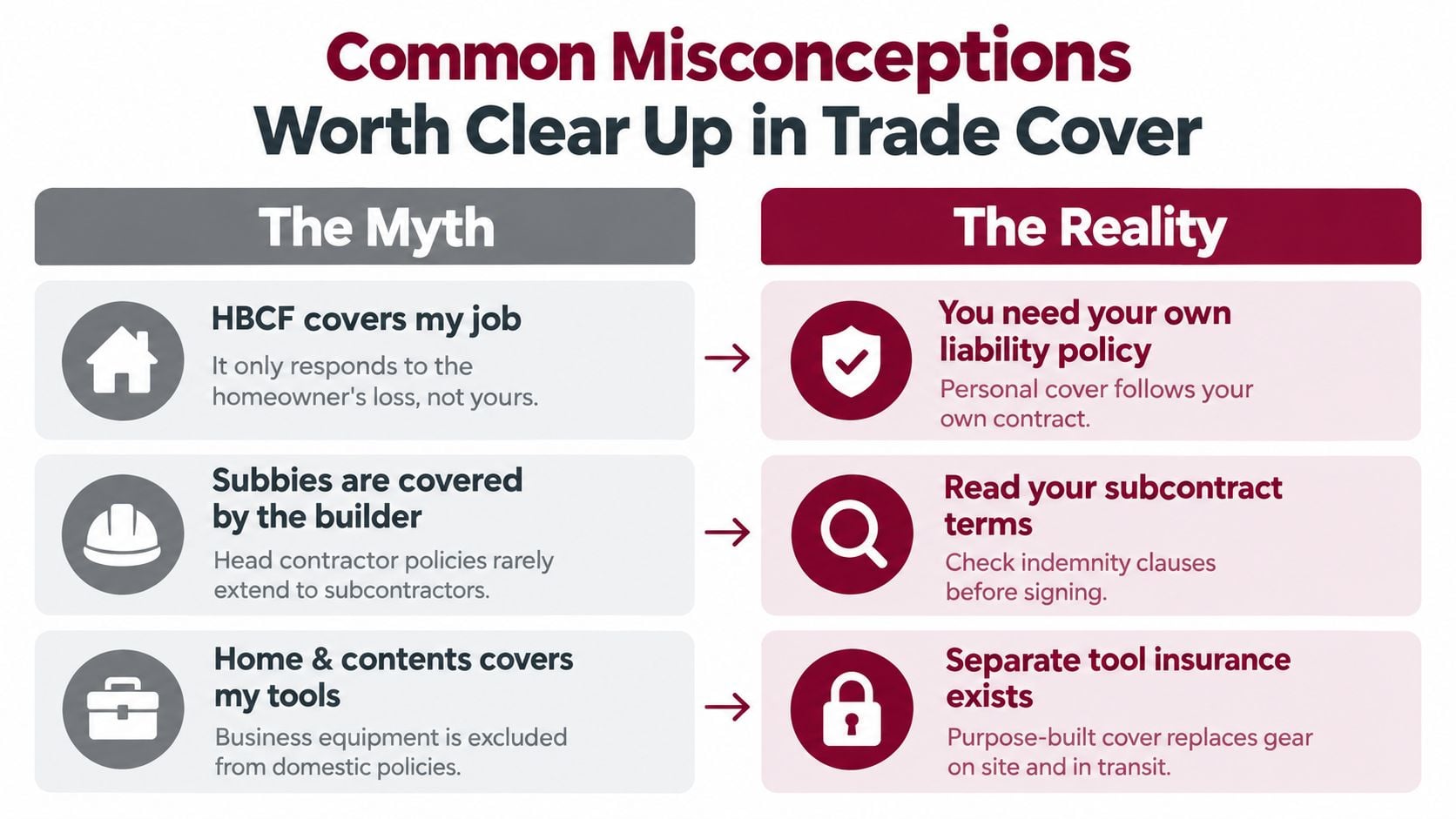
Read the policy schedule, endorsements and exclusions together. The certificate proves that a policy exists. It doesn't expand what the policy covers.
A Pre-Project Checklist Before You Start Work
Run this checklist before you order materials or send the first crew to site. It catches gaps while they're still fixable.
- Read the head contract: Identify the required liability limits, insured parties, indemnities, insurance period and certificate wording.
- Check the state obligation: Confirm whether the work triggers NSW HBCF or another statutory requirement. For eligible NSW residential building work, the threshold is over AU$20,000, as set out in the NSW insurance requirements guidance.
- Match contract works to the project: Check the declared value, materials, existing structures, storage arrangements, temporary works and construction period.
- Schedule equipment properly: List owned and hired plant, confirm replacement values and check whether registered vehicles need commercial motor cover rather than plant cover.
- Verify people and subcontractors: Confirm workers compensation arrangements where applicable and collect current certificates from subcontractors before they start.
- Review your own earning risk: If you're a sole trader or working director, consider how the business pays expenses if you can't work.
- Check exclusions against the scope: Look for height, excavation, hot work, design, waterproofing, demolition, underground services and other activities relevant to your trade.
- Keep the evidence: Store contracts, variations, invoices, certificates, equipment records, photographs and defect rectification notes in one organised file.
The best time to involve a broker is before you sign the indemnity clause, not after a loss exposes a mismatch. Phone your broker before you sign, not after the loss.
ABS Insurance Brokers Pty Ltd helps builders and trades arrange public liability, contract works, plant and machinery, professional indemnity and NSW Home Building Compensation Fund cover around the actual work and contract terms. Visit ABS Insurance Brokers Pty Ltd to discuss your upcoming project, policy gaps and certificate requirements before mobilisation.