

Choosing the right repair builder after a claim is usually harder than it looks. The urgency is real, the damage is visible, and the decision often sits between an insurer's preferred network, a private referral, or a builder you already know. If the job is a make-safe, a weather loss, a structural reinstatement, or a multi-site program, the best fit changes fast, so use the directory below to match the contractor to the claim rather than the other way around. For a quick sense of what “bonded” and insured mean in contractor terms, see what bonded vs insured means.
The comparison lens is simple. Look at coverage, capability, response model, trade coordination, and the limits the contractor states publicly. Panel access matters because many insurance-repair builders are engaged through insurer referral pathways, while private engagement usually needs clearer scope approval, access rules, and variation control. In practice, the strongest choice is the builder that can move the claim forward without creating disputes over scope, documentation, or timing.
Table of Contents
- 1. Johns Lyng Group (Insurance Building Services)
- 2. Construct Services
- 3. Townsend Building Services (TBS)
- 4. Rizon
- 5. RCC National
- 6. Ambrose Construct Group
- 7. InsureBuild
- 8. Campbell Construction Co
- 9. CBS Complete Building Solutions
- 10. IBEX Construction
- Top 10 Insurance Repair Builders Comparison
- Turn the Shortlist Into a Managed Repair
1. Johns Lyng Group (Insurance Building Services)
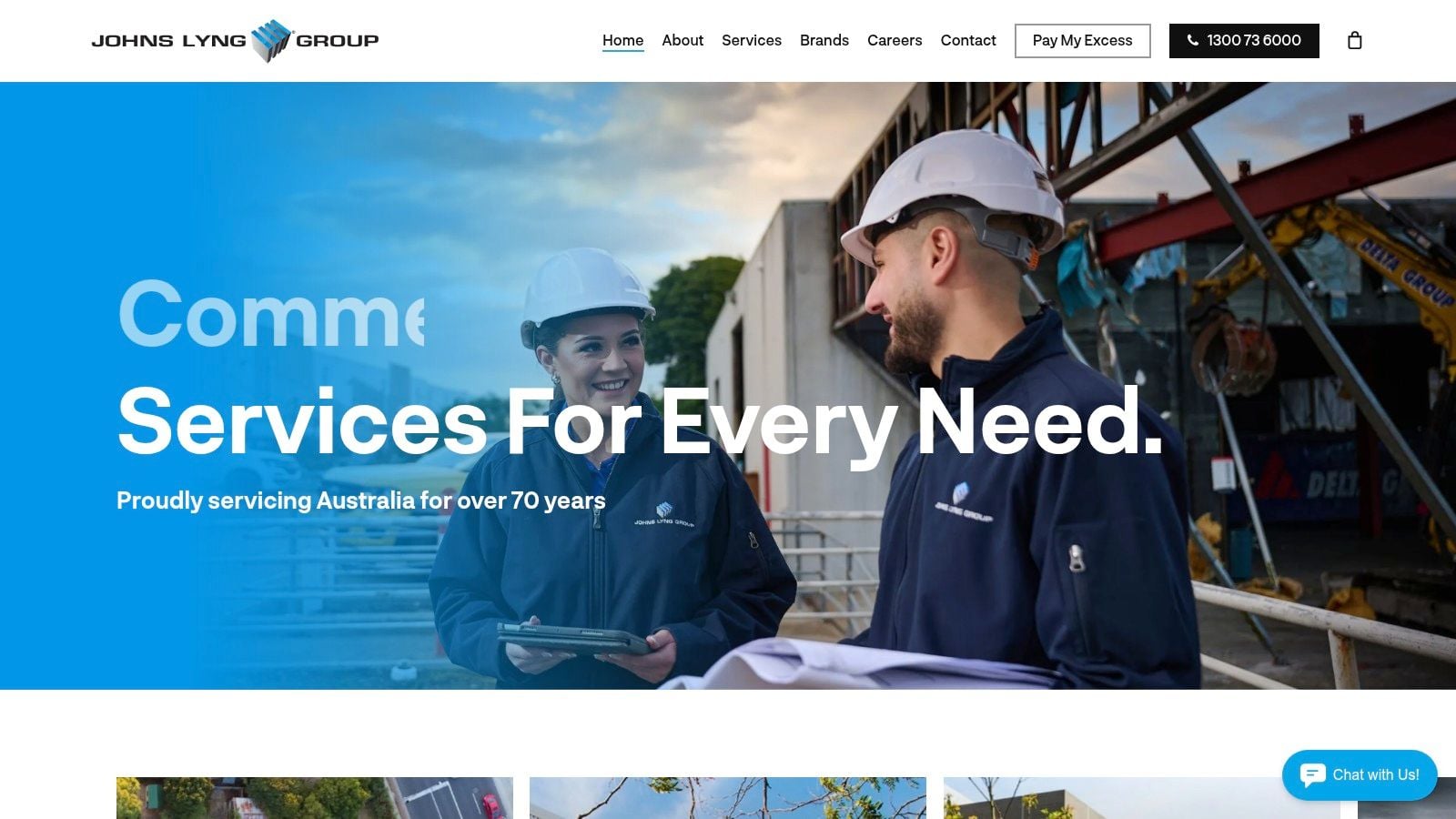
Johns Lyng Group sits in the category of large-scale insurance building and disaster recovery operators, so it makes sense when the claim needs breadth rather than a single trade fix. Its insurance building services positioning covers make-safe work, assessment, repair, rebuild, and catastrophe response, which is exactly what you want when a claim starts as an emergency and ends as a managed reinstatement. Visit the company's official website if you need to confirm current service lines and service areas.
Best fit for complex, high-volume claims
The practical advantage is coordination. A group of this size can handle assessment, scoping, trade management, and QA under one umbrella, which helps when the insurer wants a clean line of sight from damage report to completion. The same setup also suits strata, large-loss, and remote-region work, where the repair path often needs more than one crew and more than one site visit.
Practical rule: If the claim involves multiple trades, stakeholder sign-off, or a repair path that can change after inspection, a builder with integrated claims handling is usually easier to manage than a single-trade contractor.
The trade-off is familiar to anyone who has dealt with a national catastrophe program. Large workflow systems can get crowded during peak demand, so scheduling pressure can rise quickly. That is why this type of builder is usually engaged through insurer referral rather than direct retail contact. For builders comparing how warranty cover interacts with larger repair work, the overview at builders warranty insurance is a useful companion read.
2. Construct Services
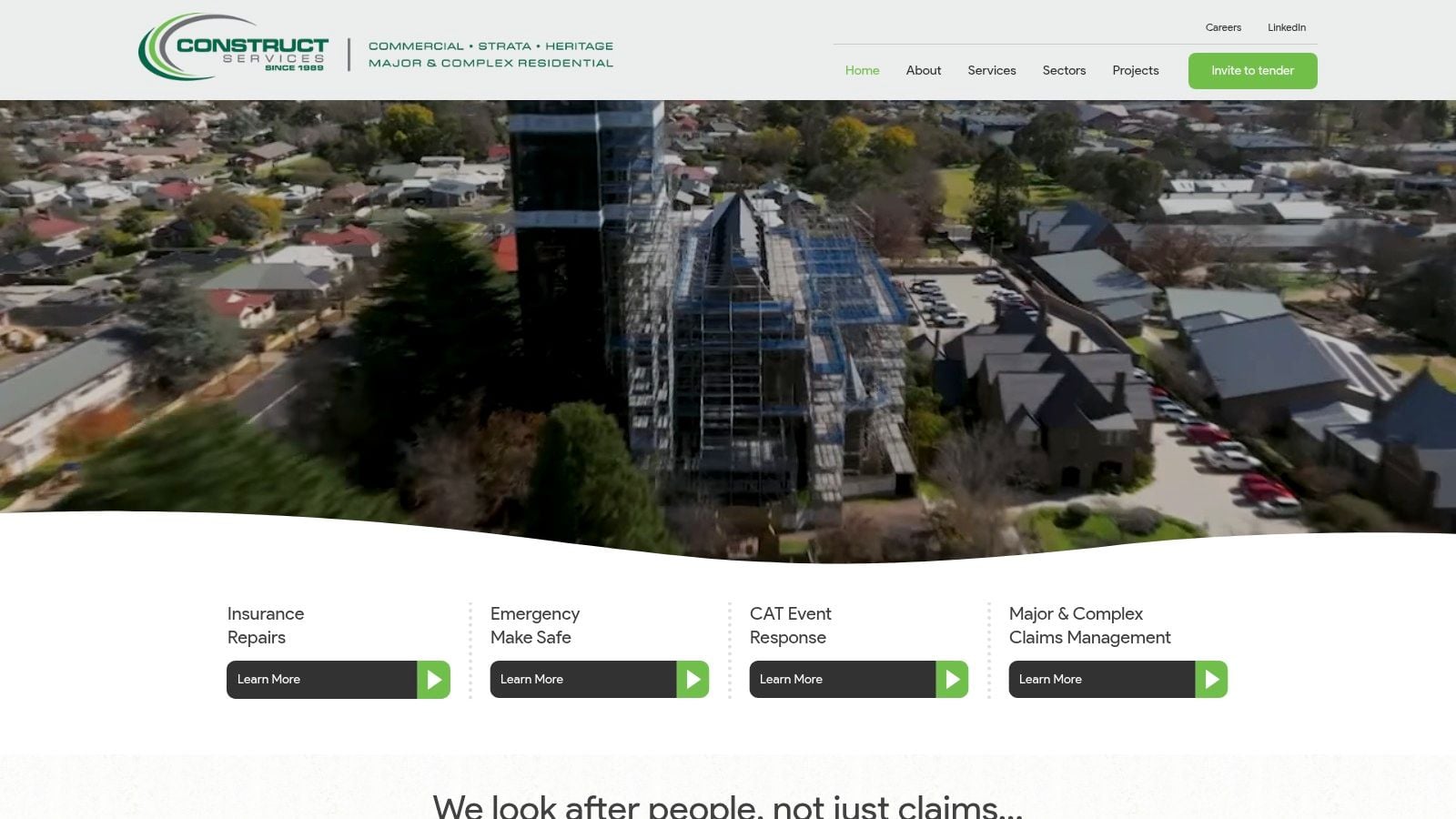
Construct Services is a strong option when the claim needs a national operating model with insurance-repair discipline baked in. Its public positioning around state licences, dedicated claims workflows, and customer care makes it relevant for building reinstatement where the insurer wants consistency across jurisdictions. The best place to verify present coverage and contact pathways is the Construct Services website.
Good for major and complex reinstatement
The key value here is the fit between process and loss type. Complex claims often need more than building labour, they need scope discipline, clear documentation, and a contractor that understands how insurer timelines work. Construct Services also signals experience in heritage, strata, and commercial claims, which matters because those jobs tend to fail when the contractor treats them like ordinary domestic repairs.
A builder like this is often most useful when the claim is already accepted in principle but still needs careful delivery. That usually means more paperwork, more approvals, and more coordination with assessors and repair teams. For builders handling their own exposures alongside repair work, the article on contract works insurance explained is a practical reference point.
Engagement check before you proceed
- Confirm nomination rules: Ask whether the insurer requires panel placement or allows a direct appointment.
- Check the repair class: Make sure the contractor is set up for heritage, strata, or commercial scope if that is what the loss needs.
- Ask about state coverage: National claims still depend on local licence status and local trades.
Construct Services suits claims where the paperwork matters almost as much as the rebuild itself.
3. Townsend Building Services (TBS)
Townsend Building Services, or TBS, sits toward the technical end of the insurance-repair market. Its focus on major and complex claims, design-and-construct delivery, and work across residential, commercial, and strata settings suits jobs that need controlled scope rather than routine reinstatement. If you need to check current delivery scope, the TBS website is the right starting point.
For bigger reinstatement jobs that need design thinking
TBS is a practical fit for repairs that involve structural work, high-value scope, or coordination across several parties. A design-and-construct approach can help keep diagnosis, remediation, and rebuild aligned, which reduces the risk of handover delays and scope drift. That matters most when the claim is accepted in principle, but the repair path still needs disciplined delivery.
The value is in technical depth. Claims of this kind often depend on clear documentation, insurer sign-off, and a builder that can keep the job explainable from the first inspection through to completion. Townsend also publishes customer guidance for claims, which is useful where scope issues are often identified late. For builders weighing contract size against liability exposure, the guide on public liability insurance for builders is a useful reference.
The best fit is a claim where the scope is clear enough to start, but detailed enough that shortcuts will create more cost later.
TBS suits repairs that need careful scope control and consistent communication with insurers, rather than a quick attendance model. That makes it a sensible option for higher-value reinstatement work where the repair path needs methodical control from start to finish.
4. Rizon
A water leak at 9 p.m. or a storm-damaged roof before the weekend changes the claim brief fast. Rizon is positioned for that kind of urgent response, with 24/7 emergency deployment and catastrophe-focused work that suits after-hours losses, storm exposure, and immediate residential make-safe needs. If you need current service reach or response pathways, start with the Rizon website.
Strong on speed and customer communication
Speed only helps if the repair stays organised. Rizon's customer-journey focus is relevant where the insurer, homeowner, and contractor all need clear ownership of access, follow-up, and reporting. That matters most in the early phase, when a temporary fix has to be documented before the full repair scope is approved.
Rizon also fits claims that need a clear handoff from containment to reinstatement. Public detail is thinner on engineering-heavy or highly specialised work, so the strongest case for using it is urgent attendance, claim support, and disciplined progression through the next repair step. For claims with structural complexity or design-led rebuild requirements, the public information gives less confidence than for straightforward emergency response.
Engagement guidance
- Use for urgent losses: Call this builder when make-safe timing is the main issue.
- Check scope authority early: Confirm whether work can begin only after insurer instruction or from a direct scope.
- Track handover points: Make sure one party owns the shift from emergency response to permanent repair.
Rizon is best suited to claims where emergency containment is the priority, with fast after-hours attendance before full scope approval begins. In that setting, clear coordination matters more than broad service claims.
5. RCC National
RCC National is a better fit when the repair needs to travel beyond one metro market. Its coverage across NSW, ACT, VIC, QLD, and SA makes it relevant for insurers and owners dealing with regional spread, especially where the claim still needs the same process discipline across different sites. If you want to check the latest coverage and service model, use the RCC National website.
Regional reach matters when the loss isn't close to a major city
Insurance-repair builders often look similar on paper until the site is two hours from the nearest depot. RCC National's coordinated contractor network helps it service jobs across several states, which matters when a claim involves a location that is not convenient for a city-based builder. That broader reach can also help when the insurer wants consistency across a portfolio of repairs rather than a one-off one.
The public profile is less detailed than some of the larger national groups, so the engagement test is simple. Ask who will be on the ground, how trades are coordinated, and how progress is reported back to the insurer. If the answer is clear, the arrangement is often workable. If the answer is vague, the claim can drift.
This type of builder is strongest when the brief is ordinary in structure but spread across geography. It's a good reminder that regional capacity is part of the claim, not an afterthought.
6. Ambrose Construct Group
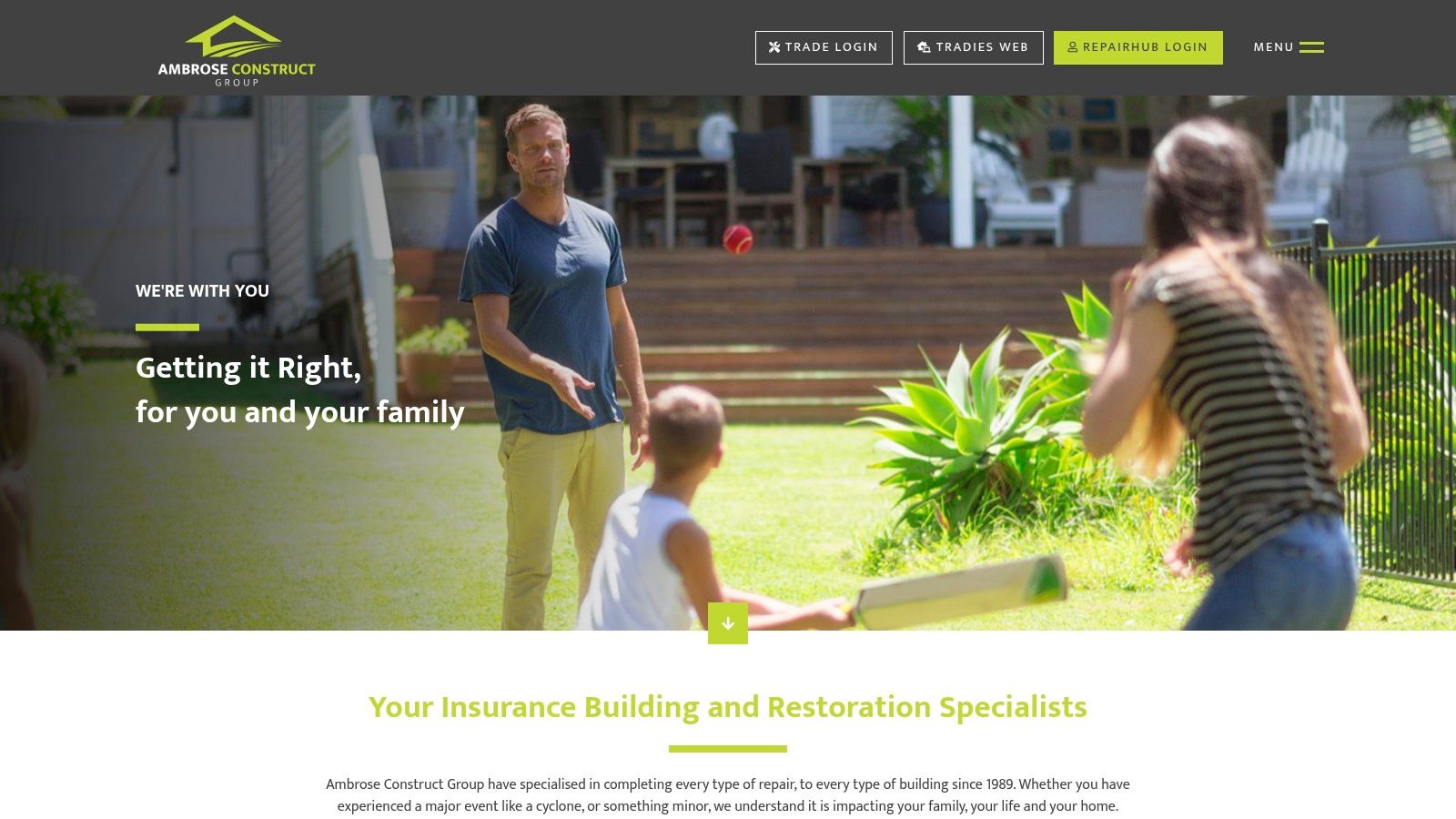
Ambrose Construct Group is built for claims that need repair and restoration under one roof. Its insurance building and restoration positioning is useful where water, fire, or impact damage has created both structural and remediation tasks, because the builder can keep the job moving without splitting responsibility too early. Confirm current service details on the Ambrose Construct Group website.
Useful where restoration and rebuilding overlap
That combined capability matters more than people expect. If a loss requires stripping, remediation, trade sequencing, and then reinstatement, an integrated contractor can reduce handover gaps and help the insurer see the job as a single managed process. A scalable workforce also helps when the event is larger than a normal local repair cycle.
The public technical detail is lighter on highly specialised engineering work, so this is not the strongest pick for the most complex structural claims. It is, however, a sensible option for insurer-funded repairs where the main risk is delay between restoration and rebuild phases. In practical terms, that often means faster movement and fewer missed handoffs.
Useful checkpoint: Ask whether the same team is handling the restoration phase and the rebuilding phase, or whether the job will be split between separate subcontractors.
Ambrose fits claims where the issue is not just damage, it's the sequence of recovery. That sequence is where a lot of insurance repairs lose time.
7. InsureBuild
InsureBuild's national strength, local service model fits volume claims and repeatable repair programs. Its end-to-end claim repairs, make-safe work, and program delivery are most useful when the insurer needs a consistent workflow across many files, rather than a one-off specialist build. Check the current service model on the InsureBuild website.
Better for consistency than for highly bespoke complexity
Process control is the main reason to shortlist InsureBuild. Standardised updates and QA checks help keep each file in the same reporting cadence, which matters when a portfolio includes, for example, 50+ water-damage claims across one suburb and the insurer wants clear progress tracking without chasing separate builders for different formats.
The public technical detail is lighter than some larger groups. If the loss is engineering-heavy, highly unusual, or tied to specialist structural issues, a contractor with more visible design or remediation depth may be a better fit. For ordinary domestic claims, the combination of local service and national structure is often enough.
InsureBuild suits portfolio work, insurer panels, and claims that need to move through a defined workflow. It is a practical choice where the priority is reliable delivery at scale and a single update process across many jobs.
8. Campbell Construction Co
Campbell Construction Co is a good match for owners who care about communication as much as completion. Its insurance repair offering runs from make-safe to full rebuild, and its public emphasis on client care makes it relevant when the claim has already been stressful enough. Visit the Campbell Construction Co website to check current service details.
Flexible enough for smaller and larger domestic claims
This is the kind of builder that works well when the loss is not a catastrophe program but still needs a proper insurance-repair pathway. Its national service positioning suggests it can move across regions, while the make-safe through rebuild workflow gives it flexibility on job size. That flexibility matters when the insurer hasn't yet decided whether the repair will be partial or full reinstatement.
The public footprint on large complex claims is thinner than some of the bigger groups, so it may not be the first call for high-volume catastrophe work. It is, however, a sensible choice when the homeowner wants a contractor that is more visibly engaged in the day-to-day repair conversation.
Practical rule: If the claim is sensitive, small-to-medium in scale, and communication has already become a problem, choose the builder that publishes a clear service path and keeps contact simple.
Campbell Construction Co is best viewed as a dependable domestic-repair option rather than a headline CAT operator.
9. CBS Complete Building Solutions
CBS Complete Building Solutions is a strong NSW and east-coast option when the claim needs rapid first contact and multi-trade capability. Its Sydney base and coverage across NSW, ACT, QLD, and VIC make it useful for owners who want a builder that understands metropolitan and regional work. Start with the CBS website to confirm current licence scope and engagement options.
A good fit for NSW claims that need quick attendance
The stated 24-hour first-contact commitment is relevant because early communication often sets the tone for the whole claim. In insurance repairs, a fast first call can stop small delays turning into access issues, missed appointments, or scope confusion. CBS also publishes licence numbers and trade scope, which gives the insurer and the owner a cleaner starting point for verification.
Its footprint is smaller than the very largest groups, so it is not the obvious answer for the biggest catastrophe portfolios. It is more attractive where the claim is Sydney-based or east-coast based and quick attendance matters. The ability to offer private quotes as well as insurer-referred work also gives it some flexibility in how the engagement starts.
For claims that are already moving but need clearer ownership, this kind of builder can be a practical middle ground between national scale and local response.
10. IBEX Construction
IBEX Construction is a NSW-focused option for insurance repairs and make-safe work where local oversight matters more than national spread. Its public positioning around construction and asset maintenance, plus a defined insurance repairs service line, makes it relevant for residential and low-rise claims inside NSW. Check the IBEX Construction website for current service scope and contact details.
Best when the claim stays inside NSW and needs structure
IBEX suits claims that need a builder with local conditions in mind and tighter process control. Its leadership by a qualified builder and civil engineer is relevant for structural issues, where scope, sequencing, and repair detail need careful handling. For owners and insurers, that can reduce avoidable surprises once work begins.
IBEX is the stronger choice for NSW residential claims where local knowledge and structural oversight matter more than interstate reach. Its public footprint also points to a narrower catastrophe role than the national groups, so it is a practical fit for localised repairs rather than large multi-state programs.
For claims that are local, technical, and NSW-based, IBEX belongs on the shortlist.
Top 10 Insurance Repair Builders Comparison
| Provider | Core strengths (✨) | Quality & responsiveness (★) | Best for (👥) | Engagement & value (💰🏆) |
|---|---|---|---|---|
| Johns Lyng Group | ✨ National 24/7 make‑safe; end‑to‑end assessment → QA; CAT & large‑loss experience | ★★★★★; mature claims comms | 👥 Insurers, large commercial, strata, CAT events | 💰 Typically insurer‑referred; 🏆 market‑leading CAT capacity |
| Construct Services | ✨ Single national model; documented state licences; complex reinstatements | ★★★★☆; strong claims workflows | 👥 Insurer panels; complex & heritage claims | 💰 Panel access common; reliable for insurer‑managed programs |
| Townsend Building Services (TBS) | ✨ Design‑and‑construct capability; >$1m reinstatements; strata/commercial | ★★★★☆; high technical depth | 👥 High‑value reinstatement, developers, strata | 💰 Panel priority; private quoting on request; 🏆 technical expertise |
| Rizon | ✨ 24/7 after‑hours make‑safe; CAT surge; customer journey focus | ★★★★☆; very responsive for emergencies | 👥 Urgent make‑safe, insurer program work | 💰 Insurer referral common; strong emergency value |
| RCC National | ✨ Multi‑state coverage; coordinated contractor network; regional reach | ★★★★; steady claim/repair workflow | 👥 NSW/ACT/QLD regional claims, insurers | 💰 Typically insurer‑scoped; good regional coverage/value |
| Ambrose Construct Group | ✨ Integrated trades + restoration; documented CAT response | ★★★★; scalable workforce for surges | 👥 Water/fire claims, insurer partners | 💰 Panel engagements common; speeds restoration (time savings) |
| InsureBuild | ✨ National strength, local teams; standardised QA & updates | ★★★★; consistent processes for volume work | 👥 Insurer volume programs; small→large domestic claims | 💰 Suited to volume programs; often panel‑based |
| Campbell Construction Co | ✨ Make‑safe → full rebuild; strong homeowner communication | ★★★★; flexible on job sizes | 👥 Homeowners, private claims, small→major jobs | 💰 Flexible engagement (insurer or private); direct quoting available |
| CBS Complete Building Solutions | ✨ Strong NSW/ACT focus; 24‑hour first contact; multi‑trade | ★★★★; fast attendance in Sydney/regions | 👥 Sydney/region claims needing quick response | 💰 Typically insurer‑referred; private quotes offered |
| IBEX Construction | ✨ Certified quality systems; led by builder/civil engineer; structural focus | ★★★★; quality‑system discipline | 👥 NSW residential, government, commercial with structural needs | 💰 NSW‑centric; best for local portfolios; limited interstate capacity |
Turn the Shortlist Into a Managed Repair
The cleanest way to choose among builders for insurance repairs is to start with the insurer's preferred-repairer rules, then match the builder to the claim type rather than the brand name. Confirm whether the job must go through a panel, a broker referral, or a direct appointment. Then document the damage before any non-emergency work begins, because once trades start, the scope can get harder to separate from pre-existing or consequential issues.
Next, ask for the written scope, approval limits, and variation process. A repair quote is not enough on its own if nobody has defined who signs off extras, who manages trades, and how the timeline gets updated. Keep written records of every contact, access arrangement, inspection date, delay, and outstanding defect, because a claim that is well documented is usually easier to resolve than one that relies on memory.
If the loss is dispersed across sites, a national provider often makes sense because it can coordinate response, trades, and reporting across states. If the claim is tightly local, structurally sensitive, or NSW-specific, a regional or NSW-focused contractor may be the better fit. The right answer depends on coverage, complexity, and how much control the insurer wants over the workflow, not just on the builder's size.
If you also need help aligning insurance placement with repair delivery, ABS Insurance Brokers Pty Ltd is one relevant source of insurance and building consultancy support for builders, trades, developers, and commercial clients. Its services around Builders Warranty Insurance, Contract Works Insurance, Public Liability, and building consultancy sit naturally alongside repair planning, especially where licensing, scope, and claim documentation all need to line up. For a wider view of how process and systems support that work, see how Foundation drives growth and efficiency.
Before you move ahead, verify current availability, licensing, scope, insurer panel status, and engagement terms. The best repair outcome usually comes from a builder that can prove it can take the claim from first contact to final defect sign-off without blurring responsibility along the way.
ABS Insurance Brokers Pty Ltd can help builders, trades, developers, and commercial clients line up the right insurance support for repair-heavy work and project risk. If you're comparing cover, claims handling, or building consultancy support alongside insurance repairs, visit ABS Insurance Brokers Pty Ltd to review the current options and contact the team.