
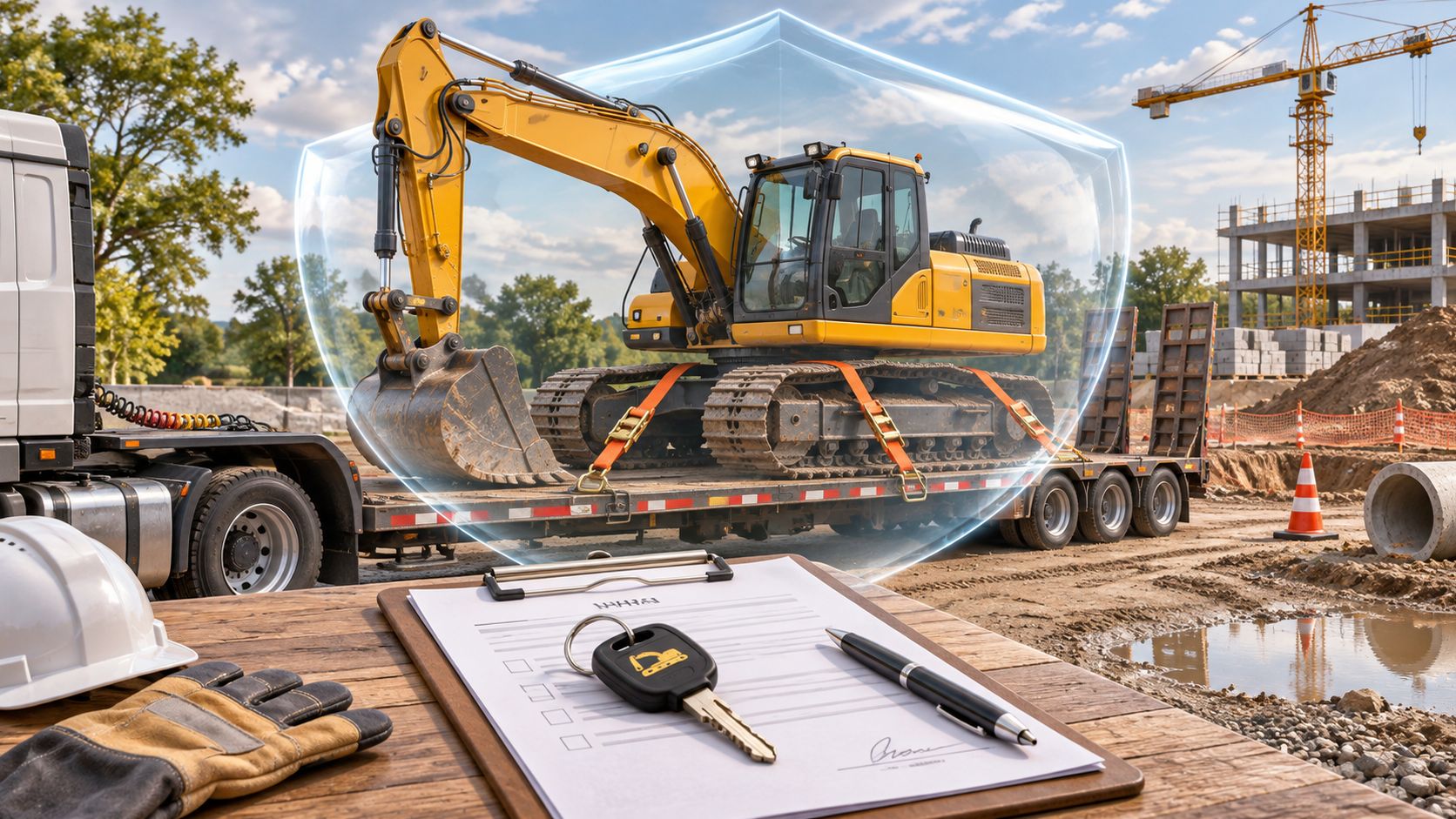
Your excavator is booked for a three week basement dig. The hire company has emailed a four page agreement, and the schedule on page two says the machine becomes your responsibility the moment it leaves their yard. You hold public liability. You hold a business pack. You assume the paperwork is done.
Usually it isn't. The gap sits between what the hire contract makes you responsible for and what your policies really agree to pay. That gap has a name, a price and a set of exclusions, and it catches out experienced builders every month.
Table of Contents
- What Dry Hire Insurance Means for Your Business
- Which Policy Responds to Each Loss and How Claims Unfold
- Why Owner Duties Survive the Hire Contract
- How to Build Cover Around the Hire Contract
- Costs Insurance Often Leaves With the Hirer
- Confirm Your Cover Before Equipment Leaves the Yard
What Dry Hire Insurance Means for Your Business
Dry hire insurance protects equipment you rent without an operator. It responds to physical loss or damage to the machine, to your liability for injury or property damage connected with it, and to the insurance obligations the hire contract places on you. Those are three separate jobs, and they're often bought as one arrangement.
The analogy that makes it click is a rental car. Take the keys, drive it yourself, and the car becomes your problem for the day. Kerb a wheel and the rental company doesn't shrug. The excess comes off your card. Dry hire works the same way, except the "car" is a 13 tonne excavator and the excess can run into thousands.
Here's the same idea in a contract context.
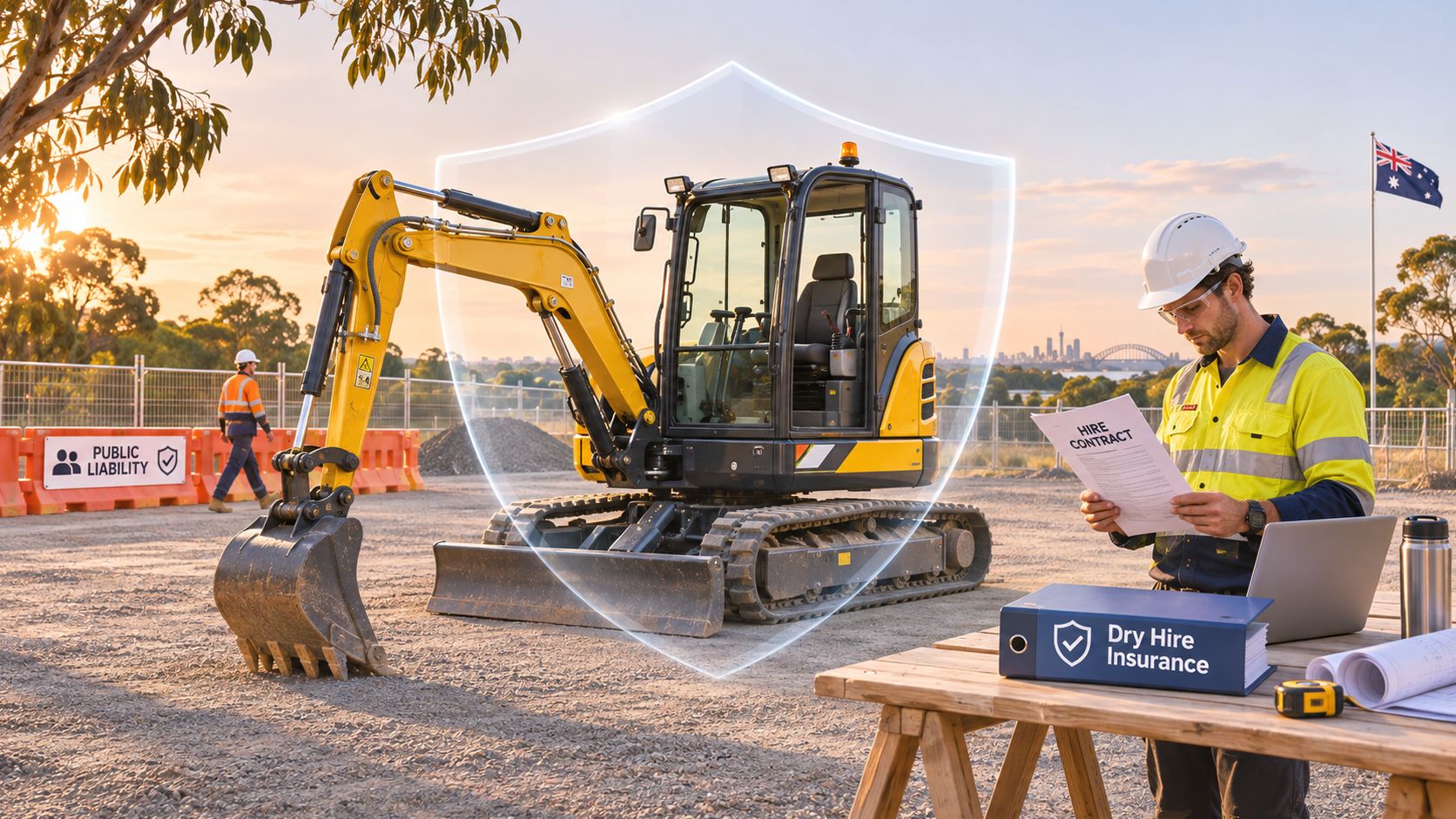
Wet hire is the mirror image. The supplier sends an operator with the machine and generally carries the operating risk. Dry hire hands you the keys and, with them, control of the site, the operator, the licences and the machine. That's why dry hire is cheaper on the day and heavier on the paperwork.
The risk doesn't switch on when the engine starts. The custody period runs from pickup through transport, on-site use, overnight storage and return. A generator stolen from a locked compound on a Sunday is a dry hire loss even though nobody was operating it. That's the detail most hirers miss, because they picture the machine working, not the machine sitting.
Who ends up holding the keys
Builders and subcontractors hire dry when they've got their own operators and want control of the schedule. Developers hire dry across a whole site. Councils hire dry for parks and road maintenance. Plant hire businesses hire dry from each other when a job needs a machine they don't own, which is where the risk gets genuinely tangled, because they're a hirer on one contract and an owner on another.
Three questions decide how much of that risk you actually carry:
- What does the policy pay for when the machine is damaged, stolen or written off?
- Who else is responsible when the machine injures someone or damages property?
- What does the contract require you to hold, prove and pay before the machine is released?
The rest of this article answers each one in turn. Before you read on, write down three things: whose equipment you're currently holding, for how many days, and which of your policies names it in writing. If you can't answer the third, that's the exposure. Plant and equipment insurance for construction businesses covers how these policies are structured for site work. If the machine is a forklift or telehandler, fuel and charging logistics matter too, and keeping forklift fleets fueled on site covers the practical side.
Which Policy Responds to Each Loss and How Claims Unfold
The fastest way to understand dry hire insurance is to stop treating it as one policy and start matching each loss to the policy that answers it. Read across each row below. The left column is what went wrong. The middle columns show which cover usually steps in. The right column is where the argument normally happens.
| Loss | Hired-plant physical cover | Public liability | Typical gap to check |
|---|---|---|---|
| Accidental damage on site | Usually, if the hired-in plant is scheduled or agreed | No | Excess and wear-and-tear exclusions |
| Theft overnight from site | Often, if theft is included and security conditions are met | No | Unattended-equipment conditions |
| Damage in transit | Often, if transit is covered for hired plant | No | Transport limits and carrier responsibility |
| Injury caused by operating the machine | No | Yes, for members of the public | Staff injuries fall under workers compensation |
| Damage to a neighbour's property | No | Yes, up to the policy limit | Limit may fall below the contract requirement |
| Total loss with hire charges continuing | Replacement value only, depending on agreed value | No | Continuing hire payments and downtime |
Two things follow from that table. First, physical damage cover and liability cover do different jobs, and buying one tells you nothing about the other. Second, the same incident can trigger both. A machine that slides off a trailer and takes out a parked ute is a physical damage claim on the hired plant and a liability claim on the ute, possibly across two policies with two excesses.
What lands in your bank account depends less on the headline limit than on three settings. Agreed value fixes the payout on a total loss instead of leaving you arguing over market value. Excess is deducted before anything is paid, and on plant it's often a percentage of the value rather than a flat figure. Sublimits silently cap categories such as transit or unattended theft, so a policy with a healthy overall limit can still pay far less than you expected.
The theft numbers behind the theft row
Theft isn't a remote risk on Australian sites. A Midland Insurance analysis of work tool theft, citing Victorian Crime Statistics Agency data, reported 27,716 stolen tools and power tools in the year to June 2026, with an estimated recorded value of AUD 37.8 million. The same analysis identified 2,416 offences at Victorian construction sites in that period, of which 1,954, or 81%, were thefts or burglaries.
Those are Victorian figures and they aren't a national count of hired machinery, so don't read them as a dry-hire claims rate. Read them as concentration: construction sites are where property crime goes. The longer trend is just as blunt. A separate analysis in the same review reported Australian plant and equipment thefts rising 45% over the decade to 2014, from 482 incidents a year to 698, with stolen equipment valued at an estimated AUD 27.9 million in 2014. Hired excavators, loaders, generators, compactors, access equipment and attachments are exactly the assets that carry that exposure, because the hirer often stays on the hook for replacement or the owner's loss.
Practical rule: don't assume your tools cover, motor policy or public liability will pick up a hired machine. Check that the policy expressly accepts hired-in plant and dry hire use, then check the security conditions attached to the theft benefit.
Five claims and how each one unfolds
- An excavator is stolen overnight from a fenced site. Physical cover may respond if theft is included and the security conditions were met. First actions: notify the insurer, secure what's left of the compound, and preserve the serial number, lock records and a photo of the fence line as it was.
- A telehandler is damaged between sites. Transit cover is the question, not site cover. Record the driver, the carrier, the loading condition and the time of departure before anything is moved again.
- An operator injures a coworker. Workers compensation responds, not public liability, because the injured person is your worker. Notify the insurer, secure the machine, and preserve the incident scene and any footage.
- A hired compactor damages a neighbour's fence. Public liability responds up to its limit, and the owner may also claim under the hire contract. Photograph the damage and the machine position, and keep the hire agreement handy because the two claims can run in parallel.
- A hired generator is a total loss while hire charges continue. Physical cover pays the agreed value. The weekly hire payments that keep accruing stay with you unless the agreement says otherwise.
The difference between the two big policies
Contract works and public liability get confused constantly on hire-heavy sites, because both sound like they cover "the job". They don't overlap the way people assume, and contract works vs public liability insurance sets out where each one starts and stops. Find the row in the table that matches your biggest exposure, then check that the policy wording names that exact event. If it doesn't, you've found your gap before a claim finds it for you.
Why Owner Duties Survive the Hire Contract
A hire contract can shift operation and site risk onto you. It can't shift everything away from the owner. That's the part hirers underestimate, and it changes what your policy has to respond to.
Safe Work Australia's model Code of Practice for managing the risks of plant in the workplace makes the split clear. Both parties keep a duty to ensure, so far as reasonably practicable, that hired plant is safe and without risks to health and safety. The owner stays a plant supplier and a person with management or control of the plant, which means maintenance, inspection, hazard information and safe-use instructions remain their responsibility. You control the operating environment, the site hazards and the operator's competency.
A faulty guard, two possible claims
Say you hire a compactor with a damaged guard. Your operator runs it, a worker's hand goes through the gap, and the injury is serious. You controlled the machine and the site, so the first look is at your operation. But the claim can also allege that the owner's maintenance failed, that the guard should have been replaced before release, or that the machine was supplied in an unsafe condition.
That's why a dry hire policy needs testing on two fronts: physical loss of the asset, and third-party liability arising from ownership, supply, maintenance or defective equipment. A policy that only covers damage while the machine is off-site answers half the question.
Practical rule: indemnity clauses move cost between parties. They don't discharge statutory work health and safety duties. A contract that says "the hirer is responsible for all injury" doesn't stop a regulator or an injured worker looking at the owner.
Keep the owner-side file tight. A dated pre-hire inspection sheet, service history, written limits on use, incident reports, and evidence that safety-critical defects were rectified before release. If maintenance is the live question, MA Hydraulics on preventive maintenance explains the servicing discipline that keeps those records credible. Ask yourself whether your own paperwork would hold up if someone disputed who was responsible. If the answer is no, fix the records before the next machine goes out.
How to Build Cover Around the Hire Contract
The hire agreement allocates responsibility; the insurance policy sets the boundaries of payment. Those documents need to fit together like matching parts. Before the machine leaves the yard, work through the checks below to identify obligations your cover may not meet.
- Confirm the legal entity, site address and intended use. Check who is hiring the machine, where it will operate and what work it will perform. Cover for your business may not automatically extend to a related entity or a site in another state.
- Schedule every item individually. Record the make, model, serial number, replacement value and hire dates. If you rely on a general hired-plant limit, confirm it covers the particular machine rather than assuming the label is enough.
- Check the custody period. Confirm that hired-in plant cover applies through pickup, transport, on-site use, storage and return. Match the insured period to the hire period. A building contract, financier, principal or state requirement may also require specific project insurance.
- Compare the public liability limit against the contract. Councils, principal contractors, financiers and hire companies can set their own minimum limits. Check the exact requirement against your policy before release. Keep this separate from checking physical-loss cover: a liability limit does not establish that damage to the hired machine is insured.
- Test the exclusions against the actual job. Compare excesses, unattended-equipment conditions and geographic limits with actual site arrangements. Use this industry review of construction site risk as context for reviewing theft exposure, then check your own policy's security requirements.
- Get a current certificate of currency that lists the equipment. Request equipment details where available, and check them against the schedule and wording. A certificate alone does not establish that the machine, dates, value or contractual obligations are covered.
- Complete a dated condition report with photos at handover and at return. These records help distinguish pre-existing damage from damage during hire and give the parties evidence if responsibility is disputed.
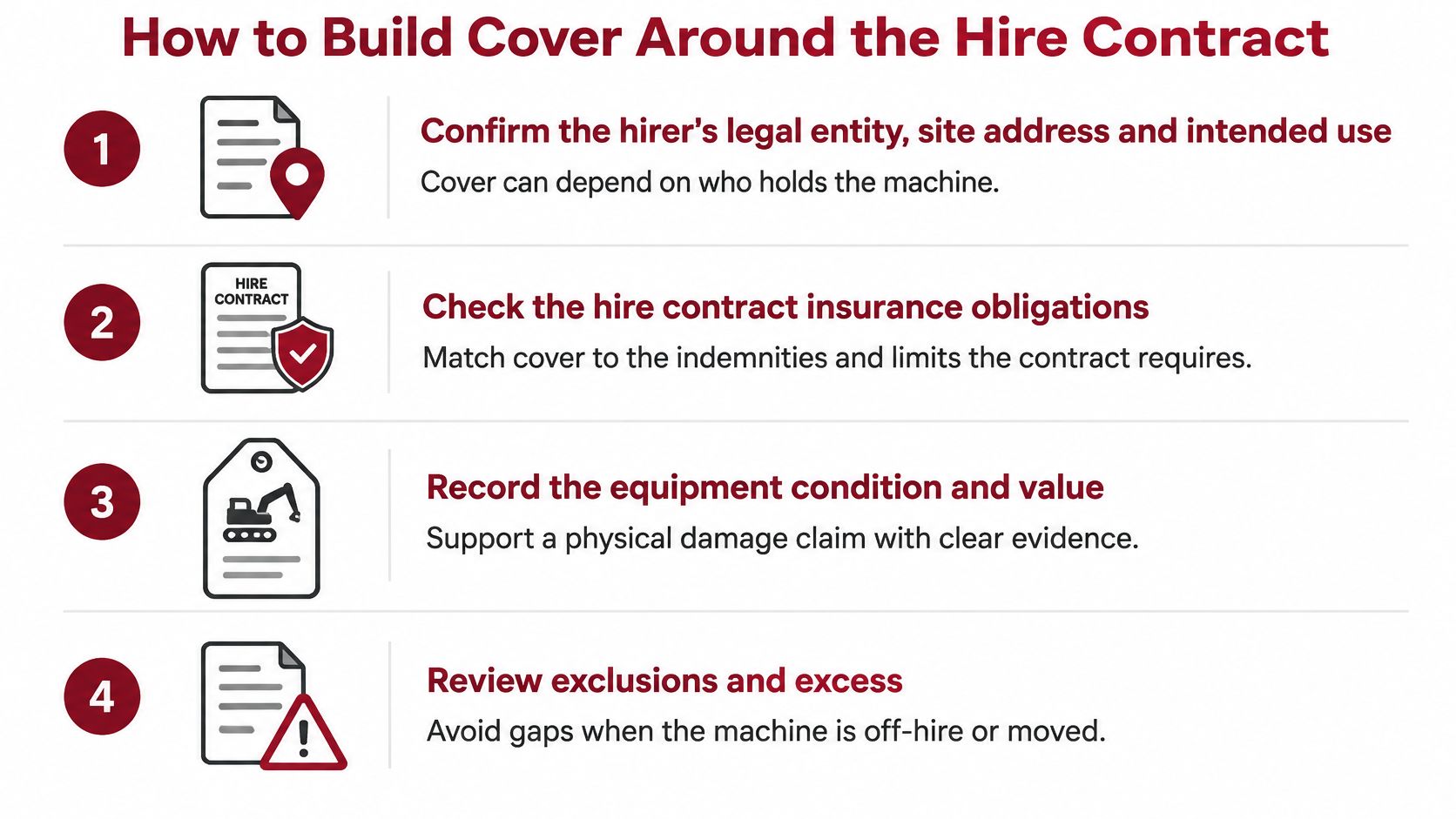
Keep the signed agreement, equipment schedule with serial numbers and values, current certificate of currency, and handover condition report together. A complete file helps the insurer assess what happened and what was insured.
Finally, separate damage to the machine from downtime and delay obligations. Physical-loss cover does not automatically pay those costs. The policy wording, limits and exclusions determine what is insured, even when the hire contract makes you responsible.
Costs Insurance Often Leaves With the Hirer
Here's the assumption worth challenging: that equipment cover protects your project cash flow. It doesn't. An equipment policy settles the owner's physical loss. Your cash flow can still take a hit on the same event, sometimes a bigger one.
The costs below sit outside the physical damage settlement, and they arrive in roughly this order.
| Cost item | Usually carried by | Example |
|---|---|---|
| Policy excess | Hirer | Excess deducted from a stolen excavator claim |
| Hire charges during repair or after total loss | Hirer, unless the agreement says otherwise | A week of hire while the excavator is in repair |
| Replacement hire while out of service | Hirer | Hiring a substitute machine for three weeks |
| Transport and recovery | Set by the hire agreement | Recovering a stolen generator |
| Delay damages under the principal's contract | Hirer | Late slab pour |
| Lost project productivity | Hirer | Crew idle while the machine is out of service |
Take the excavator that goes out for three weeks. You pay the excess, you keep paying hire while it's in the repair shop, you hire a substitute to keep the crew working, and if the slab pour slips you may owe delay damages under the principal's contract. The insurer may settle the owner's claim in full while every one of those costs lands on you.
The fixes are contractual, not insurance ones. Negotiate three clauses before you sign: who pays the excess on a claim, whether hire charges stop on a total loss, and how downtime is charged while the machine is unusable. Get those in writing and you've removed most of the argument. If you're storing plant or materials in a container between hires, container budgeting guide for facility managers sets out what that storage costs in practice, which belongs in the same budget line. Then list your top three uninsured cost items and find the contract clause that governs each one.
Confirm Your Cover Before Equipment Leaves the Yard
The loader is fuelled, the docket is signed, and the truck is idling at the gate. That quiet minute is when you confirm the policy will respond if the machine is damaged tomorrow. A hire contract can move risk to the hirer on paper. It does not force the hirer's policy to pay. Cover for accidental physical loss is one line. Downtime, a replacement machine and delay under the head contract usually stay with the hirer.
Gather three documents and keep them together:
- The hire agreement, including the insurance clause and the indemnity.
- The equipment schedule, with serial numbers, replacement values and hire dates.
- The current certificate of currency, showing the policy is live and the equipment is described.
Then test those papers. Does the policy name the hired equipment? Does it cover the full hire period, including transport and storage? Does the public liability limit meet the contract's requirement? Does the cover match the site's real security conditions? A certificate of currency works like a boarding pass. It helps only when it names the equipment, the dates and the limits, rather than just the business. What builders need on every job is that named detail.
A principal, financier or state requirement may set the minimum cover, so confirm your contractual obligations and arrange cover before work begins. ABS Insurance Brokers Pty Ltd can run a wider insurance review that considers contract works and construction insurance alongside HBCF requirements, and offers a free insurance quote on request.
Ask a broker for the policy wording on hired-in plant, and get the exclusions and excess in writing before the hire starts.
ABS Insurance Brokers Pty Ltd offers plant and machinery insurance for owned and hired equipment, so send us your hire agreement, equipment schedule and current certificate of currency and we'll tell you where the cover stops and the contract keeps going. Visit ABS Insurance Brokers Pty Ltd to start the conversation.