
The most common advice on this topic is too tidy. Buy a broad policy, insure the invoice, and the shipment is protected. That advice treats insurance marine cargo as a promise that the goods will arrive on the date the programme needs them. It is not that promise.
A cargo policy is built to answer physical loss of or damage to goods during an insured transit. A late vessel, a blank sailing, a congested terminal, or a missed site date can cost more than a crushed carton, and those costs often sit outside the wording. Depot and dispatch theft can sit outside it too, even when the ocean leg was quiet. Sums insured that were copied from last year's invoices also drift, because commodity prices, freight and duty move the landed value while the limit stays still.
If you import appliances, copper, panels or a one-off piece of plant, read the next pages as a broker would walk a first policy. Start with what is paid. Then match the clause, the journey, the limit and the port where the goods can pile up.
Table of Contents
- What Insurance Marine Cargo Usually Pays
- Institute Cargo Clauses A, B and C Compared
- How Warehouse to Warehouse Cover Works
- Sums Insured Limits and Accumulation
- Port Concentration and Longer Dwell
- Shipments Builders and Traders Can Map
- Delay and Depot Theft Left Uninsured
- Review Cover Before Goods Leave
What Insurance Marine Cargo Usually Pays
Insurance marine cargo pays when goods suffer accidental physical loss or damage in the insured transit. It does not reimburse you because the ship is late, the sailing was blanked, or the site date was missed and the goods are still sound.
Think of two losses on the same container of tapware bound for a Sydney fit-out. Seawater ruins the cartons. That is the kind of event a broad cargo form is written for. The same container arrives three weeks late, dry and intact, and the builder pays storage, weekend labour and a delay penalty. That second loss is a time problem. Time, by itself, is not a physical-loss claim.
Broader forms, often sold in the style of Institute Cargo Clauses (A), commonly respond to accidental physical loss during the insured transit. Fire, explosion, stranding, collision, heavy weather and a general average contribution after a maritime sacrifice are the events builders and importers encounter. Theft of an entire package, seawater wetting and impact breakage can be included when the packing was fit for the voyage. A restricted, named-perils form pays only the events listed on that form. If the event is not named, the claim stops there.
What the wording leaves out
Ordinary leakage, inherent vice, inadequate packing, delay, loss of market and most consequential loss are commonly outside the cargo policy. War and strikes are usually separate clauses. Do not assume they sit inside a basic form. Temperature failure for chilled food, or for moisture-sensitive electrical gear, may need a specific extension. Ordinary all-risks wording alone is not that extension.
The same physical-loss idea shows up in other shipped goods. The National Car Transport insurance guide is a clear walk-through of how a vehicle shipment is insured, which helps if you are comparing a cargo wording with what a carrier will pay.
Practical rule: If you cannot point to physical loss or damage, start from the assumption that a standard cargo policy will not pay the invoice for lateness.
| Event | Broad cargo form | Usually outside standard cargo cover |
|---|---|---|
| Accidental physical loss or damage in the insured transit | Commonly covered | Named-perils forms pay only listed events |
| Fire, explosion, stranding, collision or heavy weather | Commonly covered | Gradual deterioration from the goods themselves |
| General average contribution after a maritime sacrifice | Often covered if the clause is included | A policy that omits general average |
| Theft of an entire package with forcible entry | Often covered, subject to security conditions | Mysterious disappearance or unexplained shortage |
| Seawater wetting or impact breakage | Often covered if packing was adequate | Damage from inadequate or unsuitable packing |
| Temperature excursion for chilled or sensitive goods | Only if a temperature or reefer extension applies | Ordinary all-risks wording alone |
| Delay, port congestion, rerouting or loss of market | Not a physical-loss claim | Needs a separate delay or interruption analysis |
| War, strikes, riots or terrorism | Usually a separate clause | Assumed to sit inside a basic cargo form |
Mark the row that matches your next shipment before you worry about dates and ports. A joinery package that can be stolen whole is a different row from a bulk product that mainly fears fire or sinking. A reefer or a crate of switchgear that fails if it sweats is a different row again.
General average deserves a plain comparison. If the ship sacrifices cargo or incurs salvage costs for the common safety of the voyage, each cargo interest can be asked to contribute, even when their own goods are undamaged. The containers can be held until security is posted. A cargo policy that includes general average can put up that security. A policy that omits it leaves you funding the deposit.
Carrier liability is not a substitute. It is limited, it is defended, and it often fails where packing, inherent vice or an excepted peril is argued. Your own policy is first-party cover for the goods. The carrier's liability is a different contract, with a different limit and a different argument.
Before the next section, circle one row for the goods you are about to move. That choice decides whether you are buying a broad form or a short list of named perils, and it stops you treating a late-but-sound delivery as if it were a damaged one.
Institute Cargo Clauses A, B and C Compared
Institute Cargo Clauses are the standard wordings most marine cargo policies follow. The trade-off is breadth against price and against exclusions you still have to live with. Clause A is the widest. Clause C is the narrowest. Clause B sits between them. They are different lists of perils, not three prices for the same promise.
Which goods fit which clause
Clause A covers all risks of loss or damage unless a listed exclusion applies. Theft of a whole package, seawater entry and heavy weather can fall inside it. That is the usual fit for fragile fittings, appliances, copper, finished joinery and high-value plant, where handling damage and theft are realistic.
Clause B covers a named list, including fire, explosion, stranding, collision, general average sacrifice, seawater entry and washing overboard. It does not cover theft, or heavy weather, unless a named peril caused the loss. It can suit sturdier manufactured goods where you want seawater named, but you accept that pilferage is your own problem.
Clause C covers major casualties such as fire, explosion, stranding, sinking, collision and general average sacrifice. It does not cover seawater entry, washing overboard, theft or heavy weather. Low-value bulk commodities, where the fear is the ship being lost or on fire, are the usual candidates. It is a poor match for cartons that can be soaked or stolen.
| Clause | Usually covers | Usually outside |
|---|---|---|
| Clause A | All risks of loss or damage unless excluded | Delay, inherent vice, inadequate packing, war and strikes |
| Clause B | Named perils including seawater entry and washing overboard | Theft of whole packages and heavy weather unless a named peril applies |
| Clause C | Major casualties such as fire, stranding, sinking, collision and general average sacrifice | Seawater entry, washing overboard, theft and heavy weather |
All three levels leave out delay, inherent vice and inadequate packing. War and strikes need their own clauses at every level. Before you choose, ask to see the wording on sue and labour, general average, and any warehouse-to-warehouse extension. Sue and labour is the reasonable cost of saving the goods after a loss has started. It is not a blank cheque for airfreight because the programme slipped.
Ask the broker to show the clause reference in the quote, not only the name of the level.
A quote that says "all risks" without citing Clause A, or a local equivalent with the exclusions attached, is not yet a decision. Under many sales terms the seller's minimum insurance is the narrow form. If you are the buyer and you wanted theft and wetting covered, buy the broader clause yourself rather than assuming the seller's certificate matches your goods.
How Warehouse to Warehouse Cover Works
Cargo cover is a chain of custody, not a ship-only product. The trade-off is convenience against a hard stop. A typical warehouse-to-warehouse clause can begin when the goods leave the seller's or your warehouse to start the transit. It can continue through ordinary sea carriage, transhipment and the inland leg. It ends on delivery to the final warehouse, on expiry of a stated number of days after discharge, or when you choose to store or distribute the goods, whichever comes first.
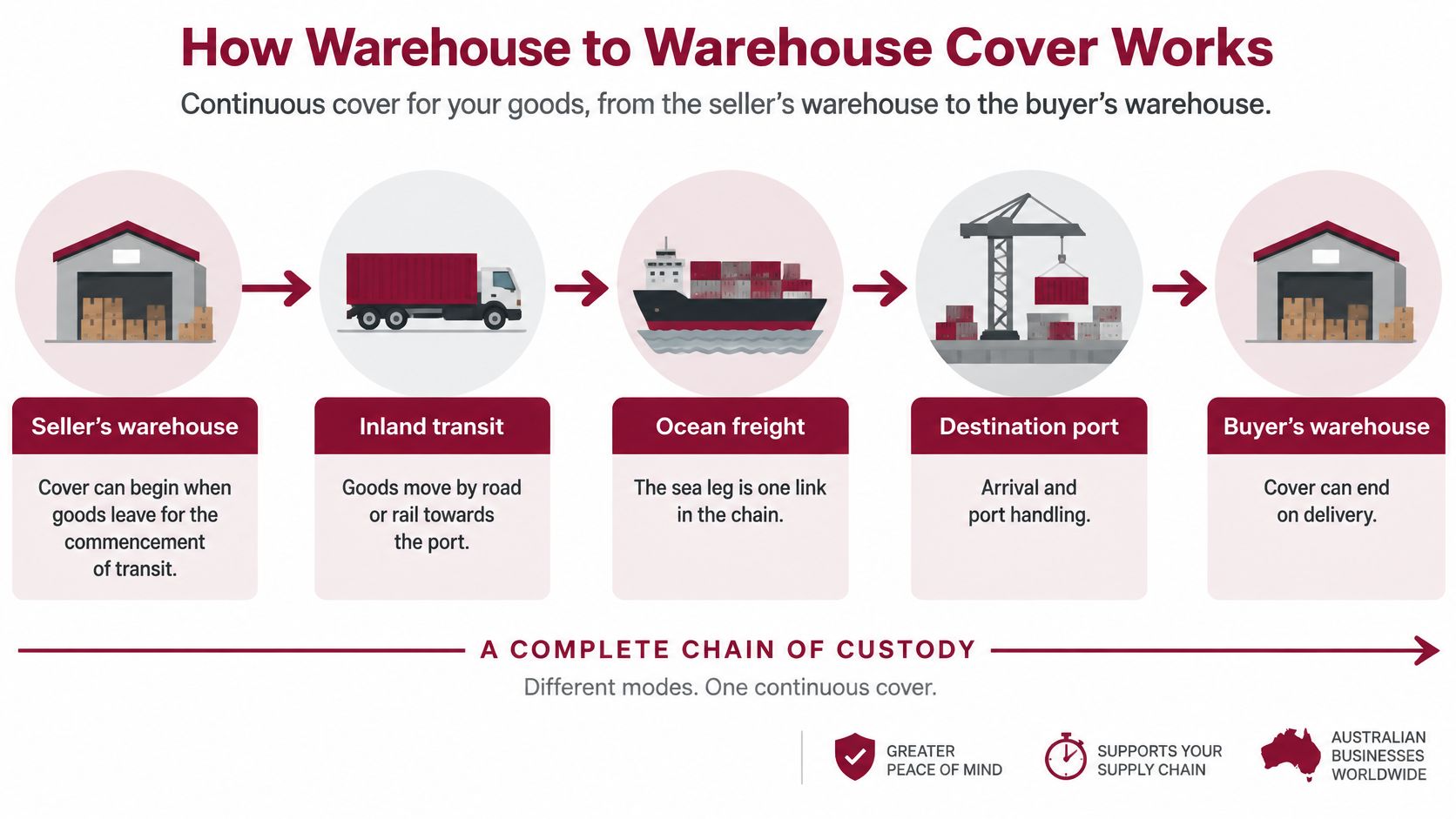
One fixture consignment, five handovers
Say a residential builder buys tapware and stone from an overseas mill for a site in inner Sydney.
- Factory gate. Cover can attach when the goods leave the mill for the commencement of transit, not when the vessel sails. If they sit in the mill as unsold stock, that is not yet this transit.
- Export terminal. The inland haul to the load port is part of the ordinary course if the policy includes it. A planned stop to consolidate with other cargo can still be transit.
- Ocean leg. This is one link. A casualty here is what people picture, and it is not the only place the wording can fail.
- Port Botany dwell. After discharge the clock in the clause matters. Ordinary handling and a short wait for a local carrier can still be transit. Weeks in a container park while the project waits for a slab often are storage.
- Local carrier, then site or a holding yard. Delivery to the final warehouse, or to the place you elect to store or distribute, can end the marine transit. An overnight drop on an open site is a new question, not an automatic continuation.
The hinge is the ordinary course of transit. A planned consolidation stop can remain inside it. A deliberate stockholding while a project waits usually is storage, and it needs its own limit and time cap. The road leg after discharge has more in common with courier and local transit cover than with a stranding at sea. Treat that leg as something you name, not as a free extra.
A cross-border vehicle shipment makes the same chain obvious in another trade. Guides on importing Copart wins into Poland show title, inland haul, ocean carriage and delivery as separate steps. Building materials deserve the same handover map, even though nobody is transferring a vehicle title.
Who needs the policy, and which papers prove the place
Incoterms allocate cost and risk between buyer and seller. They do not replace the policy. The person who needs the cover is the person who bears the risk at that point. That might be you as buyer under terms where risk has passed, a seller who still owns the goods, or neither of you if you both assumed the forwarder had arranged it. Read the certificate against the sales term. If risk passed at the overseas factory and you hold no policy until the ship sails, the inland origin leg is yours and uninsured.
When something is damaged, the papers show where it happened.
- Commercial invoice and packing list: What was shipped, in what condition it was described, and at what value.
- Bill of lading or sea waybill: The sea contract and the ports named.
- Container seal record: Whether the seal that left the origin is the seal that arrived.
- Delivery docket with exceptions: Damage noted at handover, not a clean signature followed by a complaint a fortnight later.
- Survey, if the loss is material: An independent view of cause, timing and packaging.
If the goods can sit still for weeks, ask whether that pause is still transit. If it is not, the marine wording has probably finished and a storage limit has to start.
Photograph the goods at dispatch and at delivery. A clean delivery signature is hard to reopen. An exception noted on the docket, with a seal number that does not match, is what lets a surveyor separate sea damage from a later yard incident.
Sums Insured Limits and Accumulation
Set three figures before the goods move, and set them on landed exposure, not on last year's invoice. The consignment sum insured is one shipment. The any-one-location limit is the most that can sit at one port, terminal or store at the same time. Annual sendings, or turnover on an open cover, are the year's expected insured value. A fourth choice sits beside them. Repeated imports usually belong on open cover. A one-off project shipment, such as a switchboard or a crane, usually belongs on a single-voyage policy with its own limit.
A workable cargo value stacks invoice cost, freight, duty, the insurance premium itself and an agreed uplift. Where the wording uses a CIF-plus basis, that uplift is commonly about 10 per cent, so a total loss or a general average contribution is not left short of replacement cost. Understating the value does not only cap a total loss. On a partial loss, average can reduce the payment in proportion to the underinsurance. Insuring the ex-works invoice and forgetting freight and duty is a common way to arrive short.
Why last year's cost misstates the claim
Commodity prices move faster than tonnes shipped. Between 2020–21 and 2021–22, Australian sea-export value rose 33.5%, from $395.7 billion to $528.4 billion, even though maritime export volume increased by only 1.5%, according to the BITRE Australian sea freight 2023–24 report. The same report puts 2023–24 maritime export value at approximately $467.01 billion in real terms, a 15.5% decline from 2022–23. Export statistics are not your invoice, but they show the pattern that hits an importer of steel, timber, fittings and fuel-linked freight. A limit set on an old shipment cost can be wrong in both directions. Too low after a price spike, and loosely high after a fall, with premium and accumulation still built on a stale number.
Price, not extra boxes, did most of that 2021–22 jump. Coal and LNG led it. Your tapware will not track coal, but freight, duty and the metal inside appliances still move the landed cost while a static open-cover limit stays put. Review the declaration when a project front-loads materials, not only at renewal.
| Figure | What to include | If it is set too low |
|---|---|---|
| Consignment sum insured | Invoice, freight, duty and agreed uplift | Partial payment after a total loss |
| Any-one-location limit | Peak value at one port, terminal or store | Accumulated containers exceed the limit |
| Storage time cap | Days allowed after discharge before delivery | Goods still in the yard are uninsured |
| Annual sendings or turnover | Expected insured value for the year on open cover | Premium and limit drift from actual trade |
| Single-voyage limit | Full landed value of a one-off project item | A crane or switchboard loss is capped |
| Inland and transhipment scope | Road or rail legs and intermediate ports named | The loss occurs on a leg nobody insured |
Accumulation is the quiet failure
Several containers for one builder can sit together at Port Botany or in a holding yard. Each bill of lading looks modest. Together they breach the location limit. The underwriter pays up to that limit, not up to the sum of the bills. Storage-day caps, transhipment and an inland radius should be written next to the location limit, so a long dwell does not end the cover while the value is still piled up.
Declare the peak, not the average. If four weeks of fittings land before the frames are ready, the peak is those four weeks, not a typical week. On open cover, the declaration method matters. You might declare each shipment, send a monthly bordereau, or set an annual turnover estimate and adjust it. An estimate that is never adjusted leaves both premium and limit adrift from the trade you did. A single-voyage item should not be folded into that annual estimate at a generic rate per carton. Name its landed value on its own.
Port Concentration and Longer Dwell
Almost all of Australia's international trade by volume moves by sea, and a few ports carry most of it. A storm, a crane outage or a terminal backlog is an accumulation problem. It is not a single-box problem.
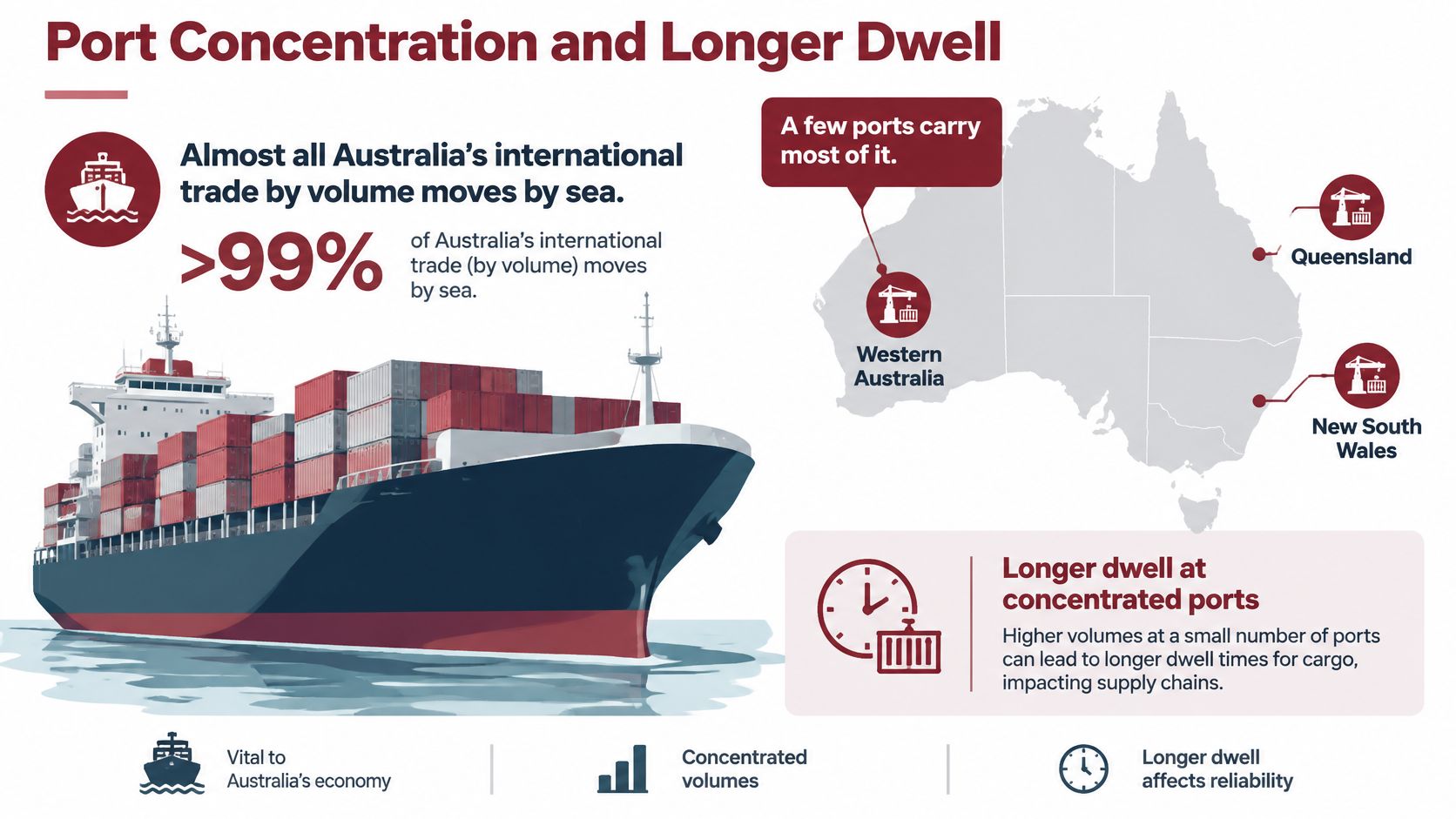
Approximately 99% of Australia's international trade by volume is transported by sea, while containerised imports are concentrated in New South Wales and Victoria, which together receive about 65% of an estimated AUD 239.1 billion in containerised freight imports, according to a Department of Infrastructure FOI release. On the load side, BITRE shipping statistics show Western Australian ports loaded about 1 billion tonnes of maritime cargo in 2020–21, Queensland 289 million tonnes and New South Wales 176 million tonnes. Together those three states accounted for 94% of Australia's maritime cargo loaded by volume.
What that means for a builder in NSW
If you discharge through Port Botany, or you receive imported building materials that have come via Melbourne, you are inside the bunch of containerised imports, not on a quiet average wharf. A disruption at Port Botany or the Port of Melbourne can touch many of your shipments at once. Test the programme against the peak value at that terminal, the number of containers in the shipment, and how dependent you are on one overseas supplier or one port. A national average hides the route. West-coast trades have faced tighter capacity and weaker schedule performance than east-coast trades in later freight conditions, so a limit built on an Australia-wide picture can understate a particular trade.
Schedule performance stretches the time the goods stay exposed. The ACCC reported that only 10% of vessels arrived within designated berth windows during 2020–21, while average idle time at Port Botany increased from 11.9 hours before the pandemic to 21.2 hours in 2020–21. Those hours are not a claim. They are extra time in a concentrated place, with extra lifts.
Controls that match a long dwell
Longer dwell and extra handling raise the chance of water ingress, impact, seal problems and misdelivery, even when the ocean passage itself was quiet. Match the controls to the goods.
- Weather-resistant packing: Liners and timber that can take a yard, not only a ship's hold.
- Desiccants and moisture indicators: For steel and electrical equipment that fails when it sweats.
- Photographs at dispatch and at delivery: Condition evidence, not a memory of how the crate looked.
- Seal reconciliation: The number on the document against the number on the door, before the container is opened in a hurry.
Name your actual discharge port and the maximum value that can sit there. Write the storage, transhipment and warehouse-to-warehouse time caps against that place. Physical damage to imported plant may be insured. A schedule loss because the vessel is late is a separate analysis, and it does not appear merely because the ship missed the window.
Shipments Builders and Traders Can Map

Three movements cover most of what a builder, a manufacturer or a developer ships. Each one forces a single decision. Pick the story closest to your next consignment and stop at that decision.
Appliances and copper for several jobs
A residential builder imports kitchen appliances and copper for jobs across Sydney. The ocean leg is routine. The goods dwell at a container park, then a local carrier drops them on an unsecured site overnight because the lock-up is not finished. The decision is temporary storage and site security. Seawater is not the question. Ask how many days the wording allows after discharge, whether an open site counts as delivery, and who holds the key overnight. High-value appliances and copper are attractive once they are out of the terminal and off the ship's seal regime. Once the goods are destined to be fixed into the building, installation floater insurance for Australian builders is the neighbouring question, because a marine transit wording is not a substitute for materials in the course of installation.
Keep the invoice, packing list, bill of lading, seal record, the delivery docket with any exception, and photographs of the site drop. If the loss is discovered on Monday and the docket was signed clean on Friday night, the argument gets much harder.
Moisture-sensitive electrical panels
A manufacturer brings in panels that fail if they sweat or if the crate is tipped. Pack them with desiccants and with tilt or moisture indicators. Photograph both ends. The wording needs to treat wetting and impact as accidental damage, which means the packing has to be adequate or the claim is argued as inadequate packing or inherent vice. A late vessel that leaves the panels undamaged and within their indicators is not, by itself, a cargo claim. The decision is packing standard plus the right clause, not a bigger annual turnover figure.
The file for this one is the indicator card, the photos, and a packing specification you can show a surveyor. If the indicator was already tripped at the origin warehouse, you do not have a transit claim. You have a supplier problem.
One high-value item beside ordinary materials
A developer ships a single high-value piece of plant on a single voyage, while ordinary materials travel on open cover. The plant needs its own insured value, at landed cost, and a check that contract works or delay-in-start-up has been coordinated with it. A crushed crate is a cargo loss. A missed crane day, with the plant undamaged, is a programme loss. Do not let the open-cover rate for cartons of fittings become the only cover on the crane.
Domestic road legs belong in the same review when the policy is transit rather than ocean only. A movement from an Australian warehouse to a regional site can be the leg where the plant is most exposed, on a low loader, through a depot, with a subcontracted carrier. Name that leg, the carrier and the handover point. For every story, the evidence set is the same shape. Invoice, packing list, bill of lading or consignment note, seal or load record, exception notation and photographs. Without those, the clause you bought is difficult to use.
Delay and Depot Theft Left Uninsured
Longer transit is not the same as an insured claim. That is the assumption to drop first. Blank sailings, port omissions and congestion can leave fixtures, retail stock or project materials physically sound and still produce storage charges, emergency airfreight, liquidated damages or a stopped site. Standard cargo cover is aimed at physical loss or damage. A delayed shipment that is undamaged has not had that loss.
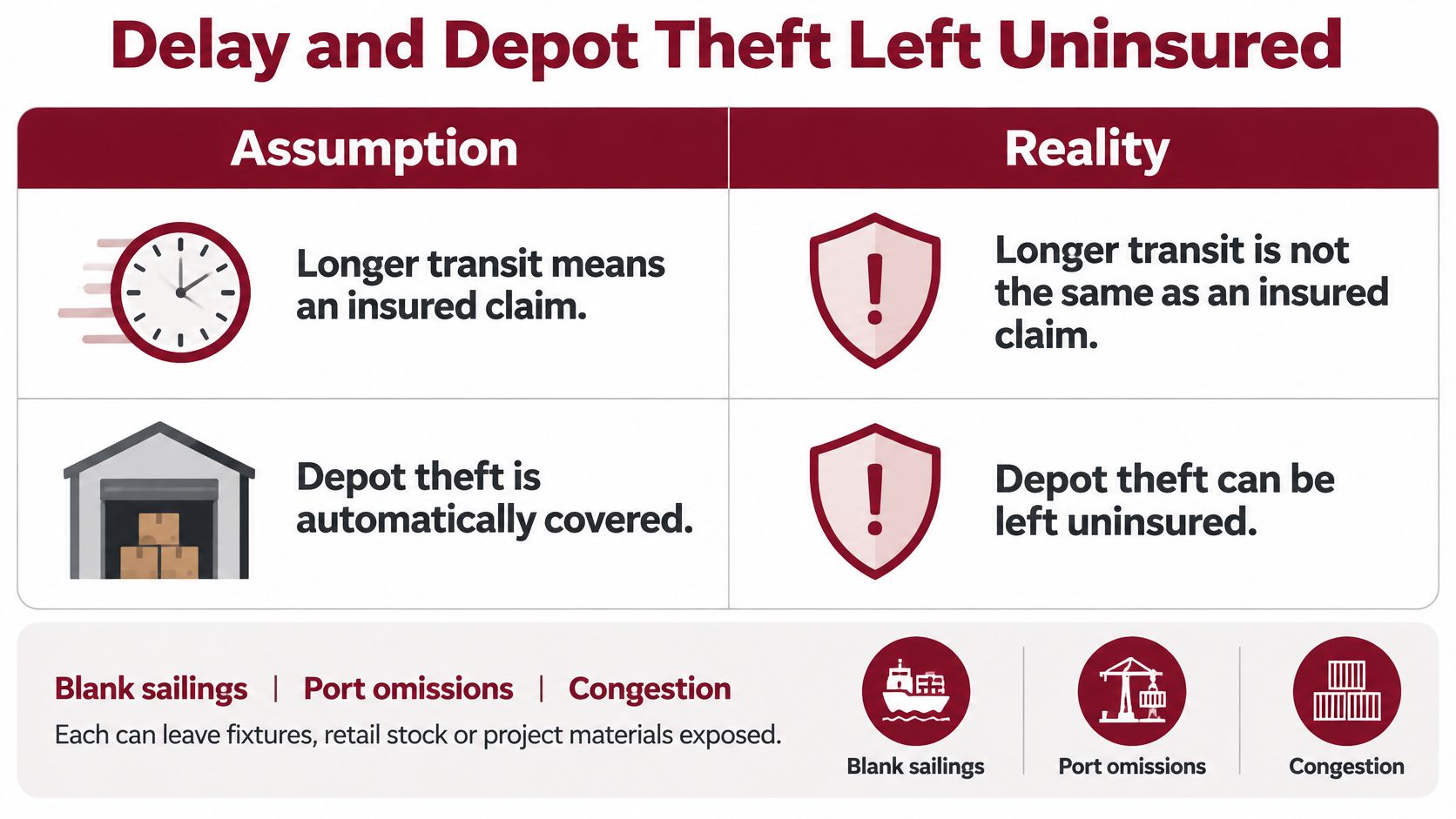
Late, sound, and still expensive
Mitigation costs, a freight forwarder's liability, a contractual claim on a supplier, and delay-in-start-up or business interruption are different tools. None of them appears automatically because a vessel is late. Cargo insurance might pay to repair or replace damaged panels. It will not, on a standard form, pay the week's site shutdown because those panels were late and perfect. If you need the shutdown covered, that is a separate delay or interruption analysis, priced and worded on its own, and it has its own exclusions.
When delay and damage overlap, keep both files. Delay notices and invoices for the extra costs show the time loss. Survey reports, bills of lading, packing lists and delivery exceptions show whether there was also physical damage, and when it happened. Mixing the two into one angry email to the insurer is how a physical claim gets tangled with a loss the policy was never going to pay.
Marine liability insurance answers a different party again. It responds to liability you may have to others, not to the invoice value of your own late or stolen goods. Buying it does not fill a delay gap on your cargo.
Theft often starts before the ship
The second comfortable assumption is that cargo crime is an ocean problem, and that a low number of incidents means a low risk. Public Australian figures are not a national crime rate. TAPA APAC recorded only 14 reported Australian incidents from January to August 2026, yet reported losses totalled US$280,448. Origin facilities accounted for 64.3% of incidents, and intrusion was recorded in 64.3% of cases. A short list of reported events can still be a material loss, and the pattern points at warehouses, depots and dispatch more than at the sea leg.
Ask, for the next movement of tools, copper, appliances or plant, whether cover applies in each of these places.
- Before pickup: Goods awaiting collection at your store or the supplier's dispatch dock.
- During transloading: The hour when seals are broken and cargo changes vehicle.
- In a depot or on a local truck: Including a subcontracted carrier you did not meet.
- In an unattended vehicle, or after delivery to an open site: Often the point where security conditions bite.
Policy wordings treat unattended vehicles, subcontracted carriers, proof-of-delivery discrepancies, employee dishonesty, inadequate packaging and a failure to follow agreed security conditions in very different ways. Some of those conditions operate as warranties. Breach them and the theft claim can fail even though the goods were insured in principle. The more useful fix is often operational. Controlled access, verified drivers, GPS tracking, seal records, dual authorisation and a documented handover match a facility-centred risk better than raising the ocean limit. Raising the limit does not repair a wording that excludes an unattended truck.
Review Cover Before Goods Leave
Five questions decide whether the programme is ready. Sit them in one conversation, before the next container is booked.
- Who owns the risk at each handover? Seller, buyer, forwarder or carrier. If you cannot name the person, you cannot know whose policy should answer.
- What landed value is exposed? Invoice plus freight, duty and the agreed uplift, not the factory price alone.
- What peak can sit at one port, terminal or yard? Use the busy week, including every container already there.
- How many days after discharge does the wording allow before storage ends the cover? Put that number next to the dwell you expect.
- Would a late but undamaged arrival cost more than a damaged container? If yes, cargo cover alone is the wrong tool for the larger number.
If any answer is unknown, the programme is not ready, even when a certificate already exists. Gather the commercial invoices, the planned route with every transhipment and inland leg, the storage points, and the highest combined value expected at one location. People who follow car export news and updates see routes and dwell shift before a vehicle leaves. Materials programmes need the same habit.
We hold Australian Financial Services Licence No. 700333. Our team helps assess your products, supply chain and liability exposures, then works through four steps. Tell us what you need, assess the risk, compare cover options, and arrange the cover. Ask for a wording comparison before dispatch. Do not buy a higher limit by default and hope the gaps were inside the old form.
ABS Insurance Brokers Pty Ltd places marine cargo and transit cover for Australian builders, importers and commercial clients, alongside the other business insurances those shipments sit next to. If your next movement could be late, piled up at one terminal, or left in a depot, a wording comparison will show what is paid and what is not before the goods leave. Visit ABS Insurance Brokers Pty Ltd and tell us the route, the peak value and the handover points.