
The renewal notice arrives with a premium, a hull value and not much else. You’ve picked up mustering work since the last one, a pilot has moved on, and a new client contract demands a liability limit nobody has checked against the schedule. The question isn’t really what the premium is. It’s what that premium buys, and what it stops paying for.
Helicopter insurance in Australia rarely fails because an owner chose the wrong insurer. It fails because the submission described an aircraft rather than an operation. Two operators can run the same model from strips twenty minutes apart and receive very different terms, because one flies private trips along the coast and the other works low and slow over cattle and scrub.
What follows is how the cover is built, what moves the price, and what you need on the table before you ask anyone to quote.
Table of Contents
- Hull and Liability Cover Explained
- What Sets Your Helicopter Premium
- How Your Operation Changes the Risk
- Common Exclusions and Coverage Gaps
- How to Prepare for a Broker Conversation
- Reading a Quote Before You Commit
- Book a Helicopter Cover Review at Bankstown
Hull and Liability Cover Explained
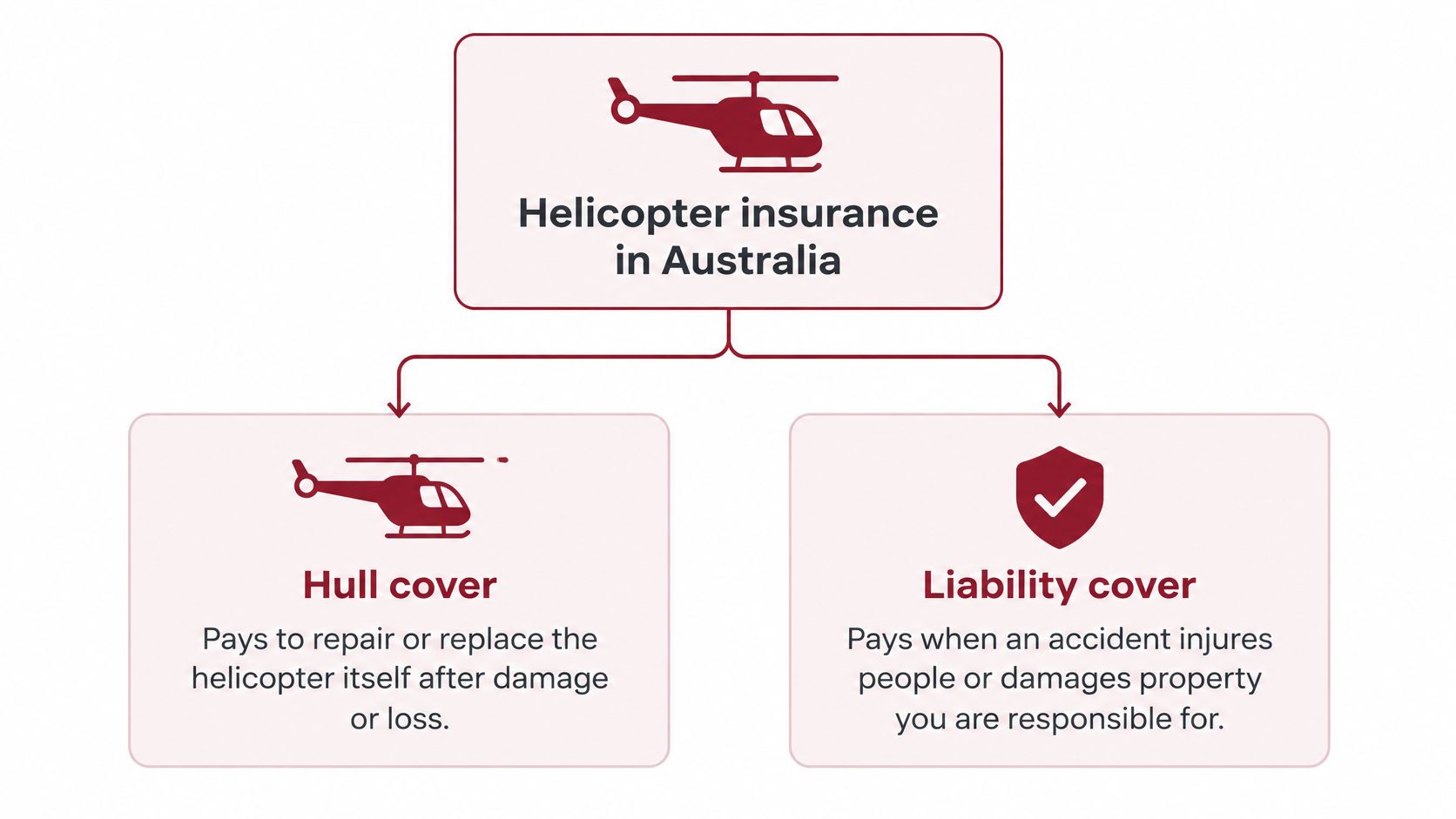
Helicopter insurance in Australia usually does two jobs at once. Hull cover pays to repair or replace your aircraft after damage or loss. Liability cover pays when your operation injures someone or damages property that belongs to somebody else. One protects the asset. The other protects you from the claims that follow an accident.
The car comparison holds well enough to start with. Hull covers your own vehicle: it deals with your machine. Liability is the third-party part: it deals with the person, the fence, the shed, the parked ute. On a road car, the two sit inside one product. On a helicopter, they carry very different limits, because the aircraft is worth a defined amount and a serious injury claim isn’t.
A Fleet That Keeps Growing
The market underneath those two covers is bigger than most owners assume. In May 2024, Australia had 2,681 helicopters, up 7% from 2,505 in mid-2022, according to CASA’s Rotortech 2024 briefing. Every one of those aircraft carries a hull value and a liability exposure.
Activity matters as much as count. LifeFlight’s Queensland helicopter operations completed 3,534 missions and flew 5,551 hours in 2024, according to LifeFlight Australia. Hours and landings accumulate exposure far faster than an airframe’s appearance suggests.
Why One Limit Can’t Cover Both Halves
A total loss usually settles at the agreed value and ends there. A ground injury claim has no such ceiling, and the historical record shows why Australian underwriters keep the two parts separate. An ATSB study of Australian helicopter accidents covering 1969 to 1988 identified 35 fatal helicopter accidents involving 62 deaths, roughly 7% of all helicopter accidents in the period, and reported 104 people seriously injured. Pilot factors contributed totally or partly to 67% of those accidents.
That is a liability profile, not a hull one. The aircraft is the smaller number in most serious scenarios.
Six Components to Test Against Your Operation
Policies are assembled from parts, and not every operation touches all of them.
| Cover part | What it pays for | Typical trigger | Who it protects | Hull damage | Repair or replacement of the aircraft | Accident, fire or ground damage | Aircraft owner or financier | Hull total loss | Agreed value when the aircraft cannot be repaired | Write-off after an accident | Aircraft owner or financier | Passenger liability | Bodily injury to people carried | Accident involving passengers | Passengers and their estates | Third-party liability | Injury or property damage to people on the ground | Crash or rotor wash damage | Members of the public and neighbours | Non-owned aircraft liability | Liability when flying an aircraft you do not own | Hired or borrowed aircraft | Operator using the aircraft | Hangar keepers liability | Damage to aircraft in your care | Damage while stored or serviced | Aircraft owners who leave aircraft with you |
|---|
Run a simple test before you ask for a price. Write down which of the six your flying touches. A private owner who carries nobody and never hires another machine may need two of them. A mustering operator with staff, clients and a hangar holding other people’s helicopters usually needs most of the list, and the two liability limits will be set far apart.
What Sets Your Helicopter Premium
You renew a helicopter you have flown for three years, and the new premium sits thousands of dollars above a near-identical machine on the same field. Underwriting is done aircraft by aircraft and operator by operator, because the insurer is pricing a set of behaviours, not a serial number.
Seven factors carry most of the weight once the work is known. Some you lock in at purchase. One or two you can move at renewal without touching the aircraft. The mission still sits above every row: mustering, charter, training and private flying are priced as different risks even when the type is the same. These seven are the levers you can adjust, and the figures an underwriter will ask for before naming a price.
The Levers and What Moves Them
| Premium factor | How it moves the premium | Why insurers ask | Aircraft type and agreed value | Higher value generally raises the hull premium | Sets the hull sum insured | Annual flying hours | More hours generally increase exposure | Measures how often the aircraft flies | Pilot experience and recency | Thin or stale experience can raise rates or limit cover | Tests whether the pilot matches the aircraft | Claims history | Prior claims often increase cost | Shows the loss pattern | Maintenance arrangements | Approved maintenance can support better terms | Shows how airworthiness is controlled | Liability limit chosen | Higher limits raise the premium | Sets third-party protection | Excess chosen | Higher excess generally lowers the premium | Shares small losses with the owner |
|---|
Where the Real Trade-Offs Sit
Agreed value is the clearest example. It fixes the payout at the figure on the schedule, which matters on a machine with a fresh overhaul or expensive mission equipment. Market value pays what the aircraft was worth on the day, usually lower and always arguable. Choosing agreed value lifts the hull premium and removes an argument later. On an older airframe it can also produce a number you would rather not pay.
Hours measure exposure in the simplest way available. A helicopter flown 500 hours a year meets more weather, more landing sites and more fuel stops than one flown 80, and the premium follows that difference.
Pilot experience works differently, because insurers test fit rather than seniority. Total hours, hours on type and hours in the last 90 days all go into the assessment. A high-hours pilot who has not flown the type in eighteen months can be rated above a lower-hours pilot who flies it weekly under supervision.
The excess rule: raise your excess only to a figure you could pay tomorrow without touching the maintenance budget. An excess you can’t fund is a discount you can’t use.
Claims history and maintenance arrangements are the two items owners most often leave out of a submission, and underwriters ask for both directly. An approved maintenance arrangement is evidence that airworthiness sits with someone accountable rather than whoever is free that week.
The liability limit and the excess finish the picture. A higher liability limit raises the premium and buys protection against a claim that dwarfs the aircraft’s value. A higher excess lowers the premium and shifts small losses onto your side of the ledger.
The quality of what you disclose changes the price more than the headline asset value. Put the hours, the pilot figures, the claims record, the maintenance arrangement, the limit and the excess on the page before you ask for a number. Lenders describe how fintech firms score risk with AI when they price a borrower. A helicopter underwriter is doing something narrower: reading the operation you have written down.
How Your Operation Changes the Risk
A coastal charter twice a week and a morning at 50 feet over cattle are different risks, even when the serial numbers sat ten apart on the production line. Underwriters treat the mission as the main variable. The airframe is only the constant they already know.
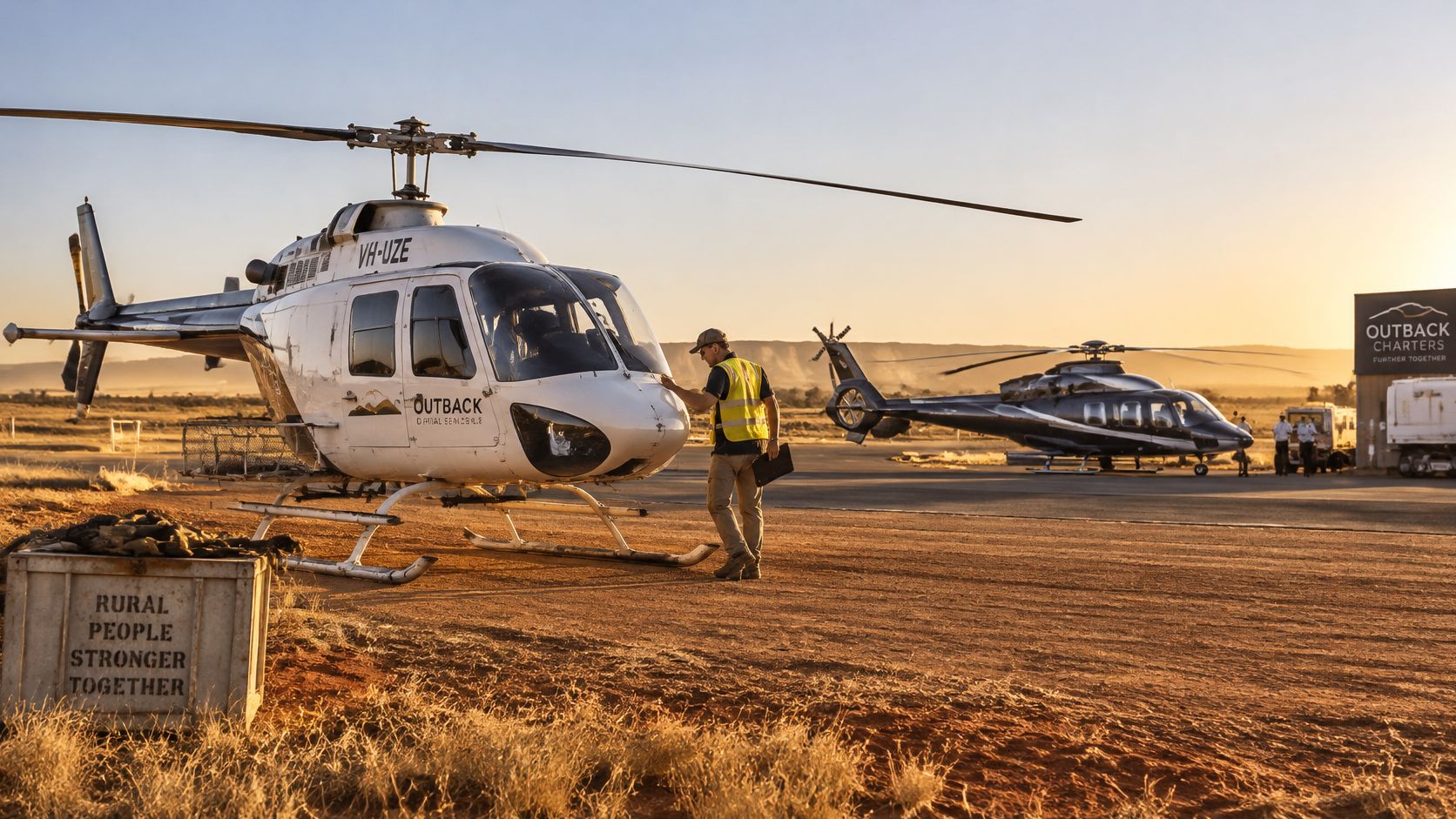
Australian accident history supports that reading. ATSB data for 1985 to 2003 recorded 776 accidents involving 777 helicopters, and light utility helicopters, roughly half of Australia’s registered fleet, accounted for 72% of those accidents. That concentration tracks the work those machines do: mustering, agricultural work, inspection, lifting and remote-area missions. A power loss leaves little height to trade for time, and recovery costs climb with distance from a sealed strip.
Where Regulation Splits the Same Aircraft
CASA draws the line by task rather than airframe. Charter, regular public transport, air ambulance, and transport of medical supplies or personnel for hire or reward sit under Part 133 as rotorcraft air transport, as set out in CASA’s Part 133 rotorcraft rules. External-load, dispensing and specialist task operations fall under Part 138 and require an aerial work certificate. Your category decides the approvals you hold. It also tells an insurer whether it is pricing a passenger-carrying business or a task-based one. Those two are worded differently, and the premium follows the wording.
The footage below is worth two minutes before you decide which row of the table you sit in.
| Operation | Main exposure | Extra cover to check |
|---|---|---|
| Private ownership | Hull damage and passenger injury | Non-owned aircraft cover if others fly it |
| Charter or passenger carriage for reward | Passenger liability and regulatory compliance | Passenger liability limits |
| Mustering, inspection or low-level work | Low-level accidents and remote recovery costs | Recovery and retrieval costs |
| Agricultural or aerial application | Aerial-application liability | Aerial-application cover |
| Construction-support lifting | External loads and ground damage | Sling and ground-damage liability |
| Flight training | Instructional-flying accidents | Instructor and student cover |
I would write the mission in one sentence before you ask for a quote: who is carried, how low you fly, whether you lift, spray or train, and whose aircraft you use. A mixed week (charter on Tuesday, mustering on Thursday) needs both uses named. Leaving the second one off is how a claim lands outside the declared operation.
Several exposures sit outside ordinary aircraft ownership and have to be arranged deliberately. Non-owned aircraft liability applies where you fly a machine you do not own. Hangar keepers liability covers aircraft in your care, custody or control. Aerial-application liability addresses spraying, firefighting and similar work. ABS’s aviation insurance lines include aviation cover and aircraft hull and liability, which is the aircraft policy itself. If you borrow or hire machines, the guide to non-owned aircraft liability for pilots and businesses shows where the gap usually opens.
Training carries its own profile. CASA’s instructional-flying sector data recorded 4,769 reported occurrences in Australia between 2014 and 2023, including 220 accidents and 14 fatal accidents, with VH-registered helicopters accounting for 253 occurrences and 29 accidents. Instruction puts two sets of hands, and a student’s learning curve, in the same cockpit. Name the instructor, the student and the training use on the submission, or the policy can still read as private flying.
Common Exclusions and Coverage Gaps
A charter drops onto a paddock beside a wedding, the skids settle, and a guest standing clear of the rotor disc is knocked by the wash. The hull is undamaged. The claim that follows is not a hull claim.
Rotor wash is an underwriting problem, not a nuisance. Injury and property damage on the ground can sit with the aircraft liability wording, the site occupier’s public liability, or the landowner’s policy. Which one responds depends on the wording, on who controlled the site, and on what was agreed in writing before the aircraft arrived. Builders, developers, event organisers and anyone using a temporary site should expect that question after an incident, not before it.
Frequency and severity of claims differ by operation type, so one standard wording often leaves gaps. Mustering, sling work, hospital transfers and private travel are not the same risk, even on the same airframe. The mission you declare is what the exclusion schedule is written against.
| Exclusion or gap | Why it matters | Question to ask the broker | Unapproved use | Flying outside declared use can reduce or void a claim response | Does the policy name every use I plan? | Unlisted pilot | Pilots not named or qualified may not be covered | Who must be named on the policy? | War and terrorism | Often excluded or sub-limited | Is war cover included or sold separately? | Contractual liability | Client indemnities can exceed standard limits | Does cover respond to indemnities I sign? | Downwash and ground-person claims | Rotor wash injury or property damage can fall outside aircraft cover | Does liability respond to landing-site claims? | Pollution and fuel spill | Ground contamination is often separately limited | Is pollution covered, and at what limit? | Hired or temporary aircraft | Substitute or hired helicopters may need separate cover | Does cover follow a temporary substitute aircraft? |
|---|
Question worth asking directly: which clause responds if rotor wash injures a pedestrian on a temporary site, and whose policy pays first, mine or the landowner’s?
A high limit does not close a gap the wording excludes. Read the use definition against every paid task, not only the one that fills most of the hours. A policy written for private and charter flying can fail on external load, low-level inspection or fire support if those missions were never named. War and terrorism cover is commonly carved out or sold as a separate sub-limit. A client’s indemnity can demand more than the liability limit you bought. Fuel spilled on a temporary pad is often capped under a pollution sub-limit rather than the main liability figure. A hired machine brought in while yours is in maintenance may not follow the policy at all.
Site controls do part of the work the policy will not. Exclusion zones, crowd management, a surface inspection before landing, and a wind assessment on the day change whether a ground-person claim is defensible. An extra million of liability that the wording never triggers does not.
Ask for the exclusions schedule in writing before you accept a quote, and get each answer above into that same document. When something does go wrong, the steps that follow an aircraft incident claim decide more than most owners expect.
How to Prepare for a Broker Conversation
A broker can only quote what you disclose, and an underwriter can only defend a claim that matches the disclosure.
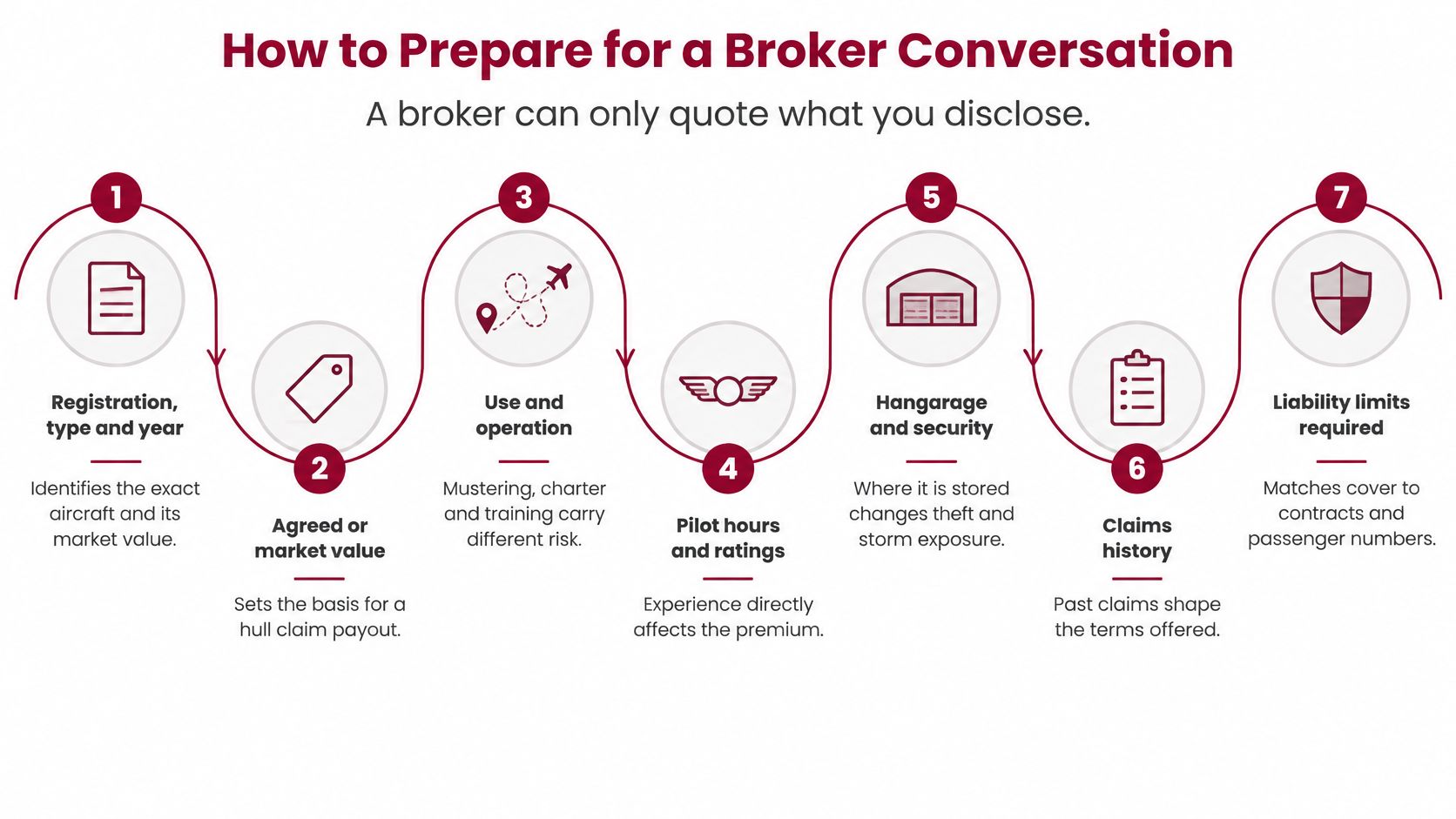
Seven Steps That Make the Quote Accurate
Aircraft identity and value. Registration, type, year, serial number, and whether you want agreed or market value. These set the hull figures, and a financier will usually need to be noted as an interested party.
Every use, not the main one. List mustering, sling and external load, low-level inspection, photography, fire support, training and private travel. One undisclosed paid task can turn a paid claim into an argument.
Hours and geography. Annual flying hours plus the areas you work, including remote strips and confined sites. Exposure depends on where and how often you fly, not just how far.
Pilot summaries. For each pilot, total hours, hours on type, hours in the last 90 days, and endorsements held. The insurer is testing whether the person matches the machine.
Limits and contracts. Decide the hull and liability limits, then read the indemnity clauses your clients have asked you to sign to see whether they demand more.
Claims and maintenance. Any incident or claim history, plus who performs maintenance and under what approved arrangement. Both are asked for directly.
Broker credentials. Request the Financial Services Guide and confirm licensing details in writing before documents change hands.
A quotation generally needs the aircraft type and value, registration, ownership or finance details, approved use, pilot experience, operating area, annual flying hours, claims history, and the hull and liability limits you want, as ABS’s aircraft hull and liability page explains. Those inputs are why terms are individually underwritten rather than set from a rate table.
One question is worth asking early. If a recommended insurer is overseas, we’ll tell you when you ask, along with which country it sits in, because that changes how a claim is handled and where a dispute goes. ABS Insurance Brokers holds Australian Financial Services Licence No. 700333, so the advice comes with the documentation that goes with it.
Renewals deserve the same discipline as new placements. The aircraft insurance renewal checklist covers the items that change between years: hours flown, pilots added, work won or dropped, and values that no longer match replacement cost.
Bring a one-page summary of all seven points to the call. A single page you can read out beats a folder of documents nobody opens.
Reading a Quote Before You Commit
Premium is the last thing to compare, not the first. Two schedules can carry near-identical prices and respond completely differently to the same event.
In the Order You Meet the Document
Start with the basis of the hull settlement. Agreed value fixes the payout, market value leaves it to be argued at the time of loss. Then check whether the sum insured reflects a realistic replacement and recovery cost, because a helicopter lifted off a remote site carries retrieval expense that a schedule written three years ago won’t cover.
The liability limit comes next. Test it against passenger numbers, the ground exposure around the aircraft, and any indemnity a client has asked you to sign.
Excess and sub-limits follow. Look specifically at recovery costs, pollution and war, because a modest headline excess often hides a large sub-limit in the sections you’re most likely to use.
Then read the exclusions against the gaps listed earlier. Finish by confirming the insurer’s location, the policy term, the renewal conditions, and any warranty about maintenance or pilot currency. A warranty is a condition, not a suggestion, and a lapsed currency requirement can affect a claim long after the flight.
One Worked Comparison
Say two quotes arrive on the same day with similar premiums. Quote A carries a higher liability limit and a moderate excess. Quote B saves a few hundred dollars through a lower liability limit and a higher excess, which looks like a straightforward win until a passenger is injured and a hangar wall needs rebuilding. Quote B pays less on the passenger claim and leaves a larger share of the building damage with you, so the cheaper schedule costs more in the only scenario that matters.
Accept the quote whose wording matches the mission you disclosed, not the one with the lowest number at the top of the page.
Book a Helicopter Cover Review at Bankstown
Call for the review when you can describe the flying, not just the helicopter. The mission is what an underwriter prices: private trips, mustering, lifting, charter, a short job on a temporary site, or time in a borrowed aircraft. Name the model and leave the work vague, and the quote will not match the day you fly.
ABS Insurance Brokers is an Australian-owned and operated brokerage at 2 Hartzell Place, Bankstown NSW 2200, at Bankstown Aerodrome. Aviation hull and liability sits with its construction, home warranty, developer finance and marine work. The firm serves operators across Australia. Ask for a free quote on 1300 871 318, or start at ABS Insurance Brokers Pty Ltd.
I would not book that call with a one-line request. Take four things.
- Aircraft details, so hull and liability can be discussed against the machine you operate.
- A short summary for each pilot.
- The full list of intended uses, including paid work, temporary sites and any borrowed aircraft.
- The exclusions you want read line by line.
The broker tests that disclosure, places the risk with a suitable insurer, and explains how the wording responds if a claim is made. Say which jobs are occasional and which are the core of the operation. A week of sling work is not the same risk as a private flight home, and mixing them under one loose description is how a cheaper quote becomes the wrong one.
Have the uses written down before you dial. The conversation is there to check the mission, not to invent it.