

The most repeated advice about aircraft insurance in Australia is to collect three quotes, take the cheapest, and set the hull figure at whatever you paid for the aircraft. That advice causes more claim disputes than any other habit in the market.
Price should be the last thing that decides a placement, not the first. A policy is a set of promises with conditions attached, and those conditions are what an assessor reads on the day something goes wrong. Get the covered value right, get a competitive premium, and one unmet warranty can still leave you holding a six-figure repair bill.
What follows is the order I'd work in: which covers your operation triggers, which terms decide whether a claim pays, the factors that move a premium, and what a CASA registration status does and doesn't do for your cover.
Table of Contents
- Aircraft Insurance Covers and Which Operations Trigger Them
- Policy Terms That Decide Whether a Claim Pays
- What Drives Your Aircraft Insurance Premium
- Registration and Maintenance Rules That Affect Insurability
- What Happens When You Make a Claim
- How an Aviation Broker Places Cover for Your Aircraft
- Confirm Your Aircraft Cover Before the Next Flight
Aircraft Insurance Covers and Which Operations Trigger Them
Two protections sit underneath every aircraft policy written in Australia, and everything else is built around them. Hull cover responds to physical loss or damage to the insured aircraft. Liability cover responds to third-party and passenger injury or property damage arising from owning or operating the aircraft, and ABS Insurance Brokers describes aircraft hull and liability cover as precisely that pairing, always subject to the policy wording and underwriting terms.
The cleanest way to hold the distinction is to ask two questions. Hull answers what happens to the aircraft. Liability answers what happens to everyone else. They carry separate limits, separate excesses and separate conditions, so a generous hull figure does nothing for a passenger injury claim, and a high liability limit does nothing for a damaged propeller.
| Cover | What It Responds To | Typical Holder |
|---|---|---|
| Aircraft hull | Physical loss or damage to the insured aircraft, paid on an agreed or market value basis | Owners of registered aircraft |
| Aircraft liability | Third-party bodily injury and property damage arising from the aircraft | Owners and operators |
| Passenger liability | Injury to passengers carried on board | Charter, flight training and business-travel operators |
| Non-ownership liability | Liability when flying an aircraft the pilot does not own | Pilots who fly other people's aircraft |
| Hangarkeepers liability | Damage to aircraft left in the operator's care, custody or control | Hangar and maintenance businesses |
| Aerial application liability | Third-party claims arising from spraying, seeding or dusting | Agricultural operators |
| Drone insurance | Damage and liability arising from remotely piloted aircraft | Commercial drone operators |
Which operations trigger which covers
A private owner flying for recreation needs hull cover at a defensible value and aircraft liability for third parties on the ground and in the air. The main variables are the insured value, the liability limit and the pilot warranty.
A flight training school carries frequent low-level exposure with a changing cast of pilots, often in airframes that are decades old. Student solo flying raises the stakes sharply, and passenger liability applies whenever an instructor or student carries someone who isn't required for the flight.
A charter operator filling seats with paying passengers needs passenger liability limits that reflect how many people are on board, plus a use declaration that names hire and reward. An aircraft insured privately and flown for reward is a frequent source of dispute in this class, and the use declaration is where it surfaces.
An agricultural operator needs aerial application liability for spraying, seeding or dusting near people, stock, crops, water and buildings. That's a chemical and third-party exposure as much as a flying one, and hull cover on the aircraft doesn't touch it.
Airport businesses sit outside the aircraft entirely. Ground handlers, refuellers and contractors face airside operations, premises, fuel and products exposures with potential claims for third-party injury or property damage, and ABS's specialist aviation cover for airport businesses sets out the information a quote for that work needs, from airport locations and contracts to fuel exposure and claims history.
Pilots who fly aircraft they don't own sit in a different position again, because there's nothing of theirs to insure. That's non-ownership liability, and it's worth reading the guide to non-owned aircraft liability for pilots and businesses before assuming an employer's policy covers you personally.
Before requesting any quote, mark every row in that table that matches what you do in a year, including the awkward ones: the two charter trips, the drone used for stock spotting, the hangar bay rented out to another owner. Unneeded cover inflates the premium. Missing cover leaves a gap the insurer will point out at claim time.
Policy Terms That Decide Whether a Claim Pays
A policy pays what its wording allows, not what the aircraft cost. That gap is where most disputes start.
Take an aircraft insured on an agreed value of AUD 300,000. After a total loss the insurer pays that figure less the excess, because agreed value is fixed when the policy starts and both parties signed up to it. Insure the same aircraft on a market value basis and the insurer pays its current value after depreciation, which on an older airframe can land well below the price paid three years earlier. Neither basis is unreasonable. The problem is an owner who assumes the first while holding the second.
| Term | What It Means | What to Check |
|---|---|---|
| Agreed value | Insured amount fixed when the policy starts | Whether it matches the purchase or rebuild value, supported by a valuation |
| Market value | Current value of the aircraft after depreciation | Whether an older aircraft would be paid well below its purchase price |
| Excess | Amount the insured pays on each claim | Whether hull, liability and ground-risk excesses differ |
| Liability limit | Maximum payable for one occurrence | Whether it meets contract, charter or airport access requirements |
| Territorial limits | Where the aircraft may fly | Whether New Zealand and overseas routes are included |
| Pilot warranty | Who may fly the aircraft | Licence class, ratings, recent experience and any named pilots |
| Use declaration | Purposes the aircraft is flown for | Private, training, hire and reward or aerial work all declared |
| Maintenance condition | Required maintenance and airworthiness evidence | Logbooks, approved maintenance and records kept current |
Where claims actually fail
Excess is what you pay on each claim, and hull, liability and ground-risk excesses are frequently different numbers. A modest hangar rash claim can sit under the hull excess entirely, which is why owners of lower-value aircraft often carry a higher hull excess and bank the premium saving.
Liability limit is the most the insurer pays for one occurrence. It's usually driven by a contract, a charter requirement or an airport access rule rather than your own view of risk, so check the number against the actual requirement before anything is bound.
Territorial limits set where the aircraft may fly. Domestic cover often extends to New Zealand and selected overseas routes, but an island-hopping trip further north needs to be declared, not assumed.
Pilot warranty names who may fly: licence class, ratings, recent experience, and sometimes named pilots only. A friend with 400 hours total and two hours on type may not satisfy it.
A single warranty the flight failed to meet can reduce a payment or void it altogether, whatever caused the accident itself.
Use declaration records what the aircraft is for. Private, training, hire and reward and aerial work price differently, and a privately declared aircraft flown for reward is the first thing an assessor will query. Maintenance condition covers logbooks, approved maintenance and airworthiness evidence, and a gap in the maintenance record damages a hull claim as effectively as a bent spar.
Pull the schedule and read it against the table. If a term doesn't match how the aircraft is flown, fix it at renewal, not after an incident.
What Drives Your Aircraft Insurance Premium
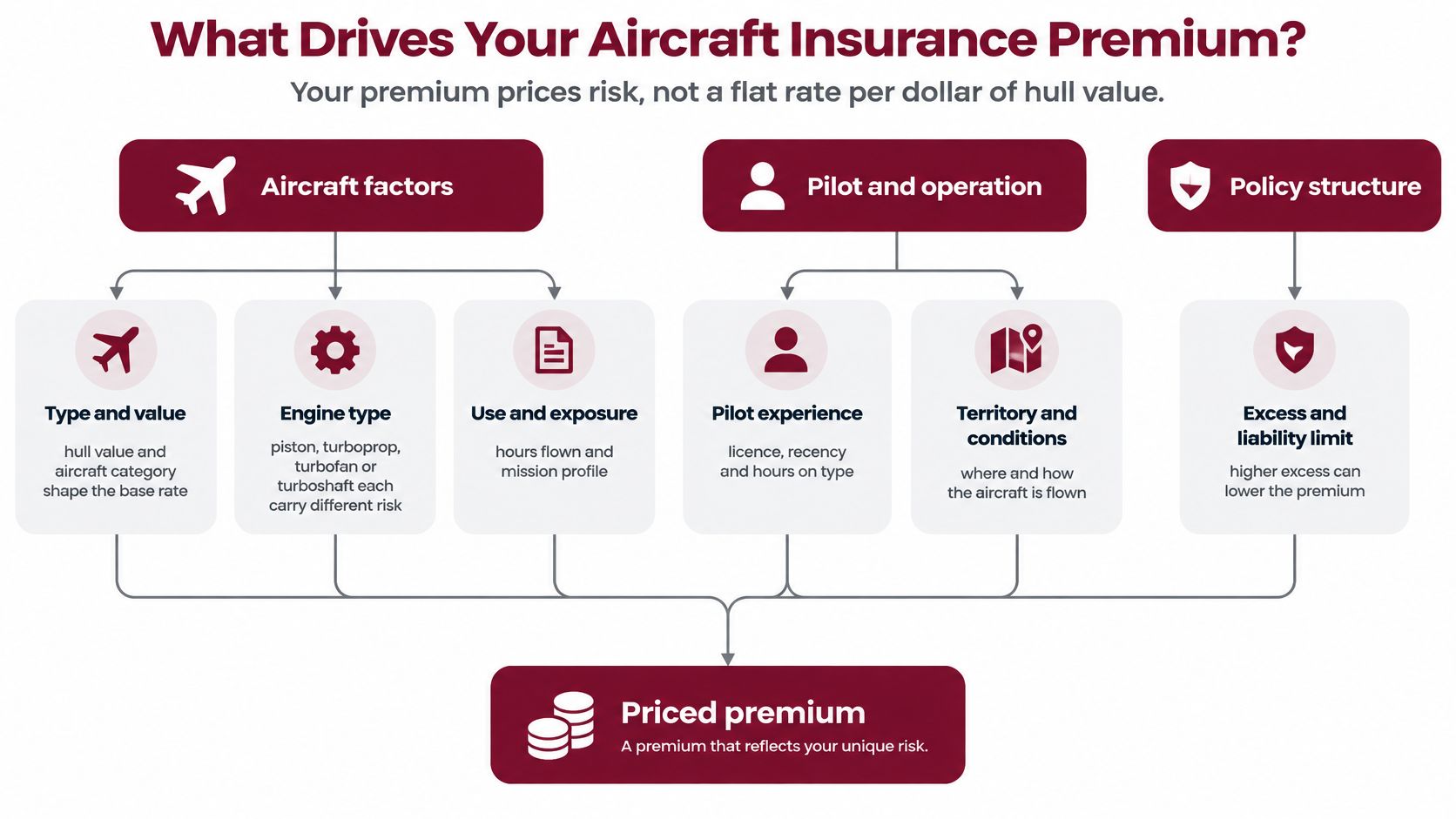
Two aircraft with identical hull values can sit thousands of dollars apart on premium. The number follows the risk profile, and the profile runs from the airframe outward to the policy structure.
Aircraft, engine and pilot come first
Aircraft type and value set the hull base and the size of a total loss. Engine type shifts both loss size and occurrence frequency: piston, turboprop, turbofan and turboshaft aircraft have different repair economics, and CASA's business-aviation data recorded 169 piston occurrences out of 275 total between 2014 and 2024, with 118 occurring during IFR operations (CASA business aviation sector safety performance). A piston fleet generating the bulk of occurrences is why underwriters treat engine class as a rating factor rather than a footnote.
Pilot experience is the next lever: total hours, hours in type and recent flying all feed the pilot-risk rating. An instrument rating with real IFR recency prices differently from one held but unused, and the 118 IFR occurrences in CASA's data show why an underwriter asks for actual recency rather than the certificate alone. Storage, aerodromes used, controlled-airspace exposure, annual hours and prior claims complete the picture.
Why the sector matters as much as the aircraft
The ATSB reported that more than 90% of Australian aviation accidents and fatal accidents between 2010 and 2019 involved general-aviation or recreational-aviation aircraft, and in 2019 alone 220 aircraft were involved in accidents in Australia (ATSB aviation occurrence statistics 2010 to 2019). Recreational aircraft accounted for 31% of all accidents and 34% of fatal accidents across that decade (ATSB aviation safety statistics). A private owner in that category starts from a statistically heavier baseline, which is why recreational categories attract tighter pilot warranties and use restrictions.
More recent figures sharpen the point. Australia recorded 169 aviation accidents in 2024 to 2025, below the 10-year average of 198.1, split across 10 commercial air transport, 28 commercial aviation, 55 non-commercial aviation and 76 uncrewed aviation accidents (CASA annual report 2024 to 2025). Non-commercial and uncrewed operations generated 131 of those 169 accidents. Underwriters price each sector separately, so a commercial charter operator and a weekend private flyer never share a loss rate even when their hull values match.
| Driver | How It Moves the Premium | Evidence to Document |
|---|---|---|
| Aircraft type and value | Sets the hull base and the size of a total loss | Valuation and aircraft specification |
| Engine type | Piston, turboprop, turbofan and turboshaft carry different occurrence profiles | Engine and propulsion details |
| Pilot experience | Total hours, hours in type and recent flying shape pilot-risk rating | Logbook and currency records |
| Instrument rating | Held but unused prices worse than held with genuine IFR recency | Instrument rating certificate and recency entries |
| Operating environment | Hangar storage, aerodromes and controlled airspace change exposure | Storage arrangements and flight profile |
| Claims history | Prior claims signal future loss frequency | Claims record from prior insurers |
| Liability limit and excess | Higher limits raise the premium; a higher excess lowers it | Chosen limits and excess on the schedule |
| Annual hours flown | More hours increase exposure | Flight log totals |
Three levers lower a premium without stripping the cover: match the hull excess to the airframe's real value rather than defaulting to the lowest offered, document maintenance and recurrent pilot training so the underwriter can price a well-run operation instead of an unknown one, and hangar the aircraft where practical rather than leaving it tied down in the open. Published accident totals set the sector benchmark your premium starts from; your logbook, storage and claims record decide where you land within it.
Registration and Maintenance Rules That Affect Insurability
The assumption I'd challenge hardest is that a change at CASA changes your insurance. It doesn't. Registration and maintenance rules define what's legal. The policy wording defines what's insured, and the two run on separate tracks.
CASA's Part 47 framework governs registration, transfers, cancellations, registration marks and exemptions for aircraft on the Australian Civil Aircraft Register, and the Part 47 registration rules set out the administrative path a buyer follows. An exemption pathway commencing 1 July 2026 lets prospective owners of certain exempt aircraft rely on an exemption when registering an aircraft before transfer, and a separate 2026 instrument permits non-builder owners to maintain certain amateur-built, kit-built and light-sport aircraft.
Why owner maintenance changes the underwriting
When a non-builder owner takes over maintenance, the insurer's questions change. Who performed the work, what approvals they held, how the logbook was signed off, and whether the owner understands the airworthiness obligations they've taken on all become material. Policy wording can still require valid registration, approved maintenance and accurate use declarations. A regulatory permission is not an insurance warranty.
| Aircraft Status | Insurance Question | Evidence to Keep |
|---|---|---|
| Registered VH aircraft | Does cover attach once registration is current? | Registration certificate and transfer records |
| Aircraft bought before transfer | Is it insured in transit and before registration? | Purchase agreement, transit cover and registration application |
| Amateur-built or kit-built aircraft | Do owner-maintenance arrangements meet policy conditions? | Build logbook, maintenance records and approvals |
| Light-sport aircraft | Are maintenance and use limits written into the policy? | Maintenance log and operating limitations |
| Exempt aircraft under a 2026 exemption | Does the insurer accept the exemption under its wording? | Exemption reference and written insurer confirmation |
| Owner-maintained aircraft under the 2026 instrument | Who is responsible for workmanship evidence? | Maintenance sign-off and pilot-owner records |
The order that avoids a gap
- Confirm the registration status first, before money moves, including whether the aircraft is exempt, still on another register, or awaiting transfer.
- Settle transit and ground-risk cover before the aircraft is registered, so an incident during reassembly or delivery isn't a self-funded loss.
- Get the insurer's written position on exempt or unregistered aircraft before settlement, and keep that written confirmation with the purchase documents.
Recreational buyers are the ones most often caught here, because regulatory flexibility feels like protection. Ask the question in writing and keep the answer.
What Happens When You Make a Claim
Notification comes first. Report the incident to the broker and insurer promptly, in the form the policy requires, and keep the aircraft in its current state for inspection where that's practical and safe. Moving or repairing it before an assessor sees it creates arguments that cost real money.
The documents an insurer typically asks for are predictable: the policy schedule, registration certificate, maintenance logbooks and sign-offs, pilot licence, ratings and recency records, and the flight log showing purpose and route. Assemble them early, because gaps read as problems.
- Registration: current certificate and any transfer documentation
- Maintenance: logbooks, approved maintenance sign-offs and airworthiness records for that category
- Pilot records: licence, ratings, recency and any named-pilot endorsements
- Flight records: purpose, route, times and passenger details
Then the claim faces its tests. Was the aircraft within the territorial limits, flown by a pilot permitted under the warranty, for a purpose named in the use declaration, with maintenance current? A failed condition can reduce or void a payment, so check each one before any flight that follows an incident.
Practical rule: the excess is deducted from every claim, so a total-loss payment on an agreed value arrives net of that amount. Budget for it rather than being surprised by it.
Timeframes and procedure come from each policy. The guide to what happens after an aircraft incident walks through the sequence, and it's worth reading before you need it, not during.
How an Aviation Broker Places Cover for Your Aircraft
A single insurer quote tells you what one market will do. A broker compares markets, reads the wording against how the aircraft is flown, and places the risk where the terms fit the operation rather than where the premium looks smallest.
Have this ready before anyone quotes: aircraft type and registration, engine type and annual hours, pilots with their ratings hours and recency, operating area and territories required, passenger and reward activity, storage arrangements, and claims history for the last five years.
Questions worth asking any broker include:
- Which insurer is being recommended, and where is it based? If an insurer is overseas, you're entitled to know which country it sits in, and we'll tell you when you ask for advice.
- How are claims handled and by whom? Local authority to settle matters more than a marginal premium difference.
- What does the wording exclude? Particularly around unapproved maintenance, undeclared use and territorial breaches.
- Who is named on the pilot warranty? Add every regular pilot at inception rather than asking for an endorsement after an incident.
ABS Insurance Brokers Pty Ltd is a specialist aviation brokerage with its Sydney office at 2 Hartzell Place, Bankstown NSW 2200, inside Bankstown Aerodrome, which puts the team on the tarmac rather than in a city tower. The aviation range covers aircraft hull and liability, aerial application liability, non-ownership liability, hangarkeepers liability, drone insurance and specialist airport cover for ground handlers, refuellers and contractors. The brokerage holds Australian Financial Services Licence No. 700333 and its team carries over 100 years of combined industry experience.
Before you sign: the cheapest quote is rarely the best fit for an aircraft flown in a mixed role. A broker who asks about your logbook, your hangar and your passengers before quoting is doing the job properly.
Confirm Your Aircraft Cover Before the Next Flight
Cover is only as good as the schedule behind it, and schedules drift out of date as aircraft, pilots and missions change. A private aircraft that picks up occasional work for reward, or a pilot added to the panel mid-year, can leave the declared use and the pilot warranty out of step with how the aircraft flies. Five checks close the gap.
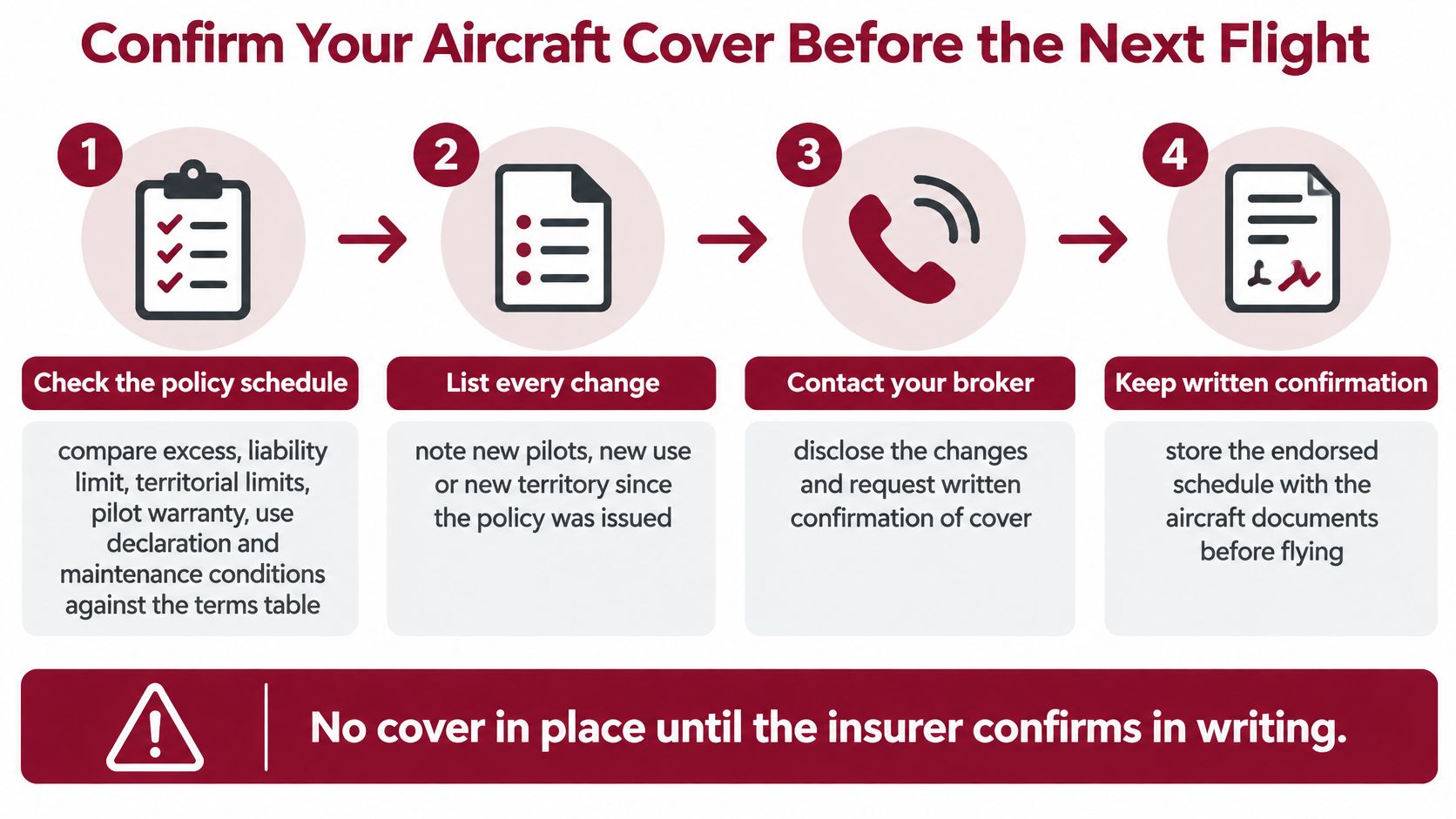
- Pull the current schedule and check the excess, liability limit, territorial limits, pilot warranty, use declaration and maintenance conditions against the terms table.
- List every operation the aircraft performs in a typical year, including passengers, training, reward flying and aerial work, and flag anything the policy doesn't name.
- Confirm registration status and gather maintenance and build records for your aircraft's category, using the status table as the evidence list. A registration category that no longer matches the operation can hold up a claim while the insurer works out what the aircraft was on the day.
- Request a quote with the complete details, so the insurer prices the actual operation rather than a simplified version of it.
- Compare wording, not just premium. Read the exclusions around unapproved maintenance and undeclared use, and weigh any higher excess against the premium saving it buys.
Keeping the aircraft insurance renewal checklist beside the schedule turns the annual review into a short job instead of a scramble. No cover is in place until the insurer confirms it in writing.
Call 1300 871 318 to talk the changes through with a broker, then review the endorsed policy before the aircraft flies again.
ABS Insurance Brokers Pty Ltd arranges aircraft hull and liability cover for Australian owners and operators, placed from an office at 2 Hartzell Place, Bankstown NSW 2200, on Bankstown Aerodrome. If your schedule hasn't been tested against how the aircraft is flown, that's the conversation to have before the next renewal or the next purchase. Visit ABS Insurance Brokers Pty Ltd to request a free quote.