

Insurance for Couriers: A Practical Australian Guide
Insurance for couriers should reflect delivery work, vehicle use, goods carried and the contracts you accept. A vehicle policy alone should not be assumed to cover every parcel, handling incident or business liability. Review commercial motor insurance alongside ABS’s transport insurance service.
Table of Contents
- Insurance for couriers: review the vehicle, goods and liability
- Commercial Motor Cover Versus Personal Car Insurance
- Goods in Transit and the Cost of a Damaged Parcel
- Public Liability and Where Courier Motor Policy Fits
- Employee, Contractor or Gig Worker, Which Cover Applies
- Matching Cover to the Vehicle You Actually Use
- Managing Fatigue, Records and the Claims Process
- Putting It Together and Getting the Right Cover
Insurance for couriers: review the vehicle, goods and liability
A courier I'd rather have my clients avoid becoming is the one who thinks a single policy will fix every problem. A van gets hit at a loading bay, the goods are damaged, and the driver still has to answer for the delay. That's where courier cover either holds the day together or falls apart.
The stack, not the sticker
The right approach is a layered protection stack. Commercial motor covers the vehicle's own damage and third-party property damage. CTP deals with recoverable personal-injury liabilities arising from vehicle use, but it doesn't fix a smashed van or a damaged TV. Public liability steps in when you damage someone else's property or injure a bystander outside the vehicle. Goods in transit responds when the cargo itself is damaged, stolen or mishandled. Personal accident and, where relevant, workers compensation protect the human being doing the job.
That's the part too many operators miss. The question isn't, “Do I have insurance?” The question is, “Which link in the delivery chain breaks first, and which policy pays?” If you're carrying customer property, driving all day, working across suburbs, or using more than one driver, the gaps multiply fast.
For a practical reference on how courier risk is often packaged across transport jobs, it's worth reading protect your shipments nationwide. The useful lesson there is simple, coverage has to follow the shipment and the trip, not just the vehicle label.
Practical rule: if a courier policy doesn't clearly answer vehicle damage, third-party injury, and cargo loss, it's not a courier program, it's a partial promise.
ABS Insurance Brokers handles this as a placement problem, not a product shelf problem. That matters because the right answer is usually a combination of covers, matched to the vehicle, the goods, and the worker status.
Commercial Motor Cover Versus Personal Car Insurance
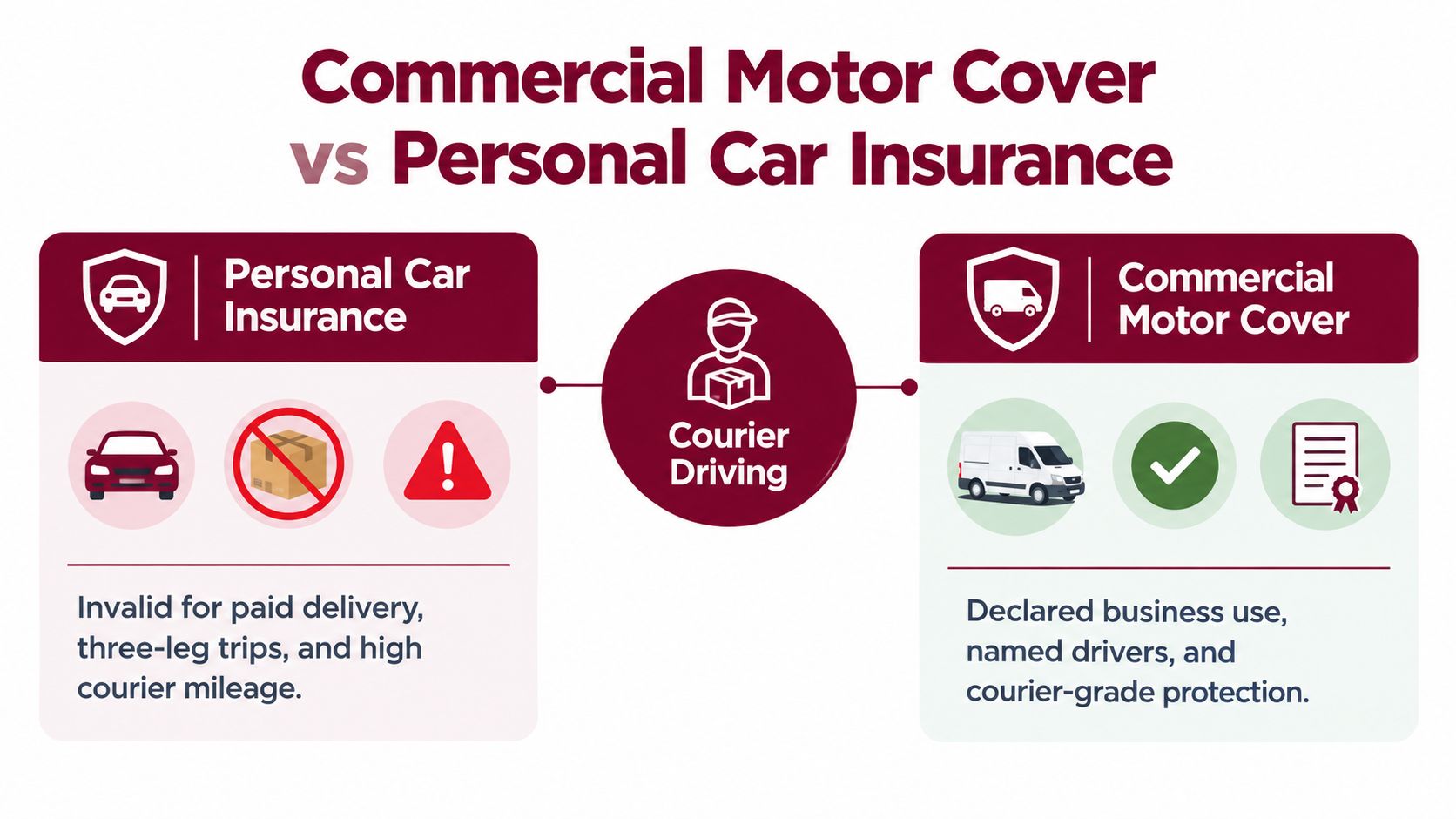
Paid delivery changes the risk profile immediately. A private car policy is written for private use, not for stop-start urban runs, constant parking, repeated loading, and business kilometres. If you're doing hire-and-reward work, carrying parcels for payment, or running a vehicle on behalf of a platform, you need commercial motor cover that says so in plain language.
Read the policy the way an underwriter does
Start with the Product Disclosure Statement. Look for paid delivery, hire-and-reward, subcontracting, and platform work wording. If those activities are excluded, do not assume “wide-ranging” means covered. It does not.
The BITRE analysis shows why this matters. Light commercial vehicles made up more than one in six registered vehicles and almost one in five vehicle-kilometres travelled. In 2015, crashes involving them caused 262 road deaths, which was 21% of all Australian road deaths, and involved 239 fatal crashes, or 21.7% of the national total. The fatal-crash rate remained 17% higher per billion vehicle-kilometres than for light passenger vehicles. That's not a private-use risk profile dressed up as business use, it's a commercial exposure profile that deserves commercial wording. BITRE analysis
Commercial motor cover should also reflect the operating pattern. That means declared business use, named drivers, realistic kilometre bands, territory that matches where the vehicle goes, and options for own damage, fire, theft and storm. A policy that's cheap because it's vague is usually cheap for a reason.
For a wider view on how commercial vehicle wording differs from private-use assumptions, see Flex Electric's advice. The key takeaway is the same across vehicles, delivery use changes the insurable risk.
A courier should check four things before buying or renewing:
- Kilometres: Are you running the vehicle daily, or just sometimes?
- Territory: Are you local, metropolitan, interstate, or crossing state lines?
- Drivers: Is it one owner-driver, or a roster of workers and subcontractors?
- Vehicle value: Can you afford the excess and downtime if it's written off?
The internal benchmark for a broader vehicle discussion is commercial vehicle insurance. That's the right mindset, because the registration class doesn't decide the claim outcome, the actual use does.
Goods in Transit and the Cost of a Damaged Parcel
A courier can do everything right on the road and still cop the cost of a damaged parcel if the goods cover is thin or missing. A smashed television, a ruined pallet of medical supplies, a warm box of meals, or a signature-required document that goes missing each create a different loss. Goods in transit deals with the cargo risk, not the vehicle risk.
What the policy should actually say
Start with the sum insured and check whether it applies per shipment, per package, or across the whole load. Then look closely at exclusions for unattended vehicles, overnight storage, refrigeration, hazardous items, and territory. Broad wording with tiny limits looks comforting, but it behaves like token cover.
Declared values matter. If you carry higher-value parcels, say so. Don't let a low generic limit become the reason a customer's loss lands back on you. For operators moving freight rather than just envelopes, the structure often follows broader carrier or transit thinking, and brokers often place it alongside other marine transit-style arrangements, as explained in our marine transit insurance guide. For a related context on transit-style property risk, insure your move with Home Removals Sydney is a useful reference point.
CTP is not cargo cover. It deals with personal injury liabilities, not the damaged goods in the back.
| Cover Type | Damage to Customer Goods | Damage to Courier Vehicle | Injury to Other People |
|---|---|---|---|
| CTP | No | No | Yes, where legally recoverable |
| Commercial Motor | No | Yes | Sometimes, for third-party property damage and related motor liability |
| Goods in Transit | Yes | No | No |
A common mistake with food and time-sensitive freight
Restaurant meals and chilled items need a hard look at the wording. If the policy says nothing about refrigeration or temperature-sensitive goods, the insurer will treat that risk narrowly. A standard parcel policy is the wrong tool for a delivery business that handles perishables, fragile goods, or high-value customer property.
Bottom line: if the customer would reasonably expect you to replace the item, the policy wording must clearly say it responds to that kind of loss.
For brokers and serious operators, marine and carrier liability thinking starts to matter at that point. Goods in transit is not a vague add-on. It decides who pays when the freight itself goes bad.
Public Liability and Where Courier Motor Policy Fits
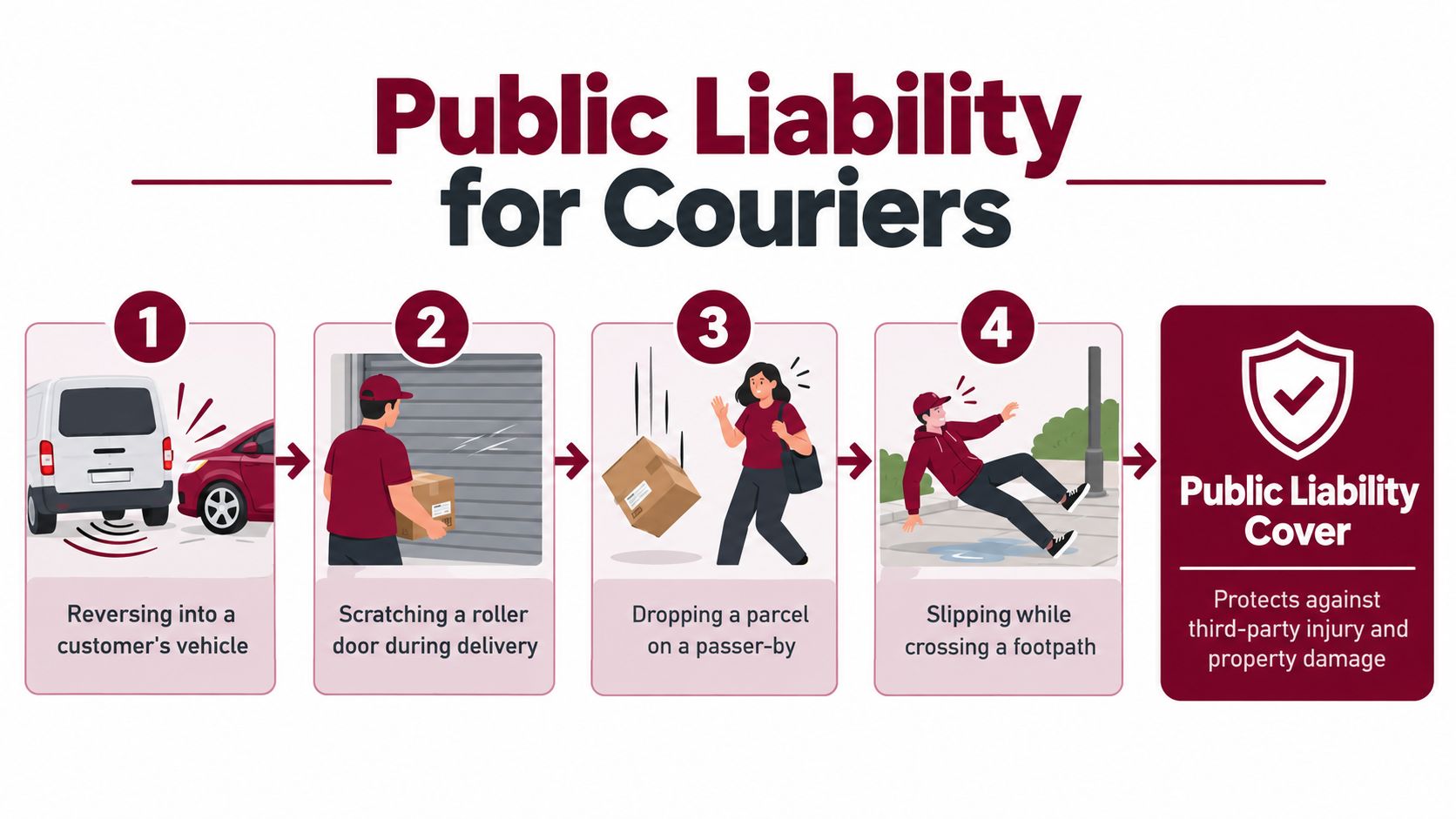
The damage courier businesses cause isn't always inside the vehicle. A reversing bump in a car park, a scratched roller door, a parcel dropped on a passer-by, or someone slipping on a doorstep can all turn into a liability claim. That's where public liability earns its keep.
Real courier moments, real exposures
A courier who reverses into a parked car is dealing with motor damage. A courier who clips a customer's fence or shopfront is in public liability territory. If a box falls and injures someone on the footpath, the injury claim sits outside the vehicle claim as well. The business needs cover that recognises those separate legal exposures.
Most courier businesses should be looking at a $5 million or $10 million liability limit as a standard starting point, because the problem isn't whether a claim will be awkward, it's whether the limit will be enough when property damage and legal costs stack up. The wrong attitude is, “I haven't had a claim yet.” The right attitude is, “What happens when one bad delivery creates a bigger loss than the job was worth?”
Where courier motor policy fits
Some courier motor policies combine own damage, third-party property damage, goods in transit and, in some cases, public liability on one schedule. That can be efficient if the fleet is simple and the work is consistent. It can also be clumsy if the operation is mixed, high-value, or split across employees and subcontractors.
A layered approach works better when different parts of the business carry different exposures. For example, a fleet may keep commercial motor separate, hold standalone public liability for premises and third-party damage, and place goods in transit on a separate basis tied to cargo value. That gives you cleaner wording and less nonsense at claim time.
For a more general public liability framework relevant to sole traders and contractors, public liability insurance for sole trader is a sensible companion read. Courier operators often underestimate how quickly a simple delivery can become a liability dispute.
Employee, Contractor or Gig Worker, Which Cover Applies
Courier cover falls apart when people pretend every driver sits in the same legal bucket. An employee running deliveries for one business all day needs a different protection path from an owner-driver juggling multiple platforms and contract jobs.
The status gap matters more than the policy label
Safe Work Australia says gig workers are generally independent contractors and usually do not receive workers compensation, so they need their own personal-injury protection instead. A platform may mention support, but that is not the same thing as statutory cover, rehabilitation help or replacement income. Safe Work Australia
The practical problem is straightforward. A courier may be covered only while actively carrying a parcel, not while waiting for a job, driving between jobs, or using a privately insured vehicle for commercial deliveries. That is why worker status has to be checked before the policy is bought, not after an injury.
What actually protects the person
The cover mix can include workers compensation, deemed-worker rules in some states, personal accident, and income protection. Which one responds depends on how the worker is engaged and where they operate. A full-time employee on payroll is in a different position from a subcontracted rider. An owner-driver doing mixed platform work sits somewhere else again.
Parliamentary material reported that one-third of food-delivery workers had been seriously hurt or injured, and more than 80% of injured workers reportedly received no compensation or support. Those figures underline the exposure. Personal injury and lost income are often the bigger problem, not the van or the bike. Parliamentary inquiry report
Rule of thumb: if the driver's income stops the moment they stop riding or driving, motor insurance alone is the wrong conversation.
The Fair Work Commission is considering minimum-standard applications covering food delivery and last-mile courier work, so the boundary between contractor and protected worker is still shifting. That uncertainty is exactly why cheap courier insurance can miss the point if it ignores injury and wage loss.
Matching Cover to the Vehicle You Actually Use
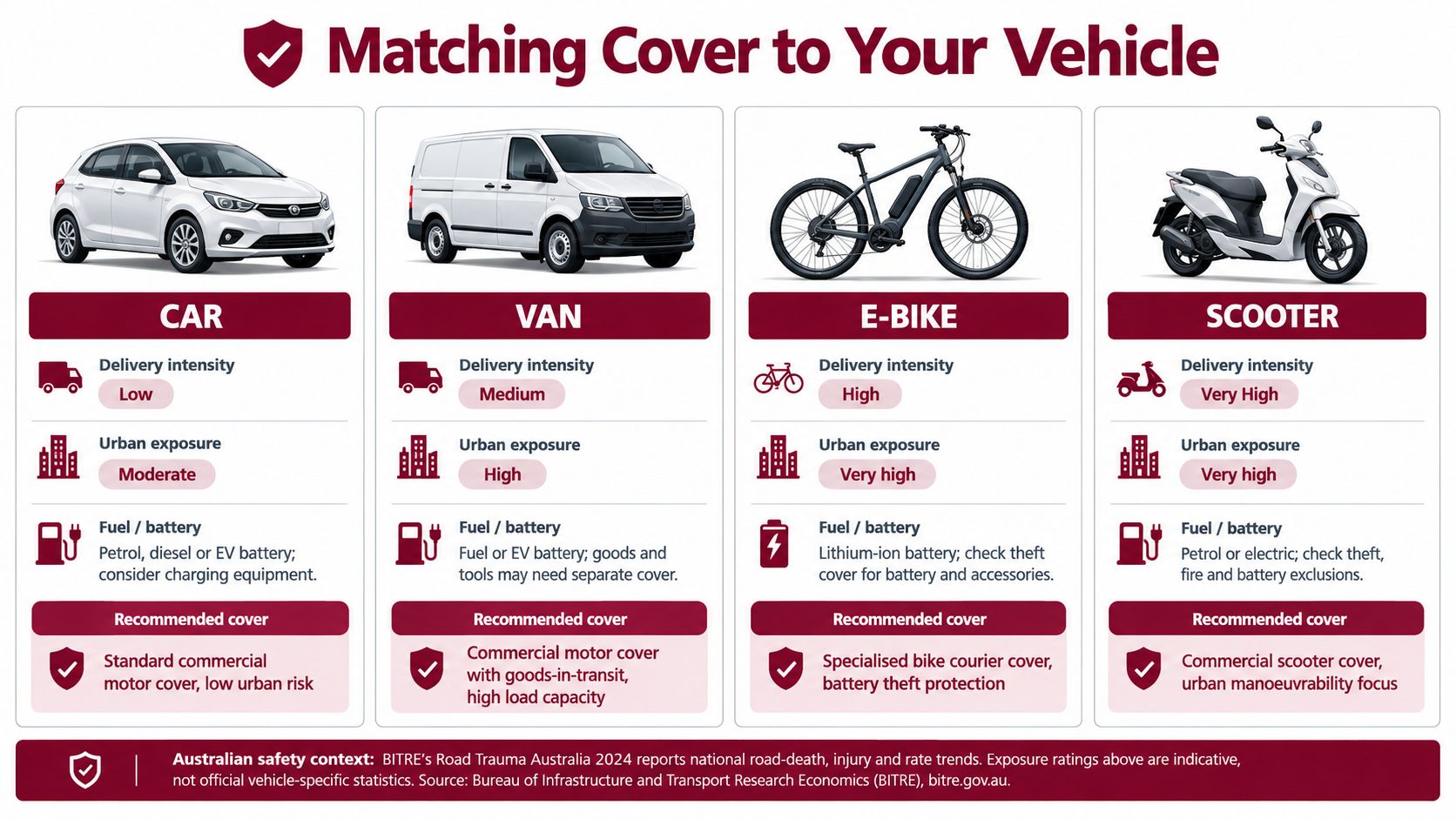
A courier car, a van, an e-bike and a scooter do not belong in the same underwriting bucket. The delivery pattern, storage risk, theft risk and riding behaviour are different, so the cover has to be different too. The vehicle type is only the starting point.
Four common vehicles, four different risk shapes
The easiest way to think about it is by exposure. A van doing metropolitan pickup and drop-off work has different loading and reversing risk from a car used part-time. An e-bike has battery, theft and speed-compliance issues that don't exist in the same way for a van. A scooter can be nimble in traffic, but it also creates questions around personal mobility device compliance and unattended parking.
Australian safety data makes the point. In Melbourne, a 2025 observation of more than 27,000 two-wheel vehicles found that most e-bike riders were food-delivery riders. It also found that one in five delivery e-bikes exceeded the 25-kilometre-per-hour limit, 33% rode on footpaths and 15% travelled the wrong way. In Queensland, there was a 112% increase in injuries to riders, passengers and pedestrians involving personal mobility devices between 2021 and 2024. SBS report
That matters because underwriting follows behaviour. A modified or high-performance e-bike can raise insurability questions straight away. So can battery charging at home, theft during a stop, or whether a personal mobility policy stops responding once the vehicle is used for paid carriage.
A simple fit-for-use matrix
- Cars: Commercial motor cover with declared delivery use, and goods in transit if parcels are carried regularly.
- Vans: Commercial motor cover with stronger cargo and liability settings, plus goods in transit for the load.
- E-bikes: Specialised courier or bike cover that addresses delivery use, battery issues, and theft conditions.
- Scooters: Commercial scooter cover with clear delivery declarations and urban-use wording.
If your fleet mixes two or more of those, treat it as a placement exercise, not a shopping exercise. ABS Insurance Brokers handles commercial motor, plant, marine and aviation placements, so mixed fleets are familiar territory rather than an odd request.
Managing Fatigue, Records and the Claims Process
Couriers don't lose claims only because of the accident. They also lose them because the records are sloppy, the notification is late, or nobody can explain the shift pattern. Fatigue is a serious operational issue, and insurers know it.
The documents that help before a claim
An Australian Government transport survey of 200 freight companies found that long driving hours, night work and poor work-rest balance were consistent determinants of fatigue. Only half of the surveyed companies believed fatigue was well managed in the industry, while one-fifth believed it was badly managed. For insurance purposes, the point is clear, if you can show fatigue controls, you're in a stronger position when an insurer starts asking hard questions. ATSB fatigue survey
Keep the records that prove discipline:
- Rosters and shift logs: show who was working and when.
- Maximum-shift rules: show there's a boundary.
- Break records: prove the driver stopped.
- Telematics alerts: help support speed, stop and route evidence.
- Subcontractor induction records: show the driver was briefed on delivery rules.
The first hour after an incident
Take photos immediately. Get dash-cam footage if you have it. Record witness details, the other vehicle's registration, the time, location and a plain description of what happened. If police are involved, note the report details and notify the insurer as soon as the policy requires.
Claims tip: the driver who writes down the facts while they're fresh usually saves the business hours of argument later.
A broker's job after that is practical, not glamorous. They chase paperwork, coordinate with insurers, and keep the claim moving so the courier isn't left guessing. ABS Insurance Brokers gets strong client feedback in that kind of work because the admin burden is often as painful as the accident itself.
Putting It Together and Getting the Right Cover
The cleanest way to buy insurance for couriers is to walk into the conversation with one page of facts, not a vague request for “full cover”. Gather the vehicle types, named drivers, kilometres, territory, goods values, whether the work is employee, contractor or platform-based, and whether the operation is local or interstate. Then ask how the policy responds to paid delivery, cargo damage, third-party injury, theft from the vehicle and driver injury.
Steadfast-network market access matters here because courier risk is not standard retail motor risk. You want terms that match the job, not the cheapest wording on a comparison page.
A few edge cases people ask me about all the time. CTP doesn't swap with a parcel across state borders, so jurisdiction still matters. A van with a stolen parcel may trigger an exclusion or excess issue, depending on the wording. Personal accident may help a gig rider between jobs, but only if the policy says so. And if an owner-builder or tradie starts doing courier work on the side, the existing cover needs to be checked before the first paid delivery leaves the driveway.
If you want the program structured properly, ABS Insurance Brokers Pty Ltd arranges commercial motor, public liability, goods in transit and related specialist cover for Australian businesses. Visit ABS Insurance Brokers Pty Ltd to discuss the way your courier work is set up, and get the right policy layers matched to that reality.