

A sole trader carries public liability insurance because a claim for third-party injury or property damage can reach business and personal assets when there's no limited-liability company between the operator and the claimant. The policy is a contract you need to read, not a checkbox you tick to satisfy a principal.
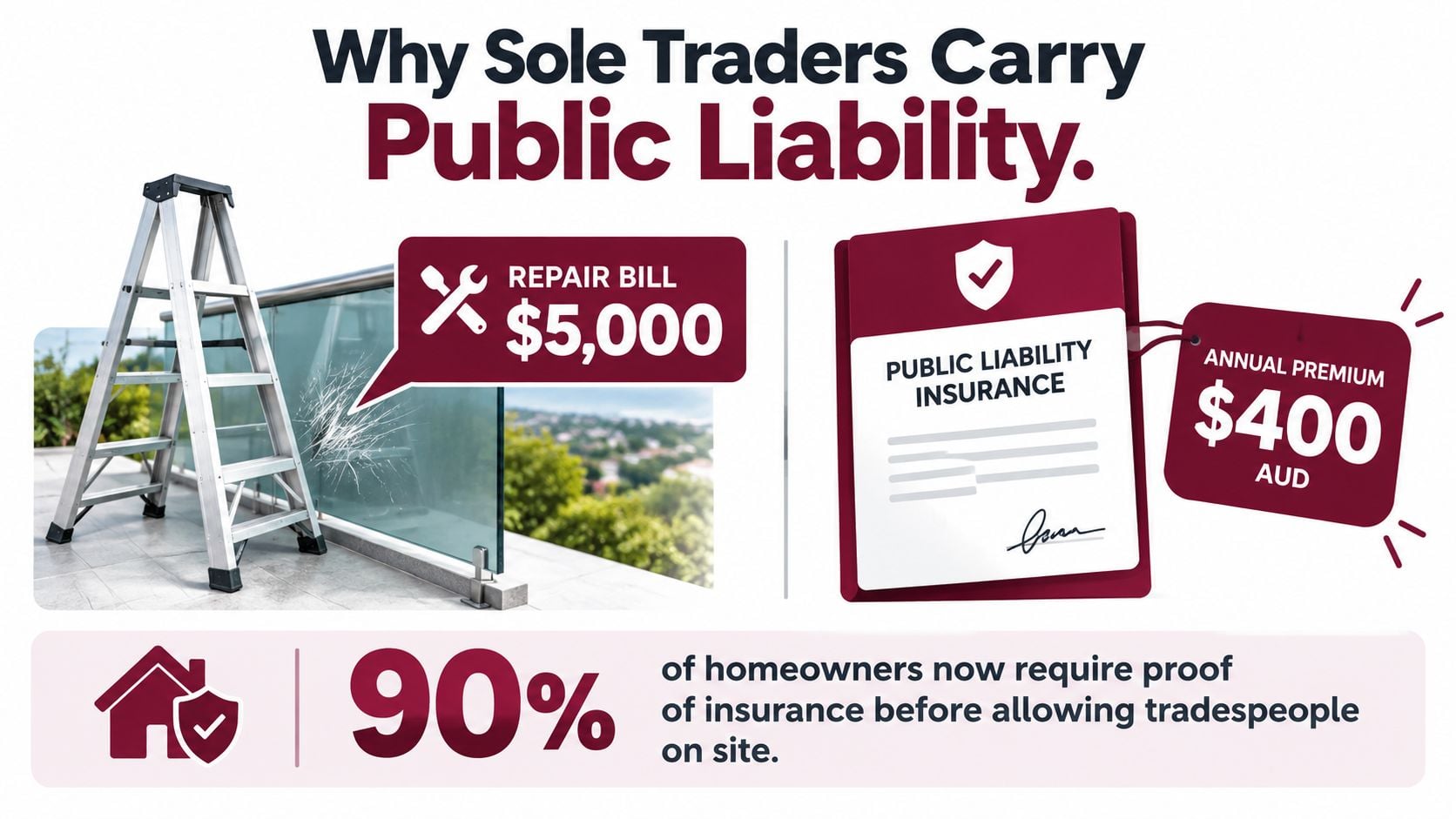
You're halfway through a job when your ladder slips against a client's glass balustrade. The glass cracks, the owner wants it replaced, and the policy you bought for $400 suddenly matters far more than the premium. A cheap certificate won't help if the insured entity is wrong, the work was undisclosed, or the wording excludes the part of the job that caused the damage.
That's the core issue with public liability insurance for a sole trader. The question isn't just whether you have a policy. It's whether the policy responds to the work you do, at a limit that matches the contracts you accept.
Table of Contents
- Why Sole Traders Carry Public Liability
- What Public Liability Actually Covers
- Choosing the Right Cover Limit
- Where to Buy Your Policy
- Getting Covered Step by Step
- Three Cost-Saving Tips That Actually Work
- Common Mistakes and Your Pre-Renewal Checklist
Why Sole Traders Carry Public Liability
A company director operating through a Pty Ltd structure may have a separate legal entity between the business and some claims. A sole trader doesn't have that same separation. The business and the operator are legally connected, so a serious liability claim can put business assets at risk and, depending on the circumstances, personal assets as well.
That exposure includes the tools in the shed, the work van, business income and potentially other assets. The Australian Bureau of Statistics data on Australian businesses recorded 664,279 sole-proprietor businesses in 2018–19, following an annual increase of 5.5%, equal to 34,890 additional businesses. Sole proprietors also recorded a 23.2% entry rate, with 146,240 new businesses entering the market that financial year.
Those figures are historical, but they show why liability isn't a niche concern. If you work in someone's home, retail premises, commercial site or construction project, one mistake can create a claim from a customer, visitor, landlord, principal or another contractor.
The policy is a working tool
Public liability is designed to respond to covered claims for third-party bodily injury, death, property damage and related legal costs caused by the business's negligence, subject to the policy wording. It can also include products liability where goods you supply later cause injury or damage.
You should treat it as part of your operating equipment. Before starting work, confirm the insured name matches your ABN and trading structure, disclose the work you perform, and check the contract requirements set by the client or principal.
Practical rule: If you wouldn't start a job without the right tools, don't start it without checking that your liability policy describes the job accurately.
Insurance won't replace safe work practices. Training that improves hazard identification and site control can sit alongside insurance, particularly for construction businesses. For practical risk-management education, consider workplace safety courses by TP Training.
The right policy won't prevent a ladder from falling. It can stop an ordinary site accident from becoming a personal financial crisis. That makes public liability foundational cover for a sole operator, not an optional business expense.
What Public Liability Actually Covers
Public liability responds to claims made by third parties, not to every loss connected with your business. In plain English, it is intended for situations where your business activity causes someone else bodily injury, death or property damage, and the policy accepts the claim.
A customer who trips over your equipment, a visitor injured at a worksite, or a client whose wall or flooring is damaged during installation may fall within the broad purpose of the cover. The insurer may also manage the legal defence and pay covered compensation or legal costs, subject to the policy limit, excess, conditions and exclusions.
A realistic trade example
An electrician drills into a concealed pipe while fitting equipment in a café. Water damages flooring, plasterwork and business contents. The public liability section may respond to the third-party property damage and the resulting defence, but only if the work, location and circumstances fall within the policy wording.
The distinction matters because the policy isn't a guarantee that every repair bill gets paid. Faulty workmanship, the cost of redoing your own work, damage to your own tools and professional errors may require different cover or may be excluded altogether.
Keep the covers separate
Workers compensation generally deals with injuries to employees. It doesn't automatically protect a sole trader personally. Business.gov.au's guidance on business insurance states that sole traders need separate protection for their own death, illness and disability arising from their work.
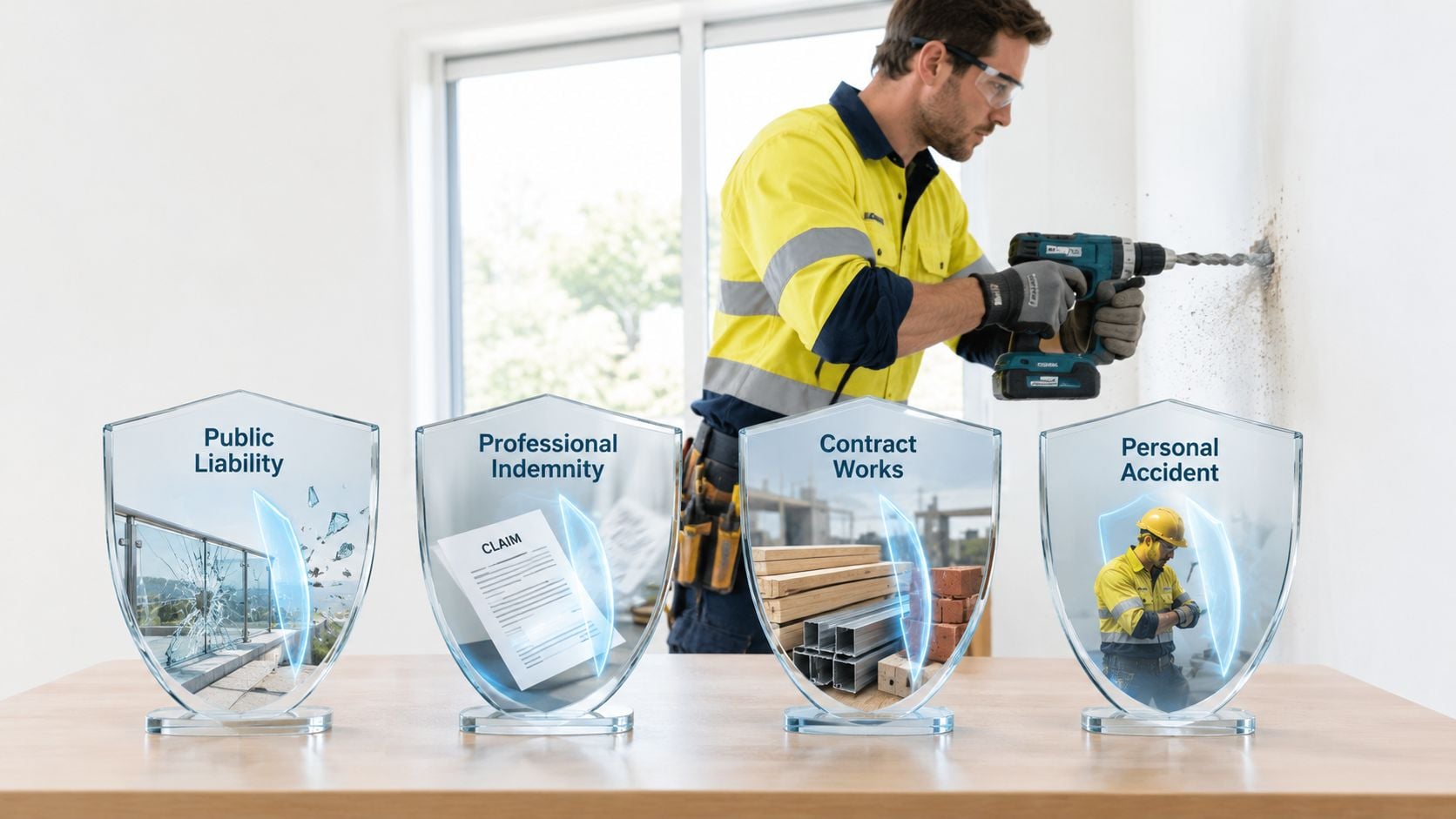
Other covers answer different questions:
- Public liability: Did your business cause a third party injury or property damage?
- Products liability: Did a product you supplied later cause injury or damage?
- Professional indemnity: Did advice, design or a professional service error cause financial loss?
- Contract works: Was project property damaged during construction or installation?
- Personal accident: Can you maintain income if you're injured or unable to work?
Your team, if you have one, also creates separate obligations and policy considerations. A subcontractor's status may depend on the working arrangement and applicable rules, so don't assume calling someone a contractor removes the need for disclosure.
The one-sentence test is simple: public liability protects against covered third-party injury or property damage caused by your business activities, not your own injury, your own assets or every cost arising from defective work.
Choosing the Right Cover Limit
There is no universal liability limit that suits every sole trader. Choose the limit by reading the contract, examining the work environment and considering the plausible severity of one incident.
NSW Small Business guidance identifies $5 million, $10 million and $20 million as commonly requested limits, with the appropriate level depending on the procurement's risk, complexity, value and public interface. The NSW insurance guide for councils and small businesses also explains that insurance should be arranged before a contract starts and that evidence should be obtained.
Compare the decision, not just the price
| Limit | Typical use | Watch-outs |
|---|---|---|
| $5 million | Lower-complexity work with limited public interface, where the client's contract accepts this level | May fail a principal's requirement or prove inadequate where high-value property or serious injury is possible |
| $10 million | Commercial work and contracts that specify a higher standard of evidence | Check whether the limit applies to any one occurrence and whether the aggregate is capped |
| $20 million | Higher-value, higher-interface or particular government and commercial programs | A higher limit still won't fix an excluded activity or an incorrect insured entity |
Consider a sole trader working inside a retail tenancy. A ceiling collapse caused by the work could damage the tenant's fit-out, stock and equipment, affect neighbouring premises and injure people nearby. The claim could involve reinstatement, hospitalisation, legal costs and business interruption. Low frequency doesn't mean low severity.
Read the aggregate wording
“Any one occurrence” usually describes the maximum available for one covered event. That doesn't necessarily mean the policy provides an unlimited amount across the policy period. An aggregate cap can limit the total payable for all claims during the period, especially for particular extensions or products liability.
Check the principal's exact requirements before accepting the job:
- Is the limit required any one occurrence?
- Is the annual aggregate unlimited or capped?
- Must the principal be noted as an additional insured?
- Is a waiver of subrogation required?
- Does the contract require completed operations cover?
- Are territorial and contractual-liability provisions suitable?
A certificate of currency confirms selected policy details. It doesn't prove that every contractual extension is available or that the work falls within the insured description.
Where to Buy Your Policy
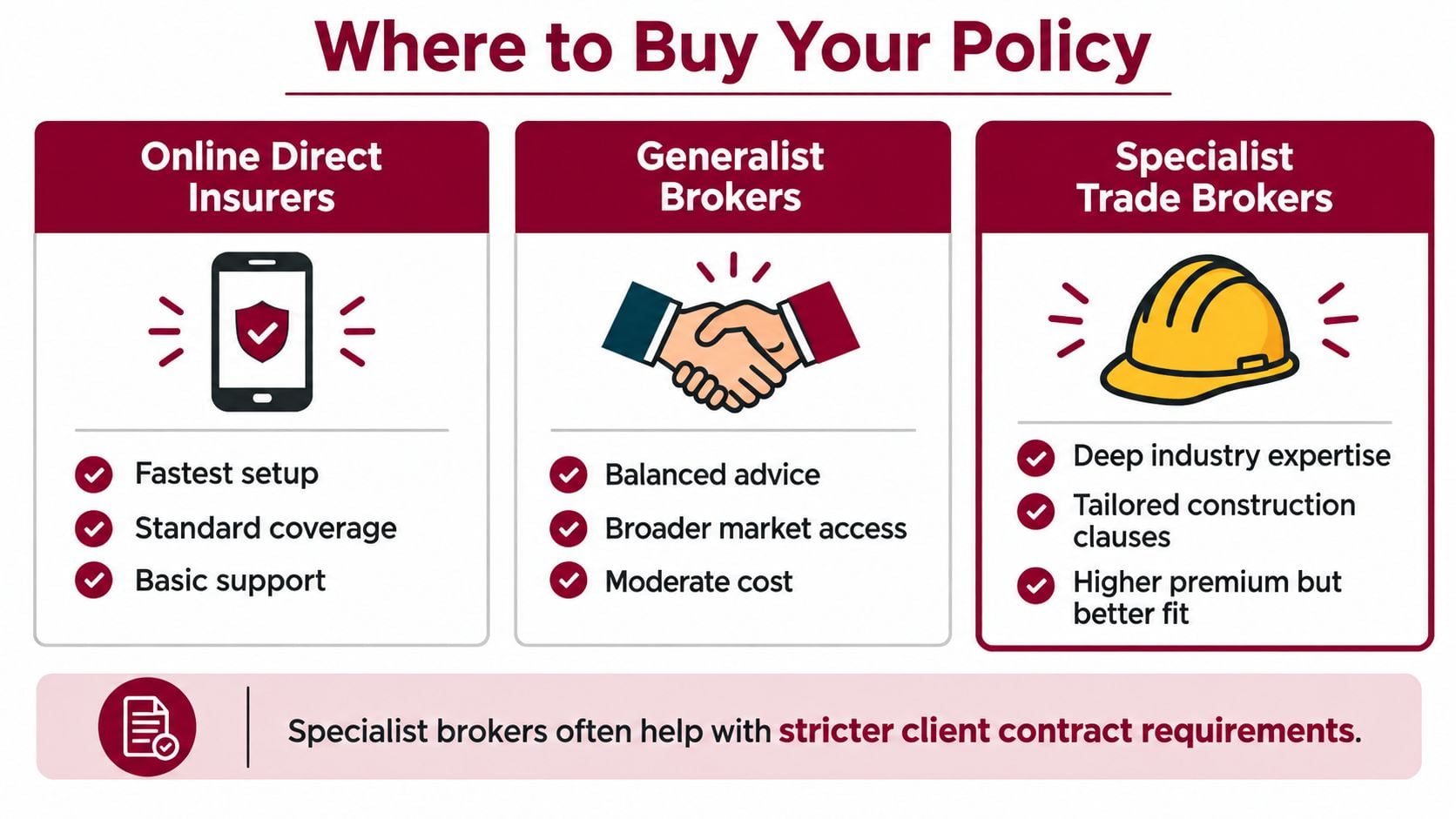
Where you buy the policy matters because the wrong buying channel is how sole traders end up with a cheap certificate and a denied claim. If your ute, savings and home equity are on the line, buy from a provider that asks how the work is really done and what the contract requires, not just your turnover and postcode.
Online direct insurers suit simple risks. If you do straightforward residential work, have no unusual contract conditions and can describe the business accurately, they can be a fast way to get cover in place. The problem is the questionnaire. It often misses the details that decide whether a claim is paid, such as roof work, hot works, subcontractors, work in occupied premises, or liability you pick up under a contract. A low premium means very little if the occupation is wrong or the exclusions cut straight across the jobs you do.
Generalist brokers sit in the middle. You get a person to speak to, and they may have access to several insurers, but that only helps if they regularly place contractor risks. Plenty of sole traders are put into an off-the-shelf small business policy that looks fine on the certificate and falls apart once someone reads the wording.
What a specialist should check
A broker who handles tradies every week should dig into the exposure, not just the business name. They should ask whether you work at height, use heat, supply or install products, disturb existing structures, enter tenanted sites, or bring in subcontractors. They should also read the insurance clauses in the contract before cover is bound.
That review should cover the wording traps that regularly cause trouble. Additional insured requirements, cross liability, waiver of subrogation, care, custody or control, and completed operations all need to line up with the job. If they do not, the policy can be cheap and still be wrong.
ABS Insurance Brokers is an Australian-owned brokerage based in Bankstown, NSW. It holds Steadfast Network Broker status and operates under Australian Financial Services Licence No. 700333.
Match advice to the job
Pay for specialist placement support when the work justifies it. Commercial sites, head contracts, government work and higher-hazard trades do. Simple domestic work often does not.
Ask each provider five direct questions:
- Who checks the occupation description against the actual work?
- Are subcontractors included, excluded, or subject to conditions?
- Does the policy cover products and completed operations?
- Will someone review the contract requirements before binding?
- Who fixes it if a principal rejects the certificate?
Choose the provider that answers those questions clearly and in writing. That is usually the better buy.
Getting Covered Step by Step
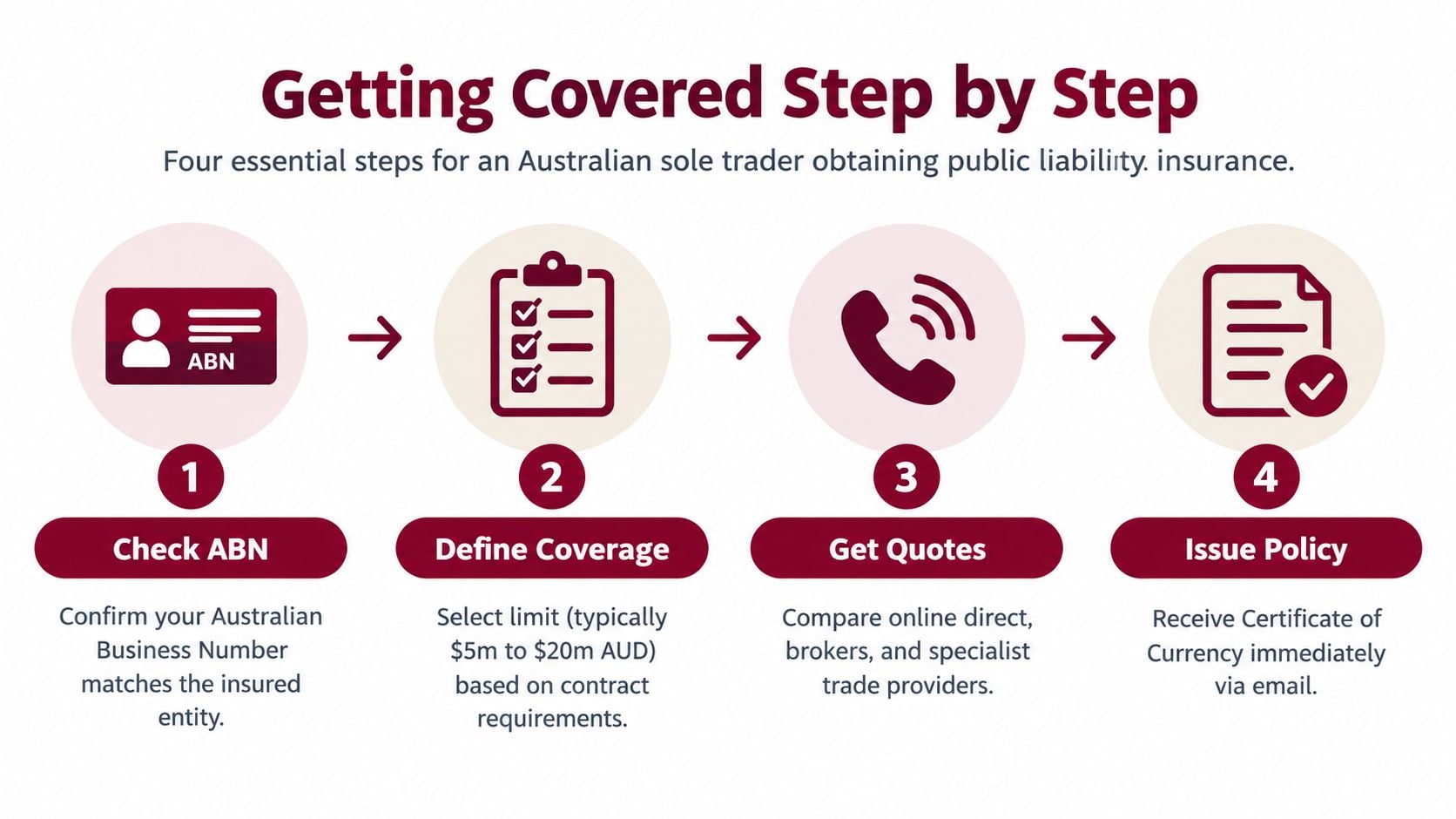
Start with the legal identity of the business. Your policy should name the sole trader or trading entity that holds the ABN and enters the contracts. A mismatch between the certificate and the contracting party can create avoidable problems when a principal checks compliance or a claim is notified.
Step one, describe the work accurately
Prepare a short, plain-English description of what you do. “Builder” is rarely enough. State whether you're a carpenter, painter, electrician, external work specialist, installer, maintenance contractor or another trade, and explain the environments where you work.
Disclose the details that can change the risk:
- Subcontracting or using labour-only contractors
- Work at height, on roofs or near edges
- Work on occupied homes, shops or offices
- Hot works, cutting, grinding or welding
- Excavation, demolition or structural alterations
- Products or materials you supply or install
- Work for government, councils, builders or major principals
Don't soften the description to obtain a lower premium. If you've changed from small residential repairs to commercial fit-outs, tell the broker before renewal.
Step two, provide the contract requirements
Give the insurer or broker the principal's insurance clause. Don't paraphrase it from memory. The wording may require a particular limit, additional-insured status, territorial scope, completed operations or a waiver of subrogation.
Then compare the requirement against the policy schedule and wording. The NSW government guidance on public liability arrangements is relevant to the principle that evidence should be obtained before contract commencement, but the specific contract remains the document that controls your obligation.
Step three, check the issued documents
A certificate of currency should show the correct insured name, policy period, occupation and limit. It's useful evidence for a principal, but it isn't the full policy.
Read the schedule, endorsements, exclusions and PDS. Confirm whether products liability is included, whether your work is restricted to certain locations, and whether subcontracting or completed work is addressed.
Step four, maintain the cover
Save the certificate where you can find it, set a renewal reminder and request an updated certificate when the policy renews. Notify the insurer when your turnover, workforce, work type or project responsibilities change.
A policy is only useful while it remains active and accurate. Letting it lapse halfway through a project creates an uninsured gap that a later renewal won't necessarily repair.
Three Cost-Saving Tips That Actually Work
Cutting the premium is sensible. Cutting the protection that makes the policy respond isn't. The useful savings come from improving how the risk is presented and choosing payment and cover options that fit your cash flow.
Pay in a way you can sustain
If annual payment is available and affordable, compare it with instalment arrangements and the total payable under each option. The important discipline is continuity. A payment structure that strains cash flow and causes cancellation can leave you exposed during an active project.
Keep your policy documents and payment records organised with an audit-ready workflow from Smart Receipts. Insurance administration is easier when certificates, invoices and renewal documents are stored consistently.
Choose the excess deliberately
A higher excess may reduce the premium, but only choose it if you can fund that amount after an incident. A sole trader dealing with damaged property still needs cash for urgent repairs, legal advice or business expenses while the claim is assessed.
Don't choose an excess based only on the quote screen. Compare it against your available working capital and the types of small claims your business could realistically face.
Bundle where the covers genuinely belong together
If you also need contract works, tools, commercial motor, personal accident or professional indemnity, ask a broker whether placing related covers together produces a more efficient structure. Bundling shouldn't mean accepting unsuitable exclusions, but one adviser can spot gaps between policies more easily than several disconnected purchases.
Before you accept any saving, disclose the full work profile. Misrepresenting the occupation, omitting subcontractors or failing to mention supplied products can create a claim problem far more expensive than the original premium.
For a practical discussion of market pricing factors, see the public liability insurance cost guide for Australia. Focus on the policy response, not just the headline amount.
Common Mistakes and Your Pre-Renewal Checklist
Most avoidable problems appear before the claim. Run this checklist before renewal and whenever your work changes.
- Confirm the insured entity: Make sure the name on the schedule matches your ABN, trading structure and contracts.
- Update the occupation: Tell the insurer if you've moved into commercial, structural, high-rise or higher-risk work.
- Declare subcontractors: Explain whether they're independent contractors, labour-only workers or part of your delivery model.
- Check the principal's wording: Review limit, additional-insured, waiver and completed-operations requirements before mobilisation.
- Test the aggregate: Confirm that “any one occurrence” hasn't been mistaken for unlimited cover across the policy period.
- Review care and control: Check how the policy treats property you're working on, holding or temporarily responsible for.
- Prevent a lapse: Keep the policy active through the full project and confirm renewal before the expiry date.
- Read the exclusions: Look for restrictions connected with height, hot works, products, excavation, pollution and professional services.
- Refresh the limit: Reconsider the contract requirements and value of the sites you now enter, rather than automatically renewing the previous limit.
A five-minute review of the contract, schedule and key endorsements costs less than discovering after an accident that the certificate never matched the work. Public liability insurance for a sole trader should be reviewed as part of the business, not filed away as a once-a-year purchase.
ABS Insurance Brokers Pty Ltd helps eligible sole traders, subcontractors and construction businesses arrange public liability insurance based on their occupation, turnover, workforce and project responsibilities. Visit ABS Insurance Brokers Pty Ltd to discuss the wording, limit and contract requirements before you start the next job.