
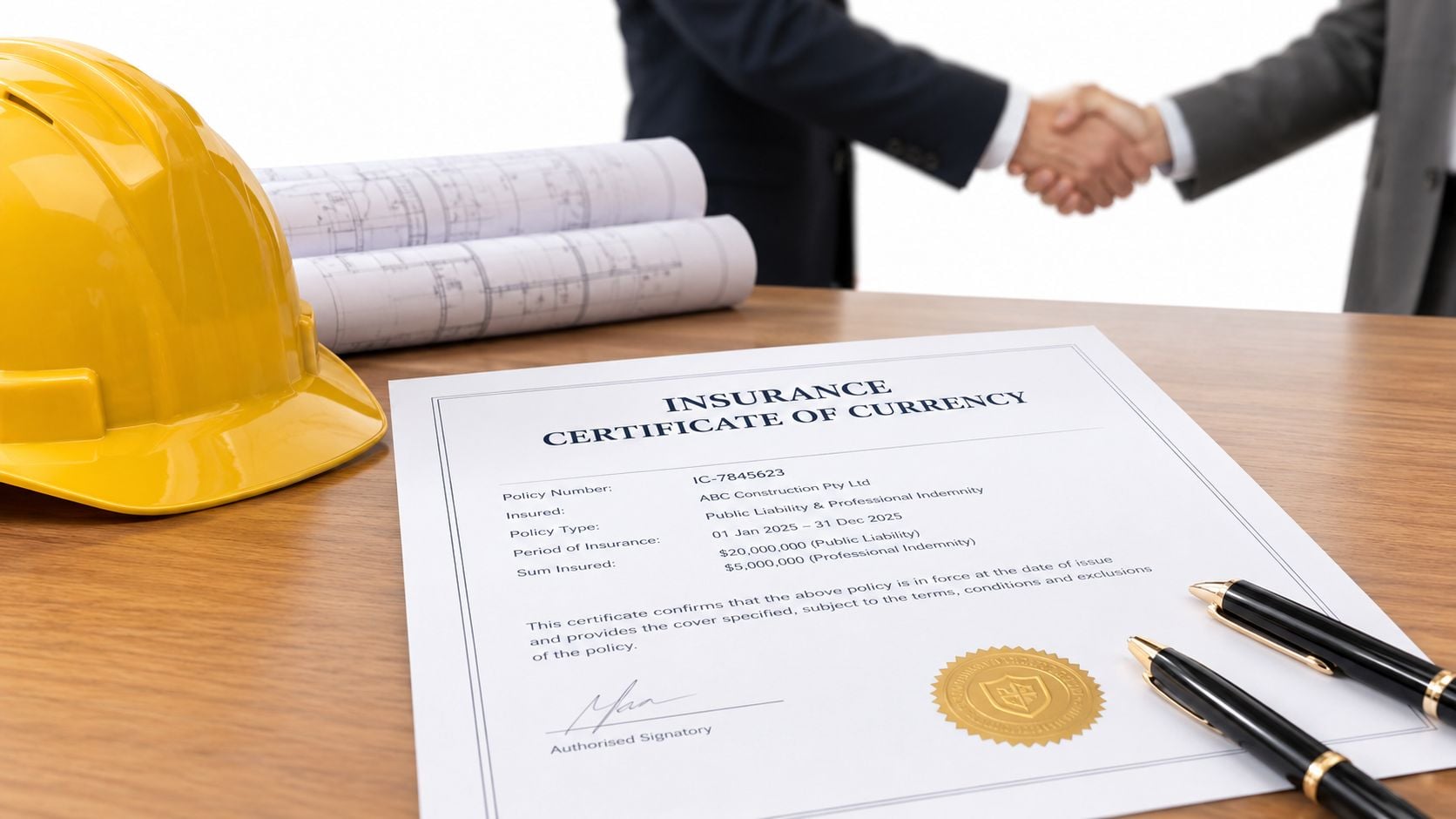
Public Liability Insurance Certificate of Currency
A public liability insurance certificate of currency helps a principal or site administrator check selected details of your policy. The insured name, activities, limit and dates should align with the requested evidence, but the certificate does not replace the wording. Review ABS’s public liability insurance service or ask ABS about your certificate.
Table of Contents
- Public liability insurance certificate of currency: what it shows
- Essential Details Included on the Document
- Navigating State and Contract Liability Limits
- Avoiding Common Documentation Mix-Ups
- How to Obtain and Manage Your Certificate
- Pre-Submission Checks for Site Compliance
Public liability insurance certificate of currency: what it shows
A public liability insurance certificate of currency is proof that a policy was in force on the date the certificate was issued. It is an evidentiary document, not the policy itself, and it does not replace the policy wording, conditions, exclusions, or endorsements, as set out in the Australian Government Department of Defence guidance on certificates of currency. ABS's public liability insurance overview is a useful starting point if you need the basic cover context before you send documents to a client.
That distinction matters because site managers and procurement teams are rarely trying to collect paperwork for its own sake. They want a document they can check quickly against the contract's insurance requirement, the named insured, and the work being performed. A policy number alone doesn't show the cover details they need, and a verbal confirmation from your office won't satisfy an induction checklist.
Practical rule: if a principal asks for the certificate, send the certificate, not the schedule, not the tax invoice, and not a screenshot from an email thread.
The key point is simple. A certificate can show apparent currency at a point in time, but it doesn't prove a particular claim will be covered. That's why good compliance checks start with the certificate and then compare it against the contract wording, not the other way around.
Essential Details Included on the Document
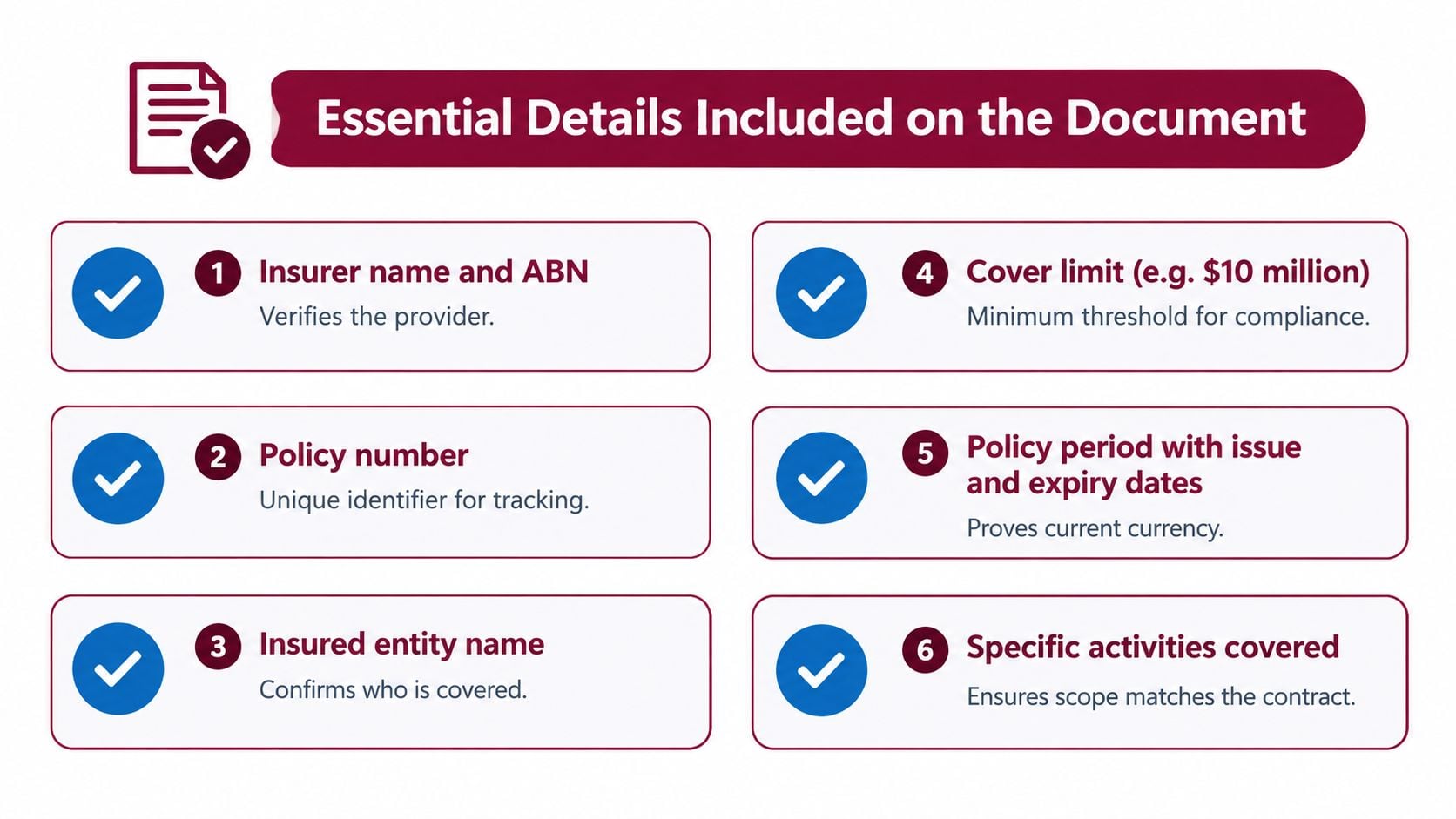
A clean certificate should let a contract manager confirm the basics without chasing your broker for follow-up emails. The Defence guidance says certificates generally identify the insurer, insured party, policy number, insurance period, type of cover, liability limit, and issue date. For public and products liability policies, the certificate should also identify the insured business and confirm whether cover is written on an occurrence basis. That same guidance is a good reminder that the certificate is a snapshot, not the full policy record.
The practical test is whether the document matches the legal entity doing the work. If the contract is in a company name, a trust name, or a specific trading entity, the certificate needs to line up with that identity. A mismatch here is one of the most common reasons a supposedly valid document gets bounced at onboarding.
What to check before you send it
- Insurer name and policy number. These let the client identify the policy fast and trace it back if there's a query.
- Insured entity name. This should match the contracting party, not just the trading name on your truck signwriting.
- Cover limit and policy period. Both need to fit the job, because a current certificate with the wrong limit still gets rejected.
- Type of cover and wording. For public and products liability, check whether the document confirms occurrence-based cover where required.
- Issue date. Some procurement teams want a fresh document, especially if they're comparing it with a current onboarding file.
- Activities covered. The description should reflect the work you're doing, not a generic label that leaves too much room for doubt.
A certificate that looks tidy but names the wrong entity can still cause delays. A certificate that names the right entity but doesn't show the right scope can do the same thing.
Navigating State and Contract Liability Limits
The mistake I see most often is treating any current certificate as good enough. It isn't. Queensland's government prequalification checklist requires contractors seeking major-project prequalification to provide a public liability certificate of currency showing at least $20 million of cover, while Tasmania's building-licensing guidance specifies $5 million public liability insurance for builders and demolishers, as set out in the Queensland government checklist. Queensland's checklist shows why the limit has to be measured against the actual job, not just against a general market norm.
That is why a certificate can be genuine and still be unusable for the site in front of you. A state licence condition, a council event permit, or a head contractor's schedule can set a different floor from the one your day-to-day work usually needs. If the contract calls for a higher limit than your policy shows, the document is functionally useless for that engagement.
Common Australian public liability limit requirements
| Jurisdiction / Context | Minimum Public Liability Limit | Application |
|---|---|---|
| Queensland Government major-project prequalification | $20 million | Contractors seeking major-project prequalification |
| Tasmania building and construction licensing | $5 million | Builders and demolishers under licensing guidance |
| Contract-specific site requirements | Varies by contract | Head contractor, principal, or council conditions |
The table above highlights the core issue. You are not checking whether you have a certificate; you are checking whether the certificate satisfies the particular gatekeeper in front of you. A limit that works for one job can fail on another, even when the policy is active and the document is perfectly genuine.
A current certificate isn't the finish line. It's the first document the client uses to test whether your insurance matches their risk settings.
Avoiding Common Documentation Mix-Ups
One of the fastest ways to stall a site start is sending the wrong paperwork. A tax invoice is not proof of cover, even if it shows you've paid something to an insurer or broker. Tasmanian building-licensing guidance is explicit that tax invoices are not accepted as proof of cover, which is why admins and site coordinators keep asking for the actual certificate.
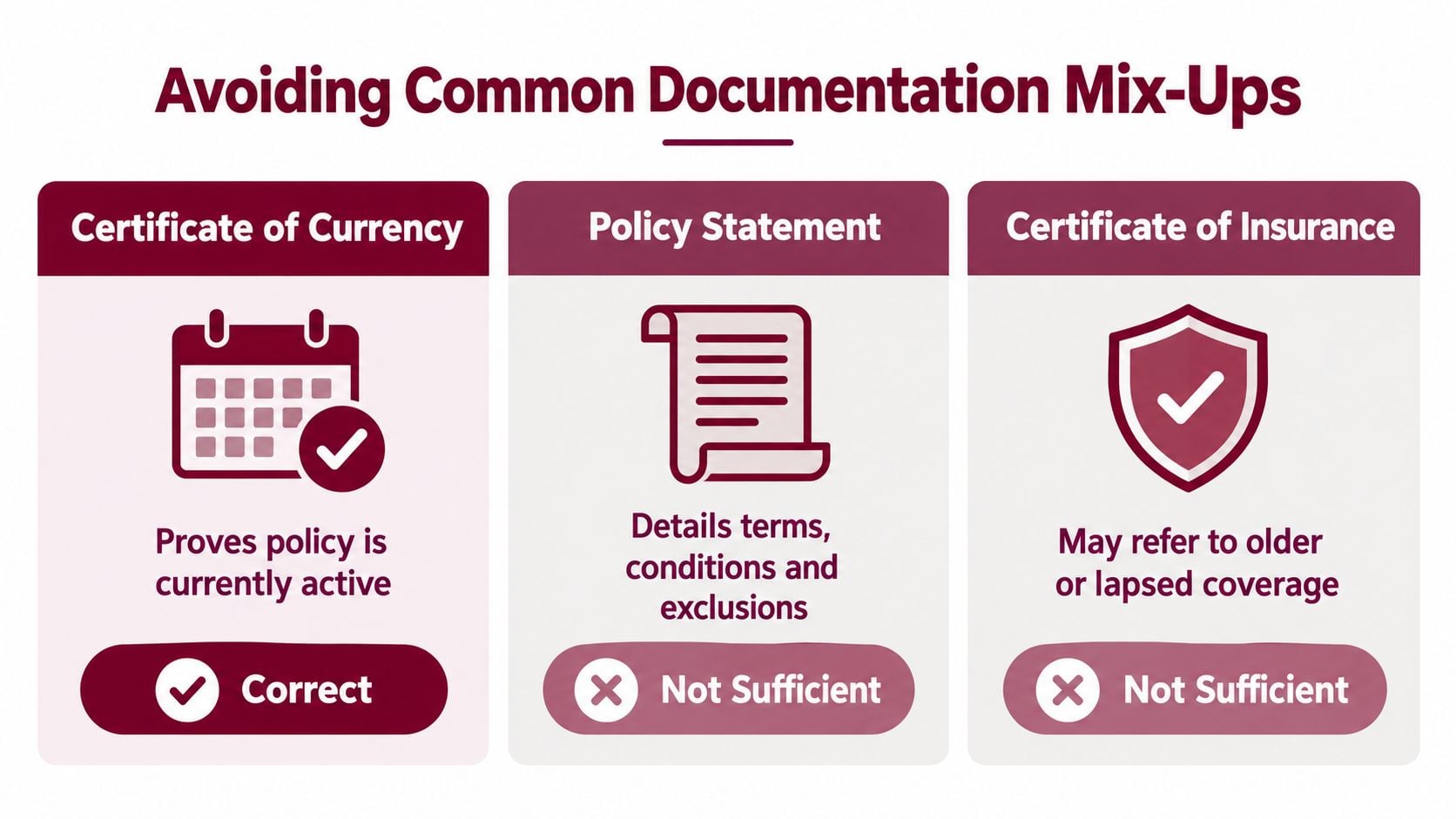
The other common mix-up is confusing public liability with domestic building insurance. They protect different risks. Victorian consumer guidance tells customers engaging tradespeople on smaller building or renovation jobs to ask for a public liability certificate because the insurance protects the customer and third parties against damage caused by the tradesperson, while separate guidance uses a distinct $16,000 threshold for domestic building insurance before deposits are taken, which shows the two products are not interchangeable.
A practical way to think about it is this. Public liability handles third-party injury and property damage exposure on site. Domestic building insurance sits in a separate lane and responds to a different kind of building risk. If you hand over the wrong document, the assessor won't do the translation work for you.
The best document pack is the one a site manager can read in under a minute without asking a follow-up question.
How to Obtain and Manage Your Certificate
Start with your broker or insurer and ask for the certificate in the exact entity name used on the contract. If you're taking on a new project, give the project specifics up front, including the work description, the site location, and any special client wording. That lets the certificate line up with the principal's requirements before the email chain starts.
If you use a broker, make them work as a document-checking layer as well as a placement layer. ABS Insurance Brokers' 2026 guide on getting public liability insurance is one example of the type of broker resource that can help tradies and builders prepare the right request before they submit paperwork to a client. For site teams that need broader operational support, an external procurement partner for site management can also help keep the paperwork flow organised across multiple suppliers and contractors.
Because most business insurance policies renew annually, you need a renewal diary rather than a memory test. Defence guidance notes that contractors may need to provide an updated certificate each year to demonstrate continuing compliance. That matters on long-running jobs, where the original certificate may be out of date even though the policy relationship is still active.
A simple management routine that works
- Request the certificate early. Don't wait until induction day.
- Check the legal name first. If the entity name is wrong, fix that before anything else.
- Match the project wording. The activities listed should fit the actual scope of work.
- File the current version centrally. Keep the latest PDF where your admin team can find it fast.
- Set a renewal reminder. A current certificate today can become stale without notice if you're not tracking expiry.
For contractors who also manage other compliance documents, this broker checklist on code compliance and commercial general insurance is a sensible companion resource because the same discipline applies across multiple policy types. The habit you want is boring and reliable, because that's what gets jobs moving.
Pre-Submission Checks for Site Compliance
Before you send the certificate, run the same check every time. Confirm the named insured is the exact legal entity in the contract, then compare the liability limit with the schedule or licence condition, and make sure the policy period covers the full project window. Government procurement guidance says agencies should verify the type of insurance, insured, insurer, cover level, policy period, and scope of cover, and it notes that a certificate can be genuine and current yet still fail if the limit is too low or the named insured is wrong. Tasmanian procurement guidance is clear on that point.
That same check should pick up any required products-liability wording or site-specific scope language before the assessor does. It should also tell you whether the certificate needs to be replaced because the policy has rolled over or the project has changed. The point is not to create more paperwork, it's to stop a rejected submission before it interrupts start dates.
If you're coordinating multiple subcontractors, fold the certificate check into your wider site paperwork process rather than treating it as a one-off task. A short, repeatable review is usually enough to keep the admin side moving while the work crew gets on with the job.
ABS Insurance Brokers Pty Ltd helps builders, tradies, and commercial clients arrange public liability cover and obtain the supporting certificate in the right name and format for site access and contract checks. If you need practical help matching your cover to a contract requirement, visit ABS Insurance Brokers Pty Ltd and ask for advice that fits the job you're about to start.