

You've quoted a second-storey deck, ordered the timber and booked the first day on site. Then the builder asks for a Certificate of Currency, the homeowner wants your insurance details, and you realise the policy you bought months ago may not match the contract in front of you.
That's where carpenters get caught. Public liability insurance isn't a generic tick box. It follows your workflow, your contract, the people working around you and the type of property you touch. Buy it by price alone and you can still be uninsured for the job that matters.
Table of Contents
- Why Carpenters Need Public Liability in the First Place
- What Public Liability Actually Covers for a Carpenter
- Choosing the Right Cover Limit for Carpentry Work
- Public Liability and the Other Covers a Carpenter Usually Needs
- Common Public Liability Claims That Catch Carpenters Out
- Reading the Contract Before You Sign
- Why the Cheapest Quote Is Rarely the Best Cover
- Putting It Together and Getting Site-Ready
Why Carpenters Need Public Liability in the First Place
A second-storey deck in Mosman is moving along smoothly. Timber is stacked across the driveway, tools are set up near the side gate and a child from next door is riding a scooter past the work area. A sawhorse shifts. A heavy post falls sideways and lands on the neighbour's car.
The homeowner's letter of demand arrives within a week. They want the repair cost, a hire car and an explanation of why the site wasn't secured. You didn't damage your own tools or property. You damaged somebody else's property while carrying out paid work. That is precisely the kind of event public liability insurance is designed to address.
A hammer can fall from a scaffold. An offcut can cut a visitor's foot. A load can shift from a ute parked in a shared street. None of those losses is the client's responsibility, and a home contents policy isn't a substitute for business liability cover.
Practical rule: If your tools, materials or workers enter somebody else's property, treat public liability as a working tool, not an optional business extra.
The NSW obligation many carpenters underestimate
For residential building work in New South Wales valued above AUD 20,000 including GST, the licensed builder or tradesperson must arrange the required Home Building Compensation cover before requesting or accepting money, including a deposit, and before starting work. NSW guidance also treats a carpenter as the principal contractor where the carpenter contracts with an owner-builder for qualifying work. NSW Government guidance on insurance cover makes clear that a subcontractor's own policy doesn't discharge the principal contractor's obligation.
That statutory obligation is separate from public liability, but it proves the broader point. Insurance sits inside the legal and commercial process of starting a job. If you're building a company structure or considering how to protect assets with a company, get tax and business-structure advice alongside your insurance advice.
Public liability pays for the third party's covered loss and the legal work needed to respond. It gives you a claims process, an insurer-appointed solicitor where appropriate and a financial limit behind your business. Without it, one ordinary site mistake can become a personal business problem.
What Public Liability Actually Covers for a Carpenter
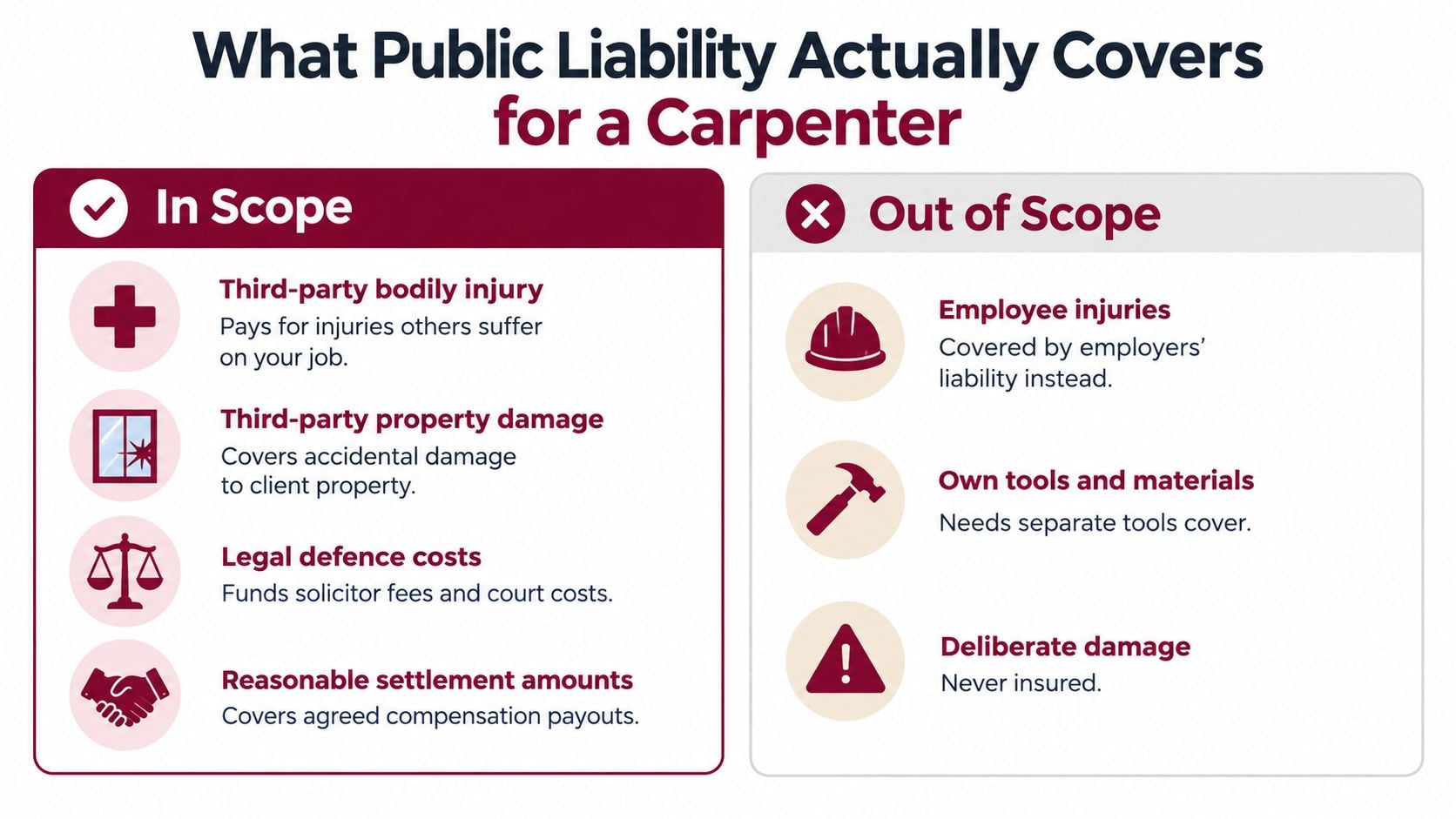
Public liability responds when your business causes third-party bodily injury or third-party property damage, subject to the policy wording, exclusions and limit. It can also pay reasonable legal defence costs and an agreed settlement or court-awarded compensation when the claim falls within cover.
A claim that normally sits inside the policy
You're cutting framing beside a client's driveway. A circular saw throws a nail or metal fragment into a parked windscreen. The vehicle belongs to somebody else, the damage happened during your work and the owner makes a demand against your business.
That is the right shape of public liability claim. Your insurer investigates what happened, considers whether you were legally liable, appoints or approves legal representation where needed, and deals with the repair or settlement if the policy responds. Don't admit liability at the gate or promise to pay before notifying the insurer. Record the scene, identify witnesses and preserve the damaged item.
The cover can also respond to an injury claim. A visitor trips over a plank left across a hallway, or a passer-by is hurt by an unsecured piece of material. The policy isn't rewarding poor housekeeping. It is transferring the financial consequences of an accidental third-party loss that arose from your business activity.
Where the cover stops
Public liability isn't a workmanship warranty. If you install a door frame out of square, the cost of removing and reinstalling your own defective work generally remains yours. If that defect damages other property, such as a wall or finished flooring, the resulting damage may be considered separately, subject to the policy terms. Australian trade insurance guidance from Marsh describes the liability limit as the maximum indemnity available for third-party injury, property damage and associated defence costs.
Your own tools need tools cover. Employee injuries normally fall under workers' compensation arrangements, not public liability. Deliberate damage is not an insurable accident. Read the exclusions and definitions before assuming a claim is covered.
The practical test is simple: what was damaged, who owned it, and was the damage accidental? Then ask whether the event arose from the insured business activity and whether an exclusion or sub-limit changes the answer.
Choosing the Right Cover Limit for Carpentry Work
Choose the limit by the worst contract you're likely to accept, not by the cheapest quote on the screen. Australian carpentry policies commonly offer $5 million, $10 million and $20 million limits, while public liability pricing also changes with turnover, claims history, work type, employee count and subcontracting.
Published Australian pricing data gives entry-level examples of about $41 per month for $5 million, $48 per month for $10 million and $55 per month for $20 million cover. The same data reports that typical carpenters paid roughly $71 to $111 per month overall, because the business profile often matters more than the limit alone. See the Australian carpenter insurance cost guidance for the underlying pricing context. A separate NSW trade guide gives an example premium band of about AUD 900 to AUD 1,600 for a small residential crew carrying AUD 10 million cover. The NSW carpenter insurance guide from BizCover also notes that 31.9% of Australia's almost 150,000 carpenters and joiners are based in New South Wales.
| Limit | Typical premium band | Best-fit contracts | Exposure case |
|---|---|---|---|
| $5 million | Entry-level examples start at about $41 per month, depending on the business profile | Small domestic repairs, minor renovations and low-risk residential work | Can be a reasonable starting point, but may fail a builder, strata or institutional contract requirement |
| $10 million | Entry-level examples sit around $48 per month, with actual pricing driven by underwriting | Most established residential subcontracting and many commercial site arrangements | The practical default where the contract asks for a substantial liability limit |
| $20 million | Entry-level examples sit around $55 per month, before business-specific adjustments | Major commercial work, government-related contracts, shopping centres and multi-party sites | Appropriate when one event could injure many people or damage high-value surrounding property |
What I recommend
For a carpenter doing ordinary residential work, $5 million can be defensible only if the contracts accept it. Don't confuse “legally possible” with “commercially acceptable”. A builder can refuse site access because the certificate shows a lower limit than the subcontract requires.
$10 million is the sensible working default for many carpenters. It gives you room for contracts that won't accept entry-level cover and avoids repeatedly upgrading the policy every time a new builder asks for a certificate.
Choose $20 million where the environment magnifies the loss: childcare fit-outs, shopping centres, multi-storey residential projects or sites with dense public access. The premium difference can be modest compared with the additional indemnity available, but the contract still controls. Before signing, use this certificate of insurance explained resource, and compare the wording with the principal's requirements. You can also review current builders public liability insurance costs as part of your budgeting.
Public Liability and the Other Covers a Carpenter Usually Needs
Public liability is the centre of the policy stack, but it isn't the whole stack. A carpenter who supplies materials, stores tools in a ute, supervises design work or takes responsibility for an unfinished structure has exposures that public liability doesn't automatically absorb.
Contract works protects the work, structure and materials during the construction period, subject to the wording. It matters on renovations, decks, fit-outs and larger fixed-price projects where a fire, storm or accidental event damages work before handover. Public liability is aimed at third-party injury and damage, not every loss affecting the project itself.
Product liability becomes important when you supply an item that later causes damage. A pre-finished door, staircase component or joinery piece can create a different claim pathway from damage caused by your installation activity. Australian trade insurers commonly package public liability with product liability and optional tools cover because supply-and-install work creates overlapping exposures. HIA's tradies insurance guidance outlines this broader approach to trade cover.
Cover Map for a Working Carpenter
| Scenario | Public Liability | Contract Works | Product Liability | Tools / PI |
|---|---|---|---|---|
| Visitor trips over timber on site | Usually the relevant liability section, subject to terms | Not the main response | Not usually relevant | Tools and PI are not the primary response |
| Storm damages an unfinished deck | Usually not the main response unless third-party damage also occurred | The relevant project cover may respond | Not usually relevant | Tools cover may respond only to insured tool damage |
| Supplied staircase component causes damage after installation | May respond to resulting third-party damage, subject to wording | Depends on whether the project is still in progress | May be relevant to the supplied component | PI may apply if the claim concerns advice or design |
| Nail gun and cordless tools are stolen from a locked vehicle | Not designed for your own tools | Not automatically the answer | Not relevant | Tools cover is the appropriate option |
| You advise on load-bearing fixings and the advice causes financial loss | Not generally designed for pure advice or design errors | Not the primary response | Not the primary response | Professional indemnity may be required |
Avoid the overlap trap
A business pack can be cleaner than buying disconnected policies, but bundling doesn't fix incorrect declarations. Tell the insurer whether you supply materials, use subcontractors, work at height, undertake structural work or provide design advice.
If you employ people, check workers' compensation requirements in the relevant state or territory. If you work alone on remote or hazardous sites, insurance should sit alongside a real safety process. A practical lone worker protection guide can help you build that process. And if clients ask why professional indemnity sits apart from public liability, this comparison of professional indemnity versus public liability is useful.
A subcontractor should also assume they need their own policy unless the contract clearly says otherwise and the insurer confirms the arrangement. The head contractor's policy is not a substitute for checking your own name, activities and limits.
Common Public Liability Claims That Catch Carpenters Out
The claims that cause trouble usually start with a normal task performed in a crowded or poorly controlled space. The policy may be sound, but the carpenter has failed to preserve evidence, declared the wrong activity or assumed somebody else's insurance would respond.
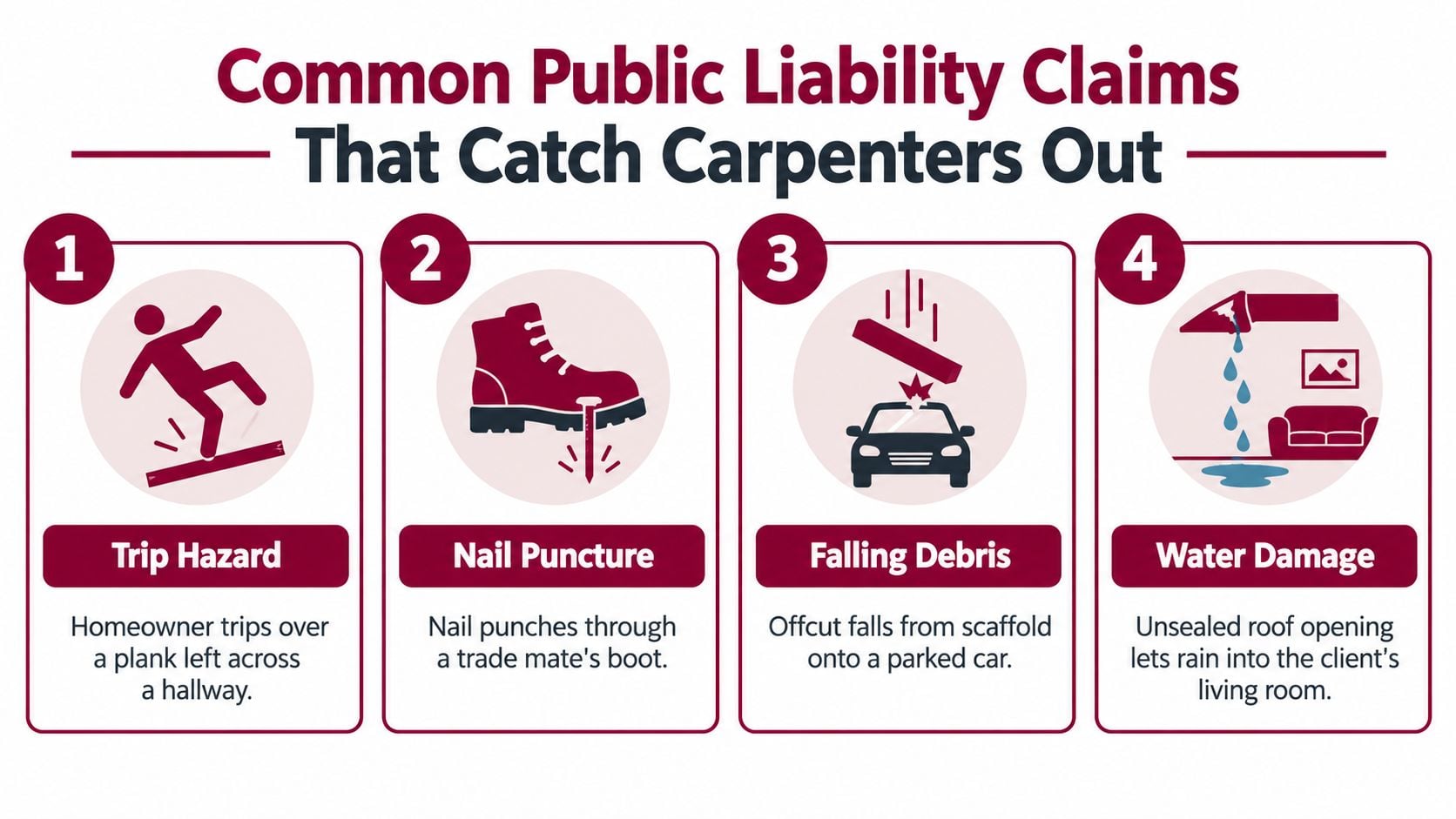
The four patterns I see most often
A third party is injured. A homeowner trips over a loose plank, a nail punctures a trade mate's boot or a child cuts themselves on offcuts. The insurer will want photographs, witness details, site records and a clear account of who controlled the area. A vague explanation such as “it was there when I arrived” weakens your position.
Someone else's property is damaged. A dropped tool cracks a stone benchtop, sparks mark a parked vehicle, overspray reaches a freshly painted wall or an auger hits a hidden water line. Stop work, prevent further damage, photograph the scene and notify the insurer promptly. Don't discard the tool or repair the damage before the insurer has had a chance to inspect it.
A subcontractor causes the loss. The principal may still look to your business because your contract makes you responsible for the subbie's work. Obtain certificates before the subbie starts, check that the insured name matches the contracting entity and keep records of the exact work they performed. A subbie's expired or inadequate policy can leave you arguing about recovery after the claim has already landed on your desk.
The defect appears after handover. A roof opening isn't sealed properly and rain enters the living room. The insurer may separate the cost of correcting your defective work from the resulting water damage. Keep the scope, photographs before covering work, product information, inspection notes and handover records. That evidence helps establish what failed and what damage followed.
Claim discipline matters: Notify the insurer when you receive a demand, not when the dispute has already become a court timetable.
The grey zone is where carpenters lose confidence in their policy. Public liability may respond to accidental damage caused by faulty work, while refusing the cost of redoing the faulty work itself. That isn't necessarily an unfair outcome. It reflects the difference between liability for damage to other property and a guarantee that your own workmanship will be perfect.
Reading the Contract Before You Sign
Most public liability problems begin in the contract, not at the saw bench. Read the insurance clauses before you accept the job, because the principal's requirements may be stricter than the policy you already hold.
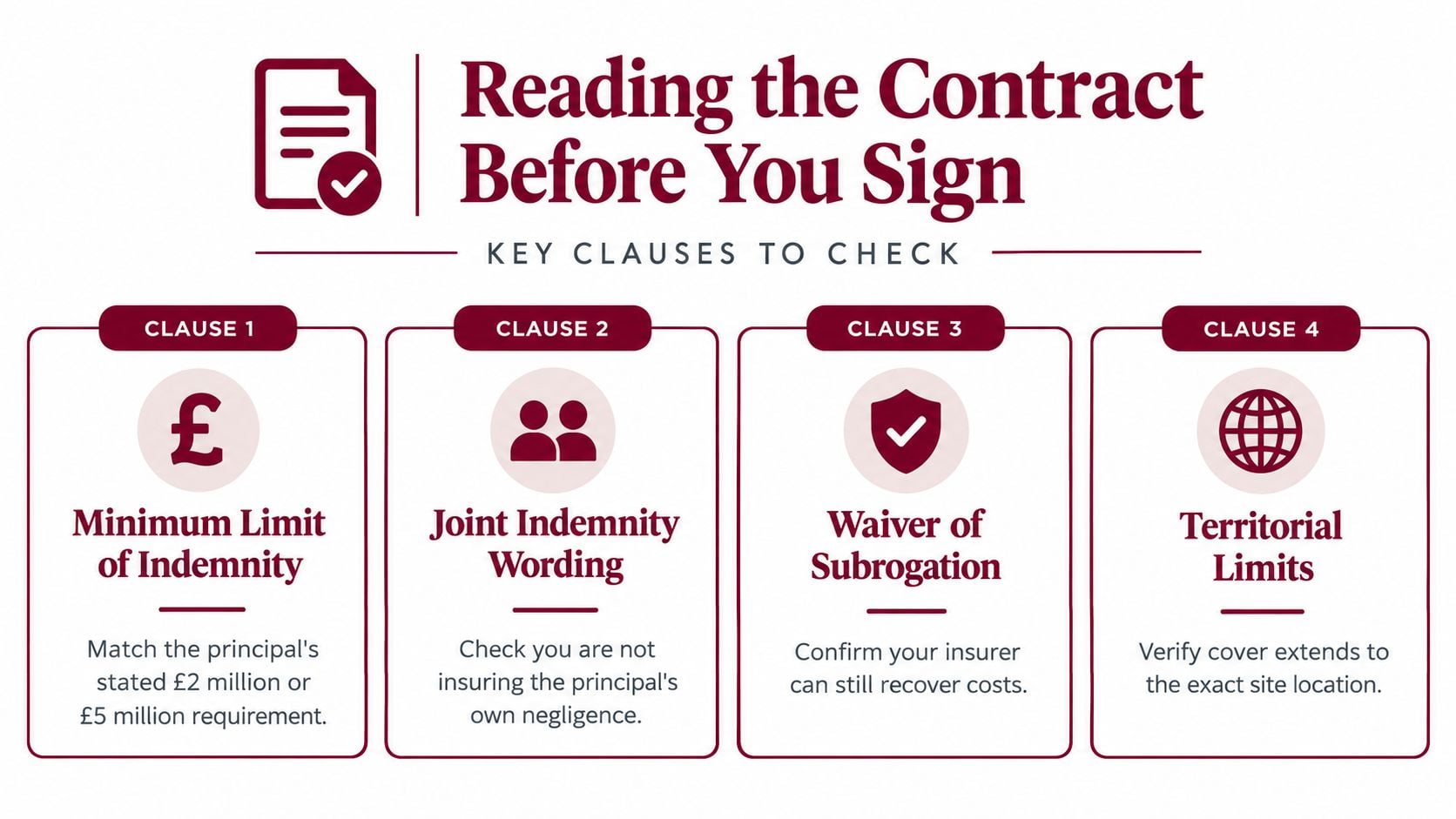
Isolate these clauses
Minimum limit of indemnity: Find the exact limit and whether it applies to each occurrence or in the aggregate. If the contract asks for more than you hold, fix the policy before signing.
Additional insured wording: Some principals want their legal entity named as an additional insured. Not every policy provides that automatically, and a certificate alone may not create the rights the contract expects.
Principal-arranged cover: A builder may arrange a project or wrap policy and require subcontractors to contribute or sit beneath it. Ask what it covers, who is insured, what excess applies and whether your own policy remains necessary.
Indemnity and liability wording: Look for cross-liability and severability provisions. Check whether you're being asked to indemnify the principal for the principal's own negligence. That transfer can be much broader than liability arising from your work.
The certificate trap
A certificate of currency proves that a policy was recorded as current on the stated date. It doesn't rewrite the policy, remove exclusions or guarantee that the job activity is covered. Check the insured name against the legal entity on the contract, the policy period, the limit, the business description and any endorsements.
Before you sign, run this short checklist:
- Limit: Does the policy meet the contract's minimum?
- Entity: Is the correct company or sole trader name insured?
- Site: Does the territorial and activity wording fit the job?
- Principal: Is additional insured or contractual liability wording required?
- Subbies: Must your subcontractors carry matching cover?
- Evidence: Can you produce the schedule and relevant endorsements, not only a certificate?
Ask the broker to comment on the actual clause. A certificate sent by email is not a substitute for contract review.
Why the Cheapest Quote Is Rarely the Best Cover
The lowest premium often wins because it looks easy to compare. Public liability isn't a commodity with one uniform outcome. Two quotes can show the same limit while treating height, hot work, subcontractors, property being worked on, hired plant and contractual liability very differently.
An underwriter will usually examine your turnover, employee count, subcontracting intensity, work type, claims history and the sites where you operate. A carpenter doing domestic repairs from ground level presents a different risk from a crew carrying out structural work across several commercial locations.
| Underwriting factor | How it moves the quote | What to watch for |
|---|---|---|
| Turnover | More work generally means more exposure for the insurer | Make sure the declared figure reflects the business you're actually writing |
| Subcontractor use | More parties can create more control and recovery issues | Confirm whether subbies are covered, excluded or required to hold their own policy |
| Height and structural work | Greater severity can change acceptance and terms | Check height limits and whether the policy matches roof framing or multi-level work |
| Hot work | Sparks, heat and fire can create a severe property loss | Look for hot-work conditions, permits and exclusions |
| Claims history | Prior losses affect underwriting confidence | Give complete details and explain the corrective action taken |
| Contractual obligations | Broad indemnities can expand your assumed responsibility | Have the insurer or broker review principal indemnity wording |
| Excess and sub-limits | A cheaper policy may shift more of the loss back to you | Check property in your care, custody or control and hired equipment provisions |
Pay for the gaps that matter
I'd rather see a carpenter pay for a policy that correctly reflects their work than buy a cheap policy with a broad exclusion for the activity they perform. Ask specifically about retroactive cover where available, principal indemnified wording, hired plant, work at height, hot work and the excess.
Don't pay extra just because a policy has a long feature list. Pay when the feature answers a real contract or claims exposure. A large limit doesn't help if the policy excludes the work, the insured name is wrong or the claim falls within a sub-limit.
The best quote is not necessarily the most expensive. It's the one that leaves the fewest surprises between the job description, the contract and the claim.
Putting It Together and Getting Site-Ready
A carpenter can make the insurance decision repeatable. Do it before every material contract, especially when the project moves from domestic work into a builder, commercial or multi-party site.
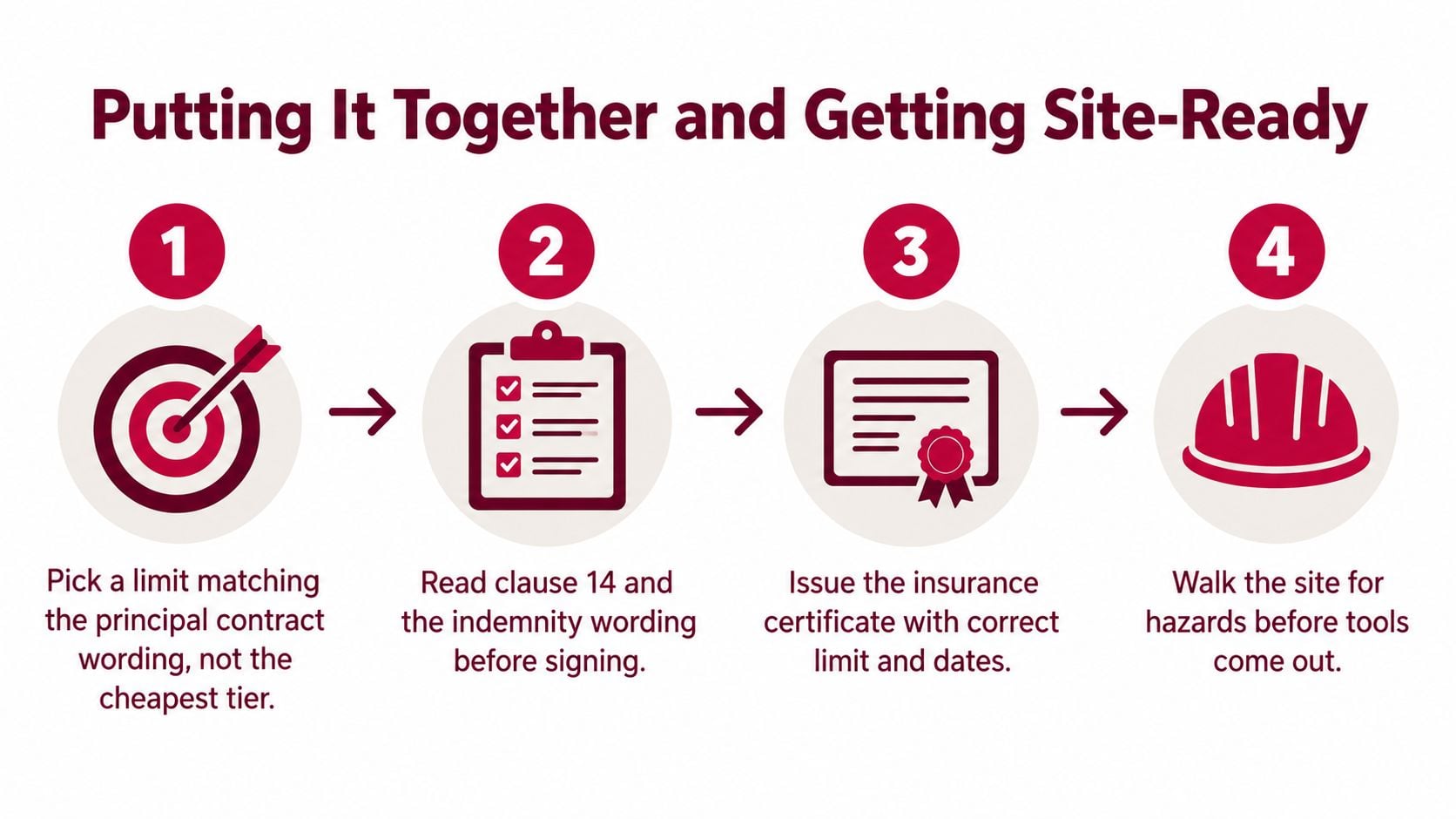
Four habits that prevent avoidable disputes
Start with the contract limit. Read the insurance clause before you price the job. Choose the limit that satisfies the principal and fits the worst work you're accepting, then check whether the policy covers the actual activity.
Match the certificate to the project. The certificate should show the correct insured legal name, current dates and required limit. If the principal requires an additional insured endorsement or special wording, ask for that before site access. This guide to getting public liability insurance is a useful starting point for organising the application and documentation.
Brief the principal in writing. If the policy has an exclusion, sub-limit or condition that affects the project, raise it early. A short written exchange is better than an argument after damage occurs.
Keep the evidence. Save the contract, certificate, schedule, endorsements, subcontractor certificates, SWMS, site photographs, delivery records and incident reports. Keep them organised for the life of the job and the relevant limitation period that may follow. When a claim arrives later, memory is a poor substitute for a dated photograph and a signed scope.
The boring routine is the defensible routine. Site-ready insurance means the contract, policy, certificate and work practices all tell the same story.
ABS Insurance Brokers Pty Ltd arranges public liability, contract works, professional indemnity and related cover for builders, carpenters and other trades, with advice focused on the work being performed and the insurer terms attached to it. Visit ABS Insurance Brokers Pty Ltd to discuss the right limit, policy structure and certificate requirements before you commit to the next job.