
You're reviewing a renewal that used to feel routine. Then the valuer updates the replacement cost, the underwriter asks for more engineering information, and your finance team realises the business interruption figure was based on a recovery plan that no longer reflects the supply chain. The policy may still look familiar, but the risk has moved.
That's the reality of industrial special risk insurance in Australia in 2026. ISR isn't just a larger business package. It's a market-sensitive placement where declared values, catastrophe exposure, reinsurance capacity, policy structure and claims preparation all affect the result. Buyers who treat it as a commodity purchase usually discover the difference when they need the wording to perform.
Table of Contents
- When a Business Pack Stops Being Enough
- What Industrial Special Risk Insurance Actually Is
- The Two Sections That Make Up an ISR Policy
- ISR Versus a Standard Business Package
- Valuation Discipline and Common Endorsements
- Why the Australian ISR Market Is Harder in 2026
- How ISR Fits With Your Other Covers and What to Do Next
When a Business Pack Stops Being Enough
A regional Victorian food manufacturer adds cold rooms, bespoke conveyors and a major electrical upgrade. It runs several processing lines, turns through stock quickly and supplies an international customer that expects consistent production. The business pack that suited the smaller operation now leaves the property limit short of the cost to rebuild the site.
For Australian buyers in 2026, industrial special risk insurance is a market-sensitive placement, not merely a larger business package. Valuation quality, reinsurance pressure, deductible selection and the way layers are arranged can decide whether the policy responds properly after a major loss. Premium is only one part of that decision.
The exposure extends beyond the damaged building. A failed processing line may need to be designed, manufactured, shipped, installed, tested and approved before production resumes. Dependence on a small group of specialist suppliers can make the equipment lead time longer than the physical repair. A packaged policy may cover the immediate property damage while leaving the business interruption calculation, sub-limits or indemnity period out of step with the actual recovery plan.
Practical rule: If the business cannot explain how it would restore production after a major loss, it is not ready to set its business interruption limit.
Check these warning signs:
- Asset concentration: Declared property values are approaching or exceeding the Australian market's rough ISR benchmark of about $10 million, as discussed in Australian commentary on switching from business insurance to ISR.
- Operational complexity: Multiple sites, linked production stages, cold storage, specialist plant or unusual construction make a standard schedule harder to apply accurately.
- Long recovery: Rebuilding, sourcing equipment and restoring customer demand may require a longer indemnity period than the packaged policy provides.
- Supplier dependency: A single overseas manufacturer, contractor or utility can prolong the interruption after the premises are substantially repaired.
- Separate liability needs: ISR generally addresses property and business interruption. It does not replace liability insurance, a distinction also made in the Australian commentary on switching from business insurance to ISR.
Risk controls affect the placement before an underwriter reviews the submission. Maintain clear housekeeping standards, isolation procedures, maintenance records and controls around hydraulic equipment. Review this hydraulic risk mitigation guidance, then give your broker evidence that those controls operate at the site.
Compare the wording, values, dependencies and recovery assumptions against available manufacturing insurance options. If the pack cannot support the declared assets and interruption period without optimistic assumptions, instruct your broker to test an ISR structure, including layered capacity where the market requires it.
What Industrial Special Risk Insurance Actually Is
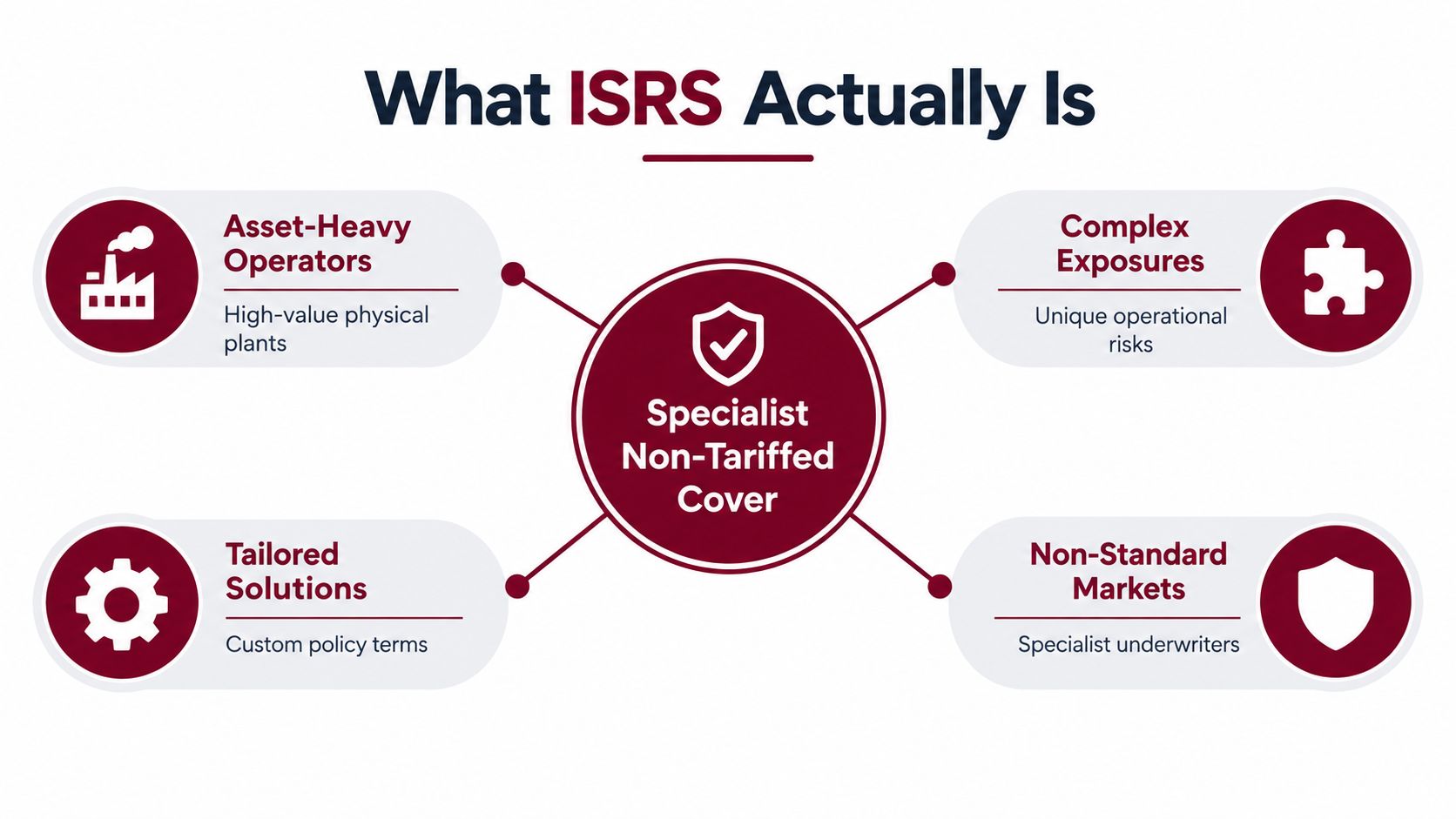
Industrial Special Risk Insurance is a specialist commercial property arrangement for businesses whose assets, interruption exposures or operating structure need more precise treatment than a packaged policy provides. In Australia, the market commonly associates ISR with physical assets above roughly $10 million, but the stronger test is whether the risk requires specialist underwriting, complex valuation or layered capacity. Marsh's Australian ISR guidance places ISR in the segment used by larger and more complex businesses.
ISR joins two connected areas of cover.
The base layer is material damage
The first section addresses physical property, including buildings, plant, machinery, stock and other declared assets. ISR is commonly written on an all-risks basis, so the policy responds to insured physical loss unless the wording excludes it. That does not mean every event is covered. Exclusions, conditions, deductibles, sub-limits and endorsements determine the actual response.
The upper layer is business interruption
The second section addresses the financial consequences of insured damage. It can be structured around loss of profit or revenue, continuing costs and additional expenditure that reduces the interruption, subject to the wording and agreed indemnity period. Both sections must align. A broad property limit cannot fix an underdeclared business interruption exposure, while a long indemnity period cannot compensate for assets insured below a realistic reinstatement cost.
ISR is used across asset-heavy sectors such as manufacturing, infrastructure, transport, utilities, aviation and commercial property ownership. Australian market guidance from Covercorp describes ISR as covering medium and large risks, with property and loss of profit exposures commonly written on an all-risks basis.
ISR is individually underwritten. The broker presents the locations, construction, occupancy, values, loss history, protection systems, risk engineering and business interruption model to specialist insurers. Those insurers decide how much risk to retain, what capacity to provide and how much must be shared through coinsurance, layered placement or reinsurance.
That market process makes ISR adaptable, but it also puts pressure on the buyer's preparation. Accurate valuations, defensible interruption assumptions and clear schedules give underwriters a basis for capacity and pricing decisions. The policy schedule, declarations and endorsements must match the cover the business actually needs. “All risks” is not a substitute for reading the exclusions.
The Two Sections That Make Up an ISR Policy
ISR works when material damage and business interruption are treated as one recovery problem. Section 1 deals with the physical loss. Section 2 deals with the financial effect of that loss on trading. A claim can involve both, but they don't respond to the same thing.
Section 1 restores the physical operation
Material damage cover applies to declared property, subject to the policy's basis of settlement, exclusions, excesses and conditions. Depending on the wording, the insured assets may include buildings, machinery, plant, stock and specialist fit-outs. The declared value needs to reflect the cost of putting the asset back into an equivalent working condition, not merely its accounting value or sale price.
Section 1 is also where the average condition can become painful. If the declared value materially understates the value at risk, the insurer may reduce the settlement in accordance with the policy condition. The correct response isn't to guess at a figure. It's to commission a valuation that accounts for demolition, debris removal, professional fees, compliance requirements, freight, installation and changes in construction cost.
Section 2 funds the interruption
Business interruption cover responds when insured physical damage causes a covered reduction in trading results. It may protect gross profit or revenue and can include additional increased cost of working where expenditure helps the business continue or recover. The indemnity period must run long enough to cover the whole recovery process, not just the anticipated repair works.
Take a hypothetical fire in a packaging plant's machinery room. The fire damages a key production machine, stops the affected line and forces the operator to source alternative capacity while the replacement is designed and installed. Section 1 addresses the damaged machinery and associated physical reinstatement. Section 2 addresses the trading shortfall and reasonable extra costs, provided the loss falls within the policy response and the declared financial basis is adequate.
| Element | Section 1 Material Damage | Business Interruption |
|---|---|---|
| What it protects | Buildings, plant, machinery, stock and other declared physical property | Gross profit, revenue, continuing costs and additional increased cost of working |
| Trigger | Covered physical loss or damage | Financial loss resulting from covered physical damage |
| Main valuation question | What will it cost to repair or replace the asset? | What financial result would the business have achieved during the interruption? |
| Main timing question | How long will reinstatement take? | How long until the business returns to normal trading? |
| Common weakness | Understated replacement cost or incomplete asset declarations | An indemnity period or gross profit declaration that doesn't reflect the recovery plan |
Finance teams should model BI with operations, not in isolation. A useful business interruption insurance overview can help establish the conversation, but the final figures must reflect the site's actual production constraints, customer commitments and recovery options.
The indemnity period deserves particular attention. Equipment lead times, approvals, testing, recommissioning and lost customer confidence can continue after the building looks repaired. If the policy expires before the business has stabilised, the financial loss doesn't stop just because the cover does.
ISR Versus a Standard Business Package
A business pack remains sensible for a smaller, straightforward operation. It can provide efficient cover where the property is uncomplicated, the locations are limited, the sums insured are manageable and the business interruption exposure can be expressed within standard settings.
ISR becomes the stronger fit when the risk needs underwriting decisions rather than preset answers. The distinction is not “cheap policy versus expensive policy”. It is whether the policy structure can follow the way the business operates.
| Criterion | Business Pack | Industrial Special Risk |
|---|---|---|
| Asset profile | Smaller or more conventional property exposures | High-value, specialised or interconnected assets |
| Locations | Often suited to a limited and straightforward footprint | Designed for complex or multi-site schedules |
| Basis of cover | May rely more heavily on standard wording and selected perils | Commonly structured on an all-risks basis, subject to exclusions and endorsements |
| Business interruption | Standard limits and periods may apply | Financial basis and indemnity period can be tailored |
| Sub-limits | Preset sub-limits can restrict unusual assets or costs | Negotiated sub-limits and extensions can better reflect the exposure |
| Risk engineering | May involve standard underwriting information | Often requires detailed risk information and engineering evidence |
| Placement style | More transactional | Specialist, negotiated and individually assessed |
| Best test | Does the standard wording fit without awkward compromises? | Does the tailored wording reflect the asset and recovery profile? |
Premium relativity matters, but price per dollar of cover is a poor decision tool. A business pack may appear cheaper because it carries narrower limits, shorter assumptions or sub-limits that only become visible during a claim. ISR may cost more because it is addressing a more complicated exposure, but that additional premium is only justified if the schedule and wording solve the actual gaps.
Ask three blunt questions before choosing:
- Can the policy rebuild every critical asset without relying on book value?
- Can the business survive the full period between damage and stable production?
- Can the wording respond across every relevant site, dependency and operating scenario?
If the answer to any of these is no, selecting the pack on premium alone is false economy.
Valuation Discipline and Common Endorsements
ISR is only as reliable as the values declared to the insurer. A finance team should separate book value, market value and reinstatement value before completing the schedule. Those figures can be materially different, especially for specialised plant, purpose-built premises and assets that would be expensive to import or reinstall.
Choose the basis of settlement deliberately
An indemnity basis generally considers the value of the property immediately before the loss, allowing for age, condition and depreciation. A reinstatement basis is intended to fund repair or replacement with property of equivalent function, subject to the policy terms and the insured's obligations. Neither basis should be selected by default.
The average condition is another area where buyers get caught. If the declared value is below the value that should have been insured, the insurer may apply a proportional reduction to the claim. Co-insurance provisions can operate similarly. The practical answer is to document how the value was calculated and update it when the business adds equipment, changes its layout or experiences material construction cost movement.
Australian market commentary recommends refreshing ISR valuations every two to three years, and potentially more frequently for assets affected by rapid inflation. ANZIIF's discussion of tailored ISR cover also notes that underwriters may review values more often for larger clients because stale declarations can create underinsurance and average-clause problems.
Build the endorsements around the operation
Common extensions may include:
- Agreed value: Reduces uncertainty about the declared basis where the insurer accepts supporting valuation evidence.
- Escalation: Provides room for values to increase during the policy period, but shouldn't replace a proper valuation.
- Accidental damage: Broadens the response where accidental physical damage might otherwise fall outside a narrower grant.
- Theft and malicious damage: Important for exposed plant, stock, vacant areas and sites with changing contractors or access arrangements.
- Removal of debris: Checks whether demolition, disposal and site clearance costs are included at a suitable limit.
- Capital additions: Allows newly acquired or installed assets to be dealt with under agreed conditions while the schedule is updated.
- Key supplier or customer extensions: Addresses dependency risk where a critical external party's damage interrupts the insured's business.
At placement, record the valuation basis, declared values, locations, critical equipment, maximum foreseeable recovery period, supplier dependencies, excesses and required extensions. Don't leave those decisions for the claims stage.
Why the Australian ISR Market Is Harder in 2026
ISR shouldn't be treated as a stable commodity cover. Reinsurers and insurers are examining catastrophe exposure, loss performance, construction costs and portfolio concentration, and those decisions flow through to deductibles, capacity, exclusions and information requirements for Australian buyers.
Recent market reporting illustrates the pressure. In the September 2025 quarter, the fire and ISR class recorded $833 million in net reinsurance expense against $538 million in net claims, according to reporting on Australian fire and ISR reinsurance performance. The same analysis states that, in the six months to June 2026, fire and ISR represented $793 million, or 68%, of premium placed with unauthorised foreign insurers. Those figures point to capacity pressure and a market where risk is increasingly being shared, repriced or placed through more complex structures.
Aon's underwriting view is equally uncomfortable. Its analysis reports a 121% first-quarter combined ratio for Fire and Industrial Special Risk risks, driven by bushfire and hail losses, and says only two quarters since December 2017 had been below 100%. Aon's Australian insurance market insights supports the conclusion that weather volatility and underwriting discipline are affecting the class.
What changes at renewal
Expect underwriters to ask for:
- Current valuations: Old schedules are harder to defend when replacement costs have moved.
- Engineering evidence: Protection systems, maintenance, fire controls, flood exposure and site improvements need documentation.
- More precise BI modelling: Underwriters want to understand dependencies, alternative production and realistic recovery assumptions.
- Natural hazard information: Location-specific exposure can affect deductibles and available terms.
- Earlier submission: A complex ISR placement needs time for insurer questions, engineering review and negotiation.
The buyer's practical choice is whether to treat renewal as procurement or risk management. Procurement seeks a quote. Risk management prepares a credible submission, gives underwriters a reason to support the account and negotiates the wording before capacity becomes scarce.
Buyers who approach ISR as a relationship-led specialty placement generally have more influence than buyers who send an outdated schedule to market at the last minute.
How ISR Fits With Your Other Covers and What to Do Next
ISR sits in the property and business interruption part of the programme. It doesn't replace the other policies that respond to liability, construction activity, mobile equipment, transit, technology or corporate management exposures.
A regional food manufacturer might place ISR over its processing premises, stock, machinery and trading interruption. It may still need product liability for contaminated or defective goods, public liability for third-party injury or property damage, machinery breakdown for defined equipment failures, marine or transit cover for goods in movement, and cyber insurance for technology-related disruption. The policies should be reviewed together so exclusions and dependencies don't create an artificial gap.
A property developer has a different structure. Contract works cover may respond during construction, while ISR becomes relevant for completed buildings or an operating asset. Public liability remains separate, and plant insurance may be needed for owned or hired equipment. A developer should also check how practical completion, handover, defects, tenancy and rental income affect the transition between project and operational covers.
| Layer or Step | What it Does | Owner or Output |
|---|---|---|
| ISR material damage | Protects declared buildings, plant, machinery, stock and other physical assets | Broker and insurer agree values, basis and wording |
| ISR business interruption | Responds to covered financial loss following insured physical damage | Finance and operations prepare the gross profit basis and recovery model |
| Public and product liability | Addresses third-party injury, property damage and product-related claims | Risk manager confirms activities, products and contractual requirements |
| Contract works | Covers project-specific construction risks before operational handover | Developer or principal confirms contract values, stages and responsibilities |
| Machinery breakdown | Deals with equipment failure exposures that may not fit the property response | Engineering team provides asset lists, maintenance information and dependencies |
| Marine and transit | Protects goods, machinery or materials while being transported | Logistics owner confirms routes, ownership and transit responsibilities |
| Cyber and management liability | Addresses technology, governance, employment and corporate decision exposures | Directors and IT stakeholders review separate limits and exclusions |
| Valuation and site review | Establishes defensible replacement values and identifies risk improvements | Valuer and risk engineer issue supporting reports |
| Market submission | Gives specialist insurers the information needed to assess capacity and terms | Broker prepares a complete submission and compares responses |
| Claims readiness | Speeds notification, evidence gathering, mitigation and financial quantification | Operations nominate contacts and maintain incident documentation |
Start with a location-by-location asset schedule. Identify buildings, production lines, stock, specialist equipment, utilities, tenant improvements and assets held for others. Then commission or refresh the valuation and test the declared business interruption figure against the longest credible recovery path.
Set the indemnity period with operations, engineering, procurement and finance in the same room. Ask what happens if the main supplier cannot deliver, if a replacement machine needs commissioning, if approvals delay reinstatement or if customers move to another source during the interruption. Those answers should shape the policy, not be discovered after the loss.
Go to market with specialist advisers who can explain the differences between the proposed wordings. Comparing two or three credible approaches can expose variations in material damage triggers, BI sub-limits, supplier extensions, debris removal, escalation, machinery treatment and natural hazard excesses. The cheapest response is not automatically the most useful response.
Review plant and machinery insurance alongside ISR where equipment failure, hired plant or mobile assets create a separate exposure. Keep incident contacts, asset registers, maintenance records, production data, supplier details and mitigation procedures accessible. At renewal, update the values and business interruption model, then monitor market conditions during the year rather than waiting for the renewal invitation.
ABS Insurance Brokers Pty Ltd provides advice and placement across commercial property, business interruption, construction, plant and specialist insurance risks for Australian businesses. Visit ABS Insurance Brokers Pty Ltd to discuss whether your current programme is ready for an ISR review and to arrange a structured assessment of your assets, recovery period and adjoining covers.