

You've got a ute full of tools, a van booked for tomorrow's site work, or a small fleet moving materials between jobs. Then a driver calls from the roadside after a collision. The immediate problem is obvious, but the expensive questions arrive quickly: was the vehicle insured for that use, will the policy pay for the tools and equipment, and what will renewal cost after the claim?
Commercial vehicle insurance isn't just a compliance item for Australian businesses. It's a financial control that protects vehicles, third-party property, employees, customers, contracts and cash flow. The difficult part is choosing cover that matches how your vehicles operate, then deciding whether to retain the policy or put it back to the market when premiums move.
Table of Contents
- Commercial Vehicle Insurance in Australia: Match Cover to Use
- The Australian Commercial Motor Market Context
- Policy Types and Cover Options Explained
- Factors Influencing Premiums and Exclusions
- Managing Claims and Understanding Loss Ratios
- Strategic Decisions – Remarketing vs Retention
Commercial Vehicle Insurance in Australia: Match Cover to Use
A builder in Bankstown might use a ute for tools, a van for materials and a truck for deliveries. A logistics operator in Melbourne may have vehicles moving through busy industrial areas, loading docks and suburban streets every day. Those businesses don't face the same exposure as a private motorist driving to work, even if one of their vehicles looks like an ordinary passenger car.
The difference is business use. Commercial vehicles may carry tools, stock, machinery or customer goods. Employees with different driving histories may use them. Routes can change, vehicles can tow trailers, and a single incident can damage another vehicle, a building, stored goods or a roadside structure. A private motor policy may not respond properly when the vehicle is being used for trade, deliveries or paid transport.

Match the policy to the operation
Start with the vehicle schedule, not the insurer's brochure. List every ute, van, truck, trailer and specialist vehicle, then record:
- Who drives it: Employees, directors, subcontractors and occasional drivers can create different underwriting issues.
- What it carries: Tools, materials, stock and customer goods may need different treatment from the vehicle itself.
- Where it travels: Local jobs, metropolitan deliveries and interstate routes produce different operating patterns.
- How it's used: Construction, courier work, transport, towing and passenger movements may be treated differently by insurers.
A commercial policy can combine vehicle damage cover with third-party liability protection, but the wording matters. Some policies limit particular occupations, cargo types or driver categories. A claim can become a dispute if the application described a general trade vehicle while the actual operation involved urgent deliveries, regular towing or a higher-risk specialist use.
Practical rule: Tell the broker what the vehicle does on its busiest day, not what it does on an average day.
Why the liability exposure is serious
Damage to your own vehicle is only one part of the calculation. A driver who causes an accident can expose the business to repair costs, property damage claims and disruption to customer commitments. The business may also need to manage vehicle recovery, replacement transport, employee arrangements and evidence for the insurer.
That's why a cheap policy with the wrong use description can be more expensive than a broader policy with a higher excess. The right question is not only, “What's the premium?” Ask whether the cover reflects the asset value, operational use, driver profile and liability exposure of the business.
The Australian Commercial Motor Market Context
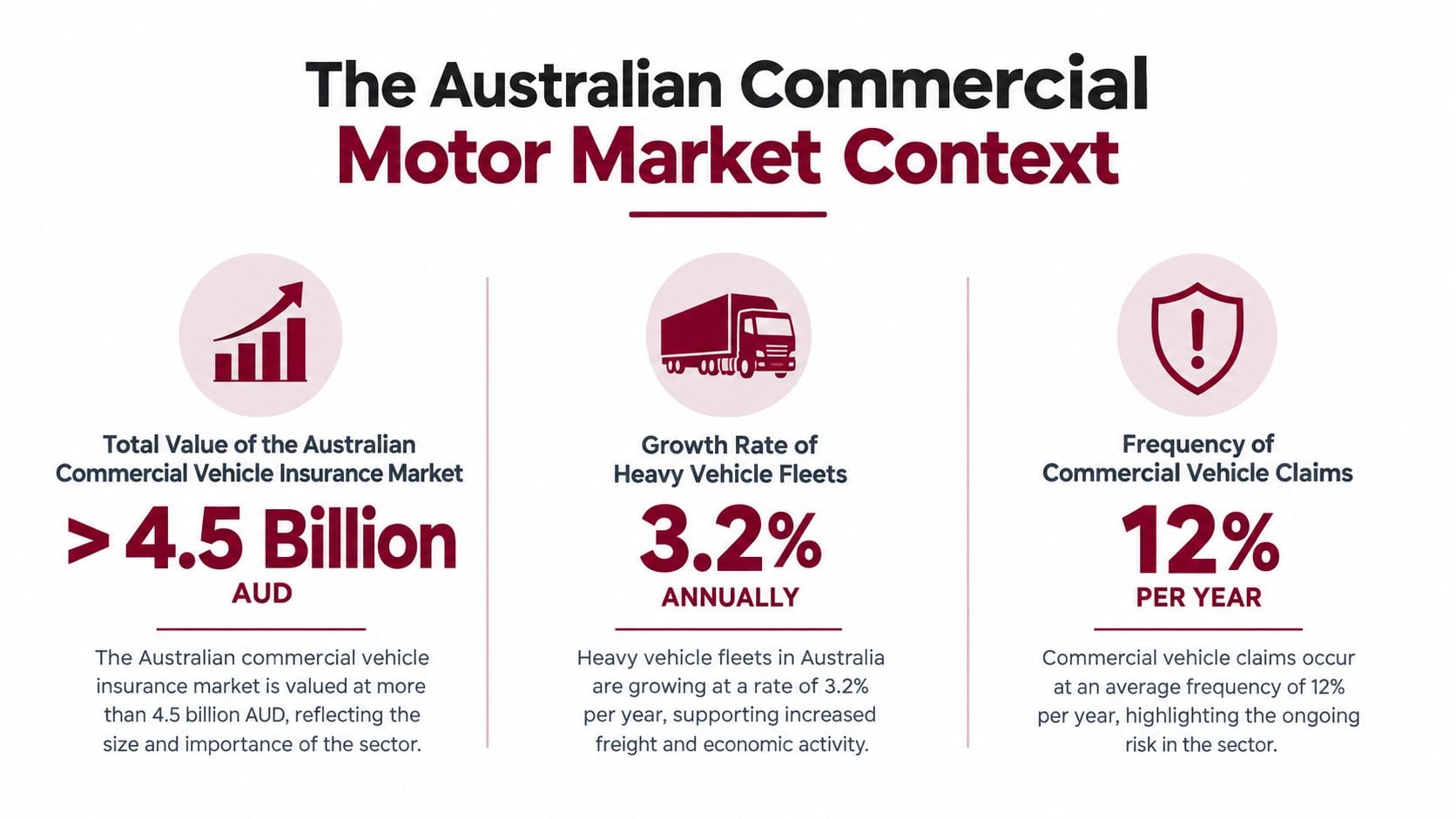
Australian operators are buying cover inside a substantial specialist market. The commercial motor vehicle insurance industry was estimated at A$5.0 billion in 2026, with revenue growing at an annualised 4.4% over the five years through 2025-26 and forecast to rise 1.8% in 2025-26, according to IBISWorld's Australian commercial motor vehicle insurance market data. The market comprised 49 businesses in 2026, which points to a concentrated sector where underwriting appetite and specialist knowledge matter.
A separate view of the market recorded approximately A$5.06 billion in gross written premiums for commercial motor insurance in 2025, representing roughly 22% of combined domestic and commercial motor premiums. The same data set estimated 21.27 million risks written across domestic and commercial motor insurance and A$23.45 billion in total gross written premiums for the segment, as reported in Australian motor insurance statistics. Earlier industry reporting also recorded around 2.1 million commercial motor vehicle policies in 2023, reinforcing the long-running scale of business vehicle cover.
What the figures mean for operators
Large premium pools don't guarantee cheap cover. Insurers still assess each business on its own vehicles, routes, drivers, claims record and risk controls. However, the market context explains why commercial vehicle insurance receives close underwriting attention. Fleet pricing is shaped by repair severity, replacement costs, vehicle availability and the quality of information supplied at renewal.
A business comparing a trade ute with a delivery van should also check the vehicle details carefully. Before buying or changing a used commercial vehicle, a VinCheck Ram ProMaster report can help identify vehicle history information that may be relevant to an asset purchase decision. It isn't a substitute for policy advice, but better asset information supports a cleaner discussion about valuation and risk.
Operators should also distinguish motor cover from broader transport protection. A business moving customer goods or operating as a transport contractor may need advice beyond the vehicle policy itself. Transport insurance information for Australian businesses is a useful starting point for reviewing those wider exposures.
Policy Types and Cover Options Explained
The three familiar policy structures are Full Cover, Third Party Property Damage, and Third Party Fire and Theft. They aren't interchangeable. The right choice depends on the value of the vehicle, the business's ability to absorb a loss and the consequences of being without transport.
| Policy Type | What is Covered | Best For |
|---|---|---|
| Comprehensive | Damage to the insured vehicle from covered incidents, plus third-party property damage, subject to the policy wording, exclusions and excess | Businesses that rely heavily on vehicles or have valuable utes, vans, trucks and specialist assets |
| Third Party Property Damage | Liability for damage the insured vehicle causes to another person's property, subject to policy terms | Older or lower-value vehicles where the business can fund its own repairs or replacement |
| Third Party Fire and Theft | Third-party property damage, with specified protection for events such as fire or theft, subject to exclusions and conditions | Operators seeking more protection than basic liability without insuring every accidental damage event |
Comprehensive cover
Broad cover is generally the practical choice when a vehicle is essential to earning revenue. If a tradie loses a fitted-out ute, the financial impact includes more than the market value of the vehicle. Tools, equipment, missed jobs and short-notice replacement transport can all affect the business.
Don't assume that a policy covering all perils means everything is automatically included. Check the agreed or market value basis, accessories, signage, trailers, tools, recovery costs, windscreen treatment and replacement vehicle provisions. Confirm whether items carried in the vehicle are covered under the motor policy or need separate business contents, tools or marine cargo protection.
Third-party options
Third Party Property Damage can suit a low-value vehicle that the business could replace without destabilising cash flow. It protects against the potentially much larger cost of damaging someone else's property, but it doesn't pay to repair or replace the insured vehicle after an at-fault collision.
Third Party Fire and Theft sits between those two positions. It can be useful where theft is a genuine concern and the owner accepts the risk of accidental damage to their own vehicle. The policy wording decides which fire, theft and attempted theft events respond, so don't rely on the label alone.
For several vehicles, the issue becomes administration as well as cover. Commercial fleet insurance guidance can help business owners consider whether a coordinated fleet arrangement is more suitable than separate policies. A fleet structure may make vehicle changes and renewals easier to manage, but it still needs accurate schedules and prompt notification when the operation changes.
Excess, valuation and extensions
A higher excess can reduce the premium, but it transfers more claim cost to the business. Set the excess at an amount the company can pay immediately, not an amount that only looks attractive on a quote.
Review these items before accepting terms:
- Vehicle valuation: Check whether the settlement basis reflects the vehicle's real replacement position.
- Accessories and modifications: Declare toolboxes, canopies, racks, refrigeration and specialist fittings.
- Towing and trailers: Confirm whether trailers are included, separately insured or subject to different conditions.
- Downtime protection: Ask whether a replacement vehicle or other business interruption response is available.
- Use restrictions: Ensure construction, delivery, courier, transport or passenger use is correctly described.
Factors Influencing Premiums and Exclusions
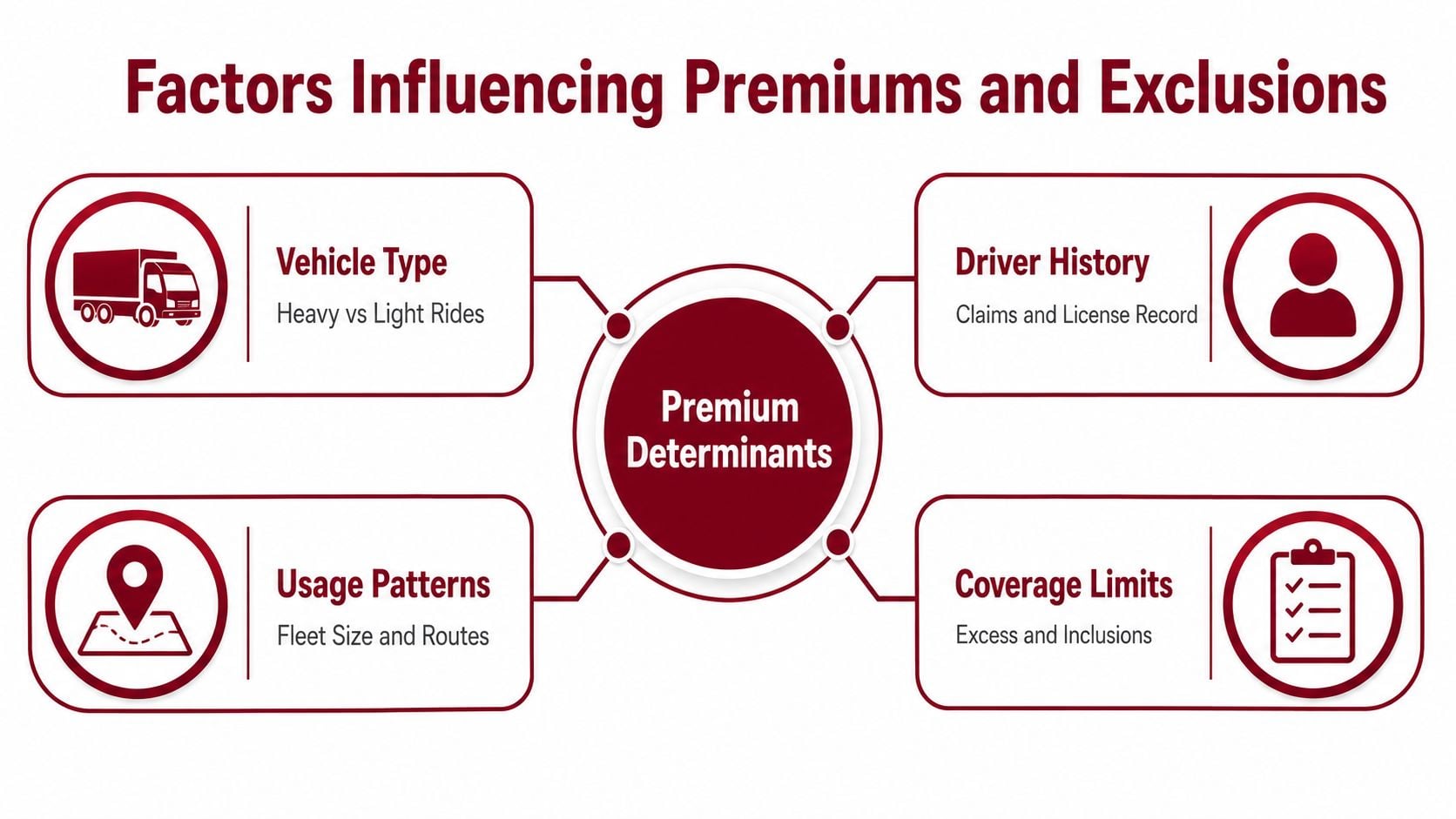
Insurers price the operation, not just the registration details. A light commercial ute used by one experienced owner for local trade work presents a different risk from a mixed fleet carrying goods on urgent metropolitan routes with several employee drivers.
Vehicle and driver variables
Vehicle type affects repair cost, replacement difficulty, payload, handling and the consequences of an accident. A ute, van, light truck, heavy vehicle, trailer and specialised business vehicle shouldn't be presented as one generic “commercial motor” risk.
Driver information matters just as much. Age, experience, licence type, prior incidents and who is permitted to drive can affect terms. Young or inexperienced drivers may attract additional excesses, and an undisclosed driver can create a coverage problem when a claim occurs.
Usage is where many policies go wrong
Business owners should be precise about the work vehicles perform. Australian product information commonly restricts or excludes particular uses and vehicle types, including couriers, ride-share, buses, taxis, underground mining vehicles and some heavy or specialist applications. A vehicle used for standard trade work may require different underwriting from one used for time-critical delivery or passenger transport.
Weather and operating environment also deserve attention. Flood-prone routes, severe weather exposure, remote work sites, unsecured parking and overnight storage can influence underwriting questions and risk controls. Insurers may also examine how often vehicles are used, where they travel and whether drivers receive practical safety instructions.
Build a cleaner submission
Better information won't eliminate risk, but it can prevent avoidable confusion. Provide a current vehicle schedule, licence details, claims history, use description and security arrangements. Explain any changes before renewal, particularly new routes, new vehicle types, new drivers, towing, courier work or a shift into transport services.
A simple control list is more valuable than a vague promise to “manage risk”:
- Driver records: Keep licence and incident information current.
- Vehicle security: Document where vehicles are stored and how keys are controlled.
- Maintenance evidence: Retain servicing and inspection records.
- Incident reporting: Require drivers to report collisions and near misses promptly.
- Coverage review: Recheck limits, excesses and exclusions when the business changes.
For a wider view of how operational choices affect business insurance pricing, review business insurance costs and pricing factors. The motor policy should fit the broader insurance programme, not sit disconnected from it.
Managing Claims and Understanding Loss Ratios
Insurers use claims data to decide whether a fleet is sustainable at a given price. A loss ratio compares earned premium with claims costs. It isn't the only underwriting measure, but it helps explain why a business with repeated incidents, expensive repairs or poor claims information can face tougher renewal terms.
APRA claims development data recorded $2,678 million in gross earned premium for the 2019 accident year and a latest estimated gross ultimate claims cost implying a 67.9% ultimate loss ratio, compared with a 70.1% 10-year average, as summarised in the business and commercial car insurance guide. The same data shows premiums rising faster than ultimate claims costs in recent years, a technical indication that underwriters have been repricing fleets to respond to claims severity.
That pressure reaches the policyholder through higher premiums, increased excesses, stricter driver requirements and closer scrutiny of frequency. Rising repair and replacement costs make a preventable incident more expensive even when the collision itself looks minor.
Run the claim properly
The first priority is safety. After that, the business should notify the insurer or broker promptly, collect photographs and witness details, preserve relevant records and avoid admitting liability before the facts are established.
A useful internal claim file should include:
- The driver's account: Record the time, location, road conditions and sequence of events.
- Vehicle evidence: Photograph damage, number plates, road position and surrounding property.
- Third-party details: Capture names, contact details, registration information and insurer details where available.
- Operational records: Keep delivery instructions, job sheets, maintenance records and relevant driver information.
- Cost evidence: Retain towing, storage, repair and replacement transport documentation.
A total loss decision depends on policy wording, valuation, damage assessment and the economics of repair. For a plain-language explanation of how insurers assess that outcome, see how the insurance total loss formula is explained. The business should still rely on its own policy and claims advice for the actual settlement.
Claims discipline protects options. Fast notification and complete records give the insurer better information and give the business a stronger basis for discussing the outcome.
Strategic Decisions – Remarketing vs Retention
Renewal shouldn't be automatic. It should be a commercial decision based on price, coverage, service, claims handling and the cost of changing insurers.
Annual remarketing has become more common in the Australian commercial motor market, and some clients have reportedly been offered 20% to 30% reductions just by moving to a major insurer, according to reporting on annual fleet remarketing pressure. That creates a strong reason to test the market, particularly when the incumbent has increased the premium or excess without a clear improvement in cover.
But switching isn't automatically cheaper. A new insurer may apply different valuation rules, impose a higher excess, exclude a vehicle use, request more information or provide less familiar claims support. A lower premium can be false economy if the fleet schedule is wrong or the business loses an extension it relied on.
Use a decision test
Ask four questions before renewal:
- Has the risk changed? Record vehicle additions, driver changes, routes, towing, cargo and specialist uses.
- Has the cover changed? Compare limits, valuation, excesses, exclusions, downtime provisions and accessories.
- Is the incumbent still competitive? Request a retention review, then compare it with properly matched alternatives.
- What is the switching cost? Consider certificates, payment arrangements, claims continuity, vehicle schedules and administrative time.
Retention makes sense when the incumbent understands the operation, claims service is strong and the terms remain competitive. Remarketing makes sense when pricing has drifted, the insurer has narrowed appetite, the fleet has changed or the broker can obtain materially better terms without weakening protection.
Don't chase the cheapest quote in isolation. Give the market a clean submission, compare like with like and make the final decision on total insurance value, not premium alone.
ABS Insurance Brokers Pty Ltd provides advice and placement for commercial motor and fleet insurance covering business vehicles such as utes, vans, trucks, heavy vehicles and specialist vehicles. Visit ABS Insurance Brokers Pty Ltd to review your current fleet schedule, test renewal terms against the market and structure cover around the way your Australian business operates.