

You've got a certificate of currency in the glovebox, a renewal quote open on the phone, and a head contractor who wants a higher limit before you mobilise on Monday. The easy move is to ring the insurer, ask for the bigger number and pay the difference. That fixes one problem and leaves the expensive one untouched, because the bill most likely to land on an electrical business isn't a third-party injury claim. It's the cost of pulling apart and remaking your own work. Sorting out insurance for an electrician means knowing which of those bills the policy answers.
Table of Contents
- What Insurance an Electrician Actually Needs
- Where Public Liability Stops and Workmanship Begins
- Cover for the Gear, the Ute and the Lost Week
- Who Is Covered When You Bring On Help
- How Your Work Mix Changes the Cover You Need
- The Checks That Reveal a Weak Policy
- What Electrician Insurance Costs and What Moves the Premium
- Confirm Your Cover Before the Next Job Starts
What Insurance an Electrician Actually Needs
A customer rings about the switchboard you replaced three weeks ago. The main keeps tripping, there's scorching around one circuit, and another sparkie has already been out to make it safe. Now the customer wants to know who pays for the return visit, the replacement RCBOs and the electrician who has to certify it a second time. Nothing burned down. Nobody was hurt. That's exactly the claim that catches people out.
The short answer: public liability is the baseline cover from your first customer job, and tools and equipment, commercial motor, contract works, workers compensation and professional indemnity get added as your work and your business shape the demand.
This isn't a niche decision. The 2021 Australian Bureau of Statistics Census, compiled in Safe Work Australia's electrician profile, recorded more than 131,900 people employed as electricians across Australia, with over 50% aged under 35. A lot of those younger tradespeople move from employment into subcontracting, and that's the moment the insurance obligation stops belonging to someone else's business and starts belonging to theirs.
The six covers an electrician is most likely to need
| Cover | What it pays for | What it routinely excludes | Who needs it |
|---|---|---|---|
| Public liability | Third-party injury and property damage claims from your work, plus legal defence costs | Your own faulty workmanship, your own tools, your own injuries | Every electrician from the first customer job |
| Tools and equipment | Theft, loss or accidental damage to hand tools, test instruments, ladders and stock | Items left in an unlocked vehicle, wear and tear, high-value items not listed | Anyone carrying more than a basic toolkit or calibrated test gear |
| Commercial motor | The ute or van, third-party vehicle damage, and tools in transit on some wordings | Undeclared drivers, private-only registration, unroadworthy vehicles | Anyone driving between jobs, especially with signage and shelving |
| Workers compensation | Wages, medical treatment and rehabilitation for injured workers | Contractors you haven't declared, fines and penalties | Any business with employees, casuals, apprentices or labour hire |
| Contract works | Accidental damage to a project under construction, sometimes theft and vandalism | Existing structures unless extended, defective work itself | Electricians on new-build, renovation or fit-out projects |
| Professional indemnity | Claims that your advice, design or certification was wrong | Physical damage you caused with tools on site | Design and construct, solar and battery design, testing and compliance advice |
Use the table by matching your typical week to a row, not by shopping for a bundle. If you spend four days on service calls and one on a fit-out, the tools row and the public liability row are doing most of the work. Read the exclusions column before the premium column, because a cheap policy with a broad exclusion costs more in one bad month than a dearer one costs in five years.
Practical rule: insurance sits alongside your licence, your safe work procedures and your statutory workers compensation. It doesn't replace any of them, and no insurer will pay a fine for working outside your licence conditions.
The gap that surprises people is the third row of that first cell block: paying to correct your own faulty work. You can hold every certificate a head contractor asks for and still fund the rework yourself.
Where Public Liability Stops and Workmanship Begins
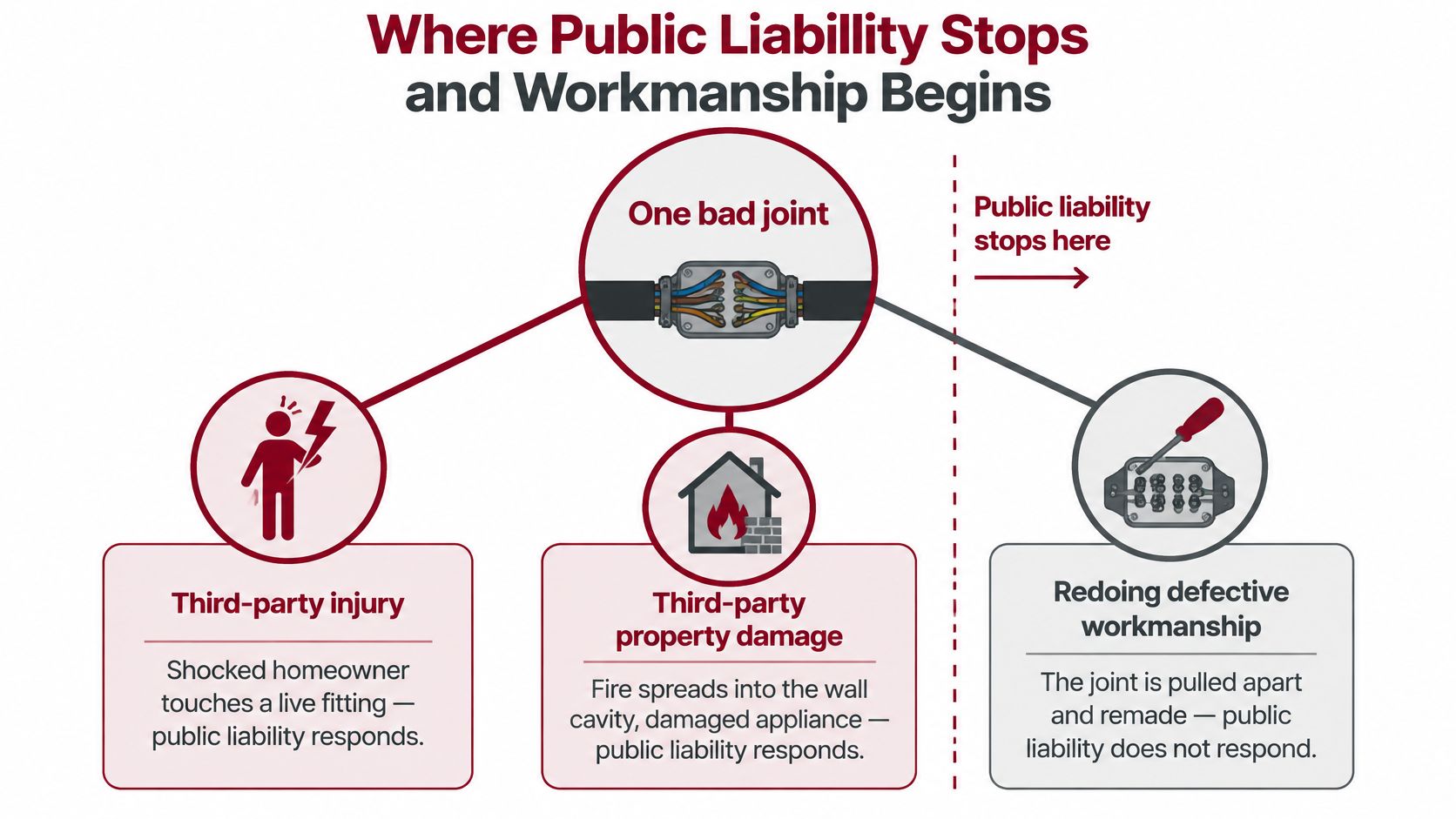
Take one bad joint at a switchboard and follow the money. It produces three separate bills, and only one of them is reliably insured.
Bill one, damage to someone else's property
Fire spreads into the wall cavity. A homeowner touches a fitting that shouldn't be live. An appliance is destroyed by a fault you introduced. These are third-party injury and property damage claims, and public liability is built for them, including the legal defence costs that run up while the argument about causation is settled. The injury side is treated seriously for good reason: the Electrical Regulatory Authorities Council fatality report for 2024–25 recorded seven electrical deaths in Australia, with six of the eight total deaths involving electrical workers.
Bill two, remaking your own work
Return labour, opening up the wall, pulling the cable, remaking the joint, retesting, reinspection and a second certificate of compliance. That's rectification of defective workmanship, and it's generally excluded, because a liability policy isn't a warranty on your work. The same split between third-party damage and fixing your own installation shows up in plumbers public liability insurance, and it's the reason a trade certificate of currency proves less than many assume.
A liability limit is not a warranty on your work.
Bill three, the fallout
A cafe's spoiled stock, a motel's cancelled bookings, a builder's delay costs. This is consequential loss, and whether it's paid turns on the resulting damage wording. Many policies cover damage resulting from a defect while excluding the defect itself, so the wall cavity gets paid and the joint doesn't. Others restrict the resulting damage extension so tightly that the whole event falls outside cover.
Three things decide which bills get paid. The resulting damage clause and how narrowly it's drawn. The contractual indemnity you signed, which can make you liable for losses the policy never contemplated. And your test and isolation records, which decide whether the insurer accepts the fault was yours at all. That's why the first question in any electrical claim is whose property was damaged, and by what. A $20 million limit answers bill one generously and bill two not at all.
Cover for the Gear, the Ute and the Lost Week
Walk around your business and price what you'd have to replace tomorrow: hand and power tools, a multimeter, insulation and loop testers, PAT gear, ladders, cable drums and stock, a signwritten ute with shelving, and the EWP or generator you hire for a week. The total surprises most sparkies. It's usually more than the ute cost new.
Tools, instruments and stock
Two mechanics decide whether a tools claim pays properly. New-for-old versus indemnity value determines whether you get a replacement tester or the depreciated value of a five-year-old one. Per-item limits determine whether your multifunction tester is paid in full or capped at a fraction of its worth. Any high-value instrument belongs on the policy schedule as a specified item, listed with its serial number and replacement cost, because the standard per-item cap rarely stretches to a quality multifunction tester or thermal camera. Then read the theft conditions: a locked canopy or a fixed site container, no overnight street parking, and confirmation that cover follows the tools onto a customer's premises rather than stopping at your workshop door.
The ute and the week off the road
Commercial motor is where declarations matter more than price. Name every driver, including the apprentice and your partner. Register for business use. Check whether tools in transit sit under the motor policy or the tools policy, because a privately registered work ute with an undeclared driver is the argument you'll be having after the accident, not before it. The detail on commercial motor insurance for work vehicles and tradie utes is worth reading against your own registration papers.
Business interruption is the third leg, and the one most sole traders skip. It covers fixed costs and lost gross profit while the van is off the road or the workshop is unusable. Check the trigger carefully: some wordings only respond to damage at your own premises, which does nothing for you when the ute is in the panel shop for three weeks and your income stops with it.
The digital version of the same loss
Your quoting, invoicing, booking and supplier payments all run through email and cloud accounting now. In FY2024–25, Australia's cyber agency received more than 84,700 cybercrime reports, about one every six minutes, and the average self-reported cost for a small business was $56,600, up 14%, according to the Annual Cyber Threat Report factsheet for businesses. Business email compromise was among the leading reported business threats, which is exactly the invoice-redirection loss that hits a contractor collecting a deposit or paying a subbie. Public liability never pays stolen funds. Ask whether the cyber wording covers social engineering, data restoration and temporary interruption, and whether multi-factor authentication is a condition of cover, because a policy that requires it won't pay if you never switched it on.
| Exposure | Cover to look at | What good cover includes | The gap that catches people |
|---|---|---|---|
| Hand and power tools | Tools and equipment | Theft from a locked vehicle or site container, new-for-old replacement | Overnight theft excluded unless the tools sit in a locked canopy |
| Calibrated test instruments | Tools and equipment, specified items | Cover at replacement value, including calibration cost | Per-item limits below the value of a good multifunction tester |
| Cable, conduit and stock | Tools and equipment or stock cover | Stock at your premises, in transit and on site | Stock left on a customer site overnight |
| Ute or van | Commercial motor | Named drivers, business-use registration, tools in transit, signage and fit-out | Vehicle registered privately with drivers left off the policy |
| Hired EWP, scaffold or generator | Plant and machinery or hired-in plant | Damage to the hired item and your liability for it | Assuming the hire company's damage waiver covers the excess |
| A week off the road | Business interruption | Fixed costs and lost gross profit while you recover | Policy only responds to damage at your own premises |
| Stolen funds or a locked accounting system | Cyber | Social engineering, data restoration, notification costs, temporary interruption | Assuming public liability or a business package picks it up |
Who Is Covered When You Bring On Help
Public liability doesn't cover the bloke on the ladder next to you. It answers claims from people outside the business: the client, the visitor, the public. Injury to your own crew sits under workers compensation, which is statutory, state-based and compulsory once you employ.
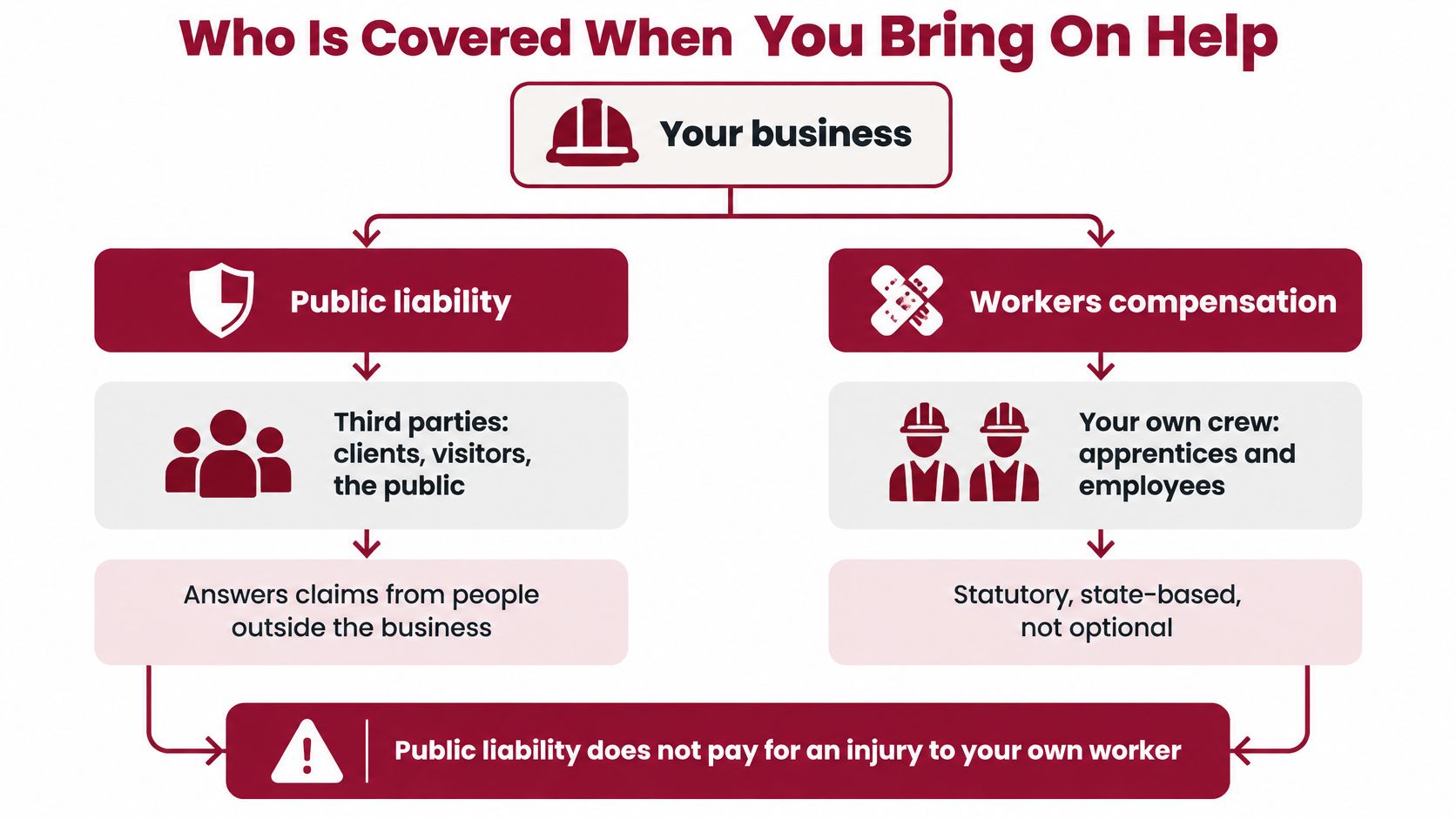
The exposure isn't marginal. Safe Work Australia reported in 2024 that the frequency of serious claims involving electrocution or shock from electric current for electricians was approximately six times the average across all occupations, in its news release on the electricians WHS profile. An uninsured injury in that trade isn't paperwork. It's a business-ending event.
Who counts as a worker
- Employees, full-time and part-time: covered from day one under your state scheme, no size exemption to hide behind.
- Casuals, apprentices and trainees: count them and declare their wages, even if the apprentice only works Saturdays.
- Labour-hire workers: the agency usually holds the policy, but your declaration and the host employer arrangement still matter at audit.
- Regular subcontractors: an ABN and their own certificate don't automatically make them someone else's worker. A subbie paid weekly for set hours, using your tools on your jobs, looks like an employee to an insurer at premium time and at claim time, and can be treated as a deemed worker.
The distinction between the two policies, and where each one stops, is set out in more detail in this comparison of public liability insurance and workers compensation.
Certificates of currency and renewal
A head contractor will ask for your certificate of currency at prequalification and again before mobilisation, showing the insured entity, the policy period, the limit and the business activities. Your subcontractor's certificate is never a substitute for your own cover, and collecting theirs doesn't transfer your liability for them. Keep a diary for expiry dates so a subbie doesn't start a job on a lapsed policy.
Premiums are built from wage estimates and trade classifications, so have your payroll split by worker type ready at renewal, along with any change in the work you do. We help employers work through their state or territory obligations, wage estimates and classifications so the declaration matches the crew on site.
How Your Work Mix Changes the Cover You Need
Electricians work across construction, maintenance, industrial, commercial and residential settings, as owners, subcontractors and employees. The same set of policies leaves different holes in different businesses, so the work mix matters more than the trade label on the certificate.
Domestic service and after-hours call-outs
Domestic maintenance runs on public liability and tools cover, and the weakness is evidentiary. You work alone, nobody witnesses the state of the installation you touched, and a later fault becomes your word against the customer's. Photograph the board before and after, keep the test results with the job number, and lodge the compliance certificate promptly.
Emergency call-outs add fatigue, lone working and a lot more kilometres. Check the policy conditions on hours, driving and working alone rather than assuming a call-out at 2am is treated the same as a Tuesday morning service.
New-build, renovation and design work
On new-build and renovation subcontracting, the head contractor's contract works policy protects the project. It doesn't insure your tools, your van or your defective work, and it may carry an excess the head contractor recovers from whoever caused the damage. Ask for a copy of the relevant section rather than a verbal assurance.
Design and construct, solar and battery work introduces professional indemnity exposure: sizing, design advice, performance promises and certification. Public liability doesn't touch a claim that your design was wrong when nothing was physically damaged by tools on site. If you're pricing that work, the numbers in your bid deserve the same scrutiny as the wording, and a tool like Exayard electrical bid software helps you see where design responsibility and allowance for rework sit in the scope before you sign.
Commercial contracts and other people's crews
Commercial and industrial maintenance contracts commonly demand a $10 million or $20 million public liability limit, plus contractual liability extensions and specific endorsements. A key risk is the indemnity clause: principals often draft it wider than the policy, and contractors sign it without checking. Have the indemnity, the hold-harmless and the insurance clause read together against your wording before execution.
Labour-hire and subcontracted crews shift the exposure back to your workers compensation declaration. Regular subs who work only for you, on your schedule, with your gear, need to be assessed as potential deemed workers rather than waved through with an ABN.
Match the contracts you already hold to those work types, then decide which add-ons to price. Buying cover for work you don't do is as wasteful as missing cover for work you do weekly.
The Checks That Reveal a Weak Policy
A certificate showing a $20 million public liability limit tells you almost nothing on its own. One bad joint creates three separate losses: the damage to the client's property, the cost of ripping out and redoing your own faulty work, and the consequential fallout like a tenant's lost trading or a fire brigade callout. The policy may pay the first, almost always excludes the second, and fights over the third. Run any quote through these checks before you compare premiums. Each one is a question you can answer from the wording in front of you.
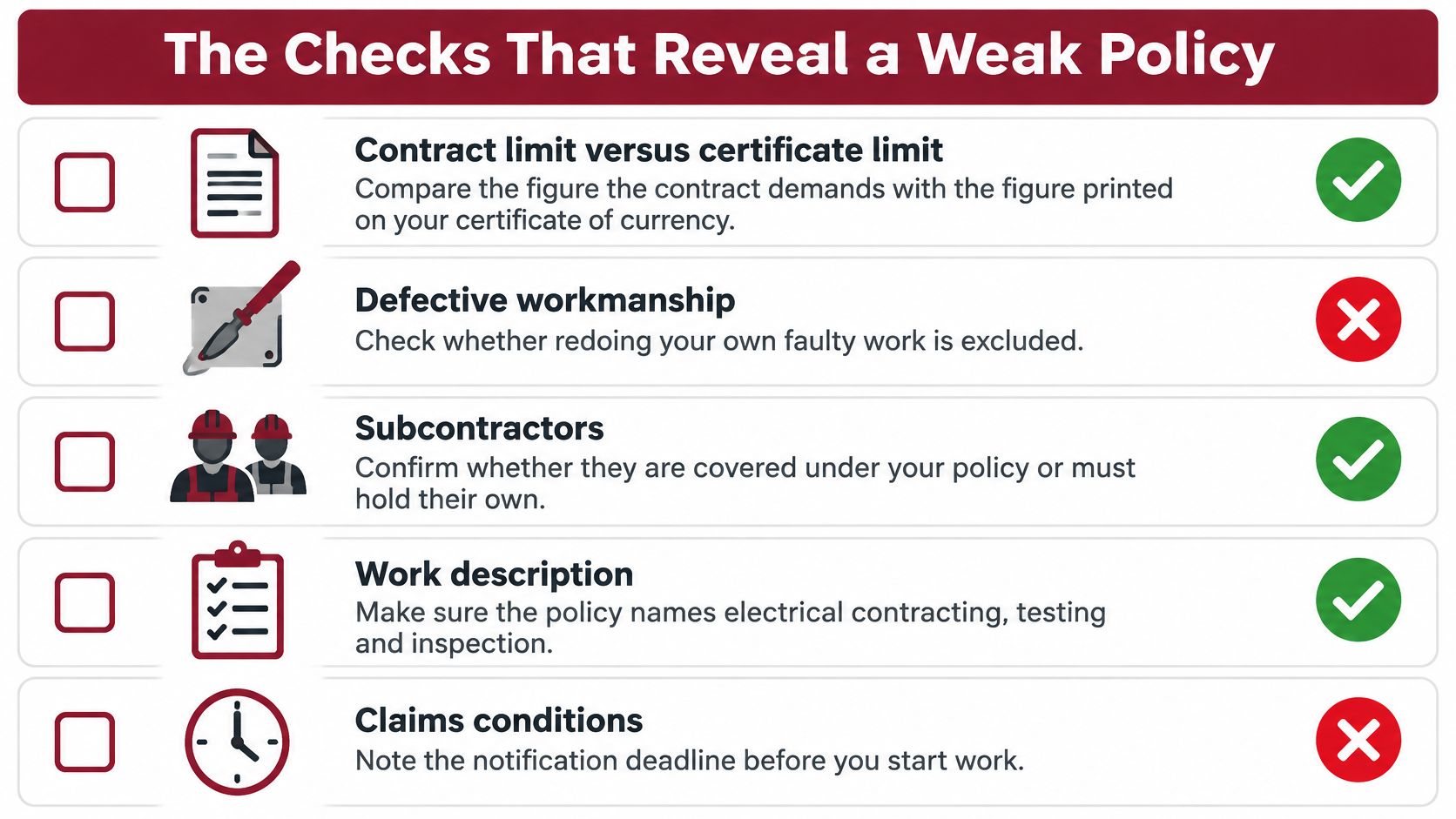
- Limit against contract: compare the figure the contract demands with the figure printed on the certificate, including whether defence costs sit inside or outside the limit.
- Defective workmanship versus resulting damage: find both clauses and read them together, because the second one is where the money is. If the resulting damage clause is narrow, the cost of correcting the joint itself stays with you no matter how high the liability limit goes.
- Height, energised work, confined spaces and hot work: look for restrictions on roof work, live or potentially energised systems and any depth or height cut-off.
- Excess structure: note the amount per claim and whether it applies per occurrence or per event, and whether a separate excess applies to theft from a vehicle.
- Subcontractors and labour hire: confirm whether they're covered under your policy, excluded, or required to hold their own.
- Entity match: the insured name, trading name, ABN and licence holder should line up across every certificate. A mismatch here gives an insurer a reason to dispute a claim before anyone argues about what happened.
- Claims-made PI: check the retroactive date and whether work you did years ago is picked up, plus the notification deadline for circumstances. Miss the deadline and a job from three years ago becomes your problem alone.
Licensing and the records that decide a claim
In NSW, insurance is tied to licensing rather than sitting beside it. NSW Government electrical licensing guidance requires a licence or certificate before electrical wiring work and a contractor licence when contracting for electrical work. A company contracting through a licensed individual, or mixing residential work with commercial maintenance, needs those documents aligned before work starts.
Keep certificates of compliance, test sheets, scope-of-work documents, permits, invoices and subcontractor licences for each job, filed by job number and retained well past the statutory warranty period for that work. They're the difference between a defended claim and an admitted one. When a fire investigator asks what you touched, a signed test sheet narrows the argument. Without it, the absence of a record gets treated as the absence of care.
Before you sign: read the insurance clause and the indemnity clause side by side. If the contract makes you responsible for something the policy excludes, you've agreed to fund it yourself.
A broker earns their fee here: comparing wordings against the contracts and licences you already hold, and matching limits to obligations you've signed rather than quoting on price alone.
What Electrician Insurance Costs and What Moves the Premium
Price follows the risk you declare, in roughly this order.
- Wages and classification. Workers compensation premiums are built from the wages declared for each worker and their trade classification, so an undeclared casual or apprentice changes the bill at audit and renewal.
- Turnover and work mix. Residential maintenance, commercial maintenance, solar and battery design and design-and-construct work each attract different rates and sometimes different available limits.
- Limits and excess. A higher public liability limit costs more. A larger excess lowers the premium and raises what you fund yourself on every claim, so set it at an amount you can afford to write a cheque for.
- Claims history. Prior claims are a major pricing input. Pull your claims record before you ask for quotes so you're not correcting the insurer's version later.
- Security and controls. Locked storage, tool tracking, multi-factor authentication on accounting and a call-back rule for changed bank details all influence tools and cyber pricing.
Compare quotes on identical terms: same limits, same excess, same named drivers, same declared activities. Then read the exclusions column before the premium column.
One more check on where the quote came from. Some comparison and software sites are paid for referrals, and the way that's disclosed tells you how independent the recommendation is. This explanation of how HVAC software referrals are compensated from Zeus Command Hub is a useful example of the disclosure to look for. Ask any adviser or comparison site how they're remunerated before you treat their ranking as neutral.
Confirm Your Cover Before the Next Job Starts
Six actions, this week, in this order.
- Pull your last three contracts and write down the liability limits and endorsements each one demands.
- List every tool worth more than your current per-item limit, plus everything that needs calibration.
- Write down every driver of the work vehicle, including apprentices and partners, and check the registration category.
- Confirm who on site counts as an employee for workers compensation and who is a genuine subcontractor with current cover. Our workers compensation cover is available for eligible employees, casuals, apprentices and trainees, so declare them accurately rather than guessing.
- Check that the insured name, trading name, licence holder and ABN match on every certificate you issue.
- Ask for a written comparison of two or three wordings scored against those answers, not three prices in an email.
For that comparison, ABS Insurance Brokers Pty Ltd can be contacted directly to compare wordings across these covers. The next job shouldn't start on last year's assumptions about what your certificate covers.
ABS Insurance Brokers Pty Ltd provides specialist insurance solutions for builders, contractors, tradespeople, developers, property owners and businesses across Australia, including public liability, contract works, commercial motor, plant and machinery, professional indemnity and cyber cover. Send through your contracts, your tool list and your driver details, and we'll compare wordings against the work you do so you can see which gaps are worth paying to close. Visit ABS Insurance Brokers Pty Ltd to request that comparison before your next job starts.