

Employment Practices Liability Insurance Australia Guide
Employment practices liability insurance may address specified claims about employment decisions and workplace conduct, subject to the chosen policy sections and exclusions. This guide explains questions to ask about defence costs, notification and cover limits. ABS’s management liability insurance service can help you review how employment-related cover fits your business.
Table of Contents
- Employment practices liability insurance: preparing for a complaint
- What Employment Practices Liability Insurance Actually Is
- The Allegations EPL Policies Are Built to Respond To
- Core Policy Features Australian SMEs Should Compare
- Limits and Exclusions That Catch Builders and Trades Off Guard
- How EPL Overlaps With Workers Compensation, WHS and Management Liability
- What Australian SMEs Should Ask Before Buying EPL Cover
- Treating EPL as Part of a Broader Management Liability Picture
Employment practices liability insurance: preparing for a complaint
Consider a hypothetical suburban builder finishing a small commercial fit-out. A worker has complained about a foreman's behaviour and disputed their pay. The project manager believes the worker's performance is unacceptable and ends the employment after a hurried conversation.
The worker sees it differently. They allege the dismissal followed their complaint, that the foreman treated them unfairly because of a disability, and that repeated intimidation affected their mental health. What management regarded as a performance decision now involves several different allegations.
One decision, several response tasks
The worker could lodge a Fair Work Commission application, pursue an available discrimination complaint pathway and raise workplace-safety concerns with the relevant regulator. Those processes aren't interchangeable, and their availability depends on the circumstances and legal advice. Nevertheless, the builder may need to respond to employment, discrimination and safety issues arising from the same site events.
Before anyone determines liability, someone must reconstruct the termination decision. The business needs emails, rosters, wage records, site diaries and witness accounts. A solicitor may need to assess the allegations, prepare responses and advise on conciliation.
- Management time: The supervisor and director must explain what happened without coordinating or influencing witness accounts.
- Professional costs: Legal advice and an impartial investigation may be needed before management knows whether settlement is appropriate.
- Operational pressure: The project still needs supervision, and remaining workers need a safe way to raise concerns.
Practical rule: Don't judge an employment dispute's insurance significance solely by the compensation demanded. Establish what response work is needed and whether the insurer must approve it.
For a builder, employment practices liability insurance in Australia is therefore a response-funding question as much as a liability-limit question. A large limit won't solve a missing investigation extension or an overlooked notification condition.
The useful broker conversation starts with the allegation, the people involved and the documents received. It then tests which policy sections might respond, what approvals are needed and which costs the business must initially fund itself.
What Employment Practices Liability Insurance Actually Is
Employment practices liability, usually shortened to EPL or EPLI, is insurance for specified claims alleging wrongful employment practices. Depending on the wording, it may cover approved defence costs, settlements and compensation associated with allegations such as unfair dismissal, discrimination or harassment. It isn't a promise to reimburse every expense connected with managing staff.
Australian SMEs commonly encounter EPL within a management liability package. That package may contain separate sections for directors and officers, employment practices, statutory liability and crime. Buying the package doesn't make every section applicable to every dispute.
Start with the trigger, not the certificate
EPL is generally arranged on a claims-made basis. The wording determines when a claim must first be made, how and when it must be notified, and whether earlier conduct is eligible. Don't assume the policy held when the worker was dismissed is necessarily the policy that responds.
A policy's definition of claim deserves close attention. Ask whether it captures a written demand, formal proceeding or another specified allegation. Also check whether an internal grievance can be notified as a circumstance that might later produce a claim.
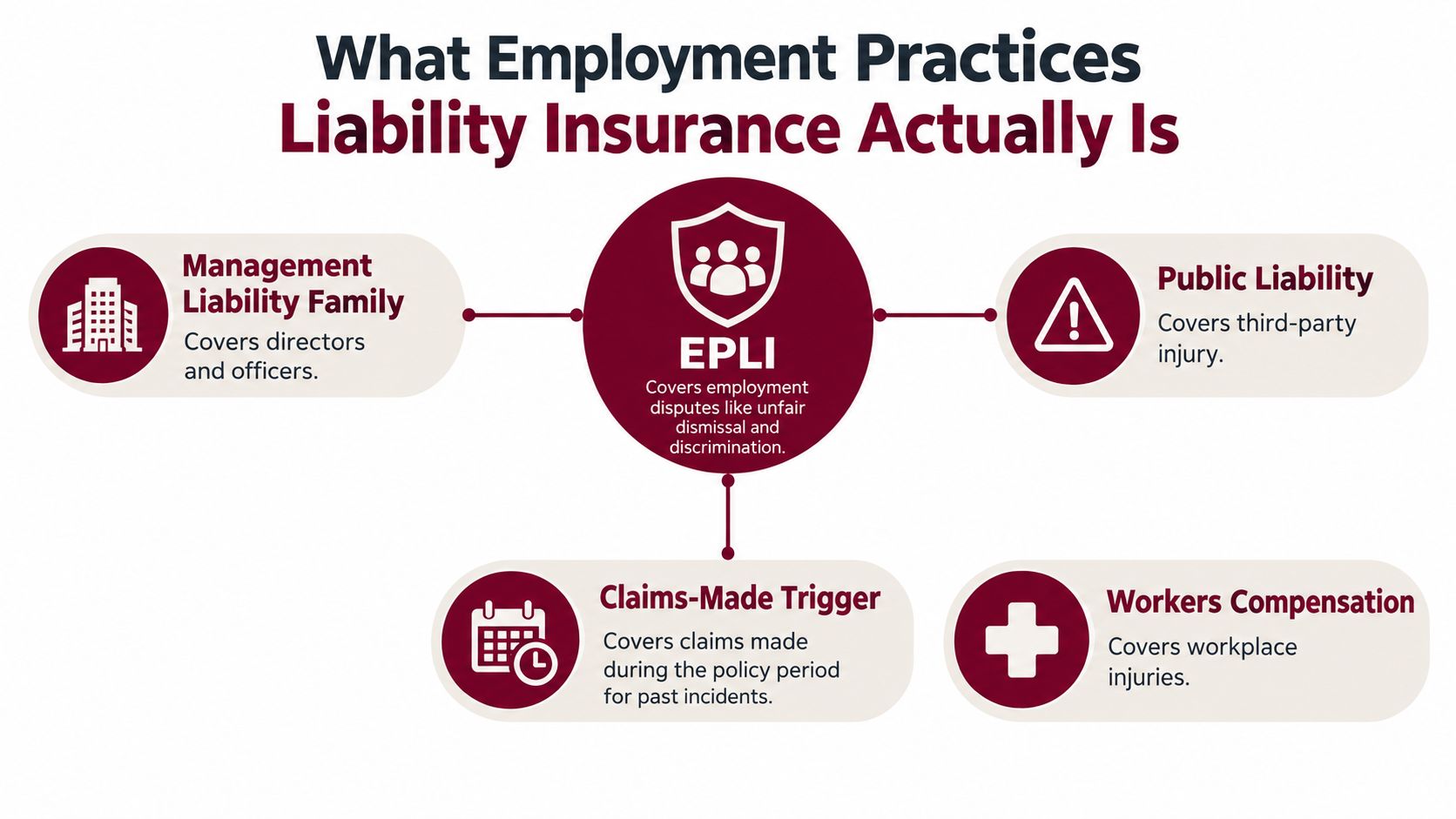
Think of EPL as a conditional legal-response fund, not a pot of damages money. The policy may help pay for defending an allegation before its merits are resolved, but only where the claim, insured parties and costs satisfy the contract.
- Public liability: Don't treat third-party injury or property-damage cover as a substitute for employment-dispute cover.
- Workers' compensation: A work-related injury and an allegation about employment treatment require different coverage assessments.
- Directors and officers: Personal management liability isn't automatically the same as the company's employment liability.
- Statutory liability and WHS-related cover: A regulator's inquiry needs its own review of the relevant insuring clauses.
- Crime: Employee dishonesty is a separate exposure, even if disciplinary action later produces an employment claim.
The practical distinction is between the event and the insured allegation. A workplace incident can involve several events, but the insurer assesses the particular claim against the applicable wording. A certificate showing management liability cover doesn't establish that assessment.
The Allegations EPL Policies Are Built to Respond To
A dismissal application doesn't need to succeed at a final hearing to require a serious response. Of 14,772 unfair-dismissal applications lodged in 2023–24, 7,744 settled through conciliation, while 183 were successful at the Commission, according to Russell Kennedy's workplace-relations review. Those outcomes shouldn't be interpreted as a simple measure of employer fault, but they demonstrate why conciliation and defence arrangements matter.
The insurer's starting point is the policy's definition of wrongful employment practice. A heading that says “employment practices” is less useful than wording that identifies the alleged conduct and the eligible claimant.
Match each allegation to the wording
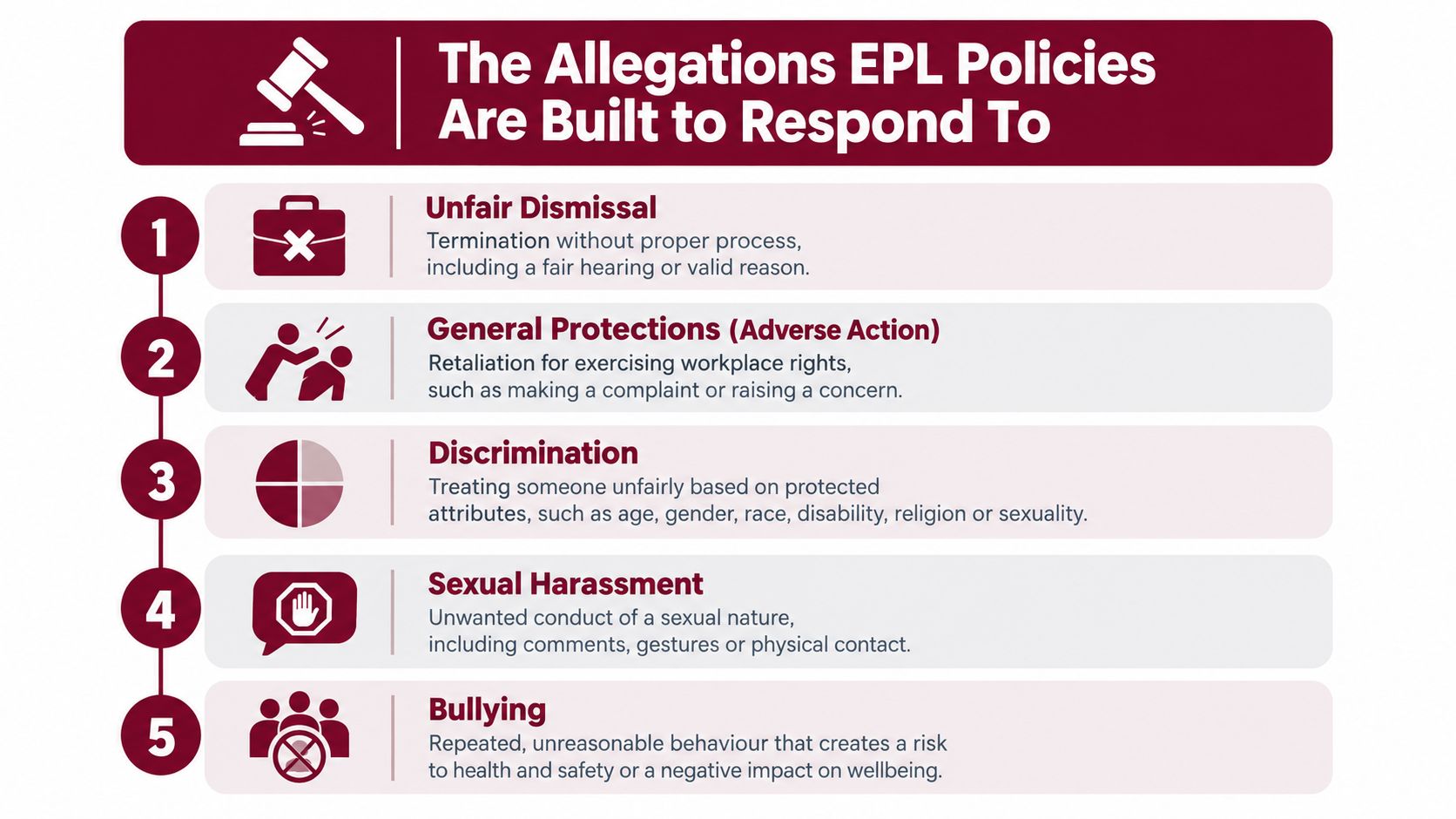
- Unfair dismissal: Check for wrongful or unfair termination within the covered practices. A performance explanation doesn't remove the need to address an alleged failure of process.
- General protections and retaliation: Test whether the wording captures adverse employment action following the exercise of a workplace right or the raising of a complaint.
- Discrimination: Look for coverage tied to relevant discrimination allegations, including decisions about recruitment, promotion, duties and employment conditions.
- Sexual harassment: Check both the covered conduct and whose alleged conduct can create liability for the insured business.
- Bullying: Don't assume an allegation is covered merely because management calls it harassment. Read the actual definitions and exclusions.
- Failure to employ: Prospective employees need to fall within the eligible claimant wording if recruitment disputes are to be addressed.
Discrimination exposure also extends beyond termination. The Australian Human Rights Commission recorded 2,708 complaints in 2023–24, with disability discrimination representing 43% and sex discrimination 22%, as recorded in its annual complaint statistics. These are discrimination complaints overall, not a count of insured EPL claims.
For a trades business, the practical questions include how supervisors allocate duties, respond to disability-related requests and handle complaints about site behaviour. Records should explain the management decision, not merely state that the worker was difficult.
Kons Law's litigation tactics for securities professionals is a supplementary resource for readers considering employment-discrimination defence. It isn't Australian coverage advice, and it shouldn't replace locally qualified employment counsel.
A broker can map allegations to policy clauses, but a solicitor assesses the legal merits. Keeping those roles distinct helps the business defend the claim without assuming that a plausible defence guarantees insurance cover.
Core Policy Features Australian SMEs Should Compare
Compare wording, schedule and endorsements together, rather than choosing EPL by premium and headline limit. A cheaper policy may suit a straightforward payroll workforce but leave unresolved questions for a builder using labour hire, related entities and interstate crews. Conversely, paying more for an extension that doesn't match your operations isn't a useful improvement.
The comparison should produce decisions you can explain. Would you accept defence costs reducing the available settlement limit? Can the business fund the excess promptly? Does the inquiry cover apply at the stage when you're likely to need legal assistance?
Typical EPL Policy Features and What They Mean
| Feature | What it controls | Why it matters for an SME |
|---|---|---|
| Liability limit | Maximum available payment under the applicable cover | Check whether other sections share the same aggregate |
| Defence costs | Whether legal expenses sit inside or outside the limit | Inside-limit costs reduce funds remaining for other insured payments |
| Investigation sublimits | Restricted cover for specified inquiries or investigations | Broad liability cover may still provide narrow inquiry funding |
| Retroactive date | Eligibility of earlier alleged conduct | Preserve continuity when replacing cover |
| Extended reporting period | Additional time to report eligible claims | Review before a sale, closure or policy cancellation |
| Insured persons and entities | Who receives protection | Include the correct employing entities and relevant individuals |
| Territorial scope | Geographic and jurisdictional boundaries | Match where crews work and where claims could be brought |
| Notification conditions | Reporting requirements | Identify the correct recipient and required information |
| Solicitor and consent provisions | Who handles defence and authorises spending | Existing legal advisers may need insurer approval |
| Excess structure | The insured's contribution | Check whether related allegations attract separate contributions |
Make the comparison operational
Ask the broker to test each proposed wording against a realistic complaint from your own business. A useful test might involve a former apprentice alleging harassment by a supervisor, with the employing company and director both named. That exposes definition gaps more clearly than a generic benefits summary.
A policy comparison should tell you what you'd do after receiving a claim, not just what you'd pay at renewal.
Professional indemnity belongs in a separate assessment where the business provides design, certification or technical advice. The professional indemnity insurance Australia guide provides a related starting point, but that cover shouldn't be confused with protection for employment decisions.
Request written clarification of material ambiguities before binding. A broker's explanation helps, but an assumption made during a phone call isn't a replacement for an agreed endorsement. Keep the final comparison with the policy documents so the person handling a complaint can find it.
Limits and Exclusions That Catch Builders and Trades Off Guard
The most dangerous wording gap on a construction site is often a definition, not a dollar limit. An apprentice, casual employee, labour-hire worker and subcontractor may work beside each other, yet occupy different positions under the EPL contract. Their site access cards don't tell you whether their claims are eligible.
Separate who can bring a covered claim from who is insured against that claim. A subcontractor might be an eligible claimant under an extension without being an insured person. Equally, protecting a supervisor doesn't establish cover for every allegation made by a worker supplied through another business.
Check the boundaries before relying on the label

- Deliberate or fraudulent conduct: Examine when the exclusion applies, whether a finding is required and how one person's conduct affects other insureds.
- Wages and entitlements: Don't assume unpaid wages, superannuation or contractual benefits become insured because the worker includes them in an employment demand.
- Penalties: Check the applicable section and legal insurability. Defence-cost cover doesn't establish cover for a penalty itself.
- Bodily injury and property damage: Read exclusions and any relevant carve-backs, particularly where psychological injury accompanies an employment allegation.
- Known circumstances: Review unresolved grievances before arranging or replacing insurance. Fresh cover isn't a reliable solution for an existing problem.
- Contractor and third-party claims: Seek explicit wording where the business needs protection against allegations from people outside its direct payroll.
These exclusions need careful application to mixed allegations. A pay dispute followed by termination may involve both an entitlement demand and an adverse-action allegation. The answer shouldn't be an automatic rejection of everything, or an assumption that everything is covered.
Complaint pathways aren't confined to federal employment law
Workplace matters accounted for 53% of complaints received by the Victorian Equal Opportunity and Human Rights Commission, while 51% of accepted discrimination complaints in Queensland arose in the workplace, according to HFW's Australian workplace-relations update. These figures describe complaint environments, not insurer acceptance rates.
For businesses working across jurisdictions, the practical response is to check the relevant forum and allegations rather than assume every employment complaint belongs at the Fair Work Commission. Obtain employment advice before treating a dispute as only a wage issue, only bullying or only dismissal.
Ask the insurer to explain any allocation between covered and uncovered components. That distinction can matter as much as the overall coverage decision.
How EPL Overlaps With Workers Compensation, WHS and Management Liability
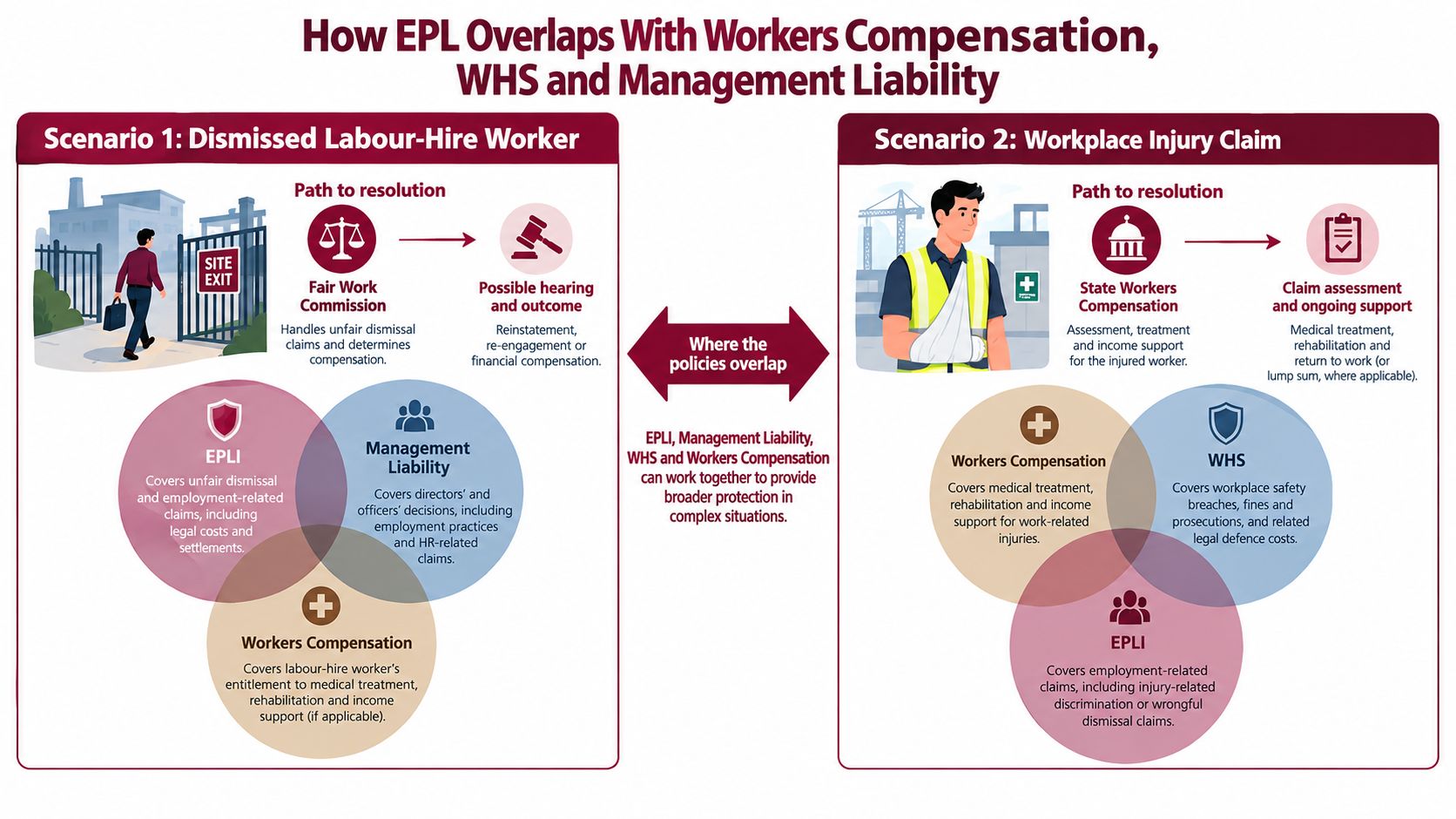
A mixed workforce makes coverage allocation particularly important. Consider a hypothetical labour-hire worker removed from a developer's site after complaining about discriminatory treatment. The labour-hire employer ends the assignment, and the worker alleges that both businesses contributed to the outcome.
A dismissed labour-hire worker
The worker might seek advice about Fair Work and available human-rights or state discrimination pathways. Those pathways aren't automatically all available together; jurisdiction and election questions need legal advice. The host business should nevertheless assess its own exposure rather than assume the labour-hire agency will handle everything.
EPL may be relevant to an eligible employment allegation, while another management liability section may require assessment if individuals are named. Workers' compensation isn't triggered by dismissal alone. An alleged work-related injury introduces a separate question under the relevant scheme.
The first allocation task is to identify who employed the worker, who made the site-removal decision and which entities received demands. Contracts between the host and agency should be retained, but contractual responsibility doesn't settle insurance coverage.
A psychosocial-injury crossover
In another hypothetical case, an employee alleges persistent bullying, submits a psychological-injury claim and reports unsafe workplace conditions. Workers' compensation may address an accepted injury; EPL may address an eligible employment allegation; and relevant WHS or statutory liability wording may address specified regulator-response costs.
Serious mental-health workers' compensation claims rose 14.7% to 17,600 in 2023–24, representing 12% of all serious claims; harassment and workplace bullying accounted for 33.2%, and work pressure 24.2%, of serious mental-stress claims, as reported in HRD Australia's workplace-stress analysis. These aren't automatically EPL claims.
Review the workers' compensation insurance guidance alongside the employment and regulator-response assessment. Keep a common chronology, but track invoices and proceedings separately so insurers can assess the costs attributable to each matter.
Response discipline: Notify potentially relevant insurers without promising that any particular policy will pay. Ask them to clarify defence coordination and cost allocation before duplicated work develops.
What Australian SMEs Should Ask Before Buying EPL Cover
Bring workforce details and unresolved complaint information to the placement conversation, not just payroll totals. Identify employing entities, labour-hire arrangements, apprentice numbers qualitatively where precise figures aren't needed, and the jurisdictions in which crews operate. The broker needs to understand the actual working arrangements.
EPL Buying Checklist for Australian SMEs
| Check | What to ask | Watch for |
|---|---|---|
| People and entities | Are our companies and relevant managers insured? | Missing employing entities |
| Claimants | Can apprentices, casuals, former staff, applicants and supplied workers bring eligible claims? | Narrow employee definitions |
| Prior conduct | What retroactive and prior-matter restrictions apply? | Lost continuity on replacement |
| Available funding | How do defence costs, sublimits and excesses interact? | Less usable funding than the headline limit |
| Reporting | What triggers notice, and can circumstances be notified? | Waiting for formal proceedings |
| Geography | Does the wording match our operating jurisdictions? | Territorial or forum restrictions |
| Extensions | Are contractor or third-party allegations addressed? | Assuming payroll cover extends to everyone |
| Response arrangements | Who authorises solicitors, investigations and settlement? | Unapproved expenditure |
Do and don't at placement
- Do request a wording comparison: A Steadfast-network broker can use market access to compare options, but the recommendation should still identify material gaps.
- Do separate legal and insurance advice: HeyAtty's small business lawyer guide is a supplementary resource for considering legal support, not Australian policy interpretation.
- Don't wait for a hearing date: Ask about early notification when a potentially significant grievance emerges.
- Don't promise a settlement first: Obtain legal advice and check insurer-consent requirements before committing the business.
A circumstances notice should describe the actual facts and potential allegations, not offer a vague statement that staff occasionally complain. Keep confirmation that the insurer received it and seek clarification about how the policy treats it.
Treating EPL as Part of a Broader Management Liability Picture
A sound insurance programme follows the business's exposures rather than its organisational chart. Employment decisions, director conduct, regulator inquiries, dishonesty and cyber incidents can involve the same people without belonging under the same insuring clause. The management liability insurance for small business guide provides context for assessing that broader package.
For construction businesses, renewal should reflect changes in how work gets done. Moving into development, adding another employing entity or relying more heavily on supplied labour deserves a fresh assessment, not just a revised premium.
A useful renewal decision frame
- People: Does the programme reflect who works for the business and who directs them?
- Decisions: Have new operating arrangements changed the allegations the business could face?
- Response: Can management identify the right adviser and notification process immediately?
Early notification remains the most valuable practical habit, supported by reliable records and prompt advice. Insurance can help fund an eligible response, but it can't recreate a missing termination record or undo a poorly handled complaint.
ABS Insurance Brokers Pty Ltd offers management liability advice and placement, including EPL options, for Australian builders, trades, developers and commercial businesses. Visit ABS Insurance Brokers Pty Ltd to arrange a review of your workforce arrangements, current policy wording and related covers before your next renewal or significant staffing change.