
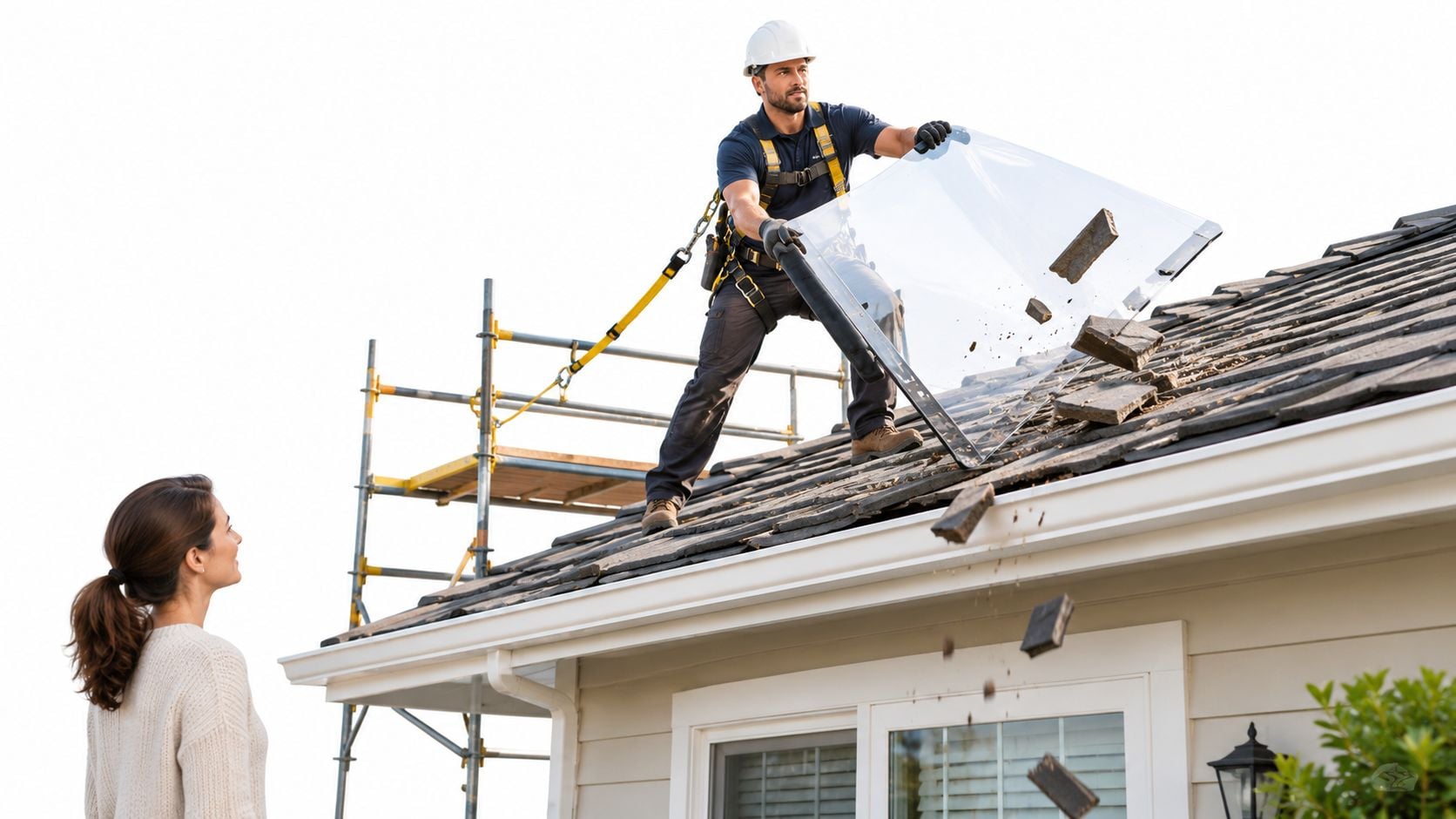
$10 million to $20 million is the typical public liability limit required for roofing contracts, depending on the project and client. The cover protects against third-party injury and property damage, but it doesn't replace workers compensation or contract works insurance.
That distinction matters more than the headline limit. Public liability insurance for roofing is often mandatory under contracts, yet many contractors buy the cheapest policy, accept a certificate of currency and assume every roof-related loss will be covered. That assumption fails when a subcontractor falls, rain damages occupied premises, a tile hits a neighbour's vehicle or the policy excludes the actual height, hot work or roofing method.
A roof is both a workplace and a source of third-party danger. The right question isn't just, “How much cover do I have?” It's, “Which policy responds, for which person, property and stage of the work?”
Table of Contents
- Why Generic Roofing Insurance Advice Fails
- What Public Liability Insurance Actually Covers for Roofers
- How Much Public Liability Cover Do Roofing Contracts Require
- Real Claim Scenarios That Test Roofing Liability Cover
- Risk Mitigation and Documentation Builders Should Maintain
- What Public Liability Does Not Cover and What You Need Instead
- How to Choose the Right Public Liability Policy for Your Roofing Business
Why Generic Roofing Insurance Advice Fails
Most roofing contractors don't buy the wrong insurance because they're careless. They buy it because the market presents public liability, workers compensation and contract works insurance as one convenient roofing package, even though each section responds to a different loss mechanism.
Think of the package as an umbrella sold for rain, wind and hail. It may sit under one broker's file or one business insurance program, but the shields are separate. Public liability generally addresses third-party bodily injury and property damage. Workers compensation addresses statutory employee injury obligations. Contract works cover is designed for insured damage to work, materials or the structure during construction, subject to its wording.
A bundled policy doesn't make those sections interchangeable.
Broker's rule: A certificate proving that a policy exists doesn't prove that the policy covers the incident you're worried about.
The safety data makes the distinction impossible to ignore. Safe Work Australia recorded 37 construction-worker deaths in 2024, while falls from height accounted for 24 deaths nationally, or 13% of all traumatic workplace fatalities. Only 30.5% of workers with a work-related injury or illness received workers compensation, according to the same national source. Those figures don't turn public liability into workers compensation. They show why a contractor must identify the injured party before deciding which policy should respond. Safe Work Australia's national statistics provide the relevant context.
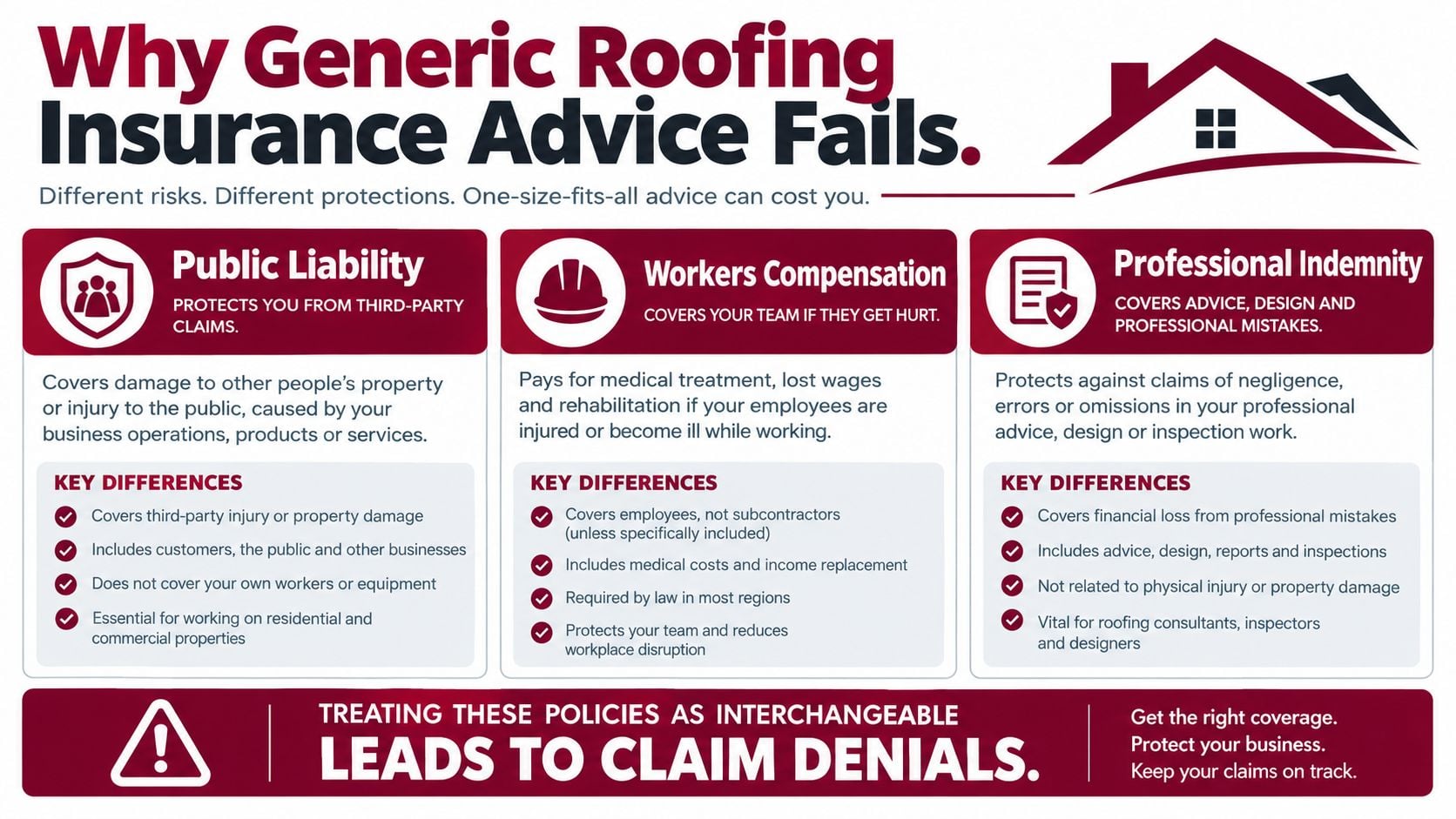
A roofer who damages a neighbour's property may have a public liability issue. A roofer who damages the client's existing building may need contract works or damage-to-property wording. An employee injured on site may fall within workers compensation, while a design or specification error may involve professional indemnity in appropriate circumstances.
The cheapest package is only cheap until the claim lands in the gap between those categories.
What Public Liability Insurance Actually Covers for Roofers
Public liability insurance covers legal liability for third-party bodily injury or property damage arising from the roofing business. “Third party” usually means someone who isn't the insured business or its employee, such as a homeowner, tenant, visitor, pedestrian, neighbour or another contractor. The policy responds according to its wording, exclusions, conditions and declared activities.
Roofing creates obvious third-party pathways. A tile, sheet, tool or piece of debris can leave the work area. A poorly controlled access route can expose a visitor to a fall. Temporary uncovering can allow water into occupied premises. Public liability is designed for the resulting claim where the contractor is legally liable, but it doesn't automatically pay every cost connected with the job.
Safe Work Australia recorded 142 worker fatalities in the Australian construction industry over 2017–2021. Among construction fatalities involving falls from a height, 27% resulted from falls from a building or other structure, including roofs, while 18% involved ladders. The same data recorded 44 construction fatalities from falls from a height during that period. These figures are not roofing-specific claims data, but they show why insurers and principal contractors examine roof access, falling-object controls and public separation. The Safe Work Australia fatality report sets out the national construction figures.
Mapping Roofing Activities to Insurance Responses
| Scenario | Correct insurance response | Why it matters |
|---|---|---|
| A tile falls onto a pedestrian or neighbour's vehicle | Public liability | The alleged loss involves third-party injury or property damage caused by business activities. |
| An employee is injured while roofing | Workers compensation | Public liability isn't a substitute for statutory employee injury cover. |
| The client's building or materials are damaged during construction | Contract works or suitable damage-to-property wording | The damaged property may be the subject of the contract rather than unrelated third-party property. |
| A completed roof leaks after handover | Policy-specific completed-operations or defective-work analysis | Liability for resulting damage and the cost of rectifying the contractor's own work may be treated differently. |
| A hired elevating platform is damaged | Plant, equipment or hired-in plant cover | Public liability generally isn't property insurance for the contractor's equipment. |
The practical test is simple. Identify who suffered the loss, what property was damaged and whether the work was complete. Then check the policy wording rather than relying on the label “roofing insurance”.
How Much Public Liability Cover Do Roofing Contracts Require
Most roofing contracts specify a minimum liability limit, commonly $10 million or $20 million, depending on the client, site and project. Commercial builders, developers and owners corporations often impose their own contract requirements, and the limit may be fixed once the tender is accepted.
Victorian guidance states that most owners corporations with common property must carry public liability insurance of at least $20 million for liability involving injury, illness, death or property damage on common property. That building-level policy doesn't insure the roofer's operations or remove the contractor's responsibility to maintain its own cover. Consumer Affairs Victoria explains owners corporation insurance requirements.
Match the limit to the contract
Use this decision sequence before signing:
- Read the insurance clause. Confirm the required limit, insured parties, territory, period and any requirement to name a principal or provide a specific endorsement.
- Describe the actual work. Re-roofing an occupied strata building presents a different exposure from isolated residential maintenance. Include height, roof condition, access, hot work, fragile materials and subcontractors.
- Check the policy scope. A $20 million limit is of little comfort if the policy restricts the height, excludes the method used or removes completed-operations cover.
- Compare the contract with the schedule. Check maximum contract values, work locations, activities and any special conditions before work starts.
- Get written confirmation. Ask the broker or insurer to address unusual requirements, not merely issue a certificate.
For practical guidance on control measures, find HSE-aligned working at height rules before you submit a tender. You can also compare the insurance issues raised by larger building projects in this guide to choosing a public liability limit for builders.
A certificate of currency proves that cover was arranged at a particular time. It doesn't amend exclusions, extend the declared trade or guarantee that an additional-insured request will be accepted. The wording matters more than the certificate's appearance.
Real Claim Scenarios That Test Roofing Liability Cover
A roofer can follow the contract, hold the required limit and still face a coverage dispute if the work was described inaccurately or a policy condition was ignored. The following scenarios show how responsibility can split between parties.
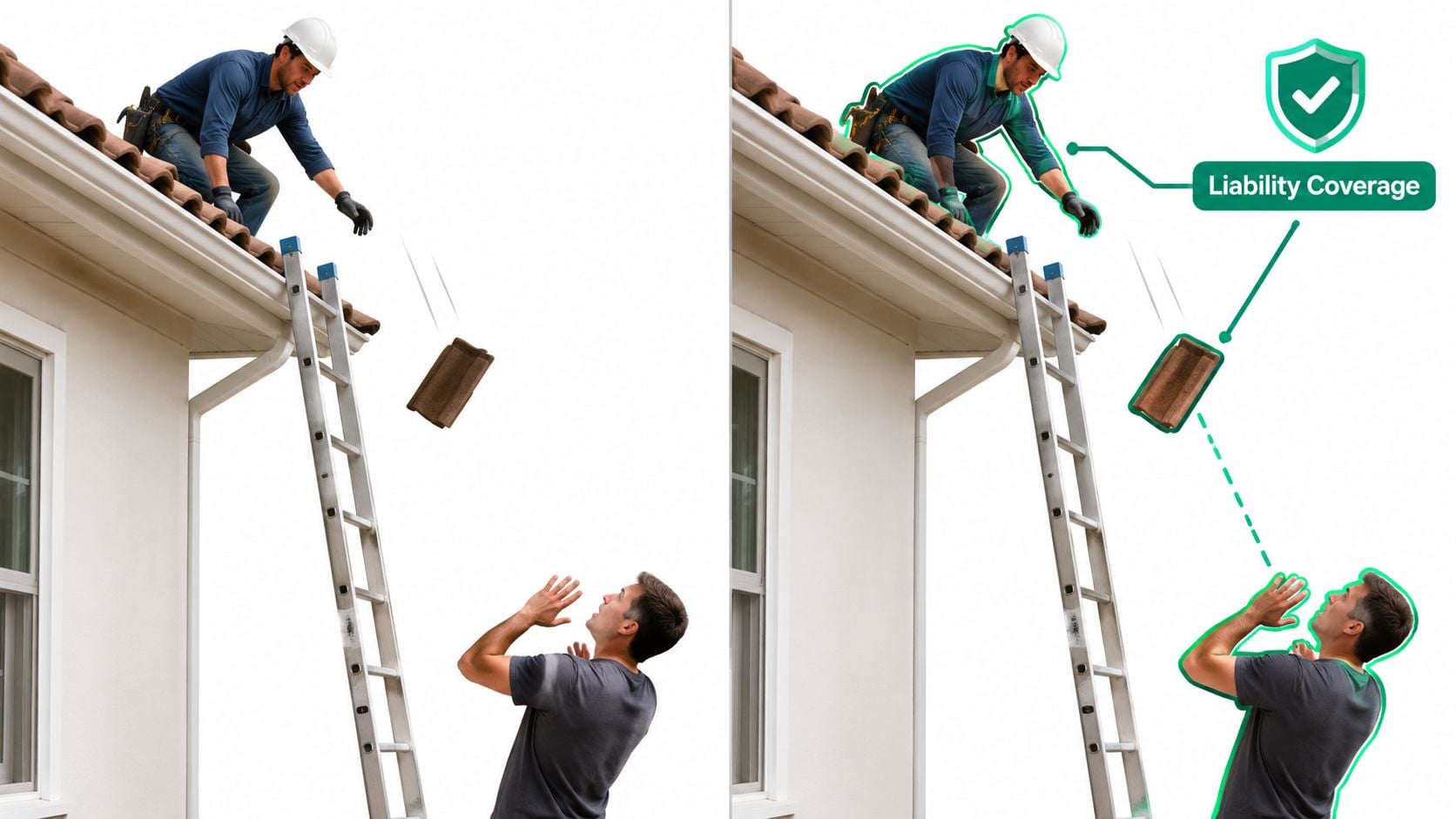
A crew is replacing tiles on a suburban home. One tile slips past the work zone and damages a neighbour's car. If the roofer is legally liable, the neighbour's property damage is the kind of third-party loss public liability is intended to address. The insurer will still examine whether materials were secured, whether the exclusion zone was adequate and whether any policy condition concerning height or roof work was breached.
When a subcontractor is injured
A subcontractor is struck by falling sheets while working below another part of the roof. The subcontractor may pursue its own arrangements, the principal roofer or both, depending on the facts and contractual relationships. Public liability may become relevant to liability owed to the subcontractor, but the contractor must not assume that calling someone a “subbie” settles the insurance question.
The insurer may examine the subcontractor agreement, certificates of currency, supervision, site controls and whether the subcontractor was treated as an employee in practice. Workers compensation obligations may also arise under applicable law. A principal's policy doesn't automatically replace the subcontractor's own responsibilities.
When rain damages tenant stock
A roofer temporarily uncovers an occupied commercial building. Rain enters before the area is protected, damaging a tenant's stock. Several questions follow: who controlled the premises, who owned the stock, what did the contract say about temporary protection, and was the water ingress caused by negligence or an excluded construction defect?
Public liability may address resulting third-party property damage if the policy responds. It may not pay to redo defective work or damage to the contractor's own work. The building owner, tenant, principal builder and strata entity may each have separate policies, but multiple policies don't eliminate the need to allocate responsibility under the contract.
In every scenario, photographs, weather records, site instructions, inspection notes and incident reports can influence the investigation. Intent isn't the test. The policy wording, legal liability and compliance with conditions are.
Risk Mitigation and Documentation Builders Should Maintain
A strong insurance submission begins before the quote. Roofers who can show how they prevent falls, control public access and secure materials give an insurer something more useful than the vague description “roof repairs”.
SafeWork NSW identifies falls from heights as the leading cause of traumatic fatalities in the state's construction industry. Serious and fatal incidents commonly occur below 4 metres, including single-storey roofs, ladders and scaffolds. SafeWork NSW recommends physical guardrails or other prevention controls before relying on harness-based restraint, with guardrails at least 900 mm above the roof surface and additional considerations for roofs pitched above 10 degrees. SafeWork NSW's construction incident guidance explains the control hierarchy and site risks.
Build an evidence file
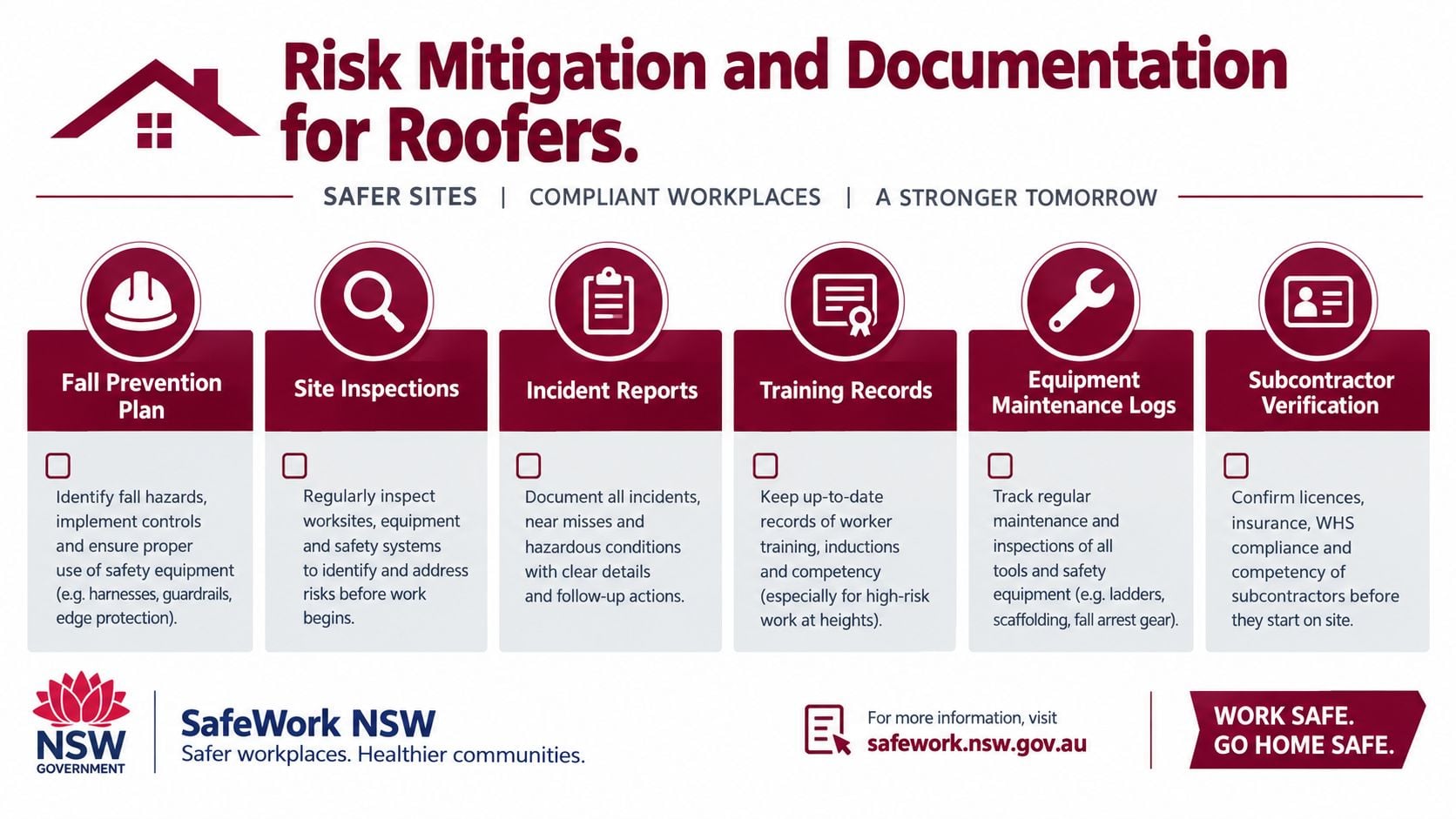
Keep a job record that answers what was known, what was controlled and who was responsible:
- Pre-start inspection: Record roof condition, fragile areas, skylights, access points, pitch and nearby public areas.
- Work method: Prepare a site-specific SWMS where construction work could expose a person to a fall of more than 2 metres.
- Exclusion zones: Photograph barricades and note how pedestrians, residents, vehicles and other contractors were separated from overhead work.
- Material security: Document how tiles, sheets, tools and waste were stored, tied down and lowered.
- Penetration protection: Cover and mark skylights, openings and fragile roof areas before work begins.
- Edge protection: Record the equipment used, its position and any changes during the job.
- Subcontractor verification: Retain certificates of currency, scopes of work, agreements and evidence of site induction.
- Incident response: Report events promptly, preserve photographs and avoid admitting liability before receiving advice.
These records serve two purposes. They reduce the chance of an incident, and they help demonstrate what the business did when an insurer, principal contractor or regulator asks questions.
A good file won't turn an excluded claim into a covered claim. It can, however, prevent a preventable dispute about what happened.
What Public Liability Does Not Cover and What You Need Instead
Public liability is not a general repair fund for every problem connected with roofing. It normally focuses on third-party bodily injury and property damage, subject to the policy wording. It isn't workers compensation, a warranty for workmanship or insurance for every tool and machine owned by the business.
The ABS recorded 563,600 people experiencing a work-related injury or illness during 2017–18, equal to 4.2% of people who had worked during the year. Construction had the highest industry rate in that dataset, at 59 injuries or illnesses per 1,000 employed persons. Sprains and strains represented 28%, chronic joint or muscle conditions 18%, and cuts or open wounds 16% of reported injury categories. The Australian Bureau of Statistics data supports the need to separate worker injury arrangements from public liability.
Match the exposure to the policy
| Roofing exposure | Cover to investigate | Boundary to check |
|---|---|---|
| Employee injury | Workers compensation | Statutory obligations and worker status apply. |
| Damage to work in progress or construction materials | Contract works | Confirm the insured property, events and construction period. |
| Damage to the existing building | Contract works or damage-to-property extension | Check whether the wording covers existing structures and resulting damage. |
| Design, advice or specification error | Professional indemnity, where appropriate | It won't usually cover ordinary poor workmanship or the cost of improving defective work. |
| Tools, plant or hired equipment | Plant, machinery, tools or hired-in equipment cover | Confirm ownership, hire agreements, locations and security conditions. |
| Vehicle-related loss | Commercial motor | Public liability generally isn't a substitute for motor cover. |
A roof that leaks after handover may produce two different costs. Resulting damage to a tenant's contents could raise a public liability question, while removing and replacing the defective roof may be treated as rectification of the contractor's own work. For a focused comparison of advisory errors and third-party damage, review the differences between professional indemnity and public liability.
How to Choose the Right Public Liability Policy for Your Roofing Business
Start with the application, not the premium. Write down every service the business performs, including repairs, maintenance, re-roofing, metal work, skylights, fragile roofs, hot work, commercial sites, strata buildings and work through subcontractors. A generic trade description can hide the hazard profile an insurer needs to assess.
Ask the broker these questions:
- Height restrictions: Does the wording impose a maximum working height, and does it match the roofs you access?
- Fragile materials: Are skylights, asbestos-related work, brittle sheets and fragile roofs included or restricted?
- Hot work: Are welding, cutting, soldering, grinding and heat-producing equipment covered under the required controls?
- Completed operations: Will the policy respond to third-party damage alleged after handover, and for how long under the wording?
- Subcontractors: Are subcontractors covered, excluded or required to hold their own insurance? Does the policy respond to liability attributed to their work?
- Occupied premises: Is temporary weather protection, tenant access and damage to contents addressed appropriately?
- Geographic scope: Does cover apply where the business operates, including interstate projects?
- Contract obligations: Are principal indemnities, additional-insured requests and waiver clauses acceptable to the insurer?
Don't accept “roof repairs” as a sufficient answer if the business also performs full re-roofing, commercial maintenance or work on fragile structures. Disclose the full scope of operations and ask for the response in writing. If you need help understanding the role of a construction-focused intermediary, this guide to public liability insurance brokers outlines the questions worth asking.
Review the policy before renewal and before accepting any unusual contract. ABS Insurance Brokers Pty Ltd arranges public liability and contract works insurance for Australian builders, trades and construction businesses, with advice on policy wording and certificates suited to declared project requirements.
ABS Insurance Brokers Pty Ltd can review your roofing activities, contract conditions, subcontractor arrangements and existing policy wording to identify gaps between the required cover and the cover you currently hold. Visit ABS Insurance Brokers Pty Ltd to discuss a public liability and construction insurance structure that matches your next roofing contract.