

Most advice about owner builders insurance NSW starts with the wrong conclusion. Because an owner-builder doesn't take out Home Building Compensation cover for work they perform themselves, many guides imply that insurance is largely optional. That advice confuses a statutory warranty scheme with protection for a live construction site.
The HBC exemption may remove one specific obligation from your own scope. It doesn't protect your unfinished house from storm damage, theft, fire or accidental damage. It doesn't pay a visitor's medical costs after a fall, and it doesn't automatically respond when a neighbour's property is damaged by your work. NSW guidance strongly recommends public liability insurance for owner-builders and tells them to check their home and contents cover before building starts. NSW guidance for owner-builders makes the practical position clear: legal exemption isn't the same as adequate protection.
You need to separate three issues from the outset: statutory HBC obligations for licensed contractors, physical damage to the works, and liability to other people. Treating those as one insurance problem is how owner-builders end up with expensive gaps.
Table of Contents
- The Dangerous Myth of Owner-Builder Insurance Exemptions
- Decoding the Home Building Compensation Fund Rules
- Essential Construction Phase Covers You Must Secure
- Navigating the Owner-Builder Permit and Compliance Process
- Managing Subcontractor Risks and Statutory Thresholds
- Common Exclusions and Costly Assumptions to Avoid
- Securing Compliant Protection with a Specialist Broker
The Dangerous Myth of Owner-Builder Insurance Exemptions
The dangerous assumption is simple: “I'm an owner-builder, so I don't need building insurance.” The accurate version is narrower. An owner-builder can't take out Home Building Compensation cover for work performed directly on their own project, but that exemption only concerns the statutory compensation scheme. It doesn't insure the building materials stacked on site, the partially enclosed structure or the people moving through the property.
A construction site changes the risk profile of a home. The roof may be incomplete, temporary fencing may fail, materials may be stored outdoors and trades may be working around open edges, excavation or exposed services. A standard home policy may not respond to that condition, particularly if you haven't told the insurer that substantial building work is underway. Your policy wording, construction scope and insurer approval matter more than the fact that the property was previously insured as a home.
HBC is not a construction site policy
Home Building Compensation cover is designed as a last-resort safety net for certain incomplete or defective residential work. It can respond when a builder dies, disappears, becomes insolvent or loses a licence after a compensation order, subject to the scheme's conditions. It isn't a substitute for Contract Works Insurance, and it isn't a general liability policy.
That distinction matters commercially. If a storm damages stored materials, you need property damage protection. If a visitor is injured, you need liability protection. If a contractor damages adjoining property, you need to understand which policy responds and whether the contractor's cover is current and adequate.
Broker's rule: Start with the event you fear, not the policy name. Ask who pays if the works are damaged, who pays if another person is injured, and who pays if a licensed contractor leaves defective work behind.
The exposure sits with the person controlling the site
As owner-builder, you act as the principal contractor for the work you organise. You choose trades, control access, coordinate deliveries and decide when parts of the site are safe. That control creates practical responsibilities even where a particular insurance product isn't legally compulsory for your own work.
Public liability deserves priority because a construction accident can involve people who aren't part of the build. NSW specifically recommends this cover for owner-builders because it addresses injury to family members or the public during the work. Your family may walk through the site, a delivery driver may enter the property, or a neighbour may suffer damage caused by construction activity.
The correct response isn't to buy the cheapest policy labelled “owner-builder”. It is to map the project from demolition or excavation through to completion, identify every party who could suffer loss, and arrange cover that follows the actual work. The HBC exemption is a narrow legal position. It isn't a financial safety net for the entire project.
Decoding the Home Building Compensation Fund Rules
The Home Building Compensation Fund is a statutory safety net, not a complete insurance package for an owner-builder project. It responds only to defined residential building risks, parties, triggers and time periods. Treating the scheme as site-wide protection leaves a serious gap between legal compliance and the losses that can occur during construction.
For residential building work exceeding $20,000 including GST, HBC cover is mandatory in NSW. The licensed contractor must arrange it before work starts or any payment is taken, including a deposit, under NSW's builder and tradie HBC requirements. That threshold applies to the contractor's relevant residential building work. It does not automatically apply to the full owner-builder project.
What the statutory cover actually does
HBC protection addresses incomplete or defective work in specific circumstances. Those circumstances include the builder's death, disappearance, insolvency or loss of licence after a compensation order. It does not pay for every physical event during construction, and it does not replace cover for injury or property damage caused by work on the site.
The protection period is limited to 6 years for major defects and 2 years for other defects from completion, as set out in the NSW government guidance. These periods establish a statutory warranty and claims framework. They do not convert HBC into an all-risk policy for the construction phase.
The scheme also has financial ceilings. The maximum amount payable on a single policy is $340,000, while policies issued before 1 February 2012 were capped at $300,000, according to the NSW HBC insurance fact sheet. That fact sheet identifies a non-completion sub-limit of 20% of the contract price. Those limits can leave a substantial shortfall if rebuilding or completion costs exceed the statutory response.
The owner-builder rule changed
NSW changed its treatment of owner-builder transactions on 15 January 2015. Owner-builder work stopped being insured in the same way for subsequent purchasers, which matters if you may sell the property later. A future buyer does not automatically receive the statutory protection that applies to work performed by a licensed builder.
The decisive question is who performs each part of the work. An owner-builder cannot obtain HBC cover for their own work. A licensed contractor engaged directly by the owner-builder may have to provide HBC when that contractor's residential building work exceeds the statutory threshold. Your project therefore has two risk categories: self-performed work outside HBC and qualifying contractor work subject to separate statutory obligations.
HBC insurance can be offered only by licensed insurers approved by the Minister under the Act, and icare administers the scheme. A builder also needs a Certificate of Eligibility before applying for project-specific cover. The policy is issued for each project through an approved distributor, not as blanket protection. The NSW insurance obligations guidance explains why the contract structure, materials and scope require review rather than reliance on the headline project value.
For a practical explanation of how the statutory scheme fits into a broader insurance program, read this guide to Home Building Compensation Fund insurance in NSW. The correct response is to verify HBC for each qualifying contractor, then separately arrange contract works and public liability cover for the physical and third-party risks HBC leaves exposed.
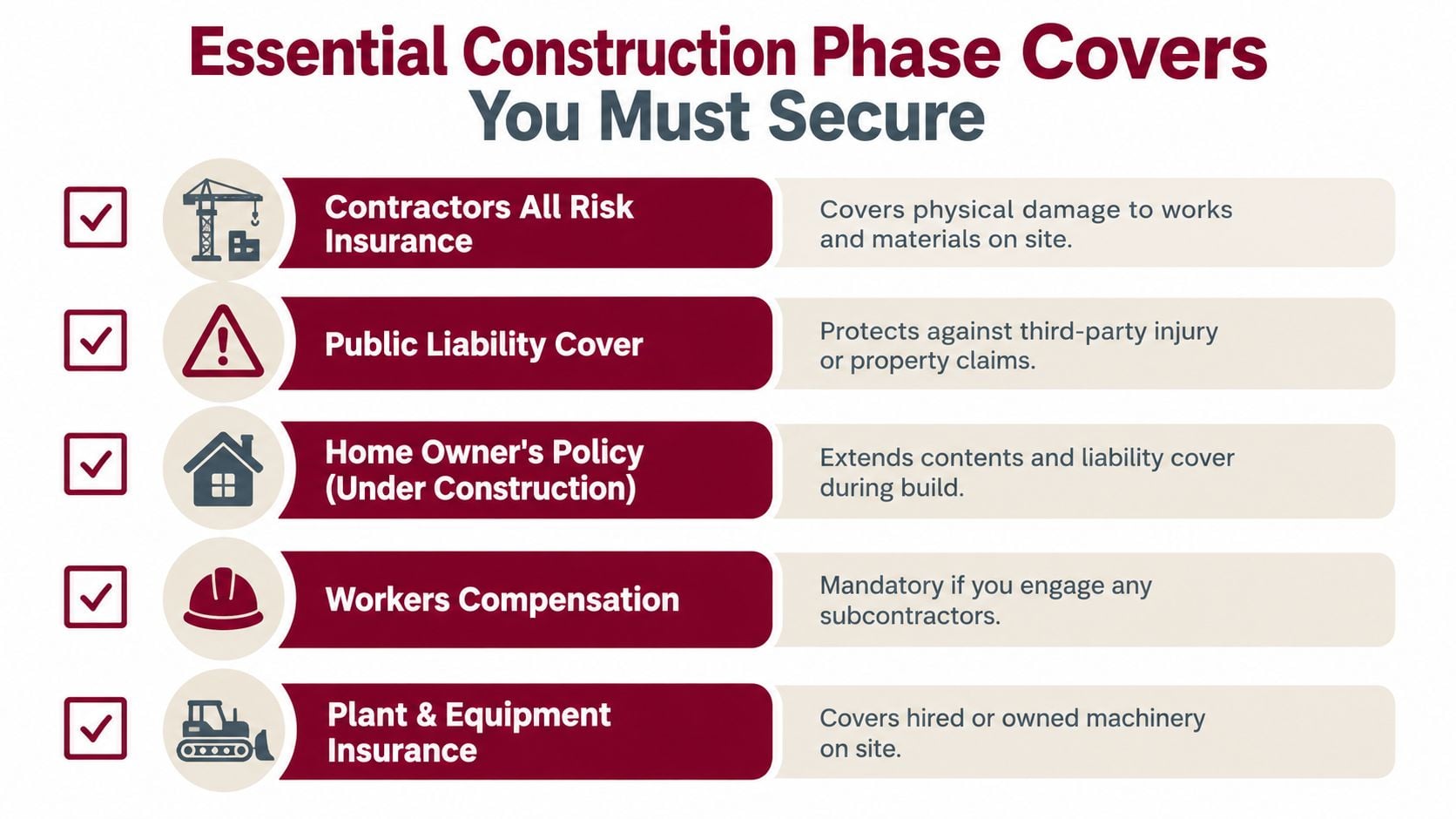
Essential Construction Phase Covers You Must Secure
The HBCF exemption can leave an owner-builder legally outside the scheme while the site remains exposed to fire, storm, theft, accidental damage, and injury claims. Treat those as separate problems. Build the project insurance program around the risks HBC does not address, starting with Contract Works Insurance and Public Liability Insurance.
Contract Works Insurance covers physical loss or damage to the building work and construction materials, subject to the policy wording. Depending on the policy, insured events may include fire, storm, accidental damage, and theft. Set the sum insured at the realistic cost of reinstating the work, not just the amount quoted by a contractor. Allow for demolition, debris removal, professional fees, and escalation where available, then review the figure as the project changes.
Keep property and liability cover separate
Contract Works responds to damage to the project. Public Liability responds to claims from other people for injury or property damage arising from the work or site. These policies perform different jobs, and one cannot replace the other.
Public liability matters particularly on an owner-builder site because you control access, sequencing, and coordination. The NSW owner-builder insurance guidance recommends this protection for owner-builders, including cover for injury to family members or members of the public during construction. Check the policy schedule, definitions, excesses, and exclusions rather than relying on the label alone.
Arrange cover before workers, deliveries, tools, or materials arrive.
Each contractor should also carry public liability and Contract Works protection for the scope they undertake. Obtain current certificates and confirm that the stated activities match the work being performed. Their policies transfer part of the risk, but they do not remove your responsibility for project-level gaps, shared areas, or disputes about damaged work.
Site reality: Identify the policy responding to damage to the structure and the policy responding to third-party injury. Until you can do both, the insurance program is incomplete.
Check the policies around the build
Tell your home and contents insurer about the owner-builder works before construction starts. Confirm whether the existing policy remains valid while the home is occupied, vacant, or partly demolished. Ask how it treats temporary accommodation, stored contents, construction materials, theft, and liability during the project. Get the response in writing. A phone assurance does not override the policy wording.
Give the construction insurer accurate underwriting information:
- Site access: State whether the property is secured, occupied, vacant, or shared with trades and deliveries.
- Construction method: Describe demolition, structural alterations, extensions, excavation, and unusual materials.
- Contractors: Keep licences, written scopes, certificates, and evidence of insurance for every trade.
- Project value: Report changes to the works, materials, or professional costs so the sum insured stays adequate.
- Claims records: Photograph progress, retain invoices, and record delivery dates to establish what was on site before a loss.
For a practical explanation of protection for work in progress, read Contract Works Insurance for residential builders. Arrange the policy before exposure begins, not after the frame is standing or materials have arrived.
Navigating the Owner-Builder Permit and Compliance Process
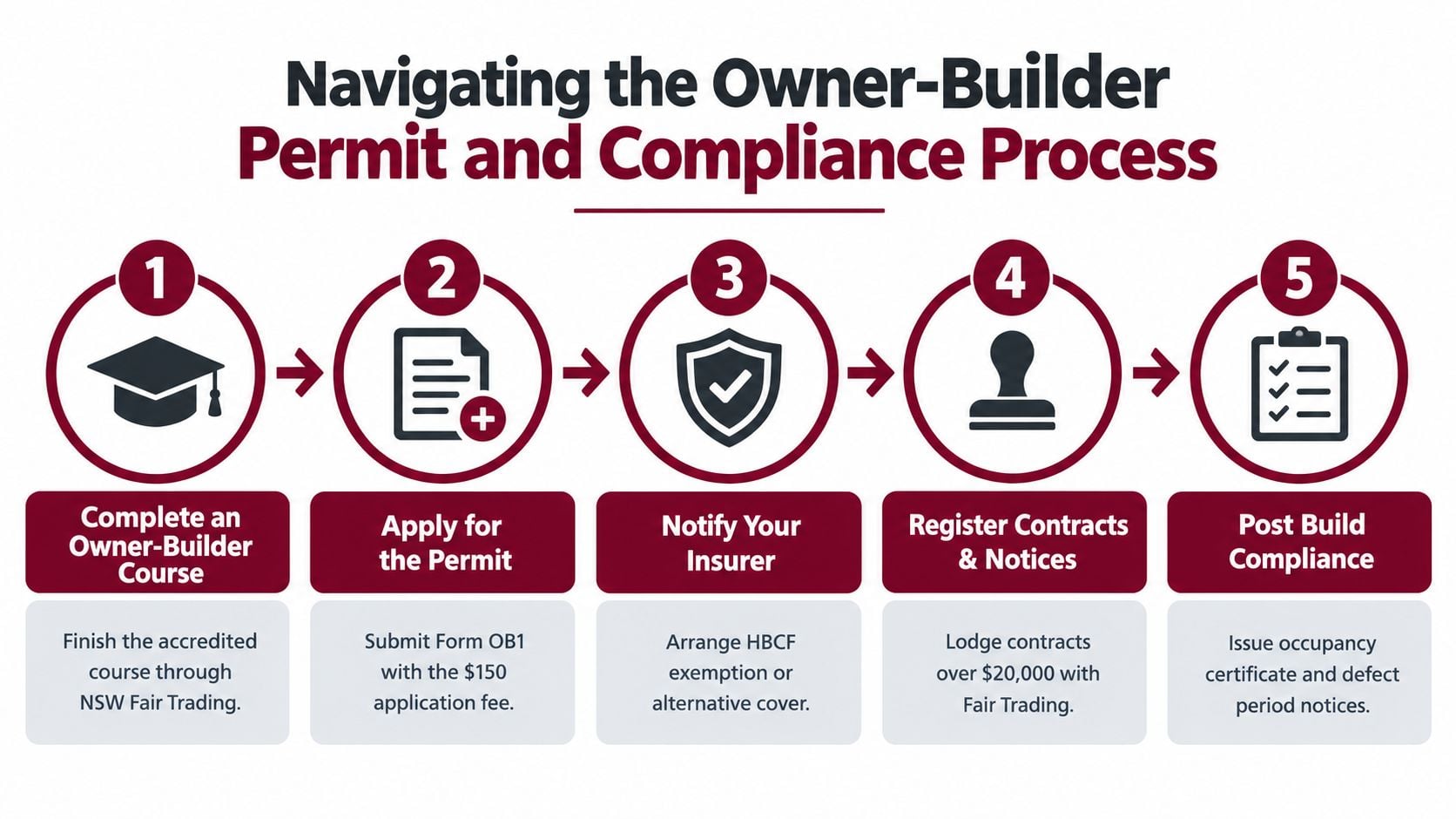
Insurance and permitting should be organised as one project-control exercise. Don't apply for permission with a vague plan, then try to arrange cover once work is ready to start. Give the insurer a clear description of the property, works, estimated completion value, construction method and contractors involved.
Build the compliance file before work starts
Start with the NSW Fair Trading owner-builder requirements that apply to your project. The permit pathway can involve evidence of training, identity, land ownership, the proposed work and other supporting material. Requirements can change, so confirm the current application documents directly with NSW Fair Trading rather than relying on an old checklist or a forum post.
Your insurance file should contain:
- The permit documents: Keep the application, approval and project description together.
- The policy schedules: Confirm the insured name, site address, period of insurance, construction description and sum insured.
- The liability evidence: Record your public liability policy and each contractor's certificate.
- The trade records: Retain licences, written scopes, quotes, invoices and payment evidence.
- The approval trail: Store plans, notices, inspection records and completion documents.
The critical timing point is straightforward. Contract Works and public liability policies should be active before site exposure begins. A certificate issued after a loss won't repair a gap that existed when the incident occurred.
Manage disclosure and future sale risk
Keep records from the first quote to final completion. If you later sell, the buyer and their advisers may need to understand that the work was performed under an owner-builder arrangement. NSW's treatment of owner-builder work has changed, and the statutory position for a subsequent purchaser isn't identical to the position created by a licensed builder's insured work.
Don't describe the project casually in sale documents or insurance applications. State who performed each portion, which licensed contractors were engaged, what certificates were supplied and what approvals were obtained. Clear records help your solicitor, conveyancer, insurer and buyer understand the risk rather than forcing them to reconstruct it.
A permit is not proof that the building is insured. A public liability policy is not proof that the structure is insured. A contractor's HBC certificate is not proof that your own workmanship or stored materials are covered. Keep those documents separate and review them at each major stage of the build.
Practical discipline: No trade starts, no deposit is paid and no material is delivered until the responsible party, insurance evidence and scope are recorded.
Managing Subcontractor Risks and Statutory Thresholds
The legal HBC exemption does not remove the physical and liability risks created by subcontractors. It only addresses a specific statutory obligation. Once other businesses enter your site, control, documentation and insurance must be managed trade by trade.
Owner-builders commonly engage licensed electricians, plumbers, carpenters, concreters and other specialists. Each engagement needs a written scope, agreed price, licence check and review of the contractor's insurance. Do not treat a subcontractor's certificate as a substitute for project-level protection.
A licensed contractor engaged directly by an owner-builder must provide HBC cover when the residential building work exceeds $20,000 including GST. The policy must be arranged before the contractor starts work or accepts any payment, including a deposit, according to NSW Fair Trading's owner-builder guidance.
Separate the scopes and invoices
Do not combine several trades under one informal arrangement and assume the smallest invoice determines the insurance position. Review every direct contract separately. Consider the full scope, labour, materials and any variations when deciding whether the contractor falls within the statutory requirement.
The reasonable market cost of labour and materials can also matter when the contract price is unclear or the owner-builder is performing work on their own land. Compliance depends on how the work is structured, not solely on the figure written on an invoice.
Use written documents that identify:
- The exact scope: State what the contractor supplies, installs, removes and warrants.
- The contracting party: Confirm whether you engage the business directly or through another builder.
- Materials and variations: Record who buys materials and how changes affect the scope and price.
- Payment timing: Check the required certificate before paying a deposit.
- Insurance evidence: Obtain HBC evidence where required, plus current public liability and Contract Works certificates.
The contractor's HBC cover addresses the relevant statutory exposure attached to that contractor's work. It does not cover your self-performed work, the entire project or your liability as the person controlling the site.
Arrange your own Contract Works and public liability protection before construction exposure begins. Contract Works should address the physical works and project materials. Public liability should respond to claims involving injury, property damage or site conditions for which you may be responsible. The HBC exemption creates no answer for those risks.
Owner-builder versus subcontractor responsibilities
| Insurance Type | Owner-Builder Responsibility | Licensed Subcontractor Responsibility |
|---|---|---|
| HBC cover | Not available for work performed directly by the owner-builder | Provide it for qualifying residential work above the statutory threshold |
| Contract Works | Arrange project-level cover for physical works and materials | Maintain cover appropriate to the contractor's scope and obligations |
| Public Liability | Protect against site-level claims connected with control of the property | Carry cover for the contractor's operations and liability |
| Home and contents | Confirm whether the existing policy continues during construction | Do not assume the homeowner's policy protects the contractor |
| Evidence and records | Keep permits, scopes, certificates, invoices and progress records | Supply licences, certificates and clear written contract documents |
This is risk transfer, not risk elimination. A certificate is weak protection if the policy was cancelled, excludes the activity, carries an inadequate limit or names the wrong business. Before work starts, check the insurer, policy period, business name, activity description and relevance to your site.
Common Exclusions and Costly Assumptions to Avoid
The most expensive insurance mistake is assuming that an existing home policy automatically follows the property into construction. Major building work can alter occupancy, security, fire protection, access and the condition of the structure. Those changes can affect whether the insurer accepts a claim.
A home and contents policy may not be designed for an open frame, demolition debris, temporary weatherproofing or building materials awaiting installation. It may also contain conditions about vacancy, security, notification of alterations or construction activity. Your insurer may accept the project, impose conditions, exclude part of the work or require a separate construction policy. You need the answer before the risk changes.
Damage to the works
Owner-builders commonly focus on the finished home and overlook the period when the investment is most exposed. Materials can be stolen before installation. Rain can damage internal areas after part of the roof is removed. Fire, impact or accidental damage can affect work that has already been paid for but isn't yet complete.
Contract Works Insurance is the appropriate place to investigate those exposures. Ask whether the policy covers existing structures, temporary works, materials in transit, materials stored off site, debris removal, professional fees and defective components. Some policies respond to resulting damage but not the cost of correcting defective workmanship or faulty design. That distinction can decide the size of a claim.
Liability and access
Don't allow family, friends or neighbours to treat the site as a normal home. An open trench, temporary stair, unsecured delivery or falling object can create a claim even when nobody intended to cause harm. Public liability should be arranged for the owner-builder's control of the site, and contractor policies should be checked separately.
Ask the broker or insurer about exclusions and conditions relating to:
- Excavation and earthmoving: Confirm whether ground works, shoring and damage to adjoining property are included or restricted.
- Unoccupied periods: Check what happens if the home can't be lived in during the build.
- Theft prevention: Understand fencing, locks, alarms and material storage requirements.
- Contractor negligence: Establish how the policy treats damage caused by a subcontractor.
- Existing structures: Confirm whether the original home is insured while extensions or alterations occur.
Never rely on a policy schedule alone. The schedule tells you what was purchased, while the wording explains how cover operates. Read exclusions, excesses, conditions and definitions with the actual construction program in front of you. If the insurer's answer is unclear, obtain written clarification before work starts.
Securing Compliant Protection with a Specialist Broker
Owner-builder insurance sits between regulation and underwriting. You need someone who can understand the NSW HBC framework, identify which contractor scopes trigger statutory cover, and then build private protection around the risks HBC doesn't touch. A generic online quote rarely captures that interaction.
A specialist construction broker should ask questions that reflect the site, not just the property address. They should want to know whether the project is a new build, extension, alteration or renovation, who controls the work, which trades are engaged, what materials are stored, whether the home is occupied and how the project will be staged.
What good advice looks like
The broker's work should produce a clear insurance map:
- Statutory cover: Identify which licensed contractors need HBC cover and verify the relevant certificates before payment or commencement.
- Physical damage: Arrange Contract Works cover for the works, materials and project-specific exposures.
- Liability: Protect the owner-builder's site control and review every contractor's public liability evidence.
- Existing insurance: Coordinate with the home and contents insurer so construction activity doesn't create an undisclosed gap.
- Claims preparation: Establish what photographs, invoices, contracts and progress records you'll need if damage occurs.
Market access also matters where the project falls outside a standard residential template. Sloping sites, major alterations, unusual construction methods, existing structures and mixed owner-builder and contractor scopes can all require more detailed underwriting. A broker can present the risk accurately rather than forcing it into an unsuitable online category.
Use a broker as an adviser and claims advocate, not as a document-ordering service. Before accepting a recommendation, ask what is covered, what is excluded, who is insured, which events require notification and how the policy responds when a subcontractor causes the loss. For a broader discussion of the value of specialist advice, read why construction insurance broker support matters.
Owner-builder insurance should leave you with certainty about three things: the statutory obligations attached to each contractor, the policy that protects the physical works, and the policy that responds to injury or property damage involving other people. If any answer is vague, the program needs another review.
ABS Insurance Brokers Pty Ltd arranges owner-builder, Contract Works, public liability and NSW Home Building Compensation Fund-related insurance support for construction projects. Visit ABS Insurance Brokers Pty Ltd to discuss your project structure, contractor scopes and the cover needed before work begins.