
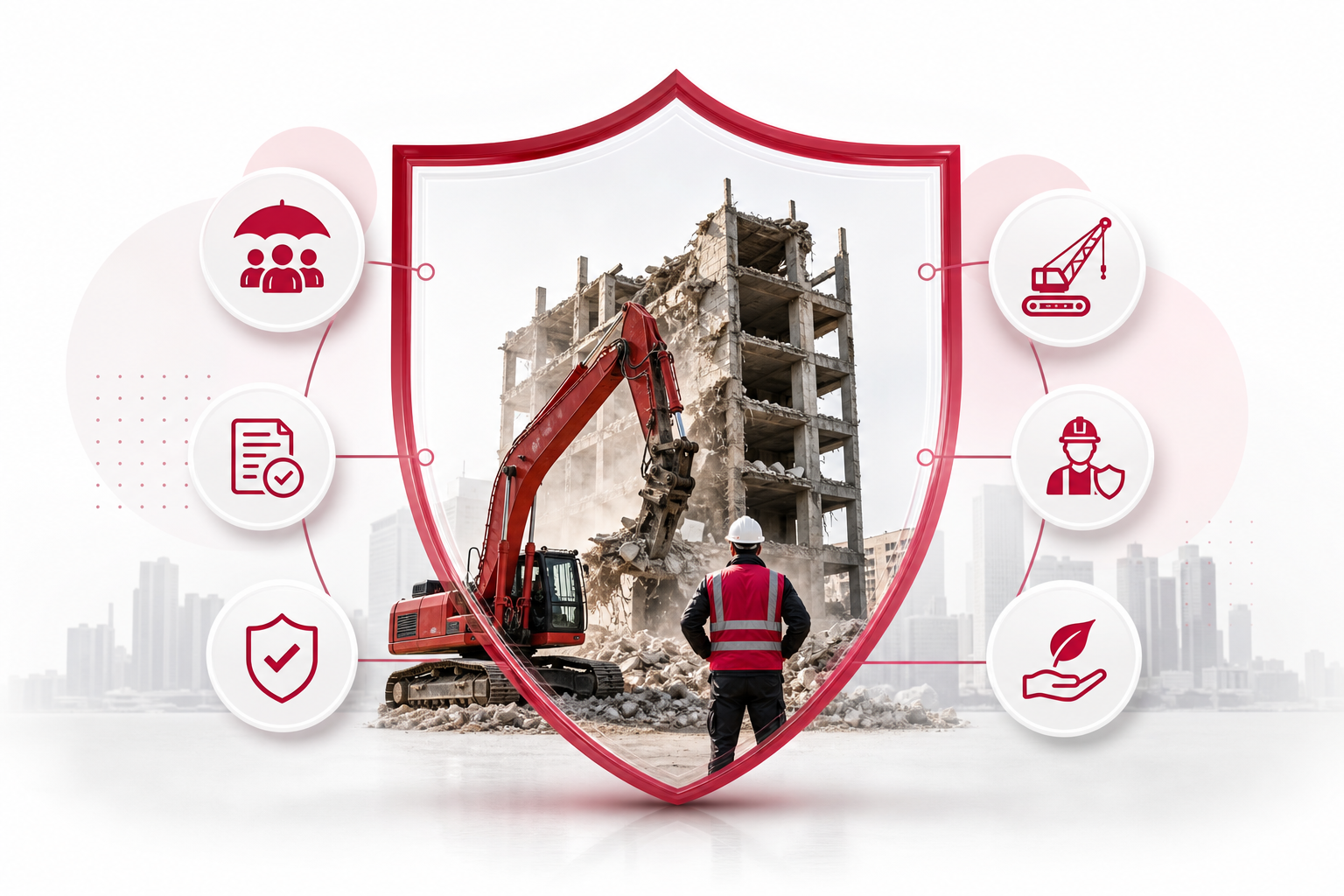
Demolition Contractor Insurance: Covers That Protect High-Risk Demolition Work
- Demolition Contractor Insurance: Managing High-Risk Work
- Core Covers for Demolition Contractors
- Covers That Are Often Overlooked
- What Standard Policies Often Miss in Demolition
- Working With a Broker Who Understands Demolition
- Key Questions to Ask Before You Arrange Cover
- Frequently Asked Questions
- Getting the Cover Right
Demolition contractor insurance should be arranged around the work actually performed, including structural demolition, strip-outs, site conditions and any hazardous-material handling. No single policy covers every exposure: liability, contract works, plant and workers cover have different terms and exclusions. Safe Work Australia’s demolition work guidance is a useful starting point for identifying site hazards to disclose to insurers.
This article covers the key policies that apply to demolition work, explains why standard construction cover often falls short, and outlines what to ask when arranging a program that actually fits your work.
Demolition Contractor Insurance: Managing High-Risk Work
Demolition sits at the high-risk end of the construction spectrum. Unlike building work, where risk builds gradually as a structure takes shape, demolition involves controlled destruction — and uncontrolled outcomes are always possible.
The hazards are specific and serious:
- Structural collapse during partial demolition
- Debris striking workers, bystanders, or neighbouring properties
- Dust, silica, and asbestos exposure
- Vibration damage to adjacent buildings
- Underground services being struck
- Fire from cutting, grinding, or hot work
These aren't theoretical scenarios. They're the situations that generate claims, trigger third-party legal action, and — without the right cover — can end a business financially.
Standard builders insurance is designed around construction activities. It may exclude or significantly limit coverage for demolition-specific risks, particularly those involving hazardous materials or deliberate structural removal. That gap matters more than most contractors realise until it's too late.
Core Covers for Demolition Contractors
Public Liability Insurance
Public liability is the non-negotiable starting point. It covers your legal liability for third-party bodily injury or property damage arising from your work.
In demolition, that exposure is constant. A piece of falling masonry, a dust cloud drifting onto a neighbouring property, vibration cracking a party wall — any of these can result in a claim. Public liability responds to those claims, covering legal defence costs and any compensation awarded.
Most demolition sites require a minimum level of public liability before work can begin. Clients, head contractors, and councils routinely specify $10 million or $20 million as a minimum. Your policy limit needs to match what your projects and contracts actually require.
One thing to check carefully: whether your policy covers work involving asbestos. Many standard policies exclude asbestos-related claims entirely, or restrict cover to removal work carried out by licensed contractors. If your work touches asbestos — even incidentally — this needs to be addressed explicitly in the policy wording, not assumed.
Contract Works Insurance (Demolition Projects)
Contract works insurance, sometimes called construction all risks (CAR) insurance, covers physical loss or damage to the works during a project. For demolition, this typically includes:
- Damage to the structure being demolished before completion
- Damage to plant and equipment on site
- Temporary works such as scaffolding, shoring, or hoardings
The key distinction for demolition is that the "works" being insured are a structure being removed, not one being built. Not all contract works policies are written to accommodate that, and some specifically exclude demolition activities. You need a policy structured with demolition in mind — not one adapted from a standard building template.
Professional Indemnity Insurance
If your business provides advice, planning, or project management services alongside physical demolition work, professional indemnity (PI) insurance becomes relevant. It covers claims arising from errors or omissions in your professional advice or services.
This matters more than many demolition contractors expect. If you advise a client on the sequence of demolition, the structural stability of a partially demolished building, or the scope of hazardous materials present — and that advice turns out to be wrong — you may face a claim that sits entirely outside your public liability policy.
PI cover responds to those claims, covering legal defence and compensation costs tied to your professional services.
Workers Compensation Insurance
In Australia, workers compensation is a legal requirement for any business with employees. It covers workers who are injured or become ill as a result of their work.
Demolition is one of the highest-risk occupations for workplace injury. The combination of heavy machinery, unstable structures, hazardous materials, and physical labour creates an injury profile well above the industry average. Your premiums will reflect that risk — but the cover is essential, both legally and practically.
If you use subcontractors, the picture gets more complex. Depending on the state or territory and the nature of the arrangement, subcontractors may or may not be covered under your policy. Clarify this with your broker before a project starts, not after an incident occurs.
Plant and Equipment Insurance
Demolition work is equipment-intensive. Excavators, skid steers, hydraulic breakers, cranes, and specialist attachments represent significant capital. Plant and equipment insurance covers these assets against physical damage, theft, and breakdown.
There are two main forms of cover: agreed value and market value. Agreed value policies pay out a pre-agreed sum if equipment is lost or destroyed, removing the uncertainty of depreciation calculations at claim time. For high-value or specialist demolition plant, agreed value is generally the better option.
If you hire in equipment for specific projects, check whether the hire agreement requires you to insure it under your own policy or whether the hire company's cover applies. Many hire agreements transfer risk to the hirer — which means you may need to extend your plant cover to include hired-in machinery.
Environmental Liability Insurance
Demolition work can disturb contaminated ground, release hazardous materials, or cause pollution incidents affecting neighbouring land or waterways. Standard public liability policies typically exclude gradual pollution and environmental contamination claims.
Environmental liability insurance fills that gap. It covers the cost of cleaning up pollution caused by your operations, as well as third-party claims arising from environmental damage.
This cover is particularly relevant for contractors working on older industrial or commercial sites, where the history of the land may include contamination that isn't fully known at the start of the project. It's also increasingly required by clients and regulators on higher-risk sites.
Covers That Are Often Overlooked
Management Liability Insurance
If you operate a company or employ staff, management liability insurance protects the business and its directors against claims arising from how the business is managed. This includes employment practices claims such as unfair dismissal or discrimination, statutory liability for regulatory breaches, and directors and officers liability.
For demolition businesses, statutory liability is particularly relevant. Workplace health and safety regulators can and do take action against businesses and individuals following serious incidents. The fines and legal costs involved can be substantial — and they typically fall outside the scope of public liability or workers compensation cover.
Cyber Insurance
It may seem out of place in a discussion about demolition, but cyber insurance is increasingly relevant for trade businesses of all sizes. If your business holds client data, uses cloud-based project management software, or processes payments electronically, you have cyber exposure.
A ransomware attack or data breach can disrupt operations and generate significant costs. Cyber insurance covers incident response, data recovery, and third-party liability arising from a breach.
What Standard Policies Often Miss in Demolition
The most common insurance gap for demolition contractors isn't a missing policy type — it's a policy that appears to cover the work but contains exclusions that apply precisely when a claim arises.
Common exclusions to watch for:
Asbestos exclusions. Many liability policies exclude claims arising from asbestos, or restrict cover to licensed removal work. If your demolition work involves any asbestos-containing materials, this needs specific attention.
Gradual damage exclusions. Vibration damage to neighbouring structures often develops gradually over the course of a project. Policies that exclude gradual damage may not respond to these claims.
Deliberate acts exclusions. Demolition is, by definition, deliberate destruction. Some policy wordings create ambiguity around whether damage caused by deliberate demolition activity is covered. The policy needs to be structured to accommodate this clearly.
Subcontractor exclusions. If you engage subcontractors and they cause damage or injury, your policy may not cover their actions unless it's written to extend cover to subcontractors working under your direction.
These aren't obscure edge cases. They're scenarios demolition contractors encounter regularly — and they're exactly why getting the policy wording right matters as much as having the right policy types in place.
Working With a Broker Who Understands Demolition
Arranging demolition contractor insurance through a general insurer or a comparison platform carries real risk. The policies available through those channels are typically designed for lower-risk trades, and the people arranging them may not have the technical knowledge to identify the gaps that matter for demolition work.
A specialist construction insurance broker works differently. They understand the risk profile of demolition, know which insurers have appetite for it, and can negotiate policy wordings that address the specific hazards involved.
ABS Insurance Brokers operates as part of the Steadfast Network, giving the firm access to a wide panel of insurers and specialist products. For demolition contractors, that access matters — because the right cover for this kind of work isn't always available through standard channels.
The process is straightforward: contact the team directly by phone or through the online quote request form, and a broker works with you to identify cover that fits your work, your contracts, and your risk profile.
Key Questions to Ask Before You Arrange Cover
Before finalising any demolition insurance program, work through these questions with your broker:
- Does the public liability policy specifically cover demolition activities, including partial demolition and structural removal?
- How does the policy treat asbestos — is it excluded, limited, or covered with conditions?
- Does the contract works policy cover the demolition of existing structures, or only new construction?
- Are subcontractors covered under the policy, or do they need their own cover in place?
- Does the policy cover vibration damage to neighbouring structures?
- Is there environmental liability cover, and does it extend to pre-existing contamination?
- What are the notification obligations if an incident occurs on site?
These questions don't have universal answers. They depend on the specific policy, the insurer, and how the cover has been structured. That's exactly why the conversation with a broker matters.
Frequently Asked Questions
What insurance do demolition contractors need in Australia?
At a minimum, demolition contractors need public liability insurance and workers compensation if they have employees. Most projects also require contract works insurance. Depending on the scope of work, plant and equipment insurance, professional indemnity, environmental liability, and management liability cover may also be appropriate.
Is demolition work covered under standard builders insurance?
Not always. Many standard builders insurance policies are designed for construction activities and may exclude or limit cover for demolition-specific risks — particularly those involving hazardous materials, deliberate structural removal, or vibration damage. Check the policy wording carefully, or work with a broker who understands demolition.
Does public liability insurance cover asbestos removal on demolition sites?
Many standard public liability policies exclude asbestos-related claims entirely. Some cover licensed asbestos removal with conditions attached. If your work involves asbestos-containing materials, this needs to be addressed specifically when arranging cover — it's not something to assume is included.
Do I need separate insurance for hired plant and equipment on demolition sites?
It depends on the hire agreement. Many equipment hire agreements transfer risk of loss or damage to the hirer, which means you may need to extend your plant and equipment policy to cover hired-in machinery. Check the hire agreement and discuss it with your broker before the equipment arrives on site.
What is environmental liability insurance and do demolition contractors need it?
Environmental liability insurance covers the cost of cleaning up pollution caused by your operations and third-party claims arising from environmental damage. Standard public liability policies typically exclude gradual pollution. For demolition contractors working on older industrial or commercial sites, or anywhere contaminated ground may be disturbed, this cover is worth considering seriously.
How much public liability cover do demolition contractors need?
The minimum required varies by project, client, and contract. Many commercial and industrial demolition projects require $10 million or $20 million in public liability cover. Check your contracts and any site-specific requirements before settling on a limit.
Can a broker arrange demolition contractor insurance for a single project?
Yes. Project-specific cover is available for demolition contractors who don't carry ongoing annual policies, or who need cover for a project that falls outside their existing program. A broker can structure cover for the duration of a specific project, including contract works and public liability.
Getting the Cover Right
Demolition contractor insurance is not a one-size-fits-all product. The risks are specific, the exclusions matter, and the consequences of getting it wrong are serious.
The most practical step you can take is to work with a broker who has genuine experience in construction and demolition insurance — someone who can read a policy wording, identify the gaps, and negotiate terms that actually respond when a claim arises.
For demolition contractors across Australia, ABS Insurance Brokers offers specialist brokerage services backed by access to a wide panel of insurers through the Steadfast Network. Contact the team directly to discuss your cover requirements.