

“Notify your insurer when a claim arrives” is incomplete advice. For Australian builders and consultants, the critical event can be an earlier email alleging a defect, an adverse inspection report or a warning that another consultant intends to seek a contribution. Waiting for a solicitor's demand can create an avoidable coverage dispute.
Professional indemnity claims also need a better cost test than “how often do they happen?” A business can face greater financial exposure without receiving more complaints, because defending and resolving each matter can become more expensive. The first notification and the potential severity deserve more attention than the claim count alone.
Table of Contents
- What Professional Indemnity Claims Really Involve
- Common Triggers of Professional Indemnity Claims
- How a Claim Develops From Circumstance to Settlement
- Documentation to Keep Before an Incident
- How to Notify a Professional Indemnity Claim Step by Step
- What a Broker Does During a Claim
- Why Premiums and Cover Change Without a Claim
- Audit Your Cover Before the Next Claim
What Professional Indemnity Claims Really Involve
Stable claim numbers don't mean stable claim costs. A professional indemnity claim typically involves a client, principal, owner or other party alleging that your professional services caused loss through negligence, an error, an omission or a breach of duty. Whether the insurer pays depends on the allegation, the policy wording and the notification history, not only on whether someone has accused you of making a mistake.
For a builder, the professional service might be design coordination or technical advice rather than physical construction. For an engineer or certifier, it might involve calculations, inspections or certification. A regulator's inquiry may also require notification, although an inquiry isn't automatically a covered compensation claim.
Separate the cost drivers
Professional Indemnity Cost Drivers in Australia
| Driver | Australian evidence | What it means for the insured |
|---|---|---|
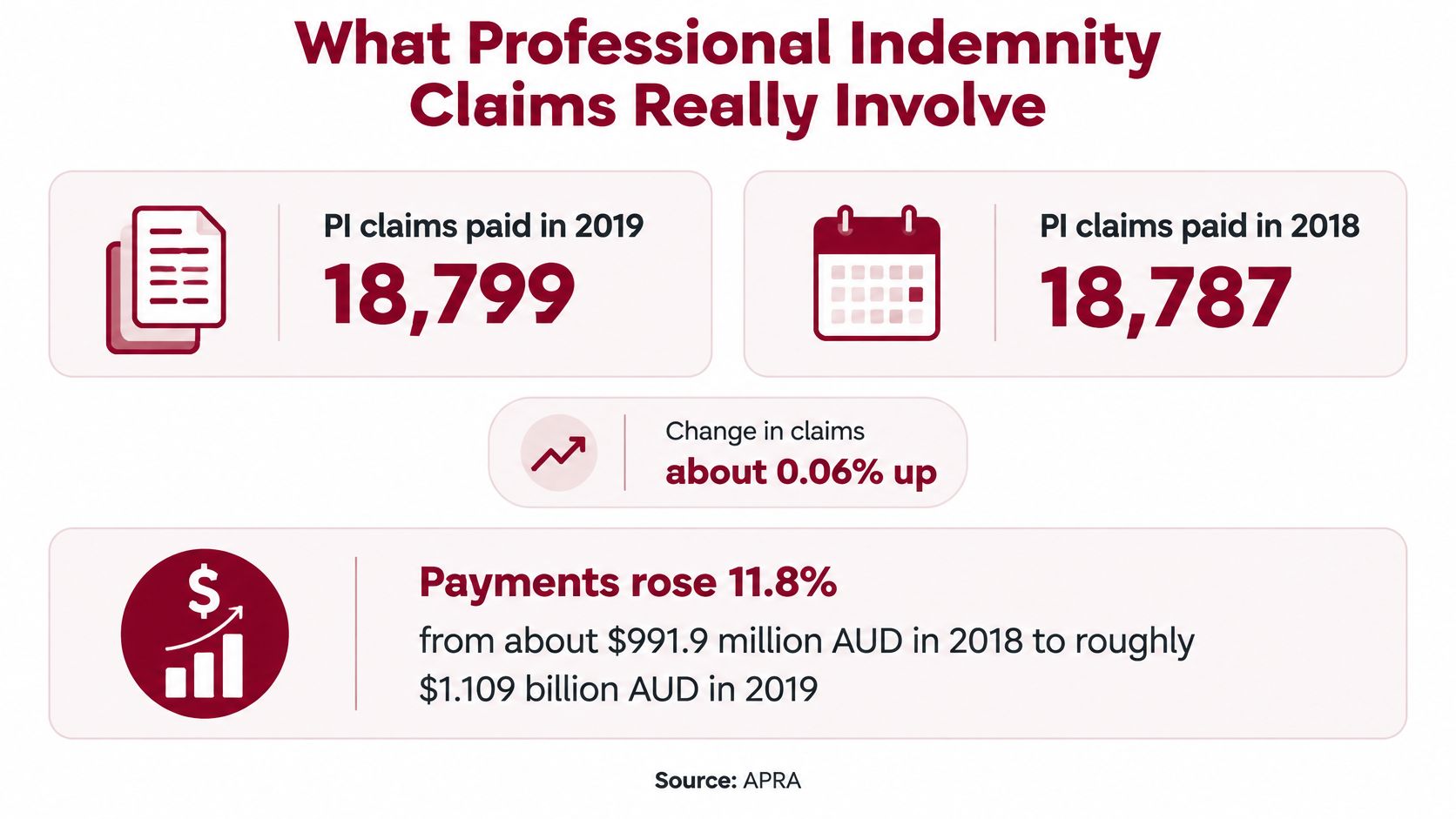
| Claim frequency | For non-facility business reported by APRA-regulated insurers, APRA's overview recorded 18,799 PI claims with payments in 2019 versus 18,787 in 2018, approximately 0.06% higher, while payments rose 11.8%, from about $991.9 million in 2018 to $1.109 billion in 2019. | Almost unchanged paid-claim counts can accompany materially higher payments. |
| Settlement value and claim size | The ACCC's monitoring report found reported PI claim frequency fell from more than 16% in 2001 to about 12% in 2004, while average settled claim size increased more than 60% in 2004. | Lower frequency doesn't necessarily reduce financial exposure. |
| Defence and expert costs | The policy sets whether defence costs sit inside the indemnity limit, outside it or within a separate sublimit. | An inclusive limit can be substantially consumed before settlement. |
| Defect remediation | Responsibility must be separated between professional error, workmanship, products and contractual performance. | A repair invoice isn't automatically an insured professional liability loss. |
| Premium response | Insurers assess the services, contracts, project mix and available capacity at renewal. | A clean claims history doesn't guarantee unchanged pricing or terms. |
These are historical indicators, not current quotations or forecasts. The APRA database release identifies December 2023 as its reported reference period, so the earlier payment comparison shouldn't be presented as today's claims experience.
Read the allegation before choosing the policy
A demand involving damaged property can contain both workmanship and professional negligence allegations. Don't assume public liability will handle everything because the dispute arose on a building site. The distinction between professional indemnity and public liability insurance helps identify which policies may need notification.
Administrative systems matter too. If your business uses automated complaint intake or AI-generated correspondence, Bridge Global's guide to compliant insurance AI rollouts is a useful governance resource to consider alongside human review, access controls and escalation procedures. Don't let an automated summary replace the original complaint.
Practical rule: Choose limits and notification procedures for a difficult allegation, not merely for the likelihood of receiving one.
The meaningful coverage questions are specific: does the retroactive date reach the work, are the services insured, how are defence costs treated, and what must be notified?
Common Triggers of Professional Indemnity Claims
Say an engineer provides structural input for a renovation, relying on assumptions about existing footings. If movement later occurs, the dispute may concern whether investigation was required before providing that input, not just whether the final calculations were correct. Calling the appointment “limited advice” won't resolve a disagreement about what the engineer undertook.
Construction PI exposure follows the task performed. It isn't confined to the person who signs the final certificate.
Where allegations start
- Design and specification: A waterproofing detail omits a critical junction, or a structural design relies on an unverified existing condition. The design assumptions and revision history become central.
- Certification: A professional certifies compliance despite an unresolved departure from the approved documentation. The qualification, supporting evidence and certificate wording matter.
- Inspection: A defect is allegedly visible at a required inspection but isn't recorded or escalated. Photographs need dates, locations and a connection to the inspection report.
- Advice and feasibility: A client proceeds after receiving cost, planning or technical advice, then alleges that a missing qualification changed the investment decision.
- Coordination: An architect, engineer and specialist consultant each assume someone else owns an interface. The resulting scope gap becomes a dispute over who should have identified and resolved it.
Contract terms can intensify any of these allegations. A promise to achieve a guaranteed outcome or accept responsibility for another party's work may extend beyond the liability the PI policy intends to insure.
Task Risk Map for Construction Professionals
| Task | Typical trigger | Deciding evidence | Policy wording to check |
|---|---|---|---|
| Design | Structural, façade or waterproofing failure traced to design | Calculations, drawings, assumptions and revision history | Retroactive date, design liability and professional services definition |
| Certification | Compliance certificate issued for non-compliant work | Inspection records, certificates and applicable standards | Certification exclusions and statutory duty wording |
| Inspection | Missed defect at a stage inspection | Site diaries, photographs and inspection reports | Inspection-by-others clauses and endorsement limits |
| Advice | Loss allegedly caused by cost, planning or feasibility advice | Emails, reports and engagement scope | Advice exclusions, contractual liability and liability caps |
| Coordination | Scope gap between consultants | Consultant scopes, meeting minutes and project programme | Contractual liability and aggregation wording |
A defect isn't proof of professional negligence
A Society of Construction Law Australia submission to NSW Parliament cited an analysis in which 97% of NSW buildings examined had at least one defect, and described insurers responding to cladding exposure through exclusions, higher premiums or higher excesses. That finding concerns the analysed buildings, not every NSW building or every PI claim.
The practical lesson is to preserve the distinction between what was designed, what was approved and what was built. A defective installation may depart from a sound design; equally, a contractor may follow an inadequate detail exactly.
Check cladding, waterproofing and workmanship exclusions against the actual allegation. An exclusion's wording and causal connection matter more than its heading, and a task appearing in your engagement doesn't establish that it appears in your insured services.
How a Claim Develops From Circumstance to Settlement
A circumstance is an event or information that could give rise to a claim. A claim is generally an allegation or demand that meets the policy's definition, which may include written demands for compensation or other relief. A complaint can therefore deserve immediate attention even when the sender hasn't specified an amount.
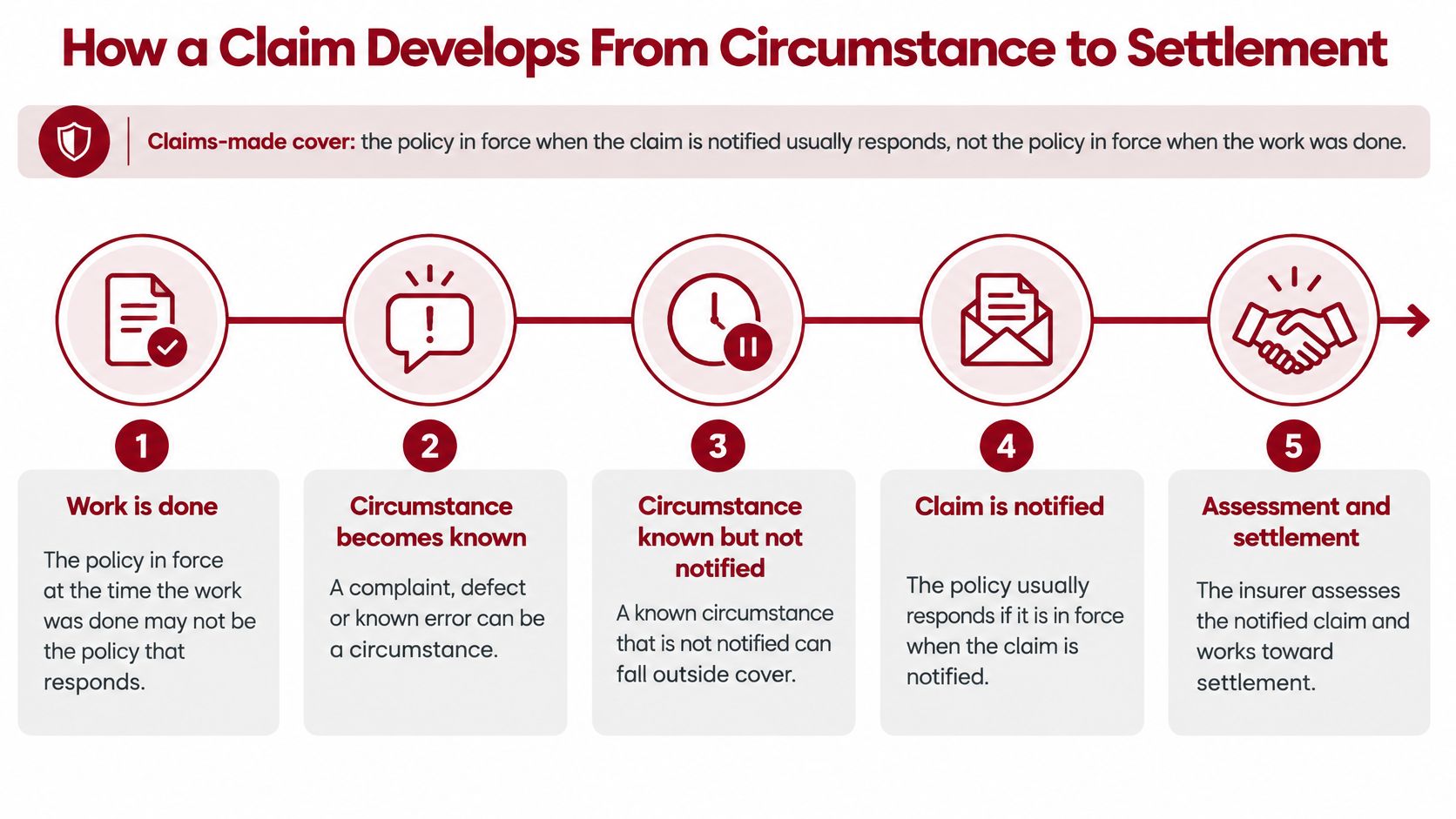
PI insurance is generally claims-made, often with a notification requirement. The relevant policy is usually the one operating when the claim is first made and notified, subject to its wording and applicable law, rather than the policy held when the work occurred. A circumstance known before renewal but left unnotified can create a gap that buying another policy won't necessarily fix.
| Incoming document | What to establish immediately | What to preserve |
|---|---|---|
| Complaint or defect notice | Whether it identifies a professional error or potential loss | Original message, attachments and receipt details |
| Adverse expert report | Which service and project element it criticises | Complete report, instructions and supporting material |
| Contribution warning | Who may seek recovery and on what basis | Correspondence, consultant appointments and project chronology |
| Formal demand | Response deadline and remedy sought | Demand, delivery record and earlier exchanges |
The developing matter
- Signal: A complaint, threatened demand, adverse report or project dispute alerts the business to potential liability.
- Circumstance notification: The insured provides enough facts to identify the concern, affected work and possible consequences.
- Insurer acknowledgement: The insurer records the matter and may request information. Acknowledgement alone isn't confirmation of indemnity.
- Formal demand: The claimant sets out allegations and seeks compensation or another remedy. This may arrive before, during or after investigation.
- Investigation and defence: Solicitors and technical advisers examine duty, breach, causation, loss and the responsibility of other parties.
- Mediation: The parties test settlement options against evidence, defence costs and litigation risk.
- Settlement or determination: The dispute resolves by agreement or a court or other decision-maker determines it.
- Closure: The file is closed, with records retained and any continuing obligations identified.
Don't confuse status with exposure
APRA's National Claims and Policies Database distinguishes open, reopened and finalised claims, and its analysis identifies rising incurred costs in recent accident years despite relatively stable finalised costs. An unresolved file can carry substantial future cost, while reopening is a separate possibility rather than an inevitable outcome.
Say an owner emails about cracking and an engineer's report follows later. The chronology should record both events, not treat the report as the first sign merely because it sounds more authoritative.
Has the insurer been told about the allegation, or only about the demand that followed it?
That question should remain visible throughout the file. Notification should describe facts neutrally, without conceding that the alleged defect establishes negligence.
Documentation to Keep Before an Incident
A folder labelled “final plans” isn't a defensible project record. You need to show which revision was approved, what assumptions supported it, who received it and whether subsequent instructions changed the work.
Test the archive with a hypothetical allegation arriving long after practical completion. Could someone unfamiliar with the project find the inspection photograph, identify its location and connect it to the coordination minute dealing with that element?
Standing Record Plan for Professional Liability
| Record | Allegation it helps answer | Retain until |
|---|---|---|
| Approved plans and revision history | You designed the element as built | Applicable legal, contractual and policy retention requirements are satisfied |
| Scope of engagement and liability cap | You accepted the disputed responsibility | Applicable requirements expire and any related matter is resolved |
| Design calculations and assumptions | Your design lacked an adequate basis | A documented technical and legal retention review permits disposal |
| Stage inspection evidence and photos | You missed a visible defect | Applicable requirements are satisfied and no preservation hold applies |
| Consultant coordination minutes | You failed to warn or coordinate | Applicable requirements expire and related disputes are resolved |
| Certificates and statutory declarations | You certified unsupported compliance | Statutory, contractual and policy retention requirements are satisfied |
| Client correspondence and site instructions | You ignored instructions or failed to advise | Applicable requirements expire and no claim or circumstance remains open |
These are retention decision rules, not universal legal periods. Set the actual schedule with jurisdiction-specific legal advice and the policy requirements; suspend disposal when a matter may become contentious.
Make handovers explicit
- Subcontracting or novation: Each firm retains its appointment, issued work and relevant correspondence. Record who holds the shared project archive.
- Inherited designs: Preserve the incoming design, review scope, assumptions and departures. Don't overwrite the original.
- Informal or unpaid advice: Record the question, limitations and response. A missing invoice isn't a reliable boundary on responsibility.
- Change of firm: Confirm authorised access and custody before departure, without taking confidential material improperly.
For engagement reviews, Documind's contract review tips for legal teams can support a structured checklist, but legal review remains necessary for liability allocation and retention duties.
Stress-test more than the repair invoice
IPART's HBCF review reported average NSW major-defect claims of about AUD 80,000. These are home-building compensation claims, not PI claims, but they illustrate the rectification environment in which professional allegations arise.
A PI limit test should also consider defence, expert investigation, delay allegations and responsibility shared across defendants. A repair quote alone won't capture that scenario.
How to Notify a Professional Indemnity Claim Step by Step
Treat the first concerning communication as a triage task, not an invitation to argue the merits. Your immediate objectives are to preserve evidence, meet notification obligations and avoid making commitments that prejudice the defence.
The ACCC's PI monitoring report separates claim frequency from settled claim size. For claims handling, that distinction supports a practical discipline: don't dismiss an apparently minor notification just because the initial demand looks inexpensive.
The notification procedure
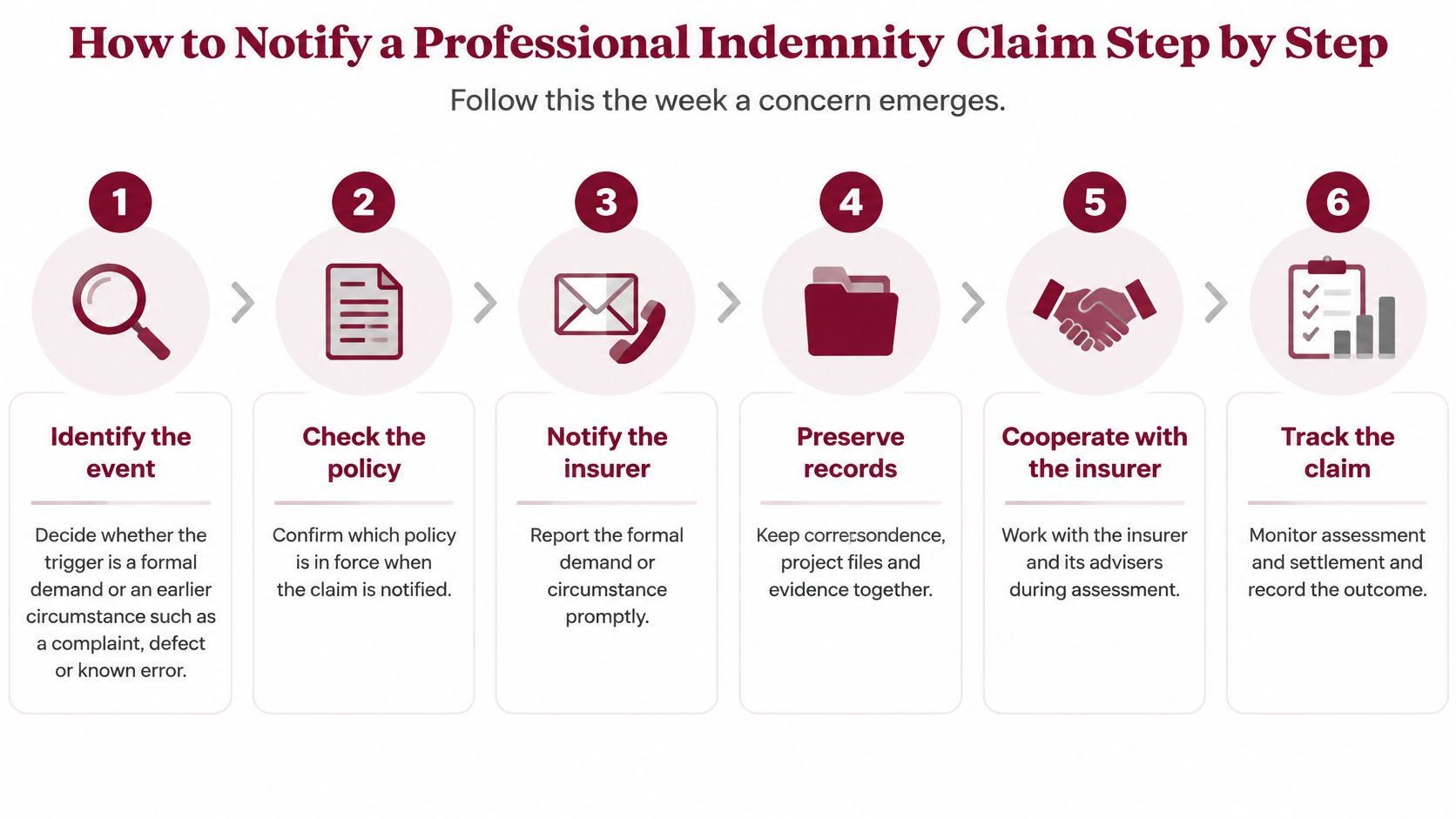
Identify the event. Record the first complaint, defect notice, adverse report or demand and who received it.
Slip to avoid: Waiting for legal proceedings before treating the matter as potentially notifiable.Preserve the record immediately. Export relevant emails with attachments, download original site photographs and duplicate inspection reports and certificates. Suspend routine deletion for affected material.
Slip to avoid: Assuming shared drives, phones and former employees' mailboxes will remain accessible.Read the notification clause. Check the definitions of claim and circumstance, the required recipient, the method of notice and deadlines linked to awareness.
Slip to avoid: Assuming every deadline starts with the formal demand.Contact the broker promptly. Give a neutral account and agree how insurer notification will be delivered. If a deadline is imminent, don't let difficulty reaching someone prevent notice through the policy's specified route.
Slip to avoid: Treating a conversation with the principal as notification to the insurer.Submit a factual notice. Identify the project, parties, services, allegation, relevant dates and potential consequences. State what remains uncertain and avoid admissions or promises to pay.
Slip to avoid: Turning an apology or proposed commercial fix into an acceptance of liability.Obtain written acknowledgement. Keep the submitted notice, attachments, delivery evidence and insurer reference together. Follow up on missing confirmation.
Slip to avoid: Relying on an undocumented phone conversation.Report material developments. Forward new demands and reports, and obtain required consent before appointing experts, agreeing settlements or undertaking disputed repairs. Address urgent safety risks promptly while documenting conditions and seeking immediate direction.
Slip to avoid: Destroying evidence through non-urgent rectification before inspection.
Send a usable evidence pack
First Notification Document Kit
| Document | Why the insurer needs it | The failure it helps prevent |
|---|---|---|
| Completed claim or circumstance form | Records the matter and notification details | Disagreement about what was notified and when |
| Chronology of events | Shows what was known and when | Confusion over awareness and reporting dates |
| Contract and engagement scope | Identifies the services undertaken | Misunderstanding the insured role |
| All claimant correspondence | Establishes allegations and remedies sought | Missing the substance of the complaint |
| Expert and audit reports | Helps assess defects and possible causes | Conflating professional fault with workmanship |
| Site records, minutes and certificates | Supports allocation of duties | An unsupported account of consultant responsibility |
A practical notice can say that the business is notifying potential allegations concerning identified services, is investigating the facts and makes no admission of liability. That wording isn't a substitute for the required particulars.
The insurer may appoint a panel solicitor or technical adviser and confirm indemnity or reserve its position. Ask for a defence plan, reporting arrangements and clarity about responsibility for costs before work expands.
What a Broker Does During a Claim
The broker's job isn't finished when the notice is forwarded. During a live professional indemnity claim, useful broking support turns a collection of emails, deadlines and coverage questions into a managed file.
The broker doesn't determine legal liability or guarantee that the insurer will accept cover. The value lies in checking obligations, maintaining the record and pressing for clear decisions.
What you should be able to check
- Notification review: The file identifies the policy requirements and any urgent deadline before unnecessary correspondence consumes time.
- Notice preparation: The draft describes the concern accurately, distinguishes established facts from allegations and avoids unnecessary admissions.
- Acknowledgement tracking: Someone follows up receipt, records the insurer's reference and diarises promised responses.
- Coverage scrutiny: If the insurer reserves or declines indemnity, the broker asks for the specific wording and factual basis relied upon.
- Adviser coordination: Solicitors, adjusters and technical advisers work from a consistent chronology and understand their respective roles.
- Defence oversight: The insured receives intelligible updates about strategy, expenditure and decisions requiring approval.
Accurate call notes are part of that work. VoxNote's resource on how to track policy conversations after calls is relevant to the administrative discipline, provided recording, privacy and confidentiality requirements are respected.
When coverage is disputed
Expect a written explanation, an opportunity to address missing facts and a clear escalation route. This may include the insurer's internal dispute resolution process and, for eligible policyholders and complaints, the Australian Financial Complaints Authority.
Our explanation of a general insurance broker's role during a claim sets out the broader support process. At ABS Insurance Brokers Pty Ltd, we provide personalised support from quotation through claims, so the claim isn't treated as an unrelated administrative handover.
Why Premiums and Cover Change Without a Claim
Your premium can increase even when your own claims history hasn't changed because the insurer is pricing more than your past notifications. It also considers the potential cost of your services, its broader portfolio and the terms on which it can continue offering capacity.
Bellrock Advisory's professional indemnity market update describes broadly stable frequency across many professional classes alongside increasing claim severity and quantum. That doesn't establish the cause of any individual renewal increase, but it explains why “we haven't claimed” may not settle the pricing discussion.
Ask what changed in the quotation
Larger remediation exposure, extensive expert evidence and prolonged litigation can make an otherwise familiar project type less attractive to an insurer. Aggregation wording also matters: related allegations may be treated as a single claim, affecting both the available limit and excess application.
Contractual assumptions deserve equal attention. A firm accepting broad indemnities or responsibility for coordination beyond its stated appointment may present a different risk from a firm delivering the same technical service under controlled terms.
Compare options with their trade-offs
- Consider a higher excess. It may reduce premium, but the business must fund more of an insured matter. Check when the excess is payable and whether it applies to defence costs.
- Describe services accurately. Replace vague descriptions with the work undertaken. Narrowing the description too far can leave genuine activities uninsured.
- Improve contract terms. Seek proportionate obligations and enforceable liability caps where appropriate. Commercial negotiations and legal review take effort, and a cap won't necessarily bind every claimant.
- Update discontinued activities carefully. Stop presenting obsolete work as current operations, but preserve appropriate protection for historical services and consider run-off requirements.
- Test alternative limits. Compare a severe multi-party defect scenario against the proposed structure. A cheaper limit isn't a saving if it leaves a material uninsured balance.
Our guide to professional indemnity insurance costs provides context for comparing quotations. The useful broker discussion is about differences in protection, not just the total payable.
A lower premium and a narrower promise from the insurer are not the same result as a lower premium for equivalent cover.
Audit Your Cover Before the Next Claim
A certificate of currency confirms that a policy exists. It doesn't demonstrate that the policy will respond to the work now attracting an allegation.
Set aside a working week for a focused audit, with one person responsible for collecting the schedule, wording, endorsements and project examples. Involve whoever approves consultant appointments and whoever receives site complaints, not only the person who pays the premium.
Put the policy against the work
- Check the retroactive date. Compare it with the earliest services for which the business still has exposure. Identify acquisitions, predecessor firms and inherited appointments rather than assuming uninterrupted protection.
- Match services to actual invoices. Review billed activities, variations and informal technical assistance. Flag discrepancies between what the firm does and what the schedule describes.
- Run a severe scenario. Use a plausible structural, façade or waterproofing allegation involving multiple consultants. Include defence expenditure, expert access and the effect of related claims.
- Read the endorsements. Locate exclusions or restrictions involving cladding, waterproofing, certification and contractual liability. Record the operative wording, not just the endorsement title.
- Make the reporting route accessible. Put broker and insurer notification instructions where project managers can find them, including outside normal office hours. Confirm who can authorise and send notice.
- Review the circumstance log quarterly. Compare unresolved complaints, adverse reports and contribution threats with the policy definitions. Give every entry an owner and a documented decision.
Decide who owns each gap
An audit is incomplete if the outcome is merely a list of concerns. Allocate each issue to a person who can resolve it through revised wording, contract changes, better records or a deliberate decision to retain the risk.
We provide specialist insurance solutions for builders, contractors, tradespeople, developers, property owners and businesses across Australia. Our support from quote to claim gives that review a practical purpose: connecting the cover arranged with the way the business delivers and records its work.
If you're a builder, contractor, developer or advisory firm whose schedule hasn't been tested against a severe claim scenario, book an independent construction-focused review. Bring the policy wording, endorsements, a representative engagement and an unresolved complaint log, not just the certificate.
ABS Insurance Brokers Pty Ltd offers professional indemnity insurance alongside construction-related insurance solutions, with personalised support from quote to claim. Visit ABS Insurance Brokers Pty Ltd to arrange a review of your professional services, notification requirements and protection against a severe construction-related allegation.