
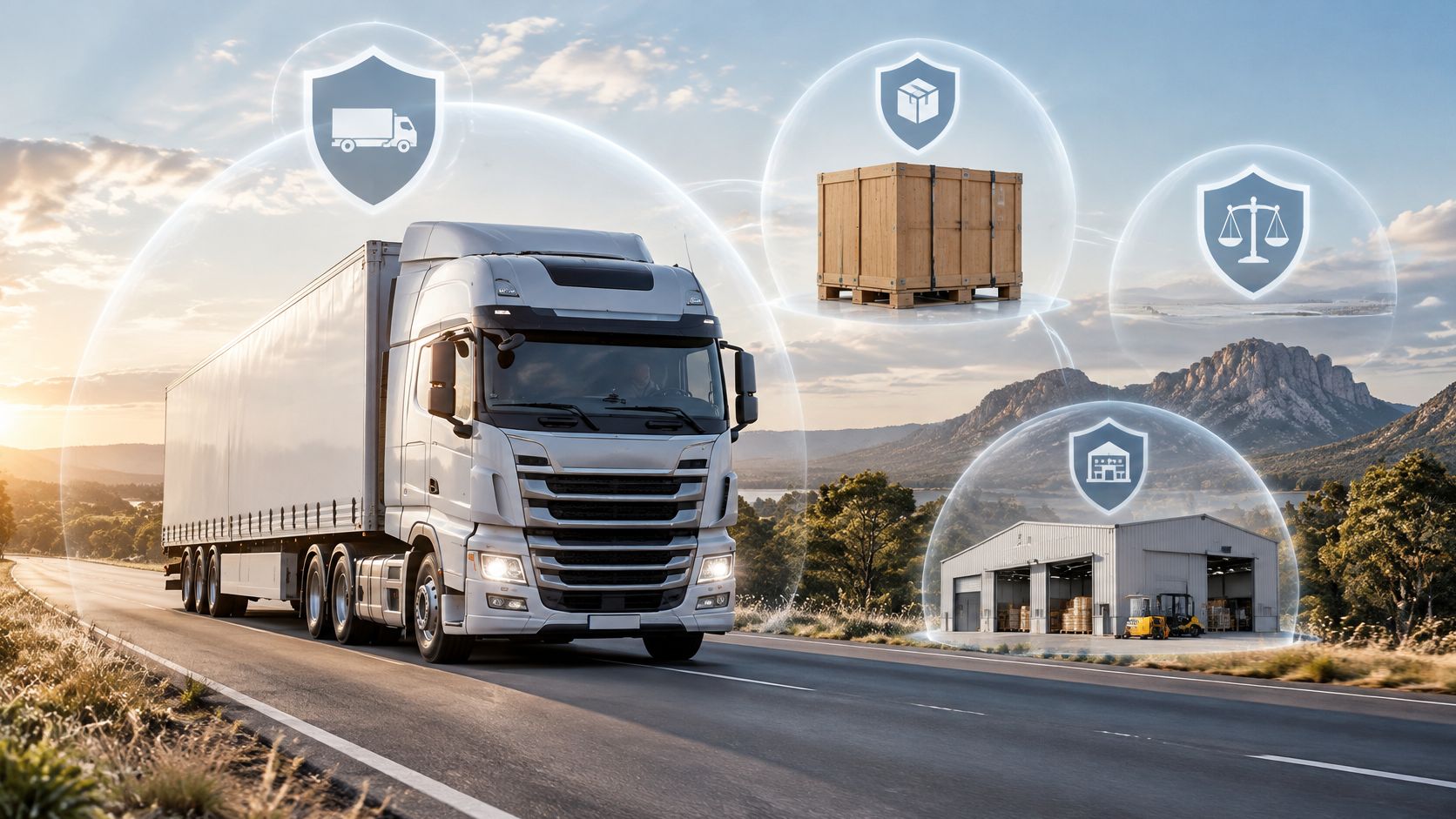
Australian truck drivers recorded a workplace fatality frequency rate of 22.6 deaths per 100,000 workers, compared with 1.5 for all occupations, across the decade to 2023, according to Safe Work Australia figures reproduced in the National Freight and Supply Chain Strategy annual report. That reframes trucking insurance: the truck is a valuable asset, but the people, freight and business obligations around it can create much larger consequences.
If you're searching for commercial insurance trucking businesses need, start with what could happen after an incident, not just the cost of repairing the vehicle. A useful insurance programme separates vehicle damage, liability, freight, injured workers and lost trading income. Fleet age, fatigue controls and telematics then help insurers assess the risk, but they don't replace the policy wording that determines what gets paid.
Table of Contents
- Commercial Insurance Trucking Covers at a Glance
- Why Trucking Losses Reach Beyond the Vehicle
- Commercial Motor Cover for Trucks and Trailers
- Cargo, Public Liability and Business Cover Explained
- Telematics, Claims and Exclusions to Check Before You Buy
- Selection Criteria and the Pre-Quote Checklist
Commercial Insurance Trucking Covers at a Glance
Main commercial insurance covers for trucking businesses
| Cover | What it protects | Typical trigger | Who usually needs it |
|---|---|---|---|
| Commercial motor | Truck, trailer and declared attached equipment, plus specified third-party liabilities | Insured collision, fire, theft or road-related liability claim | Businesses running trucks |
| Cargo (goods in transit) | Freight carried or held in the business's care within the insured transit | Insured damage, loss or theft of goods | Carriers and businesses moving their own stock |
| Public liability | Liability for third-party injury or property damage arising from operations | Someone injured or property damaged during work or delivery, subject to motor exclusions | Contractors, carriers and tradespeople working on client sites |
| Business cover | Selected premises, contents and business-interruption exposures | Insured property damage, theft or another selected event | Operators with a depot, yard, office or stored equipment |
| Plant and machinery | Declared owned or hired equipment, such as cranes, tipping equipment and forklifts | Insured damage or theft, with breakdown requiring suitable cover | Fleets using mounted or hired machinery |
| Workers compensation | Eligible injured workers' wages, medical treatment and rehabilitation | Covered workplace injury or illness | Employers subject to applicable state or territory requirements |
A truck rarely needs just one policy. An owner-driver carrying customers' freight needs to distinguish the vehicle from the load, while a builder delivering their own materials also needs to consider unloading activities, employees and equipment used on site. These covers may sit within packages or separate policies, but the insured business activities must match what happens.
Start with ownership and responsibility
Write down who owns the truck, who owns the goods and who bears responsibility during loading, transit and delivery. A customer's goods don't automatically become insured because they're inside your insured truck, and a hired trailer isn't necessarily covered on the same basis as one you own.
For a separate box-truck perspective, Peak Transport's box truck compliance guide can help identify questions about vehicle use and insurance responsibilities. Keep overseas compliance guidance separate from your Australian registration, employment and insurance obligations.
Practical rule: Describe the work first, then choose the policies. Buying cover against a vehicle registration alone can leave the actual operation poorly described.
This is a map of the usual cover mix, not a price list. Premiums reflect the fleet, drivers, operating patterns and claims record, while the schedule, endorsements and exclusions determine the protection you've bought.
Why Trucking Losses Reach Beyond the Vehicle
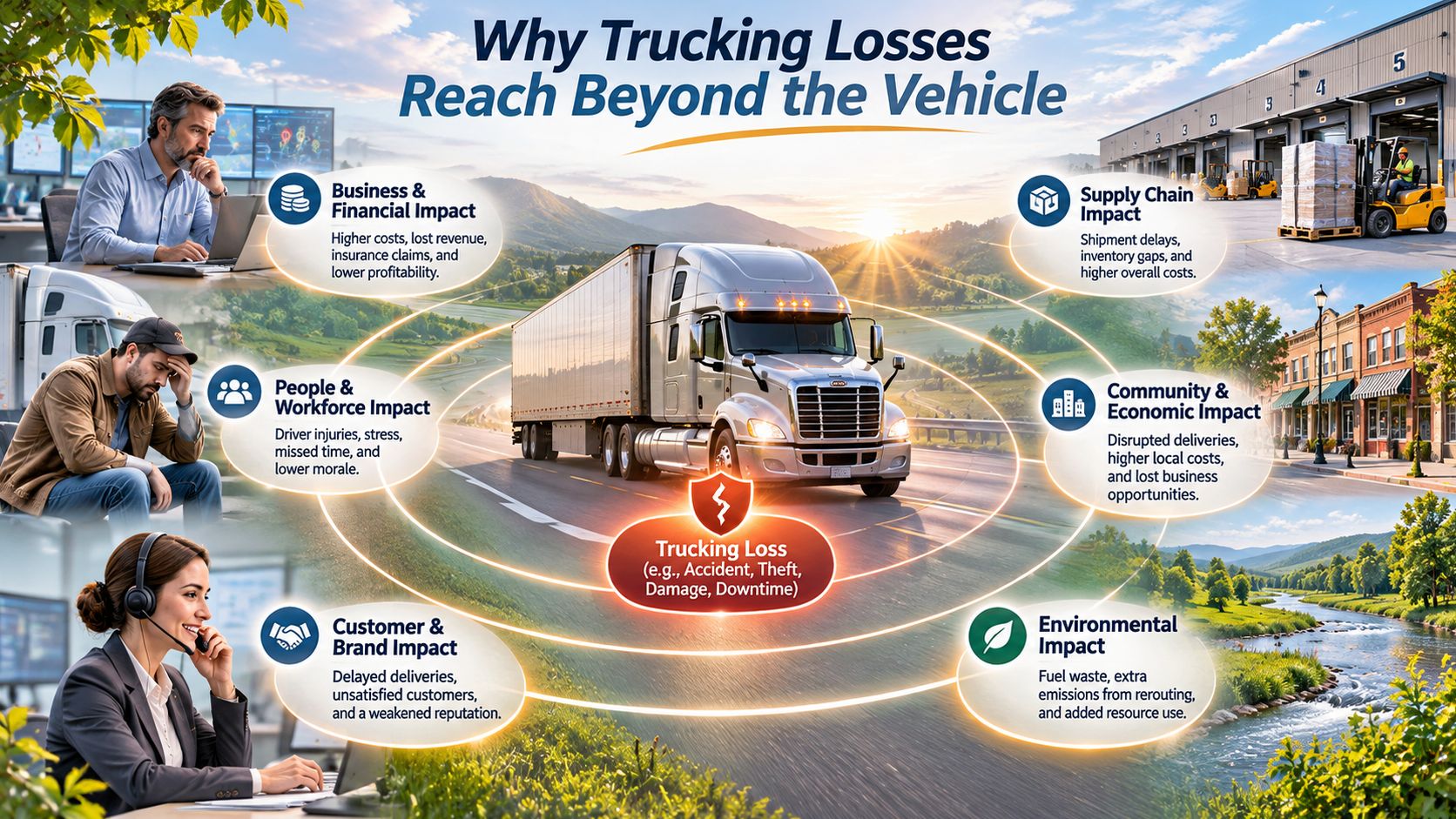
Heavy vehicles form a large and varied part of Australia's road risk pool, as shown by the government's heavy-vehicle road-safety reporting. For one fleet owner, the practical question is narrower. When a truck stops, which losses can the business recover, and which bills still arrive?
Follow the incident beyond the repair bill
Say a delivery truck collides with another vehicle while carrying building materials. The insurer assessing the truck repairs isn't necessarily responsible for every consequence of that collision. Vehicle cover works like the frame of a mattress. It supports one visible layer, but the body, load and business around it still need separate attention.
Separate the potential bills:
- People: Third-party injury claims and the driver's workplace injury require different insurance pathways.
- Property: Damage to another vehicle, roadside infrastructure and the truck itself may involve different sections and limits.
- Freight: Damaged materials need a cargo assessment, including ownership, value and transit conditions.
- Response costs: Recovery, salvage, storage and legal defence must fit the relevant wording.
- Trading losses: Cancelled jobs and replacement transport need their own cover assessment.
An injured driver also creates an operational problem. The business may need a replacement driver, recruitment support and a safe return-to-work arrangement while the vehicle claim is still being assessed. A late load can affect a builder's programme even when the truck is repaired quickly, so the business needs to know whether the contract, cargo cover or cash reserve absorbs that delay.
Fleet age changes the shape of this risk. Older vehicles may create more repair questions around parts, condition and pre-existing wear. Newer vehicles may carry higher repair values or finance commitments. Telematics and fatigue controls also affect what can be shown after an incident. Speed, braking, location and rest data can support a clearer account of how a vehicle was used, while a driver fatigue policy can show what the business required. That information sits behind the claim, but the insurance outcome still depends on the policy wording, limits and exclusions.
Cover and fleet management must work together
Keep incident reporting, maintenance responsibility and driver supervision organised before a loss occurs. Oz Coach Hire's explanation of managing bus and coach fleets offers a useful parallel for thinking about vehicle availability, maintenance and operational oversight, although passenger transport and freight operations have different exposures.
An insured repair doesn't mean the business has been reimbursed for everything the incident cost.
Match each likely loss to a policy, a limit and a responsible person. Good records help, but they do not turn an uninsured loss into an insured one. Where no cover responds, identify the cash reserve or operational alternative that will keep deliveries moving. That is more useful than assuming broad vehicle insurance means broad business protection.
Commercial Motor Cover for Trucks and Trailers
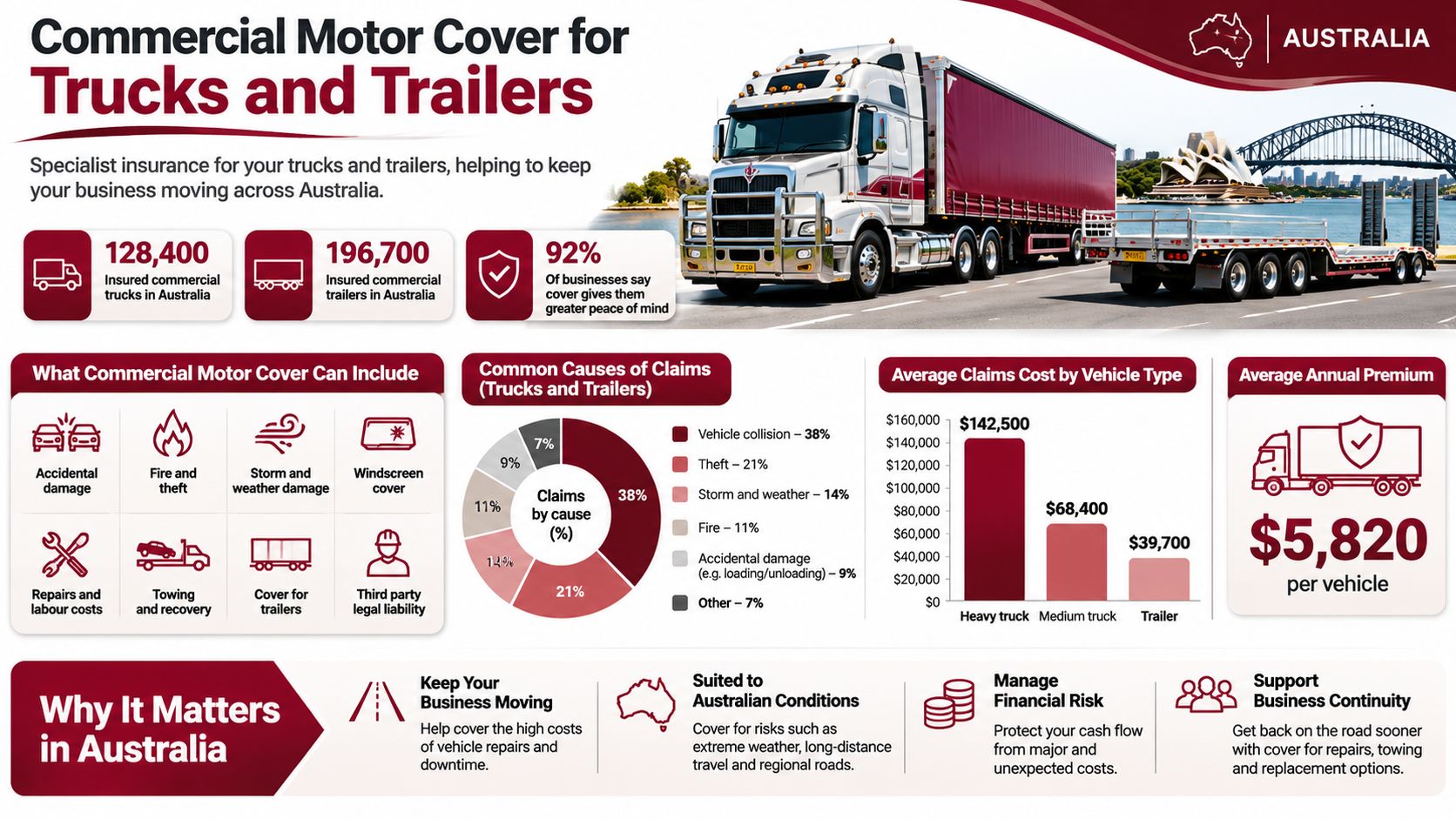
Broad cover doesn't mean every cause of loss. It generally provides the broadest commercial motor protection, but exclusions, excesses and settlement rules still apply. Start by choosing the level of vehicle cover, then test the extensions against how your fleet works.
Choose the vehicle damage protection
Broad cover generally combines insured accidental damage to your own vehicle with theft, fire and third-party property liability. It can cover a truck or trailer only where that asset and your interest in it fall within the policy.
Third-party property damage generally addresses your legal liability for damage to other people's vehicles or property. It doesn't ordinarily pay to repair your truck after an at-fault collision.
Third-party fire and theft adds specified fire and theft protection for your vehicle to third-party property cover. It isn't a substitute for accidental damage protection.
Our commercial vehicle insurance guide provides additional context for comparing business-use vehicle cover. When reading any quote, distinguish the insurer's product description from the actual insured assets and selected benefits shown on the schedule.
Check the combination, not just the prime mover
Australia recorded 202 deaths in crashes involving heavy vehicles during the year ending June 2024, including 100 involving articulated trucks and 80 involving heavy rigid trucks, according to the Bureau of Infrastructure and Transport Research Economics bulletin. Those are crash-involvement figures, not findings that truck drivers caused the deaths.
Articulated and rigid vehicles have different coupling, manoeuvring and load-restraint exposures. Describe the actual combinations, routes and uses rather than supplying only a fleet count.
Before accepting cover, check:
- Trailer interests: Identify owned, financed, hired and borrowed trailers, including obligations under hire agreements.
- Attached equipment: Confirm cranes, tail lifts, refrigeration units and other fittings are declared and valued appropriately.
- Recovery: Check towing, salvage, load transfer and storage limits, including any requirement for insurer approval.
- Liability: Review the property-damage limit and any applicable bodily-injury wording rather than assuming all liabilities sit together.
- Downtime: Identify any selected hire-vehicle or downtime benefit, its trigger and its stopping point.
Keep CTP and business losses separate
Compulsory third party arrangements concern personal injury arising from motor vehicle use, with entitlements and operation differing by jurisdiction. CTP doesn't replace property-damage liability insurance, and commercial motor shouldn't be assumed to replace the applicable statutory injury scheme.
Say an articulated combination jackknifes on a highway. The truck may be repairable, but specialist recovery, cargo transfer and replacement transport could create a larger immediate cash demand than the repair itself.
Ask for a written explanation of which section pays each cost. A repair approval alone doesn't establish entitlement to lost income, replacement transport or every recovery expense.
Cargo, Public Liability and Business Cover Explained
A damaged load, an unloading injury and a depot fire can all stop deliveries. They don't belong under the same insurance section. The clearest way to choose these covers is to follow the property or person affected and identify what caused the loss.
Cargo cover protects the freight interest
Say a load shifts on a trailer and damages the customer's goods. Goods-in-transit cover may respond if the goods, journey, cause of damage and insured interest meet the wording.
Establish whether the policy protects the goods themselves or your legal liability as carrier. Those are different arrangements: a carrier's liability policy doesn't necessarily promise payment for every damaged consignment.
Check the maximum value carried, not just the average load. Include freight temporarily stored during a journey, goods awaiting unloading and any specialised cargo requiring express acceptance.
Load restraint needs particular attention. If the wording excludes damage caused by inadequate securing or packing, a cargo claim may be reduced or declined where that exclusion applies. Temperature deterioration, delay and unattended-vehicle theft also need a specific wording review rather than an assumption of cover.
Our marine cargo insurance explanation offers further context for matching transit protection to the goods and the journey. Keep consignment documents, photographs and restraint procedures available so the insured value and circumstances can be established.
Public liability concerns the work around the delivery
A driver unloading materials might damage a client's equipment or leave a pedestrian exposed to an unsafe work area. Public liability may address legal liability for resulting injury or property damage, subject to the policy's terms.
Don't assume every unloading incident belongs under public liability. Motor-use exclusions, loading and unloading provisions, and mobile plant conditions can determine whether the claim belongs under motor, public liability or another section.
Client contracts also matter. A principal may require a particular liability limit, but the contract doesn't change your insurer's limit automatically. Contractual promises to accept responsibility beyond your ordinary legal liability also need review.
Contract check: A certificate of currency confirms insurance exists. It doesn't confirm that every indemnity you've signed is insured.
Business cover protects the operating base
Consider a hypothetical depot fire that damages the office and prevents dispatch. Property cover may address insured building or contents damage, while a selected business-interruption section may address the resulting reduction in income and specified continuing expenses.
The trigger is critical. Business interruption often requires insured damage under the relevant property arrangement; it isn't a general promise to replace income whenever trading slows.
Choose an indemnity period that allows for rebuilding, equipment replacement and customer recovery. Also examine whether extra costs, such as temporary premises or outsourced dispatch, fit an increased-cost-of-working provision.
Plant cover follows the equipment and its use
A crane mounted on a hired truck creates another boundary. Accidental damage to the vehicle, damage while operating the crane and internal mechanical breakdown may need different provisions.
Declare the equipment, ownership and hire responsibilities. A plant policy covering accidental damage and theft doesn't automatically include mechanical or electrical breakdown.
Which cover responds and where it stops
| Situation | Cover that responds | Where it stops |
|---|---|---|
| Cargo damaged by a shifting load | Cargo cover, where the goods and cause are insured | An applicable load-restraint exclusion can prevent payment |
| Client fence damaged or passer-by injured near a site | Public liability or motor liability, according to the activity and wording | Motor exclusions, contractual liability provisions and policy limits apply |
| Depot fire stops operations | Insured property damage and selected business interruption | The required damage trigger and indemnity period must be satisfied |
| Crane or tipping equipment on a hired truck breaks down | Appropriate plant cover with breakdown protection | The equipment, hire interest and breakdown event must be insured |
Telematics, Claims and Exclusions to Check Before You Buy
A telematics alert isn't an automatic claim rejection. It's evidence that may need interpretation alongside the policy, driver authorisation, statutory compliance and the circumstances that caused the loss.
Australia recorded 210 deaths in crashes involving heavy vehicles in the year ending September 2025, according to the Australian Government's quarterly heavy-vehicle bulletin. That measures road-safety outcomes across a population. It doesn't determine fault, insurance causation or entitlement in an individual claim.
Separate an alert from a coverage decision
Harsh braking could indicate poor following distance. It could also show that a driver reacted to another road user entering the lane. A route deviation might be unauthorised, or it might reflect a road closure.
The claims assessment needs context. Relevant questions include what the driver was permitted to do, which conditions applied, what caused the damage and whether an exclusion or other policy provision affects payment.
A fatigue warning deserves immediate operational action, but it still isn't a substitute for a coverage analysis. The operator's response matters: a recorded instruction to stop, a roster adjustment and confirmation of rest tell a different story from an ignored warning.
Safety information helps explain what happened. The insurance outcome still requires the wording to be applied to the facts.
Make the records useful before an incident
Set up a documented process for handling telematics rather than collecting dashboard alerts.
- Assign access: Name the people permitted to view location records, camera footage and driver-behaviour reports.
- Set retention rules: Align storage periods with operational needs, privacy obligations, insurer requirements and any claim-preservation instructions.
- Record the response: Keep the alert, supervisor review, driver explanation and corrective action together.
- Preserve context: Retain relevant footage, timestamps, route instructions and maintenance information, not just an isolated screenshot.
- Explain monitoring: Tell drivers what is collected, why it's used and how concerns can be raised.
Before buying, compare the policy's driver restrictions, use limitations and relevant exclusions with your actual monitoring process. Don't promise the insurer continuous supervision if staff only review alerts intermittently.
Telematics may support an underwriting submission or help establish a defence. It doesn't guarantee a premium discount, prove that your driver was at fault or promise that a claim will be accepted.
Selection Criteria and the Pre-Quote Checklist
Fleet age deserves more attention than a simple purchase-price comparison. A Productivity Commission submission citing Monash University Accident Research Centre data reports that trucks older than 20 years are involved in crashes at rates two to three times those of trucks less than 10 years old. That's a fleet-level finding, not a verdict on the condition or insurability of your particular truck.
A cheaper vehicle can still create expensive operational exposure. Parts availability, repair lead times and the value payable after a total loss deserve attention alongside the premium.
Test the older truck's settlement position
Compare agreed value and market value carefully. Agreed value uses the amount accepted under the policy, subject to its terms; market-value settlement requires an assessment of the vehicle's value at the relevant time. Neither should be assumed to fund a newer replacement with better specifications.
Check how fitted equipment, modifications, finance interests and applicable deductions affect settlement. A truck with a modest insured value may perform an essential role that's expensive to replace operationally.
Keep evidence of parts availability and repair options. If you maintain DAF vehicles, you might browse used DAF truck components through Daf Marketplace Ltd when assessing sourcing options, but verify compatibility, condition, delivery arrangements and local compliance. A parts listing isn't evidence that an insurer will approve that component or reimburse a repair.
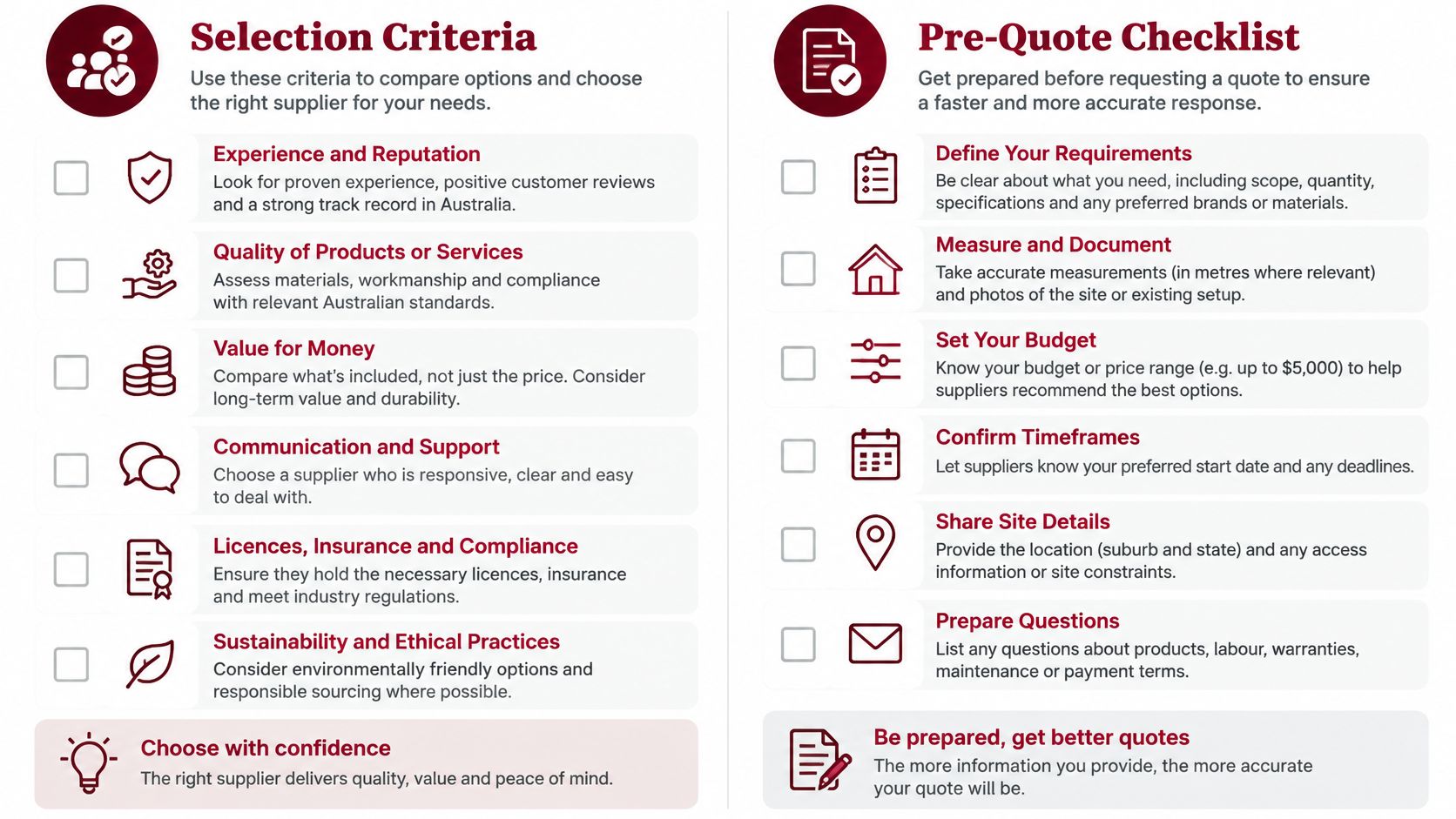
Selection criteria and the records to gather
| Criterion | Why it changes cover | What to document |
|---|---|---|
| Fleet age | Condition, repairability and safety equipment can affect acceptance, valuation and conditions | Inspection reports, maintenance logs, fitted safety systems and replacement plan |
| Vehicle class | Articulated and rigid vehicles have different operating and manoeuvring exposures | Vehicle class, axle configuration, combinations and attached equipment |
| Operating area and annual kilometres | Interstate corridors and urban delivery work create different exposures | Routes, states of operation, depot locations and annual kilometres per vehicle |
| Driver fatigue controls | Work scheduling and rest compliance affect crash prevention and risk assessment | Work-and-rest records, roster reviews, escalation process and fatigue-risk policy |
| Cargo type and value | Determines suitable transit limits and cargo-specific conditions | Peak load values, consignment sizes, storage arrangements and restraint methods |
| Claims history | Insurers assess the loss pattern and evidence of improvement | Claims history for the period requested, incident explanations and corrective actions |
Make fatigue controls demonstrable
The NHVR's fatigue advice explains that fatigue reduces alertness and slows reaction times. An insurer needs more than a statement that drivers are told to take breaks.
Show how dispatch staff plan realistic journeys, how drivers report being unfit to continue and who can authorise a delayed delivery. Include subcontractor arrangements where they form part of the operation.
Your documents should agree with each other. A fatigue policy promising safe scheduling won't explain a roster that repeatedly leaves insufficient time for the planned work.
Prepare the quote submission in a practical order
Build an asset register. List trucks, trailers and equipment with registration or serial details, ownership, finance interests and proposed values. Separate permanently mounted machinery from portable tools so neither disappears between policy categories.
Map the actual work. Describe freight, loading responsibilities, routes, client sites and annual kilometres. Include occasional activities, such as an interstate trip or hired crane operation, rather than describing only the most routine delivery.
Review client and principal contracts. Extract insurance requirements, indemnities, responsibility for goods and hired-equipment obligations. Our public liability coverage guide can help you identify liability questions to resolve before signing.
Compare conditions with your records. Put driver restrictions, maintenance requirements, load-restraint provisions and theft-security conditions beside the procedures you follow. Resolve any mismatch before cover starts, rather than relying on an explanation after a loss.
Submit the evidence with the request. Attach the asset register, operating description, requested claims history, maintenance evidence and key contracts. Ask for a comparison that identifies limits, excesses, exclusions and settlement bases, not the annual premium alone.
Compare the uncovered cost
A higher excess is only workable if the business can fund it promptly. A lower premium isn't a saving if the policy excludes an essential activity or leaves the business unable to replace a critical vehicle.
For each quote, test a collision, a theft, a damaged consignment and an equipment failure. Record what would be paid, what evidence would be required and what the business would still need to fund.
Our process follows Tell Us What You Need, Risk Assessment, Compare Cover Options, and Arrange Your Cover. We offer a free insurance quote on request, giving you a practical starting point for comparing the proposed protection with your documented operations.
The right mix is the one that matches both the work you perform and the controls you can demonstrate.
ABS Insurance Brokers Pty Ltd offers commercial motor, public liability, business, and plant and machinery insurance to help businesses address the different exposures around their trucks. Visit ABS Insurance Brokers Pty Ltd to request a free quote, and bring your fleet register, operating details and claims records so we can assess your needs and compare cover options.