
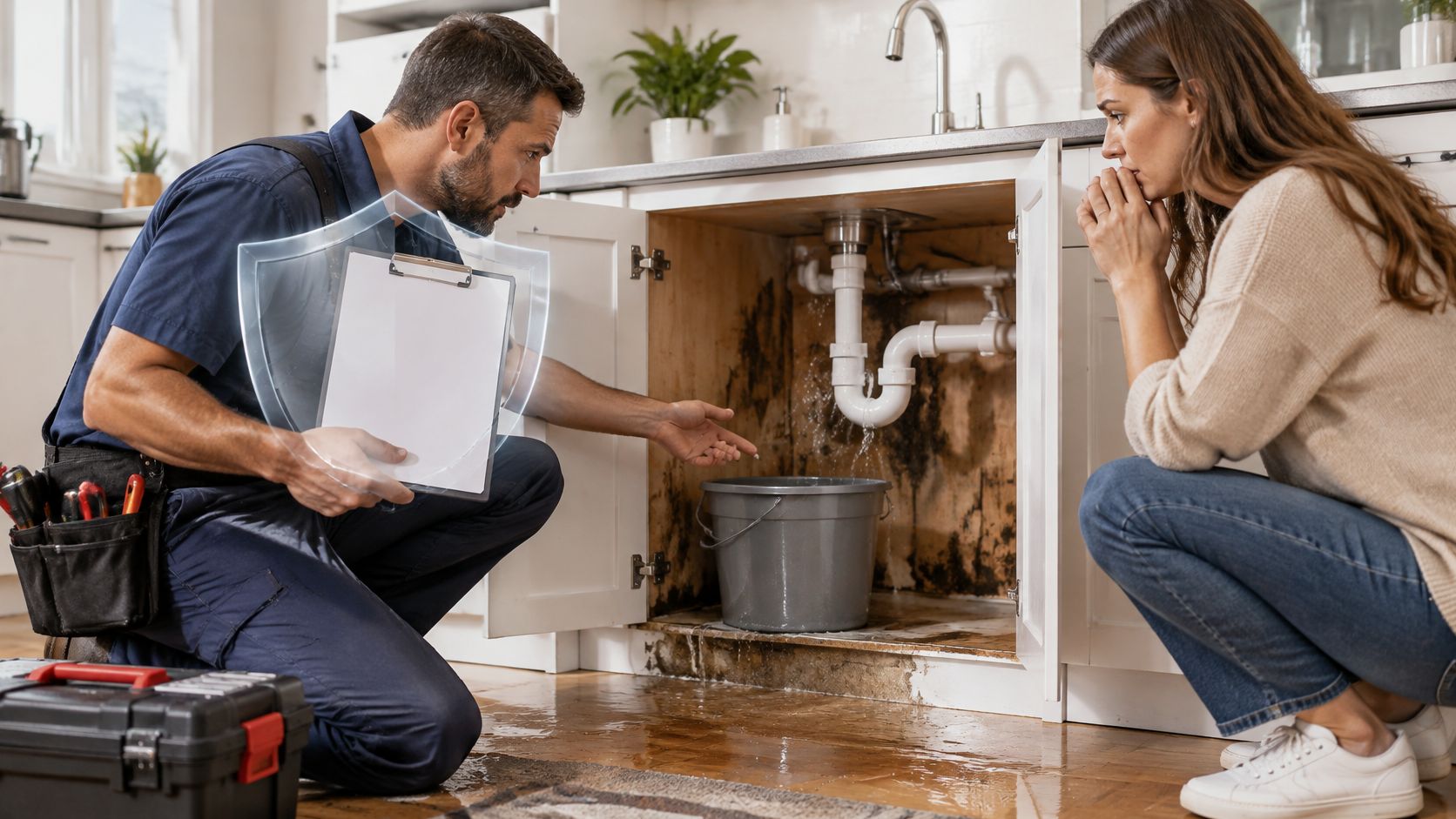
The advice most plumbers repeat is that a current certificate and a large limit mean water damage is sorted. It is not. Plumbers' public liability insurance pays when your business is legally liable for injury to someone else, or for damage to property you do not own. It does not pay you to rip out a joint you installed badly, replace a flexi-hose that was the wrong product for the job, or fund a leak that soaked a subfloor for months before anyone noticed.
A burst fitting that floods a ceiling the same afternoon is a different claim from the cost of correcting that fitting. Treat those as one loss and you will argue with an insurer over the part of the invoice they were never going to pay.
Table of Contents
- What Public Liability Covers for Plumbers
- Why Water Work Creates Third-Party Exposure
- Public Liability Versus Other Plumbing Policies
- Where Claims Succeed and Where Cover Stops
- What Public Liability Commonly Excludes
- Choosing a Limit That Matches Your Contracts
- What Public Liability Costs for Plumbers in Australia
- Check Your Certificate Before Your Next Job
What Public Liability Covers for Plumbers
Public liability pays your legal liability when plumbing work, or the way you run the job, causes bodily injury or property damage to a third party. Defence costs and a settlement sit inside that response, up to the policy limit and subject to the excess and the wording.
The test is short. Was the event sudden and accidental? Did it harm someone else's body or property? Did it arise from work you declared? Pass those three and a claim is usually in scope. Fail them and you are often looking at an exclusion, even on a policy with a large number on the schedule.
| Situation | Covered by public liability? | Why |
|---|---|---|
| Client trips over tools or hoses left on site | Yes | Third-party bodily injury from your operations |
| Sudden burst fitting floods a client's ceiling | Yes | Accidental third-party property damage |
| Slow concealed leak rots adjoining subfloor | Often disputed | Gradual damage may be excluded; wording decides |
| Cost to replace your own faulty joint | No | Repairing your own defective work is not third-party damage |
| Damage to your tools, van or equipment | No | Not third-party property; needs separate tools or motor cover |
| Legal costs to defend a valid claim | Yes, subject to policy | Defence costs are usually included up to the limit |
How the rows split
A client who trips on hoses left across a hallway has a straightforward injury claim. You created the hazard while working, and the injured person is not your employee. Notify the insurer, photograph the site, and do not promise to pay medical bills out of your own pocket before the insurer has a say.
A fitting that lets go the day you pressure-test, and floods the ceiling below, is the claim public liability is built for. The water hit finishes, cabinetry or wiring that were already there. You may still have to fix the fitting at your own cost. The ceiling repair is the third-party loss.
A slow leak behind a wall is where wording does the work. Insurers look for sudden and accidental language. If the water has been tracking for weeks, they will ask when it started, whether a pressure test would have found it, and whether anyone ignored a stain. Gradual deterioration is a common exclusion, so "often disputed" is the honest label, not a soft yes.
Your own work is not their property
Replacing the faulty joint is you correcting your own work. That cost is not compensation to a third party, so public liability does not pick it up. The same logic keeps your tools, your van and your own plant outside this policy. Those assets need tools cover or a commercial motor policy.
Legal costs to investigate, defend and settle an eligible claim are usually part of the same limit, not a bonus pool on top. Read the schedule so you know whether defence costs sit inside the limit or in addition to it.
Before you assume a loss is covered: Was it sudden? Did it harm someone else's body or property? Did it come from activities the policy actually declares?
Why Water Work Creates Third-Party Exposure
Severity is what underwriters price, not the size of your invoice. A failed connection, an isolation you got wrong, or a leak you could not see can leave the room you were working in and reach flooring, cabinetry, switchboards, the tenancy next door and strata common property. One event then stacks physical repair, leak investigation, legal defence and the lost trade of whoever could not open their doors. That total can dwarf the original plumbing job.
The setting makes third-party contact routine. You work in occupied homes, around families and tenants, in shared areas of apartment buildings, and on construction sites where other trades and visitors pass through your work zone. Live water, gas and electrical services sit in the same rooms as people who did not hire you and property you do not own.
Water only has to travel a few metres to turn your job into someone else's loss.
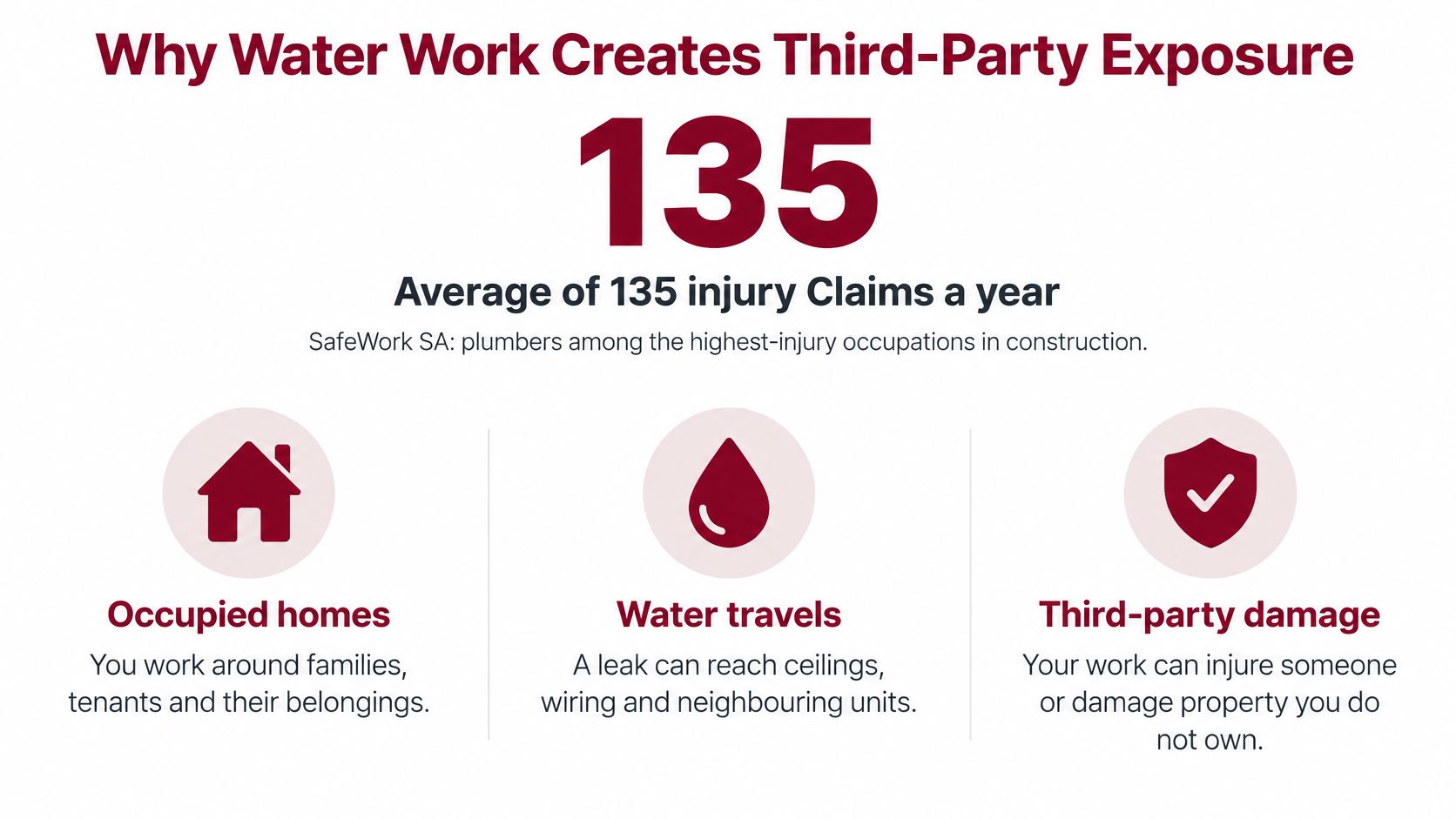
SafeWork SA's plumbers claims profile identifies plumbers as one of the highest-injury occupations in construction and reports an average of 135 injury claims per year, with 50% of reported injuries involving workers under 26. Those injury claims are generally a workers compensation matter, not public liability. The profile still matters to liability buyers, because younger crews need tighter supervision, and that supervision is exactly what a principal or an underwriter will ask about when a visitor is hurt or a ceiling fails.
What gets examined at renewal
Underwriters and head contractors look at safety procedures, how you engage subcontractors, your claims history and the scope of work you perform. A business that sends an apprentice into an occupied bathroom with no induction, no barrier and no incident log reads as a harder risk than one that can show the opposite. The controls that support better terms are ordinary and documented:
- Induction: a short site briefing before anyone picks up a tool, apprentices included.
- Site separation: barriers or a marked work zone so residents and other trades are not crossing wet floors and open tools.
- Tool control: hoses, ladders and power leads stored out of hallways, where they otherwise become a trip hazard.
- Incident reporting: photos, isolation records and a same-day note to your broker if water leaves the work area.
Once a service is open, escaped water moves through finishes faster than most owners expect, which is why a specialist doing burst pipe repairs in Caroline Springs treats isolation as the first job, not the last. Your liability policy is the transfer for the damage that escape causes to other people's property, the part of the loss that belongs to a third party rather than to your own workmanship. It is no substitute for isolating the service and supervising whoever is on the tools.
Public Liability Versus Other Plumbing Policies
Each policy answers a different allegation. Buying one and assuming the others come with it is how a licensed plumber still writes a cheque.
| Policy | Responds to | Plumber example |
|---|---|---|
| Public liability | Third-party injury or property damage from your business | Client's floor damaged by an escape of water |
| Product liability | Injury or damage caused by a product you supply | Faulty fitting you sell that causes flooding |
| Professional indemnity | Negligent advice, design or certification | Hot-water design error or compliance certificate claim |
| NSW home building compensation | Homeowner losses such as builder insolvency on projects of $20,000 or more including GST | Contractor insolvency leaves homeowner needing completion |
| Workers compensation | Injury to employees, casuals, apprentices and trainees | Apprentice hurt on site |
Site injury and property damage
Public liability is the policy for most site incidents: a visitor hurt by your setup, or a client's building damaged by an escape of water from your operations. Product liability is the companion when a product you manufacture, import, sell or supply is alleged to have caused the injury or damage. A fitting you install as part of a contract is usually argued under public liability. A fitting you supply into someone else's job, which later fails, can pull in the products section. Some policies combine the two. Read which one you bought.
Advice is a different policy
Professional indemnity responds to negligent advice, design or certification. If you size a hot-water plant, specify a drainage layout, or sign a compliance document, a later allegation about that advice is not a public liability claim. Public liability is about injury and property damage from operations. It is a poor fit for "your certificate was wrong."
NSW home building compensation is not liability cover
NSW Government guidance states that a licence or certificate is required for plumbing, draining or gasfitting work whether the job is residential, commercial or industrial, and whatever the project costs. Separately, home building compensation insurance is required for a home-building project valued at $20,000 or more, including GST.
That statutory cover protects eligible homeowners in defined circumstances such as a builder's insolvency, death, disappearance or licence suspension. It does not respond because a falling heater injures a visitor, or because a burst pipe ruins a finished floor during your work. You can hold the project certificate and still be uninsured for those events. The $20,000 figure also does not set your public liability limit. Limits follow your activities, the contract, the site, your turnover, subcontracting and what the builder or facility owner demands.
Workers compensation is the policy for injury to employees, casuals, apprentices and trainees. It is compulsory where you have those people, and it is not interchangeable with public liability.
Contract works is yet another policy: it protects the works in progress against accidental physical loss during construction. If you are weighing that against liability for injury and third-party property, the comparison in contract works versus public liability is the clean split. Holding home building compensation does not mean your public liability is in place. The policies answer different people, for different events, and a gap in one is not filled by the other.
Where Claims Succeed and Where Cover Stops
Four questions come up after almost every water loss. The schedule limit does not answer them. Causation, exclusions and how fast you notify do.
Internal water leaks sit at the centre of defect disputes. The Australian Building Codes Board waterproofing analysis reports that 42% of surveyed respondents identified internal water leaks as a building defect, while waterproofing issues affected 32% nationally. That volume is why insurers write faulty-work and gradual-damage terms tightly. A common leak is not the same thing as a covered leak.
Did a concealed leak rot the frame over months?
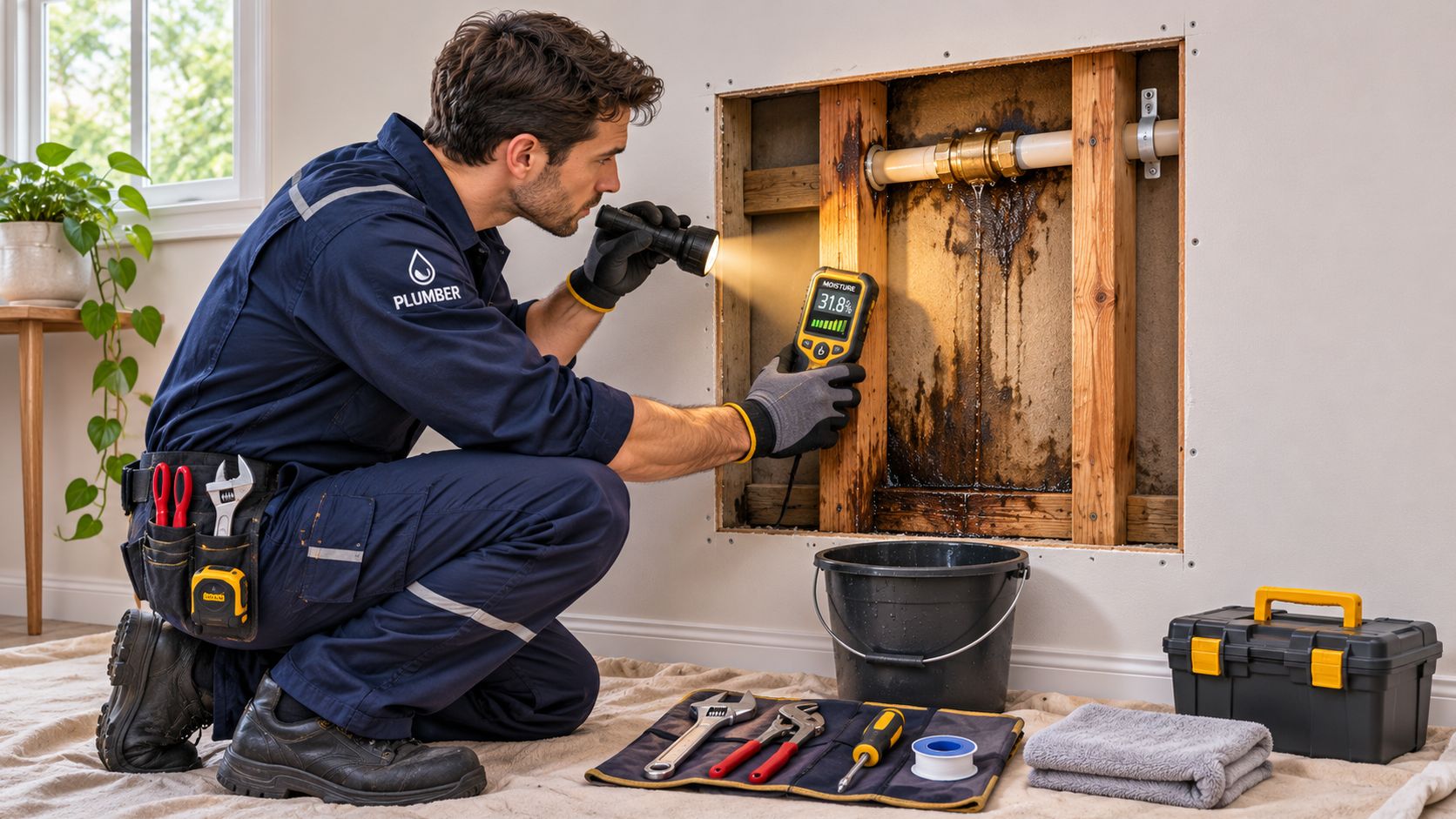
Say you fitted a bathroom six weeks ago. A resident notices soft skirting, and a moisture meter shows framing wet well beyond the tray. The insurer will ask when the leak started and whether a competent test would have found it before you left. If the wording needs a sudden and accidental event, seepage over weeks is where claims stall. Reasonable-precautions conditions matter here: skipped pressure tests and ignored staining give the insurer a basis to dispute. Notify as soon as you know, even if you still hope it is a small job.
Did water reach the rooms next door?
Damage in adjoining rooms is often the part that responds, even when the failed item does not. Water from your work that ruins a neighbour's ceiling, a strata hallway or a tenant's stock is third-party property damage. The insurer can accept that portion and still refuse the cost of opening your own installation and rebuilding it. Subcontractor status changes who they pursue. If you were labour-only under a builder, the contract may push the claim to the principal's policy, or it may leave you holding it. Do not assume either way from the handshake.
Did a hot-water component fail?
Replacing the failed valve, element or unit is the cost of putting your supply or your installation right. That part is typically excluded as defective work or as the product itself. Resulting water damage to other property, a flooded laundry and a damaged ceiling, may still be considered if the escape was sudden and you are legally liable. Split the quote that way before you send it to the client. One invoice that mixes "new valve" and "replaster ceiling" invites the insurer to decline the lot while they untangle it.
Was the pipework already failing?
On pre-existing pipework the questions are who was responsible, what you knew before you started, and how quickly you told the insurer. If you opened a wall and found pinholing you did not cause, say so in writing the same day. If you disturbed that pipe and it let go, expect an argument about causation. Late notification is a favourite reason for a reservation of rights, even when the facts would otherwise support you.
The policy pays for damage you cause to other people's property, not for fixing your own mistake.
Faulty-work exclusions, reasonable precautions, whether you were a subcontractor, and notification timing decide these files. A $10 million limit does not drag a gradual leak, a defective joint or an undeclared activity back inside the wording. The number only caps what is already covered.
What Public Liability Commonly Excludes
The losses that surprise plumbers often never appear in a coverage brochure. They sit in the exclusions, and a quotation summary has no force until the same words are in the policy.
Injury to your own people is the first. Employees, casuals, apprentices and trainees who are hurt on the tools are a workers compensation claim. Public liability is aimed at people outside the employment relationship. Sending an apprentice's medical bills to the liability insurer wastes the notification window on the policy that responds.
Liabilities you volunteer in a contract come next. A head-contract indemnity that makes you pay for the principal's own negligence goes beyond what the law would impose on you. Standard public liability usually stops at your legal liability. Contractual liability extensions exist, but they are not automatic, and a one-sided indemnity signed on a portal at 6 pm is a common reason a claim is only partly insured.
Money the policy will not pay
Fines, penalties and the cost of obeying a regulator's order are not damages. If a water authority or a council fines you, or orders you to rectify at your own expense, liability insurance does not fund that penalty. Pollution, asbestos and mould are usually excluded, or limited to a sudden and accidental escape. A slow mould complaint after a bathroom leak needs its own reading of the wording, and often separate cover if that exposure is a real part of your work.
Professional advice and design errors belong under professional indemnity. A wrong pipe size on a drawing, or a compliance certificate a certifier later challenges, will not be rescued by an operations policy.
Damage you knew about before the policy started is another hard stop. Changing insurer without telling the new one about an open leak, or about a complaint already in your inbox, can leave both policies pointing at each other. Continuous disclosure matters more than a cheaper renewal.
Finally, work outside the activities you declared is a coverage problem before any exclusion is even reached. Hot-water installs, excavation, work at height, underground services and subcontracted scopes need to appear in the business description if you do them. If the policy says "domestic maintenance" and the loss is a commercial plant room, expect a dispute about whether the risk was ever accepted.
Find the exclusion in the schedule and the wording, not in a brochure. If it is not in the policy, a sales summary will not save the claim.
Choosing a Limit That Matches Your Contracts
Match the limit to the largest loss you can realistically aggregate, not to the value of one invoice. A $1,800 tap replacement can still wet three apartments. The exposure is the water's path through the building, whatever your invoice said.
I would start from the contract in front of you, then check whether the policy you already hold meets it. Buying a cheap limit and hoping the builder will not ask is how jobs stall on the morning you are meant to mobilise.
| Limit | Where it is commonly requested | What to check |
|---|---|---|
| $5 million | Smaller residential and maintenance work | Confirm the contract's required minimum and insured entity |
| $10 million | Common site expectation on larger residential and commercial projects | Check sublimits and water-damage exclusions in the schedule |
| $20 million | Major commercial, infrastructure and government work | Confirm territorial scope and completed-operations cover |
| No prescribed NSW licence limit | Set by principal contractors, councils and property managers | Verify the requirement in writing before mobilising |
Treat the table as a typical market example. Principals commonly ask for $5 million, $10 million or $20 million, with the higher figures tending to appear on major commercial, infrastructure and government work. These are contract demands rather than a single statutory figure, so confirm the required limit in each contract before you price the job.
NSW does not set the number for you
Holding a NSW licence for plumbing, draining and gasfitting does not tell you what limit a site will demand. Principal contractors, builders, councils and property managers set that figure job by job, and it belongs in the subcontract or the purchase order before you roll a van. A verbal "ten million should be fine" is not a limit you can insure to.
Checks before you start
Public liability responds to third-party injury and property damage, including defence costs, up to the policy limit. It does not insure your own tools, your vehicle or your own injury, and it does not pay to redo defective work. A burst flexi hose flooding the unit below is the kind of sudden loss it exists for. Refitting that same hose because you installed it wrongly is your cost. Do not price a job on the assumption the insurer will fund the rework.
Before mobilisation, get a certificate of currency in the exact trading entity named on the contract, with any wording the principal has specified. Read the schedule for sublimits, water-damage exclusions, hot-work conditions, underground-services provisions and whether subcontractors must carry their own insurance. Confirm the territorial scope, and confirm liability for completed operations continues after you leave site. A leak found a fortnight later is a dispute you do not want if cover stops at practical completion.
If the contract names a limit your policy does not meet, the contract wins in practice. You will be asked to lift the limit, or you will be in breach before the first fitting is tightened. Lifting cover after a loss has already happened does not fix that loss.
What Public Liability Costs for Plumbers in Australia
Published prices come with a basis attached, and the basis matters more than the number. Three figures circulate most often. Read what each one measured before you hold your own quote up against it.
| Source | Figure | Basis |
|---|---|---|
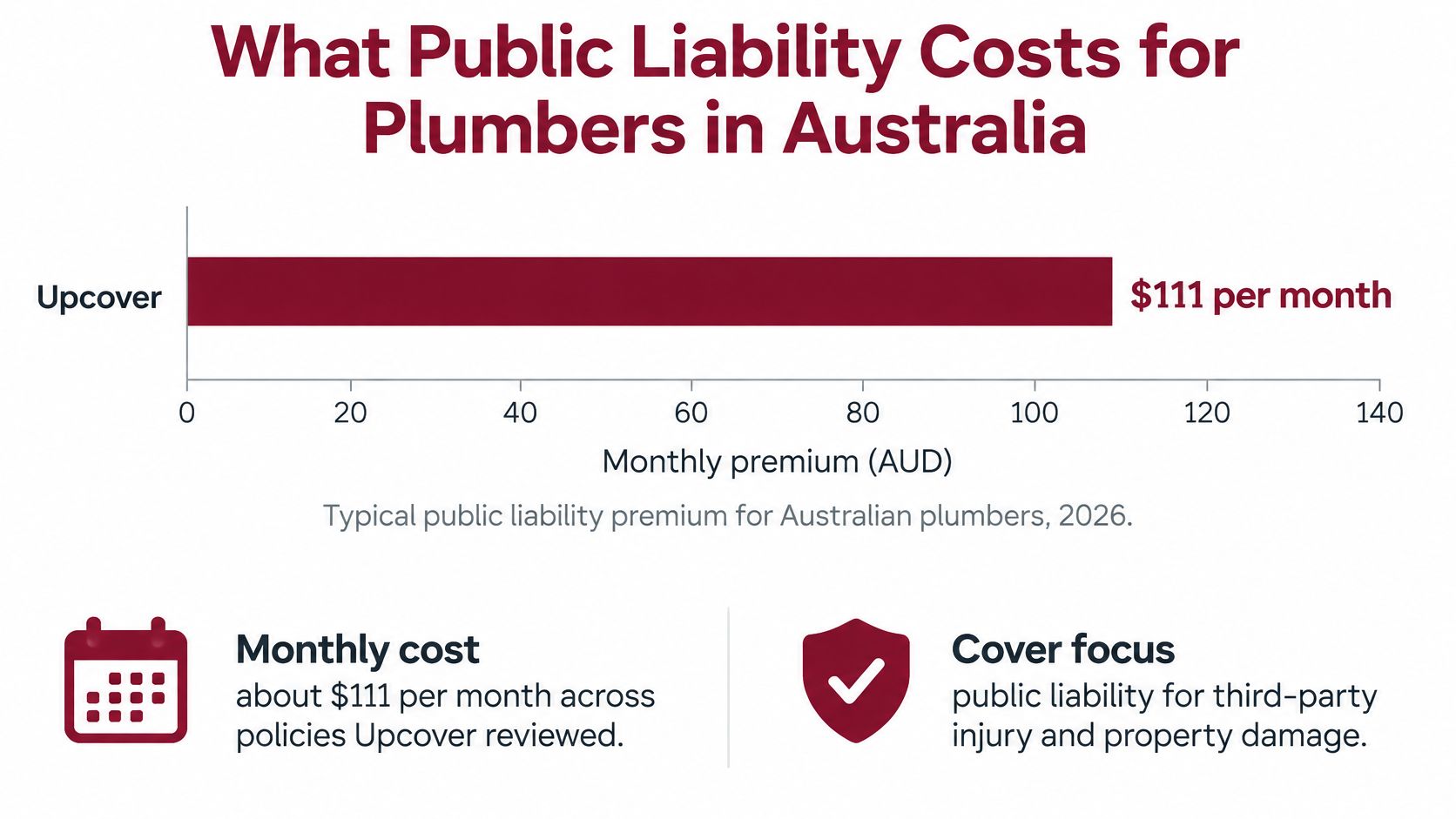
| Upcover | About $111 per month | Typical plumber public liability policies it reviewed, 2026 |
| Australian Small Business | $60.11 per month | Sole trader earning up to $50,000 seeking $5 million cover, April 2025 |
| BizCover average | $143 per month | All business insurance bought through BizCover, 2024–25; public liability mixed with other covers |
Upcover reported that Australian plumbers typically paid about $111 per month for public liability insurance in 2026, based on policies it reviewed. Of the three, this is the figure aimed squarely at this policy.
A starting price is not an average
Australian Small Business published a starting price of $60.11 per month in April 2025 for a sole-trader Australian plumber earning up to $50,000 and seeking $5 million of public liability. Turnover and limit do most of the pricing work. A sole trader on domestic maintenance is a different risk from a contractor with staff, excavation work and a $20 million contract clause.
The $143 per month figure needs a warning label. BizCover reported that as an average monthly business-insurance spend for Australian plumbers during the 2024–25 reporting period, across all business insurance bought through its platform. Public liability is only part of that basket. Treat it as a liability price and every genuine quote will look cheap or expensive for the wrong reason.
What actually moves the premium
Underwriters weigh turnover, the limit you ask for, and the activities declared on the proposal. Hot-water installation, excavation, strata work and a heavy subcontract book draw more attention than tap repairs in single houses. Staff numbers, including apprentices, and a claims history of water damage move the price faster than a small change in excess.
Remember what the premium buys. You are paying for cover on the water that escapes and damages someone else's property, so a cheap policy that excludes water damage strips out the claim a plumber is most likely to make. Ask each insurer, in writing, what the quoted price leaves out: water damage, completed operations, underground services, labour-only subcontractors. Compare quotes at one limit and one scope, and a lower monthly figure only counts as a saving if it still pays for the loss you would cause. For a wider look at how Australian liability premiums are built, see this 2026 pricing guide.
Check Your Certificate Before Your Next Job
A certificate of currency gets waved at site gates like a pass, and plenty of principals accept it at face value. The problem is that a certificate proves a policy exists. It does not prove the policy matches the contract you just signed. The entity, the limit, the activities and the end date all have to line up with the clause, and each one deserves its own look.
- Insured name. Confirm the insured entity and trading name on the certificate of currency match the names on the contract. A policy in your personal name does not automatically cover a company you invoiced through, and the reverse is just as messy.
- Limit, territory and completed operations. Check the required limit, where the cover applies, and whether liability continues after you finish. A job in another state, or a defect found after handover, fails if those boxes are wrong.
- The work you will do. Compare the wording on water damage, work at height, excavation, hot work and underground services with the scope on this job. A sudden leak that damages a client's flooring is exactly the third-party loss public liability exists for. Repairing your own defective joint sits outside it, and a certificate that never mentions water damage leaves you guessing which side of that line you are on.
- Subcontractors. Confirm whether subcontractors are covered under your policy or must hold their own. Labour-only and bona fide subcontractors are not treated the same. Guessing exposes both of you.
- A written answer on this job. Ask your broker to confirm in writing that the policy responds to this job type before you mobilise. A general certificate is not that confirmation.
- A notification habit. Decide who calls the insurer, and how fast, if water escapes or someone is hurt. Same-day notice, photos and no admission of liability in a text message will matter more than a polished explanation a month later.
A certificate only helps when someone has read it against the clause. ABS Insurance Brokers Pty Ltd provides specialist insurance solutions for builders, contractors, tradespeople and businesses across Australia, placing public liability alongside the other covers a contracting business uses, such as business insurance where tools, stock or interruption sit outside liability. Builders and trades can request a free quote or call 1300 871 318.
For the mechanics of what a certificate must show and where principals reject them, read how a public liability certificate of currency is assessed before you send yours. Then lay the contract's insurance clause next to your current certificate and run the six checks above yourself. That single pass tells you whether the policy you hold will respond to the job you are about to start, or only looks like it will.
If you would rather have a broker on the phone while you do it, visit ABS Insurance Brokers Pty Ltd to request a quote on your next job.