

Strata insurance is the building-level policy an owners corporation arranges to protect the building and common property, separate from each owner's contents cover. In NSW, that policy must sit with an approved insurer, and the scheme must also hold public liability cover to a minimum limit of $20 million.
So who pays when a pipe bursts in a top-floor bathroom and water runs through three apartments below?
Most owners answer that with confidence, and a good number get it half wrong. They assume the building policy covers everything under the roof, or they assume their own home cover picks up the mess. Neither assumption survives contact with a real claim, and the gap between them is where committees, builders and lot owners lose the most money.
Table of Contents
- Strata Insurance Explained in Plain English
- What the Owners Corporation Building Policy Covers
- Common Property, Lot Boundaries and Setting the Sum Insured
- Owners Corporation Duties and Maintenance Evidence
- Quote Transparency and Remuneration
- How Strata Insurance Rules Differ Across Australia
- Confirm Your Strata Policy Before You Renew
Strata Insurance Explained in Plain English
A block of forty apartments is a house with forty front doors. The roof, the external walls, the lift, the foyer carpet, the pipes buried in the slab: every owner holds a share of those things, and nobody can carry their share out at settlement. That's why the cover is arranged once, at building level, by the owners corporation, and funded through levies.
Inside the lot, the logic flips. Your couch, your laptop, your tenant's washing machine and the stone benchtop you installed after settlement belong to you, so you arrange the cover that protects them.
The building is insured collectively. The contents are insured individually.
That one distinction settles most of the arguments that reach a committee, because the question "is this covered?" nearly always means "whose policy is this on?"
Who insures what in a strata scheme
| Item | Who arranges cover | Included in owners corporation policy |
|---|---|---|
| Building structure and roof | Owners corporation | Yes |
| Common property such as foyers, lifts and gardens | Owners corporation | Yes |
| Public liability for common areas | Owners corporation | Yes, with a statutory minimum in NSW |
| Personal contents and furniture | Individual lot owner | No |
| Lot improvements and tenant fittings | Lot owner or landlord | Usually no, check the schedule |
One certificate, three things to check
Ask the strata manager for the certificate of currency, the one-page proof that cover is in force. Then check three things on it: the insurer's name, the policy period, and the sum insured against the building you live in. If the schedule describes a brick building with a tiled roof and yours is concrete with a membrane roof, that's a conversation for before renewal, not after a fire.
What the Owners Corporation Building Policy Covers
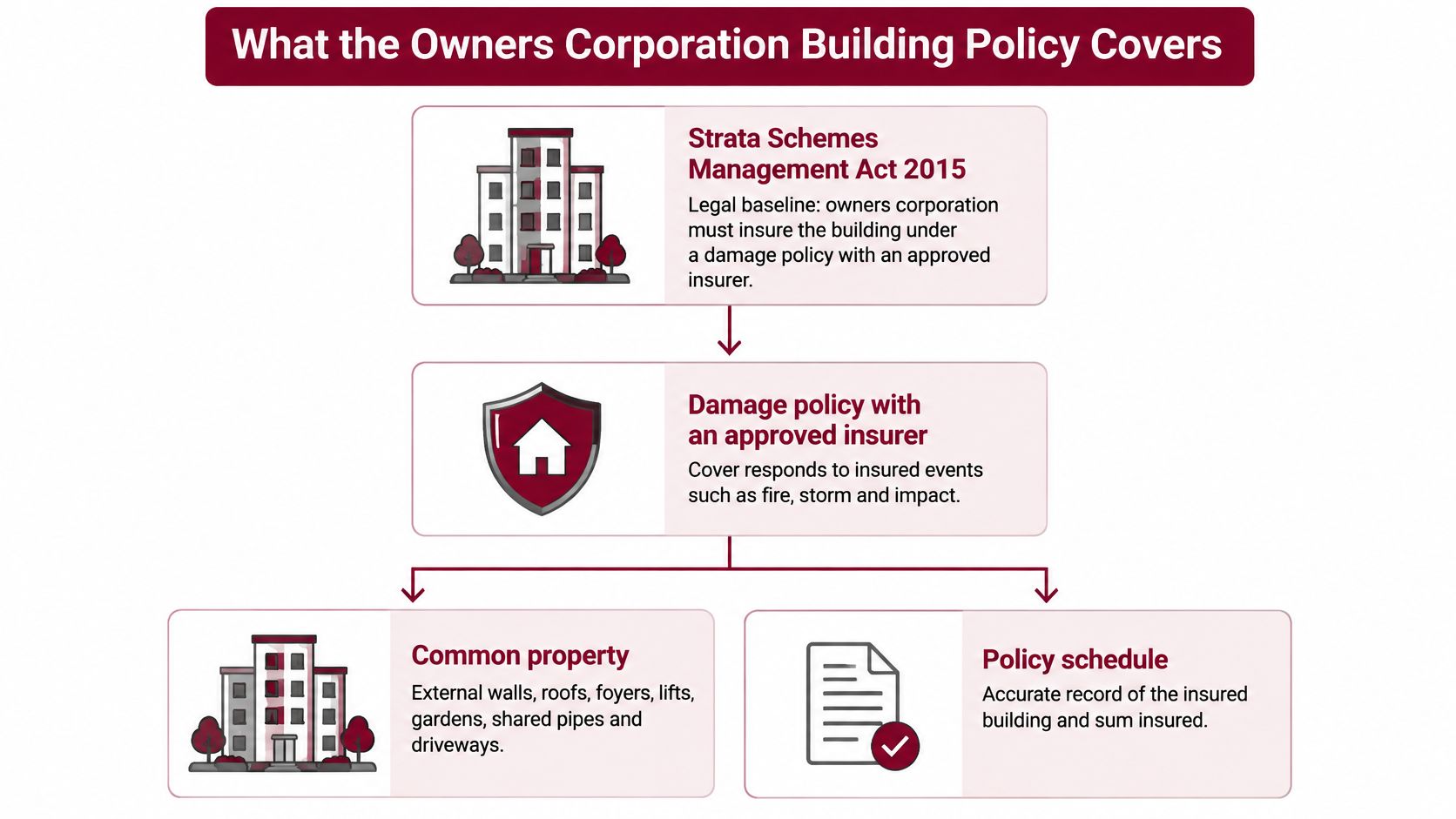
The duty isn't optional and it isn't a committee preference. The NSW Government's strata insurance guidance sets out that under the Strata Schemes Management Act 2015, an owners corporation must insure the building under a damage policy with an approved insurer, and the building must be insured for at least the amount determined under the regulations. The same guidance confirms the scheme must carry public liability cover with a minimum limit of $20 million.
The events a damage policy responds to
Fire, lightning and explosion are the named starting points, along with the other insured occurrences written into the contract. Storm, impact and water damage typically sit in that second group, and the wording matters enormously here, because water is where most claims land.
Reinstatement, not market value
The same NSW Government guidance explains that building insurance generally covers reinstatement or replacement to an as-new condition, professional fees such as architects' costs, and debris removal. That's a rebuilding number, so it has nothing to do with what a unit sold for last month. The distinction trips up owners who watch a strong property market and assume the sum insured kept pace with it.
How the pieces stack up
Read the policy as a hierarchy rather than a list:
- The structure first. Footings, slabs, frames, external walls, the roof, and the common ceilings and floors.
- Common property second. The lift, the foyer, stairwells, shared pipes, driveways, garden structures and the plant room.
- Plant and equipment third. Pumps, fire systems, air conditioning serving common areas, and switchboard equipment.
- Fixtures in common areas fourth. Foyer joinery, letterboxes, lighting and shared furniture.
- Liability alongside all of it. Cover for injury or property damage arising from common areas, at the statutory floor.
For taller buildings with complex plant or mixed uses, the risk profile shifts again. Owners and developers weighing that up can read more on high-rise building insurance risks and cover types, because height concentrates services, access problems and repair costs in ways a three-storey walk-up never does.
What the policy leaves out
Personal belongings, furniture, business stock, and many tenant or owner-installed fittings sit outside the scheme policy. So does the lot owner's own legal liability. Owners need contents cover, investors need a landlord policy, and tenants need contents and liability cover of their own. None of those replace the building policy, and the building policy replaces none of them.
The closing check is boring and effective: put the policy schedule beside the strata plan and confirm the insured property, the common property described, and the sum insured all match the building standing on the block.
Common Property, Lot Boundaries and Setting the Sum Insured
Common property is everything in the strata plan that isn't inside a lot: external walls, roofs, foyers, lifts, gardens, shared pipes and driveways. The plan draws the boundary lines, and the boundary line decides who insures the item. A fixture sitting on that line, such as a balcony enclosure or a hot water system recessed into a wall, can land on either side, which is exactly why the schedule needs reading rather than guessing.
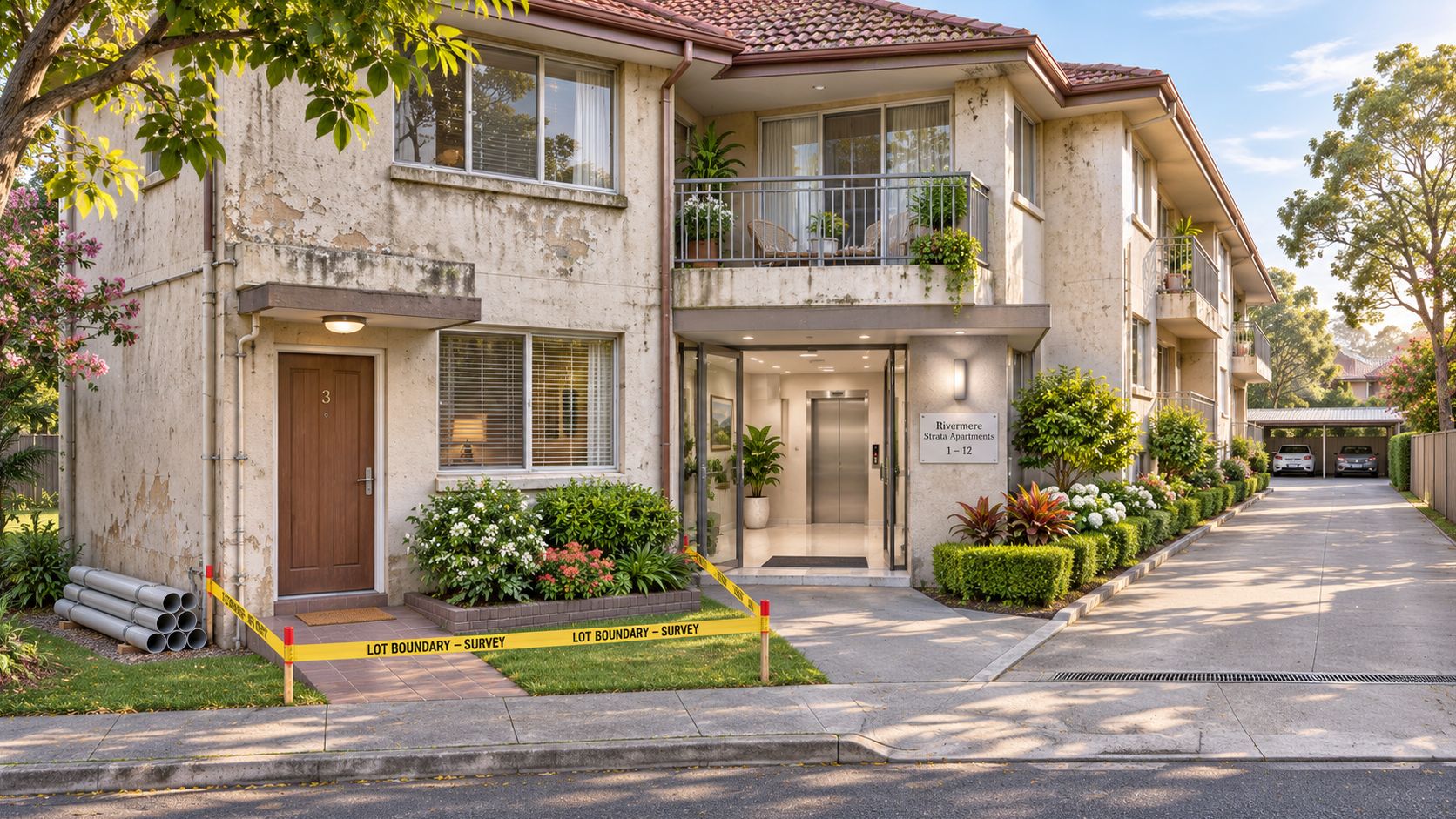
Here's how a valuation gap opens. Say a 20-lot block last had its insurance valued six years ago. Since then the committee has replaced the foyer with stone and joinery, installed a new lift motor, and repaired a failed membrane. Construction costs have climbed across the same period. The sum insured still reflects the old building, so a total loss would leave owners funding the difference out of levies, on top of losing their homes for a year.
What triggers a fresh valuation
- Major renovations, especially common-property upgrades that never reached the schedule.
- New defects that change how the building must be repaired, not just patched.
- Changed construction materials, such as recladding or a roof replacement in a different system.
- Construction cost inflation, which erodes a sum insured without anyone touching the building.
Under-insurance doesn't show up until the worst day, and then it shows up as a shortfall shared across every lot. Commercial and mixed-use schemes carry the same exposure with larger numbers attached, and the common underinsurance risks in commercial property cover follow the same pattern of stale values against rising rebuild costs.
Ask the strata manager two direct questions: when was the building last professionally valued, and have common-property upgrades been added to the schedule since then.
Owners Corporation Duties and Maintenance Evidence
The committee's job list is shorter than expected and heavier than anticipated.
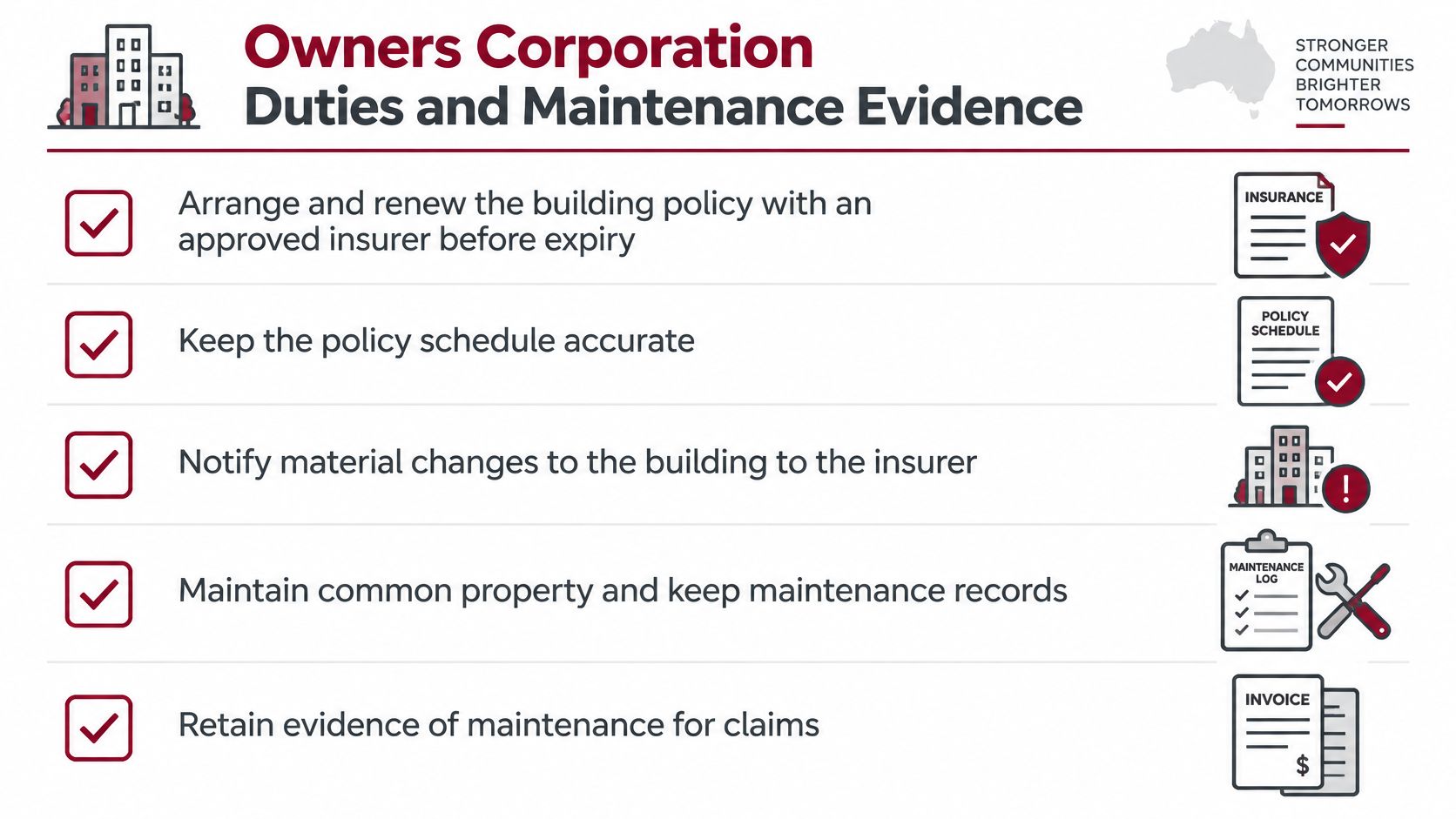
- Arrange and renew the policy with an approved insurer before the expiry date, not after.
- Keep the schedule accurate so the insurer is covering the building as it stands today.
- Notify material changes, such as a new plant installation, a change of use or major common-property works.
- Maintain common property and keep records showing that maintenance happened.
- Respond to claims promptly and retain the paperwork behind every repair.
None of that is a purchase. All of it affects the price and the payout.
Renewing a policy does not transfer the building's risk to the insurer. It buys a promise with conditions attached.
The evidence is blunt. The NSW Government's strata building repairs health check notes that more than 50% of residential strata insurance claims reported by a major insurer involved water damage, and that delayed repairs can increase premiums and excesses, reduce available cover or make a building difficult to insure at all.
Picture a committee that defers a roof repair for two years to hold levies down. At the next renewal the water damage excess has climbed, and when a ceiling collapses after a storm, the insurer asks for the maintenance history. There isn't one. The claim becomes a negotiation the scheme is poorly placed to win.
Record-keeping here overlaps with broader building management practice, and the maintenance responsibility framework for facility managers is a useful reference for allocating tasks and proving they were done. Three records carry the most weight at renewal: the maintenance log, the claims register, and a schedule of documented defects with dates and status.
Quote Transparency and Remuneration
When two strata quotes show similar premiums, do they necessarily offer similar value? Not always. The premium is one part of the cost; commissions, fees, excesses and the scope of cover can change what the owners corporation pays and what protection it receives.
A quote is easier to compare when its charges are clearly set out. Ask for the premium and any commissions, broker fees or other charges to be shown separately. Commission and fee arrangements vary, so the total cost and how the insurance was arranged both matter. A lower premium may still come with a higher excess or narrower water damage cover.
For example, two quotes with the same premium can have different totals after fees are added. And if the cheaper option has less suitable cover, the apparent saving may come at the cost of protection when a claim occurs. The building policy is also separate from owners' contents cover, so compare the cover the owners corporation is buying rather than assuming it protects personal belongings.
The question to ask before signing: is the cheapest quote the best value once exclusions, excesses, valuation quality, defect disclosure and remuneration are considered?
Request each quote in writing, then compare the same details side by side: premium, GST, commissions, broker fees, excess and water damage wording. This makes differences easier to spot than relying on a phone summary. It also helps the committee understand whether costs reflect the cover itself or the way it is arranged. A transparent comparison gives owners a clearer basis for deciding what they are paying for, not just which headline premium looks lowest.
How Strata Insurance Rules Differ Across Australia
Who must insure an apartment building depends on where it stands. Strata rules are set by state and territory law, so owners moving between states should not assume the same responsibilities apply everywhere. The building policy is also separate from each owner's contents insurance: it generally protects the building, while owners arrange cover for their belongings.
Strata insurance rules by state and territory
| Jurisdiction | Governing legislation | General insurance duty |
|---|---|---|
| New South Wales | Strata Schemes Management Act | The owners corporation must insure the building against damage with an approved insurer and hold public liability cover of at least $20 million. |
| Victoria | Owners Corporations Act | The owners corporation must insure common property and the building as required by the legislation, including public liability cover. |
| Queensland | Body Corporate and Community Management Act | The body corporate generally arranges building insurance and public risk insurance for the scheme. |
| Western Australia | Strata Titles Act | The strata company must insure the building against damage and maintain public liability cover. |
| South Australia | Strata Titles Act | The corporation must insure the building against damage and hold public liability insurance. |
| Tasmania | Strata Titles Act | The body corporate is responsible for insuring the building and maintaining public liability cover. |
| ACT | Unit Titles (Management) Act | The owners corporation must insure the building and maintain public liability cover. |
| NT | Unit Titles Act | The body corporate must arrange building insurance and public liability cover. |
The legislation sets the broad responsibility, but the scheme's boundaries and the policy wording still matter. Common property is generally insured through the owners corporation's policy; contents inside a lot are usually the owner's responsibility. Like a shared roof over private rooms, the policy needs to distinguish the structure everyone relies on from belongings each owner controls.
Before relying on a summary, check the applicable act and ask the strata manager who arranges the policy, what cover the law requires, and whether remuneration must be disclosed. Maintenance matters too: unresolved repairs can affect the building's condition and the cost or availability of cover. For developers and owners working across state borders, identifying the correct legislation for each site helps prevent insurance requirements being missed before a project proceeds.
Confirm Your Strata Policy Before You Renew
Price is one input. Exclusions, excesses, valuation quality, defect disclosure and remuneration affect a policy's actual cost, which is why the cheapest quote and the best value are often different documents.
Work through the checks in this order:
- Pull the current schedule and compare the sum insured against a recent professional valuation.
- Read the exclusions for water damage, wear and tear, and gradual deterioration, because those words decide most claims.
- Compare excesses by claim type. A low excess on fire is irrelevant if the water damage excess is the one that gets triggered.
- Ask for the itemised quote showing base premium, GST, commission and broker fees in writing.
- Confirm public liability meets the state minimum where one applies.
- Log outstanding defects and repairs with the committee, and update the maintenance log and claims register before renewal begins.
Gather the schedule, valuation and claims history into one folder before contacting any insurer or broker. If the committee wants an independent read, a licensed broker can compare offers from several insurers against the identical schedule, which is the only way to see whether a lower premium came from a better deal or a thinner policy. Our own process runs in four steps, Tell Us What You Need, Risk Assessment, Compare Cover Options, and Arrange Your Cover, and it works the same way for a strata scheme as for a construction project.
Note the renewal date and work backwards from it. Every week of delay narrows the options for fixing a gap, and cover that lapses is harder and dearer to reinstate than cover that's amended. Investors weighing their own layer of protection can also check what landlord's insurance covers so the two policies meet rather than leave a seam.
ABS Insurance Brokers Pty Ltd works with owners corporations, strata managers and property owners on building and common-property cover, placing policies with the insurers we access as a Steadfast Network Broker. If your renewal is approaching and the schedule hasn't been tested against a current valuation, we can review the sum insured, the water damage wording and the excess structure before you commit. Request a free insurance quote through ABS Insurance Brokers Pty Ltd and we'll compare cover options against the same schedule, so your committee can see exactly what each offer includes.