

The popular advice to budget aircraft insurance as a percentage of the aircraft's purchase price misses what changes an Australian quote. Aircraft insurance cost reflects the aircraft, the pilots, the operation and the cover requested, not a universal multiplier. A purchase-price estimate might help organise an early ownership budget, but it isn't a price you can rely on when arranging cover.
Table of Contents
- Why Aircraft Insurance Costs Vary So Widely
- The Premium Drivers at a Glance
- What Value, Type, Pilot Experience and Use Set the Price
- Hull and Liability Limits Explained
- Information Your Insurer Needs for an Accurate Quote
- Common Mistakes When Comparing Premiums
- Confirm Your Limits and Request a Quote
Why Aircraft Insurance Costs Vary So Widely
An underwriter has to consider both the likelihood of a claim and its potential size. A repairable landing accident, an aircraft destroyed on the ground and a passenger injury claim create very different financial exposures. Aircraft value tells the insurer something about the first, but very little about the last.
Historical Australian accident costs illustrate that distinction. A Bureau of Infrastructure and Transport Economics assessment estimated $76 million in total social costs from aviation accidents in 1993, including $16.4 million in aircraft damage and property loss, or 22%, and $30.4 million in lost earnings, or 40%.
Those are historical social costs, not insurance payouts or current premium benchmarks. Their useful lesson is that the damaged aircraft represents only part of an accident's consequences.
Severity matters alongside frequency
BITRE's later assessment estimated aviation accident and incident costs of $114 million in 2003–04 across 153 accidents involving Australian-registered aircraft, averaging $745,000 per reported accident, despite accident numbers falling 37.6% compared with 1996. Fewer accidents didn't remove the substantial cost of the events that remained.
That's why a useful insurance discussion needs an aircraft-specific assessment, not just a national safety headline. The practical work starts with identifying the aircraft and understanding its condition and operation.
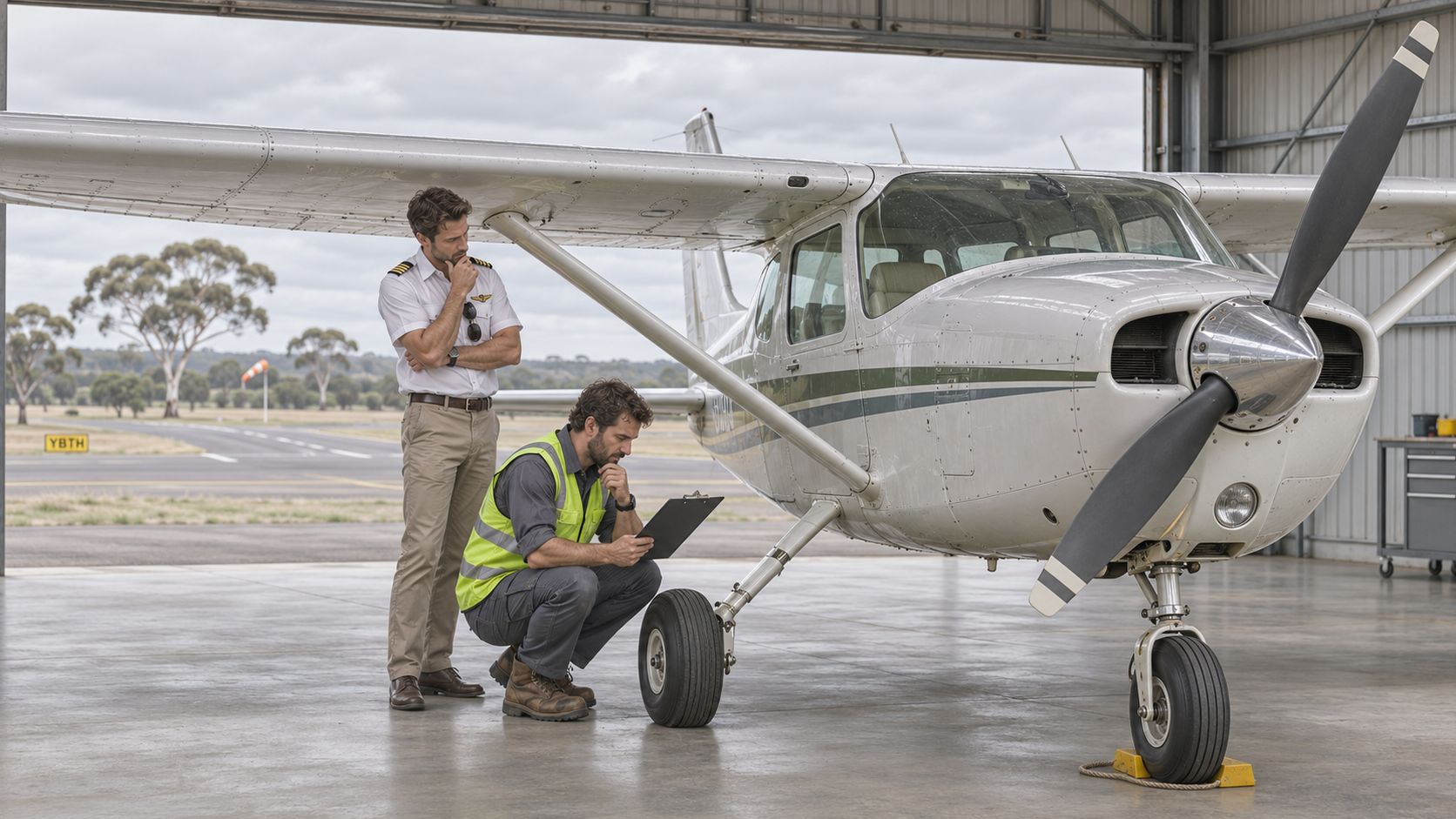
Underwriters distinguish hull exposure, meaning physical damage to the insured aircraft, from liability exposure, meaning covered claims involving other people or property. They assess these separately because the aircraft's replacement value doesn't establish the potential cost of an injury claim.
Practical rule: Treat the premium as a judgement about the operation and the potential size of a claim, not simply the aircraft's price tag.
A lower-value aircraft can still create substantial passenger or third-party exposure. Equally, an expensive aircraft doesn't automatically have an unfavourable operating profile. The insurer needs enough detail to distinguish those situations before offering meaningful terms.
The Premium Drivers at a Glance
Premium drivers and their effect on the quote
| Factor | What the insurer checks | Typical effect on premium |
|---|---|---|
| Aircraft value and age | Declared hull value, age, repair and parts cost | Higher value and costlier repairs raise hull premium |
| Aircraft type and model | Complexity, avionics, engine type, parts availability | Harder-to-repair types usually cost more to insure |
| Intended use | Private, instructional, charter, aerial work or agricultural | Passenger and revenue use usually raise premium |
| Pilot experience | Total hours, recent hours, ratings and training | Limited experience or little recent flying can raise premium and excess |
| Annual utilisation | Annual hours or departures | More flying means more exposure |
| Operating location | Base airfield, destinations and runway profile | Remote or difficult operating areas can raise the rate |
| Claims history | Prior incidents and claims for the aircraft and pilot | Recent claims can raise premium |
| Storage and maintenance | Storage arrangements, maintenance provider and records | Secure storage and documented maintenance can support more favourable terms |
| Liability limit | Third-party and passenger limit requested | Higher limits generally increase premium |
Read the table as a set of directional influences, not a calculator. An insurer won't necessarily add a separate loading or discount for every row, and favourable details don't guarantee a particular saving.
A technically complex aircraft might still attract competitive terms when the submission demonstrates appropriate pilot experience, regular training and well-organised maintenance. Conversely, a modest hull value won't neutralise frequent instructional flying or demanding destinations.
Assess the combination, not isolated details
Consider the same aircraft used privately and then offered for paid passenger operations. The hull value might remain unchanged, but the insurer now has to consider a different operating purpose, passenger exposure and liability requirement.
Storage also needs context. A hangar address is useful, but the underwriter may need to understand security, how the aircraft is handled and whether the maintenance arrangements suit the operation. A short description supported by records is more useful than calling the aircraft well maintained.
If you're assessing jet ownership, the jet cost breakdown from Approved Jets provides context for the broader ownership budget. Keep that budgeting exercise separate from an Australian insurance quotation, which must reflect your own aircraft and operation.
Before contacting a broker, mark the factors that apply to you and flag anything likely to change during the policy period. A planned change of pilot, operating base or commercial activity belongs in the submission, not in a conversation after cover has been arranged.
There's no supported universal Australian premium percentage or price range to apply here. Use these factors to understand what moves the quote, then obtain an actual price on stated terms.
What Value, Type, Pilot Experience and Use Set the Price
Take an older aircraft with scarce replacement parts and a newer aircraft with readily available parts, both insured for the same hull value. An underwriter needn't offer identical premiums: the likely repair process, specialist labour and economic repair threshold may differ substantially.
Australian aviation underwriting guidance from Chubb identifies aircraft type, insured value, use, utilisation, pilot experience, training and claims history as rating considerations, with policies assessed case by case rather than under a universal tariff. It also distinguishes exposure while an aircraft is flying, taxiing or subject only to ground risks.
Hull value needs evidence
A higher declared hull value increases the insurer's maximum physical-damage exposure. But choosing an artificially low figure to reduce premium isn't a sound substitute for discussing the valuation basis.
Provide a valuation, purchase documentation or relevant market evidence, together with details of material equipment changes. Then confirm whether the policy uses agreed value or market value, and how its wording applies to a total loss. An agreed-value policy shouldn't be described as automatically reverting to market value at claim time.
Age alone doesn't settle repair economics. Engine configuration, avionics, airframe construction, parts availability and access to suitably qualified repairers all help explain why apparently similar aircraft can produce different terms.
The operation changes the comparison
These scenarios show why hull value can't carry the whole pricing decision:
- Higher-value private aircraft: An experienced pilot flies recreationally, maintains recency and completes appropriate training. The submission should distinguish total hours from time on type and identify the usual destinations.
- Lower-value instructional aircraft: Frequent flights, different students and repeated training activity create another exposure profile. Instructor arrangements, student use, annual utilisation and training controls become central underwriting details.
- Charter aircraft using remote strips: Paying passengers, runway characteristics, destination access and pilot suitability need explicit treatment. Calling the operation business flying doesn't communicate those details adequately.
CASA's aviation accident trends distinguish operating sectors rather than treating aviation as a uniform exposure. That's the useful underwriting principle: identify the activity before trying to interpret its risk.
The instructional aircraft can therefore attract a higher premium or excess than the more valuable private aircraft. That isn't a guaranteed outcome, but it's entirely plausible once the insurer considers utilisation, pilot mix and training activity.
For pilots budgeting the pathway into further qualifications, CFII's financing options for accelerated pilot training offer a separate planning resource. Financing training doesn't itself earn an insurance discount; the insurer needs the qualifications, completed training and flying experience relevant to the proposed operation.
Rotorcraft operators should also consider the operational questions in our helicopter insurance guide. Describe private, instructional, charter, aerial work and agricultural use precisely: they aren't interchangeable permissions, and an inaccurate description can lead to revised terms or a coverage dispute.
Hull and Liability Limits Explained
Hull cover responds to insured physical damage to the aircraft, subject to the policy terms and applicable excess. Liability cover responds to covered legal liability for injury or property damage involving others.
An aircraft assessment helps establish the asset being insured, but it doesn't establish the liability limit an operation needs.

Compare the cover parts separately
CASA's carriers' liability insurance guidance makes this insurance mandatory for Australian carriers transporting passengers for hire or reward and specifies the passenger and baggage minimums shown below.
Hull and liability cover compared
| Cover part | What it pays for | How the limit is set | Effect on cost |
|---|---|---|---|
| Hull (physical damage) | Covered repair or replacement of the insured aircraft | Agreed or market value under the policy | Greater declared value generally increases cost; excess applies |
| Third-party liability | Covered injury or property damage involving people outside the aircraft | Operation, exposure and requested limit | Higher limits and wider exposure generally increase cost |
| Passenger liability (carriers) | Covered death or injury claims involving passengers carried for hire or reward | CASA minimum of $925,000 per passenger on a domestic carrier; 480,000 SDR, approximately AU$975,000, on international flights | Mandatory carrier cover establishes a minimum, not a pricing formula |
| Baggage liability (carriers) | Covered registered and non-registered baggage claims | CASA minimum of $3,000 registered and $300 non-registered baggage | Required carrier exposure; confirm its treatment in the quotation |
The Australian-dollar equivalent of an SDR amount moves with exchange rates. Confirm the applicable requirements when arranging cover rather than treating the approximate conversion as a fixed Australian-dollar limit.
Choose a limit for the exposure
For an applicable passenger carrier, the decision isn't whether to purchase the required insurance. It's whether the minimum adequately addresses the operation and what additional capacity is available.
A serious passenger injury can generate a claim substantially different from the cost of repairing the aircraft. Ask for the additional premium associated with available higher limits, and check whether defence costs sit within or outside the relevant limit.
For a further visual explanation of the distinction, watch the following video.
Our aircraft hull versus liability insurance guide can help frame that discussion. Request the proposed hull value, required liability limit and available excess options separately, including the premium effect of each alternative.
Information Your Insurer Needs for an Accurate Quote
Build a single submission before requesting prices. An underwriter can't reliably assess an operation from an aircraft registration and an estimated value, and missing details can produce qualifications that prevent a clean comparison.
Prepare the aircraft and pilot records
Use the checklist as a starting point, then attach the operating detail needed to explain how the aircraft will be used.
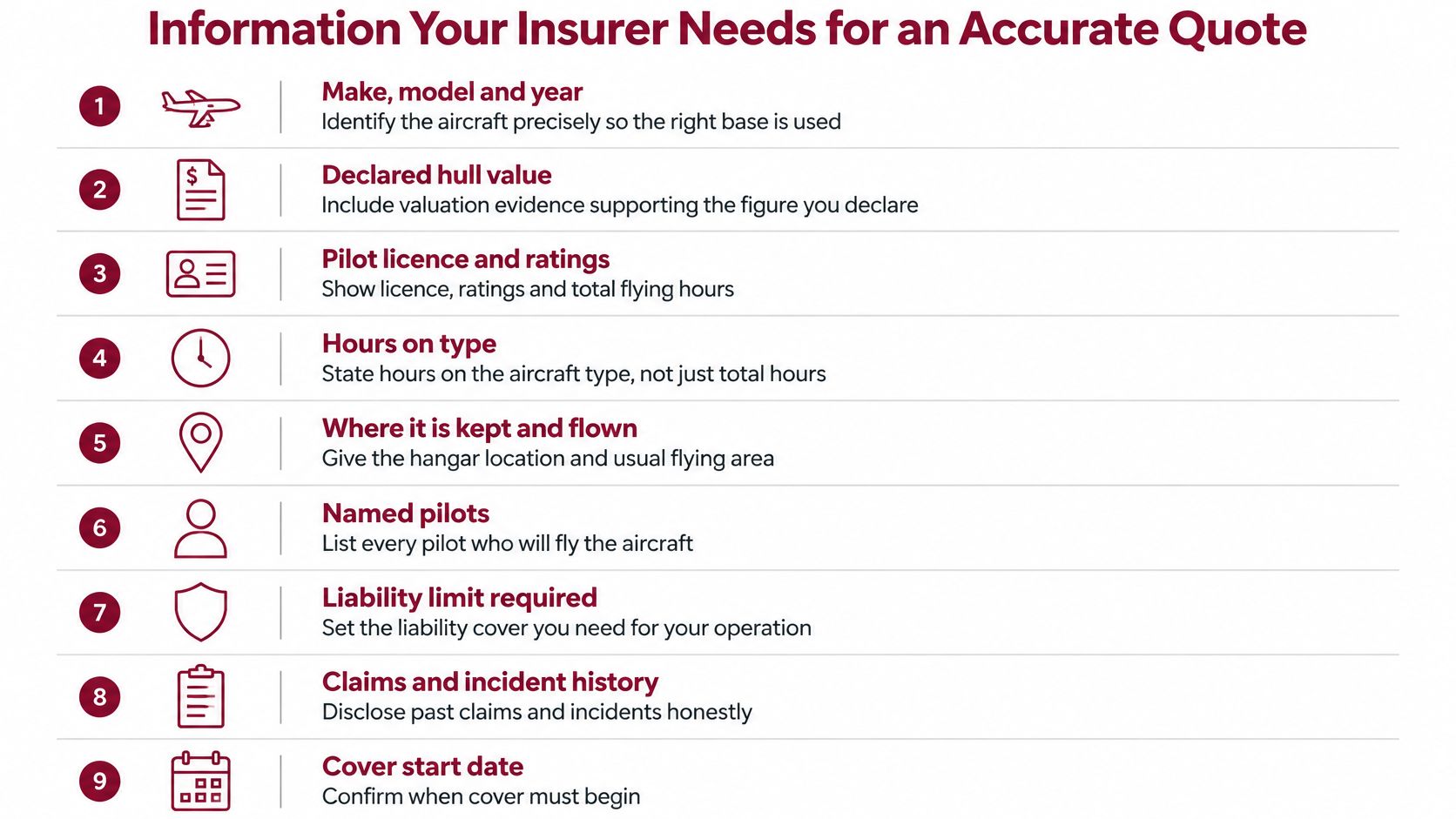
- Aircraft identification and value: Supply make, model, year, registration and declared hull value, with supporting valuation evidence and material equipment details.
- Pilot qualifications: List every proposed pilot, their licence, ratings, total hours, hours on type, recent flying and relevant training.
- Intended activity: Describe private or commercial use precisely, including instruction, rental or other training activity.
- Flying exposure: Give expected annual hours or departures and explain any planned increase or seasonal concentration.
- Location and storage: Identify the base airfield, usual destinations, runway profile, hangar or tie-down arrangements and security.
- Maintenance: Name the maintenance provider and supply relevant records, including information about outstanding issues.
- Loss history: Disclose claims and incidents involving the aircraft and pilots, with circumstances and corrective action where relevant.
- Requested terms: Specify the liability limit, hull excess preference and required commencement date.
Give the insurer measurable exposure
CASA's annual report records 168 aircraft accidents in 2024–25, below the 10-year average of 198.1, and notes that accident rates are standardised by departures where possible. That approach accounts for flying activity, which a raw national accident count cannot do.
Your expected departures or hours therefore deserve the same care as your aircraft description. For quote preparation, prioritise flying exposure, pilot recency and the exact liability limit: each can materially alter how the underwriter interprets the submission.
A complete submission doesn't promise a lower premium. It gives the insurer a better basis for offering terms you can actually use.
We provide insurance quotes through our insurance quotation platform, Quotation Services. Our aircraft insurance renewal checklist can also help organise changes before renewal.
Send the same dated information to every broker involved. If something changes during the quotation process, update everyone so you aren't comparing prices based on different facts.
Common Mistakes When Comparing Premiums
The expensive mistake is choosing between quotes that insure different things. A smaller premium attached to a lower hull value, narrower permitted use or reduced liability limit doesn't establish better value.
Start by aligning the specifications. Then examine what you'd retain yourself if a claim occurred.
Check what creates the saving
- Excess differences: A higher excess transfers more of an otherwise covered loss back to you. Assess whether the premium saving justifies that retained cost and whether different excesses apply to particular events or pilots.
- Operating permissions: A private-use quotation isn't a substitute for terms covering instruction, charter or aerial work. Match the actual activities against the schedule and wording.
- Pilot conditions: Check named pilots, experience requirements and any training conditions. Don't assume a general reference to approved pilots includes everyone you intend to use.
- Unresolved qualifications: A price subject to satisfactory pilot records or valuation evidence remains conditional. Establish what must be accepted before relying on it.
National accident headlines aren't a sound basis for challenging an individual quotation. A more productive discussion identifies the specific aircraft, pilot or operational information that could justify different terms.
Compare the payable total
Budget for GST and any applicable stamp duty, together with disclosed fees and charges. Ask for an itemised total rather than comparing a base premium against another quotation's all-inclusive amount.
Also check the policy period, territorial scope, exclusions and any separate treatment of ground-only cover. A shorter period or narrower geographic permission can make an apparent saving misleading.
Comparison test: Put each quote against the same use, hull value, liability limit and excess before deciding which price is preferable.
A quotation isn't a promise that every future incident will be covered. The final schedule, wording, endorsements and accepted disclosures determine the contract, so resolve inconsistencies before arranging cover.
Confirm Your Limits and Request a Quote
You control the quality of the information submitted and the cover you ask the insurer to consider. Start with an evidenced hull value, select a liability limit suited to the operation, and document the pilots and intended use accurately.
Those decisions won't guarantee the lowest aircraft insurance cost. They do help prevent a low initial estimate from becoming unsuitable or conditional terms.
Bring a clear specification
At ABS Insurance Brokers Pty Ltd, a leading supplier of aviation insurance based at Bankstown Aerodrome, we serve aircraft owners, operators and aviation businesses across Sydney and Australia. Our aviation offering includes aircraft hull and liability, aerial-application liability, non-ownership liability, hangar keepers liability and drone insurance.
Our Sydney office is at 2 Hartzell Place, Bankstown NSW 2200, at Bankstown Aerodrome. If you'd prefer to discuss the submission in person, bring the aircraft, pilot and operational records rather than just a renewal premium.
- Set the asset value: Provide evidence supporting the hull figure and identify the valuation basis requested.
- Specify liability: State the passenger and third-party exposure, required limits and relevant operating obligations.
- Describe the operation: Include all intended activities and the pilots who will undertake them.
For businesses with separate UK activities, Lighthouse Consultants' UK business insurance advice may help organise that distinct insurance discussion. It shouldn't replace Australian aviation advice or the assessment of Australian carrier obligations.
We offer a free insurance quote on request, working through Tell Us What You Need, Risk Assessment, Compare Cover Options, and Arrange Your Cover. Send the completed checklist and request the hull value, liability limit and excess as separate entries, with any alternatives clearly identified.
ABS Insurance Brokers Pty Ltd offers aviation insurance assistance for aircraft owners, operators and aviation businesses, including aircraft hull and liability cover. Visit ABS Insurance Brokers Pty Ltd to request a quote, and send your aircraft details, pilot records and intended use so we can help you compare terms on a consistent basis.