
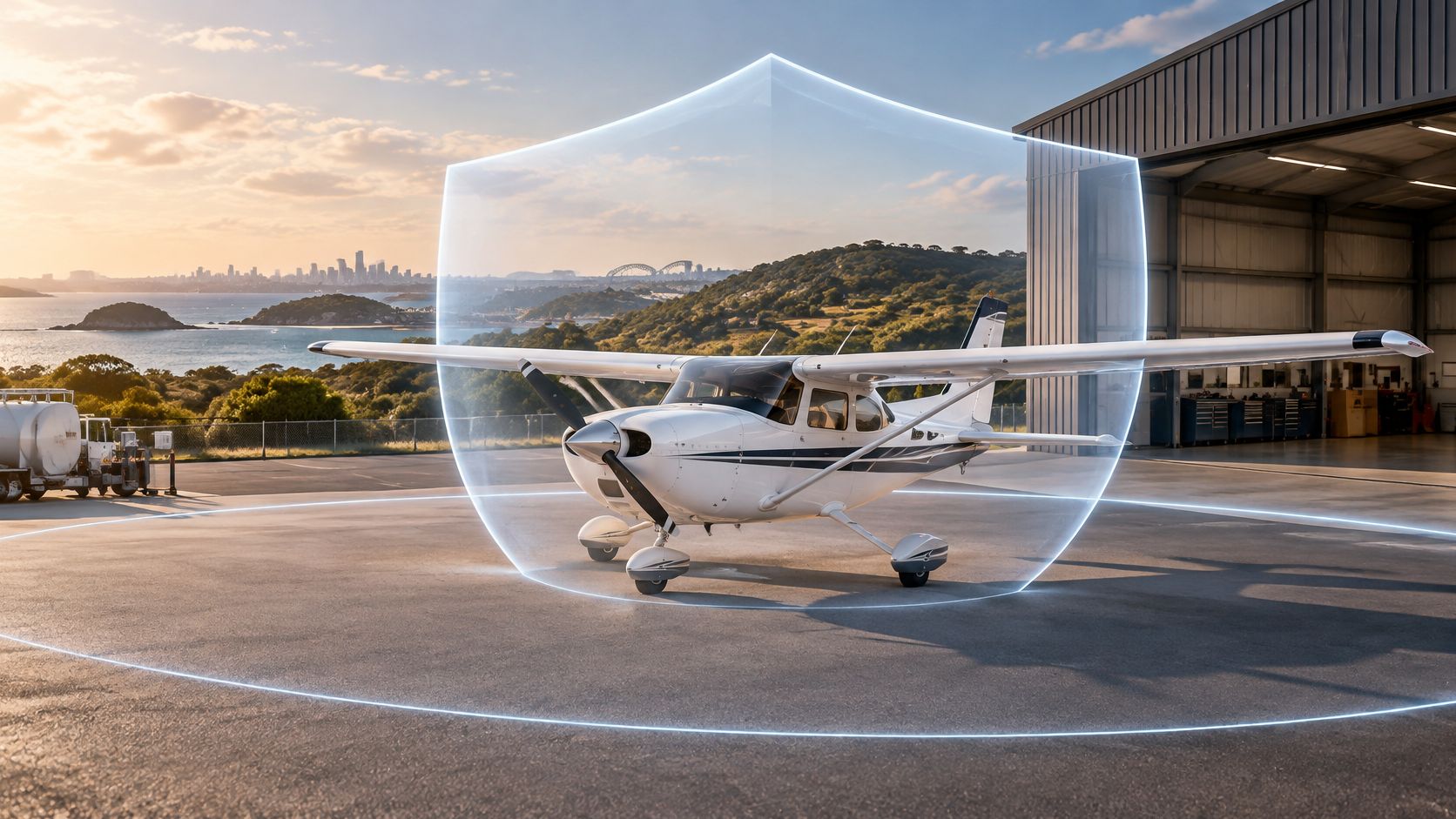
The renewal invitation lands three weeks before expiry. The premium has moved a little, the schedule still reads "private and business use", and you sign it the way you signed it last year.
Except the last twelve months didn't look like private and business use. You flew tailwheel instruction most weekends, carried a survey camera for a client twice, and the aircraft now sits on a tie-down at a busy regional field instead of inside a hangar. Nothing on the schedule describes the year you had.
That gap is where claims fall apart. Aviation insurance in Australia is a small, specialist market, and policies are written tightly on purpose. Cover responds when the schedule matches the use, the pilots and the places you fly, not just whether a passenger ever sat in the back. A private owner who never takes a fare can still carry liability for ground damage at a crowded strip, and for a hired aircraft flown while their own is in maintenance.
ABS Insurance Brokers, a specialist aviation insurance broker based at Bankstown Aerodrome, sees that mismatch often, and this guide is built around the questions that decide whether cover responds.
Table of Contents
- Hull and Liability Cover Explained Simply
- Aviation Cover Needed for Each Type of Operator
- Policy Terms and Exclusions to Check Before Signing
- What Drives Your Aviation Insurance Premium
- How to Arrange Aviation Cover in Four Steps
- Confirm Your Cover Before Your Next Flight
Hull and Liability Cover Explained Simply
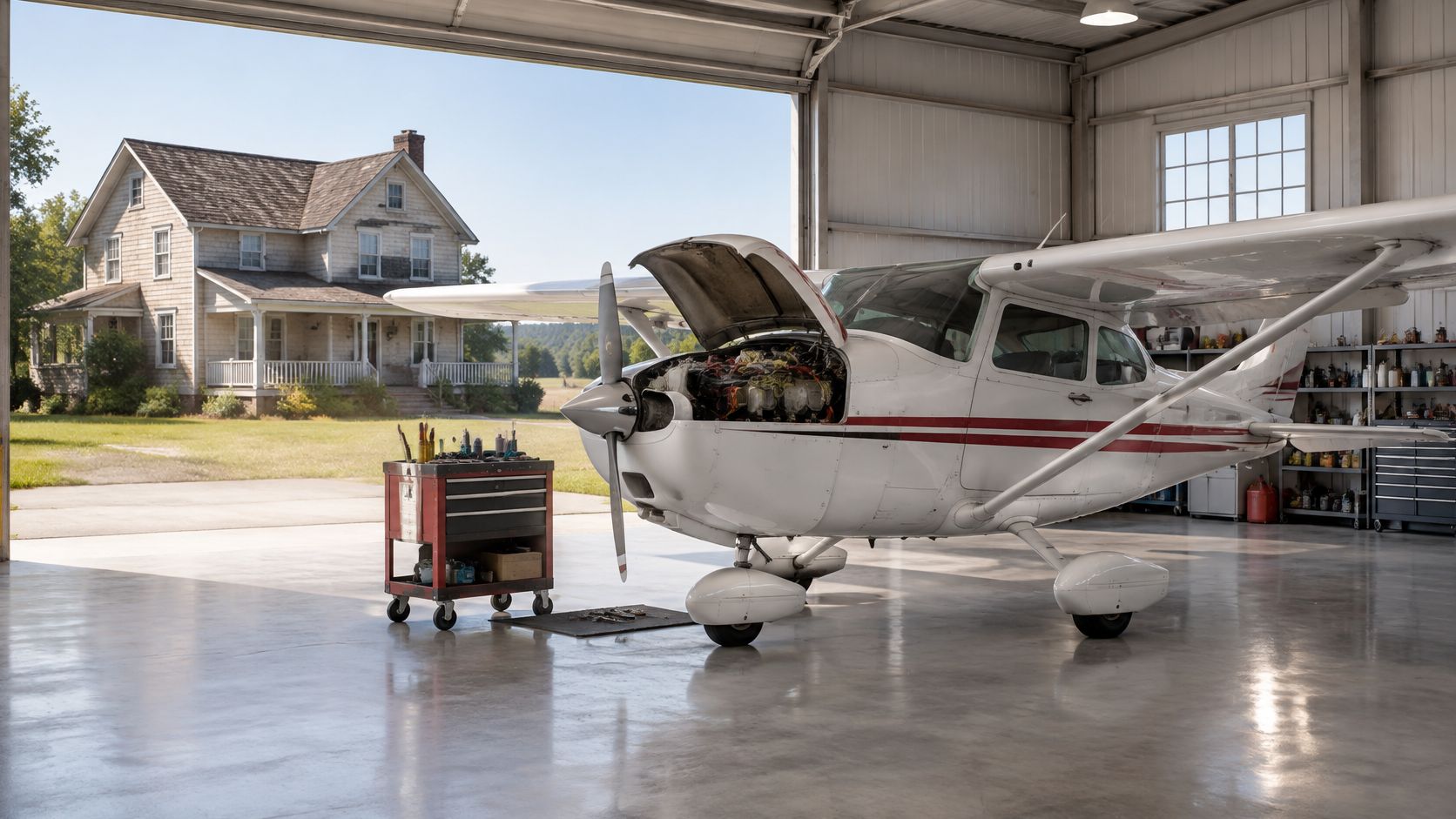
Insuring an aircraft is easier once you stop treating it as one product. Start with a house. Hull cover is the building: it pays to repair or replace your aircraft after a crash, a hangar fire, hail or theft. Liability cover is what you owe the neighbour when something of yours damages something of theirs.
In aviation, the neighbour could be a person beside the taxiway, a farmer's crop, a parked car or the airport's lighting gantry. Two exposures, two very different conversations with an underwriter.
Three Exposures That Sit in Different Pockets
Hull responds to damage to your aircraft. Third-party liability responds to damage your aircraft causes to other people and their property.
Passenger liability responds to injury to people on board, and it's the exposure most often assumed to be bundled into the liability limit when it's written as its own section or sub-limit. Ground damage follows its own legal pathway too: the Damage by Aircraft Act 1999 deals with third-party surface victims, which is a separate question from whether the person in the right seat is covered.
A Three Step Method for Matching Cover to a Loss
- Identify what was damaged. Your aircraft, someone else's property, or a person. Answer that before you open the policy.
- Match the cover to the answer. Hull for your asset, liability for their loss, passenger liability for the people you're carrying. If you can't point to the section that responds, it probably doesn't.
- Check the limit against a realistic worst case. A liability limit sized to the average prang leaves the gap wide open on the bad one, and third-party injury is where that gap gets expensive.
Say a training aircraft clips a fence on landing. Hull cover pays to repair the wing and the prop. Liability answers the fence owner's claim for the damaged fence and the crop behind it. If a passenger on board ends up with a back injury, passenger liability answers that.
One event, three sections of the policy, and if any one of them was missing or set too low, the shortfall lands on the operator's balance sheet.
Run this test before you renew. List every person and object your aircraft could damage on a bad day, from the instructor beside you to the fuel bowser, the parked Cessna next door and the vineyard at the end of the strip. Then check each one has a matching cover on paper.
Underwriters treat hull and liability as separate decisions, and the difference between aircraft hull and liability insurance matters most in the single event that triggers both at once.
Aviation Cover Needed for Each Type of Operator
Australia's insured aircraft base is far wider than the scheduled airlines. In 2024, Australian-owned and operated civilian aircraft flew 3.63 million hours, up 1.4% from 3.581 million hours in 2023, and the VH register finished the year with 15,051 aircraft, according to BITRE's aviation activity statistics.
General aviation alone accounted for 1.3764 million of those hours, spread across aerial work, instruction, sport and pleasure flying, own-use business and other operations. Hull and liability risk looks nothing alike across that spread.
Find your operation below and read across.
| Operator | Hull cover | Liability cover | Passenger liability |
|---|---|---|---|
| Private owner flying own aircraft | Usually held if financed or high value | Strongly recommended | Not required |
| Flight training school | Usually held | Strongly recommended | Not required unless passengers are carried for hire |
| Charter operator carrying passengers | Usually held | Strongly recommended | Compulsory, minimum A$925,000 per passenger for domestic injury or death |
| Aerial work (agriculture, mustering, survey) | Usually held | Strongly recommended, including aerial-application liability | Not required unless passengers are carried for hire |
| Aircraft hirer or non-owner | Rarely held, check the hire agreement for a damage waiver | Non-ownership liability | Not required |
| Hangar, maintenance or ground handling business | Customer aircraft usually insured by the owner | Hangarkeepers liability and care, custody and control | Not required |
| Construction firm using helicopter or drone | Hull cover if the aircraft is owned or hired | Third-party liability for ground damage | Not required |
The Row Most People Misread First
The charter row. CASA requires passenger liability insurance for operators carrying passengers for hire or reward to, from or within Australia, with minimum cover of A$925,000 per passenger for domestic injury or death claims, as set out in CASA's carriers' liability guidance.
That figure is a floor for one exposure only. It says nothing about your hull value, your ground damage exposure, or the aircraft you hire in from another operator while yours is in for maintenance.
Why Not Carrying Passengers Isn't the Same as Low Risk
A construction firm using a helicopter for lift work or a drone for survey doesn't carry passengers for hire, so the compulsory floor doesn't apply. The exposure doesn't vanish with it. Ground damage, aircraft in your care and contractual indemnity all still apply, and the last one is where projects bite, because a head contract can call for indemnity limits well above what the policy carries.
An aircraft hirer has a parallel problem. Non-ownership liability answers when you're flying an aircraft you don't own and the claim lands on you rather than the registered owner, which this guide to non-owned aircraft liability for pilots and businesses walks through.
Those usual cover positions are a starting point, and the wording decides the final answer. Find the row that matches your use, then check whether you sit in a second one. A flight school that also dry-hires to a graduate is a training school and a hire arrangement at once, and a policy written for the first may not answer for the second.
Policy Terms and Exclusions to Check Before Signing
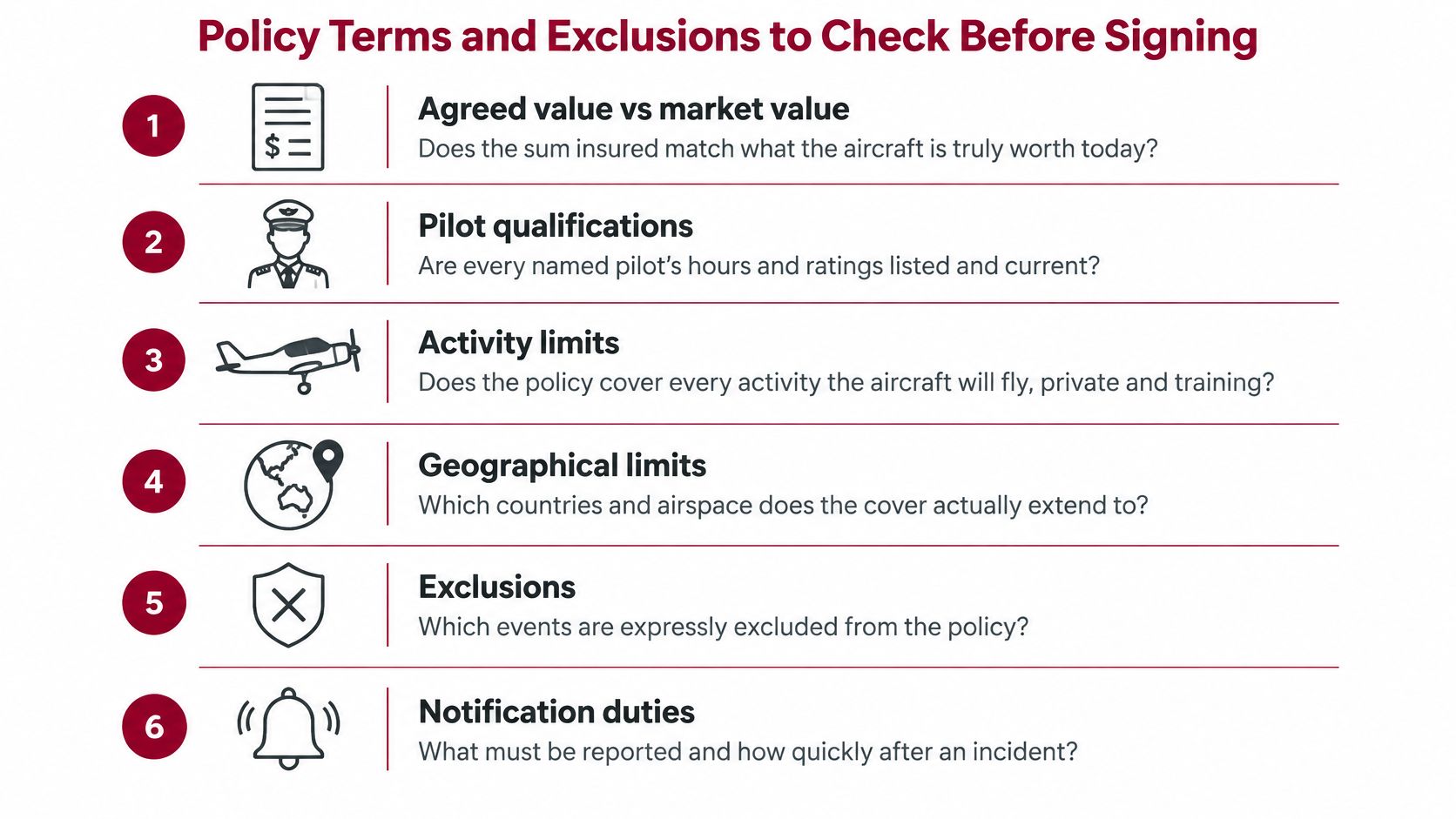
A policy is a set of promises with conditions attached. Most claim disputes turn on a clause that was in the wording the whole time. Read the schedule like a checklist, and put the matching question to whoever is arranging your cover.
- Agreed value versus market value. Confirm the sum insured would replace the aircraft at today's prices, then ask whether a total loss settles at the agreed figure or at market value on the day. A schedule written three years ago against a market that has moved is quiet underinsurance.
- Pilot clauses. Named pilots, minimum total hours, minimum hours on type and required ratings. Ask specifically whether an instructor, a check pilot or a friend flying under supervision is covered, because a pilot outside the clause can void the whole claim.
- Territorial limits. Confirm whether remote-area, interstate and overseas flying sit inside the limit. A strip in the Top End and a strip in Indonesia aren't the same line on the map.
- Liability limits. Confirm the third-party limit and whether passenger liability is written inside it or separately. A combined limit shared between ground damage and passengers erodes fast after one serious event.
- Excess per claim. Note what you pay before the insurer does, and check whether the hull excess and the liability excess are different figures.
- Storage and ground handling. Check where the aircraft is kept, and whether damage while parked, hangared or being towed by an airport operator is covered.
- Intended use. A policy written for private flying may not cover paid charter, aerial application or flight training. Ask for written confirmation of each activity you plan to fly.
Here's the version of that checklist worth keeping with the paperwork.
Two Questions Worth Asking Before You Accept
Ask for every exclusion in writing before you sign. Then ask which insurer is carrying the risk and where that insurer is based.
Both answers belong on your file. When you ask us for insurance advice, we'll tell you whether a recommended insurer is overseas and which country it's located in, because an offshore carrier isn't automatically a problem, but a claim desk is a bad place to discover it.
Ask in writing. A verbal "that should be covered" is worth nothing when a claim is on foot. An email from the underwriter is worth a great deal.
Some of the vocabulary on a schedule, from type ratings to hull values, is easier to follow with a reference open, and this aviation glossary explaining common aviation acronyms covers the terms without the jargon.
Keep the policy schedule with the aircraft logbook. When something goes wrong, the first two documents anyone asks for are the schedule and the hours.
What Drives Your Aviation Insurance Premium
An underwriter doesn't price an aircraft. They price a specific machine, flown by a specific pilot, on specific tasks, kept somewhere in particular. Every question on a proposal form is that idea in a different suit, and each answer moves the rate.
| Factor | How it moves the premium | Information to provide |
|---|---|---|
| Aircraft type and value | Higher replacement value and complex types raise hull premiums | Make, model, year and sum insured |
| Pilot experience | Low total hours and few type ratings raise the rate | Logbook hours, type ratings and recent flying |
| Intended use | Charter and aerial work carry higher loss rates than private flying | Written description of every activity |
| Passenger carriage | Carrying passengers for hire adds passenger liability | Seats used and fare arrangements |
| Claims history | Recent losses can lift the premium or increase the excess | Five-year claims record |
| Annual hours flown | More hours means more exposure | Estimated hours per year for each activity |
| Storage location | Open parking and busy airfields raise damage risk | Hangar or tie-down location and security |
| Remotely piloted aircraft | Drones on projects add their own hull and liability terms | Weight class, payload and operating area |
Why the National Accident Count Doesn't Set Your Premium
The ATSB's review of 2005 to 2014 recorded 254 aircraft involved in fatal accidents in Australia, resulting in 374 fatalities. CASA-registered general aviation accounted for 240 of those fatalities, non-CASA-registered recreational aircraft for 98 and commercial air transport for 36, according to the ATSB's aviation accident data.
Read side by side, those figures show where the exposure sits: outside the airlines. An underwriter reads them the same way, which is why the questions follow what your aircraft does rather than whether it carries passengers. A private owner who hires a machine while theirs is in maintenance, or a small operation that picks up occasional contract work, carries exposure that a passenger count alone will never capture. Some of it isn't even airborne. An aircraft on a tie-down through a hail season is still a risk someone has to price.
The national count has come down. CASA's annual report on trends in aviation accidents records 168 civil aviation accidents in 2024–25, below the 10-year average of 198.1 accidents.
Treat that as a measure of sector safety, nothing more. A falling national figure won't lower your premium, because the price is set off your aircraft, your pilots, your hours and your history, and none of those moved when the average improved.
What to Put in Front of an Underwriter
One accurate page beats five vague ones. State the aircraft, its value, each named pilot's hours and recency, the planned hours split by activity, and five years of claims history, and the quote comes back priced for the risk you carry.
Underwriters price what they can see.
So describe the use fully: passenger carriage, aerial work, training, night or instrument flying, remote-area strips, subcontracted pilots, and the aircraft you hire when yours is on the ground. An activity left off the submission doesn't leave the risk profile. It just gets loaded as uncertainty, or priced into an exclusion you find later.
A quote that's cheaper because the pilot clause excludes your instructor isn't a cheaper quote. It's a smaller policy.
Storage deserves a line of its own. Security and access control at a smaller field shape how an underwriter views theft and unauthorised access, so describe your parking accurately rather than generously. At a regulated aerodrome, the aviation screening and access control arrangements around your parking are part of that picture, and worth stating plainly.
How to Arrange Aviation Cover in Four Steps
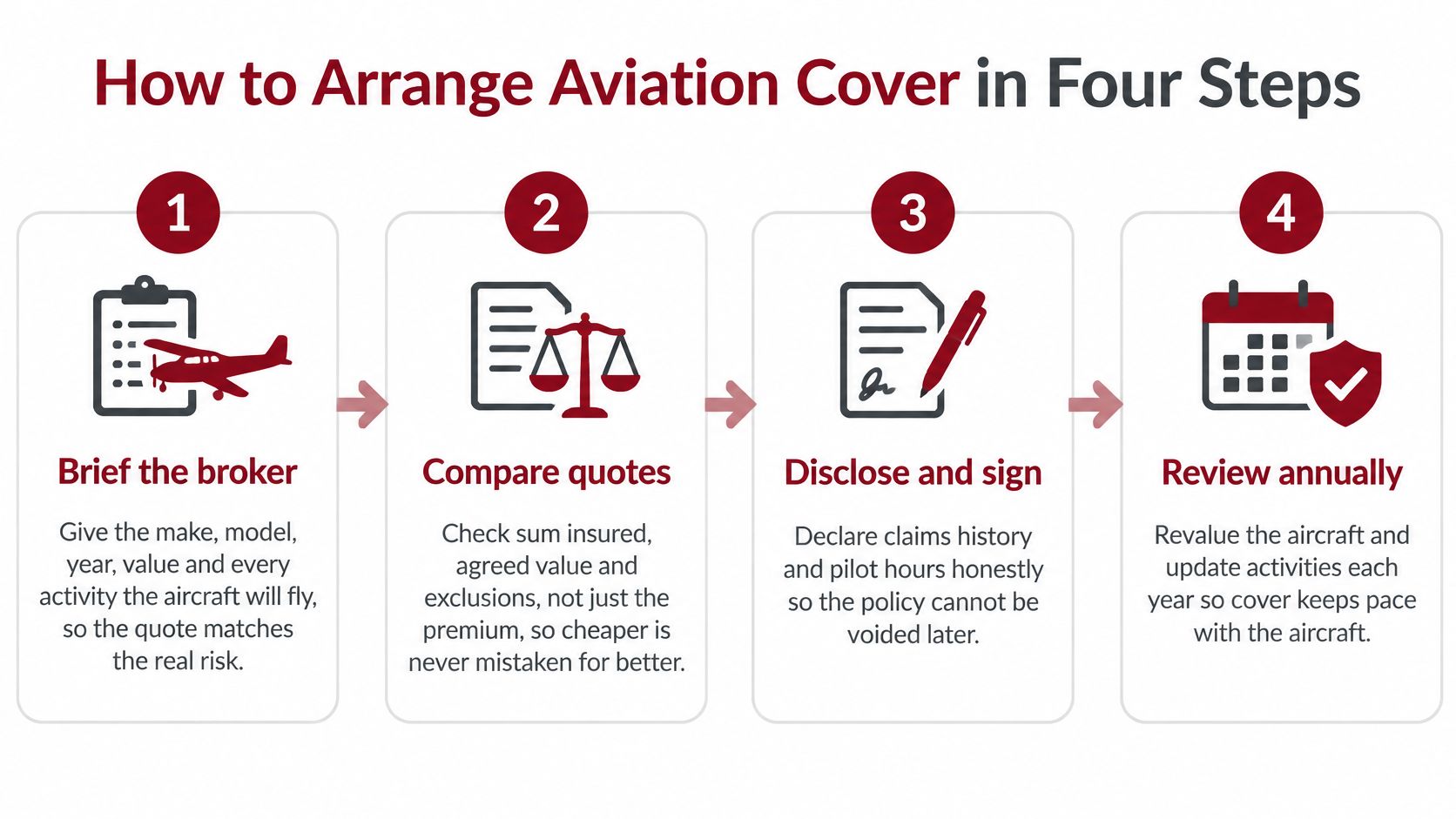
Four stages, in order. Skipping one usually costs more than it saves, and the cost turns up at claim time.
Step 1. Tell Us What You Need
Give the make, model, year and current value, every activity the aircraft will fly, whether that's private, training, charter, aerial work or drone, and every pilot who will fly it, with hours and ratings.
Every later step depends on this being accurate. A submission that says private use when the aircraft also does instruction gets priced for the wrong risk, and the error surfaces when you claim rather than when you quote.
Step 2. Risk Assessment
Pilot experience, logbook hours, storage arrangements and claims history get reviewed against what the cover you already hold says. Gaps usually show up here: a passenger liability section nobody renewed, a hire arrangement nobody insured, a hull value set three owners ago, a named-pilot list that no longer matches who flies the aircraft.
Step 3. Compare Cover Options
Compare hull, liability and passenger liability side by side, along with specialist covers such as aerial-application liability, non-ownership liability, hangarkeepers liability and drone insurance. Put excesses and exclusions in the same table as the premium.
The cheapest quote is frequently the one with the narrowest pilot clause and the widest gap between the hull value and the replacement cost.
Step 4. Arrange Your Cover
Check the policy schedule line by line against the brief: the pilot clause, the territory clause and the stated use. File a copy with the logbook. Then diarise the renewal date and the revaluation date separately, because aircraft values move and schedules don't update themselves.
We arrange aviation insurance across Australia for aircraft owners, pilots, charter operators, aerial-application businesses, drone operators and aviation businesses working around airports, as set out on our aviation insurance page. The covers we place include aircraft hull and liability, aerial-application liability, non-ownership liability, hangarkeepers liability, drone insurance and specialist cover for ground handlers, refuellers, aircraft service providers and airside contractors.
Our process runs through four steps: Tell Us What You Need, Risk Assessment, Compare Cover Options and Arrange Your Cover.
Get the timeline in writing. Whoever arranges your cover should confirm what they need from you, by when, and who is chasing the underwriter, so the policy is bound before the first flight rather than after it.
Confirm Your Cover Before Your Next Flight
Three Checks Before Your Next Flight
Run these against the schedule itself, not from memory.
- Does the cover match the logbook? Every activity flown in the past twelve months, and every one planned for the next twelve, should be named on the schedule.
- Are the named pilots the ones flying? If somebody new has started flying the aircraft, they aren't covered until the insurer knows about them.
- Do the territory and passenger clauses fit the trip? A border crossing, a remote strip and a seat full of paying passengers each test a different clause.
If any answer is no, arrange a review before the next flight rather than after it. An aircraft insurance renewal checklist is a practical way to get the paperwork ready in advance.
ABS Insurance Brokers is a specialist aviation broker based at Bankstown Aerodrome. Its Sydney office at 2 Hartzell Place, Bankstown Aerodrome, NSW 2200 sits within the Bankstown Airport precinct and is open Monday to Friday, 8:00 am to 5:00 pm, as listed on the ABS locations page.
Clients can speak with a broker by calling 1300 871 318, and we offer a free insurance quote on request. A review is worth requesting even when the aircraft is already insured, because it's the cheapest way to catch a mismatch between what the policy says and what the aircraft does. Bring the current policy schedule to the review.
ABS Insurance Brokers Pty Ltd arranges aircraft hull and liability cover for private owners, flight schools, charter operators, aerial work businesses, drone operators and the airports and ground businesses around them. If the schedule doesn't describe how your aircraft is really flown, that's the conversation to have before the next flight rather than after an incident. Visit ABS Insurance Brokers Pty Ltd to start a review or request a quote.