
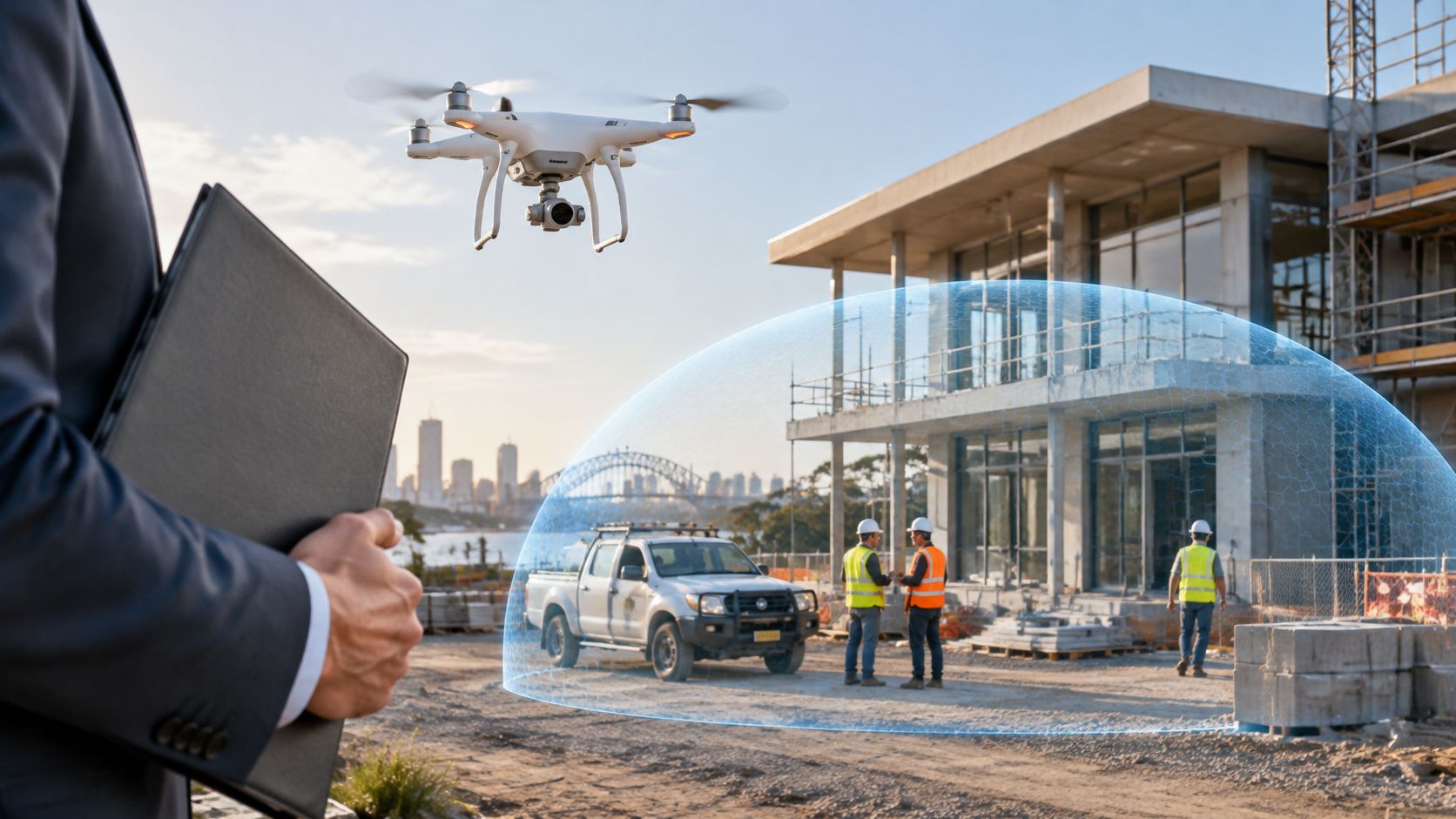
CASA doesn't generally require public liability insurance for ordinary drone operations in Australia, and the ATSB has recorded 939 occurrences classed as encounters with remotely piloted aircraft since 2015, while CASA still advises operators to arrange suitable third-party cover. Both halves of that answer matter, and the usual advice only picks up one of them.
The popular line is that a drone policy with a large liability limit settles the question. That treats the aircraft as a flying camera. On an Australian construction site it's a tool working above other people's property, their vehicles and their heads, and which policy answers a claim is decided by wording, declared use and who was holding the controller, not by the size of the number printed on the certificate.
A lawful flight is not automatically an insured flight. For builders, developers, surveyors and trades, the claim that hurts is rarely a wrecked airframe. It's a survey that sends a project down the wrong path, a roof defect nobody picked up, an indemnity promised to a principal that an insurer never agreed to, or a complaint about footage that was never cleared.
Table of Contents
- Why Australian Operators Still Need Liability Cover
- Which Third Party Risks Liability Cover Addresses
- Operational Factors That Shape the Policy
- Exclusions That Can Leave a Claim Unpaid
- How Claims Play Out on Real Jobs
- Lawful Flights Are Not Always Insured Flights
- What to Do After a Drone Incident
- Questions to Take to an Aviation Broker
Why Australian Operators Still Need Liability Cover
A drone that costs less than a mitre saw can still put a person in hospital. Liability is a function of what the aircraft reaches and who is underneath it, not of the airframe's price tag, and the absence of a statutory insurance requirement cancels none of that.
The sector record explains why third-party cover belongs in the conversation even though collisions are uncommon. In CASA's RPAS sector safety risk profile, remotely piloted aircraft types represented approximately 1% of all Australian aviation occurrences recorded by the ATSB from 2015 to 2024, and ATSB data identified 939 occurrences classified as encounters with remotely piloted aircraft since 2015.
Separate frequency from severity and the picture sharpens. Occurrence reporting counts safety events, many of which caused no damage at all, and it doesn't capture near misses nobody filed or incidents settled between two parties. What it can't tell you is the size of one claim when a drone comes down on a windscreen, a scaffold, a switchboard, a parked ute or a pedestrian. A single strike on a façade or a power connection carries a repair bill and a negligence argument that can dwarf the aircraft's value several times over.
A job file that proves what was flown, where and by whom does more for a claim than a glossy certificate.
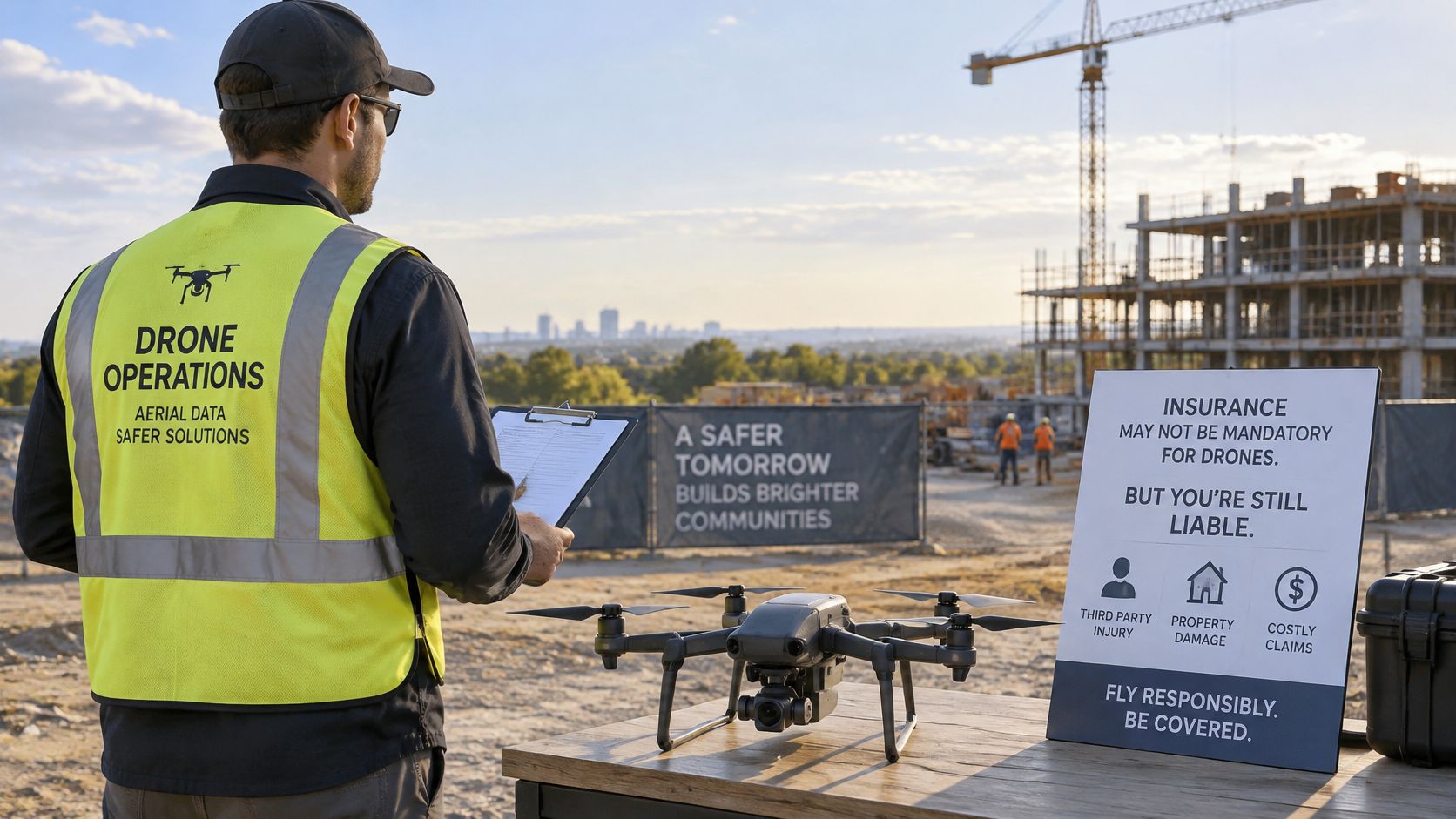
Builders, developers, surveyors and trades run the uses that make this concrete: roof inspection, progress photography, mapping, thermal imaging. Each one puts an aircraft above somebody else's property on a timetable set by a construction program, and each creates a plausible path from a minor technical failure to a third-party demand.
A policy limit is a ceiling, not a guarantee. What sits under the ceiling is a set of conditions about how, where and by whom the aircraft was flown.
Money limits only work alongside conditions. A limit is what the insurer pays once the flight has been shown to match what was declared, which means written site permissions, authorised pilots, documented pre-flight checks and maintenance records kept with the job. Landowners and public land managers routinely ask for a certificate of currency before granting access, and that request is a commercial condition rather than a legal one.
Which Third Party Risks Liability Cover Addresses
Match the exposure to the policy before you compare price. The table below is the working map, and most disputes about drone liability insurance come from reading one row and assuming it covers another.
| Exposure | Cover that usually responds | What it is aimed at | What it usually does not pay |
|---|---|---|---|
| Injury to a bystander or other third party | Drone or aviation third-party liability | Legal liability for injury, illness or death | The operator's own injury or workers compensation |
| Damage to a vehicle, façade, plant or other third-party property | Drone or aviation third-party liability | Physical loss or damage to someone else's property | Repair of the insured's own drone |
| The drone itself is damaged or lost | Aircraft hull | Repair or agreed value of the scheduled RPAS | Third-party injury or property claims |
| Inaccurate imagery, a missed defect or bad site advice | Professional indemnity | Negligent professional service and related defence costs | A pure crash injury unless the wording also includes it |
| Indemnity promised to a builder, principal or venue | Contractual liability, only if accepted by the insurer | Indemnities the insurer has agreed to | Broad hold-harmless wording that was never disclosed |
| Privacy or misuse of footage | Often a separate extension, not standard liability | Allegations tied to collected imagery, if endorsed | Defamation or misleading advertising unless an advertising extension applies |
The two rows that carry most site claims
The first two rows are the same cover doing two jobs. Drone or aviation third-party liability responds to the legal liability an operator carries for injury, illness, death or damage to somebody else's property, and it is the row that matters when a passerby is struck or a ute is dented. Note what it leaves alone: your own injury, and your employee's injury, which belongs to workers compensation rather than to an aviation policy.
The third row is where operators over-insure the wrong thing. Hull cover protects the scheduled aircraft, which is useful when a payload-heavy airframe goes into a wall, but it does nothing for the person the aircraft landed near. A cheap hull-only arrangement leaves the expensive risk open.
Where general liability stops and other covers begin
A business or public-liability policy can contain an aviation exclusion, so a construction package shouldn't be assumed to pick up RPAS flights just because it protects everything else on site. CASA's guidance on hiring a drone operator confirms that public liability isn't generally mandated for ordinary RPAS operations, that existing property rights and liability for damage caused directly or indirectly by a flight are preserved, and that operators should discuss suitable third-party cover with an insurer.
CASA's 30-metre separation rule and its requirement to prevent injury or property damage after a foreseeable system failure give you a way to test residual risk rather than guess at it. The same guidance warns that flying without required registration, licensing or approvals may void insurance, which makes compliance paperwork a claims-control tool rather than an administrative habit.
Professional indemnity is a separate purchase again, and it answers a different question: whether the advice or the deliverable was negligent. Where a project requires the two to sit side by side, it helps to understand how public liability insurance coverage interacts with an aviation wording before the first flight rather than after a demand letter. Privacy allegations are usually a further extension, and advertising-style exposures such as alleged defamation sit outside standard drone liability entirely.
Operational Factors That Shape the Policy
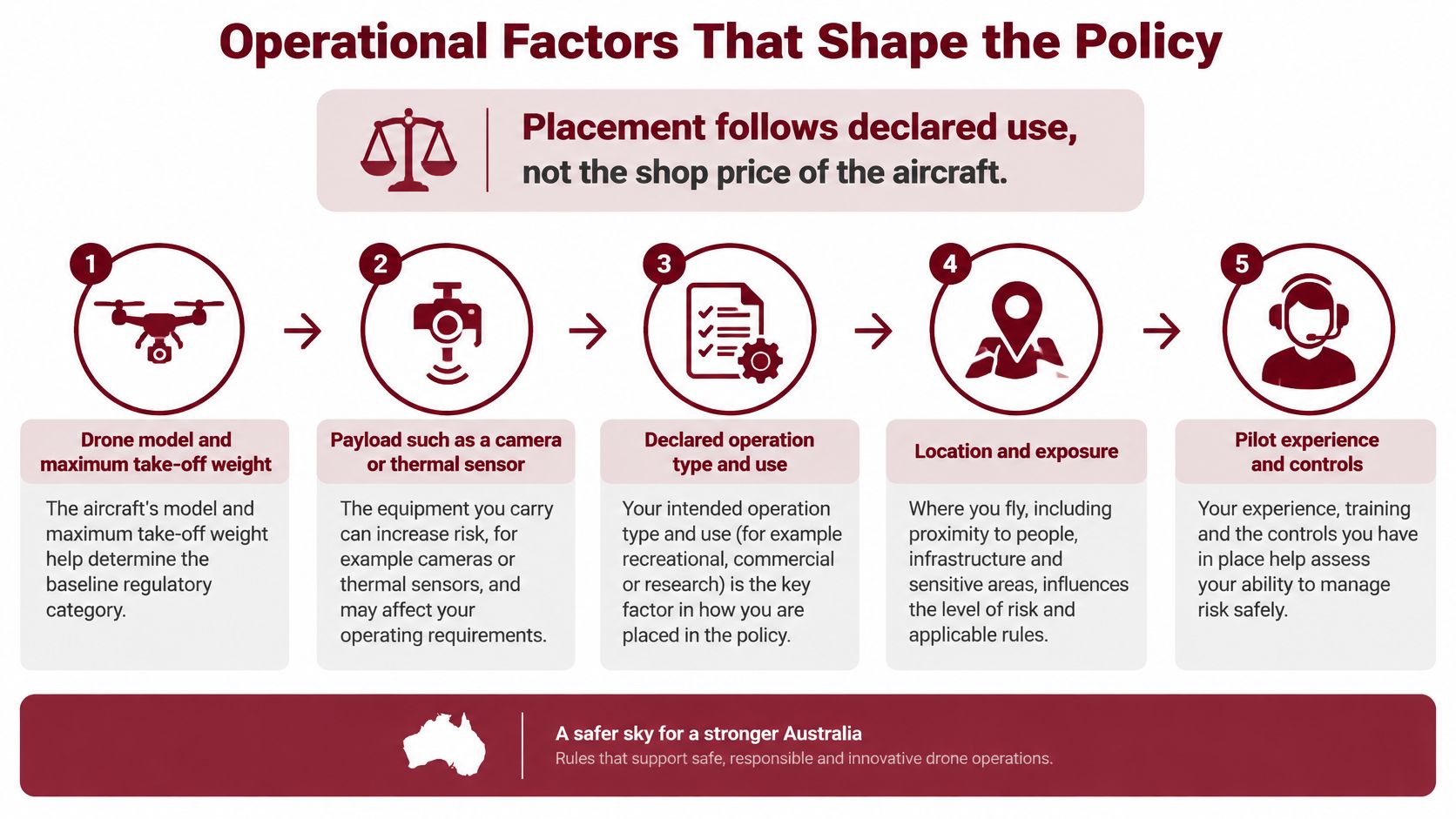
Underwriters price the operation, not the carton. The same aircraft flown over your own paddock on a Sunday and flown for weekly roof inspections above a row of terraces beside a main road are two different risks, and the schedule should read like the second one.
From a hobby flight to a site flight
A recreational flight over private land is the lightest case on the scale: short duration, clear line of sight, no commercial purpose and nobody below. Liability still exists the moment the aircraft crosses a fence line, but the exposure is thin.
Now swap the paddock for a suburban street. A builder running inspections on eight roofs in a day has people walking beneath the flight path, traffic on one side, power lines on the other, and a repetition that turns a one-off error into a pattern. A surveyor mapping an active site adds plant, workers in high-vis, exclusion zones and a client who will make decisions from the data. Each step up that ladder adds a factor an insurer wants declared, and the ones that matter most are:
- Aircraft and weight: the model and maximum take-off weight, because a heavier RPAS carries more energy into whatever it hits.
- Payload: a camera, a thermal sensor or a mapping unit, each named rather than assumed.
- Declared use: inspection, progress photography, mapping, marketing footage or something else again.
- Location and exposure: the actual sites, proximity to roads, populous areas, airports and critical infrastructure, plus the policy's territorial limits.
- Pilot and controls: qualifications, authorisation, whether a subcontractor flies, and how line of sight is maintained.
Separation distances from people and property, and the duty to avoid injury or damage after a foreseeable failure, are practical controls you can point to when an insurer asks how residual risk is managed. They're also the checks a site supervisor can see happening.
Why the commercial shift changes the paperwork
The exposure base is moving. CASA reported an 18% year-on-year increase in drone registrations between 2023-24 and 2024-25, alongside 28,545 commercially operated registered drones reported in 2025, with activity shifting beyond hobby use into mapping and infrastructure inspection, as set out in CASA's announcement on licensed drone pilots. More aircraft, flown for business rather than recreation, over assets that cost more to repair.
That makes an incomplete schedule the common failure. A policy written for aerial photography may not describe thermal imaging, and a wording built around a standalone drone job may not describe an aircraft flown as one step inside a broader construction service. Write every service on the schedule, including the ones you only occasionally sell.
Hired pilots and hired aircraft need naming too, which is where the next set of examples lands. An undeclared subcontractor is a different risk from the one the insurer priced, and different risks get treated differently at claim time.
Exclusions That Can Leave a Claim Unpaid
The distinction that decides claims: permission to fly and an insurer's agreement to pay are two separate permissions, granted by two different parties, on two different sets of conditions.
The most expensive false comfort in this market is the belief that a business policy covers the drone because it covers everything else the business does. Test that assumption against the conditions below, using the flights you already run rather than the flights you plan to run one day.
| Condition | Why a claim can fail | What to verify |
|---|---|---|
| Unlawful operation | Missing registration, licensing or a required approval may void cover | Aircraft registration, pilot authorisation and CASA approvals |
| Aviation exclusion | A business or public-liability policy may exclude aircraft | A written RPAS or unmanned-aircraft endorsement |
| Wrong aircraft or payload | The schedule may list a different model, weight or sensor | Model, maximum take-off weight and payload match the flight |
| Pilot or subcontractor not insured | A hired pilot may sit outside the named insured | Who is an insured person and whose policy is primary |
| Location or airspace limit | Cover may exclude airports, populous areas or undeclared sites | Territorial limits and each work site |
| Undeclared flight profile | Night, beyond visual line of sight or emergency flights may be outside the wording | Endorsements for the actual profile |
| Contract or privacy gap | A principal's indemnity or a footage allegation may be excluded | Contractual-liability and privacy extensions |
The three that catch construction businesses
Unlawful operation sits first because it's the least forgiving. A pilot who believed the flight was routine, on a site they'd flown a dozen times, can still find a gap in registration, licensing or an airspace approval that gives an insurer a basis to refuse. Compliance records are what close that gap.
The aviation exclusion is the quiet one. General liability and business packages are drafted around premises, products and operations on the ground, and an aircraft in flight doesn't always fit. Ask for the endorsement in writing, not for an assurance over the phone.
The subcontractor row is where builders lose the most sleep. A contractor arrives with a certificate of currency, flies the site, and damages something. Whether that contractor's policy responds first, and whether you're named as an interested party, decides who handles the claim.
Contractual liability deserves its own warning. A principal's subcontract might promise a broad indemnity for anything arising from drone work, and an insurer only backs indemnities it has agreed to in writing. If you want a wider view of how insurers approach injury claims in aviation generally, coverage for aviation injury claims sets out the shape of that market.
Policy terms, limits, excesses and exclusions always apply, and defence costs aren't automatic unless the wording says they are. Test each habit you already have, including changing work sites and night flights, against the schedule before a loss forces the question.
How Claims Play Out on Real Jobs
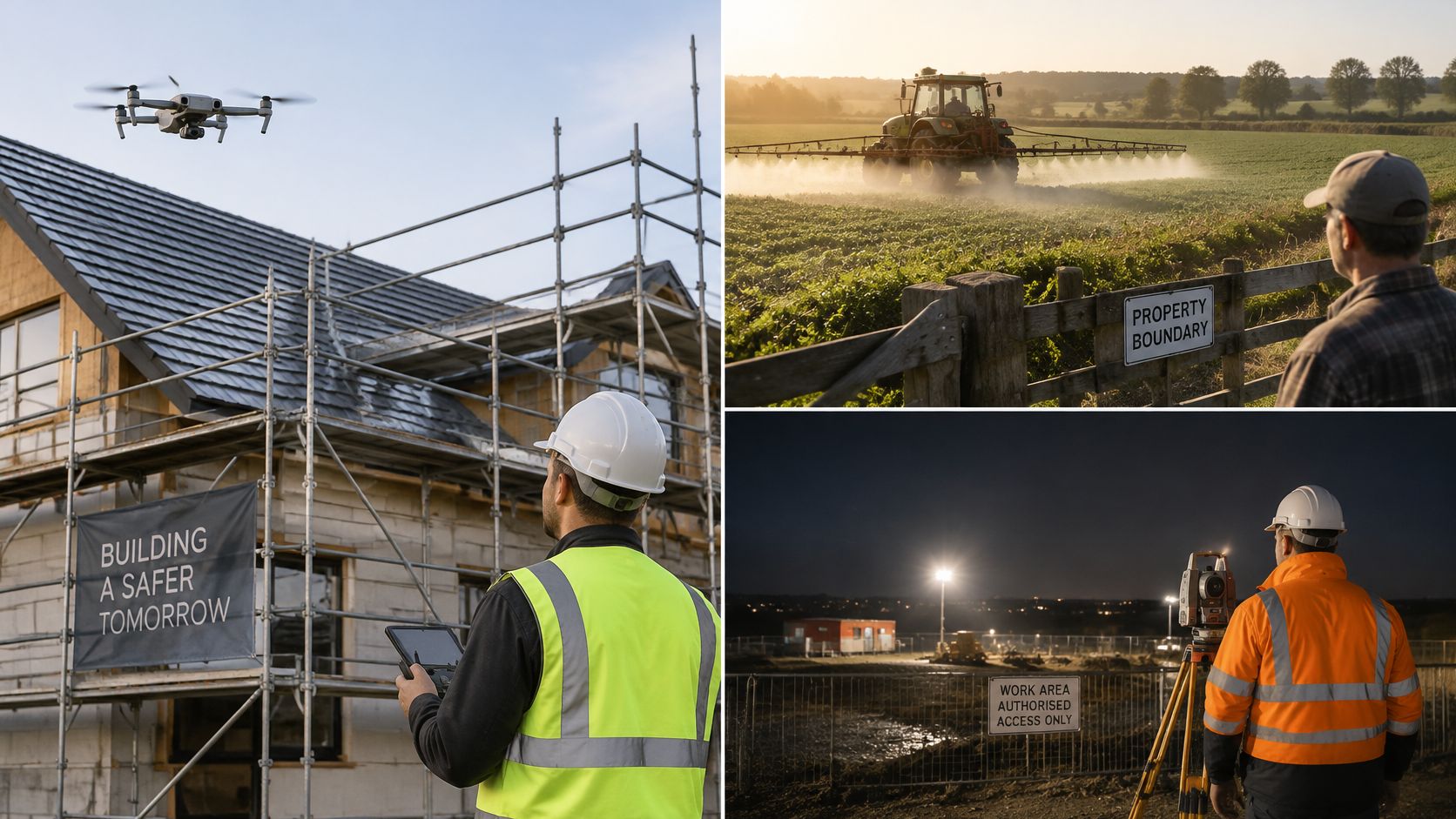
Three jobs, three different policies, and none of them begins with a dramatic crash.
A roof inspection on an active site
Say a builder runs weekly roof inspections over a townhouse project. The aircraft clips scaffolding on a gust, drops onto the footpath, injures a passerby and dents a parked ute. Third-party liability is the part of the policy that answers both the injury and the vehicle damage. Hull cover deals with the aircraft, which is the smallest number in the story.
One detail catches people out here. If the person injured was an employee of the builder, the claim moves into workers compensation, a different regime altogether, and the liability policy steps back.
The map that misses a defect
A surveyor produces an elevation map for a developer, and a structural defect goes undetected because the imagery was misread. Nobody is hit. Nothing is physically damaged. The loss is professional and contractual: a decision made on bad data, a variation, a delay, a remediation bill.
Aviation liability alone may not respond to that at all, because the failure sits in the service, not the flight. The drone did its job. The advice built on its output did not, and that distinction is where construction operators get surprised. A claim like this one argues about professional duty, not airframes, so it needs cover written for the deliverable rather than the aircraft that gathered the data.
The builder who hires a drone contractor
A head contractor engages a specialist to capture progress photography twice a month. Before the first flight, four questions matter more than the certificate itself. Who is insured under the contractor's policy? Does that policy respond first if something goes wrong? Is the builder noted as an interested party? And what exactly does the subcontract indemnity promise, in words an insurer has already accepted?
Allocation rule: the party whose policy responds first is decided long before the incident, usually in a subcontract clause nobody read.
The reason these questions matter is scale. A failed flight over an active site can reach workers, pedestrians, neighbouring property, parked vehicles and the principal's assets in a single event, and every one of those parties looks to someone else's policy first. The aircraft is the cheapest item in the loss. The paperwork decides who pays for everything else.
That is why the close on any drone placement is a matching exercise. Commercial use, subcontractor operations, hired equipment, data and privacy exposures and contractual indemnities all need to line up, and the drone, operator, purpose and flight conditions should be specifically accepted rather than assumed. A fully compliant CASA operation can still produce an uninsured claim if the policy never agreed to that job in the first place.
Lawful Flights Are Not Always Insured Flights
A flight can satisfy every CASA requirement and still breach a policy condition, and that gap is where most Australian drone insurance content stops early. Three permissions have to line up before a claim will respond, and each one is granted by a different party.
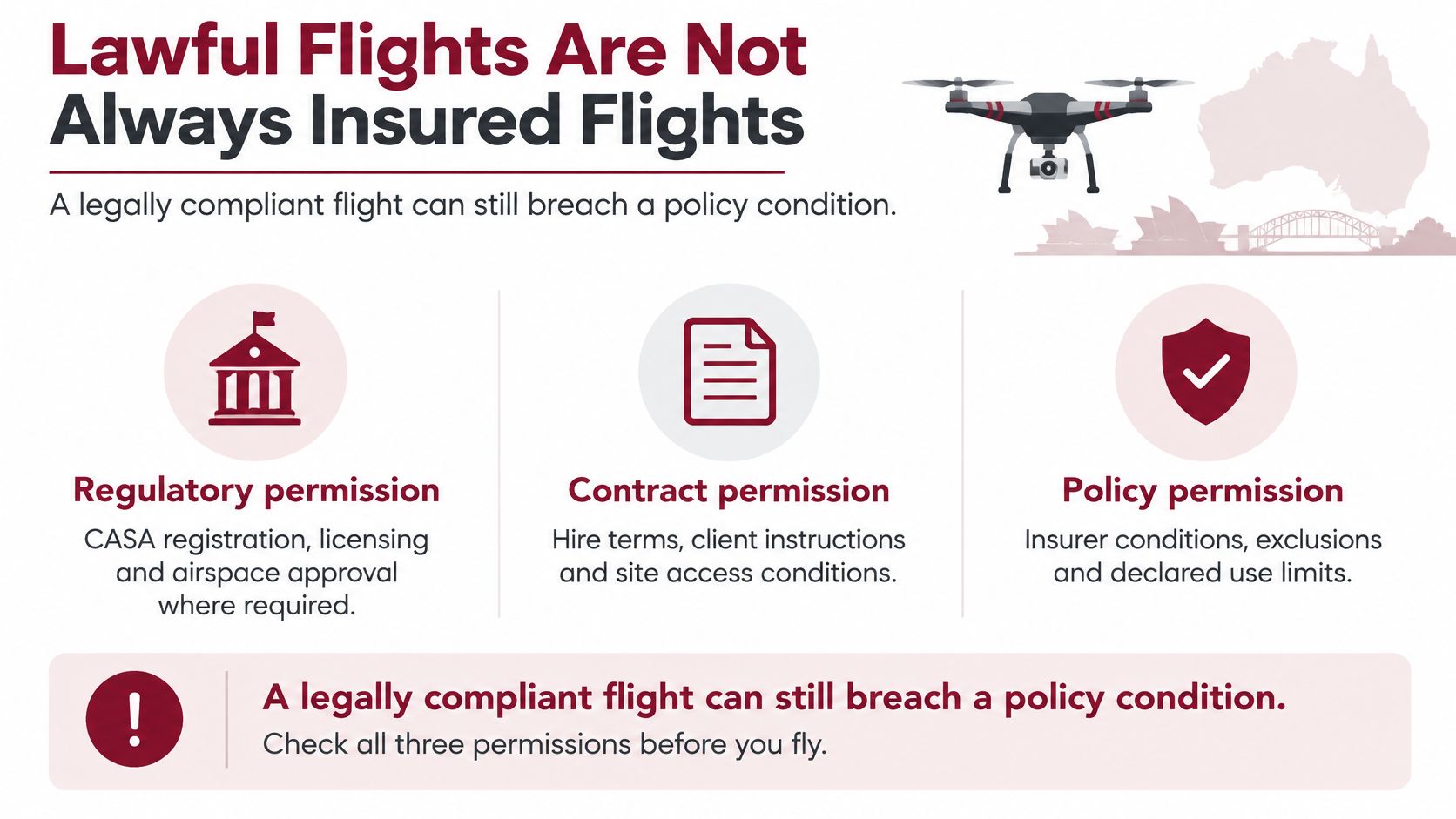
Regulatory permission is registration, licensing and any airspace or operational approval the rules require. It works like a driver's licence: it proves you may operate, while cover for a particular trip is a separate question. Contract permission is the client, landowner or public land manager allowing the flight, usually with a certificate of currency and an indemnity attached. Policy permission is the insurer accepting that aircraft, that pilot, that purpose, that place and that flight profile.
An operator can hold the first two and still fail the third. CASA records very few serious uncrewed-aviation incidents, which reads as reassuring until you see where the losses sit. Ordinary commercial inspection and photography work is now the main exposure, and the expensive claim on a construction job is more often bad imagery, a defect the flight was meant to catch, or a subcontract indemnity than a crashed airframe.
The paperwork below is what closes the gap, and it belongs in the job file rather than a drawer at the office.
- Pilot credentials and authorisation for the aircraft and the operation.
- Aircraft registration matching the airframe that flew.
- Flight approvals required for the airspace on the day.
- A written risk assessment for the specific site.
- Site and landowner permissions in writing, dated.
- The subcontractor's certificate of currency, with your interest noted.
- Incident records, including near misses, kept consistently.
- Pre-flight check records signed by the pilot.
- Maintenance notes for the aircraft and payload.
- Visual-line-of-sight procedure notes for the crew on site.
Each item answers the same question an assessor will ask: did the flight that flew match the flight the policy describes? When a person, a vehicle or a façade is damaged later, that match is what keeps the claim alive. A low incident count changes none of this, because the failures that matter (subcontracting, night work, emergency flights and shifting sites) sit in the policy wording rather than the sky.
What to Do After a Drone Incident
The first hour protects the cover as much as it protects anyone on site. Work through this sequence in order.
- Make the scene safe. Secure the area, check for injured people, and call emergency services where anyone is hurt.
- Stop flying and preserve the aircraft, battery and controller as found, without cleaning or restarting anything.
- Notify your insurer and broker promptly, using the notice clause and giving the policy number, date, time and location.
- Preserve the evidence: flight logs, telemetry, controller data, photos and video, the pre-flight checklist and the site permission record.
- Record the witnesses: names and contact details of affected people and property owners, plus the pilot's credentials and the aircraft registration.
- Report the occurrence to CASA and, where it is a notifiable occurrence, to the ATSB.
- Admit nothing. Don't promise payment or settle with a third party without the insurer's consent.
- Ask your broker whether defence costs, the subcontractor's policy and any contractual notice duties to the principal apply before you respond to a demand.
A prompt, documented response protects both the cover and the claim. For a closer look at how the claim process runs once it's notified, this guide to an aviation insurance claim after an aircraft incident walks through the sequence from notification to assessment.
Questions to Take to an Aviation Broker
Treat the broker conversation as a pre-flight briefing rather than a shopping trip. Nine questions cover most of the ground.
- Is RPAS liability written into this policy, or is aviation excluded and handled elsewhere?
- Are third-party injury and property damage both included, and is hull cover a separate decision?
- Which pilots, subcontractors and hired aircraft are insured, and whose policy responds first?
- Are roof inspection, progress photography, mapping and thermal imaging each scheduled, or only some of them?
- Do the territorial limits and site conditions allow this job, including roads, populous areas and airports?
- Are night, visual line of sight and any beyond-visual operations accepted by the wording?
- Is contractual liability wide enough for the principal's indemnity, and is privacy or imagery covered?
- What evidence must be kept so that a lawful flight is also an insured flight?
- Does the certificate match what the contract requires? A building contract, financier or state requirement can demand specific insurance, so the wording has to line up.
A broker who places both aviation and construction lines can run those questions against a public liability insurance broker placement and a subcontract in the same conversation, which is where most of the confusion lies. ABS Insurance Brokers places aviation insurance, including aircraft hull and liability, alongside construction, contract works and public liability cover, and can review your aircraft, payloads, operating locations and liability limits when arranging RPA cover. A free insurance quote can be requested once the scope of the work is clear.
ABS Insurance Brokers Pty Ltd works with builders, contractors, developers and trades businesses across Australia, placing aircraft hull and liability cover alongside the construction and public liability policies already protecting a project. We can review your drone activity against the way the aircraft is used on site, from roof inspections and progress photography through to mapping, thermal imaging and subcontracted flights, so the schedule reflects the work rather than a generic description. Visit ABS Insurance Brokers Pty Ltd to start that review and request a free insurance quote.