

You are on a bare lot, or halfway through a 2027 extension, with an owner-builder permit in one folder and a stack of trade quotes in the other. The lender wants proof of insurance before it releases the first draw. A neighbour has already asked who pays if a truck cracks the driveway. Someone told you to "just get owner builder insurance", as if one policy closed the file.
It doesn't. The work you do yourself, the licensed trades you hire, the materials on the slab, and the person who buys the house later all sit under different rules. A certificate that looks complete can still leave your own labour, a flood, or a later buyer outside the cover.
This is a practical map for a first-time owner builder. It matches each risk to the policy that responds at that stage, and it is blunt about the gaps that remain even when a New South Wales project is fully compliant.
Table of Contents
- What Owner Builder Insurance Covers
- Which Policy Responds at Each Project Stage
- NSW Rules, the $20,000 Threshold and Other States
- Exclusions and Flood Gaps That Leave Owners Exposed
- What Drives Owner Builder Insurance Costs
- Documents to Confirm Before Work or Payment Starts
- How to Get Cover Through a Broker, Step by Step
- Frequently Asked Questions
What Owner Builder Insurance Covers
The first schedule that comes back for an owner-builder project usually names the frame, the bricks and the materials on site. Read it for what it omits: the visitor who trips on reinforcement mesh, the carpenter's contract, and the buyer who finds a leak three years after settlement.
The covers on a project work like watertight compartments on a ship. Each one holds a different kind of loss. Seal five of them and a hole in the sixth still lets water in.
Owner builder insurance is the set of covers and statutory protections that apply when you manage or perform residential building work instead of handing the whole job to a head contractor. Owner-builder status moves each risk to a different party; the risk itself stays on the project.
No single policy holds all of it. The schedule described above is typically contract works cover alone. The visitor's injury falls to public liability, the carpenter's defective work falls to statutory cover where it applies, and the buyer's leak falls to whatever post-sale protection your state provides.
Owner builder insurance is a set of covers, each triggered by a different event.
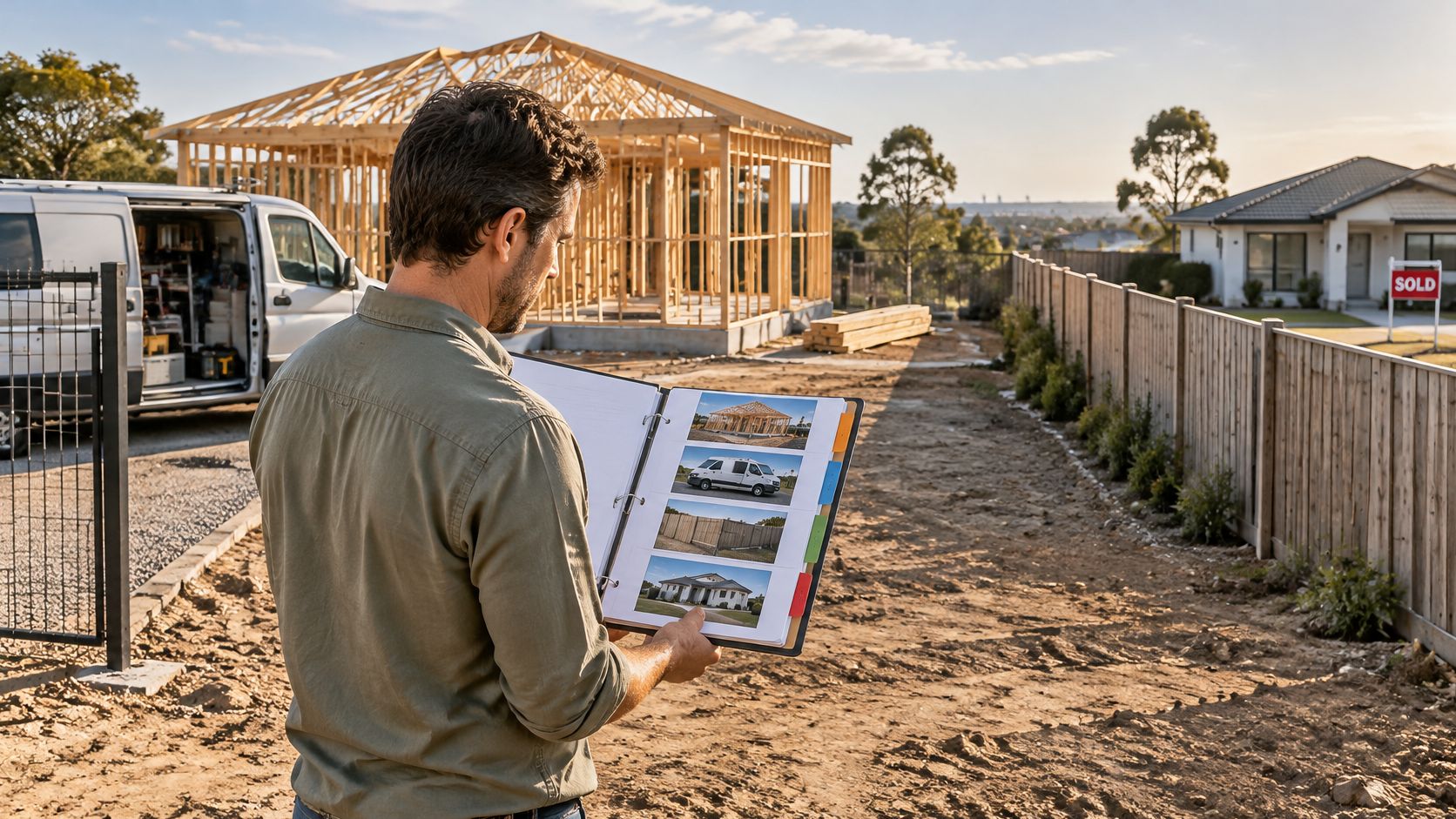
The layers used here are:
- Contractor statutory cover: Home Building Compensation held by the licensed contractor for eligible contracted work.
- Contract works insurance: accidental damage, theft, storm and flood affecting the works and materials.
- Public liability: injury or property damage to neighbours and visitors.
- Post-sale protection: whatever statutory cover a later buyer has, plus ordinary home cover once the dwelling is finished.
Which Policy Responds at Each Project Stage
Read the table as a gap-finder. Any risk with no named responding policy is an exposure you fix before that stage starts.
| Risk during build or after | Policy that responds | Who usually holds it | Check before you bind |
|---|---|---|---|
| Contracted residential work above the NSW statutory threshold | Home Building Compensation (HBCF) cover | Licensed contractor engaged by the owner | Certificate needed before work or any deposit |
| Owner's own labour (NSW) | Not HBCF-covered under an owner-builder permit | Owner builder | Possible uninsured defects after sale |
| Accidental damage, theft, storm or flood to works and materials | Contract works (construction) insurance | Owner builder, often with contractors | Flood and stored-materials wording |
| Injury or property damage to third parties | Public liability | Owner and each contractor | Limit amount and whether it applies on site |
| Defects found after sale | Post-sale statutory protection (state rules differ) | The contractor's statutory policy, where the state provides one | Time limits and caps |
| Finished dwelling | Home and property insurance | Owner | Replacement cost, not purchase price |
Walk the rows in build order. Each one has a trigger and one check.
Contracted work first. The NSW Government owner-builder guidance requires a licensed contractor engaged directly by an owner builder to hold HBCF cover when the contract price exceeds AUD 20,000, including GST and materials the contractor supplies, and the scheme has issued no compulsory cover for work an owner builder performs under a permit since 15 January 2015. Trigger: you engage that contractor. Check: the certificate is in your hand before work begins or any payment moves, including a deposit. An owner builder's own work isn't required to be insured under the scheme when the property is later sold, which is the gap the next row covers.
Your own labour is the empty row. Trigger: you frame, waterproof or finish it yourself. Check: you accept that a later purchaser can face an uninsured exposure on defects in that personal work, even when separately contracted work above the threshold has HBCF protection. A project can be fully compliant on paper and still carry this hole.
Contract works is the property policy for the build itself. Trigger: storm, flood, theft or accidental damage hits the structure, temporary works or materials. Check the flood wording and whether stored materials sit inside the sum insured; treat flood as unproven until the wording shows it in the schedule. A plain guide to what contract works insurance covers for residential builders is the right place to test those words before you bind.
Public liability answers a different event: someone is injured, or a neighbour's property is damaged. Trigger: a third-party claim. Check the limit and that the policy applies on this site, not only at the contractor's yard. Your policy and each contractor's policy are not substitutes for each other.
After a sale, statutory protection responds only where that state's rules say it does, and only inside the stated time limits and caps. Trigger: a defect found by a buyer. Check those limits before you assume the buyer is protected. On the owner builder's personal work in NSW, there may be no statutory policy behind them at all.
The finished house moves to home and property insurance. Trigger: the construction period ends. Check that the sum insured is a rebuild cost, not what you paid for the land and the build.
Practical rule: If a row has no policy name you can point to, that stage is uninsured until you place one.
A two-storey extension with a builder, a plumber and an electrician typically runs four covers at once: the builder's HBCF certificate, contract works over the site and stored materials, public liability for the owner and each trade, then home cover once construction ends. Count the policies on your own project the same way. If the number is one, the schedule is missing rows, and your own labour is one of them.
NSW Rules, the $20,000 Threshold and Other States
A compliant owner-builder project can still leave a gap when the rules change at the point of sale. Check the requirements in the state where the property is located, and keep contractor cover separate from any protection a later buyer may have.
The NSW test
For licensed builders and tradespeople, NSW Home Building Compensation Fund (HBCF) cover applies to each residential home-building project valued above $20,000 including GST. The NSW insurance-cover guidance explains how the requirement applies to licensed contractors. For a fuller explanation of who needs HBCF insurance in NSW, check the rules before engaging trades.
Before signing a contract or paying a deposit:
- Confirm the owner-builder permit is current and matches the site.
- List each contractor, licence class and contract price, including GST.
- Flag contracts above AUD 20,000 and ask for the HBCF certificate before paying a deposit.
- Check each contractor's licence through official NSW channels.
- If work is divided among smaller contracts, ask SIRA or NSW Fair Trading how the threshold applies to the project.
Council approval is a separate requirement. For a Melbourne project, check when Melbourne renovations need council approval before setting the work schedule.
Where other states part company
State rules for protection after a sale are not interchangeable. Victoria's owner-builder guidance describes domestic building insurance of up to $300,000 for eligible work, covering structural defects for six years and non-structural defects for two years. The policy responds in specified circumstances, including when the builder has died, become insolvent or disappeared.
For Victorian work above $16,000, the builder must provide the policy and certificate of currency before taking a deposit or other payment.
In Western Australia, the Department of Energy, Mines, Industry Regulation and Safety's home indemnity insurance guidance sets out the requirements, including the rule for an owner-builder who sells within seven years of the building permit.
| State | Post-sale trigger | Protection described | Key note |
|---|---|---|---|
| New South Wales | Sale of a property with owner-builder work | HBCF applies to eligible contractor work above AUD 20,000 | Check the sale requirements with the NSW regulator |
| Victoria | Relevant completion or sale circumstances | Up to $300,000 for structural defects (six years) and non-structural defects (two years) | For work above $16,000, provide the policy and certificate before taking payment |
| Western Australia | Sale within seven years of the building permit | Home indemnity insurance | Check the WA regulator's current requirements before sale |
| Queensland | Before selling or settling | Confirm the applicable protection with the regulator | Check QBCC requirements before contracting |
| South Australia | Before selling or settling | Confirm the applicable protection with the regulator | Check the state building regulator's requirements before signing |
| Tasmania | Before selling or settling | Confirm the applicable protection with the regulator | Check the Tasmanian regulator's requirements before signing |
| Australian Capital Territory | Before selling or settling | Confirm the applicable protection with the regulator | Check ACT planning and building requirements before signing |
| Northern Territory | Before selling or settling | Confirm the applicable protection with the regulator | Check the NT regulator's requirements before signing |
Use the row for your state as a prompt to check the current sale rules with its regulator. The Victorian limits and conditions apply to Victoria; they do not set the rules for another state.
Exclusions and Flood Gaps That Leave Owners Exposed
A storm shuts the site for three weeks, ruins the stored timber, and washes out the access track, and the policy in the folder refuses every part of the claim. Whether it pays comes down to the wording on the schedule.
APRA's climate vulnerability assessment projects Australia's insurance protection gap reaching 25–26% of existing houses under climate scenarios, and as high as 28–29% depending on where new homes are built, while recording home insurance premiums rising an average 7.2% a year from 2010 to 2025 against 3.1% annual wage growth and severe-to-extreme flood exposure across roughly 242,000 dwellings, about 77% of them without flood cover.
Those national figures land on a single site decision: is this address covered for water, and is the sum insured still enough after material and labour inflation?

Seven wording tests
Put the schedule next to this list and ask the broker each question in plain words.
- Flood excluded or sublimited. Ask whether flood is covered at this address, or only storm, and what the sublimit is in dollars.
- Storm on stored materials and temporary works. Ask whether timber in the garage, scaffold, and formwork sit inside the sum insured.
- Theft from an unsecured site. Ask what fencing, lighting, or lock-up the policy requires before theft is payable.
- Defective workmanship. Ask whether the policy pays to redo bad work, or only the resulting damage to other property. Most contract-works wordings refuse the defective item itself.
- Delay and lost rent. Ask whether a stopped programme, holding costs, or rent you cannot collect is covered at all.
- Sums insured behind inflation. Ask for an escalation clause, and whether the limit still matches a rebuild if steel and labour jump mid-job.
- Excesses that rise with the site. Ask the dollar excess for storm and flood at this flood zone, not the cheap excess on the quote summary.
I would rather pay a higher premium for flood cover that pays on a flood claim than hold a cheap certificate that excludes the hazard on the flood map.
Three exposures survive even a fully compliant NSW file. The first is your own labour: a contract-works policy pays for damaged materials and contracted work, and the weekends you spend rebuilding carry no insurable value. The second is the buyer after sale: statutory cover protects the purchaser against defects, a separate policy responding to a different person's loss, and it does not reimburse you. The third is flood: contract works, public liability and statutory cover can all be in force while the flood exclusion at your address stays untouched.
The test to write at the top of the schedule stays the same. Could this policy pay on a flood, a storm, a theft, or a construction delay, and is the sum insured enough after inflation? Document the replacement cost, then review the wording before each major stage, not just on the day you bind.
What Drives Owner Builder Insurance Costs
There isn't a single price for owner builder insurance. The premium is built from the risks that policy has to carry, so the inputs you give the broker move the number more than the brand on the letterhead.
| Cost factor | How it moves the premium | What to give the broker |
|---|---|---|
| Sum insured (rebuild or contract value) | Higher value, higher premium | Replacement-cost estimate, not purchase price |
| Site location and flood zone | Flood-prone sites can attract higher premiums, sublimits or exclusions | Site address, flood map and council records |
| Build duration | Longer programme means more months of exposure | Stage-by-stage programme with dates |
| Stored materials and temporary works | More value on site raises the sum insured needed | Materials register and delivery schedule |
| Number of contractors | More trades mean more certificates and more liability exposure | Contractor list with licence numbers and contract prices |
| Excess (deductible) | Higher excess lowers premium but raises out-of-pocket cost in a claim | The excess level you can comfortably pay |
| Claims history | Prior losses can increase pricing or narrow options | Five-year loss history for owner and contractors |
How to compare without fooling yourself
Quote every option on the same sum insured and the same excess. A cheaper premium that excludes flood, caps theft, or carries a larger excess isn't a saving. It is a different product.
Ask each contractor whether the HBCF premium sits inside the contract price. That statutory cost is built into the job. It isn't a policy the owner buys on the side, and it doesn't replace contract works or liability.
A sum insured below replacement cost is a common reason a claim pays less than the loss. Insurers can reduce the payout in proportion to the underinsurance. A high excess can also wipe out the premium you thought you saved. If you can't write the excess cheque on a bad Friday, the lower quote isn't affordable.
Budget three lines, not one: the premium, the excess you might pay, and the cost of a stage that stops while an assessor attends. The quote page only shows the first.
Documents to Confirm Before Work or Payment Starts
Hold this set before anyone starts, and before you pay a deposit. The broker's second step draws on it, and the third step is just sending it.
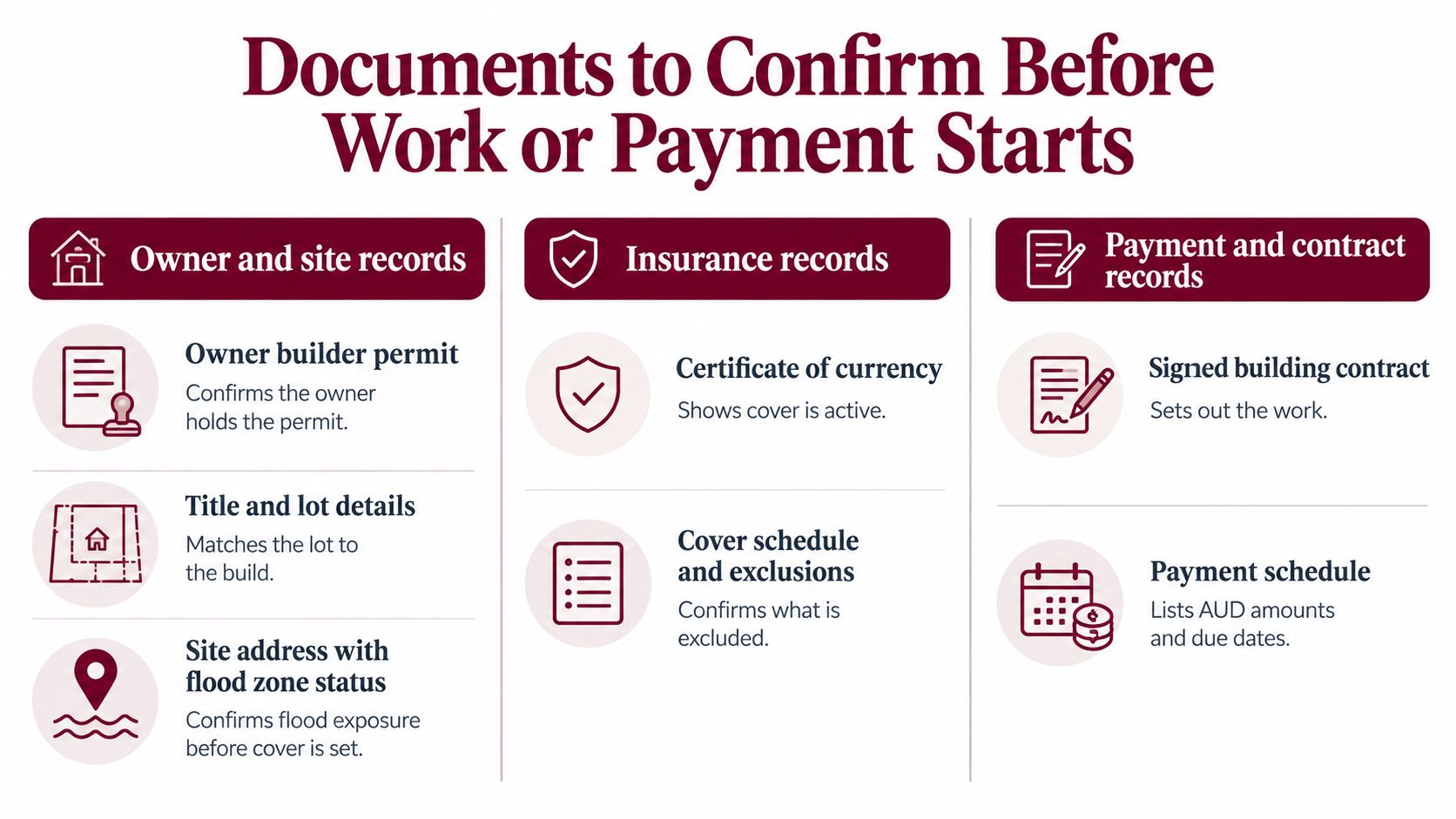
Owner and site records
- Owner-builder permit: the current permit, matching this lot, not a draft application.
- Title and lot details: so the policy address and the land title describe the same place.
- Flood and council records: the site address plus any flood notation you already have from council.
- Dated baseline photos: the site and neighbouring boundaries, taken before the first machine arrives, so later damage has a start point.
Contractor records
- Licence number and class: for every trade, checked against the official register.
- HBCF certificate: for each NSW contract above AUD 20,000 including GST, dated before work starts.
- Public liability certificate of currency: for each contractor, with the site and the dates visible.
- Written contract: price including GST, scope, and who supplies materials.
- Workers compensation: separate from liability. A trade with employees should be able to show it, and a plain explainer of workers compensation insurance in Australia helps you see why that certificate isn't optional paperwork.
Insurance records
- Quote and policy schedule: for each cover, with exclusions marked.
- Replacement-cost estimate: for the finished dwelling, not the purchase price.
- Materials register and temporary works list: so the sum insured isn't a guess.
- Build programme: stage dates, because the policy period has to cover them.
- Sale intention: a note on whether you expect to sell inside the state's post-sale window, because that timing changes what a buyer can claim.
Keep policy numbers, insurer names, and the broker's contact in one folder, paper or digital. The list of what brokers need before they can price construction cover is the practical packing list if a quote comes back with blanks.
Send this set to your broker by phone or email before the first deposit is paid. A quote built on a missing flood map or a missing contract price is a quote you can't trust.
How to Get Cover Through a Broker, Step by Step
Do the work in this order. Binding cover on the morning the excavator arrives is how exclusions get missed.
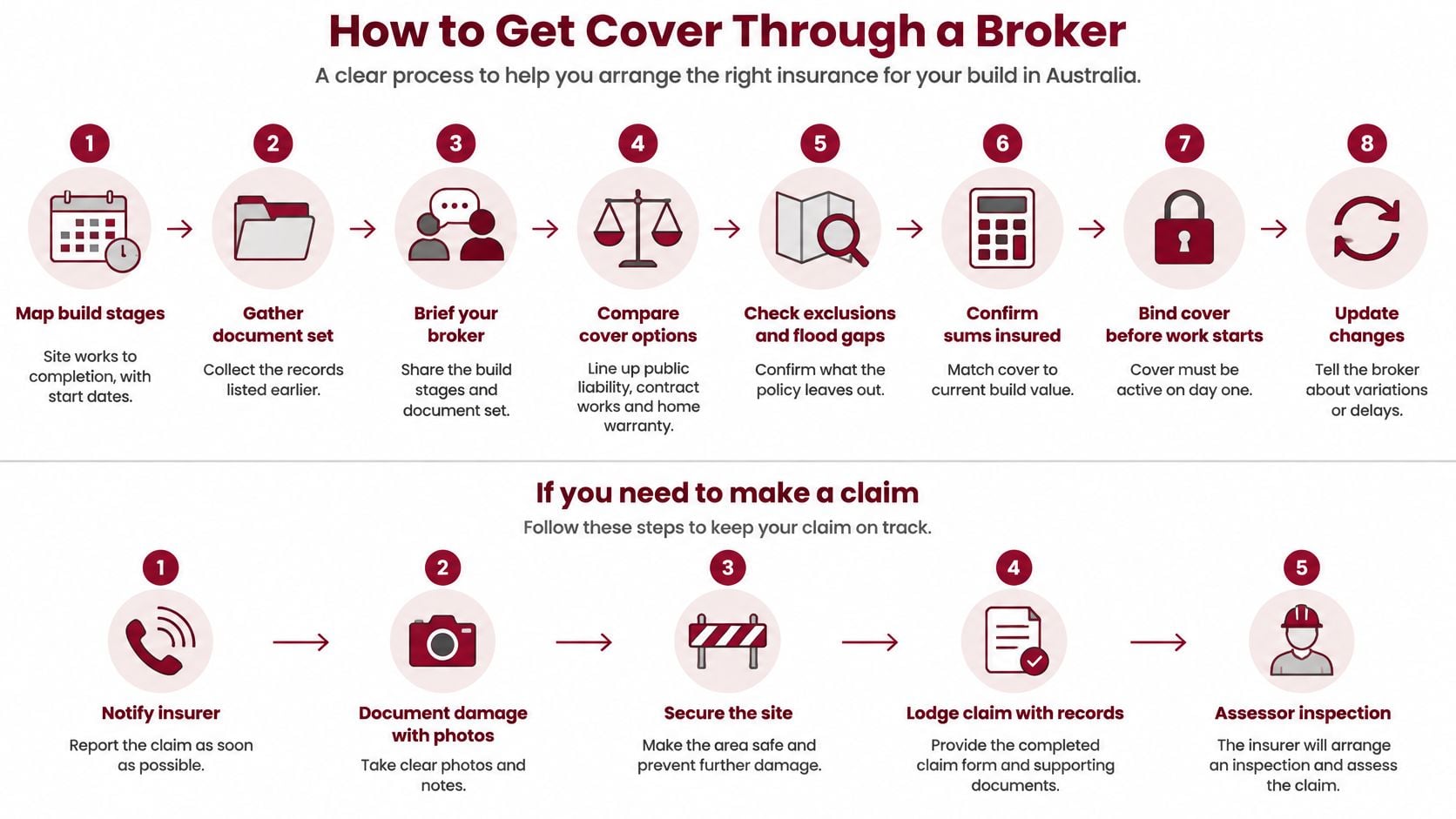
- Map the stages and start dates, from site works to completion. If you are renovating in Highett, read permit guidance for Highett homeowners first, because a permit date often becomes day one of the risk.
- Gather the document set from the checklist: permit, contracts, flood notes, programme, and replacement cost.
- Brief the broker with the site address, flood status, whether you plan to sell, and the contractor list with prices.
- Let the broker source quotes across contract works, public liability, and owner builder cover, alongside the contractor's own HBCF where the threshold applies. ABS Insurance Brokers is one brokerage that places those lines for owner builders. Compare at least the options they put in front of you. Don't stop at the first premium.
- Compare on exclusions, excess, and sublimits, not on the premium alone. Line the flood, theft, and materials clauses up on one page.
- Bind so the start date matches the first day of work or the first deposit, whichever comes sooner. A policy that starts next Monday doesn't cover Saturday's delivery.
- Check each contractor's certificate before any payment. No certificate, no deposit.
- Review at each turn: materials arriving, a budget increase, a longer programme, or a decision to sell. Tell the broker before the change, not after a loss.
If you have to claim
Notify the insurer promptly. Photograph the damage with dates. Keep receipts, delivery dockets, and variation orders. Make the site safe so the loss doesn't grow. Your broker can handle the paperwork and the timeframes with the insurer. You still own the facts: what failed, when, and what it will cost to put right.
Contractor failure is a real mid-build event, not a rare story. In 2024, 3,217 Australian construction companies entered external administration, compared with 2,546 in the preceding 12 months, according to figures released by the Australian Securities and Investments Commission and reported by realestate.com.au. If a trade stops, your contract-works position and that contractor's HBCF certificate are the two documents you pull first, then you call the broker the same day.
Frequently Asked Questions
Does owner builder insurance cover my own labour?
No. HBCF doesn't cover work you perform under an owner-builder permit. Treat defects in that work as your exposure, including after a sale, and keep enough records to separate owner labour from contractor-certified work if a buyer later questions the whole job.
Do I need HBCF for a small contract?
In NSW, the licensed contractor needs it when the residential project is above AUD 20,000 including GST. Confirm the GST-inclusive total, and whether packages are aggregated, before work starts.
What if a contractor enters administration mid-build?
Pull the contract-works schedule and the HBCF certificate, make the site safe, and notify the broker and the insurer promptly. Don't pay further claims on that contract until you know who is now responsible for the work.
Is one policy enough?
No. On a knockdown-rebuild, stored materials and site damage sit with contract works, an injury to a visitor sits with public liability, a licensed contractor's residential work may need HBCF above the threshold, and the finished house moves to home cover. A compliant file can still leave your own labour and flood outside the response.
Will 2027 rules differ?
Treat the threshold as a signing check, not a fixed number. Confirm the current NSW trigger with SIRA, or the relevant state regulator, before contracts are signed, and recheck before the next stage payment if the programme crosses a year boundary.
Can a policy cover flood?
Only if flood isn't excluded or sublimited for that site address. Ask the broker to show you the flood clause, the excess, and the sublimit in the wording, not on a one-page certificate.
Take the document set from the checklist to a broker before you pay anyone. The gaps are cheapest to close while the site is still empty.
ABS Insurance Brokers Pty Ltd places owner builder insurance alongside contract works, public liability, and Home Building Compensation for residential projects, and can walk a first-time owner builder from quotation through to a claim. If you are planning NSW work for 2027, take your permit, contractor list, and flood details to a broker before the first deposit. Visit ABS Insurance Brokers Pty Ltd to start that conversation.