

Insurance in Construction: A Complete Australian Guide
Insurance in construction addresses different exposures through project, liability and other business policies. Understanding which party holds each responsibility helps you check the contract and respond when a loss occurs. Explore ABS’s construction insurance service and the contract works cover overview alongside this guide.
Table of Contents
- Insurance in construction: identify the risks and responsibilities
- The Core Policies Every Construction Business Weighs Up
- Statutory Cover Through HBCF and State Warranty Schemes
- Cover Limits, Exclusions and Where Gaps Open
- How Contracts Shift Insurance Duties Between Parties
- Claims Handling From First Notice to Settlement
- How an Insurance Broker Adds Value Beyond Price
- Confirm Your Cover Checklist Before Work Starts
Insurance in construction: identify the risks and responsibilities
Think of a scaffold. One missing bracket doesn't stay a local problem, because load shifts to every other part of the frame. Insurance in construction works the same way, with owners, head contractors, subcontractors, and consultants each carrying part of the risk.

The scale explains why hand-offs matter. Construction accounted for 7.0% of gross domestic product and employed approximately 1,291,000 people in 2023-24, while construction services derived A$116.6 billion from subcontracting compared with A$71.4 billion from primary contracting, according to ABS analysis of the Australian construction industry. Risk passes like a relay baton, and a gap at any changeover reaches the whole job.
Four Exposures on One Project
- Physical damage: Fire, storm, theft, or accidental damage hits the works, materials, and temporary works.
- Injury and third-party damage: A worker, visitor, or neighbour is hurt, or nearby property is damaged.
- Defective work: Faulty work surfaces after handover and needs rectification.
- Failure to finish: A builder can't complete, leaving the owner to fund another contractor.
A standard business policy is written for a comparatively stable operation. A build changes weekly as materials arrive, trades rotate, excavations open, and completed sections sit beside exposed work. Good planning for managing construction project risks therefore starts before mobilisation, not after a loss.
For builders and trades, the payoff is knowing which policies respond to your activities. Developers need contract, delay, and handover alignment. Owner-builders need to separate project cover from statutory warranty obligations. Each reader should finish able to match activities to policies, identify required certificates, and run a pre-start check.
The Core Policies Every Construction Business Weighs Up
A building project can suffer damage, injure someone, or leave an owner with unfinished work. Those events follow different claim pathways, so start by asking what each policy pays for, who receives the payment, and what triggers cover.
| Policy | What It Covers | Who Typically Needs It | Key Question to Answer |
|---|---|---|---|
| Contract works insurance | Physical loss or damage to works, materials and temporary works, plus debris removal | Principals, developers and head contractors | Is the sum insured enough for full reinstatement and debris removal? |
| Public liability | Third-party injury or property damage caused by the work or site | Builders, trades, developers and owner-builders | Does the limit meet the highest amount required by a contract? |
| Professional indemnity | Claims alleging negligent design, advice or specification | Designers, engineers, consultants and design-and-construct builders | Does it cover design work, and what is the retroactive date? |
| Plant and machinery | Damage to, or theft of, owned or hired excavators, cranes and generators | Contractors using heavy or hired equipment | Are hired items and equipment at other sites covered? |
| Motor and fleet | Vehicle damage and third-party motor liability | Businesses operating vans, utes and trucks | Are tools and materials carried in vehicles covered? |
| Workers compensation | Employee injury costs, medical expenses and wage replacement | Employers, and principals potentially liable for subcontractor workers | Are subcontractor workers insured elsewhere? |
| Builders warranty (HBCF in NSW) | Rectification and completion for eligible residential work when the builder fails | Licensed residential builders, for owners' benefit | Has the certificate been issued before eligible work starts? |
| Delay cover | Lost income or extra finance costs when insured damage delays completion | Developers and commercial owners | Is the indemnity period linked to a documented programme? |
How the Main Policies Differ
Start with damage to the project itself. Contract works may respond when a storm damages a partly framed house or fire harms installed materials. The policy is generally arranged for the project, with responsibility for arranging it set by the contract. Set the sum insured to cover full reinstatement cost plus debris removal, because the cost of rebuilding after a loss may exceed the value of the original stage.
Public liability addresses a different loss: injury to another person or damage to someone else's property. A ladder that falls onto a passer-by or a temporary water line that floods a neighbour's property may lead to a liability claim. It generally does not pay to rebuild your own defective work. For a closer look at how contract works insurance differs from public liability, check which policy responds to the loss before signing a head contract.
A design error can follow the project beyond the site. Professional indemnity may respond to claims alleging negligent design, advice, certification or specification. A design-and-construct builder may need it even if most income comes from physical building work. Check whether subcontracted design is covered and whether the retroactive date includes the earlier work being claimed.
Other policies protect people and equipment needed to keep work going. Plant cover may respond to theft of a hired excavator; motor cover addresses vehicle risks; workers compensation deals with eligible employee injury costs. Construction recorded 16,600 serious workers' compensation claims in 2022-23, or 12.0% of all serious claims, according to Safe Work Australia's key WHS statistics for 2024. Workers compensation premiums depend on payroll and the industry classification used by the relevant state or territory scheme. Employers should confirm their classification and premium basis with their insurer or local regulator. The premium calculations with Bookkeeping and Accounting of resource can serve as a general calculation reference, but it does not replace Australian scheme guidance.
Practical rule: Match each activity, asset and advice role on the job to a policy in the table. If something has no match, establish whether it is self-insured, transferred by contract or left as a gap.
A plasterer with employees, a van, ladders and hired scaffold has different needs from a developer excavating beside occupied buildings. The plasterer should check employee, vehicle and equipment cover. The developer should examine project damage, third-party exposure and delay cover. In both cases, match policies to the work, asset values, contract duties and who controls each risk.
Statutory Cover Through HBCF and State Warranty Schemes
Project policies protect the building while it's going up. Builders warranty insurance protects the owner if the builder can't finish or rectify eligible residential work. That distinction matters because a contract works payout for storm damage won't complete a house after the builder becomes insolvent.
NSW HBCF in Plain English
In NSW, the Home Building Compensation Fund (HBCF) operates as a last-resort scheme. The owner generally claims after the builder dies, disappears, or becomes insolvent, rather than solely because a defect exists. For eligible residential work, the builder must arrange the certificate before work starts, and the builder entity, licence, contract value, and construction category need to align.
The financial stakes are clear in historical scheme data. A published report recorded 4,226 claims costing approximately A$306.6 million, with an average claim size of A$72,541, including 2,051 major-defect claims costing about A$155.5 million and 1,454 failure-to-complete claims costing approximately A$115.9 million, in SIRA's HBCF scheme information report. Failure to commence and general defects also generated claims, which shows why commencement controls matter as much as workmanship inspections.
Licensed builders should read the NSW HBCF requirements for licensed builders in 2026 before quoting eligible work. Don't treat certificate issue as back-office paperwork. A mismatch in entity or project category can delay commencement and undermine client confidence.
| Jurisdiction | Scheme | When Cover Responds | Key Limit or Trigger |
|---|---|---|---|
| NSW | Home Building Compensation Fund (HBCF) | Last resort after builder death, disappearance or insolvency | Certificate required before eligible residential work starts, subject to current scheme limits |
| Victoria | Domestic Building Insurance (DBI) | Last resort today, with first-resort model planned | Specified limits and defect periods under current and proposed settings |
| Queensland | QBCC Home Warranty Scheme | Insurance-backed statutory warranty for residential work | Confirm current threshold, cover categories and cap with QBCC |
| SA, WA, Tasmania, ACT and NT | State or territory warranty arrangements | Varies by jurisdiction | Check thresholds, certificates and caps with the local regulator |
Victoria illustrates why state labels can't be swapped. Its existing last-resort DBI generally responds after death, disappearance, insolvency, or failure to comply with a tribunal order. It's capped at 20% of the original contract price, up to $300,000, with six-year structural and two-year non-structural defect periods, based on Victorian Parliament's domestic building insurance research paper. Under the planned first-resort model described there, owners could claim without first proving insolvency, and the mandatory-contract threshold is expected to rise from $16,000 to $20,000.
Treat that Victorian change as planned, not automatically current for your contract date. In every state, warranty protection complements careful contractor selection, progress documentation, contract works, liability, and professional indemnity. It doesn't replace any of them.
Cover Limits, Exclusions and Where Gaps Open
A policy can be active and still leave a builder paying for part of a loss. The limit sets the maximum payment, the sum insured sets the insured value, and exclusions, sublimits and excesses determine what the insurer will not pay or what the insured must contribute.

The Insurance Council of Australia catastrophe report records 409,094 claims from declared catastrophes and significant weather events between 2022 and 2026, costing $11.3 billion. It separately reports 147,552 claims and $3.98 billion in insured losses for 2025-26. These figures cover insured property claims across the industry, not construction claims specifically. They show the scale of catastrophe losses, while a building site has its own exposure: temporary works, unsecured materials, open excavations and fire protection that is not yet complete. A finished building and a project under construction may therefore face different insurance terms.
| Gap or Exclusion | Why It Arises | Typical Outcome | Fix Before Starting |
|---|---|---|---|
| Defective workmanship itself | Contract works may exclude the cost of redoing faulty work | The builder or owner pays for rectification, though resulting damage may be covered | Check wording for resulting damage and rectification |
| Design errors | Public liability generally does not cover professional design failure | Professional indemnity may respond | Confirm design cover and retroactive date |
| Delay after insured damage | Material damage cover does not pay lost income or extra finance costs | No delay payment unless delay cover was bought | Match the indemnity period to the programme |
| Flood, storm and bushfire sublimits | Catastrophe terms may cap cover and apply higher excesses | Lower payout or larger excess | Check sublimits against the site's exposure |
| Handover gap | Contract works cover can end before the owner's permanent policy starts | Loss may fall between policies | Align cover and handover dates |
| Fines and penalties | These are generally uninsurable | The business pays | Budget for compliance management |
| Cyber-enabled disruption | Project policies often exclude or limit cyber losses | Delay without income protection | Ask whether separate cyber cover applies |
Three Gaps Readers Miss Most
Faulty work and damage caused by it are separate questions. If poor waterproofing has to be removed and replaced, that rectification may be excluded. If water from the leak damages cabinetry, the policy may treat that physical damage differently. The wording decides what is covered, so check both outcomes rather than assuming the exclusion applies to everything.
A payment for physical damage does not automatically cover time-related costs. Contract works cover may pay to reinstate storm-damaged framing while rent, interest and holding costs continue. Delay in start-up or advanced loss of profits cover addresses insured delay costs, if included in the policy.
Handover creates another potential gap. If contract works ends at practical completion on Friday and the owner's property policy starts Monday, a fire over the weekend could leave the parties disputing which policy responds. Before keys change hands, align policy dates with possession, risk transfer and responsibility for defects. Statutory warranty cover addresses a different stage of the claim pathway: it may respond under the applicable scheme when a builder fails to meet its obligations, while project-stage cover deals with insured damage during construction. Check the relevant policy and scheme terms, since one does not fill every gap in the other.
How Contracts Shift Insurance Duties Between Parties
Imagine two maps of the same site that don't line up. The contract is one map, saying who carries each loss. Insurance is the other, saying which losses an insurer will fund. If a subcontractor indemnifies a head contractor beyond its liability limit, the maps don't match.
| Contract Term | What It Does | What to Check on the Certificate |
|---|---|---|
| Principal's project insurance | Owner buys contract works cover for project parties | Named insureds and sum insured |
| Head contractor minimum limits | Sets minimum liability and indemnity limits | Certificate limits match the contract schedule |
| Indemnity clause | Makes one party liable for losses it causes another | Indemnity isn't wider than insurance backing it |
| Waiver of subrogation | Stops insurer recovering from a named party after paying | Waiver is endorsed on the policy |
| Additional insured | Extends liability cover to principal or head contractor | Endorsement wording and applicable limit |
| Subcontractor flow-down | Requires each subcontractor to hold its own cover | Certificates remain current for the whole job |
Capacity Affects What You Can Promise
Older market evidence shows direction, not today's quote. Infrastructure Australia reported insured weather losses exceeding AUD 4 billion in 2011 and industry estimates of approximately a 50% reduction in construction-market insurance capacity as costs increased, in Infrastructure Australia's national study of infrastructure risk. Use those dated figures cautiously. Your broker must confirm current appetite, sublimits, deductibles, exclusions, and delay terms.
That capacity pressure changes tender behaviour. If you promise broad indemnities first and shop later, the insurer may offer narrower terms or decline an endorsement. Send draft insurance clauses to your broker before tendering, while you can still qualify the bid or price the retained risk.
Prepare a project risk schedule covering flood, storm, bushfire, sequencing, temporary works, off-site fabrication, plant, design responsibility, subcontractor dependencies, and cyber disruption. Size contract works for realistic reinstatement and debris removal. Tie delay calculations to a credible programme and maximum indemnity period.
Design responsibility deserves special attention where drawings evolve during construction. Clear, staged coordination between designers and builders helps you identify who designed each element, who checked it, and whose professional indemnity policy should respond. Record that allocation in writing rather than relying on site conversations.
Don't collect certificates just to fill a tender folder. Compare named insureds, activities, limits, expiry dates, endorsements, and exclusions against the exact contract schedule.
Claims Handling From First Notice to Settlement
If a builder remains solvent but refuses to rectify defects, who pays first? Usually, the owner's first route is the building contract and dispute process, not contract works or public liability. Those project policies respond to insured physical damage or third-party claims. They don't automatically fund redoing the builder's own defective work. A statutory warranty scheme responds only when its trigger is met, which in a last-resort system may mean insolvency, disappearance, death, or another specified event.
The visual below separates notification, evidence, cover assessment, and settlement so you can see where defect disputes branch away from insured damage claims.
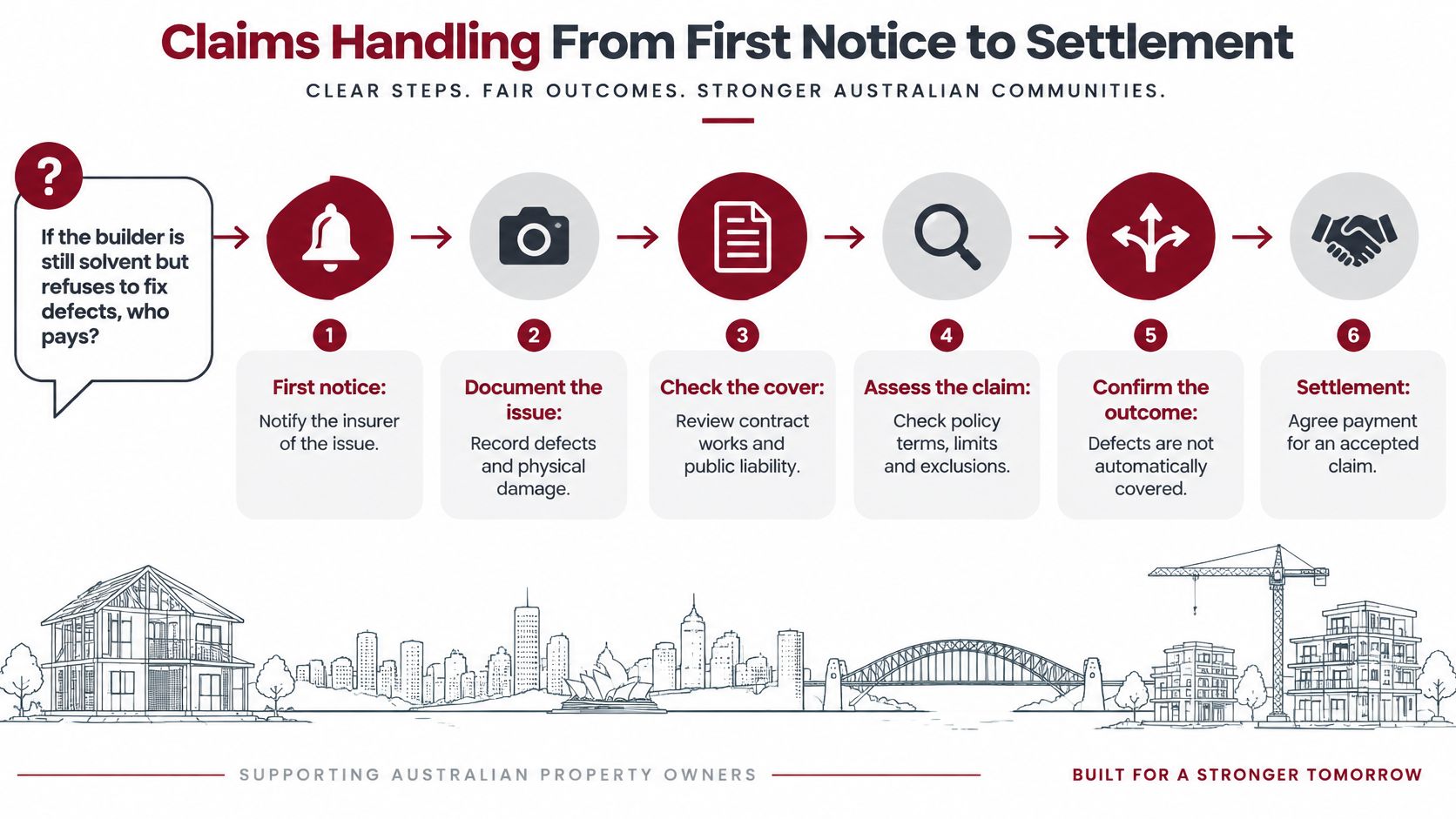
The Claim Pathway
- Notify promptly: Tell your broker and insurer as soon as you become aware of loss or a potential claim, because policies commonly impose notification duties.
- Make the site safe: Isolate hazards, protect people, and stop further loss where it's safe and lawful to do so.
- Preserve evidence: Keep dated photos, plans, inspection reports, emails, delivery dockets, weather records, and damaged materials where practical.
- Limit further loss: Use reasonable temporary protection and keep invoices, but don't start permanent reinstatement before assessment unless authorised or urgent.
- Lodge complete documents: Provide the contract, programme, invoices, incident report, witness details, and a clear chronology.
- Cooperate with assessment: Give the loss adjuster access and answer causation questions precisely. Separate pre-existing defects, insured damage, and betterment.
- Agree scope and settlement: Confirm what's accepted, what excess applies, who performs repairs, and whether payment is cash, reinstatement, or staged.
For a site disaster, causation and timing drive the result. Was the material on site, incorporated into the works, or still in transit? Did practical completion occur? Was delay caused by insured damage or an unrelated labour shortage? Your programme updates and daily records answer those questions.
The short video below is useful background before you document a loss, especially if several parties may notify different insurers.
For builder failure, keep deposit receipts, progress claims, contract variations, inspection evidence, and communications about non-completion. For defects, identify when you first noticed the problem and what notice you gave the builder. Warranty assessors need that chronology.
Don't admit liability to a neighbour, promise repairs for a third party, or settle a subcontractor's damage bill before notifying the relevant insurer. You can express concern and make the area safe without accepting legal responsibility. Premature admissions can complicate cover and recovery rights.
How an Insurance Broker Adds Value Beyond Price
A broker's value shows when a claim crosses from one policy to another. If a builder cannot complete eligible residential work, statutory warranty cover may respond under the applicable scheme. If a storm damages unfinished work, contract works cover may be the first policy to examine. The broker helps identify the likely route, check the relevant wording, and coordinate the hand-off. Each policy still has its own limits and conditions.
The liability market has also become harder for some businesses to access. Insurance News reporting on APRA liability data describes changes in public liability premiums and the number of written risks over the period reported. That market context makes price only one part of a placement decision. The policy must also fit the work.
A capable broker compares exclusions, sublimits, excesses, activity definitions, and claim conditions. They check whether contract works sums account for reinstatement and debris costs, and whether contract duties match policy endorsements. For delay cover, they examine how the insured events and waiting periods fit the project programme. Specialist construction insurance broker advice can help builders understand these checks before renewal.
At claim time, that preparation gives the builder a clearer route. The broker can identify which insurer should receive notice first, organise supporting documents, and query a proposed repair scope that appears inconsistent with the policy. The insurer still decides cover under its wording.
What to Ask a Construction Insurance Broker
A brokerage's profile can help you judge whether it understands your work, but it does not prove that a particular policy suits your project. ABS Insurance Brokers is an Australian-owned Bankstown, NSW brokerage holding Australian Financial Services Licence No. 700333 and operating as a Steadfast Network Broker. Its construction work includes builders warranty (HBCF) placement, contract works, public liability, and building consultancy support.
Use that information to guide specific questions. How are you paid, including commissions or fees? Which insurers can you access for this class and project type? Who will handle the claim with us, and what support will they provide during assessment?
Ask what details could affect an insurer's decision. A useful discussion covers claims history, financial controls, hot works, excavation, work at height, site security, and subcontractor checks before an application is submitted. Clear answers help you assess the broker's fit and give the insurer a more accurate picture of the risk.
Confirm Your Cover Checklist Before Work Starts
Use your role to find the checks you own. Another party saying they're insured isn't evidence that their policy covers your loss.
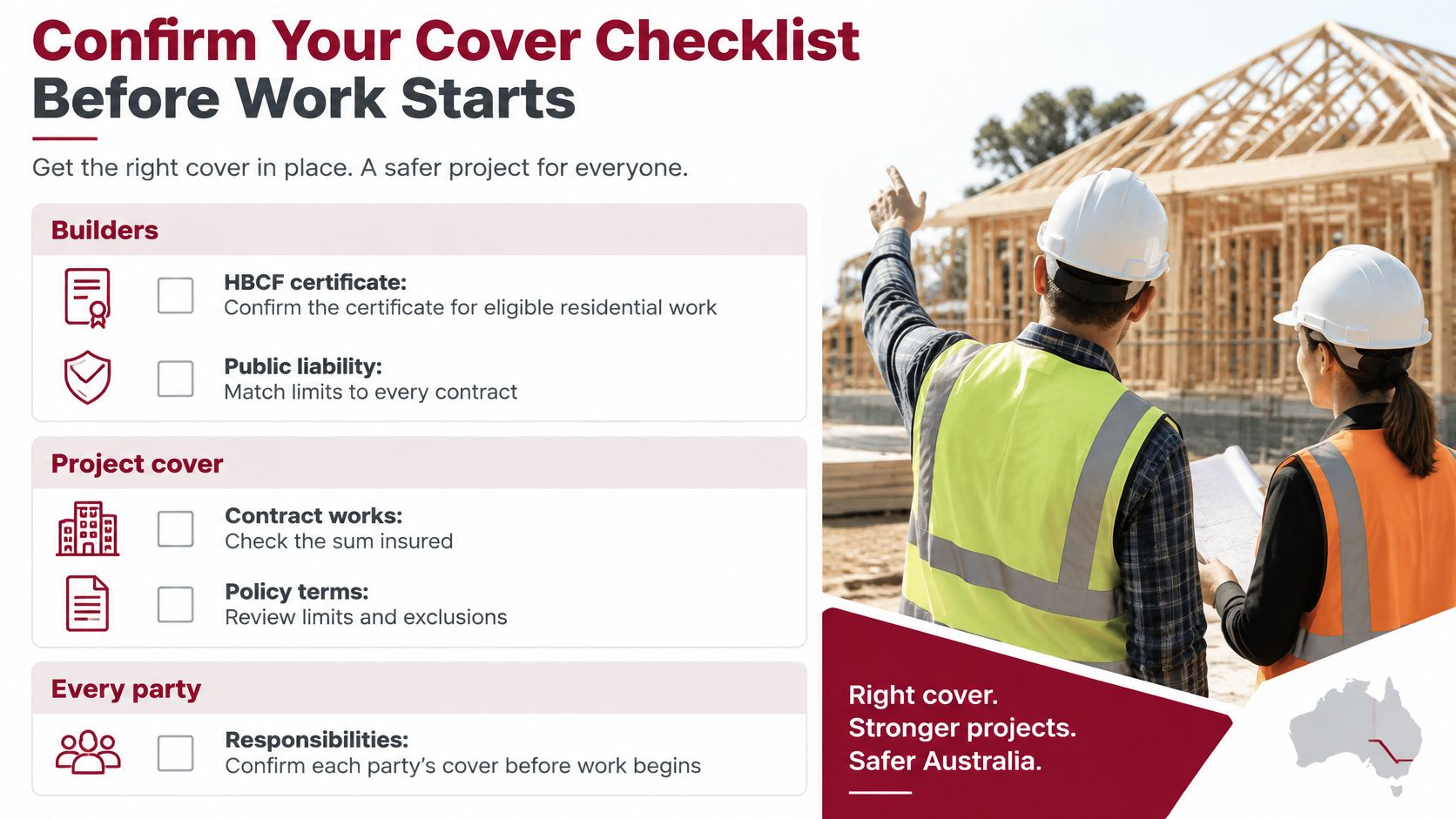
Builders and Trades
- Builders: Confirm the HBCF certificate for eligible residential work, public liability limits for every contract, professional indemnity for design responsibility, and workers compensation for employees.
- Trades: Confirm public liability activities match the actual work, hired plant is included, motor wording addresses tools and materials, and subcontractor certificates stay current.
Developers and Owner-Builders
- Developers: Size contract works for reinstatement and debris removal, consider delay cover tied to the programme, align handover with the owner's permanent policy, and confirm project insurance names the required parties.
- Owner-builders: Confirm owner-builder requirements in your state and whether statutory warranty obligations apply to the work, its value, and any later sale.
Run the Checks in This Order
- List activities and values: Include design, excavation, temporary works, off-site materials, hired plant, vehicles, employees, and subcontractors.
- Map each activity: Match it to the core policy table and mark anything uninsured or contractually retained.
- Check contracts against certificates: Compare parties, limits, expiry dates, endorsements, waivers, and indemnities.
- Confirm statutory requirements: Verify warranty certificates, workers compensation, thresholds, and state rules before commencement.
- Get a pre-signing review: Ask your broker to identify exclusions, sublimits, handover timing, and delay exposure while terms can still change.
Don't wait for practical completion to discover that materials in transit, existing structures, or off-site fabrication sat outside the project policy. Walk the site programme month by month and ask what changes. New trades, higher contract values, design changes, and extensions of time can all require notification.
Keep one live insurance register for the project. Record insurer, policy number, insured parties, limits, excesses, expiry, endorsements, and certificate holder. Review it at contract award, major variations, programme extensions, and handover.
If you're about to tender, start work, renew cover, or untangle who pays after damage or builder failure, ABS Insurance Brokers Pty Ltd can review your construction activities, contracts, certificates, and statutory warranty needs before you commit. Contact the Bankstown team to compare suitable contract works, liability, professional indemnity, plant, motor, and HBCF arrangements for your next Australian project.